
Specs are compiled from manufacturer listings and verified buyer reviews and can change over time — please confirm the key details on the product page before buying.
Using the wrong fertilizer on rhododendrons is a common mistake. These shrubs need acidic soil, and a general-purpose plant food often leads to pale, yellowing leaves and disappointing blooms instead of the vibrant display you want. This guide helps you pick the right feed for your garden, whether you prefer a no-mix slow-release option or a potent organic formula.
I’m Rikta — the founder and writer behind Lawn Gear Lab. This guide is built by comparing the manufacturers’ published specifications and the patterns across verified customer reviews, so you get each pick’s real strengths and trade-offs instead of marketing spin.
Matching the best rhododendron fertilizer to your soil type, your schedule, and your tolerance for mixing or measuring is the smart way to shop — and we have done the digging for you.
Our Picks at a Glance


How To Choose The Best Rhododendron Fertilizer
Choosing the right plant food starts with understanding what your soil and your rhododendrons actually need. The wrong ratio or the wrong release method can lead to burnt roots or underwhelming flowers.
N-P-K Ratio: The Three Numbers on the Bag
The three numbers on any fertilizer label — Nitrogen (N), Phosphorus (P), and Potassium (K) — tell you how much of each major nutrient you are applying. For rhododendrons, a slightly higher middle number (phosphorus) encourages root development and flower production. Products like the Fertilome 9-15-13 lean into this with a strong phosphorus boost.
Water-Soluble vs. Slow-Release Granular
Water-soluble formulas, such as the Miracle-Gro powder, require you to mix them with water and apply every 7-14 days. These give you fast-acting results but demand a regular schedule. Slow-release granular options, like the Schultz 14-7-7, are sprinkled around the base and break down over weeks, so you apply far less often. Your choice depends entirely on how much time you want to spend feeding.
Organic vs. Synthetic
Organic fertilizers, like the Dr. Earth and Espoma Holly-Tone options, derive their nutrients from natural sources such as seabird guano, shrimp and crab shell meal, and composted materials. They feed the soil microbes and build long-term soil structure rather than giving a quick chemical jolt. Synthetic formulas provide more immediate nutrition and are often more precisely balanced, but you must be more careful about over-applying.
Additional Soil Acidifiers
Some fertilizers include ingredients specifically to lower soil pH. The True Organic Azalea, Camellia & Rhododendron Food contains 5% soil sulfur, which actively works to bring alkaline soil down into the acidic range that rhododendrons need. If your soil is already very acidic, a standard acid-loving plant food without extra sulfur is the better call.
Quick Comparison
| Model | Best For | N-P-K Ratio | Item Form | Item Weight | Amazon |
|---|---|---|---|---|---|
| Miracle-Gro Water Soluble★ Best Overall | Fast, regular feeding | 30-10-10 | Powder | 5 lb. | Amazon |
| Schultz Slow ReleaseLow-Effort Pick | low-maintenance | 14-7-7 | Granules | 1 lb. | Amazon |
| Dr. Earth Acid Lovers | Organic feeding | Not listed | Granules | 1 lb. | Amazon |
| Fertilome 9-15-13 | Stressed plants | 9-15-13 | Granules | 4 lb. | Amazon |
| GARDENWISE 8-4-8 | Year-round health | 8-4-8 | Granules | 0.96 kg (2.1 lb) | Amazon |
| Espoma Holly-Tone | Traditional organic | 4-3-4 | Granules | 4 lb. (per bag) | Amazon |
| True Organic 5-4-3 | Lowering soil pH | 5-4-3 | Granules | 12 lb. | Amazon |
In‑Depth Reviews
1. Miracle-Gro Water Soluble Azalea, Camellia, Rhododendron Plant Food
Our pick — over 4.5★ from 600+ verified ratings; the strongest balance of quality and price.
The fast-acting classic that feeds on your schedule, not the bag’s.
For gardeners who want results they can see within days, this water-soluble powder delivers a potent nutrient boost every time you water. You mix it at a ratio of 1:144 (one tablespoon per 144 tablespoons of water) for indoor plants or a stronger 1:18 (one tablespoon per 18 tablespoons of water) for outdoor shrubs, then apply every 7-14 days with a watering can or a Miracle-Gro Garden Feeder. The 5-pound bag at 5 pounds versus the Schultz slow-release option at 1 pound gives you many more feeding rounds.
Buyers report that it “dissolves completely and easily,” which matters because clumpy fertilizer can clog sprayers or leave uneven deposits on leaves. The formulation is gentle enough not to burn foliage when you follow the directions, but a common caveat is to be careful not to over-fertilize, especially on plants in containers. The resealable bag has drawn mixed feedback — some appreciate it, while others find the Velcro closure useless and resort to wooden clothespins to keep it dry.
It works on a wide range of plants beyond rhododendrons, including azaleas, camellias, gardenias, hibiscus, hollies, hydrangeas, and orchids, making it a versatile staple for any acid-loving garden.
Fast-feeding powerhouse: The most versatile and fastest-acting option here, ideal if you are committed to a regular watering-can routine and want to see quick greening and blooms across multiple plant species.
Reach for this if: You don’t mind mixing a little powder into your watering can every week or two and you want the most widely trusted, proven formula available.
Look elsewhere if: You prefer a “low-maintenance” approach — the Schultz slow-release option below requires no mixing and far fewer applications.
2. Schultz Azalea, Cameillia, Rhododendron, ACR 14-7-7 Slow Release Plant Food
The no-mix granular option that feeds your shrubs for weeks.
If you dislike dragging out a watering can and measuring spoons, this is your answer. Schultz’s 14-7-7 formula comes as dry granules that you simply sprinkle around the base of your plants — no mixing, no measuring beyond the scoop. It is a slow-release food (the granules break down gradually with rain and watering), providing a steady supply of nutrients over an extended period rather than a quick spike.
Reviewers report that it “spreads easily and starts showing noticeable results in about a week,” which is impressive for a slow-release product. The plants come back with “vibrant blooms and lush foliage” according to long-time users. The smaller 1-pound bag is lighter than the 5-pound Miracle-Gro bag, so it is a good fit if you have a small to medium garden and don’t want to store a large sack.
It comes with micronutrients included, which support overall plant health rather than just pushing out leaves or flowers. Given its low-maintenance nature, it is an excellent choice for gardeners who want to spend less time feeding and more time enjoying their garden.
Hands-off feeding: The best pick for those who want a simple, effective product that requires zero mixing and keeps delivering for weeks after a single application.
One caveat: Because it is slow release, you cannot tweak the dose mid-week if your plants suddenly look hungry — you have to wait for the next granule breakdown.
Ideal for: The beginner or busy gardener who wants to scatter granules in spring and forget about fertilizing until the next season.
Skip it for: The true organic purist — Dr. Earth or Espoma below offer certified organic inputs.
3. Dr. Earth Acid Lovers Azalea, Camellia, Rhododendron & Maple Fertilizer

Handcrafted organic granules that feed the soil, not just the plant.
For those committed to an organic garden, Dr. Earth Acid Lovers is as clean as it gets. It is the only fertilizer on this list that is Non-GMO Project Verified, and it carries certifications from OMRI (Organic Material Review Institute), OIM, and CCOF (California Certified Organic Farmers) — the highest level of purity and transparency in the organic world. The formula is handcrafted from human and feed-grade ingredients, enriched with multi-minerals, proteins, carbohydrates, humic acids, and trace elements that build healthy soil biology.
The granular form means you can just “toss and water” — one buyer used it exactly that way and reported it quickly greened up their sad camellias with new leaves, and even pushed nearby agapanthus flower buds a month early. Another gardener used it on a rhododendron that hadn’t bloomed in two years and saw it “covered with huge pink flowers” in no time. The product is also praised for reviving gardenias and azaleas.
It is sustainably made in the U.S.A. and is people and pet safe, containing no synthetic chemicals, GMO-infested chicken manure, or toxic ingredients. The 4-pound bag provides solid coverage without taking up too much storage space.
Natural Power
- Certified organic with multiple third-party seals (OMRI, CCOF, Non-GMO)
- Works fast for an organic — one buyer revived a non-blooming rhododendron
- Safe around kids and pets when used as directed
Purity Premium
- Higher price point than synthetic, commodity options
- N-P-K ratio is not as clearly front-and-center as other formulas
Best for: The organic gardener and anyone concerned about synthetic runoff who wants a proven, highly-pure product that still delivers visible results quickly.
Not for: The budget-maximizer who just wants the cheapest bag on the shelf — this is a premium organic product.
4. Fertilome (10685) Azalea, Camellia, Rhododendron Food 9-15-13

The phosphorus-heavy formula that revives stressed, non-blooming shrubs.
Fertilome stands out with its 9-15-13 ratio — notice the middle number (phosphorus) is significantly higher than the nitrogen (9) and potassium (13). This extra phosphorus is exactly what helps struggling rhododendrons develop strong root systems and push out flower buds after a tough season. One buyer described having “several Rhododendron’s that looked extremely stressed for a year due to the weather conditions,” and after feeding with Fertilome over several weeks, they saw “huge improvement” with greener, brighter leaves and plenty of new growth they hadn’t seen in a while.
The granular formula is easy to apply: use 1/4 to 1/2 cup for plants 1 to 5 feet tall, and 3/4 to 1 1/4 cups for plants 6 to 12 feet tall. A review from a large-yard owner noted that Fertilome is the only source they found for 15-pound bags of azalea-camellia fertilizer, which is a real convenience if you have many ericaceous (acid-loving) plants. The micronutrients in this formula are a real benefit, even more than any acid-forming reaction.
It also helps control soil acidity, creating the right growing condition for rhododendrons, azaleas, and gardenias to thrive. Feeding is recommended in very early spring, again after blooming, and again in the fall.
Crisis responder: The best pick when your rhododendrons are looking pale, stressed, or simply refusing to bloom — the high-phosphorus formula directly addresses root and flower development.
Reach for it when: Your shrubs have gone through drought, bad weather, or a pest issue and need a strong, targeted nutrient push to bounce back.
Pass if: Your plants are already performing well — you could use a more balanced or organic formula for maintenance feeding.
5. GARDENWISE 8-4-8 Acidic Fertilizer
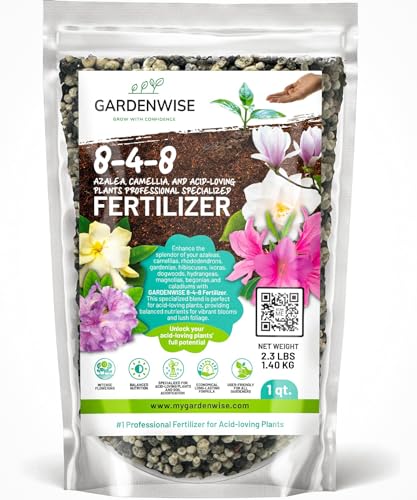
An iron-rich slow-release formula that needs just three feeds per year.
GARDENWISE is marketed as economical because its slow-release granules require only three feedings per year — spring, early summer, and fall. The 8-4-8 ratio is balanced but enriched with iron, magnesium, and manganese, which are commonly deficient in alkaline soils and are key to preventing chlorosis (the yellowing of leaves between green veins) in acid-loving plants. This makes it ideal for rhododendrons, azaleas, camellias, hydrangeas, and even blueberries.
The product goes a step further by including live bacterial microbes derived from eco-conscious bio-solid fertilizer technology. The manufacturer describes a rigorous process of heating, drying, and prilling to strip toxins and heavy metals, leaving behind a safe bio-solid that enriches soil biology. One reviewer noted that their rhododendron “doubled in size” after using this, while another said their previously struggling plant “came back to life” with greener leaves and many beautiful blooms.
The application is simple — sprinkle the granules around the base, gently mix into the soil, and water. The 32-ounce bag covers a decent area, and a single bag may last an entire season for a small to medium garden of acid-loving plants.
Infrequent feeder: A great option if you want the low-maintenance convenience of slow-release but also want added iron and microbial benefits to fight yellowing leaves.
Ideal for: Gardeners with a mix of acid-loving plants who want a single product that covers rhododendrons, blueberries, and hydrangeas with the same feeding schedule.
skip it if: You prefer a purely organic formula — Dr. Earth or Espoma are better organic fits.
6. Espoma Organic Holly-Tone 4-3-4 Evergreen & Azalea Plant Food (Pack of 2)
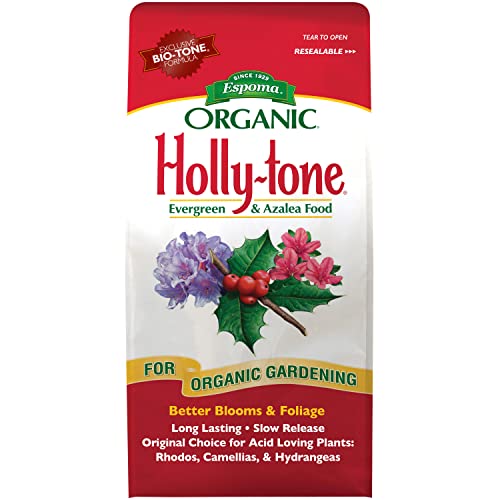
The original natural plant food for acid lovers, with a legacy since 1929.
Espoma’s Holly-Tone is the original organic fertilizer formulated specifically for acid-loving plants. Its 4-3-4 analysis includes 5% sulfur to help maintain an acidic soil environment, and the natural organics break down slowly to provide a long-lasting reservoir of nutrients. This pack contains two 4-pound bags, giving you 8 pounds total for feeding a medium to large garden twice a year — apply in spring and fall for flowering and evergreen shrubs.
Owners mention that Holly-Tone is “recommended by my tree expert” and that when used in spring and fall, it gives trees and shrubs the food they need for year-round good health. It is an approved organic input material, meeting all requirements for organic production, and it uses a Bio-tone formula enriched with beneficial microbes. One buyer mentioned a strong smell for a few days after application, which is a common trait of natural organic fertilizers, but the results on blueberries and azaleas were described as “improved.”
It is ready to use with no mixing required — just apply to the soil around the drip line of the plant and water thoroughly. It is environmentally safe with no sludges or toxic ingredients.
Time-tested organic: The most traditional organic pick on the list, backed by nearly a century of reputation and a simple, effective formula for all acid-loving plants.
Best for: The gardener who wants a straightforward, certified organic product with a long, trusted history and the convenience of two bags per purchase.
Not for: Those who need a fast-acting or water-soluble formula — this is a slow-release organic option.
7. True Organic Azalea, Camellia & Rhododendron Food 5-4-3 (12 lb.)
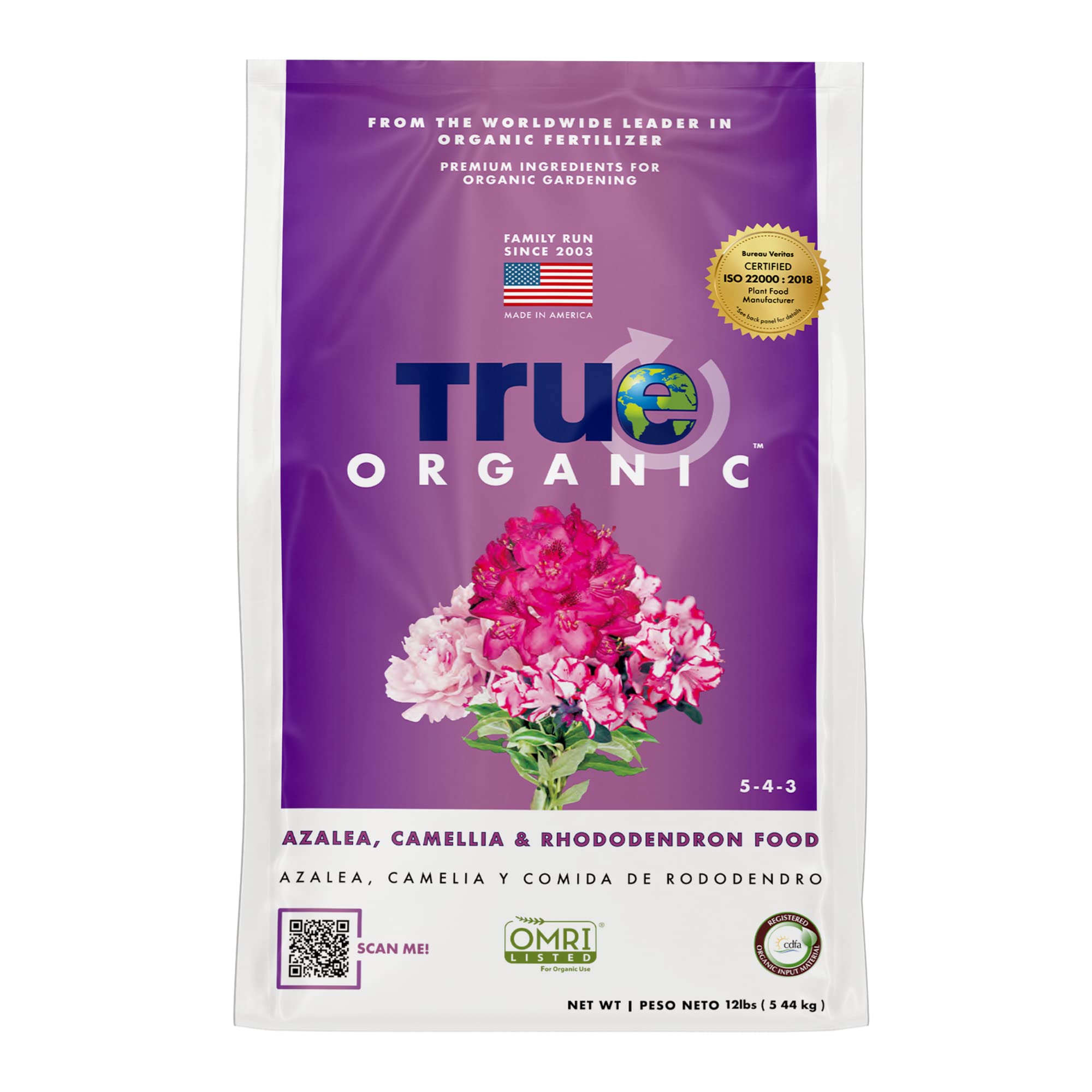
The 12-pound bag that brings heavy-duty soil correction for alkaline gardens.
True Organic is the heavy lifter of the group, both in bag weight and in purpose. The 5-4-3 formula contains 5% soil sulfur, a key ingredient that actively lowers soil pH naturally, making nutrients more available to acid-loving plants. This is a critical feature if your garden soil is neutral or alkaline — without lowering the pH, even the best fertilizer may not be absorbed by the roots. The 12-pound bag covers up to 261 square feet, making it a cost-effective option for large gardens or multiple large shrubs.
The formula features seabird guano, shrimp and crab shell meal, and other organic inputs that nourish the soil while adjusting its chemistry. Application is twice-yearly — once in spring and again in fall — making it easy to remember. While some reviews discuss other plants (roses and raspberries), the consistent theme is that this product helps revive struggling plants and boosts healthy growth.
It is 100% made in the USA with organic inputs, and the large bag ensures you have enough for the entire season without needing a refill.
Soil Fixer
- Contains 5% soil sulfur to naturally lower pH
- 12 lb. bag covers up to 261 sq. ft.
- Organic with seabird guano and shellfish meal
Heavy Commitment
- Large bag may be excessive for small gardens or container plants
- As a true organic, results are slower than synthetic fast-release options
Best for: Large landscapes with alkaline soil where you need both feeding and active pH correction from a single organic product.
Not for: Small gardens or containers — the 12-pound bag will last years and may take up too much storage space.
Understanding the Specs
N-P-K Ratio
Every fertilizer label shows three numbers separated by dashes, like 14-7-7 or 30-10-10. The first is Nitrogen (N), which pushes green leaf growth. The middle is Phosphorus (P), which builds root systems and supports flowering. The third is Potassium (K), which contributes to overall plant health and disease resistance. For rhododendrons, a balanced to slightly higher phosphorus formula (such as 9-15-13) can help encourage blooms, while a higher nitrogen content (like 30-10-10) pushes leafy growth. If your soil is already rich in one nutrient, you can pick a ratio that supplements what is lacking.
Water-Soluble vs. Granular
The form of fertilizer you choose determines how often you apply it. Water-soluble powders are mixed with water and applied every 1-2 weeks during the growing season — they give quick results but require a consistent routine. Granular fertilizers (either slow-release or organic) are sprinkled on the soil surface and break down over weeks or months, meaning you may only feed once in spring and once in fall. The trade-off is speed: granular products take longer to show visible results, but they demand far less of your time.
FAQ
What N-P-K ratio is best for rhododendrons?
How often should I fertilize my rhododendrons?
Can I use a general-purpose fertilizer on rhododendrons?
What does “slow-release” fertilizer mean?
Is organic fertilizer better for rhododendrons than synthetic?
Will rhododendron fertilizer work on azaleas and hydrangeas too?
How much fertilizer should I use per rhododendron bush?
What is chlorosis and can fertilizer fix it?
Can I over-fertilize my rhododendrons?
When is the best time of year to fertilize rhododendrons?
Final Thoughts: The Verdict
If you want one dependable pick, the best rhododendron fertilizer winner is the Miracle-Gro Water Soluble Azalea, Camellia, Rhododendron Plant Food because it is incredibly versatile, fast-acting, and suitable for a huge range of acid-loving plants — a proven staple backed by a 4.8-star rating from 643 reviews. If you want the convenience of a no-mix, low-maintenance routine, grab the Schultz Slow Release 14-7-7. And for certified organic feeding that also revives stressed plants, the standout is the Dr. Earth Acid Lovers Fertilizer.
How We Picked
We do not accept paid placement. Every pick is matched to a real buyer and a real use-case; we do not hands-on test units.
Sources & Methodology
Specifications: manufacturer listings and product documentation. Review insights: verified customer reviews, as of July 2026. Pricing: not shown on this page (it changes often); check the current price via the retailer link.
As an Amazon Associate, Lawn Gear Lab earns from qualifying purchases. This does not affect which products we feature.