
Specs are compiled from manufacturer listings and verified buyer reviews and can change over time — please confirm the key details on the product page before buying.
Picking the right spring fertilizer is the difference between a lawn that pops with deep green color and one that grows patchy, fast, and weak. A misapplied bag can scorch turf with a nitrogen surge or starve it weeks later. Guessing soil needs often leads to dumping phosphorus that’s already abundant, feeding runoff instead of turf.
I’m Rikta — the founder and writer behind Lawn Gear Lab. This guide is built by comparing the manufacturers’ published specifications and the patterns across verified customer reviews, so you get each pick’s real strengths and trade-offs instead of marketing spin.
You want a crisp lawn without a chemistry degree. That’s why we’ve sorted through the leading granular and liquid options to find the most dependable recommended spring lawn fertilizer for your yard’s specific needs.
Our Picks at a Glance
How To Choose The Best Recommended Spring Lawn Fertilizer
Spring feeding wakes the lawn and builds roots for the season ahead. First-time buyers grab the cheapest high-nitrogen bag, but the real choice is how nitrogen is delivered.
Match the Nitrogen Release to Your Schedule
Fertilizer nitrogen comes in two basic styles. Quick-release nitrogen greens within days but fades fast.
Quick Comparison
| Model | Best For | N-P-K Ratio | Feeding Duration | Coverage | Amazon |
|---|---|---|---|---|---|
| Andersons PGF 16-0-8★ Best Overall | Phosphorus-free feeding | 16-0-8 | Up to 8 weeks | 10,000 sq ft | Amazon |
| Pennington Full Season 32-0-5One & Done | One application per season | 32-0-5 | Up to 4 months | 4,000 sq ft | Amazon |
| PetraMax Liquid 16-4-8Liquid Power | Quick liquid feeding | 16-4-8 | Quick + slow release | — | Amazon |
| Petramax Liquid Nitrogen 28-0-0 | Nitrogen-deficient lawns | 28-0-0 | 70% quick, 30% slow | Up to 12,800 sq ft | Amazon |
| GreenView Fairway Formula | Medium to large lawns | 30-0-12 | Up to 12 weeks | 10,000 sq ft | Amazon |
| Lawnbox Grass Genie | Organic & pet-safe yards | 10-0-6 | Up to 6 weeks | 2,500 sq ft | Amazon |
| Andersons Premium Lawn Food | Summer stress prep | 28-0-12 | Quick + slow release | 5,000 sq ft | Amazon |
| Espoma Spring Lawn Booster | Warm & cool season organic | 8-0-0 | Slow-release nitrogen | Up to 5,000 sq ft | Amazon |
| Yard Mastery Flagship | Large, high-performance lawns | 24-0-6 | 24% slow release nitrogen | 15,000 sq ft | Amazon |
In‑Depth Reviews
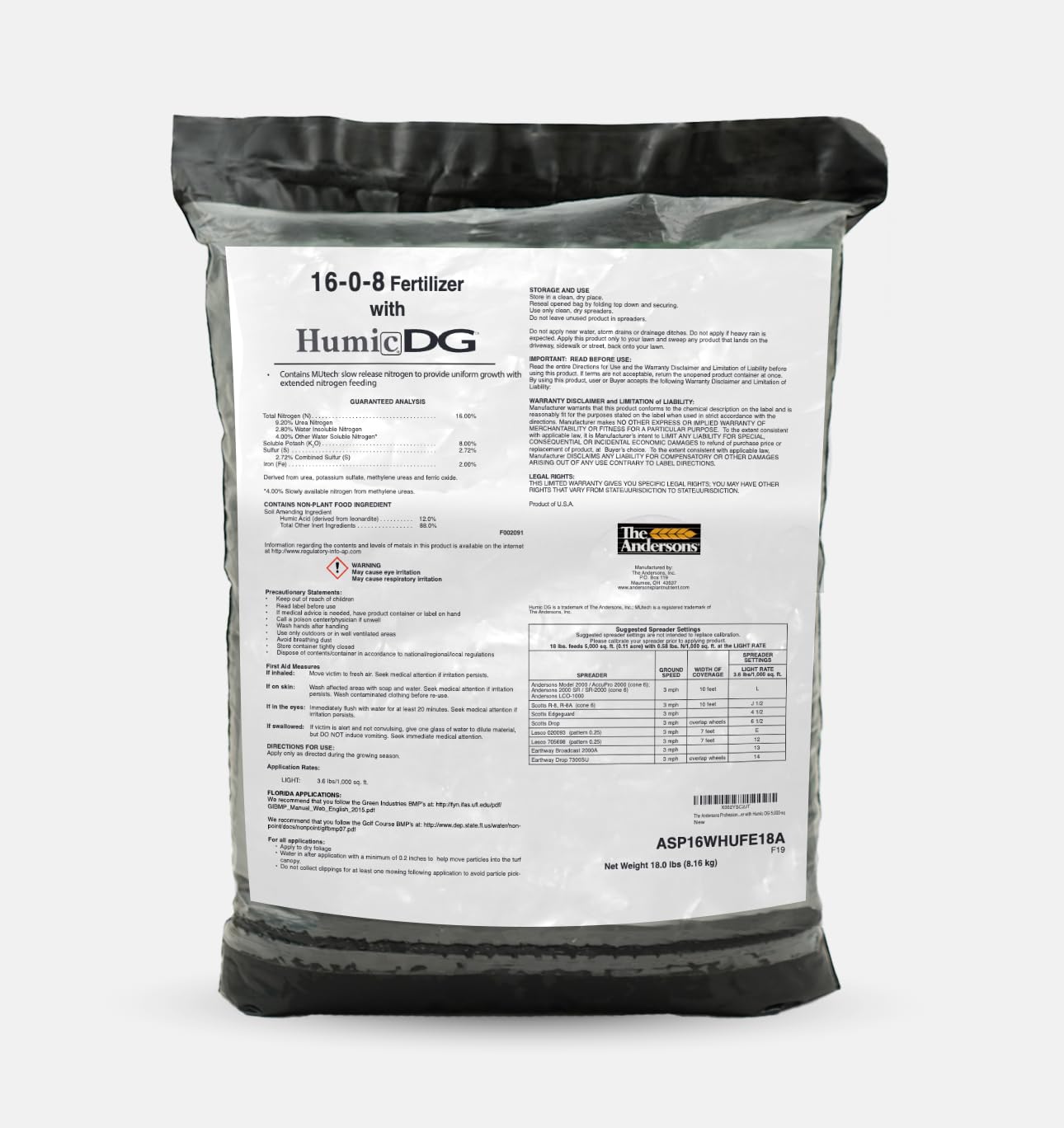
1. The Andersons Professional PGF 16-0-8 Fertilizer with Humic DG (18lb)
Our pick — over 4.5★ from 900+ verified ratings; the strongest balance of quality and price.
A phosphorus-free professional blend that still delivers the deepest green.
What wins people over here is the outright quality — the particle size is so fine it gives you twice the number of particles per square foot, which means you’re not chasing streaks across your yard. Each tiny granule carries iron, micronutrients, and Humic DG (a soil conditioner that helps roots take up nutrition). The 16-0-8 ratio means zero phosphorus, making it ideal for yards where a soil test already found high phosphorus levels.
The 18-pound bag is a heavy one — it outweighs the lightweight liquid options here by a dramatic margin, landing at 18 pounds versus just 2.4 pounds for a liquid concentrate. But that heft buys you coverage for about 10,000 square feet of turf. The nitrogen is split between quick-release for immediate feeding and slow-release that keeps working for up to 8 weeks, so a single application carries you deep into spring.
Buyers report dramatically improved lawn quality with greener, healthier grass, and the crowd favorite status is well earned — it holds a 4.7-star average from over 900 owners. The honest downside is the price tag; it’s a premium product and a few owners mention the cost. This isn’t the bag for a yard that already has nitrogen-heavy soil or for bargain hunters, but for a serious homeowner it’s a reliable workhorse.
Why it leads the pack
- Quality is the #1 praise point by far — dozens of owners single out the professional-grade results
- Phosphorus-free formula is perfect for high-phosphorus soil
- Fine particles spread evenly and cover 10,000 sq ft effectively
The trade-offs
- Premium price point that some find steep
- Not available for sale in CA or OR
- Must follow guidelines to avoid turf burn from over-application
Reach for this if: you have healthy soil, want the most reliable professional-grade results, and don’t mind paying for quality.
Look elsewhere if: you need to feed a lawn with low phosphorus levels or live in California or Oregon where this isn’t sold.
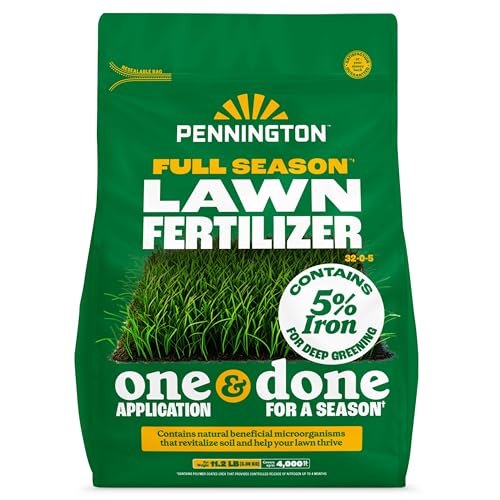
2. Pennington Full Season Lawn Fertilizer 4M 32-0-5 RF 3/11.2Lb
One spring application that keeps feeding your grass for up to four months straight.
The whole pitch here is the polymer-coated urea (a plastic-like coating on each nitrogen granule) that releases slowly to feed your lawn for up to 4 months. That’s the longest feeding window in this lineup — the Andersons PGF tops out at 8 weeks, so this one covers nearly twice the season in a single pass. The 32-0-5 ratio delivers a heavy nitrogen punch to wake the grass up, and the 5% iron content drives that deep green color homeowners crave.
Bermuda owners will feel right at home here — the reviews are full of golf-course comparisons after application. The 11.2-pound bag is an easy lift and covers 4,000 square feet, which makes it a mid-size yard pick. Natural beneficial microorganisms in the blend help revitalize tired soil rather than just feeding the blade.
There’s a caveat hiding in the fine print: some owners found the real coverage runs closer to 2,000-2,500 square feet rather than the advertised 4,000, so you may need a second bag for a bigger lot. Still, the effectiveness is the #1 point of praise (over 30 owners cite it), and the value-for-money feedback is strong.
Season-long convenience: The slow-release polymer coating means you truly can low-maintenance for months, making it the lowest-maintenance option here.
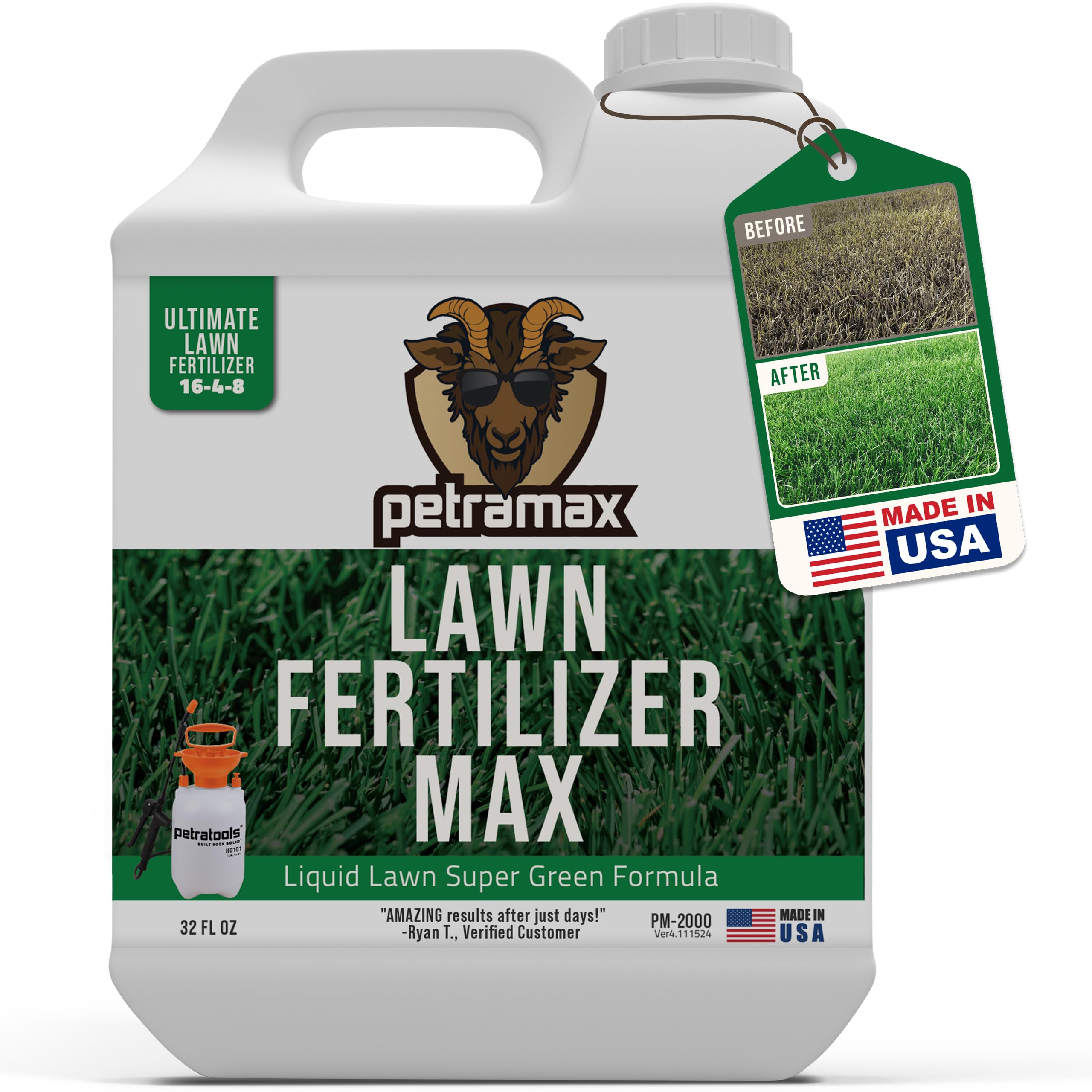
3. PetraMax Liquid Lawn Fertilizer for Lawns Concentrate 16-4-8 (32 oz)
A 2.4-pound liquid concentrate that stretches further than expected.
This is the spray-on answer for homeowners who hate lugging 30-pound bags around the yard. The 16-4-8 NPK ratio (16% nitrogen, 4% phosphorus, 8% potassium) combines with high-purity humates to encourage deep root development. The standout trick here is the 2-in-1 nitrogen: quick-release for fast green and slow-release for steady growth between applications, so one bottle does double duty.
You get a real weight advantage here: this 32-ounce bottle weighs just 2.4 pounds, while the Andersons PGF bag is 7.5 times heavier. The mixing ratio is a simple 1:20 (1 part fertilizer to 20 parts water), so one bottle stretches across multiple sprayer loads. Owners mention it “worked as advertised” and that a good shake keeps the strainer clear.
The effectiveness is the top praise point, but the recurring gripe is clogging — some sprayers got hung up, so a clean, well-shaken mix matters. It’s a great fit for small to mid-size yards or spot-treating patches, though for a whole-acre feeding you’ll be refilling the sprayer often.
Choose this for: quick green-up with minimal storage space and easy mixing.
Think twice if: you have a huge lawn or a sprayer that clogs easily.
4. Petramax Liquid Nitrogen Fertilizer 28-0-0 NPK (32 oz)

The pure nitrogen shot that turns yellow, deficient grass thick and green in a hurry.
If your lawn looks pale and hungry, this is the targeted rescue. The 28-0-0 formula is almost pure nitrogen — the highest concentration in this guide — and it’s built specifically to correct nitrogen deficiency. The blend splits into 70% quick-release nitrogen for rapid green and 30% slow-release for sustained feeding between applications, so you see fast results without the crash.
This 2-pound liquid treats up to 12,800 square feet at the maintenance rate (mix 5 oz per gallon of water), or 6,400 square feet if you’re correcting seriously nitrogen-starved grass (10 oz per gallon). That makes it more generous per bottle than the PetraMax 16-4-8, which trails on coverage. It works on both warm- and cold-season grasses, which is a genuine versatility win.
The response was a wave of green — owners describe grass getting thick and dark green quickly, with ease of use as a reliable praise point. The value-for-money feedback is mixed, so watch the price per application. This is a niche tool: it delivers nitrogen and nothing else, so it’s not a complete spring feed for a balanced lawn.
Targeted fix: Best viewed as a rescue product for nitrogen-starved turf, not a general-purpose spring food.
5. GreenView Fairway Formula Lawn Fertilizer 33 lb. Bag

The fairway-grade 30-0-12 that covers 10,000 square feet and feeds for up to 12 weeks.
Named for golf courses, this 33-pound bag behaves like it. The 30-0-12 formula packs 63% slow-release nitrogen, which feeds continuously for up to 12 weeks without surge patterns — no sudden growth spikes, no burn risk. The small blue granules spread evenly and are visible on the lawn, so you can see where you’ve been and avoid overlap.
This is the strongest pure feeding-duration value in the granular group here — it rivals the Pennington for longevity but covers more than double the ground at 10,000 square feet. The no-phosphate composition protects waterways, matching the Andersons PGF’s environmental stance. Bermuda, St. Augustine, and cool-season grasses all respond well, and customers note thick, dark green results within about two weeks.
The catch with a bag this size (33 pounds) is storage and lifting; it’s a workout to haul around. But for larger lawns, the cost per square foot of coverage is tough to beat. Owners note it handles extreme heat well and can be reapplied every six weeks if you want continuous season-long feeding.
Highlights
- Covers 10,000 sq ft — the most ground per bag in the granular group
- 63% slow-release nitrogen feeds evenly for 12 weeks
- Visible blue granules prevent overlap and burn
Consider
- Heavy 33 lb bag is tough to carry and store
- Some bare spots may need a second treatment
6. Lawnbox Grass Genie 10-0-6 100% Organic Spring Grass Fertilizer 16 lb
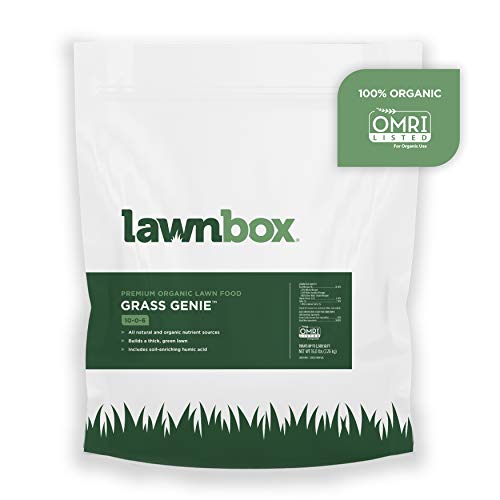
The fully organic 16-pound bag that’s safe for kids and pets the moment it hits the ground.
If your yard doubles as a playground or dog run, this is the pick that takes the worry out of feeding. The 10-0-6 formula is 100% organic, contains no animal byproducts, manures, biosolids, or waste material, and the manufacturer states the yard is safe to use immediately after applying. That’s a meaningful difference from synthetic blends — you don’t have to keep the kids off the grass for days.
Like the Andersons PGF, this blend includes humic acid, which promotes healthy soil rather than just feeding the blade. But the Grass Genie trades away phosphorus entirely (the 0 in 10-0-6) and offers a gentler nitrogen profile — both quick and slow release for an immediate green-up plus up to 6 weeks of extended feeding. The 16-pound bag covers 2,500 square feet, the smallest footprint in this guide.
Owners who switch to organic often become loyalists — reviews are full of repeat buyers praising it for safety and effectiveness on any grass type, and one mentions they immediately use it on a lawn for a dog with health issues. The trade-off is coverage: 2,500 square feet is small, so a bigger lot needs multiple bags. It’s a premium per-square-foot cost, but for a kid-safe yard, that premium buys confidence.
Ideal for: families with kids and pets who want organic, low-maintenance feeding.
Not for: large lawns where the 2,500 sq ft coverage means multiple bags and a higher cost.
7. The Andersons Premium Lawn Food 28-0-12 Spring Summer Fertilizer

The late-spring application that conditions turf to shrug off summer heat and drought stress.
This is Application 3 in The Andersons Lawn Program, which means it’s designed for that transition window when spring growth slows and summer heat looms. The 28-0-12 ratio leans hard on nitrogen for green and potassium (the 12) to strengthen grass blades against heat and drought. The added iron pushes extra deep-green color and helps prevent yellowing — a common late-spring problem.
It includes both quick- and slow-release nitrogen, so you get the fast green-up and the sustained feeding. This is the one to reach for when you want your lawn to look fresh all the way through July.
Owners who use it report yellow areas turning greener and healthy areas going deeper green within days, even when rain doesn’t cooperate. The brand-loyalty is strong — multiple owners mention switching from big-box brands and never going back. The one honest gripe: some found the customer service phone line unresponsive, though the product itself delivered.
Season-specific tool: Buy this for the spring-to-summer bridge, not as an early-spring wake-up call.
8. Espoma Organic Spring Lawn Booster 8-0-0 (30 lb)

The 30-pound natural-feeding booster that won’t burn grass, even in heavy piles.
Espoma has been in the natural organics game since 1929, and this 8-0-0 Spring Lawn Booster reflects that legacy. The low, slow nitrogen formula is enhanced with extra calcium for deep green color, and it’s environmentally safe — no sludges or toxic ingredients. It’s registered as an Organic Input Material, so it meets requirements for organic production, which is a strict bar few competitors clear.
The 30-pound bag covers up to 5,000 square feet and works on both cool-season (fescue, bluegrass, rye) and warm-season (St. Augustine, zoysia) grasses. Because the nitrogen releases slowly, it won’t burn your lawn even if you get heavy with the spreader, and it won’t leach out of the soil the way synthetic quick-release products can. It’s also safe for animals and birds, a key point for wildlife-friendly yards.
The honest trade-off is the experience of applying it. Owners describe a strong, unpleasant odor and a very powdery texture that “smokes” up at you during broadcasting — one recommends an outdoor shower afterward. It also spreads harder than typical fertilizers. If you can handle the mess, the results are real growth and dark green color.
Best for: organic gardeners who prioritize safety for pets, birds, and soil over ease of application.
Skip if: you’re sensitive to strong smells or want a clean, dust-free spreading experience.
9. Yard Mastery 24-0-6 Flagship Granular Lawn Fertilizer (45 lb)

The 45-pound heavyweight with 24% slow-release nitrogen that covers a 15,000-square-foot property.
This is the biggest footprint in the entire guide — a 45-pound bag covering 15,000 square feet, which is roughly double the GreenView’s coverage. The 24-0-6 formula is enhanced with 3% iron for color and Bio-Nite™ (a chicken manure-based additive) for soil health. It’s built as an all-purpose fertilizer designed to promote lush, green growth through the entire season.
The nitrogen story here is strong: 24% of it is slow-release, so nutrients trickle out steadily and reduce the need for frequent reapplication. The 6% potassium boosts drought resistance, which makes it a smart choice for summer lawn care. Reviewers point out it’s “simply the best” fertilizer they’ve used, with neighbors asking which lawn care company they hired — the answer is just this bag.
Greening is the dominant praise point, with dozens of owners highlighting fast, thick, deep-green results — some within a week on a patchy brown lawn. The value-for-money feedback is also positive, which matters given its premium positioning. The trade-off is purely practical: at 45 pounds, it’s a serious lift, and it’s not meant for a small city yard where you’d be storing half a bag for next season.
Big-lot champion: If you have an acre or close to it, the per-square-foot cost and single-bag convenience make this the standout.
Understanding the Specs
N-P-K Ratio
The three numbers on a fertilizer bag stand for nitrogen (N), phosphorus (P), and potassium (K). Nitrogen drives green growth, phosphorus supports root development, and potassium builds overall plant strength. In spring, you usually want a higher first number (nitrogen) to wake the lawn up. But if a soil test shows your ground already has enough phosphorus, a 0 in the middle spot — like the 16-0-8 or 24-0-6 picks — is the smarter, more responsible choice.
Slow-Release vs. Quick-Release Nitrogen
Quick-release nitrogen greens the lawn within days but fades fast and risks burning the grass. Slow-release nitrogen feeds steadily over weeks or months, which means more even growth and fewer applications. Most quality blends, like the Andersons PGF or Yard Mastery, split the difference — a fast hit for immediate color plus a slow pool for sustained feeding. This is the single spec that most affects how often you’ll be back in the yard with a spreader.
FAQ
When should I apply spring lawn fertilizer?
How do I read the N-P-K numbers on a fertilizer bag?
What is the difference between granular and liquid lawn fertilizer?
What does slow-release nitrogen actually do for my lawn?
Is iron important in a spring fertilizer?
Will this fertilizer burn my lawn?
How much area will one bag typically cover?
Can I use a spring fertilizer on any type of grass?
What is humic acid and why does it matter in fertilizer?
Should I choose a fertilizer with or without phosphorus?
Final Thoughts: The Verdict
For most people, the recommended spring lawn fertilizer winner is the The Andersons PGF 16-0-8 because it’s the crowd favorite — a 4.7-star average from over 900 owners — and it pairs that quality with the phosphorus-free, humic-enhanced formula that serious lawn care demands. If you want a low-maintenance season, grab the Pennington Full Season for its 4-month feeding window. And if you have a sprawling property, the Yard Mastery Flagship is the one to reach for with a 15,000-square-foot single-bag coverage that outperforms everything else on this list.
How We Picked
We do not accept paid placement. Every pick is matched to a real buyer and a real use-case; we do not hands-on test units.
Sources & Methodology
Specifications: manufacturer listings and product documentation. Review insights: verified customer reviews, as of August 2026. Pricing: not shown on this page (it changes often); check the current price via the retailer link.
As an Amazon Associate, Lawn Gear Lab earns from qualifying purchases. This does not affect which products we feature.