
Specs are compiled from manufacturer listings and verified buyer reviews and can change over time — please confirm the key details on the product page before buying.
You are tired of wrestling your mower on slopes where the front wheels just spin. A rear-wheel-drive lawn mower solves that by putting the weight over the back wheels, so they dig into the turf for grip on any grade. That bite makes RWD (rear-wheel drive) your best move if your yard has hills, soft spots, or wet patches that turn mowing into a battle.
I’m Rikta — the founder and writer behind Lawn Gear Lab. This guide is built by comparing the manufacturers’ published specifications and the patterns across verified customer reviews, so you get each pick’s real strengths and trade-offs instead of marketing spin.
Finding the right rear wheel drive lawn mower depends on engine size, cutting options, and the honest feedback from people who have already pushed these machines across their own lawns.
Quick Picks
- SENIX 170cc OHV Rear Wheel Drive Mower — Best Overall
- PowerSmart 22 in. 170cc Self Propelled Gas Lawn — Best Value
- SENIX 22 Inch 3-in-1 Gas Lawn Mower — Premium Power
- PowerSmart 22-Inch Gas Lawn Mower — Easy Start
- PowerSmart Self Propelled Gas Lawn Mower — Lightweight
- YARDMAX 24 in. 201cc Electric Start RWD Mower — Wide & Fast
How To Choose The Best Rear Wheel Drive Lawn Mower
The biggest mistake new buyers make is assuming any self-propelled mower will climb a hill the same way. Rear-wheel drive matters because your weight sits over the back wheels, pressing them into the turf so they dig in instead of spinning. If your yard is flat as a board, a front-drive mower might save you a few dollars, but the moment you hit a slope, RWD earns every cent back.
Start with the engine
The engine’s displacement — measured in cubic centimeters (cc) — tells you how much raw power you have. A 140cc unit handles thin, weekly cuts on a small flat lawn. Bump up to 170cc or 201cc and you get the torque to power through damp grass, taller weeds, and thicker growth without bogging down. The trade-off is weight: a bigger engine adds pounds, which helps traction but makes the mower harder to push when the self-propel disengages.
Check the cutting deck and height range
A wider deck — 22 inches is the standard — covers more ground per pass, which shrinks mowing time. But the real detail is the cutting height range. A mower that drops to around 1.25 inches lets you scalp a lawn for a clean spring start, while a 4-inch top end handles the longer grass of summer. The more positions between those extremes, the finer you can dial in the cut.
Weigh convenience features against reliability
Electric start sounds great until you read reviews of first-day failures. A recoil starter (a pull cord) is simpler and rarely breaks. Tool-free assembly and a washout port (a hose connection that cleans the underside) save you time. And a 3-in-1 system — mulch, bag, side discharge — gives you flexibility, but check the bag capacity: a 1.4-bushel bag fills fast if you have a big lawn, while a 19-gallon bag means fewer trips to the compost pile.
Quick Comparison
| Model | Best For | Engine | Cutting Width | Height Range | Amazon |
|---|---|---|---|---|---|
| PowerSmart 22 in. 170cc | Best value for sloped lawns | 170cc | 22 in. | 1.5″ – 3.9″ | Amazon |
| PowerSmart 140cc B&S | Lightweight mower for small yards | 140cc B&S E550 | 22 in. | 1.5″ – 3.9″ | Amazon |
| SENIX 170cc OHV | Best overall mid-range performer | 170cc OHV | 22 in. | 1.25″ – 4″ | Amazon |
| SENIX 201cc Single Speed | Premium pick for thick grass | 201cc OHV | 22 in. | 1.25″ – 4″ | Amazon |
| PowerSmart 150cc B&S | Mid-range with easy-start tech | 150cc B&S EX625 | 22 in. | 1.5″ – 3.9″ | Amazon |
| YARDMAX 24 in. 201cc | Large yards and variable terrain | 201cc | 24 in. | 1.57″ – 3.74″ | Amazon |
In‑Depth Reviews
1. SENIX 170cc OHV Rear Wheel Drive Mower
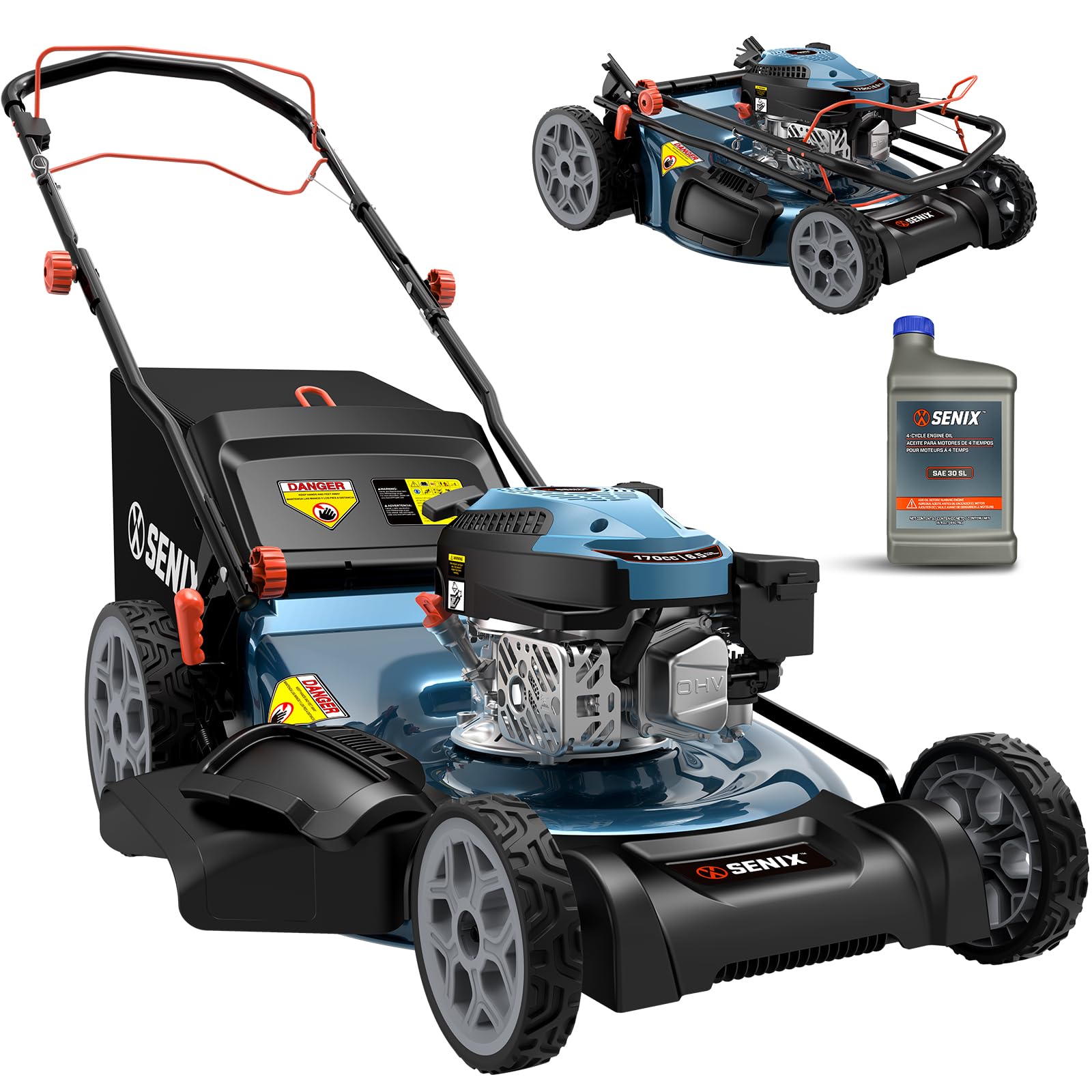
The mid-range workhorse that balances power, weight, and price for the average sloped yard.
The 170cc OHV (overhead valve) 4-cycle engine gives you consistent power for small to medium lawns, and the rear-wheel drive keeps you climbing without spinning out. At 72.8 pounds it is noticeably heavier than the 60-pound PowerSmart 140cc, that extra heft helps traction on damp grass, but you feel it if you need to push manually around tight turns. The cutting height adjusts from 1.25 inches all the way up to 4 inches, a wider low-end than the 1.5-inch minimum on the PowerSmart models, so you can scalp the lawn lower for a clean spring start.
Buyers report it “has started up and run steadily from the first pull each time,” and that the mower “cut the yard with very little effort.” The 19-gallon bagger is generous — (a bushel is a volume measurement equal to about 9.3 gallons) — meaning fewer stops to empty compared to the 1.4-bushel bags on other picks. The trade-off is that the single-speed self-propel is not adjustable, so you walk at one pace, and some owners found the assembly instructions hard to follow without listing the needed socket sizes.
A washout port (a hose connection that cleans the deck’s underside) and a foldable handle for vertical storage round out the package. For most people with a quarter-acre to half-acre sloped lot, this is the one to beat. If you need variable speed, the YARDMAX 201cc CVT is a better fit; if your lawn is small and flat, the PowerSmart 140cc saves you money at 60 pounds.
What stands out
- Wider cutting range than rivals: 1.25″ to 4″
- Large 19-gallon bag cuts emptying trips
- Washout port simplifies deck cleaning
What to watch
- Single-speed self-propel has no pace adjustment
- Assembly instructions omit tool sizes
Best match: Owners of small to medium lawns on gentle slopes who want a reliable, well-equipped RWD mower without spending premium-tier cash.
skip it if: You need variable speed control — you will walk at one set pace, no faster or slower.
2. PowerSmart 22 in. 170cc Self Propelled Gas Lawn Mower

The entry-level RWD that gets you on slopes without blowing your budget.
For the price, you get a 170cc engine and a rear-wheel-drive system on a 22-inch steel deck — the same cutting width as the higher-priced SENIX picks. The auto-choke (which automatically adjusts the fuel-air mix for cold starts) means you do not fiddle with a primer bulb before pulling the cord, which helps on cold mornings. Cutting height adjusts with a rear-wheel lever across six positions from 1.5 inches to 3.9 inches, so it does not go quite as low as the SENIX 170cc’s 1.25-inch floor, but the range covers most seasonal needs.
The 60-liter bag (about 1.7 bushels) is smaller than the 19-gallon bag on the SENIX, meaning more trips to empty on larger lawns. Unlike the SENIX 170cc, this model does not list a washout port, so cleaning the deck underside requires a manual scrape or hose from underneath. That is a reasonable trade given the spending level, and owners mention the tool-free assembly is genuinely simple — just unfold the handle and go.
If your yard is under a quarter-acre with a modest slope, this RWD mower gives you the traction you need at a price that leaves room for a trimmer in the same season. If you mow more than half an acre regularly, the bag will have you making extra trips compared to the SENIX 170cc.
Why it works
- Auto-choke for easier starting
- Tool-free assembly straight from the start
- Solid 170cc power at a value price
The catch
- No washout port for easy deck cleaning
- 60L bag fills quicker on bigger lawns
Reach for this if: You have a small sloped lawn and want a no-fuss RWD mower that starts easily and assembles in minutes.
Look elsewhere if: You mow more than half an acre — the bag will have you making extra trips.
3. SENIX 22 Inch 3-in-1 Gas Lawn Mower, 201cc Rear Wheel Single Speed
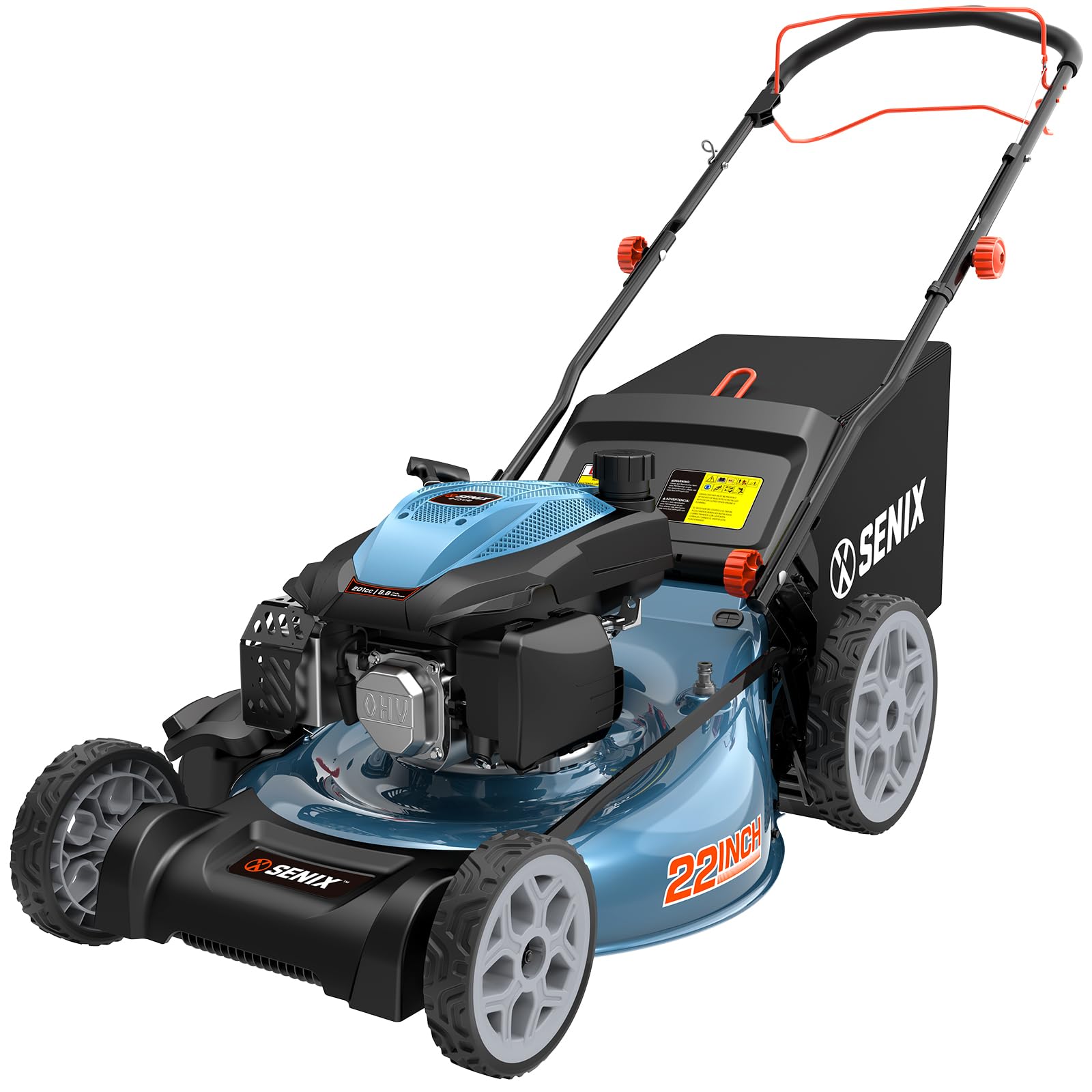
The 201cc heavy hitter that chews through thick, wet grass without flinching.
With 201cc and 4.7 HP (8.8 ft-lb torque), this SENIX has more displacement than the 170cc or 150cc alternatives, and it shows in tall or damp conditions. The single-speed rear-wheel drive reaches 2.9 MPH, which is roughly a brisk walking pace, and the 22-inch deck is built from DC04-06 low-carbon steel — a step up in durability from the lighter-gauge decks on budget models. Cutting height spans the same 1.25-inch to 4-inch range as the 170cc SENIX, so you get the same low scalp and high summer cut, but with 31 extra cc of power that the brand says helps prevent bogging.
Buyers mention the mower “cranked on 1st pull” and that “rear wheel drive on the big wheels works very well on uneven terrain.” One experienced owner replaced a 14-year-old mower and found this SENIX “light and decently sturdy” for trimming around a pool and fence on a larger property. Unlike the PowerSmart 150cc (which lacks a wash port), this model includes a foldable handle for compact storage and easy-maintenance engine design.
The self-propel is single-speed only, so you will not vary your pace mid-mow. And at 72 pounds it weighs the same as the other SENIX pick but packs 31 more cc — that power comes with a metal build that feels solid underfoot. If your grass grows fast and thick and you already ruled out the 170cc SENIX for lack of torque, this is the step-up. Variable-speed shoppers should look at the YARDMAX 24-inch CVT instead.
What you gain
- 201cc engine with 4.7 HP for thick grass
- Same wide 1.25″ – 4″ height range as top SENIX
- Manganese-steel blade for cleaner cuts
What you give up
- Single speed — no pace adjustment
- Reviewers report no gas capacity in the manual
Pick this when: Your grass grows fast and thick, and you need the extra displacement to avoid bogging down in damp conditions.
Consider another if: Variable speed is essential — this mower walks you, not the other way around.
4. PowerSmart 22-Inch Gas Lawn Mower, 150cc B&S Engine with ReadyStart
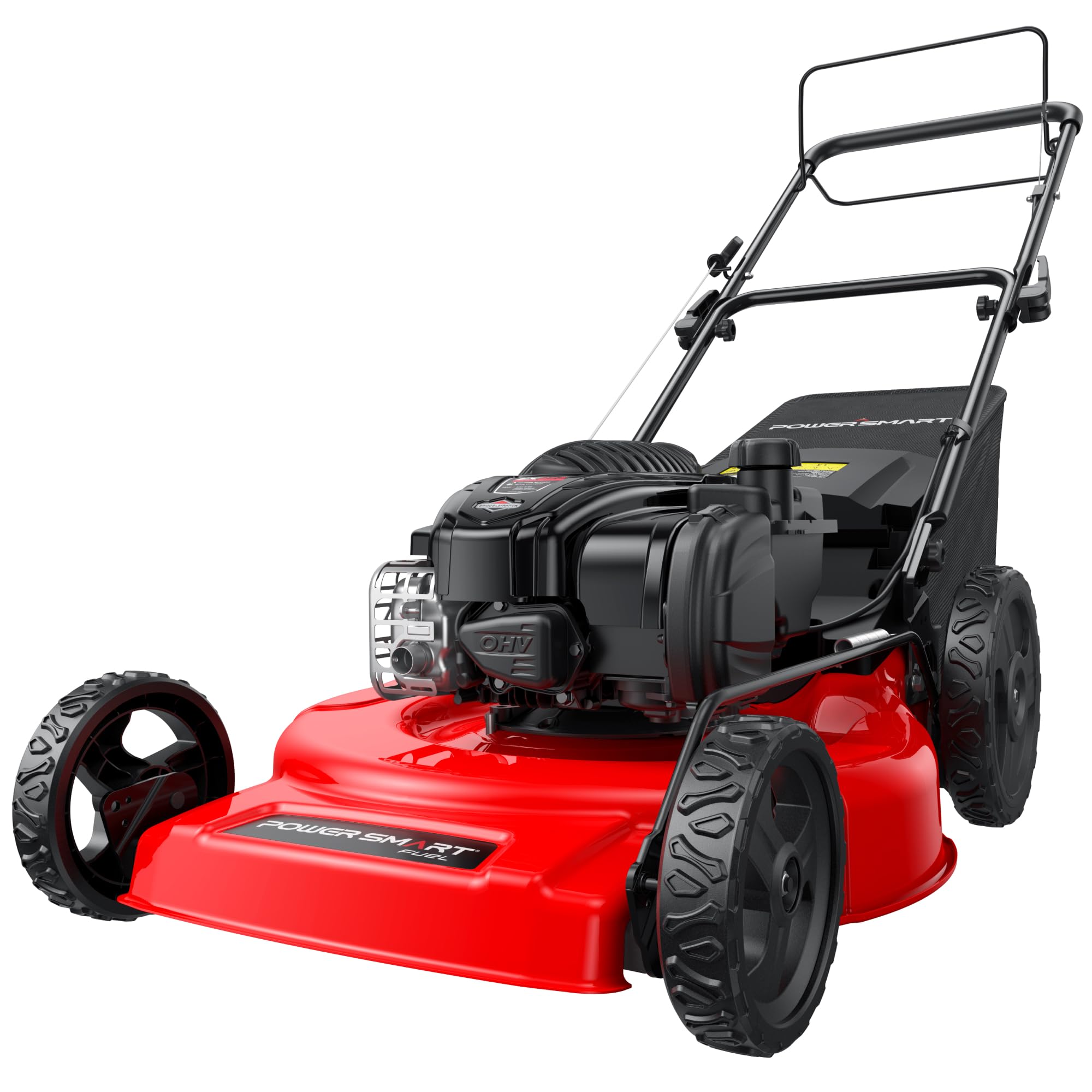
A Briggs & Stratton engine with ReadyStart that fires up without the choke dance.
The centerpiece is the USA-made Briggs & Stratton EX625 150cc engine with ReadyStart technology, meaning you skip the primer bulb and just pull. That is a real advantage over the 170cc PowerSmart that uses an auto-choke — both are easy, but the B&S name carries weight with buyers who have been burned by no-name engines. At 72 pounds it matches the heavier SENIX picks, but the 150cc displacement is the smallest in this group except the 140cc model, so you trade a little power for the trusted brand and easy start.
Cutting height runs from 1.5 inches to 3.9 inches with a single-lever, six-position adjustment — fewer steps than the seven-position YARDMAX but still enough to cover seasonal changes. One reviewer noted “excellent mulching of leaves” and that it “starts easily (1-2 pulls),” but also pointed out the self-propel has no speed adjustment (it is a fixed single speed) and that there is no deck wash port. That means cleaning the underside is more work than on the SENIX 170cc with its washout port.
Buyers also flagged a reliability issue: one owner reported the metal clip holding the engine start wire detached after about six mows, stopping the mower. So while the starting tech is smooth, the build quality has some inconsistency at this price point. For someone who values a brand-name engine over raw cc, this works — but if durability is your top concern, the 170cc PowerSmart avoids that clip problem.
Strong points
- Briggs & Stratton EX625 engine with ReadyStart
- Single-lever height adjustment, easy to switch
- Mulches leaves effectively, per owners
Weak points
- No speed control on self-propel drive
- No washout port for deck cleaning
- Some durability issues reported on wire clip
Good fit for: Anyone who wants a familiar B&S engine and easy pull-start convenience, especially for mulching leaves in fall.
Not for you if: You expect premium build consistency — a few owners hit parts failures early.
5. PowerSmart Self Propelled Gas Lawn Mower, 140cc Briggs & Stratton E550

The lightest RWD on the list, built for easy maneuvering on smaller, gentler slopes.
At 60 pounds, this PowerSmart is 12.8 pounds lighter than the 72.8-pound SENIX 170cc — that makes a noticeable difference when you lift it out of a shed or pivot around flower beds. The Briggs & Stratton E550 140cc engine is USA-made and uses a Prime ‘N Pull system for easy starts.
It shares the same 1.5-inch to 3.9-inch height range as the other PowerSmart models, with 2-lever, 6-position adjustment. The 1.4-bushel grass bag is smaller than the SENIX 170cc’s 19-gallon bag, so expect more trips to dump clippings if your lawn is larger. One buyer mentioned the “mower leaked oil from day one” and the seller refused a refund, so checking the unit on arrival for any shipping damage is wise. Other owners call it “light weight, fast, easy to maneuver” and say it “works very well” for the money.
For a flat or slightly sloped lawn under a quarter-acre, this is a capable, easy-to-handle RWD mower at a moderate cost. Just verify the oil seal is intact before your first mow. If your grass grows thick or your slope is steep, skip this and go for the SENIX 170cc or 201cc instead.
Why you might choose it
- Lightest RWD at 60 pounds — easy to lift and turn
- USA-made Briggs & Stratton E550 engine
- Simple two-lever height adjustment
Where it falls short
- 140cc struggles in tall or wet grass
- 1.4-bushel bag fills fast on bigger lawns
- Oil leak reports from some units
Best suited for: A small, relatively flat yard where light weight and easy maneuvering matter more than raw power.
Steer clear if: Your lawn is over a quarter-acre or has thick, fast-growing grass — the 140cc will work harder than you want.
6. YARDMAX 24 in. 201cc Electric Start RWD Mower
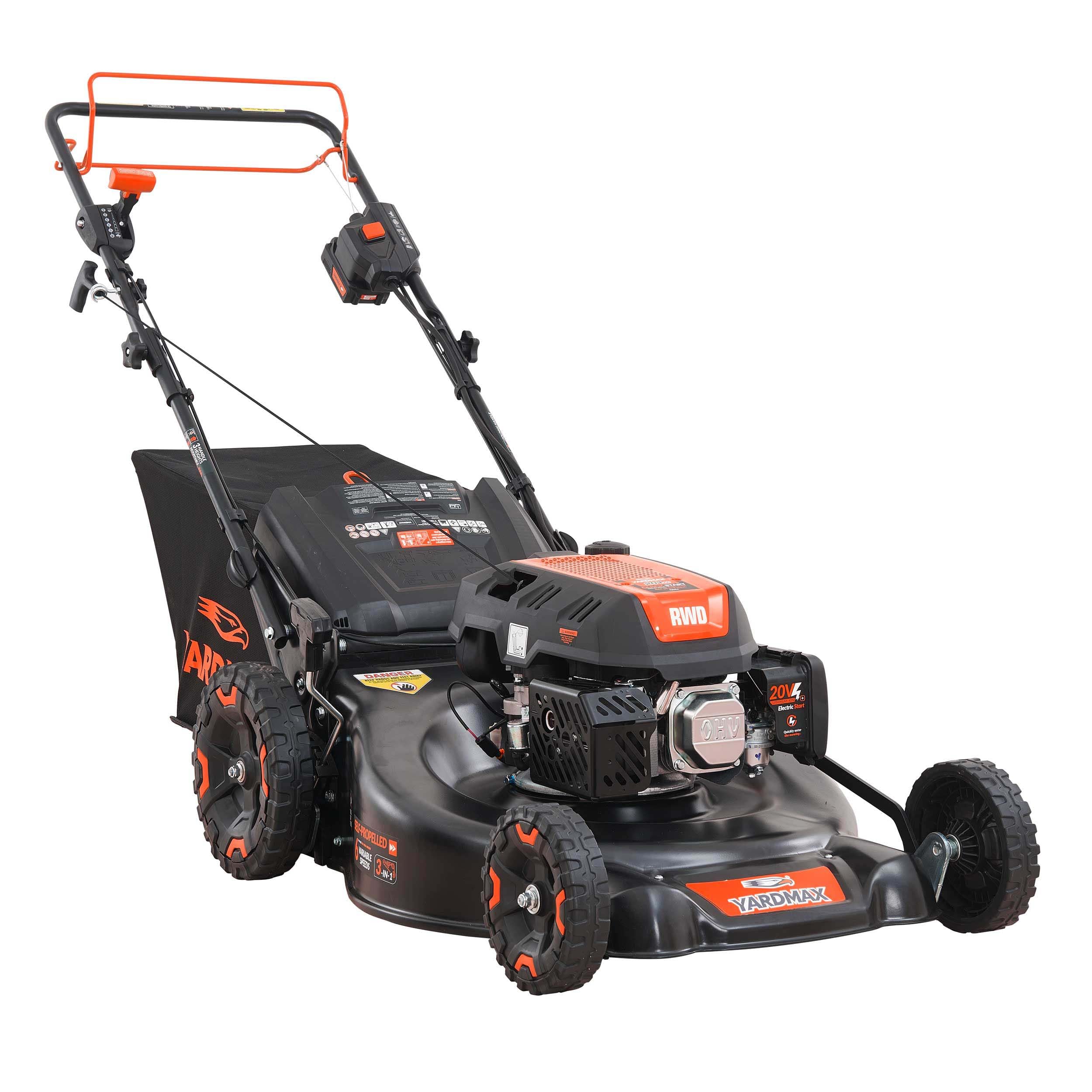
The biggest deck and only CVT on the list, built for large yards and variable walking speeds.
This is the most advanced drivetrain here: a CVT (continuously variable transmission) with 6-speed shift lever that lets you match the mower’s pace to your natural stride — from a slow trim to a quick walk over open stretches. The 24-inch cutting deck is two inches wider than every other mower on this list, meaning each pass covers more ground, and the 201cc engine gives it the displacement to pull the wider deck through thicker grass without choking. Electric start (push-button) means no pull cord, which is a real relief if you have arm or shoulder issues.
That weight helps traction on slopes, but turning it around at the end of a row takes more effort. Buyers love that the “electric start simplifies the process” and that the “self propelled force” is strong, but one owner reported the electric start failed on day one and the handle broke on day two, and another noted the mower “struggles and cuts off” when grass is higher than the deck. The MAXFlow Deck Technology (a volute spiral design the brand says improves airflow for better mulching) is supposed to improve mulching, but mixed reviews suggest real-world performance varies.
The cutting height offers seven positions from 1.57 inches to 3.74 inches — slightly tighter at the top end than the 4-inch max on the SENIX picks. The deck cleanout port lets you hose off the underside easily, and the double ball-bearing wheels roll smoothly. For large, open, sloped properties where you want to set a pace and cover ground fast, this YARDMAX is a serious contender — just buy from a source with good return support in case of early defects. If you prefer a simpler build with fewer electronics, the SENIX 201cc gives you a durable steel deck at 72 pounds without the electric-start complexity.
What makes it unique
- 24-inch deck cuts wider per pass than any other here
- CVT 6-speed matches mower pace to your walk
- Electric start is gentle on your arm
What to consider
- 103.5 pounds is heavy to maneuver around obstacles
- Early electric start and handle failures reported
- Top cut only 3.74″ — less than the 4″ on SENIX picks
Choose this for: A large, sloped lawn where variable speed and a wider cut save significant time per mow.
Think twice if: You have tight turns, flower beds, or a narrow gate — the weight and width make it less nimble than the lighter 22-inch mowers.
Understanding the Specs
Engine Displacement (cc)
Cubic centimeters measure the size of the engine’s cylinders. A 140cc engine is fine for weekly cuts on a small, flat lawn. A 170cc engine handles damp grass and moderate slopes without bogging. A 201cc engine powers through tall, thick, or wet grass that would stall a smaller motor. Bigger cc usually means more weight and fuel consumption, so do not oversize if your lawn is small and easy.
Cutting Height Range
Measured in inches from the lowest to highest blade position. A mower that drops to 1.25 inches lets you scalp the lawn for a clean spring start or overseeding prep. A top end of 4 inches handles the longer, cooler-season grass in summer or fall. The more positions between the bottom and top (6 or 7), the more precisely you can set the cut for your grass type and the season.
FAQ
Will a rear wheel drive mower climb a steep hill better than a front wheel drive?
How often should I change the oil in a gas rear wheel drive mower?
Can I use a rear wheel drive mower on wet grass?
What is the difference between single-speed and variable-speed self-propel?
How do I clean the underside of a mower without a washout port?
Is a 140cc engine powerful enough for a half-acre lawn?
What does 3-in-1 mean on a lawn mower?
How long does a gas rear wheel drive lawn mower typically last?
Why is the YARDMAX 24-inch mower so much heavier than the others?
Can I convert a rear wheel drive mower from bagging to mulching without buying extra parts?
Final Thoughts: The Verdict
Across the board, the best rear wheel drive lawn mower is the SENIX 170cc OHV because it balances strong power, a wide 1.25-inch to 4-inch cutting range, a large 19-gallon bag, and a washout port at a mid-range price. If you want the extra grunt for thick grass while staying affordable, grab the SENIX 201cc Single Speed for its 4.7 HP engine and durable steel deck. And for large, open sloped lawns where you need variable speed and a wider cut, the YARDMAX 24-inch CVT with electric start covers more ground with every pass.
How We Picked
We do not accept paid placement. Every pick is matched to a real buyer and a real use-case; we do not hands-on test units.
Sources & Methodology
Specifications: manufacturer listings and product documentation. Review insights: verified customer reviews, as of July 2026. Pricing: not shown on this page (it changes often); check the current price via the retailer link.
As an Amazon Associate, Lawn Gear Lab earns from qualifying purchases. This does not affect which products we feature.