
You have probably bought solar spot lights before and felt let down when they barely glowed by midnight or went dark after a cloudy day. That frustration comes down to two key numbers: the battery capacity (how much energy it stores, measured in milliampere-hours or mAh) and the solar panel’s conversion efficiency (how well it turns sunlight into electricity). The best-rated solar spot lights solve those exact problems by using larger, higher-efficiency panels and bigger batteries, so you get real light — not a dim flicker — from dusk through the night.
I’m Rikta — the co-founder and writer behind Lawn Gear Lab. This guide is built by comparing the manufacturers’ published specifications and the patterns across verified customer reviews, so you get each pick’s real strengths and trade-offs instead of marketing spin.
Whether you need to highlight a tree, light a pathway, or secure your front yard, these rated solar spot lights were chosen for brightness, battery capacity, weather resistance, and real-world night-long performance.
How To Choose The Best Rated Solar Spot Lights
Picking the right solar spot light means looking past the flashy claims and focusing on the specs that actually determine whether you will have a well-lit yard at midnight or a dark disappointment. Here are the three things that matter most.
Brightness (Lumens) and Battery Capacity (mAh)
Lumens measure how much visible light the fixture produces — higher lumens mean a brighter beam. But brightness is useless if the battery (measured in milliampere-hours, or mAh) is too small to sustain it. A light that claims 800 lumens but has a 1200mAh battery might last only 4-6 hours on high. Look for a 1800mAh battery or higher if you want full-night runtime without dimming.
Weather Resistance: IP65 vs IP67
The IP (Ingress Protection) rating tells you how well the light resists water and dust. IP65 means it can handle rain and splashes but is not fully dust-tight. IP67 means it can survive being submerged in 1 meter of water for 30 minutes — that is a big difference if you live in a rainy area or plan to use the lights near sprinklers. For most yards, IP67 gives you better long-term reliability.
Color Temperature: Warm vs Cool Light
Color temperature is measured in Kelvin (K). Lower numbers (around 2700K-3000K) produce a warm, yellowish glow similar to old incandescent bulbs — comfortable and cozy for patios and gardens. Higher numbers (5000K-6500K) give a cool, bluish-white light that looks surgical and bright — better for security or showing off architecture. There is no “right” choice, but warm light tends to feel more natural in a residential landscape.
Quick Comparison
On smaller screens, swipe sideways to see the full table.
| Model | Category | Best For | Key Spec | Amazon |
|---|---|---|---|---|
| HGGH 60 LED 4-Pack | Best Overall | All-night brightness with long battery life | 800 lumens / 8500K | Amazon |
| Brightown 58 LED 4-Pack | Best Battery Life | Ultra-long runtime (20 hours on low) | 800 lumens / 1800mAh | Amazon |
| nipify 53 LED 4-Pack | Value Pick | Compact, versatile 2-in-1 placement | 800 lumens max | Amazon |
| APOMAO 36 LED 2-Pack | Premium Brightness | Most powerful beam (1000 lumens) | 1000 lumens / 5000K | Amazon |
| APONUO 4-in-1 | Best for Flexibility | Remote solar panel with 9.8ft cable | 3000K warm / 2000mAh | Amazon |
| Fratink 10-Pack | Best for Coverage | Large-area coverage (10 lights) | 450 lumens / 4 modes | Amazon |
In‑Depth Reviews
1. HGGH 60 LED Solar Spot Lights 4-Pack
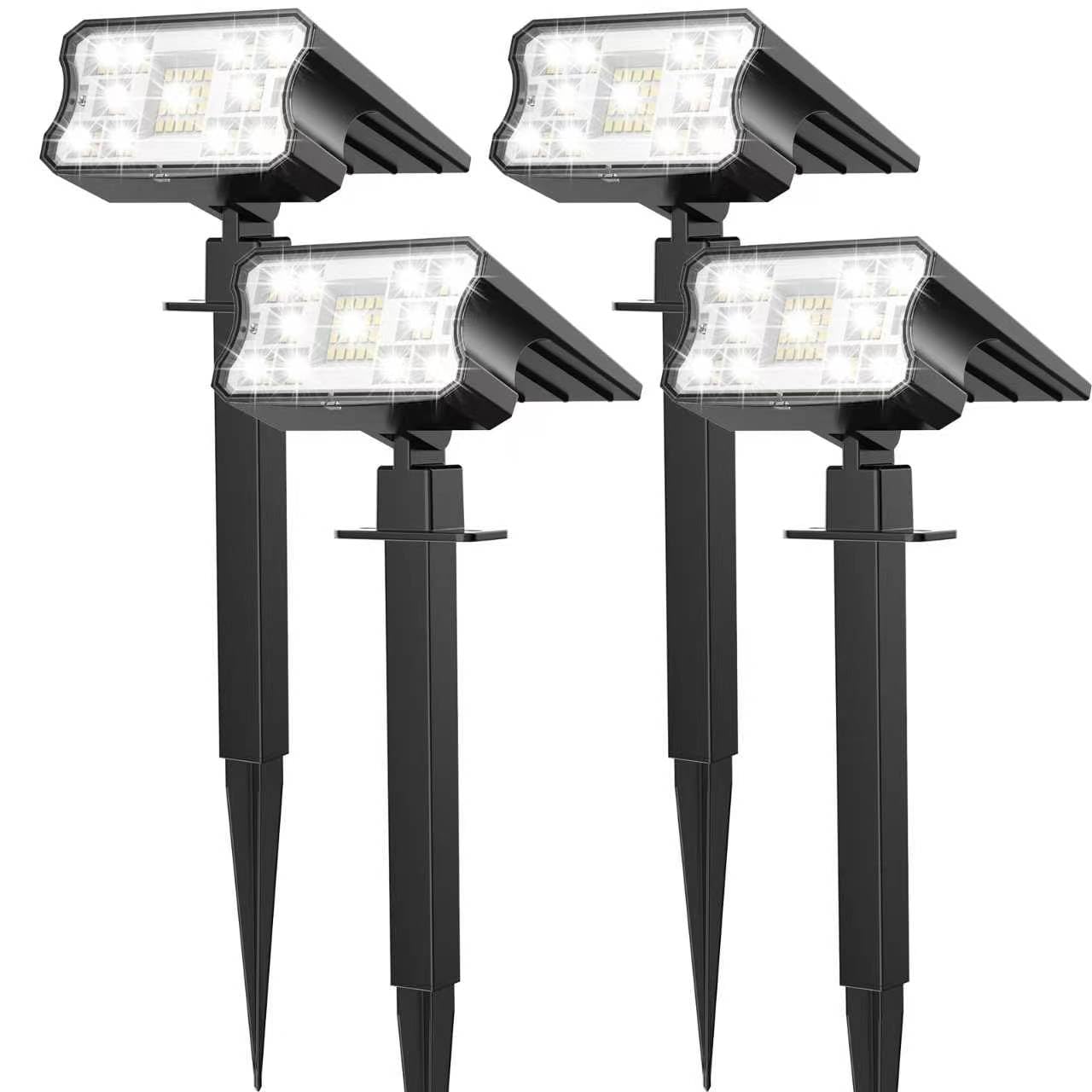
The HGGH 4-pack delivers a crisp 8500K (daylight white) beam at 800 lumens, making trees and flags pop sharper at night than the Brightown pick below does — that cooler beam temperature gives it a visual edge. You can pick Low mode for 24 hours of soft glow, Medium for 13 hours, or High for 9 hours of vivid highlighting, according to buyer reports. That 9-hour High setting covers a full winter evening without dimming. Its IP67 rating (meaning it survives 30 minutes submerged in 1 meter of water) shrugs off rain, snow, and dust, and the polycarbonate housing handles temperatures from -4°F to 140°F without cracking. If you prefer a warm 3000K glow instead of a crisp daylight look, the 8500K might feel too clinical for your patio. For most yards that need guaranteed all-night performance, this set is the top choice.
Why it’s great
- 800 lumens of bright cool-white light (8500K)
- Runs up to 24 hours on Low mode
- IP67 fully waterproof and dustproof
- 2-in-1 ground stake or wall mount setup
Good to know
- Cool white light (8500K) may feel too bright for some nighttime settings
- Color temperature is much higher than the warm 3000K of other picks
2. Brightown 58 LED Solar Spot Lights 4-Pack

The Brightown matches the HGGH’s 800-lumen brightness but beats it on raw staying power with an 1800mAh battery — a larger capacity than the HGGH, packed into a squatter 8″ x 4″ x 3.5″ body. Buyers report it delivers 20 hours on the 30% brightness setting, 15 hours on medium, and 12 hours on full power. So even on High, it outlasts many competitors by hours. The polycrystalline silicon solar panel has a claimed 30% photoelectric conversion efficiency (how well it turns sunlight into electricity) and needs only about 4 hours of direct sun to hit that runtime. Buyers with two years of ownership report the lights still work perfectly. Pick the Brightown over the HGGH if your yard is partly shaded — it charges faster with less sun — or if your top priority is the absolute longest runtime per charge.
Where it shines
- 1800mAh battery delivers up to 20 hours on low setting
- Charges in just 4 hours of direct sunlight
- IP67 rating handles full submersion
- Proven reliability over 2+ years per customer feedback
Worth noting
- Cool white (6500K) beam is less natural than warm alternatives
- Dimensions are wider and flatter than taller stake designs
3. nipify 53 LED Solar Spot Lights 4-Pack
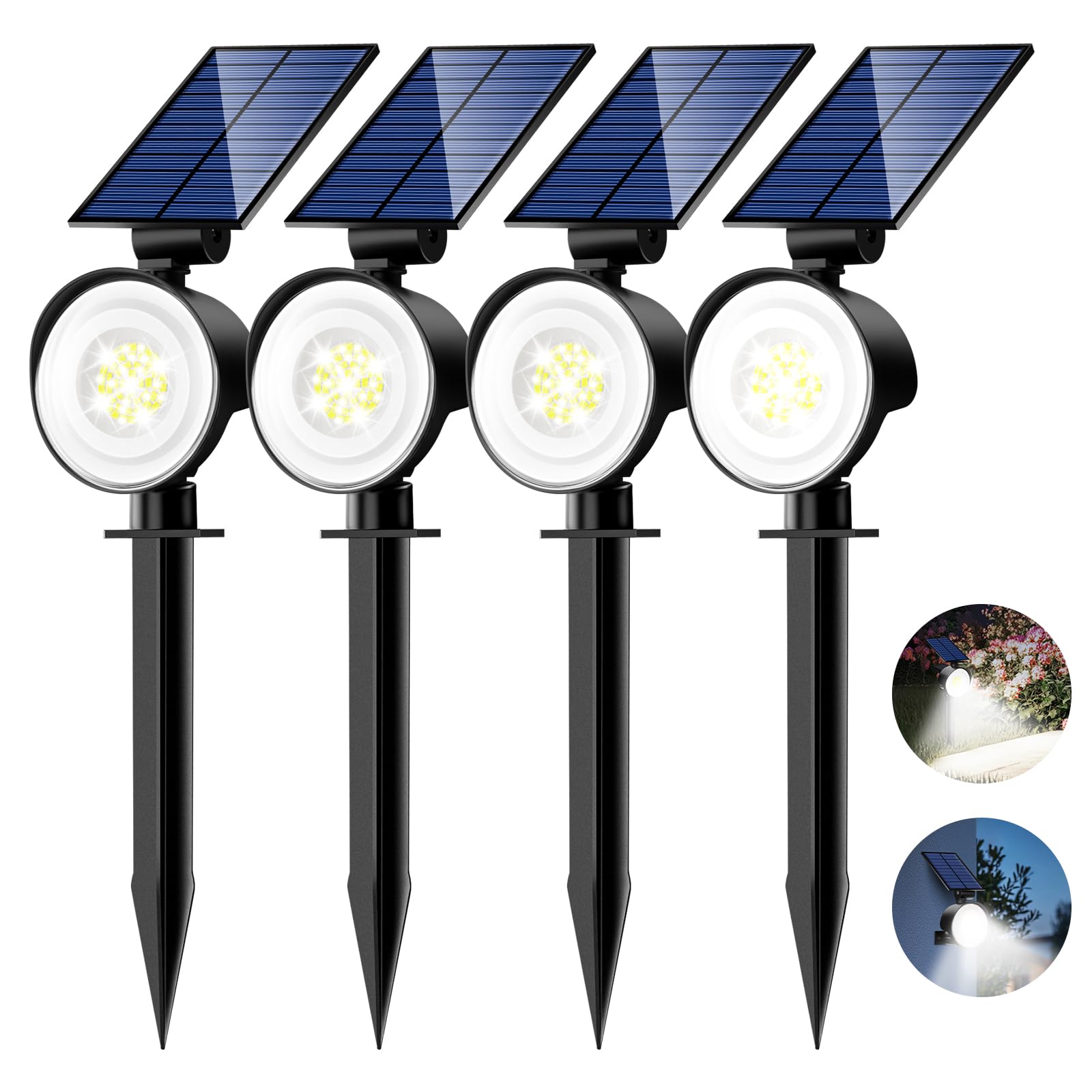
If you have a narrow garden path and a wall to light — but do not want two different light types — the nipify 4-pack solves that with a 2-in-1 design: stake it into the ground for landscape accenting or screw it to a wall for downward lighting. It stands 3.15″ x 3.15″ x 12.25″, making it a sleeker, taller profile than the squatter 8″ x 4″ x 3.5″ Brightown. The solar panel rotates 300° horizontally and tilts 150°, so you can aim it to grab sun even in a tight corner. Owners mention the three modes (dim, medium, high) deliver decent brightness, though a few note “the brightness is not as high as advertised.” The beam maxes out at 800 lumens, same as the top picks. The adjustable light head tilts 90° independently, letting you beam light onto a low shrub or a high wall sculpture without moving the base — a feature fixed-head lights cannot match.
What stands out
- 300° rotating and 150° tilting solar panel for best sun capture
- 2-in-1 stake or wall mount installation
- Three brightness modes (dim, medium, high)
- Compact, low-profile design for discreet placement
The trade-offs
- Some buyers find the actual brightness lower than the 800-lumen claim
- Plastic construction feels less premium than ABS-metal hybrids
4. APOMAO 36 LED Solar Spot Lights 2-Pack

The APOMAO 2-pack leads the entire field at 1000 lumens per fixture — 25% more brightness than the 800-lumen HGGH and nipify picks. That makes it the best option for lighting up a large flagpole, a tall tree, or a dark corner weaker lights cannot reach. Its 5000K color temperature sits in the middle: cooler than warm 3000K lights but less harsh than the 8500K HGGH. The catch is runtime: High mode gives about 6 hours of bright light, while Low mode stretches to 12 hours for ambient coverage. The oversized 1.5W monocrystalline solar panel (a type of solar panel made from single-crystal silicon, known for high efficiency) charges 25% faster than standard panels, per the brand, which helps on shorter winter days. Customers note these lights work perfectly for tree uplighting and flag illumination, with one reviewer calling them “perfect landscaping lights” that hold a charge well. At roughly 40% more per fixture than the competition (a 2-pack vs a 4-pack at a similar price), you are paying for pure brightness. If you need raw power over coverage, this is the most intense beam in the lineup.
The upsides
- 1000 lumens — the brightest beam in this guide
- 1.5W monocrystalline panel charges 25% faster than standard panels
- 180° rotatable panel + 90° adjustable light head
- IP67 waterproof for all-weather durability
Keep in mind
- Only 2 fixtures per pack, so coverage is limited
- High mode lasts only 6 hours per charge
- Solar panel only tilts up/down, no side-to-side rotation
5. APONUO 4-in-1 Solar Spot Lights

The APONUO solves a problem no other pick here does: it uses a 9.8-foot (3-meter) cable to separate the solar panel from the light head. You place the panel in a sunny spot, and the light itself shines into a dark, shaded corner — perfect for covered patios, north-facing walls, or under dense tree canopies. Its warm white 3000K glow is a deliberate contrast to the cool-blue beams of the HGGH and Brightown. Two 2000mAh batteries (one per light in the set) deliver 8-12 hours of runtime on low mode. Reviewers point out the lights hold a charge all night and produce a “strong non-fading light,” though several note the 9.8-foot cable is shorter than expected — one reviewer wished it was 15 feet instead. The IP65 rating (handles rain and splashes but is not fully dust-tight) is less protective than the IP67 of the top picks. If your yard has a sunny spot far from the area you want lit, this detached-panel design is the only practical solution here.
Why we’d pick it
- Detached 9.8ft cable lets you place panel in sun, light in shade
- Warm white 3000K glow is gentler than cool beams
- 2000mAh battery capacity for 8-12 hour runtime
- 270° adjustable light head
A few caveats
- IP65 rating is less waterproof than IP67 competitors
- 9.8ft cable may be too short for some layouts
- Only connects between panel and lights, not between light strings
6. Fratink 10-Pack Solar Spot Lights
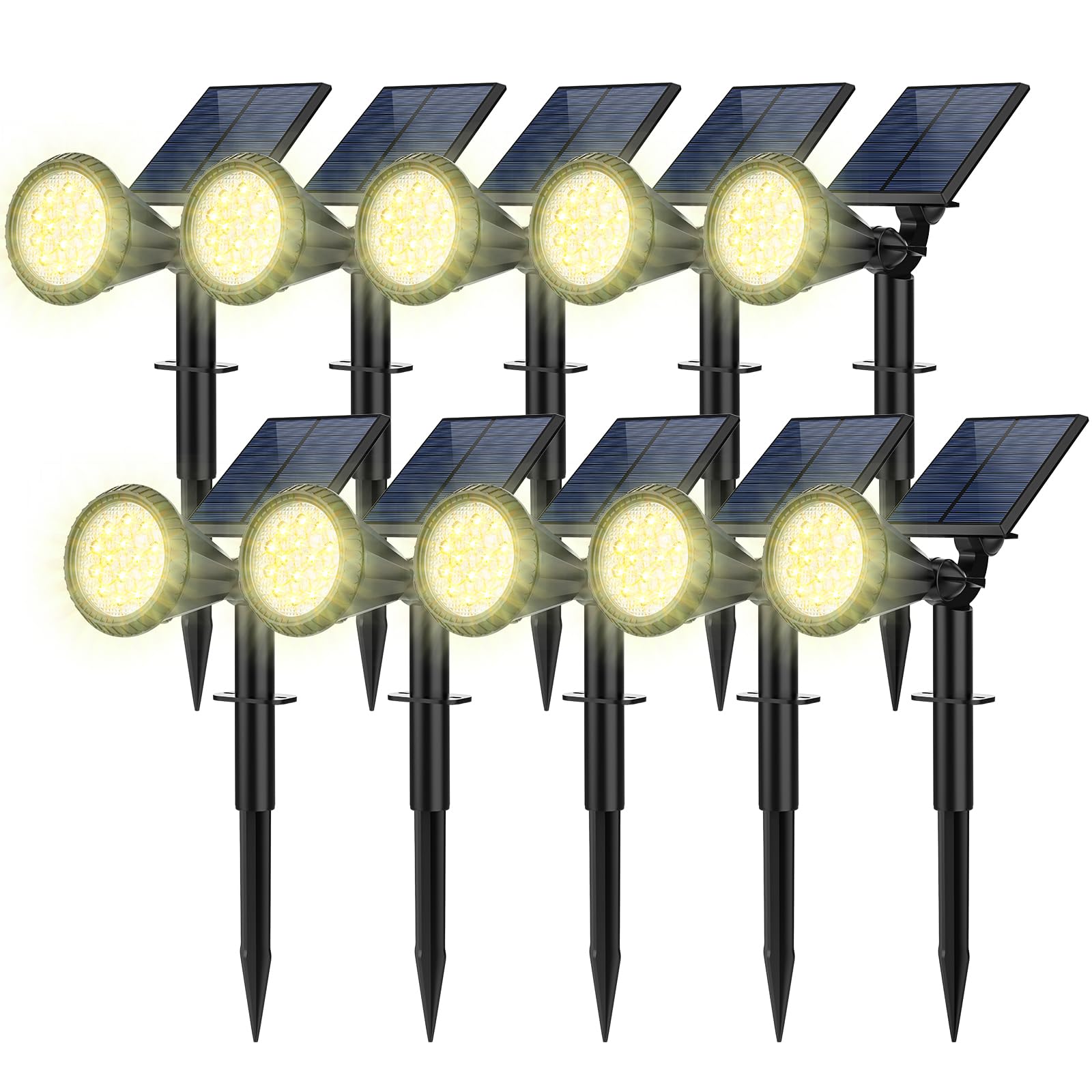
The Fratink 10-pack gives you 10 fixtures at a per-light cost that undercuts every other premium pick, making it the smart choice for covering a sprawling yard, long driveway, or multiple garden beds. Each light produces 450 lumens at 3000K warm white — dimmer than the 1000-lumen APOMAO but perfectly adequate for pathways and flower beds, shoppers say. The 4-mode system includes Low (20 hours), Medium (10 hours), High (8 hours), and a Breathing mode (8 hours) that pulses gently for decoration. Buyers report these lights are “very bright” and have lasted over a year in continuous use, with some in an enclosed patio that gets little direct sun still working well. The IP65 waterproofing and ABS housing handle rain and frost well. You give up peak brightness (450 lumens vs 800-1000 on other picks) and the IP67 rating, but you gain 10 fixtures with independent adjustable panels and 180° rotating heads — the best value for large-area coverage.
Strong points
- 10 lights per pack — best value for large-area coverage
- 4 lighting modes including unique Breathing mode
- Low mode runs 20 hours per charge
- Independent 180° adjustable solar panels and light heads
Before you buy
- 450 lumens is dimmer than 800+ lumen competitors
- IP65 rating is less water-resistant than IP67
- Plastic housing feels sturdy but not premium
Understanding the Specs
Lumens (Brightness)
Lumens are the actual measure of how much visible light the fixture emits. A higher lumen number means a brighter beam. For solar spot lights, look for at least 400 lumens for subtle path lighting, and 800 lumens or more if you want to highlight trees, flags, or house features. The APOMAO at 1000 lumens is the brightest pick here, while the Fratink at 450 lumens is better for softer, ambient coverage.
Color Temperature (Kelvin)
Measured in Kelvin (K), this tells you the “warmth” or “coolness” of the light. 2700K-3000K produces a warm, yellowish glow that feels cozy and natural for gardens and patios. 5000K-6500K gives a crisp, bluish-white light that is better for security and architectural highlighting. The HGGH at 8500K is the coolest pick, while the APONUO at 3000K gives the warmest beam.
Battery Capacity (mAh)
Milliampere-hours (mAh) measure how much energy the battery can store. A higher number means longer runtime, especially on high brightness. The Brightown at 1800mAh and the APONUO at 2000mAh lead the group, while smaller batteries (around 1200mAh) may struggle to last through a full winter night.
IP Rating (Waterproofing)
IP (Ingress Protection) ratings tell you how well the light resists water and dust. IP65 means it is protected against rain and splashes but is not completely dust-tight. IP67 means it can be submerged in 1 meter of water for 30 minutes without damage. For most yards, IP67 is worth the extra peace of mind, especially in rainy climates or near sprinklers.
FAQ
How many hours of direct sunlight do solar spot lights need?
Can solar spot lights work in winter or cloudy weather?
What is the best color temperature for a garden?
How do I install solar spot lights without wiring?
Final Thoughts: The Verdict
If you want one dependable pick, the rated solar spot lights winner is the HGGH 4-Pack because it combines 800 lumens of crisp daylight brightness with a 24-hour low-mode runtime and proven IP67 durability at a moderate per-light cost. If you want the absolute longest runtime per charge for shaded yards, grab the Brightown 4-Pack. And for those who need intense beam power to light up a specific feature, the standout is the APOMAO 2-Pack.