
An electric pressure washer that sputters, stalls, or simply lacks the muscle to strip grime from a concrete driveway is a tool that wastes your afternoon. The best models deliver a steady, punishing stream of water that makes quick work of mildew on siding, caked mud on truck tires, and years of embedded dirt on patio pavers — all without the ear-splitting roar of a gas engine.
I’m Rikta — the co-founder and writer behind Lawn Gear Lab. I’ve spent weeks analyzing motor wattage, pump technology, GPM ratings, and thousands of owner reviews to separate the units that deliver real cleaning power from those that just look good on a shelf.
Whether you need to blast away oil stains from a driveway or gently wash a family sedan, this guide breaks down every crucial spec and real-world flaw of the top contenders to help you choose the very best rated electric pressure washer for your property.
How To Choose The Best Rated Electric Pressure Washer
Picking the right electric pressure washer isn’t about grabbing the highest PSI number on the box. Cleaning units (CU = PSI × GPM) tell the real story of how much dirt-moving force you’ll get. Beyond raw numbers, pump construction, hose length, and nozzle selection determine whether your machine becomes a trusted tool or a frustrating project-stopper.
Understand Cleaning Units: PSI and GPM Together
A machine boasting 2300 PSI with only 1.1 GPM might struggle to rinse soap off a driveway, while an 1800 PSI unit delivering 2.0 GPM can wash much faster because the higher volume carries debris away. Multiply the two numbers — the resulting Cleaning Units (CU) give you a reliable measure of real-world cleaning speed. Look for at least 2000 CU for general home use and 2500 or more for concrete and heavy grime.
Pump Type: Axial vs. Wobble vs. Piston
Most residential electric pressure washers use axial cam pumps — they’re compact, affordable, and adequate for light-to-medium cleaning. Wobble-plate pumps can offer slightly better durability at a similar price. Premium and heavy-duty models use multi-piston pumps (often 3 or 5 pistons) that run smoother, vibrate less, and last significantly longer under regular use. If you plan to clean multiple times a month, investing in a piston pump saves money on replacements over the long term.
Hose, Cord, and Nozzle Ergonomics
A unit with a 20-foot high-pressure hose and a 35-foot power cord lets you reach the far side of a two-car driveway without dragging the machine. Look for a flexible, abrasion-resistant hose that won’t kink. At least four quick-connect nozzles (0°, 15°, 25°, and 40°) plus a turbo nozzle give you the versatility to switch from paint-stripping power to a gentle rinse for car paint. An onboard detergent tank or foam cannon simplifies the soap application step.
Quick Comparison
On smaller screens, swipe sideways to see the full table.
| Model | Category | Best For | Key Spec | Amazon |
|---|---|---|---|---|
| Westinghouse WPX2300e | Mid-Range | Heavy home cleaning | 2300 PSI / 1.76 GPM | Amazon |
| Greenworks GPW2101A | Premium | Medium-duty + storage | 2100 PSI / 1.2 GPM | Amazon |
| CAT 5-Piston | Premium | High flow rate cleaning | 1800 PSI / 2.0 GPM | Amazon |
| EGO HPW3204-2 | Premium | Cordless power + runtime | 3200 PSI / 2.0 GPM | Amazon |
| Kärcher K1800PS | Mid-Range | Compact maneuverable design | 1800 PSI / 1.2 GPM | Amazon |
| Sun Joe SPX3000 | Mid-Range | Dual detergent tanks | 2030 PSI / 1.2 GPM | Amazon |
| Greenworks GPW903A | Mid-Range | Light maintenance cleaning | 1900 PSI / 1.2 GPM | Amazon |
| Ryobi RY141612 | Budget | Ultra-light portable use | 1600 PSI / 1.2 GPM | Amazon |
| EGO HPW2100 | Premium | Cordless portability | 2100 PSI / 1.2 GPM | Amazon |
In‑Depth Reviews
1. Westinghouse WPX2300e
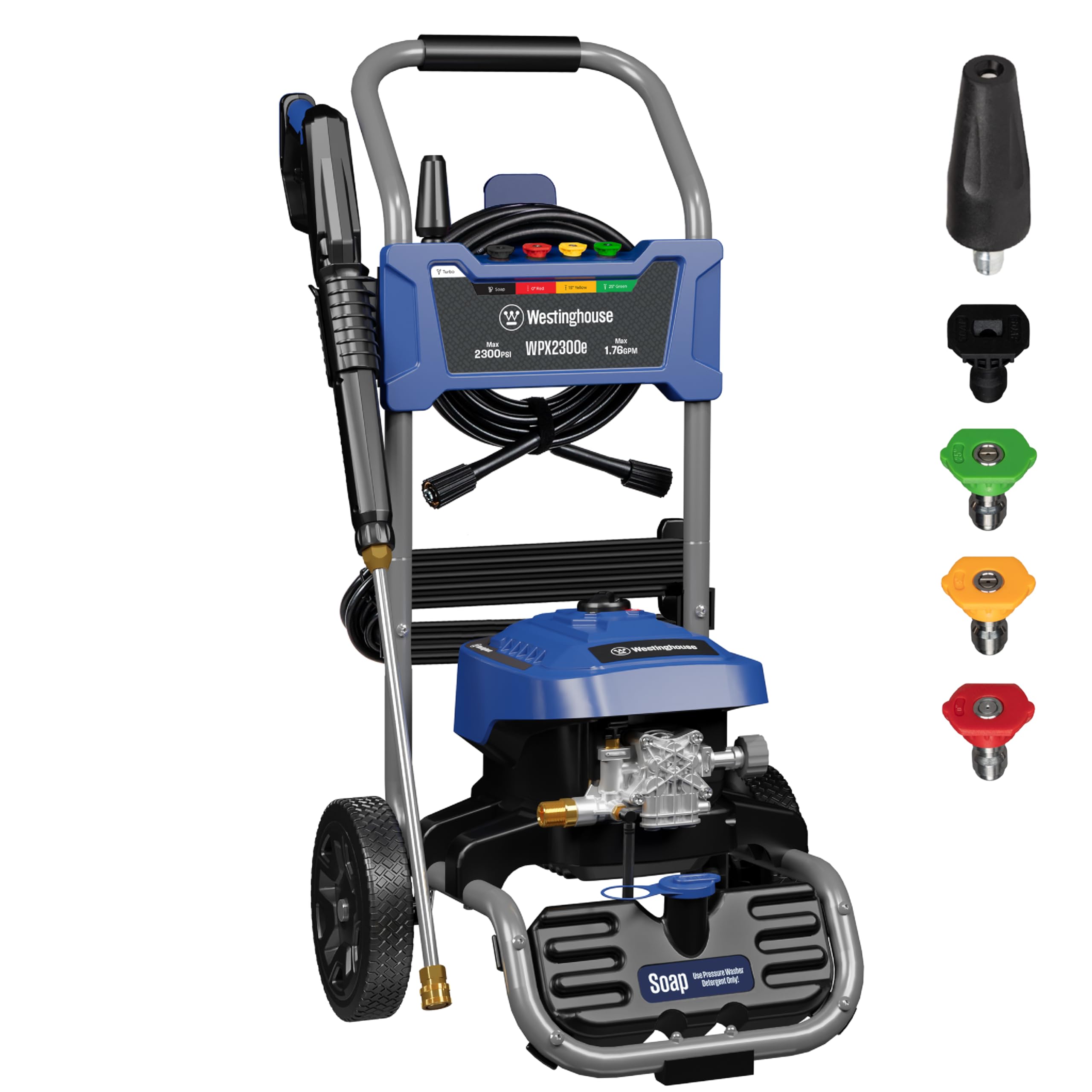
The Westinghouse WPX2300e delivers a hefty 2300 max PSI and 1.76 max GPM, translating to roughly 4048 cleaning units — enough to strip layered grime from concrete and old paint from fences in a single pass. Its induction motor runs cooler and quieter than universal-brush designs, and the tough steel frame with 8-inch never-flat wheels makes it easy to roll across rough terrain without the machine tipping.
The 25-foot abrasion-resistant hose and 35-foot GFCI cord give you a generous 60-foot work radius, and the five quick-connect nozzles (0°, 15°, 25°, soap, and turbo) cover everything from paint stripping to gentle car washing. The .42-gallon onboard soap tank is built into the frame, so you don’t have to lug a separate bottle around the yard. Assembly takes roughly ten minutes, and the pump is a maintenance-free axial unit backed by a three-year warranty.
Owners consistently praise its raw power — many compare it favorably to gas units twice its size — and report that it easily handles vinyl siding, PVC fences, and driveway algae. The main complaint is that the wand lacks a trigger lock and the hose can be stiff and prone to twisting in cold weather. Also, the soap system has no on/off valve, so detergent continues to flow until the tank empties, which can complicate the rinse phase.
What works
- Gas-rivaling 2300 PSI cleaning power for concrete and heavy grime
- Durable induction motor and steel frame with large wheels for easy mobility
- Generous 25-foot abrasion-resistant hose plus 35-foot power cord
What doesn’t
- Wand lacks a lock-on trigger for continuous spray
- Hose can feel stiff and twist in cooler temperatures
- Soap runs continuously with no shut-off valve — must empty tank to stop
2. Greenworks GPW2101A (2100 PSI)

The Greenworks GPW2101A packs 2100 PSI and 1.2 GPM into a remarkably compact, suitcase-style frame with a pull-out telescoping handle that collapses flush for under-the-bench storage. The design is a clear upgrade over the brand’s lighter-duty models — the wheels are larger, the handle feels sturdy, and the hose storage hook keeps the 20-foot tangle-free line organized. Push-button start means no pull cords or priming.
The included nozzle set covers the essentials: 25° for general cleaning, 40° for gentle rinsing, a turbo nozzle for concentrated scrubbing, and a soap applicator for detergent. The 35-foot GFCI power cord gives you decent reach, and the unit is SGS certified for safety compliance. Greenworks backs this model with a three-year limited warranty, which is better than the two-year coverage many competitors offer at this spec level.
Customers confirm it handles concrete driveway cleaning, paint stripping, and paver restoration with authority. The foam cannon works well with car soap for vehicle washing. The most common critique is that the nozzle tips touch the ground when stored, which can lead to dirt ingress. A few owners also noted that the wand lacks a quick-connect on one end, making nozzle swaps slightly less convenient than fully universal systems.
What works
- Excellent medium-duty cleaning with 2100 PSI and turbo nozzle
- Telescoping handle and compact footprint ideal for storage
- Quieter push-button start with no gas or oil maintenance
What doesn’t
- Nozzle storage position can pick up dirt from the ground
- Wand lacks a full quick-connect system on both ends
- Some owners reported missing screws in the handle assembly
3. CAT 5-Piston Electric Pressure Washer

The CAT electric pressure washer distinguishes itself with a patented 5-piston aluminum pump, which boosts cleaning power by roughly 30% over standard 3-piston designs while reducing vibration. The result is 1800 PSI combined with a high 2.0 GPM flow rate — producing 3600 cleaning units — making it one of the fastest-rinsing units in its class. The horizontal, low-profile chassis stays stable on uneven ground and won’t tip over when you pull the hose.
The accessory kit includes a 20-foot M22-15mm rubber hose (important — using M22-14mm hoses causes leaks), four quick-connect nozzles (0°, 15°, 25°, 40°), a 600ml foam cannon, and a metal lance and gun. The 35-foot GFCI cord provides ample reach, and the pump housing has a built-in compartment for storing the spray gun. The unit is CSA certified and comes with a two-year residential warranty covering the full machine and all accessories.
User feedback highlights the smooth operation and the sheer volume of water that makes short work of garage floors and sidewalks. The detachable soap bottle is a plus — you can fill only what you need. Criticisms include the gun hose being somewhat short and stiff, and the power cord holder not securing the plug properly. The GFCI plug also needs to be reset at each use, which some find slightly inconvenient.
What works
- Excellent 2.0 GPM flow rate for fast rinsing and high cleaning units
- 5-piston pump runs smoother and vibrates less than axial designs
- Stable horizontal frame with convenient gun storage compartment
What doesn’t
- Short 20-foot hose requires moving the machine frequently
- Pump and cord can heat up if cord isn’t fully uncoiled
- Switching between nozzles is cumbersome without quick-connect upgrades
4. EGO Power+ HPW3204-2
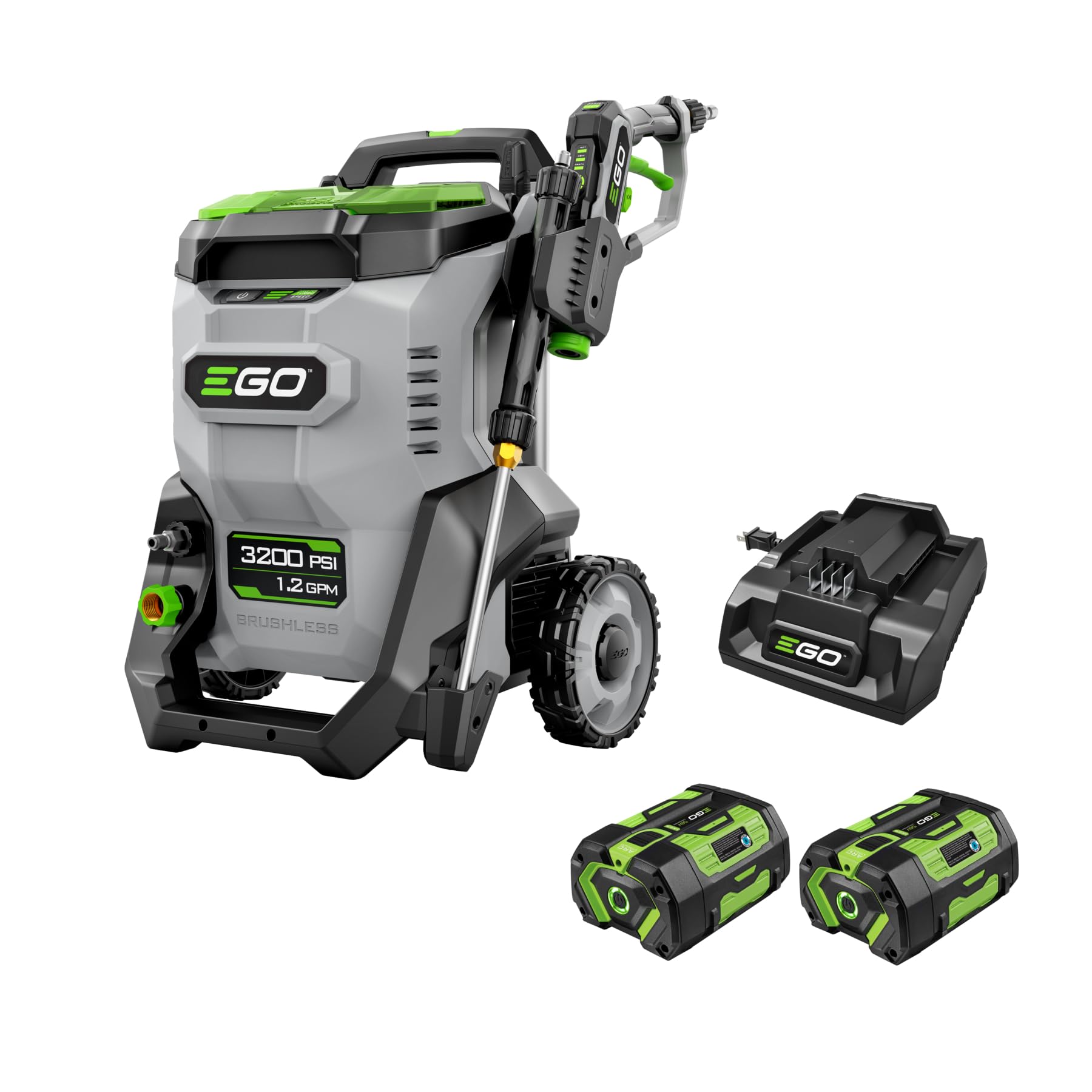
The EGO HPW3204-2 is the most powerful battery-powered pressure washer on this list, using Peak Power technology to combine two 56V ARC Lithium batteries for up to 3200 PSI at 1.2 GPM, with a peak flow of 2.0 GPM. That translates to approximately 6400 cleaning units — enough to rival mid-size gas units. The wand-integrated display lets you toggle between ECO, High, and Turbo modes and view battery charge wirelessly without walking back to the unit.
Setup is quick with quick-connection points for the hose and wand. The telescopic handle collapses for storage, and the 25-foot high-pressure hose provides solid reach. Included accessories are extensive: a foam cannon, siphon hose, stainless steel wand, and five nozzles (15°, 25°, 40°, turbo, and rinse). Two 6.0Ah batteries and a charger are included, and the tool carries a 5-year warranty with a 3-year battery warranty.
Owners love the freedom from cords and gas — the machine starts instantly and runs quietly. On High mode, you get roughly 40 minutes of runtime, and the Turbo nozzle can erase oil tire marks from asphalt. The main downsides are cost and runtime for large projects: the batteries drain faster on Turbo mode, and the 1.2 GPM flow on lower modes makes rinsing large areas slower than a corded high-GPM unit. Some users also wish the hose had a higher-end swivel fitting.
What works
- Gas-rivaling 3200 PSI with the convenience of cordless operation
- Wand-mounted display for mode selection and battery status
- Includes two 6.0Ah batteries and a rapid charger
What doesn’t
- Very expensive upfront investment compared to corded alternatives
- Battery life limits continuous runtime for large driveway or siding jobs
- Rinse speed at 1.2 GPM is slower than high-flow corded units
5. Kärcher K1800PS

The Kärcher K1800PS is CETA certified for 1800 PSI TruPressure and 1.2 GPM, and its standout feature is the on/off foot switch that lets you power the unit up without bending down. The machine rolls on never-flat wheels over grass, gravel, and pavement, and the three-nozzle set (15°, turbo, and 65°) covers concentrated cleaning, heavy scrubbing, and wide-angle detergent application. The 0.5-gallon detergent tank is integrated into the frame.
The 20-foot hose and 35-foot cord offer a work radius typical of this class, and the auto-stop function shuts the pump off when the trigger is released — reducing wear and noise. The K1800PS breaks down into separate pieces for compact transport and storage. Kärcher includes a 2-year limited warranty, and the brand is widely known for its commercial-grade pressure washers in Europe.
Customers appreciate the sturdy feel and the ease of moving the unit around obstacles. The foot switch is a genuine convenience for long cleaning sessions. Criticisms focus on assembly: the handle fitting can be difficult to align, and some owners report water inlet connector leaks. A few reviews note that the all-plastic construction and thin wheel hubs feel less robust than the price suggests, though the pump itself performs reliably during operation.
What works
- Back-friendly foot switch for easy power control
- Never-flat wheels roll smoothly over various terrains
- Compact breakdown design for convenient transport and storage
What doesn’t
- Plastic frame and thin tires feel less premium than metal alternatives
- Assembly instructions lack clarity for handle installation
- Some units experience water inlet connector leaks out of the box
6. Sun Joe SPX3000
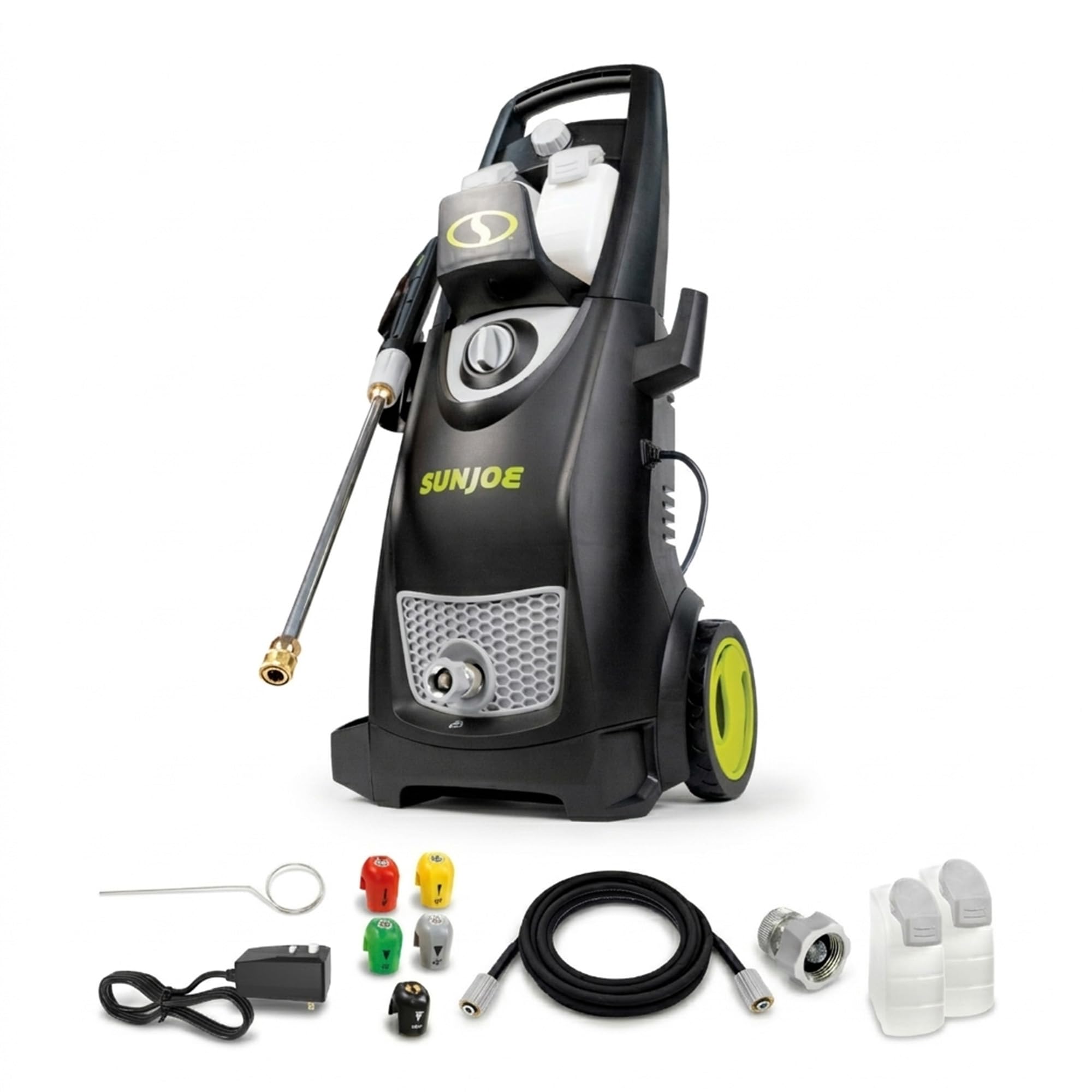
The Sun Joe SPX3000 has become a staple in the electric pressure washer category, delivering 2030 PSI working pressure and 1.2 GPM from a 14.5-amp motor. Its distinguishing feature is the dual 0.9-liter detergent tank system — you can fill one with degreaser for concrete and the other with car soap, then switch between them with a twist of a dial. This eliminates the need to drain and refill between tasks.
The 34-inch stainless steel lance and brass fittings provide corrosion resistance, and the five quick-connect nozzles (0°, 15°, 25°, 40°, and soap) give precise spray control. The 20-foot hose and 35-foot power cord offer average reach, but the unit’s 24-pound weight and integrated handles make it relatively easy to carry. Sun Joe backs it with a 2-year warranty, and the replacement parts ecosystem (O-rings, nozzles, hoses) is widely available online.
Long-term owners report the SPX3000 lasting 5 to 7 years with proper care — key maintenance includes removing nozzles after each use to prevent clogging and occasionally reseating the water inlet O-ring if leaks develop. The stiff 20-foot hose is the most common complaint, as it tends to hold a coil shape and resist laying flat. Some users also wish the high-pressure hose were longer for larger properties.
What works
- Dual detergent tanks for instant switching between cleaning solutions
- Dependable 2030 PSI performance for general home and auto cleaning
- Proven long-term durability — many units run reliably for 5+ years
What doesn’t
- Stiff 20-foot hose is hard to roll and tends to kink
- Front water connection can leak without periodic O-ring maintenance
- Large GFCI plug may block other outlets on a power strip
7. Greenworks GPW903A (1900 PSI)

The Greenworks GPW903A delivers 1900 PSI and 1.2 GPM, putting it squarely in the light-duty residential class. It’s designed for straightforward tasks: washing cars, trucks, boats, patio furniture, decks, and windows. The 35-foot power cord is generous for the price tier, and the 20-foot tangle-free hose is more flexible than the budget-level rubber hoses many competitors use. The push-button start eliminates the fuss of priming or pulling a cord.
Accessories include a gun, three nozzles (25°, 40°, turbo), and a soap applicator, all using a 1/4-inch universal quick-connect system. The unit is SGS certified and covered by a 3-year limited warranty — longer than many similarly priced machines. At just over 21 pounds, it’s light enough to carry up a flight of stairs or load into the trunk of a car for off-site cleaning.
Owner feedback is overwhelmingly positive for the price point — users describe it as quiet, easy to move, and powerful enough for mildew removal on siding and algae on concrete fences. The primary limitation is the 1.2 GPM flow rate, which makes rinsing larger areas like a full driveway slower than higher-GPM units. A few users also note that the wand assembly can feel slightly short for cleaning ground-level surfaces without stooping.
What works
- Excellent value for routine car, furniture, and light concrete cleaning
- Long 35-foot GFCI power cord for extended reach
- Lightweight and compact — easy to carry and store
What doesn’t
- 1.2 GPM flow rate slows down large-area rinsing
- Wand length can require stooping for ground-level work
- Not powerful enough for heavy-duty paint stripping or deep concrete etching
8. EGO Power+ HPW2100

The EGO HPW2100 is a battery-powered pressure washer that delivers up to 2100 PSI at 1.2 GPM, but unlike the flagship HPW3204-2, this model is tool-only — you supply your own EGO 56V ARC Lithium battery. For existing EGO Power+ owners (with mowers, blowers, or trimmers), this is the most cost-effective way to add a pressure washer to your arsenal. It connects to a garden hose or draws water from any fresh source via the included siphon hose.
The compact design weighs 18 pounds (without battery) and includes a built-in handle for easy transport. The accessory set is generous: a 25-foot high-pressure hose, siphon hose, quick-connect gun, stainless steel wand, foam cannon, and four nozzles (15°, 25°, 40°, turbo). Quick-connection points on the hose and wand make setup and breakdown fast. EGO backs the tool with a 5-year limited warranty.
Users appreciate the portability and the ability to reach remote areas without dragging an extension cord. A 6.0Ah battery provides roughly 30 minutes of runtime, which is enough for a car wash or light patio cleaning. The main trade-off is battery life — heavier tasks drain the battery faster, and you’ll want a spare for larger jobs. Some owners also add a brass quick-connect fitting to the water inlet for a more secure hose attachment.
What works
- Extremely portable and cordless — ideal for remote or multi-level cleaning
- Siphon hose allows operation from a bucket or lake without a garden hose
- Compatible with all EGO 56V batteries for existing Power+ users
What doesn’t
- Battery and charger sold separately — adds significant cost for new users
- Battery runtime is limited; extended jobs require spare batteries
- Lower maximum PSI than some corded options at a similar total investment
9. Ryobi RY141612

The Ryobi RY141612 is a lightweight, entry-level pressure washer delivering 1600 PSI at 1.2 GPM. It’s designed for quick residential tasks where a garden hose just isn’t enough — cleaning a car, rinsing a boat, sprucing up a small patio, or removing spider webs from eaves. The unit weighs just 16.4 pounds and measures about the size of a small tool box, making it trivial to store in a closet or car trunk.
The 25-foot hose is longer than many budget machines, and the spray wand uses a quick-connect coupler so you can swap to standard pressure washer tips. Ryobi’s One+ ecosystem compatibility means you can share attachments with other Ryobi tools if you have them. The 1.2-gallon detergent tank is built into the frame, providing a steady supply of soap for vehicle washing without constant refills.
Customers find it effective for light maintenance — one user reported cleaning a two-story vinyl house of mold and mildew in about three hours. The biggest strength is its portability and zero-maintenance electric motor. The downsides are predictable at this spec level: 1600 PSI won’t strip paint or etch concrete, and the 2-foot wand stem feels awkward for ground-level work. A few owners also note difficulty registering the product on Ryobi’s website for warranty purposes.
What works
- Ultra-lightweight and fits in tight storage spaces
- 25-foot hose is generous for its size class
- Effective for car washing, mold removal, and light patio cleaning
What doesn’t
- 1600 PSI is underpowered for concrete or heavy-duty grime
- Short wand stem requires stooping for ground-level cleaning
- Warranty registration can be cumbersome through the manufacturer’s site
Hardware & Specs Guide
PSI (Pounds per Square Inch)
PSI measures the force of the water stream. For electric pressure washers, 1600-1900 PSI handles car washing and light patio cleaning, 2000-2300 PSI tackles concrete driveways and mildew-stained siding, and 2500+ PSI can strip paint and deep-clean heavily soiled surfaces. Higher PSI with a narrow 0° or 15° nozzle can damage wood and soft surfaces — always test an inconspicuous area first.
GPM (Gallons per Minute)
GPM measures how much water flows through the nozzle. This is often the overlooked spec — a high GPM rinses soap and dislodges debris faster. For example, a 2.0 GPM unit can wash a driveway in roughly half the time of a 1.2 GPM unit at the same PSI. Look for at least 1.2 GPM for general use and 1.75 GPM or more if you regularly clean large areas or concrete.
Pump Types and Durability
Most residential electric pressure washers use axial cam pumps — they’re affordable and adequate for occasional use but wear faster under heavy loads. Wobble-plate pumps offer slightly better longevity at a similar price point. Premium models with 3- or 5-piston pumps run with less vibration and last significantly longer, making them the better choice for users who clean multiple times a month. Always let the pump cool between extended trigger pulls.
Nozzle Selection and Safety
Quick-connect nozzles change the spray pattern: 0° (pinpoint jet — use only on metal or concrete), 15° (paint stripping), 25° (general heavy cleaning), 40° (car washing and rinsing), and soap (low-pressure detergent application). Turbo/carbo nozzles rotate the stream in a cone pattern for concentrated scrubbing power. Never use a narrow nozzle on skin, pets, or soft surfaces — the pressure can cause serious injury.
FAQ
Can an electric pressure washer be as strong as a gas model?
What size electric pressure washer do I need to clean a concrete driveway?
How do I prevent leaks at the water inlet connection?
Final Thoughts: The Verdict
For most gardeners and homeowners, the best rated electric pressure washer winner is the Westinghouse WPX2300e because its 2300 PSI, induction motor, and steel frame deliver gas-like power at a reasonable cost. If you want cordless convenience and already own EGO batteries, grab the EGO HPW2100. And for high flow rate and smooth 5-piston pump performance, nothing beats the CAT 5-Piston.