
That scratching sound in the wall at 2 AM is a precision operator with a singular mission: raid your pantry without a single squeak. A rat’s neophobia makes it deeply suspicious of anything new placed in its path, meaning a cheap, poorly designed trap often gets sidestepped entirely—or worse, looted for its bait. The margin for error is razor-thin: you get one or two nights to prove your trap is more convincing than the food source.
I’m Rikta — the co-founder and writer behind Lawn Gear Lab. I’ve spent dozens of hours reading internal mechanical diagrams, studying rodent behavior patterns from entomology reports, and cross-referencing thousands of verified owner accounts to determine which kill mechanisms, trigger sensitivities, and bait-well designs actually overcome a rat’s survival instincts.
Whether you need a set-it-and-forget-it station for an infested barn or a high-voltage zapper for a persistent garage intruder, finding the best rat trap means matching the tool’s engineering to the specific level of rodent pressure you are facing.
How To Choose The Best Rat Trap
A trap that a rat refuses to touch is just expensive landfill. The decision breaks down into three areas: the kill mechanism’s reliability, the bait presentation’s ability to force a full commitment, and the trap’s placement versatility relative to your specific infestation level.
Trigger Sensitivity and the Baited Commitment
A Norway rat can weigh over 500 grams, yet a clever feeder can steal bait from a poorly designed pedal without springing the trap if the activation force threshold is too high. Look for traps with an oversized trip pedal or a bait-well that physically forces the rodent to stand its full weight on the trigger plate before reaching the food. The Victor M144’s recessed bait cup is a prime example of this engineering principle.
Jaw Design and Dispatch Speed
A trap with wide, flat jaws risks merely pinning a rat, while a serrated or scissor-style jaw concentrates force to achieve a precise cervical spine severance. The Bell Labs Trapper T-Rex uses a compression-style jaw with serrated teeth that lock into place, reducing the chance of a non-lethal blow. If the trap is going indoors where sound matters, prioritize a design that guarantees an instantaneous kill.
Outdoor Durability vs. Indoor Stealth
Traps placed under a deck or in a damp crawlspace face a different set of stresses than those set under a kitchen sink. Electric traps like the OWLTRA OW-7 require an IPX4 waterproof cover and dry elevation to function safely, while all-snap metal traps from Victor handle moisture far better but may rust over time. Bait stations protect poison blocks from rain, but they only work if the rat actually consumes the bait.
Quick Comparison
On smaller screens, swipe sideways to see the full table.
| Model | Category | Best For | Key Spec | Amazon |
|---|---|---|---|---|
| Victor M144 Power-Kill | Snap Trap | High catch rate, versatility | Recessed bait cup design | Amazon |
| Bell Labs Trapper T-Rex | Snap Trap | Serrated jaw power | Auto-set compression jaw | Amazon |
| OWLTRA OW-7 2-Pack | Electric Zapper | Hands-off, outdoor use | IPX4 waterproof, 11″ interior | Amazon |
| NAMEK 12-Pack Large | Snap Trap | Bulk coverage, low cost | Large clamp plate + reinforced spring | Amazon |
| Victor Metal Pedal M201 | Snap Trap | Classic reliability | True metal pedal trigger | Amazon |
| Catchmaster Max-Catch 36pk | Glue Board | Non-toxic indoor monitoring | 36 boards, pesticide-free | Amazon |
| Anblak Mouse Station 6-Pack | Bait Station | Pet-safe bait housing | Keyless + key locking design | Amazon |
In‑Depth Reviews
1. Victor M144 Instant Power-Kill Easy Set Rat Trap

The Victor M144 solves the single biggest problem snap traps face: bait-stealing. Its built-in recessed bait well forces a rat to stand fully on the oversized trip pedal to reach the food, eliminating the “lick-and-run” behavior that renders flat-pedal traps worthless. The one-click setting mechanism also reduces the risk of accidental snaps during setup, a major irritation with traditional bare-spring models.
With a clean track record of over thirty kills reported in active infestations, the high-impact kill bar delivers cervical separation on the first strike when positioned correctly. The six-pack covers enough ground for a moderate attic or garage setup. The mounting holes are a meaningful detail—allowing you to secure the trap to a pipe or beam where rats travel rather than hoping they wander across a floor model.
Some users report the trap requires a slightly firm squeeze to set, which can be difficult for arthritic hands. And while the bait cup is effective, the plastic construction of the pedal can feel less robust than a vintage all-metal Victor. Still, for the balance of engineering precision and catch rate, this is the most well-rounded trap on the list.
What works
- Recessed bait cup forces rats to fully engage the pedal
- One-click safety setting reduces finger snaps
- Oversized trip pedal catches skittish feeders
What doesn’t
- Plastic components may wear faster than metal versions
- Setting mechanism requires moderate hand strength
- Gruesome disposal if kill isn’t instantaneous
2. Bell Labs Trapper T-Rex Rat Trap

The Trapper T-Rex is the trap professionals reach for when wooden classics have failed. Instead of a single snap bar, this uses a wide, serrated compression jaw that clamps down on the rodent’s neck and upper torso, delivering a kill that is both brutal and mercifully fast. The “auto-set” mechanism is a genuine engineering win—you pull the jaw back, and a one-way locking tab holds it in place without fighting a spring.
Bait placement is clever: a deep cup sits below the trigger platform, forcing the rat to step fully onto the sensor plate to reach the peanut butter or bacon. This “hind-leg” stance buys an extra fraction of a second but makes the rat commit its full body weight. Multiple owner reports confirm that rats that avoided Victor wooden traps for weeks were caught within the first night with the T-Rex.
The drawbacks are minor but real. The trap has a large footprint, making it hard to wedge into tight crevices behind appliances. And while it is reusable, the manufacturer advises against washing the trap—throwing it away or reusing it uncleaned is the recommended approach, which feels wasteful to some.
What works
- Auto-set feature simplifies setup dramatically
- Serrated jaw provides high-percentage kill rate
- Bait cup design prevents bait theft
What doesn’t
- Large size limits placement options in tight spaces
- No instruction manual included in the box
- Cleaning the trap is not recommended after a catch
3. OWLTRA 2 Pack OW-7 In-/Outdoor Electric Rodent Trap

The OWLTRA OW-7 is the most hands-off option in this guide, offering an electrostatic plate that delivers a lethal shock when the rodent completes the circuit. The IPX4 rating with the included waterproof cover makes it genuinely usable outdoors, unlike many electric traps that fail in damp conditions. The entrance aperture is 2.6 inches wide—too small for most cats and small dogs, which addresses a major safety concern for pet owners.
With two ways to power it (4 D batteries or a USB cord), you can keep it running indefinitely in a high-pressure zone. The sound and light alarm is a practical touch: instead of checking the trap daily, you get an immediate notification when a rodent is caught. Over 130 kills have been reported with a single two-pack over two months. The large bait compartment makes re-baiting less fiddly than refilling a tiny cup.
However, this trap demands patience. Most users report a 3-to-8-day acclimation period before rats approach it. Using a strong-smelling bait like beef stick coated in peanut butter near the entrance accelerates acceptance. The battery compartment can be vulnerable to melting if left in direct, intense sun—placement under a shaded eave or inside a structure is best.
What works
- Hands-off operation with audible/visual kill alerts
- IPX4 rating allows secure outdoor placement
- Large bait compartment reduces frequent re-baiting
What doesn’t
- Requires several days for rats to trust the tunnel
- Battery compartment can degrade in direct heat
- Needs dry, elevated surface for safe operation
4. NAMEK 12-Pack Large Rat Traps
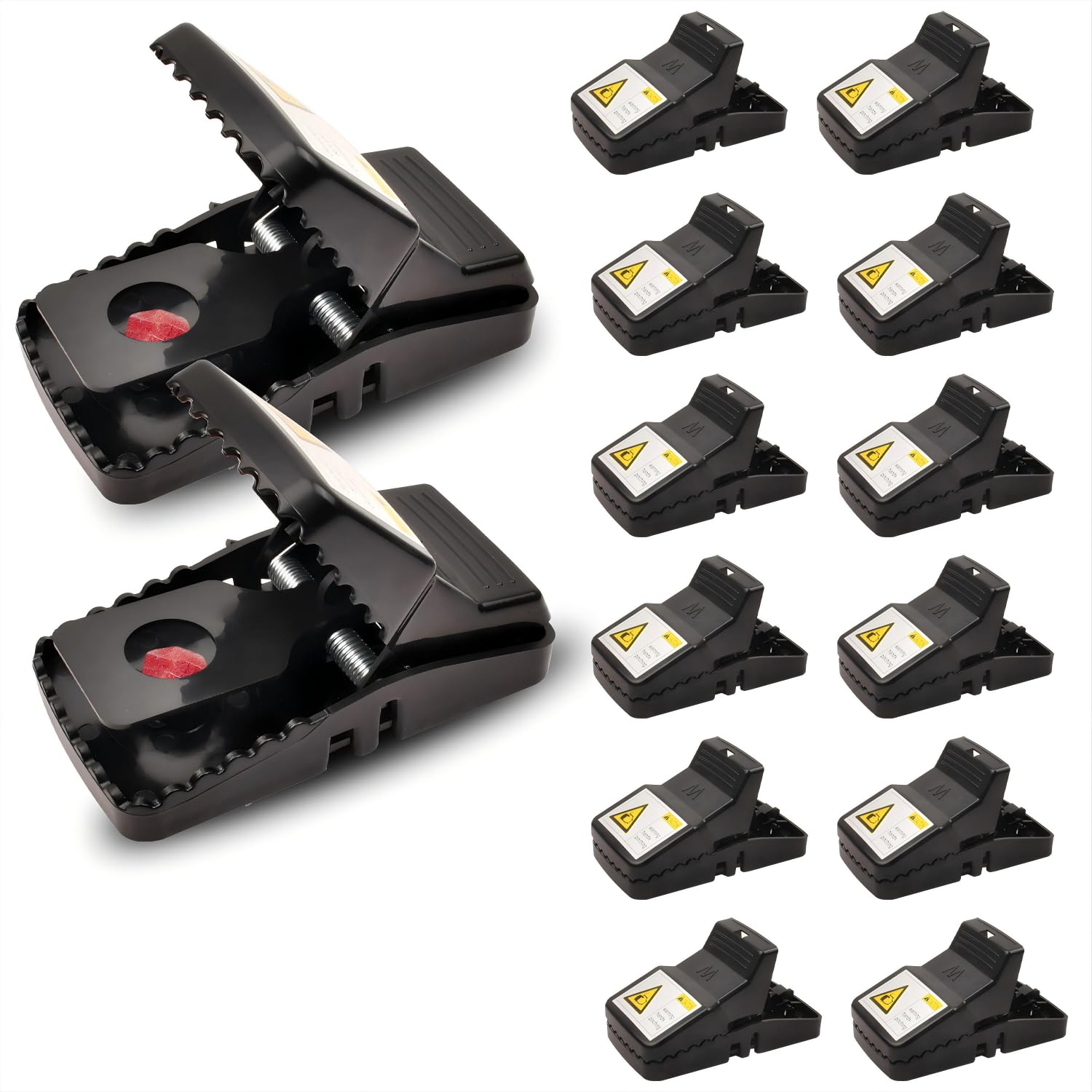
The NAMEK 12-pack takes the classic snap-trap formula and improves it with a wide clamping plate and a reinforced spring that generates more compressive force than the typical wooden Victor. This means a higher likelihood of a clean kill on large Norway rats rather than a painful wound that lets the animal escape. The ABS plastic body is resistant to outdoor moisture and doesn’t warp like wood-based traps do after a rain.
The trigger area is deliberately oversized, which actually increases the chance of a catch when placed in rodent runways. Multiple owners report that rats chose the NAMEK over older wooden traps left in the same location—likely because the larger plate area reduces the pressure needed to fire the mechanism. The 12-piece count is ideal for saturating a barn or crawlspace during an initial knockdown.
On the downside, the plastic hinge points can fatigue after many reuses, and the kill bar assembly is not as refined as premium brands. Some users also noted that the traps can be difficult to arm without placing fingers near the strike zone, though most found the safety tab adequate after a short learning curve.
What works
- Large clamping plate covers more strike area
- Reinforced spring delivers strong compressive force
- Bulk 12-pack provides complete coverage for large areas
What doesn’t
- Plastic hinge may wear out with repeated reuse
- Setup requires careful finger placement
- Some units may have inconsistent trigger sensitivity
5. Victor Metal Pedal Rat Trap M201 (3-Pack)

Some things don’t improve with reinvention. The metal pedal stays flat and maintains consistent trigger sensitivity after multiple settings, which is critical for catching suspicious bait-shy rats.
The three-pack is the perfect size for a single-rodent incursion: one trap in the suspected entry point, one in the high-traffic run, and one for backup. Users consistently report a close to 90% catch rate when baited with peanut butter and set perpendicular to the wall. The small footprint slides easily into gaps behind refrigerators or under low decks where larger plastic traps cannot go.
The single biggest complaint is the primary predator of the M201: the plastic pedal version. Some sellers ship the plastic-pedal variant under the same listing despite the “metal pedal” title, leading to traps that fail to hold their tension or warp during summer heat. Buyers should verify they receive the metal version or expect a return.
What works
- Proven metal pedal maintains reliable trigger sensitivity
- Compact design fits in tight spaces
- Simple construction with few failure points
What doesn’t
- Risk of receiving plastic pedal version from some sellers
- Wooden base can absorb odors over time
- No bait well requires creative placement
6. Catchmaster Max-Catch Mouse & Insect Glue Trap 36pk
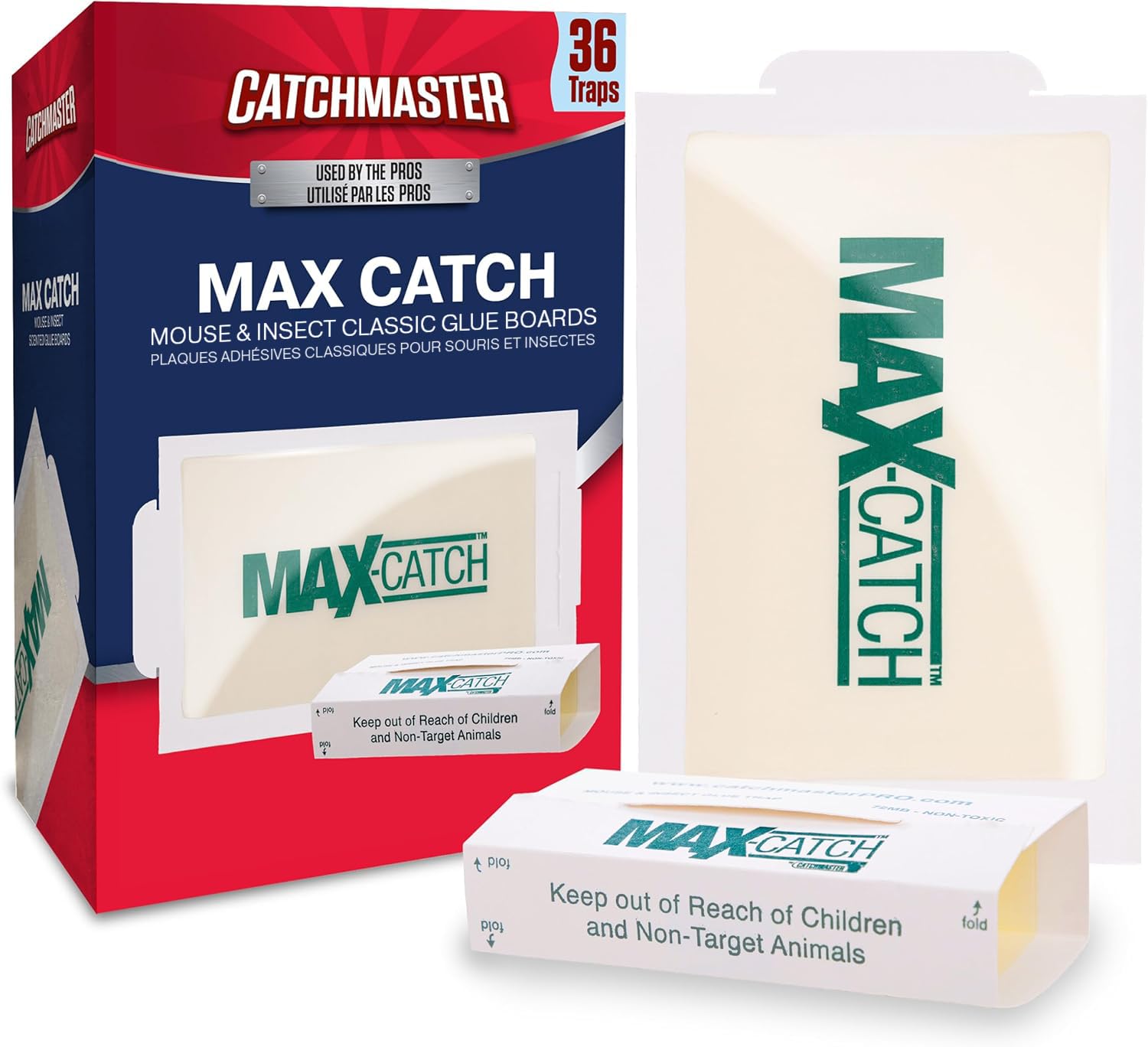
The Catchmaster Max-Catch is not a kill trap—it is a glue board designed to capture rodents alive through adhesive entrapment. As a non-toxic monitoring tool, it excels. The 36-pack offers enormous coverage: line them along baseboards in a basement or attic and you can quickly identify problem areas without poisoning pets or non-target wildlife. The traps are also effective for catching insects, making them a dual-purpose tool.
The boards are unscented and pesticide-free, which is important for homeowners concerned about chemical exposure. The peel-and-place design is straightforward: remove the paper cover and put the tray against the wall where you see droppings. The adhesive remains effective for up to one year in normal indoor conditions, allowing long-term monitoring without frequent replacement.
Glue boards are controversial for a reason. They are not instantaneous, and trapped rodents may struggle for hours before dying of exhaustion or exposure—a reality that many owners find deeply inhumane. Cleanup is unpleasant: you must deal with a glued rat that is still alive. These traps also lose tackiness in high humidity, reducing effectiveness in basements or damp crawlspaces.
What works
- Huge 36-pack covers large areas affordably
- Pesticide-free and safe around food storage
- Effective for monitoring rodent pathways
What doesn’t
- Inhumane—trapped rodents die slowly
- Adhesive weakens in humidity or damp conditions
- Requires manual dispatch of live-caught rodents
7. Anblak Mouse Stations with Keys 6 Pack

The Anblak stations are bait boxes—they secure poison blocks or snap traps inside a sealed plastic housing to prevent children and pets from accessing the toxic bait. The double-locking system offers both a keyless press-button release and a traditional key unlock, giving you flexibility depending on the location. The ABS plastic construction resists UV degradation, making them suitable for year-round outdoor placement near a chicken coop or garden shed.
The compact footprint (4.72 inches long) fits into tight spots under porches or between deck slats. The internal cavity is designed for standard 1-1/8 inch bait blocks, which aligns with most major rodenticide brands. Users report that the low-profile black design blends into surroundings better than bright bait stations, helping keep them unnoticed by both rodents and neighbors.
The primary limitation is size: these are genuinely mouse stations, not rat stations. The interior dimensions are too small for large rat bait blocks or for containing a full-sized snap trap. If your target is Norway rats, look for a dedicated rat station with taller clearance. Additionally, the plastic tabs that hold the lid closed can snap off if forced, reducing weather resistance over time.
What works
- Dual locking system keeps children and pets safe
- UV-stable ABS plastic withstands outdoor conditions
- Compact, discreet design fits under overhangs
What doesn’t
- Too small for standard rat bait blocks
- Plastic locking tabs are fragile if over-torqued
- Not a trap—requires separate bait blocks
Hardware & Specs Guide
Trigger Plate Sensitivity
The fundamental metric separating an effective snap trap from a bait-thief is the force required to spring the mechanism. Premium models like the Victor M144 and Bell Labs T-Rex engineer their trigger plate to fire at less than 50 grams of downward pressure. Cheaper traps often require 150 grams or more, allowing a cautious rat to extract peanut butter without committing. Look for an oversized trip plate or a recessed bait well—both designs mechanically force the rodent’s full weight onto the sensor.
Jaw Strike Force
The kill bar’s velocity and surface area determine whether the strike is fatal. Traditional wooden traps generate roughly 8–12 foot-pounds of force at the jaw. The reinforced springs on models like the NAMEK 12-pack bump that number to around 20 foot-pounds, which is enough to sever the cervical vertebrae of a full-grown Norway rat. Electric traps bypass mechanical force entirely, delivering 4,000–6,000 volts with milliamperage low enough to be safe for pets but lethal for rodents.
FAQ
Do rat traps lose their effectiveness after the first kill?
Should I use glue boards inside a home with pets?
What bait works best for triggering a rat trap?
Final Thoughts: The Verdict
For most gardeners and homeowners dealing with a confirmed rat incursion, the best rat trap winner is the Victor M144 Power-Kill Rat Trap because its recessed bait cup and one-click safety set deliver the highest first-night catch rate. If you need a trap that can handle brutal pressure in a barn or attic, grab the Bell Labs Trapper T-Rex for its serrated jaw and auto-set mechanism. And for a completely hands-off outdoor solution that alerts you to each kill, nothing beats the OWLTRA OW-7 Electric Zapper.