
Specs are compiled from manufacturer listings and verified buyer reviews and can change over time — please confirm the key details on the product page before buying.
Mulch is awkward stuff. A standard leaf rake just skims the top, while a flimsy bow rake bends its tines the second you try to spread a heavy pile.
I am Rikta, founder of Lawn Gear Lab. This guide compares published specs and patterns from verified customer reviews, so you get each pick’s real strengths and trade-offs instead of marketing spin.
Whether you are refreshing a flower bed or covering a whole garden, the right rake for mulch saves your back and keeps the work moving fast — so you finish before the sun gets too high.
Quick Picks
- Bully Tools 14-Tine Level Head Rake — Best Overall
- Bully Tools Bow Rake 16″ Tines — Top Performer
- Nohovu Garden Rake – 14 Tine Heavy Duty — Premium Pick
- DIIG 63” Bow Rake, 17 Tines Metal Head — Versatile Pick
- INFLATION Heavy Duty Leaf Rake (65” Adjustable) — Budget Champion
- LLARGUEST Bow Rake, 17 Prongs (63” Adjustable) — Budget Pick
How To Choose The Best Rake For Mulch
Focus on head shape, handle length, and steel gauge to pick the right rake the first time.
Head shape and tine count
A bow rake (the classic arched-head design) works well for breaking up clumps and spreading heavy loads, while a level-head rake (a flat, straight head) gives you a smooth, even finish on top. For mulch, you want at least 14 tines spaced close enough to move material without leaving deep grooves behind.
Handle length and material
A 58-inch or longer handle keeps you standing upright, which saves your lower back when you are moving beds of mulch around a yard. Fiberglass handles resist weather and splintering far better than wood, and they stay stiff under pressure without twisting.
Steel gauge and build quality
Thicker steel means the tines will not bend sideways when you hit a buried rock or a patch of compacted soil. Look for terms like “10-gauge” or “high carbon steel” and welded (not just bolted) joints where the head meets the handle bow — that connection takes the biggest strain.
Quick Comparison
| Model | Best For | Head Width | Handle Length | Weight | Amazon |
|---|---|---|---|---|---|
| Bully Tools 14-Tine Level Head | Smooth leveling & finish work | 16 inches | 60 inches | 3.35 lbs | Amazon |
| Bully Tools Bow Rake | Heavy-duty spreading & tough soil | 16 inches | 58 inches | 3.5 lbs | Amazon |
| Nohovu Garden Rake | Durable one-piece build | 14 inches | 58 inches | 3.2 lbs | Amazon |
| INFLATION Leaf Rake | Light duty & adjustable length | 18 inches | 65 inches (adjustable) | — | Amazon |
| DIIG Bow Rake | Two-sided versatility | 17 inches | 63 inches (adjustable) | 1.75 kg (~3.86 lbs) | Amazon |
| LLARGUEST Bow Rake | Budget pick for rock & soil | 16 inches | 63 inches (adjustable) | 1 lb | Amazon |
In‑Depth Reviews
1. Bully Tools 14-Tine Level Head Rake

The flat-headed finisher that turns a pile of mulch into a picture-perfect bed
The 14 tines on this Bully Tools level head rake are spaced wide enough to let dirt and small rocks fall through while they push the mulch forward in an even layer. You pull it, and it levels — no gouging, no raking the same spot twice. The head is 16 inches wide and made from alloy steel, giving you good coverage per pass without making the tool unwieldy.
The 60-inch fiberglass handle keeps you standing upright, saving your lower back even after spreading yards of material. It weighs just 3.35 pounds, which is noticeably lighter than some heavy bow rakes, but it still feels solid in the hand. Reviewers report it handled crushed rock and rooted vines without bending or loosening — one reviewer noted it “outperformed three previous rakes.”
It is 100% made in the USA with a limited lifetime warranty, unusual at this price.
The smooth finisher: For anyone who wants a flat, even mulch bed without digging ruts into the soil underneath — this is the tool. The level head design simply does a cleaner job than a curved bow rake for this specific task.
One caveat: The 14 tines are slightly wider-spaced than a leaf rake, so very fine or shredded mulch might slip through more than you expect. It is fast, but you may need an extra pass for perfection.
Reach for this if you want a single tool that spreads, levels, and finishes mulch without leaving ruts. It is the best all-around choice for most yards.
Look elsewhere if you need to break up hard, rocky soil first — a bow rake with digging tines would be a better first pass before this level head finishes the job.
2. Bully Tools Bow Rake 16″ Tines
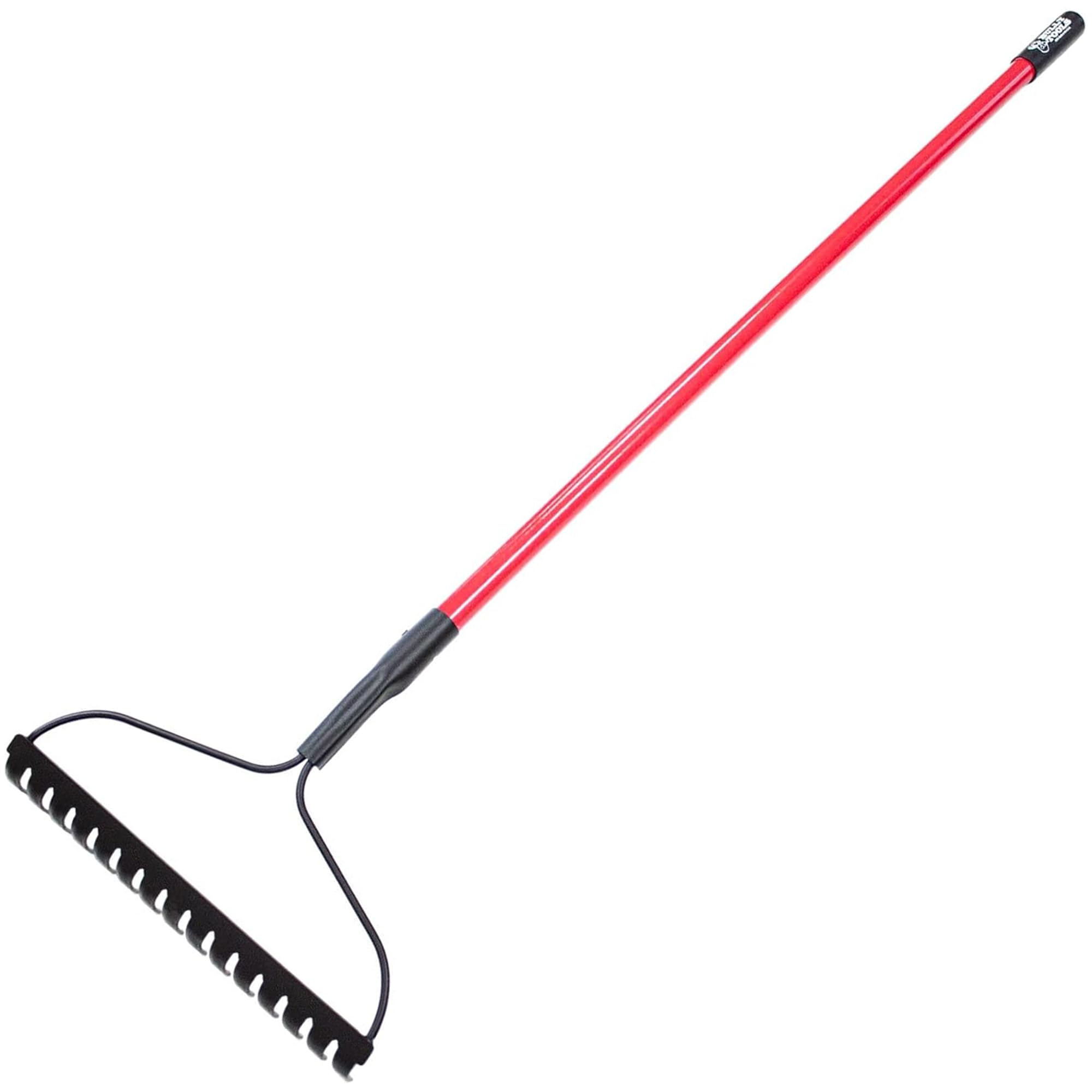
Where the level-head rake above is a finisher, this bow rake is the first tool you grab when you need to break down big clumps of old mulch or spread a heavy load of fresh material across a wide area. The 16 tines are made from 10-gauge steel — the manufacturer claims it is up to 30% more durable than foreign competitors. The head is 16 inches wide, standard for solid coverage.
The fiberglass handle is 58 inches long, and the rubber grip reduces hand fatigue when you are leaning into rough work. This rake weighs 3.5 pounds, which is heavier than some alternatives, but that weight translates into real digging power. One buyer mentioned the teeth dig in well and can tear tough vegetation — but the same buyer cautioned that it requires gentle use for delicate tasks because it is so aggressive. The head has robotically overwelded connections and ribbed teeth that add structural strength where normal bow rakes snap.
Unlike the Nohovu below, the head is not one-piece, so it does require a few minutes of assembly with a Phillips head screwdriver, but buyers report it takes under a minute. It is 100% made in the USA.
Built to hammer
- 10-gauge steel head is noticeably thicker than budget rakes — owners mention it survives drops and weather without bending
- Ribbed tines and reinforced ridges give extra digging power against compacted soil
- Rubber grip stays comfortable even when your hands are sweaty
The trade-off
- Weighs 3.5 lbs — heavier than most, and customers note it requires a gentle touch for delicate finish work
- The 58″ handle is slightly short for users over 6 feet tall, according to one review
Best for the heavy-lifting stage: If your mulch pile is rock-hard or mixed with gravel, this bow rake breaks it up and spreads it fast. The steel is overbuilt and the handle will not splinter.
Not the one for perfect final-leveling of a flower bed — that job belongs to a level-head rake like the Bully Tools model above.
3. Nohovu Garden Rake – 14 Tine Heavy Duty

The one-piece rake that skips assembly and jumps straight to work
Most bow rakes arrive in three pieces that you screw together — the Nohovu arrives fully assembled with an integrated handle that does not detach. That single-piece fiberglass handle eliminates the wobble and looseness that often develop at the threaded joints of adjustable rakes. The handle is 58 inches long, giving you the same standing posture as the Bully Tools models while weighing 3.2 pounds, a touch lighter than the Bully Bow Rake at 3.5 lbs.
The head is 14 inches wide — smaller than the 16-inch heads on the Bully Tools rakes above, which means it covers slightly less ground per pass but gets into tighter spaces between plants. It is made from high carbon steel with an anti-rust coating. The tines are 14, and they are sharp enough to penetrate soil easily. Reviewers point out it is “solid, durable” and appeared “more sturdy than previous rakes that fell apart.” The double rivet connection between the handle and the head reduces the risk of the head detaching during heavy pulls, a common failure point on budget rakes.
Unlike the adjustable-length rakes later in this list, you cannot shorten the Nohovu for storage or child use — what you get is one fixed length. But for an adult doing regular yard work, that trade-off buys you a significantly stiffer, more reliable handle.
Grab-and-go simplicity: If you hate fiddling with threaded poles and want a rake that feels like a single solid tool rather than a collection of parts, this is the one. The high carbon steel head and riveted connection give it a premium feel.
The catch: The 14-inch head covers less ground than the 16-inch options. If you have a large area to cover, the extra width on the Bully Tools rakes will save you real time.
A strong choice for the gardener who values build quality and wants a ready-to-use tool straight from the start. The one-piece fiberglass handle is a real advantage for long-term durability.
skip it if you need maximum coverage speed for a huge yard — the 16-inch heads on the Bully rakes are faster per pass.
4. DIIG 63” Bow Rake, 17 Tines Metal Head

The two-sided rake that flips from claw to spreader in one move
The DIIG bow rake is built around a 17-tine, 17-inch-wide head — slightly wider and with one more tine than the 16-inch Bully rakes above. That extra inch of width means more material moved per pass. But the real standout feature is the dual-sided head: one side has a short claw (about 1 to 1.5 inches deep) for digging and breaking soil, and the other side has a regular rake (about 3 inches deep) for spreading and leveling. You flip the head over to switch functions.
The handle is made of stainless steel (the entire grip and shaft are stainless steel), and it is adjustable in length by unscrewing sections — you can go from a full 63-inch handle down to a kid-friendly short length. At 1.75 kilograms (about 3.86 pounds), it is heavier than the Nohovu or the Bully Bow Rake. Shoppers say the adjustable handle works well and that it handles “dry clay and rocks up to cantaloupe size.” One reviewer called it “the last rake you will buy.”
The triple-welded connection at the bow where the head meets the handle is meant to prevent the head from falling off under heavy use. The head is coated with an anti-rust and anti-corrosion coating, and the steel thickness is 3mm, which is on the thicker end for this price range.
Two tools in one
- 17-tine, 17-inch head is the widest in this guide — covers more ground per pull
- Flip-over head gives you a short claw for digging and a standard rake for spreading
- Adjustable stainless steel handle can be shortened for kids or storage
The drawbacks
- At about 3.86 lbs, it is the heaviest rake here — noticeable if you are working for hours
- The threaded handle joints can loosen over time (buyers report to follow the assembly instructions carefully)
Best for the multi-tasker: If you need one tool that digs, breaks clods, then flips to spread and level mulch, the dual-sided head makes this the most versatile rake in the lineup. The width also makes it fast for large areas.
Not ideal if you want the simplest, lightest tool — the adjustable handle and heavier weight make it more complex and tiring than a fixed-length rake.
5. INFLATION Heavy Duty Leaf Rake (65” Adjustable)
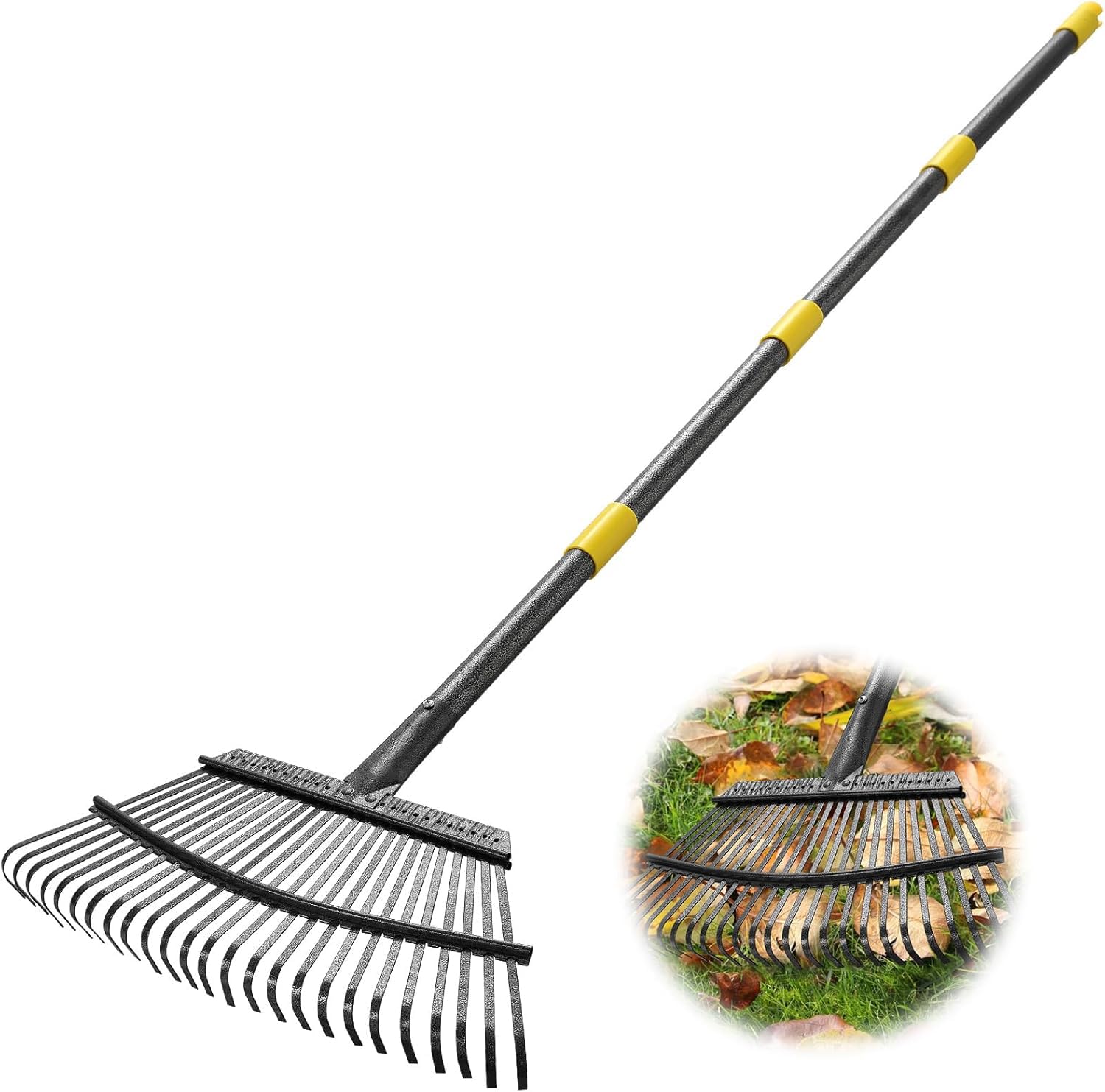
The cheap trick that works better than it should for light mulch spreading
This rake is technically a leaf rake — it has 25 thin metal tines spread across an 18-inch-wide head — but it earns a spot here because its tines are made of metal, not plastic, and it is genuinely sturdy for its price. The handle is made of alloy steel, and it is adjustable in length by adding or removing rod sections. You can go from a short 2-segment tool for a child all the way up to a full 65-inch handle. Owners mention it is “sturdy, lightweight” and “adjustable to child’s height.”
The large 18-inch head (18 inches wide by 65 inches long overall) covers more width than any other rake in this guide. That makes it fast for light work like spreading a thin layer of fresh mulch over existing beds. But the thin tines are designed for leaves and light debris — they will bend if you try to dig into compacted old mulch or pull heavy, wet material. The handle rods screw together, which is convenient for storage but can loosen during heavy use.
This is not a heavy-duty rake, but for the price it is a very functional tool for top-dressing beds and cleaning up light debris between seasons. Customers note it is “good for thatching, around bushes, delicate plants” — tasks where you do not want a heavy steel bow rake digging in too deep.
A fine budget option for light duty: If you are maintaining small beds or need a rake the whole family can use (thanks to the adjustable length), this works well. The 18-inch head is the widest here, making it fast for surface-level work.
Where it falls short: The thin metal tines cannot handle heavy, compacted mulch or soil. It is a leaf rake at heart, not a dedicated mulch tool. For serious spreading, step up to one of the bow rakes above.
Reach for this if you need a lightweight, adjustable rake for topping up beds and the heaviest work is pulling dry leaves. The price is right.
Look elsewhere if you are breaking up old, packed mulch or spreading heavy loads across a large area — the tines will flex and frustrate you.
6. LLARGUEST Bow Rake, 17 Prongs (63” Adjustable)

The cheapest bow rake that actually has 17 steel tines and a real handle
At this price point, most bow rakes are flimsy stamped metal that bends on the first rock. The LLARGUEST bow rake avoids that fate with a 16-inch-wide head and 17 steel prongs that hold their shape under normal use. The handle is metal (the grip is rubber) and adjustable in length by screwing or unscrewing sections, reaching up to 63 inches. Reviewers point out it is “heavy duty and perfect for rocks” and that the handle length adjustment is genuinely useful for different users.
However, there is a clear trade-off for the low price. The head is only 1 pound, compared to the Nohovu rake above which weighs 3.2 pounds and featherlight compared to the DIIG bow rake. That lack of weight means you have to push down harder to get the tines to bite into mulch or soil. Buyers confirm this: one review bluntly says “it works but it’s really heavy” (in terms of effort to use it, not actual weight), and another says it is “heavier than other rakes but digs in easily,” suggesting the user has to supply muscle the tool lacks on its own. The handle, while adjustable, is also not as stiff as the one-piece fiberglass handles on the premium picks, because it relies on threaded connections.
If your budget is tight and you only need to spread light mulch or loosen soil occasionally, this rake will get the job done. It also comes with a clear guard for safety during shipping.
The budget option works
- 17 steel tines on a 16-inch head give you real bow-rake coverage
- Adjustable handle (up to 63 inches) suits different heights
- Rubber grip is comfortable and the price is tough to top
The real limitations
- Extremely light at 1 lb — you have to push down to make the tines dig in
- Shoppers say it feels heavy to use even though the scale says 1 lb, because the user supplies all the weight
- Threaded handle joints can loosen during work
Best for the tight-budget gardener: If you need a functional bow rake for occasional use and cannot justify spending more, this one works. It spreads mulch and levels soil, but you will work harder for it.
Not for heavy daily work: The low weight and threaded handle mean it lacks the stiffness and bite of the Bully Tools or Nohovu rakes. Consider this a backup or starter tool, not a lifetime buy.
Understanding the Specs
Bow Rake vs Level Head Rake
A bow rake has curved tines attached to an arched metal frame, which gives it spring and digging power for breaking up clumps and pulling heavy material. A level-head rake has straight, flat tines set into a straight head — it moves material in an even sheet and leaves a smooth finish. For mulch, start with a bow rake to spread and break clumps, then switch to a level-head rake for the final even pass.
Handle Material and Length
Fiberglass handles (like the Bully Tools and Nohovu) resist weather, do not splinter like wood, and stay stiff under load — ideal for heavy work. Stainless steel handles (like the DIIG) are also durable but can be heavier. Length matters: a 58-60 inch handle lets you work standing upright, saving your lower back. Adjustable handles are convenient for storage and multi-user households, but the threaded joints can loosen over time compared to one-piece handles.
Steel Gauge and Tine Thickness
Thicker steel means the tines will not bend sideways under heavy loads. The Bully Tools bow rake uses 10-gauge steel, which is noticeably thicker than budget options. High carbon steel (like the Nohovu) is also strong and holds an edge well. For mulch work, you want at least 14 tines — fewer tines spaced widely will leave grooves, while too many thin tines (like a 25-tine leaf rake) will bend under the weight of wet material.
Weight and Balance
Heavier rakes (3.2 to 3.9 pounds) dig in with less effort from you because gravity does the work. Lighter rakes (1-2 pounds) require you to push down manually, which can fatigue your arms faster even though the tool feels light in the hand. The best balance for spreading mulch is around 3 to 3.5 pounds — heavy enough to bite in but light enough to swing for an hour without tiring.
FAQ
Can I use a leaf rake for mulch?
Bow rake or level head rake for mulch — which is better?
How wide should the rake head be for mulch?
What handle length is best for spreading mulch?
How many tines should a mulch rake have?
Is a heavier rake better for mulch?
Will a fiberglass handle outlast wood?
What is the difference between a 14-tine and 17-tine bow rake?
Are adjustable-length rakes worth it?
How do I prevent the rake head from falling off?
Final Thoughts: The Verdict
For the majority of shoppers, the rake for mulch winner is the Bully Tools 14-Tine Level Head Rake because the flat head gives you a smooth, even finish without digging ruts, and the 60-inch fiberglass handle saves your back. If you want a bow rake for heavier clumps and soil, grab the Bully Tools Bow Rake with its 10-gauge steel head and ribbed tines. And for a premium one-piece build with zero assembly, the Nohovu Garden Rake is a solid choice that will last for years.
How We Picked
We do not accept paid placement. Every pick is matched to a real buyer and a real use-case; we do not hands-on test units.
Sources & Methodology
Specifications: manufacturer listings and product documentation. Review insights: verified customer reviews, as of July 2026. Pricing: not shown on this page (it changes often); check the current price via the retailer link.
As an Amazon Associate, Lawn Gear Lab earns from qualifying purchases. This does not affect which products we feature.