
Quackgrass isn’t just an ugly weed; it’s an aggressive perennial grass that spreads through deep, white rhizomes, strangling your desirable turf and creating unsightly patches. One rogue clump can quickly colonize an entire garden bed or lawn section if you use the wrong spray or just try to dig it out.
I’m Rikta — the co-founder and writer behind Lawn Gear Lab. I’ve spent hundreds of hours dissecting herbicide labels, comparing active ingredient concentrations (like Mesotrione and Glyphosate), and analyzing owner feedback to separate the true quackgrass killers from the general weed sprays that fail against this tenacious invader.
This guide breaks down the exact chemistry and application strategies you need to finally eradicate quackgrass from your turf or landscape. Choosing the right quackgrass killer comes down to understanding systemic action rates and whether you need selective or non-selective control.
How To Choose The Best Quackgrass Killer
Selecting the right herbicide requires a clear strategy. Quackgrass is a perennial grass with underground rhizomes that can travel several feet, meaning any product that only burns the tops will leave the root system alive to regrow. You need a systemic herbicide that moves through the leaves into the rhizome network.
Active Ingredient: The Core Chemistry
The active ingredient is the most critical spec. For selective control in cool-season lawns (Fescue, Bluegrass, Ryegrass), Mesotrione is your primary weapon — it bleaches the quackgrass white and systemically kills it without harming the turf. For non-selective control in gardens or bare areas, Glyphosate (41% concentrate) is the heavy-duty standard. Products like Fluazifop-P-butyl (found in Hi-Yield and Fertilome grass killers) offer selective control around ornamentals but may need multiple applications.
Selective vs. Non-Selective Application
Knowing where you’re spraying determines the product type. If quackgrass is invading your Kentucky Bluegrass or Tall Fescue lawn, you must use a selective post-emergent like Mesotrione or a Fluazifop-based formula; non-selective Glyphosate will kill the lawn too. If the quackgrass is in a flower bed, driveway crack, or garden path, a non-selective concentrate (Glyphosate) is the correct choice because you want total vegetation kill.
Concentration and Coverage Area
Herbicide concentrates vary dramatically in strength and yield per bottle. A high-concentration Glyphosate (41%) in a 32oz bottle can mix to treat large areas but must be mixed precisely. Selective grass killers often come in small 8oz bottles that make 8-16 gallons of spray solution — covering significantly less square footage. Check the label’s “covers up to X square feet” metric, not just the bottle volume, to ensure you buy enough for your infestation size.
Rainfast Timing and Activation
Application timing directly influences kill success. Some products like Ortho GroundClear are rainfast in just 15 minutes. Others, like Mesotrione, require watering in within 10 days if no rain falls. Quackgrass is tough; you need the herbicide to fully absorb. Also, consider temperature — most selective grass killers work best when air temperatures are above 60°F and the grass is actively growing, not stressed by drought or heat.
Quick Comparison
On smaller screens, swipe sideways to see the full table.
| Model | Category | Best For | Key Spec | Amazon |
|---|---|---|---|---|
| Liquid Harvest Mesotrione | Selective | Lawn-safe quackgrass kill | Mesotrione 8oz concentrate | Amazon |
| Ortho GroundClear Super Concentrate | Non-Selective | Fast-acting hardscape paths | 41% Glyphosate 32oz | Amazon |
| Fertilome Over The Top Grass Killer | Selective | Bermuda & crabgrass control | Fluazifop 8oz concentrate | Amazon |
| Fertilome Weed Free Zone | Selective | Creeping Charlie & thistle | Dicamba 32oz concentrate | Amazon |
| Hi-Yield Grass Killer 8oz | Selective | Around garden vegetables | Fluazifop 8oz concentrate | Amazon |
| Control Solutions Eraser | Non-Selective | Budget total vegetation kill | 41% Glyphosate 32oz | Amazon |
| Hi-Yield Grass Killer 16oz | Selective | Large garden area coverage | Fluazifop 16oz concentrate | Amazon |
In‑Depth Reviews
1. Liquid Harvest Mesotrione

This Mesotrione concentrate is the closest generic alternative to the brand-name Tenacity, offering the same selective systemic action that targets quackgrass, crabgrass, and over 40 other weed species. The key differentiator is its bleaching mode of action — susceptible grasses turn white before dying, which provides clear visual feedback that the chemical is translocating into the rhizomes. Users report full desiccation of crabgrass and quackgrass in around 10 to 14 days when applied at the label rate.
Mesotrione works by inhibiting the HPPD enzyme, which blocks carotenoid production and essentially starves the weed of its photosynthetic protection. This makes it safe for established Kentucky Bluegrass, Tall Fescue, Perennial Ryegrass, Fine Fescue, and Centipede grass. Importantly, it is safe to overseed immediately after application, so you can repair bare spots right away. The pre-emergent activity also prevents new crabgrass seeds from germinating for several weeks.
The main catch is activation — the chemical needs 0.15 inches of rainfall or irrigation within 10 days, or it won’t fully activate in the soil. Some users noted slight discoloration or stunting on healthy turf if the rate is overlapped during spraying. Using a spray dye indicator helps avoid double-coverage. For anyone with a cool-season lawn who wants a quackgrass killer that won’t torch the turf, this is the standard.
What works
- Selective for most cool-season grasses; won’t kill your lawn.
- Pre-emergent and post-emergent activity in one product.
- Seed-safe; you can overseed immediately after application.
What doesn’t
- Requires precise watering-in within 10 days.
- Slower visible results compared to non-selective Glyphosate.
- Cannot use on Bentgrass, Zoysia, or Bermudagrass.
2. Ortho GroundClear Super Concentrate
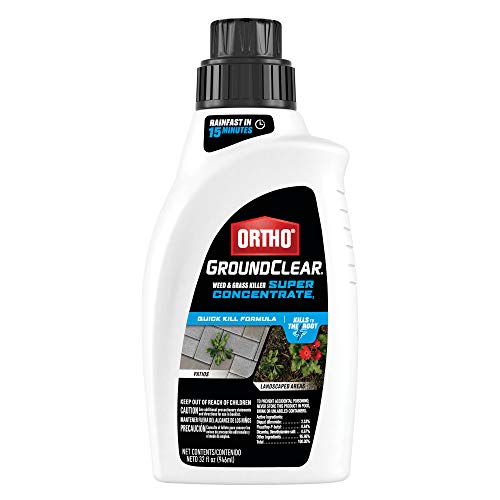
Ortho GroundClear is a non-selective, high-concentration Glyphosate (41%) formula designed for clearing entire areas of vegetation, including deep-rooted quackgrass, dandelion, clover, and crabgrass. The 32-ounce bottle mixes to cover up to 1,120 square feet, and users report visible wilting beginning within 24 to 48 hours. The standout spec here is the 15-minute rainfast claim — rain guaranteed within 15 minutes of drying ensures the chemistry stays on the leaf surface.
This is the right tool when quackgrass is growing in gravel driveways, sidewalk cracks, fence lines, or garden beds where you don’t care about killing surrounding vegetation. The systemic action is powerful; Glyphosate moves through the leaves down into the rhizome network, which is exactly what quackgrass requires for true eradication. Users mixing with a surfactant (like dish soap) report even faster results on mature clumps.
Because it is non-selective, even the smallest drift onto a desirable lawn grass will kill those blades. The concentrate must be mixed carefully — at the wrong ratio, it can be too weak to kill mature quackgrass. Several verified purchasers noted that adding a bit more concentrate than the label minimum dramatically improved performance on tough Silverleaf Nightshade and deep-rooted weeds.
What works
- Very fast visible results within 1-2 days on quackgrass.
- Excellent systemic translocation to kill rhizomes.
- Rainfast in just 15 minutes after application.
What doesn’t
- Non-selective; will kill any grass or plant it touches.
- Must be used carefully to avoid spray drift onto lawns.
- Some users report needing double-strength for woody perennials.
3. Fertilome Over The Top Grass Killer

Fertilome Over The Top Grass Killer is a selective post-emergent herbicide containing Fluazifop-P-butyl, which is specifically formulated to target grassy weeds without harming broadleaf ornamentals, shrubs, roses, and vegetable gardens. The 8-ounce bottle makes up to 8 gallons of spray solution, covering roughly 2,000 square feet. Users consistently report that it effectively kills Bermuda grass and crabgrass in flower beds within 2 to 3 weeks, though quackgrass may require a second application.
The active ingredient Fluazifop works by inhibiting acetyl-CoA carboxylase (ACCase) in grasses, which is an enzyme pathway that broadleaf plants do not rely on, which is why your daylilies and hostas remain unharmed. Many reviewers noted that adding a surfactant like Dawn dish soap markedly improves adhesion to waxy grass blades. The product stops visible growth within about 2 days, but the full systemic kill of the rhizome takes several weeks.
Performance drops significantly when grass is taller than 6 inches — the chemical may only stunt the top growth rather than kill the entire clump. Some users with mature patches of Bermuda grass required up to three applications spaced 10 days apart before seeing complete death. The small 8-ounce bottle does not go far, especially if you have a large area, and the price per ounce is higher than non-selective concentrates.
What works
- Selective for grasses; safe for shrubs, roses, and garden vegetables.
- Systemic action kills Bermuda and crabgrass rhizomes.
- Easy to mix concentrate with water and surfactant.
What doesn’t
- Tall grass over 6 inches may not fully die.
- Requires patience — results take 2-3 weeks.
- Small bottle size; expensive for large infestations.
4. Fertilome Weed Free Zone
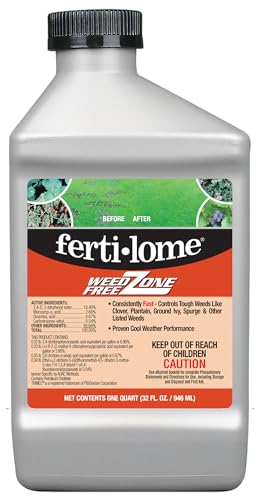
Fertilome Weed Free Zone is a selective broadleaf herbicide containing Dicamba and other active ingredients, formulated for use over lawn grasses including Kentucky Bluegrass, Bermudagrass, Zoysiagrass, and Bahiagrass. While it controls over 80 broadleaf weed species like clover, spurge, chickweed, thistle, and the notoriously difficult creeping charlie, it is critical to note that this product does NOT kill quackgrass or any other grassy weeds. It is included here as an essential companion product for overall lawn health after quackgrass is removed.
The chemistry provides rapid evidence of injury within hours of application — broadleaf weeds wilt, curl, and die within 5 to 7 days. Users battling creeping charlie specifically call this the only product that truly kills it overnight. The 32-ounce bottle is cost-effective for mid-sized lawns, and the concentrate mixes easily with water in a tank sprayer. Many reviewers found they needed to double the recommended dosage for stubborn clover, and adding Dawn dish soap improves leaf adhesion significantly.
Because Weed Free Zone is safe on Bermudagrass and Zoysiagrass, it is an excellent tool for maintaining a weed-free lawn surface after you’ve spot-treated quackgrass with a selective grass killer. However, some users noted it can harm sensitive ornamentals or flowers if drift occurs. The formula also works best when weeds are young and actively growing in spring or fall, rather than during summer heat stress.
What works
- Extremely effective on creeping charlie and thistle.
- Safe on most common lawn grass types.
- Visible damage begins within hours of application.
What doesn’t
- Does NOT kill quackgrass — grassy weeds only.
- May require double-strength for mature clover.
- Drift can damage flowers and ornamentals.
5. Hi-Yield Grass Killer 8oz
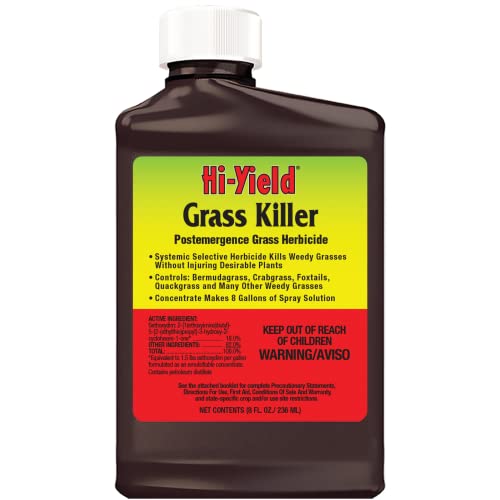
Hi-Yield Grass Killer (8oz) is another Fluazifop-P-butyl selective herbicide, aimed at gardeners who need to eliminate grassy weeds like quackgrass, tall fescue, and Bermuda grass without damaging their vegetable crops, trees, or ornamentals. The concentrate makes up to 8 gallons of spray solution, and the manufacturer claims growth stops within 2 days of application. Users confirm it effectively kills tall fescue in garden beds within a few days, with Vinca and other broadleaf ornamentals remaining completely unharmed.
The active ingredient targets the ACCase enzyme specifically found in grassy weeds. This makes it a safe option for spraying directly over established flowers, shrubs, and even vegetables as long as they are not grasses. The product works noticeably faster on Bermuda grass (yellowing within 4 days) compared to Japanese Stilt grass, which took up to 3-4 weeks to fully die. A surfactant (non-ionic or a drop of dish soap) is strongly recommended to help the concentrate stick to the waxy leaf surface of quackgrass.
The small 8-ounce bottle is the primary drawback — multiple users noted the bottle arrives not completely full and feels tiny for the price. Additionally, a minority of users reported zero effect after multiple applications over two weeks, which may indicate their particular grass strain or application timing was off. This is best used for targeted spot treatments, not blanket coverage.
What works
- Safe for use around vegetables and ornamental plants.
- Effective on tall fescue and Bermuda within days.
- Systemic kill prevents quick regrowth.
What doesn’t
- Very small bottle; not enough for large areas.
- Some users reported no results at all.
- Slow action on certain grass varieties like Stilt grass.
6. Control Solutions Eraser Concentrate
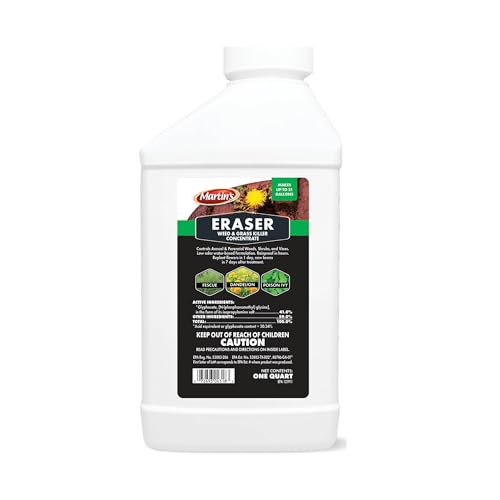
Control Solutions Eraser is a high-concentration (41%) Glyphosate formulation that delivers the same active ingredient as Roundup at a significantly lower cost per ounce. The 32-ounce bottle is a non-selective, water-based formula with low odor and no residual soil activity, making it safe to plant ornamentals and turf into treated areas once the chemical has dried and the weeds have died. Users consistently rate it 5 stars, with many reporting 17 years of repeat purchases for its reliability against poison ivy, vines, and all grassy weeds including quackgrass.
The recommended mixing ratio is 8 ounces of concentrate per gallon of water for general weed control. Because this is a non-selective killer, it will absolutely destroy any quackgrass clumps it touches, but it will also kill the surrounding lawn grass. The systemic action takes patience — users note no visible effect for the first 2 days, followed by yellowing between days 4-7, and full death between days 7-14. For woody weeds or poison ivy, a stronger mix (up to 12 oz/gal) is needed.
The instructions are notoriously sparse; the bottle does not include clear mixing guidelines, so first-time users may need to research best practices. Adding a surfactant is essential for best results, especially on waxy quackgrass leaves. While the price is very competitive, the slow systemic speed may frustrate those accustomed to fast-acting consumer brands. This is a heavy-duty, cost-effective solution for wholesale vegetation elimination.
What works
- Excellent price per ounce for high-concentration Glyphosate.
- Systemic action kills deep quackgrass rhizomes.
- Low odor, water-based formula.
What doesn’t
- Very slow visual results — takes 1-2 weeks.
- Poor labeling with minimal mixing instructions.
- Requires added surfactant for best results.
7. Hi-Yield Grass Killer 16oz
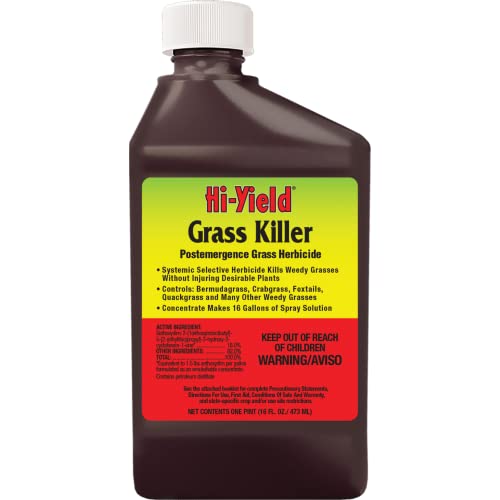
This is the larger 16-ounce bottle of the same Hi-Yield Fluazifop-P-butyl selective grass killer, designed for those who need to cover significantly more ground. While the 8oz version makes up to 8 gallons, this 16oz bottle makes up to 16 gallons of spray solution, delivering a coverage area of approximately 28,800 square feet. This quantity makes it practical for treating entire garden beds or large landscape areas infested with quackgrass, Bermuda grass, or tall fescue without harming broadleaf ornamentals.
The chemical mechanism is identical to the smaller bottle — ACCase inhibition that targets only grass plants. Verified buyers report that it kills tall fescue and Bermuda grass effectively within several days, with a notable speed advantage on Bermuda grass (yellowing and death within 4 days) versus Japanese Stilt grass (requiring 3-4 weeks). The product is safe to use around vegetables, trees, shrubs, and most ornamental flowers, which makes it a staple for serious gardeners.
Some of the same issues from the 8oz version persist: a small percentage of users report zero effect, which may be linked to applying during drought stress or using incorrect mixing ratios. The larger bottle is not cheap, but the cost per gallon of mixed solution is reasonable compared to buying multiple small bottles. This is a practical choice for anyone who needs to treat a large area without switching to non-selective chemistry.
What works
- Large 16oz bottle covers up to 28,800 sq ft.
- Selective for grass; safe for vegetables and flowers.
- Fast visible action on Bermuda and tall fescue.
What doesn’t
- Inconsistent results reported by some users.
- Requires careful temperature and moisture conditions.
- Higher upfront cost than smaller alternatives.
Hardware & Specs Guide
Active Ingredients at a Glance
The most effective quackgrass killers fall into three main chemistry families. Glyphosate (41%) is the powerful non-selective standard for total vegetation kill — it inhibits the EPSPS enzyme, stopping protein synthesis in the weed. Mesotrione is a selective HPPD inhibitor that bleaches susceptible grasses white, making it safe for cool-season turf. Fluazifop-P-butyl is a selective ACCase inhibitor used specifically around broadleaf ornamentals and vegetables. Each chemistry requires different mixing rates and application windows. Dicamba-based products are for broadleaf weeds only and will not kill quackgrass.
Concentration and Mixing Ratios
Not all concentrates are created equal. A 41% Glyphosate concentrate like Control Solutions Eraser requires 8 oz per gallon for standard weeds but up to 12 oz per gallon for woody vines and mature quackgrass. Mesotrione is extremely potent — typically 1 teaspoon per 2 gallons of water. Fluazifop-based products (Fertilome, Hi-Yield) usually need 1 oz per gallon. Always use a spray dye indicator to avoid overlapping applications, as overlapping can damage desirable turf or waste expensive chemical. A non-ionic surfactant (0.25% concentration) dramatically improves leaf adhesion and systemic uptake.
FAQ
Can quackgrass be killed without killing my lawn?
Why does quackgrass come back after I spray?
Is it safe to use quackgrass killer around my vegetable garden?
How long after spraying can I plant grass seed?
Final Thoughts: The Verdict
For most gardeners, the quackgrass killer winner is the Liquid Harvest Mesotrione because it provides powerful selective control in cool-season lawns without killing your turf, and it allows immediate overseeding. If you want fast total vegetation kill for hardscapes or bare soil, grab the Ortho GroundClear Super Concentrate for its 15-minute rainfast window. And for protecting flower beds and vegetable gardens while eradicating quackgrass, the Fertilome Over The Top Grass Killer offers the safest selective application around ornamentals.