
Compacted soil chokes grass roots, blocks water from percolating, and turns your lawn into a dusty, thin, moss-prone patch. A proper manual core aerator — one that pulls a physical plug of dirt, not just pokes a hole — is the single most effective tool to fix that without renting a machine or mixing gas. The difference between a push lawn aerator that fights you and one that works hinges on tine design, steel thickness, and whether the tool self-clears or forces you to pry out clogs every three steps.
I’m Rikta — the co-founder and writer behind Lawn Gear Lab. I’ve spent hundreds of hours comparing the engineering specs, tine geometry, and owner-reported long-term durability of manual coring aerators so this guide has the data you need to buy once and stop compacting your own back.
After evaluating seven models on tine material, plug depth consistency, clog resistance, and frame rigidity, the following analysis will help you identify the best push lawn aerator for your specific soil type and yard size.
How To Choose The Best Push Lawn Aerator
Not all manual aerators are created equal. A cheap pull-behind spike tool can actually worsen compaction by pressing soil around the hole. To fix compaction, you need a core aerator that physically extracts a plug. Here are the key factors to evaluate.
Tine Count and Penetration Force
More tines don’t automatically mean a better tool. A 2-tine aerator requires less downward force per step and is easier to use in dense clay or dry soil, but it covers ground slowly. A 4-tine aerator pulls more cores per footstep and covers a small lawn faster, but demands significantly more weight and pressure to drive all four tines to full depth. If your soil is very hard, a model that lets you remove a tine (or comes with 3 tines) is a smart compromise.
Clog Resistance: The Make-or-Break Feature
Traditional hollow tines fill with soil and jam after the first few plugs, forcing you to stop and poke them clean. The best push lawn aerators solve this with beveled or semi-open tines, side-ejection ramps, or flared openings that let the plug fall out naturally. If you skip this detail, you will spend more time unclogging than aerating.
Handle Height and Frame Rigidity
A 36-inch handle forces most adults to stoop, transferring strain to the lower back. Look for a handle length of 38 to 42 inches so you can stand upright while working. The frame connection — whether the crossbar is bolted, welded, or one-piece — determines wobble over time. Bolted connections need periodic tightening; welded or single-piece frames stay rigid longer.
Quick Comparison
On smaller screens, swipe sideways to see the full table.
| Model | Category | Best For | Key Spec | Amazon |
|---|---|---|---|---|
| Landzie | Core Aerator | Pro-grade durability | 42-inch handle, 3 SS tines | Amazon |
| Xuperace Aerator | Side-Eject | Non-clog design | Alloy steel, side-eject ramp | Amazon |
| Dolibest 4-Tine with Tray | Core + Storage | Clean yard after aeration | 4 SS 304 tines, storage tray | Amazon |
| Dolibest 4 Semi-Open | Anti-Clog Frame | Self-clearing in clay | 4 semi-open SS tines | Amazon |
| EEIEER with Basket | Core + Basket | Containing soil cores | 3 tines, 38-in handle | Amazon |
| LawnVigor Manual Core | Entry-Level Core | Small lawns & gardens | 3 heat-treated hollow tines | Amazon |
| Yard Butler Spike | Spike Aerator | Light soil aeration | 4 spikes, 3-in depth | Amazon |
In‑Depth Reviews
1. Landzie Hollow Tine Lawn Aerator
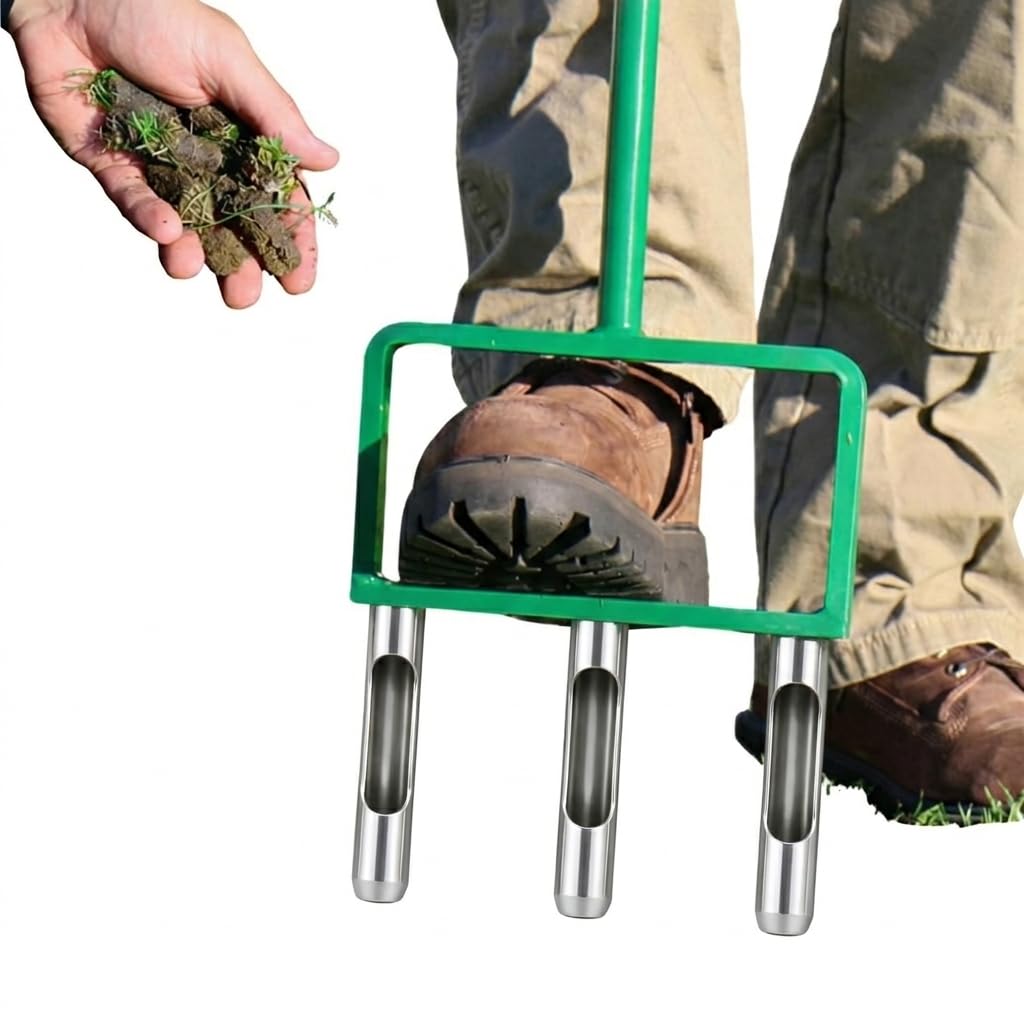
The Landzie arrives fully assembled out of the box with three beveled stainless steel tines already locked into a powder-coated steel frame. The 42-inch handle is the tallest in this roundup, allowing most users to stand fully upright while working, which dramatically reduces lower-back strain over long sessions. The beveled tine design is specifically engineered to push the previous soil plug up and out as you press down, so you never have to stop and manually clear a jammed tine.
Reports from owners who have put 50 to 60 hours on this tool confirm the frame remains rigid and the tines hold their edge longer than cheaper alternatives, though the hollow tines do need to be re-tightened every hour or two during heavy use. The wide foot bar provides excellent leverage, but several users noted it could benefit from a textured surface to prevent slipping on wet soles. On moist soil the tines sink to full depth with a clean, satisfying plug every time.
At roughly twice the price of entry-level competitors, the Landzie is an investment. But the combination of zero assembly, a full 42-inch working height, and tines that genuinely self-clear makes it the most efficient manual core aerator for anyone who plans to use it more than once a season and wants the job done without frustration.
What works
- Fully assembled out of the box — no setup time
- Beveled tines self-clear cores without manual poking
- 42-inch handle eliminates back strain for tall users
What doesn’t
- Premium price point may deter casual users
- Tines work loose after several hours and need re-tightening
- Foot bar lacks slip-resistant texture when wet
2. Xuperace Core Aerator
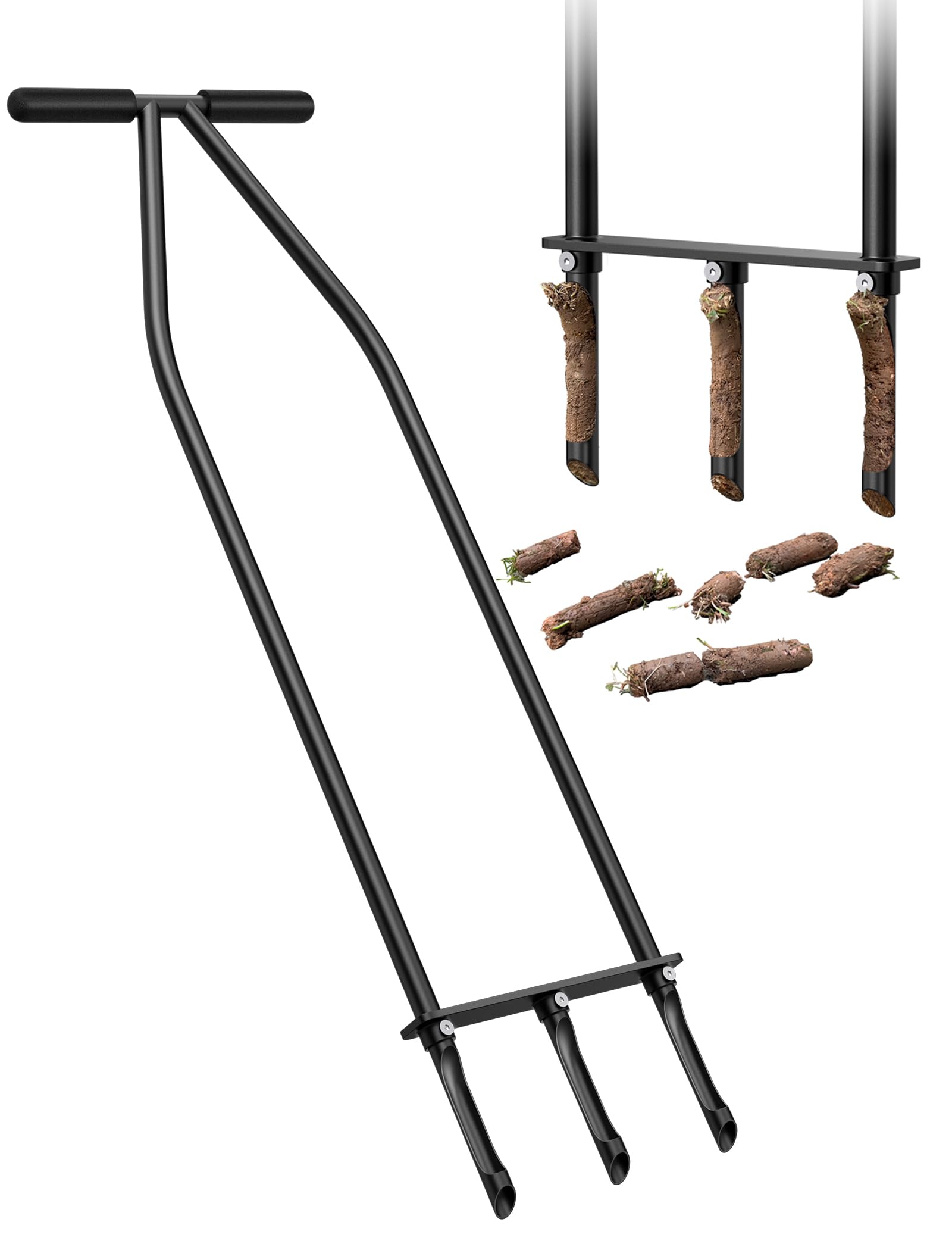
Instead of relying on traditional straight-wall hollow tines, the Xuperace uses a patented side-ejection ramp system. As the three tines penetrate the soil, the extracted plug is forced out horizontally through a port cut into the side of each tine rather than being pushed up vertically. This design solves the clogging problem mechanically because the plug never has to travel through a full-length tube — it exits immediately.
The frame is a single-piece, high-strength alloy steel construction with a two-bar handle that feels significantly stiffer than single-rod designs. Owners report it pulls clean 3- to 4-inch plugs even from compacted clay soil after a good rain. The tines are replaceable and held with screws, and the kit includes an extra tube of thread locker because the screws do vibrate loose during the first use. The curved foot plate allows a natural knee-forward motion rather than a straight downward stamp.
The trade-off is that you have to assemble the handle and tines, and the instructions are minimal. Several long-term users confirm the frame has survived multiple seasons without bending, which is rare for manually operated aerators at this price.
What works
- Side-eject tines eliminate clogging entirely
- Alloy steel frame resists bending under heavy pressure
- Replaceable tines extend tool lifespan
What doesn’t
- Screws loosen during first use even with included thread locker
- Requires assembly with limited instructions
- Higher cost than typical 3-tine manual aerators
3. Dolibest Lawn Coring Aerator with Storage Tray
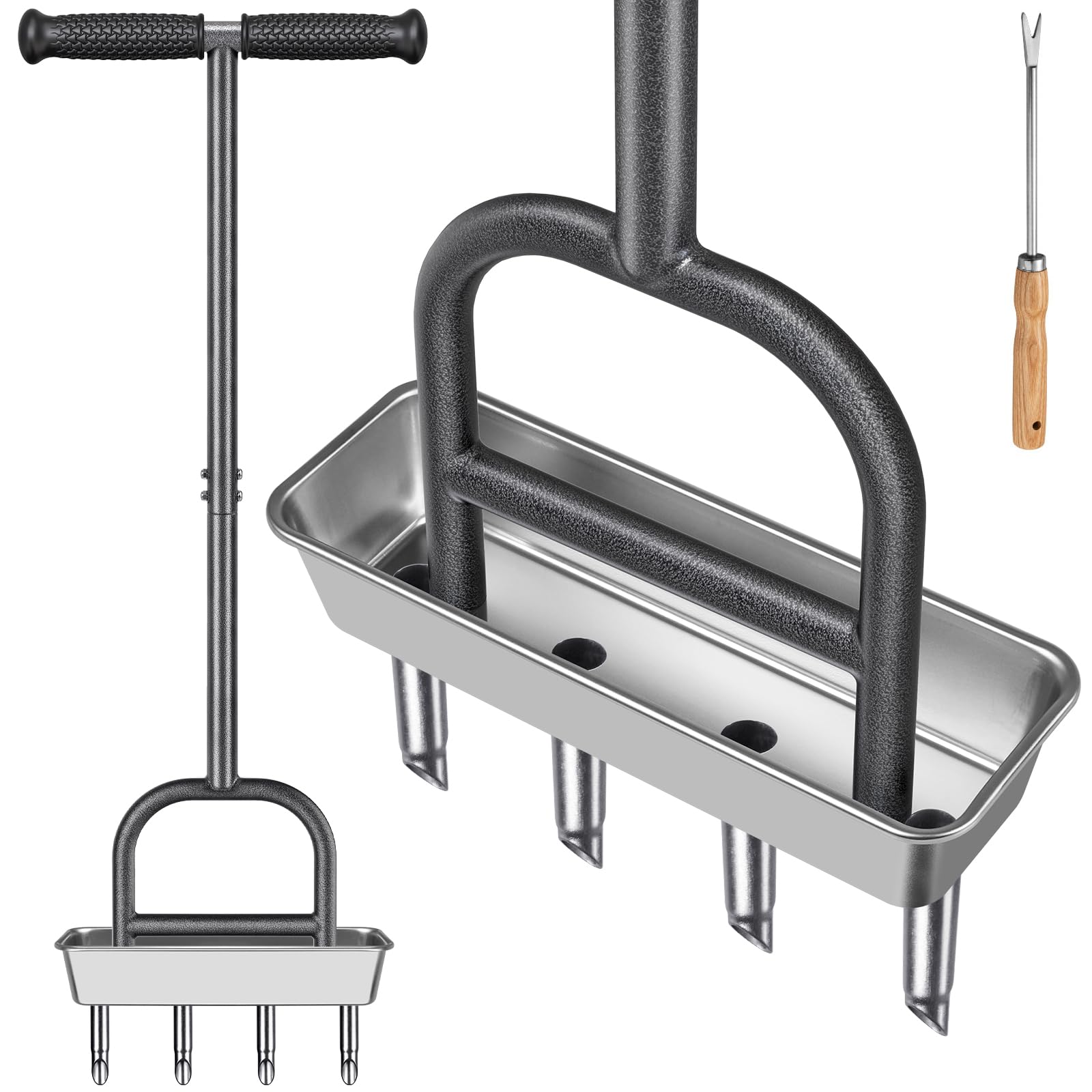
The Dolibest 4-tine model uses SUS 304 stainless steel for both the coring plugs and the integrated soil core storage tray, meaning rust is not a concern even if the tool is stored in a damp shed. Four tines pull plugs twice as fast as a 2-tine tool, but the trade-off is that you need to apply more body weight to drive all four tines to full depth, especially in dry or clay-heavy soil.
The storage tray sits just above the tines and catches each plug as it is ejected, keeping your lawn free of scattered dirt cores that would otherwise need to be raked up. The handle features a soft rubber grip and a raised crossbar that prevents your shoe from blocking the plug ejection path. The 37-inch overall height is adequate for average-height users but may still cause some stooping for anyone over 5 feet 10 inches.
Assembly takes about two minutes with three main pieces. The included 12-inch cleaning/weeding tool is a useful bonus, though one owner reported it broke after the first use. A few reviews noted a slight wobble in the connection point after repeated use, but the stainless steel tines themselves remain sharp and straight. For small to medium lawns where you want the cleanup done simultaneously, this is a strong mid-premium contender.
What works
- 4 tines pull double the plugs per step compared to 2-tine models
- Integrated storage tray collects ejected cores for easy cleanup
- SUS 304 stainless steel resists rust and corrosion
What doesn’t
- Handle height is too short for tall users without bending
- Four tines require significant body weight to penetrate hard soil
- Connection point can develop a wobble over time
4. Dolibest Manual Aerator (4 Semi-Open Tines)
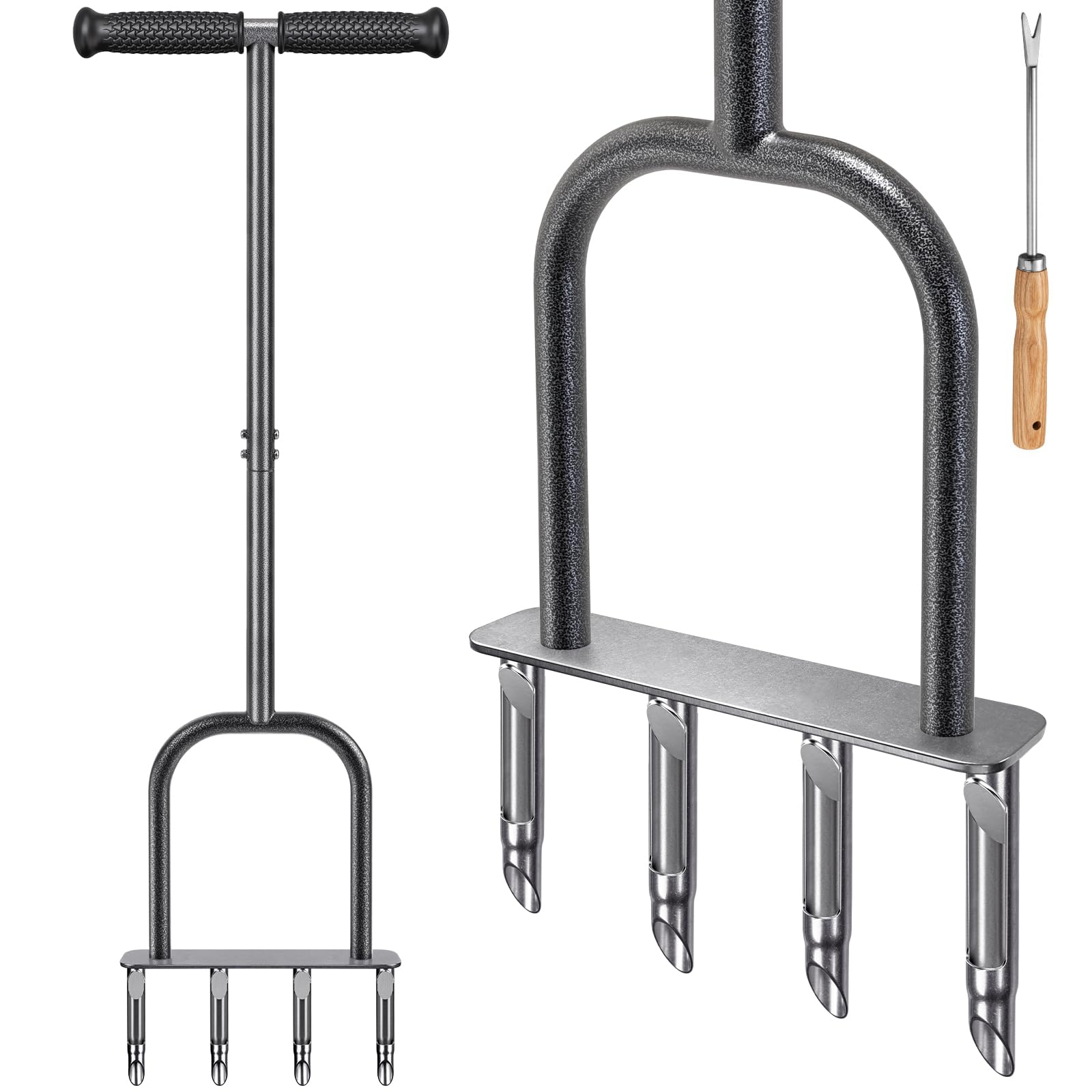
Instead of a fully enclosed hollow tube, Dolibest designed this 4-tine aerator with semi-open plugs — a U-shaped channel that curls around the soil core but leaves the front exposed. This geometry prevents the plug from jamming because there is no wall to wedge against. The soil core simply falls out as you lift the tool, making this one of the most clog-resistant manual aerators available without a premium price.
The entire base and tine assembly are stainless steel, while the handle pole uses high-strength steel with a rust-resistant powder coating. At 37.2 inches, the handle is again toward the shorter side, but the non-slip grip helps users who have to bend slightly. The tool arrives pre-assembled in three pieces that bolt together in under a minute. Owners working in dense clay report that the semi-open tines clear themselves even in sticky wet soil where traditional hollow tines would be unusable.
The weakest structural point is the single bolt connecting the handle to the tine assembly. Users report needing to re-tighten it regularly because the frame twists under load. If you are willing to keep a wrench handy, the self-clearing performance of these tines is genuinely better than many models costing more. For small lawns with clay or loam soil, this tool delivers excellent value.
What works
- Semi-open tines never clog — cores fall out automatically
- Stainless steel base resists rust in wet conditions
- Pre-assembled with minimal setup time
What doesn’t
- Single handle bolt loosens and needs frequent re-tightening
- Handle height forces shorter steps for tall users
- Twisting force on the frame can wobble the connection over time
5. EEIEER Manual Lawn Aerator with Soil Storage Basket

The EEIEER uses a patented one-piece bottom structure instead of a welded design, which reduces the risk of the frame cracking at the weld joint — a common failure point on cheaper manual aerators. The 2-millimeter thickened inner wall on the tines adds rigidity over the standard 1.2-millimeter construction, and the 38-inch handle length is a solid middle ground that suits most users between 5 feet 5 inches and 6 feet tall.
The soil storage basket sits above the 3 tines and collects the ejected cores to keep the lawn tidy. A cleaning stick is included to poke out any plugs that do get stuck, though some owners found that the basket fills quickly and needs to be emptied frequently, which slows down the rhythm of work. The foot pedal is 4.3 inches tall, giving ample clearance for boots, but the foam handle grips drew complaints about long-term durability — they tend to compress and slide out of position after a few uses.
Performance is solid in moist, non-compacted soil, but the tool struggles and clogs in dense clay or sandy conditions. Several owners noted that the basket design, while convenient in theory, adds weight and makes the tool feel top-heavy. For homeowners with small, moderately compacted lawns who prioritize a clean finished look, the EEIEER offers a unique feature set at a mid-range price.
What works
- One-piece bottom frame eliminates weld-breakage failure
- Thickened 2mm tine walls add durability
- Storage basket keeps soil cores contained for easy disposal
What doesn’t
- Basket fills quickly and must be emptied often
- Foam handle grips compress and slip over time
- Clogs in dense clay or sandy soil despite included cleaning tool
6. LawnVigor Manual Core Aerator
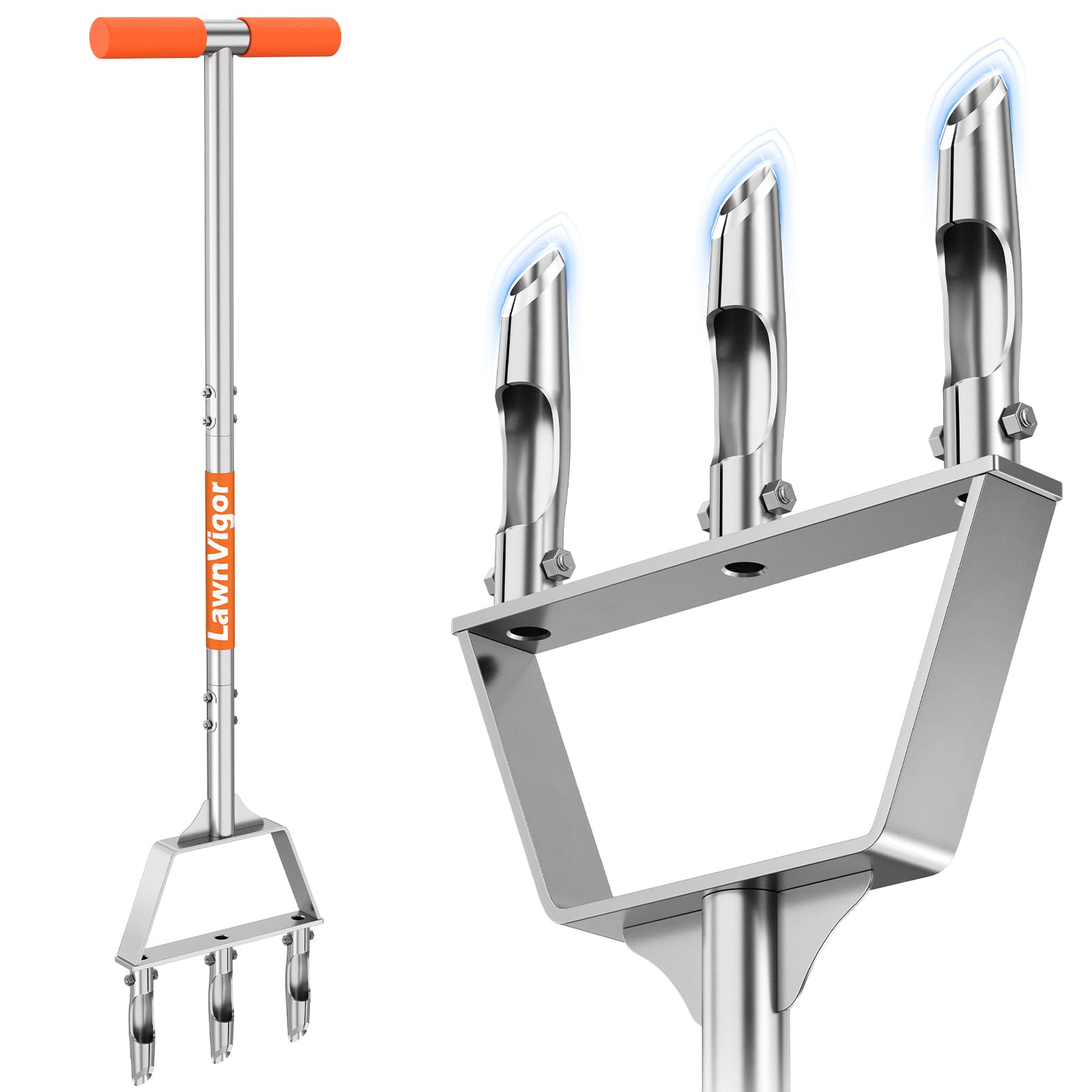
The LawnVigor is the most budget-friendly core aerator in this lineup, but it still uses genuine heat-treated hollow tines rather than spikes. Heat treatment hardens the steel so the tines resist bending when you hit compacted soil or small rocks. The 3-tine design balances penetration force with coverage, making it manageable for most adults to operate without excessive strain, even in moderately compacted loam.
The T-handle is wide with foam grips, and the 37-inch height is typical for this price class. White plastic inserts sit inside the tines to help release the soil plugs, and the manufacturer advises keeping them in place for proper ejection. Some users ignored this and removed the inserts, which caused immediate clogging. The tool is semi-assembled; the handle bolts onto the frame in roughly five minutes using the included Allen key.
The main drawbacks are the exposed bolt ends on each side of the T-handle, which can catch on your knees during use, and the overall lightweight construction at 3.5 pounds, which means you have to supply more downward force than with heavier models. For a small garden or a first-time buyer who wants to try manual core aeration without a large investment, the LawnVigor is a capable starting point.
What works
- Heat-treated hollow tines resist bending in compacted soil
- Lightweight 3.5-pound build is easy to carry and maneuver
- White plastic inserts help eject plugs reliably
What doesn’t
- Exposed bolt ends on the handle can rub against knees
- Lightweight frame requires more downward effort from the user
- Plastic inserts are easily lost if removed during cleaning
7. Yard Butler Spike Aerator
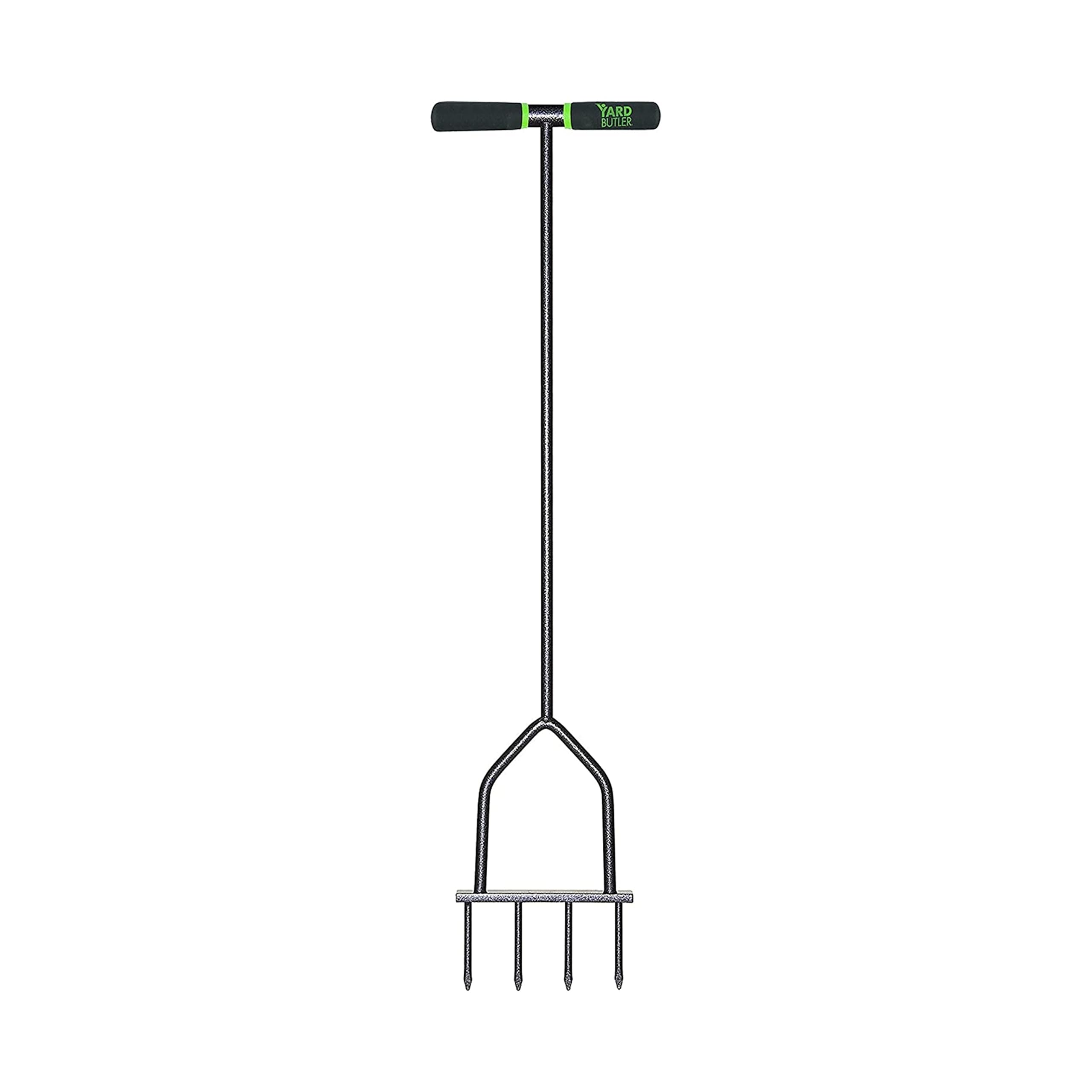
The Yard Butler is the only spike-type aerator in this selection, designed with four solid 3-inch steel spikes that punch holes into the soil rather than extracting plugs. Spike aeration does not remove soil — it simply displaces it around the hole, which can theoretically increase compaction in heavy clay soils. However, for sandy loam or for creating surface-level seedbed contact before overseeding, a spike tool is faster and requires less downward force than a coring tool.
The 36-inch handle is powder-coated steel with a classic T-grip, and the tool weighs only 2.25 pounds. Many owners report that after a light rain, the spikes penetrate easily and the tool moves across the lawn at a steady pace — approximately 325 square feet per hour. The primary concern with recent production units is a reported drop in steel quality: some buyers found the spikes bending after just 15 minutes of use and the stamped tips being too blunt to cut cleanly through even moderately compacted soil.
Because spike aerators do not remove thatch or relieve deep compaction, this tool is best used as a supplement to core aeration or on already healthy lawns where the goal is simply to increase water infiltration. If your primary issue is hard, compacted clay, skip the spikes and choose a core aerator. For quick, light maintenance on soft soil, the Yard Butler remains a cheap and effective option.
What works
- Very lightweight and easy to handle for short sessions
- Spikes penetrate soft soil quickly after a rain
- Inexpensive entry into aeration for light maintenance
What doesn’t
- Spikes can bend easily on recent production models
- Blunt stamped tips require excessive force in compacted soil
- Spike aeration does not relieve compaction — it can make it worse
Hardware & Specs Guide
How Tine Count Affects Coverage Time
A 2-tine aerator pulling a 3-inch-deep core every 10 inches covers roughly 200 square feet per 30 minutes on moist soil. A 4-tine aerator at the same spacing covers approximately 350 square feet in the same time, but each step requires 40 to 60 percent more downward force. For a 1,500-square-foot lawn, the 2-tine model takes about 3.75 hours versus roughly 2.15 hours for the 4-tine — assuming you can maintain full depth on every step.
Handle Height and Leverage Ratio
Handle length determines how much of your body weight transfers to the tines. A 36-inch handle on a 5-foot-8-inch user creates an angle at the hip that limits leg-drive force, requiring more arm and back involvement. A 42-inch handle lets the same user drive straight down through the legs, reducing back fatigue by roughly 30 percent per step. Taller users (over 6 feet) should prioritize handles at or above 40 inches to avoid stooping.
FAQ
Is a 3-tine or 4-tine push lawn aerator better for clay soil?
Can I use a spike aerator to fix soil compaction in my lawn?
How long should the tines be on a manual push aerator?
How often should I manually core aerate my lawn?
Final Thoughts: The Verdict
For most gardeners, the push lawn aerator winner is the Landzie because it combines a full 42-inch working height, beveled tines that genuinely self-clear, and a zero-assembly design that works immediately out of the box. If you want maximum clog resistance and a slightly lower price, grab the Xuperace with its side-eject ramp. And for the budget-conscious buyer who still wants true core aeration rather than spikes, the LawnVigor delivers heat-treated hollow tines that perform well on small lawns and gardens.