
You need a cut that heals fast, not a jagged tear that invites disease. A great pair of pruning scissors makes that clean slice every time, so your plants stay healthier and you spend less effort. The right choice depends on what you are cutting and how much fatigue your hands can handle — whether you deadhead delicate flowers or hack through woody stems.
I’m Rikta — the co-founder and writer behind Lawn Gear Lab. This guide is built by comparing the manufacturers’ published specifications and the patterns across verified customer reviews, so you get each pick’s real strengths and trade-offs instead of marketing spin.
After looking at the cutting width, blade material, grip comfort, and hundreds of real-world reviews, here is everything you need to choose the right pruning scissors.
How To Choose The Best Pruning Scissors
Not all pruning scissors are the same, and the wrong pair can make your work harder and harm your plants. Here are the key things to think about before you buy.
Bypass vs Anvil Blades
If you cut live plants — stems, flowers, green wood — choose bypass blades. They work like scissors, with two curved blades sliding past each other for a clean cut that heals quickly. Anvil blades crush the stem against a flat surface, which is fine for dead wood but can damage live growth.
Cutting Width and Your Plants
Check the cutting width spec — the maximum branch thickness the tool can handle. Fine-tipped pruning scissors with a 0.25-inch width are great for herbs and deadheading flowers but will snap on a woody branch. Heavy-duty models with a 1-inch cut capacity handle shrubs and thick stems but are overkill for delicate trimming.
Handle Comfort and Hand Size
Look at handle material and shape. Rotating handles reduce friction on your palm during repetitive cuts. Contoured non-slip grips help with control in wet weather. If you have small hands or arthritis, check reviews for fit — some premium brands are designed specifically for smaller grips.
Locking Mechanism Safety
A reliable lock keeps the blades closed when you reach into your bag or pocket. Simple slide locks are easiest to use one-handed. Some budget models develop a loose lock after a season, so look for reviews that mention long-term lock durability.
Quick Comparison
On smaller screens, swipe sideways to see the full table.
| Model | Category | Best For | Key Spec | Amazon |
|---|---|---|---|---|
| Corona BP 4250 | Premium | Thick branches & heavy pruning | 1-inch cutting width | Amazon |
| ARS HP-130DX | Premium | Small hands & everyday use | 7-inch overall length | Amazon |
| Original LÖWE Anvil Pruner | Premium | Dead wood & heavy-duty cuts | 22mm cutting width | Amazon |
| ARS Needle Nose HP-SE45 | Mid-Range | Precision & tight spots | 2-inch blade length | Amazon |
| Modern Sprout Pruning Shears | Mid-Range | Herbs & indoor plants | 2.25-inch blade length | Amazon |
| Dramm ColorPoint | Budget | Light trimming & flowers | 0.25-inch cutting width | Amazon |
In‑Depth Reviews
1. Corona Tools BP 4250 MAXFORGED Aluminum Bypass Pruner

The Corona BP 4250 handles live branches up to 1 inch thick, making it the top pick for the gardener who wants one tool for everything from trimming flowers to cutting woody stems, and its forged steel blade stays sharp for a full season of heavy use.
At 9.6 ounces, the lightweight aluminum handles give you excellent cutting force without tiring your arm, even when clearing thick growth. Buyers report using these for heavy weekly clearing of dirt bike trails in dense woods, and they confirm the blade cuts just as well now as when new. The serrated blade edge grips stems so they do not slide out during the cut.
The honest trade-off is the locking mechanism — after 2 seasons, some users report it slips frequently and you have to make sure you lock it hard. For the price, you get performance rivaling pruners that cost twice as much, with a replaceable blade for longevity. A gardener who rarely prunes branches over an inch should stick with this one, rather than buying a separate heavier tool.
Why it’s great
- 1-inch cutting capacity handles thick branches
- Lightweight aluminum handles reduce fatigue
- Forged steel blade makes clean cuts on live wood
- Replaceable blade extends tool life
Good to know
- Locking mechanism can slip over time
- Blade may rust if left outside
- Replacement blade costs about 3/5 of the pruner price
2. ARS HP-130DX 7-Inch Ideal Light Pruner

The ARS HP-130DX beats the Corona BP 4250 in one specific way — its 7-inch frame and soft PVC handles are made for smaller hands, and it fits in a pocket like a large pen. While the Corona handles 1-inch branches, this excels at one-handed use up to 0.5-inch branches, making it the better pick for delicate pruning and floral work where you need precision more than brute force.
Its high-carbon steel blade is precision ground and hard chrome plated, which means it stays sharp enough for a professional florist to use for 3 years straight on flower stems. Owners mention that it cuts any type of flower super smoothly and is a favorite for wedding and event arrangements. The simple slide lock works without interfering with routine cutting.
The limit is clear — customers note it struggles with branches larger than 0.5 inches, so it is not for tree work. At about half the price of ARS’s heavy-duty 7X model, it is nearly identical in feel but with thinner handles. Choose this over the top pick if you prune flowers, herbs, and thin green wood all day and need a precision tool for smaller hands.
Where it shines
- Compact 7-inch size fits small hands perfectly
- High carbon steel blade stays sharp for years
- Excellent for one-handed precision cutting
- Simple lock that doesn’t interfere with use
Worth noting
- Cannot handle branches over 0.5 inches
- Blade cannot be sharpened — replace every 5-6 months for heavy use
- Right-hand orientation only
3. Original LÖWE Professional Anvil Pruner 1.104

When you face a tangle of dry, dead wood that would wreck a bypass pruner, this is the tool you reach for. The LÖWE Professional uses an anvil blade — a sharp blade that pushes down onto a flat surface — which crushes through dead branches rather than slicing them. It is the right choice for clearing out dead growth and thick twigs where a bypass (scissor-style) blade would bind or get damaged.
Its 22mm (about 0.87-inch) cutting width lets it handle serious branches, and at 290 grams (about 10.2 ounces), it has a heavier, more solid build than Fiskars pruners, with no looseness in the hinge. Reviewers point out it cuts rose stems and branches effortlessly, and the carbon steel blade is coated with a sliding lacquer (a friction-reducing coating) to prevent rust and make each cut smoother. The one-hand safety lock works with a single finger.
The standout feature is that every part is replaceable — a rare promise in pruning scissors — so this German-made tool can last for years instead of ending up in a landfill. Anyone clearing an overgrown yard with dead limbs will find this the most efficient option. But if you mostly prune live, green plants, pick the Corona BP 4250 bypass instead; this anvil design will crush healthy stems.
What stands out
- Anvil design crushes dead wood effortlessly
- All parts replaceable for long-term use
- Sliding lacquer coating resists rust and reduces friction
- Solid build with no hinge looseness
The trade-offs
- Not suitable for cutting live green plants — crushes stems
- Heavier than most bypass pruners
- Premium price for the anvil design
4. ARS Needle Nose Pruner HP-SE45

The single number that matters most here is the 1.81-inch cutting width — the ARS HP-SE45 can handle stems almost as thick as the Corona BP 4250, but in a much more compact and precise package. Its needle-nose design (long, slim tips that taper to a point) lets you reach into tight spots, and the 2-inch stainless steel blades stay sharp for a whole season. This is for the gardener who needs both power and precision.
The catch is that it is right-hand oriented only, so left-handed users will find the grip awkward. At just 0.09 kilograms (about 3.2 ounces), it is extremely lightweight, and buyers confirm it fits arthritic hands well — one user reports it actually outperforms their Fiskars pruners on comfort and cut quality. The streamlined nose reaches buds and vines without damaging surrounding leaves.
The price sits in a sweet spot: you get professional-grade ARS performance without paying the premium for the heavy-duty models. The ideal owner is a gardener who needs to snip thorny rose canes in a crowded bed. Skip this if you are left-handed — you will struggle with the grip, and the Dramm ColorPoint is a better ambidextrous choice.
The upsides
- Needle nose reaches into tight spots
- Lightweight at just 3.2 ounces
- Cuts cleanly with no rusting
- Comfortable for arthritic hands
Keep in mind
- Right-hand orientation only
- Plastic handles may not suit all grips
- Not designed for very thick, heavy branches
5. Modern Sprout Pruning Shears
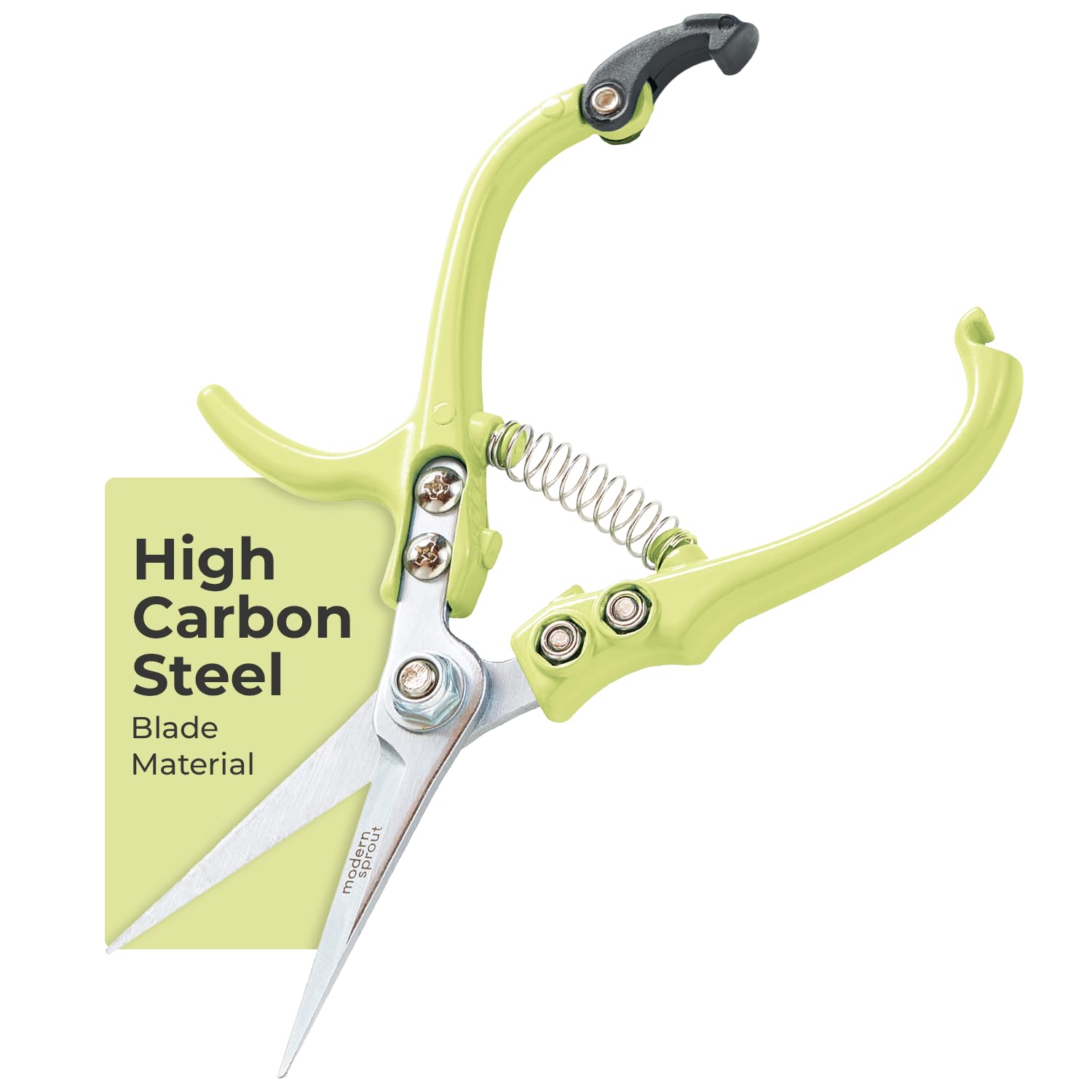
At this lower price, you get a 2.25-inch high-carbon steel blade that is 12% longer than the Dramm ColorPoint’s 2-inch blade, giving you more reach for trimming herbs, mint, and basil without damaging nearby leaves. The needle-nose tip is designed for precision cuts in tight spaces, making these shears ideal for indoor potting benches and small herb gardens.
What you give up is branch capacity — the 0.25-inch cutting width means these are only for fine stems and delicate plants, not woody growth. Shoppers say the ergonomic handles reduce hand strain during long trimming sessions and the safety lock keeps the blades secure in a drawer. The blades resist rust and stay sharp for daily use on flowers and soft stems.
The exact budget buyer it is perfect for is the indoor gardener or herb grower who needs a lightweight, precise tool that feels good in the hand for repetitive snipping. The chartreuse color and included holster are a bonus, but the real win is the sharpness and comfort at this entry-level price point. If you prune branches thicker than a pencil, you need the Corona BP 4250.
Why we’d pick it
- Longer 2.25-inch blade for extended reach
- High-carbon steel stays sharp and resists rust
- Ergonomic handles reduce hand strain
- Safety lock for secure storage
A few caveats
- 0.25-inch cutting width limits use to fine stems
- Plastic/resin handles may feel less premium
- Not suitable for woody branches
6. Dramm ColorPoint Stainless Steel Compact Pruning Shears

The Dramm ColorPoint is perfect for the budget-conscious gardener who prioritizes long-term durability over frills, especially those who have been frustrated by rust on other affordable shears. With a 2-inch stainless steel blade and a corrosion-resistant build, buyers report “no rust after 2 months daily use” and even years of outdoor storage with no deterioration. It is built for gardeners who want a simple, sharp tool that lasts without spending a premium.
At a 0.25-inch cutting width, it sits in the same fine-stem territory as the Modern Sprout shears, but its flat, straight blade edge is better suited for deadheading flowers, trimming suckers off tomato plants, and cutting twine. Buyers with small hands or arthritis specifically note it is comfortable and easy to use, with an ambidextrous design that works for both left and right hands. The bright yellow color makes it easy to find in the garden.
The one reason to choose these shears over the Modern Sprout pick is if corrosion resistance and a proven track record matter more to you than blade length — this is a time-tested design from a trusted greenhouse professional brand. It is the no-fuss, reliable choice for light pruning. A left-handed gardener who found the ARS HP-SE45 awkward will appreciate this ambidextrous alternative. Just note that its 0.25-inch cutting width limits it to fine stems only, so it is not the tool for thicker branches or woody growth.
Strong points
- Stainless steel blades resist rust even outdoors
- Comfortable for small hands and arthritis
- Ambidextrous design works for left-handed users
- Proven durability from a trusted brand
Before you buy
- 0.25-inch cutting width limits use to fine stems
- Flat blade edge may not grip stems as well as serrated
- Not for woody branches over 1/4 inch
Understanding the Specs
Cutting Width
This is the maximum thickness of branch the pruner can cut. A 0.25-inch width is for herbs and flowers only. A 1-inch width handles shrubs and thick stems. Always match cutting width to the thickest plant you regularly prune — too wide and the tool is clumsy, too narrow and it will snap under pressure.
Blade Material
High-carbon steel holds a sharper edge longer than stainless steel but can rust if left wet. Stainless steel is easier to maintain but may need more frequent sharpening. Hard chrome plating adds a layer of corrosion resistance and reduces friction for smoother cuts.
FAQ
What is the difference between bypass and anvil pruning scissors?
How do I know if pruning scissors are sharp enough?
Final Thoughts: The Verdict
For most buyers, the pruning scissors winner is the Corona Tools BP 4250 because it handles the widest range of branch sizes with lightweight aluminum handles that reduce fatigue. If you have smaller hands and do delicate floral work, grab the ARS HP-130DX. And for crushing dead wood and heavy-duty garden clearing, the standout is the Original LÖWE Professional Anvil Pruner.