
Specs are compiled from manufacturer listings and verified buyer reviews and can change over time — please confirm the key details on the product page before buying.
A programmable mower frees your weekends from manual mowing. It handles the weekly cut on its own schedule, so you come home to a fresh lawn without lifting a finger. Match the machine to your yard’s size, slope, and obstacles to avoid frustration.
I’m Rikta — the founder and writer behind Lawn Gear Lab. This guide is built by comparing the manufacturers’ published specifications and the patterns across verified customer reviews, so you get each pick’s real strengths and trade-offs instead of marketing spin.
The right programmable lawn mower frees your weekends with app scheduling and wire-free mapping, but slope limits and setup complexity decide which model truly fits your property.
Our Picks at a Glance

How To Choose The Best Programmable Lawn Mower
Choosing a programmable mower is about matching navigation tech to your yard’s shape and terrain. A model that excels on flat, open lawns can struggle in small, tree-covered yards with steep banks.
Wire-Free Navigation: RTK, Vision, or LiDAR
Most modern mowers ditch the boundary wire entirely. RTK (Real-Time Kinematic) uses a satellite reference station for centimeter-level positioning, which is great for open yards but can struggle under dense tree cover. Vision systems use cameras to “see” the lawn edge and obstacles — they adapt well to shade but need good light. LiDAR (Light Detection and Ranging) uses lasers to map in 3D, which often works well in dim conditions. Your choice should follow your yard’s biggest challenge: trees, slopes, or tight passages.
Quick Comparison
| Model | Best For | Cutting Width | Max Slope | Max Cut Height | Amazon |
|---|---|---|---|---|---|
| ANTHBOT M5★ Best Overall | Small, complex yards | 7.9 inches | 45% | 2.7 inches | Amazon |
| Segway Navimow X430Premium Pick | Maximum power & width | 17 inches | 84% | 4 inches | Amazon |
| Mammotion LUBA 2 AWDTop Performer | Steep, big properties | 15.7 inches | 80% | 4.0 inches | Amazon |
| YARDCARE M800Plus | Budget flat lawns | 7.01 inches | 35% | 2.4 inches | Amazon |
| ANTHBOT Genie3000 | Large open areas | 7.9 inches | — | 2.76 inches | Amazon |
| Sunseeker X3 Plus | Suburban edges | 8 inches | 17° | 3.2 inches | Amazon |
| MOVA LiDAX Ultra 1000 | Tech-first auto-mapping | 8 inches | 45% | 3.9 inches | Amazon |
| WORX WR320 | Large flat yards | 8.7 inches | 30% | 3.54 inches | Amazon |
| Segway Navimow i110N | Challenging layouts | — | — | — | Amazon |
| eufy E15 | Pure vision simplicity | 8 inches | 18° | 3 inches | Amazon |
In‑Depth Reviews
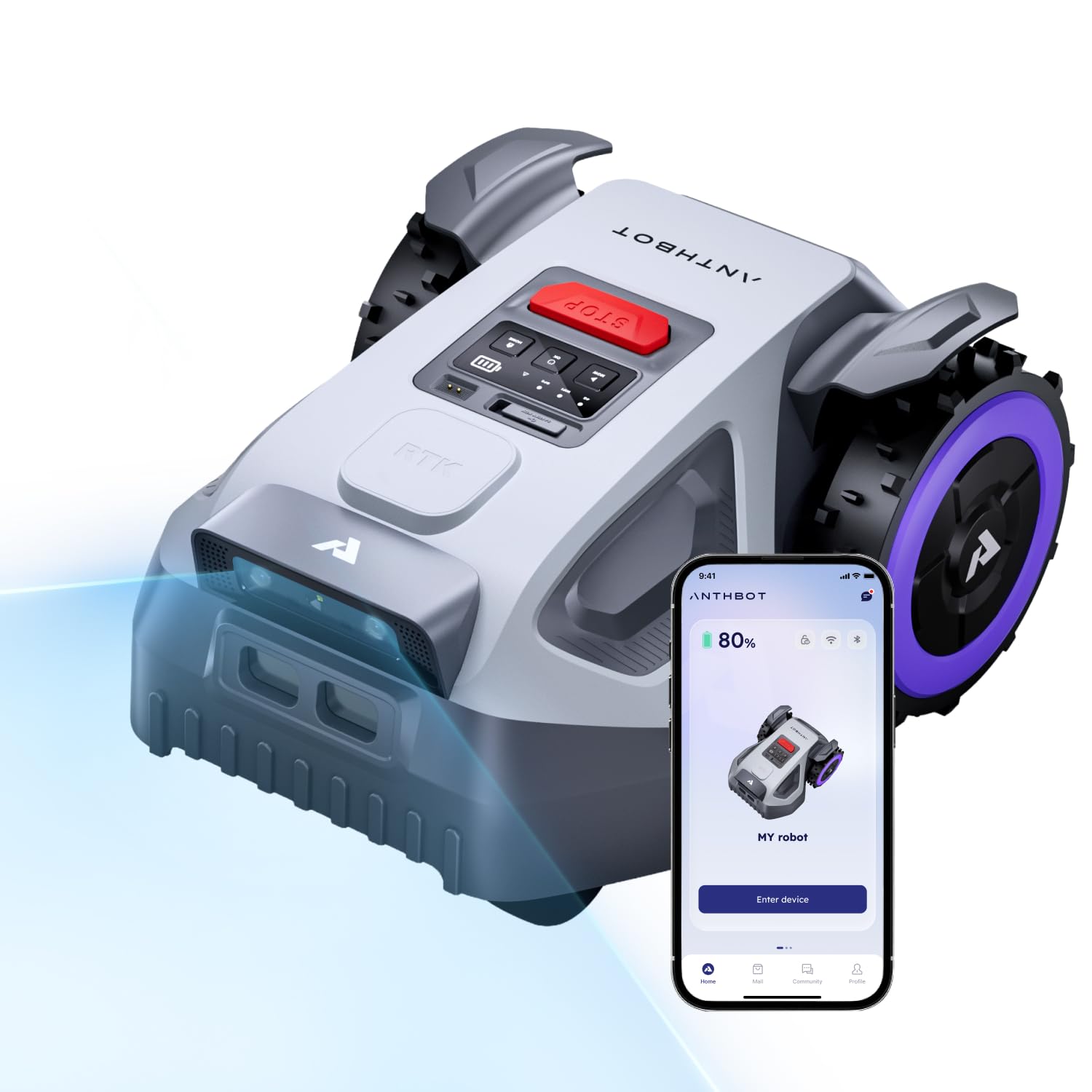
1. ANTHBOT M5 Robot Lawn Mower
Our pick — over 4★ from 350+ verified ratings; the strongest balance of quality and price.
The crowd favorite balances wire-free smarts with a price that doesn’t scare you away.
This mower is the best starting point for most people because it handles the two toughest challenges at once. Its dual-camera vision system and RTK positioning work together for centimeter-level precision, which means it can map a yard without burying any wire. It identifies over 1,000 types of obstacles using two 150° HDR cameras, so it steers around toys and trees rather than bumping into them.
It’s rated for slopes up to a 45% gradient — steeper than most residential yards ever get. The cutting height adjusts from 1.2 to 2.7 inches, and the five free-rotating blades are designed to leave a carpet-like finish. It runs quietly at ≤58 dB, which won’t disturb your neighbors on an early morning schedule.
Owners praise the obstacle avoidance and consistent cut quality, and many find it time-saving. The setup is about 20 minutes, though it needs a strong GPS signal and prefers a clean, well-kept lawn — tall grass can trip it up. For a 50×50 ft yard, buyers report it finishes in about 2.5 hours including charging stops.
Why owners rate it highly
- No boundary wire or subscription needed
- Detects objects day and night with its vision cameras
- Auto-recharges and resumes mowing where it left off
Where it stumbles
- Struggles in tall, overgrown grass
- Needs a strong GPS signal to navigate reliably
- The bright headlight can’t be turned off
Make it yours if: you want a wire-free mower that learns your yard and avoids obstacles smarter than a bumper car.
Think twice if: your lawn is consistently overgrown or you live in a deep valley with spotty satellite reception.
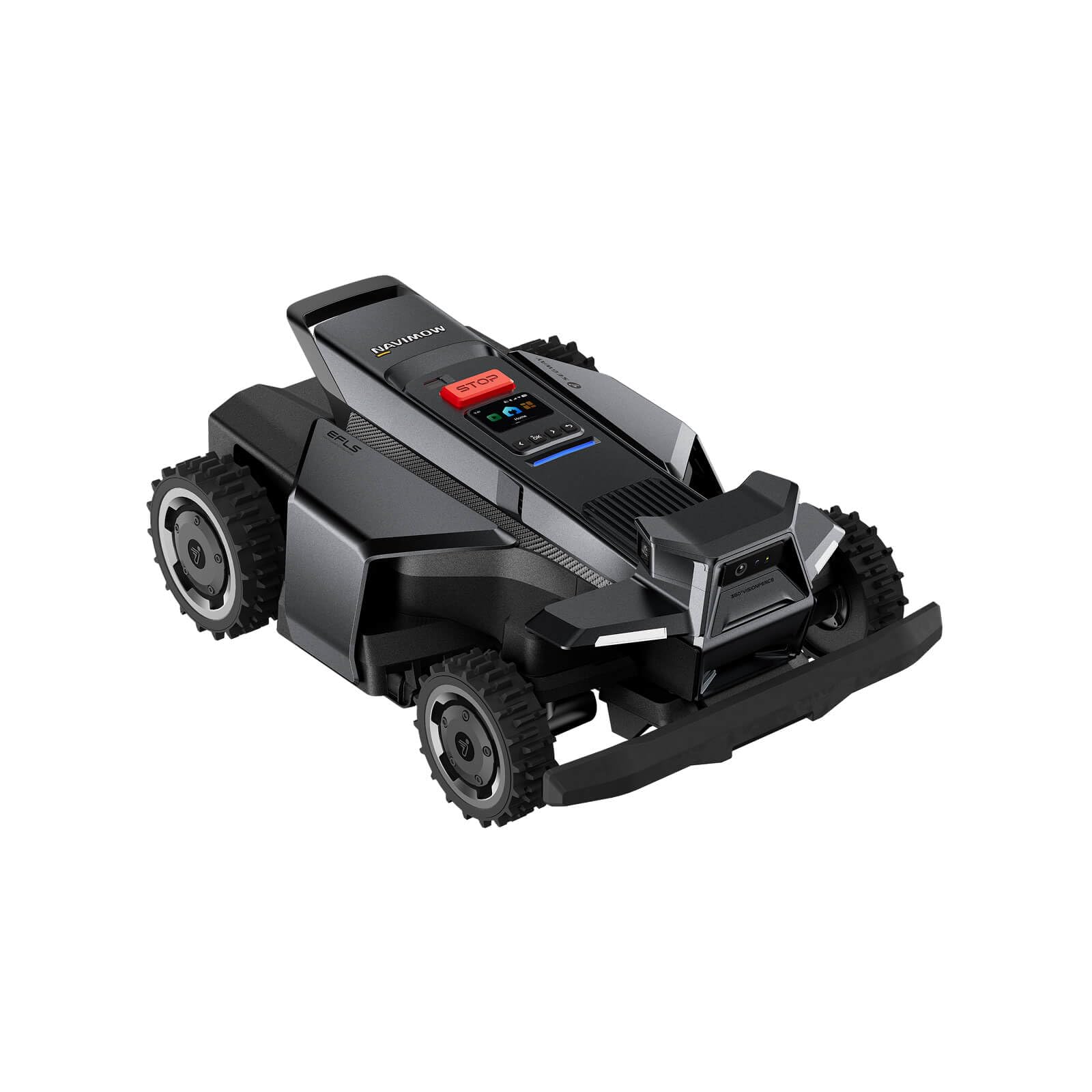
2. Segway Navimow X430
A serious machine for big, steep yards where smaller mowers give up.
When your property is closer to a hillside than a lawn, this is the mower that doesn’t flinch. It uses all-wheel drive with an ORV-tuned suspension to climb extreme 84% (40°) slopes and cross obstacles up to 2.8 inches high. The dual 180W motors drive two cutting discs with 12 blades across a 17-inch cutting width — the widest in this roundup by far.
Its zero-turn steering is turf-safe, meaning it pivots without scuffing or tearing the grass. The EFLS tri-frequency Network RTK combined with 360° Vision keeps it accurate even under trees, and it identifies over 200 obstacle types. Cutting height ranges from 0.75 to 4 inches, so you can go from a tight putting-green look to a longer, drought-tolerant cut.
The setup is described as hands-free with one-tap auto mapping and no antenna required, though owners note the app guidance could be clearer. It’s a maintenance mower, not a brush-cutter — it expects a pre-mowed lawn and handles tall weeds poorly, leaving 6-8 inch spots. Battery life is generally good, but some owners mention needing to split mowing across zones or days for larger lawns.
What makes it a flagship
- Climbs 84% slopes with its 4WD system
- Widest cutting width at 17 inches covers ground fast
- Zero-turn steering protects the turf
The trade-offs to know
- Expect a learning curve with the app setup
- Won’t handle tall, weedy growth
- Heavy at 63.7 pounds, so repositioning is a chore
Reach for this if: you have a half-acre or more with serious slope and want a mower that cuts wide and climbs hard.
Look elsewhere if: your yard is small and flat — this is more machine than you need.
3. Mammotion LUBA 2 AWD 3000HX
The all-terrain specialist that laughs at hills other bots slide down.
This is the mower for the worst terrain you can throw at it. A 165W four-wheel motor climbs 80% (38°) slopes and powers through potholes and thick grass without getting stuck. Its 15.7-inch cutting width is nearly double the standard 8-inch bots, so it covers a 0.75-acre property in far fewer passes.
The UltraSense AI Vision works alongside RTK navigation to keep mowing under trees where satellite signals fade. It manages up to 30 mowing areas, including no-go zones around pools and flower beds. The cutting height adjusts from 2.2 to 4.0 inches, giving you a wider range than most rivals for seasonal changes in grass growth.
In practice, customers note it handles complex multi-zone yards with daily clean lines. They also note it tears grass on sharp turns and can get stuck on a 1-2 inch ramp bump. Setup is involved — you’ll likely need to drill for an RTK mount, which is sold separately. It uses razor blades that need occasional changes, and you’ll still weed-whack the edges every couple weeks.
Who it dominates: if your yard is genuinely steep, the LUBA 2 is the one to buy — it handles slopes up to 80%, while the ANTHBOT M5 tops out at 45% and the eufy E15 at 18°, so it climbs hills the others simply can’t.
The honest catch: setup requires more effort than a plug-and-play bot, and the razor blades are a consumable you’ll budget for.
4. YARDCARE M800Plus
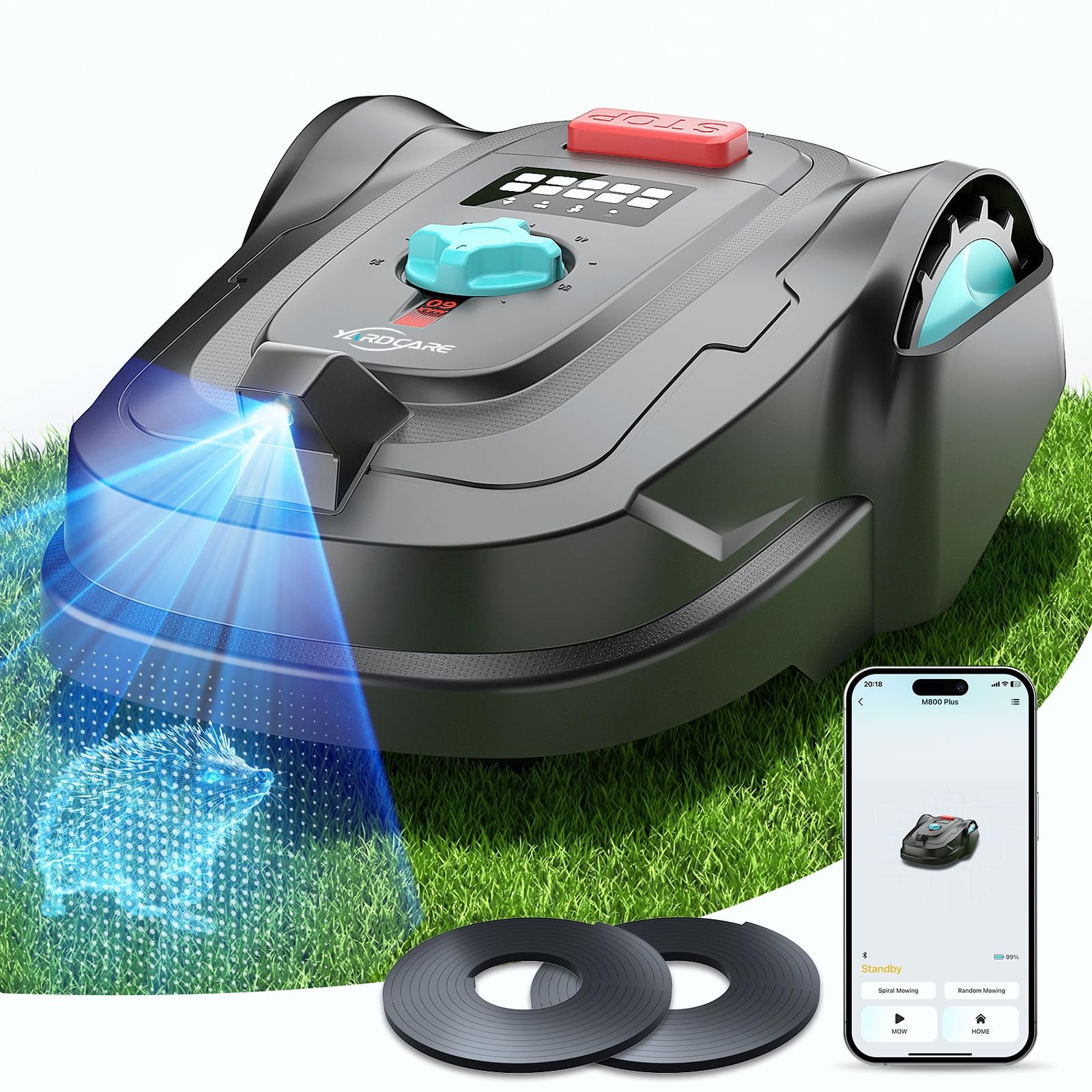
The budget-friendly entry that still brings app scheduling and wire-free mapping.
If you want to test the robot-mower waters without a flagship investment, this is the sensible starting point. It uses GPS and 3D vision to identify grass versus non-grass areas, so there’s no boundary wire to bury. A 32.8 ft magnetic stripe lets you create no-go zones without digging or adding a power source.
Its three-blade cutting disc spans a 7.01-inch width, and the cutting height adjusts from 0.8 to 2.4 inches — the lowest minimum in this comparison, which is handy for very short, manicured lawns. It handles slopes up to 35% (20°) and features a spiral spot-mowing mode for thicker, faster-growing patches. The app manages schedules, mowing patterns, and firmware updates.
Owners who schedule it love the freedom — one buyer replaced hours of Saturday mowing on a 0.5-acre yard with a hike, praising the even cut every time. The recurring caveat is durability: a few reviewers point out the unit dying within months, and support was slow to respond in those cases. Most users find it reliable, but it’s worth knowing the risk.
Value verdict: for a flat, clearly-bounded lawn, this delivers 90% of the experience at a fraction of the premium price.
Reliability note: the small but real chance of early failure makes a good warranty and return policy worth checking before you buy.
5. ANTHBOT Genie3000
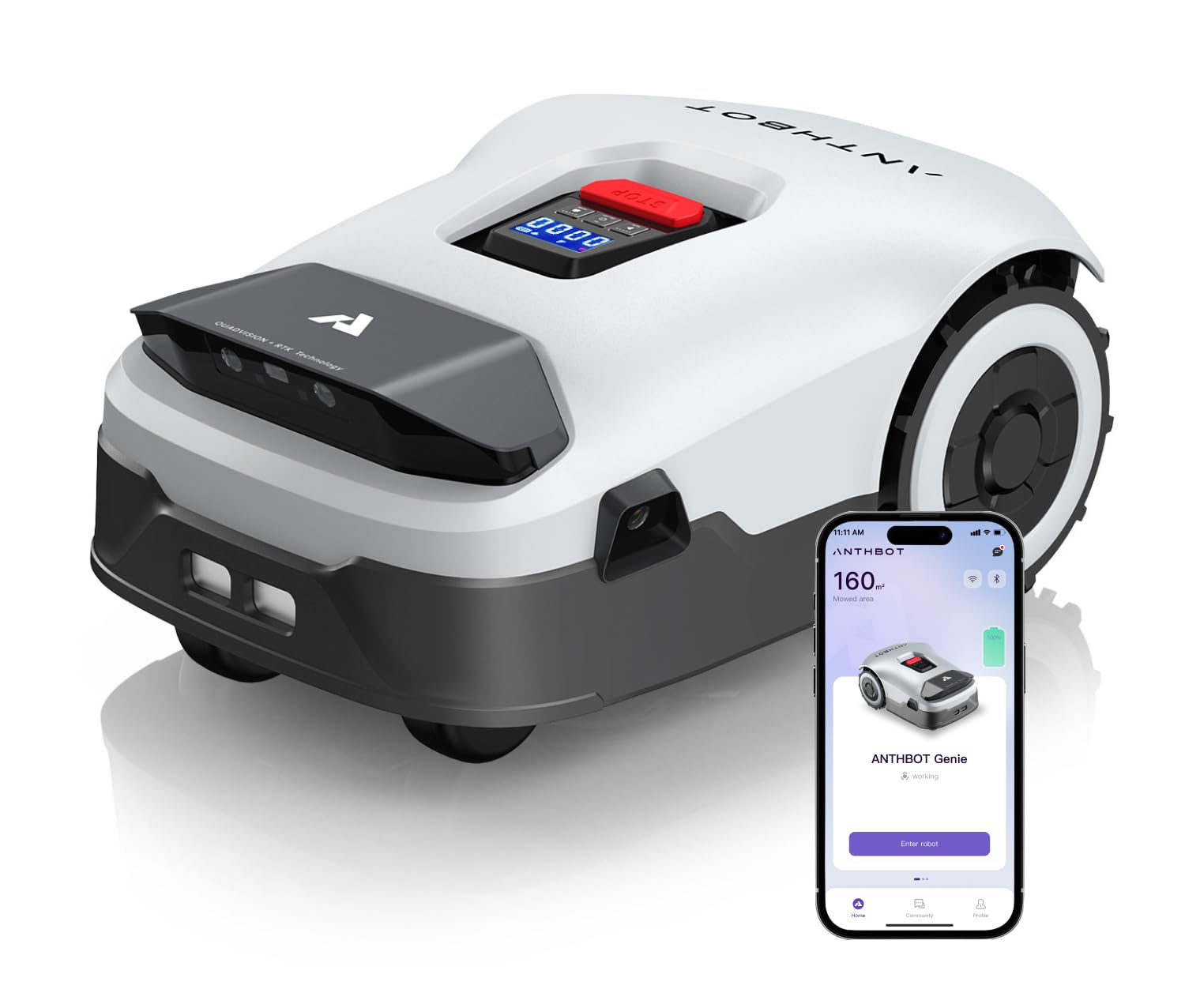
A heavy-duty wire-free mower built to handle larger properties with weak GPS.
This is the bigger sibling in the ANTHBOT lineup, designed for yards up to 0.9 acres. It combines Full Band RTK with a 4-camera “human-like” 3D vision system to hold precise positioning even under dense trees, eaves, or near buildings where GPS drops out. That dual system is its standout feature — it keeps mowing where single-system bots stall.
It’s heavier than its sibling at 46 pounds, and its footprint of 25″D x 11″W x 16″H is notably larger. The cutting width matches the M5 at 7.9 inches, but the max cutting height stretches to 2.76 inches versus the M5’s 2.7 inches — a small edge for longer grass. It manages 30+ mowing zones with customizable no-go areas via the app.
The consensus from owners is that it’s easy to use with an intuitive app, and it handles thick grass well. The setup earns the most praise by far — buyers single out the simple setup experience most often, with performance a close second. But it’s not perfect: the stability is the most-discussed mixed point, with some owners finding it gets stuck on the steepest slopes and occasionally needs remapping. It also requires occasional edging and perimeter tuning.
Best for: large, complex yards where losing GPS signal under trees is a real fear, not a hypothetical.
Not for: those who want a lightweight, portable bot they can easily carry between front and back — this one is heavy.
6. MOVA LiDAX Ultra 1000
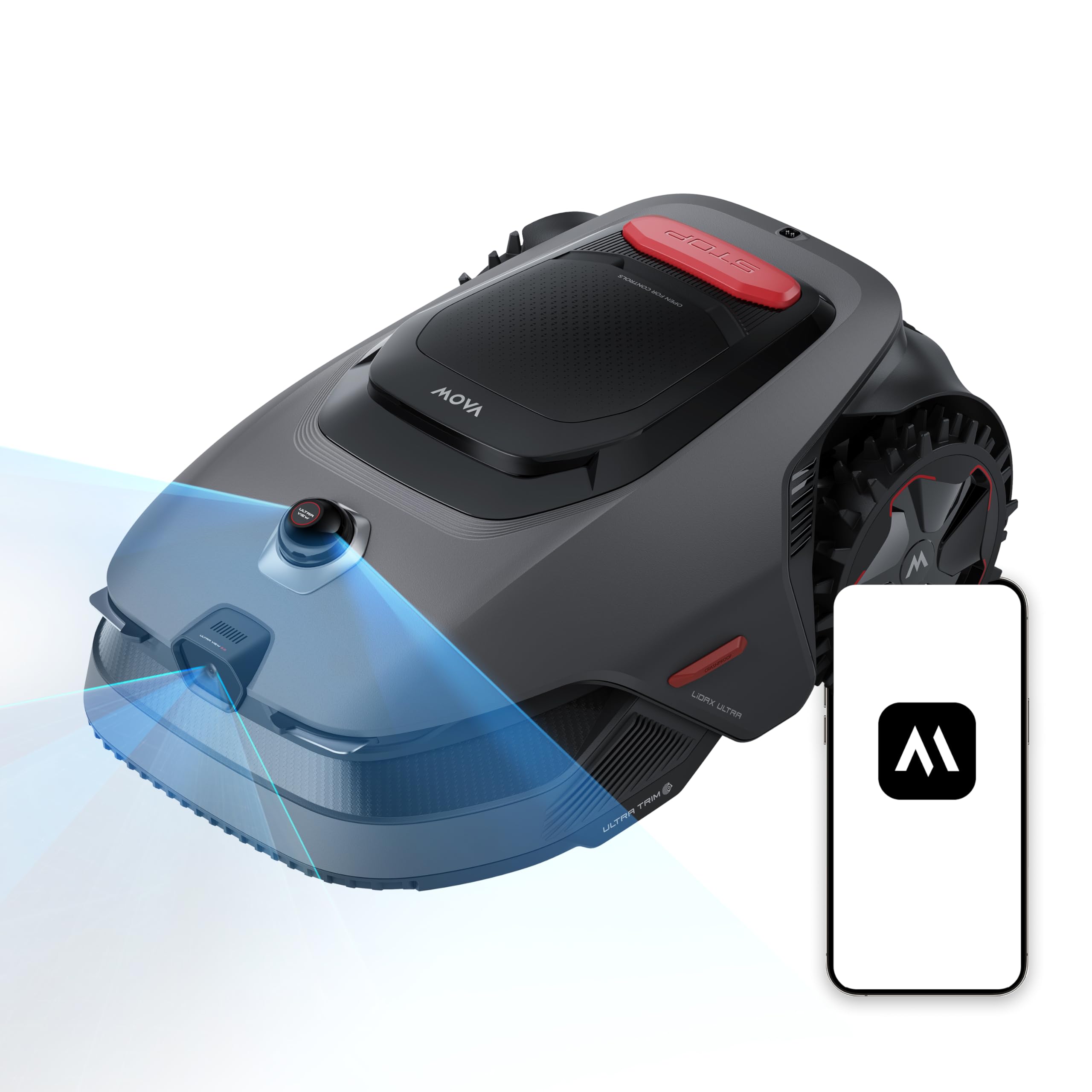
The tech-forward choice that maps itself in 3D with no base station at all.
This mower skips the RTK reference station entirely, relying on a 360° 3D LiDAR sensor and AI vision to auto-map your yard in three dimensions with centimeter accuracy. That means no wires and no separate station to install — you power it on and it figures out the lawn. It’s designed to work even in dim or harsh light, which gives it an edge over pure-vision systems.
Its cutting height range is the widest here at 1.2 to 3.9 inches, adjustable directly from the app. It handles 45% slopes with rear-wheel drive and off-road wheels, climbing obstacles up to 1.6 inches high. The 8-inch cutting width and U-shaped path planning aim for even coverage, and it auto-returns to charge and resumes exactly where it stopped.
Owners rave about the easy setup — mapping a 0.25-acre yard in about 20 minutes is a common report. The thing everyone mentions is its ability to avoid obstacles like hoses, toys, and even dogs. The edge cutting gets mixed feedback, though: while it cuts within about 2 inches of edges, some owners note it struggles with weeds and thick grass, and a few find the dock alignment finicky. It manages up to 150 zones across two independent maps, which is exceptional for split properties.
Standout spec: the 1.2-inch to 3.9-inch app-adjustable cutting height offers the most flexibility of any pick here, letting you switch from a tight cut to a summer-length lawn with a tap.
The trade-off: if your lawn gets weedy or you skip mowing for weeks, this machine will struggle — it’s a maintenance mower, not a rescue tool.
7. Segway Navimow i110N

A proven workhorse that learns tricky yards and mows reliably day after day.
With one of the largest review counts in this category, the i110N has earned its reputation the hard way — through thousands of real mowing seasons. Its EFLS 2.0 system pairs customized RTK with vision sensors for stable, centimeter-level navigation, even in narrow passages or under trees. AI-assisted mapping means you guide it once with your phone and it maps the rest automatically.
It identifies over 150 types of obstacles with a 140° field-of-view camera, and it changes mowing direction after full coverage to minimize tracks. The cutting height and other settings are managed through the app, and a full 3-year warranty backs it up. It’s a 1/4-acre machine with multi-zone management, making it ideal for typical suburban lots.
Buyers consistently describe it as a workhorse that “does a very nice job cutting grass,” with many considering it well worth the cost. Owners with challenging yards report it maps up to 1/4 acre successfully, even with 95% tree cover when the GPS antenna is mounted high. For flat lawns, it’s nearly perfect — but on uneven terrain, it can bottom out or get stuck in depressions, and some owners found soil leveling necessary. Antenna placement is picky, and you may need a mount kit.
Why it’s a crowd favorite: the sheer volume of long-term owners who report consistent, reliable mowing makes this a low-risk choice for a flat-to-gentle lawn.
Who should pass: if your yard has serious dips or ruts, you’ll do better with an all-wheel-drive model like the LUBA 2 or Navimow X430.
8. Sunseeker X3 Plus
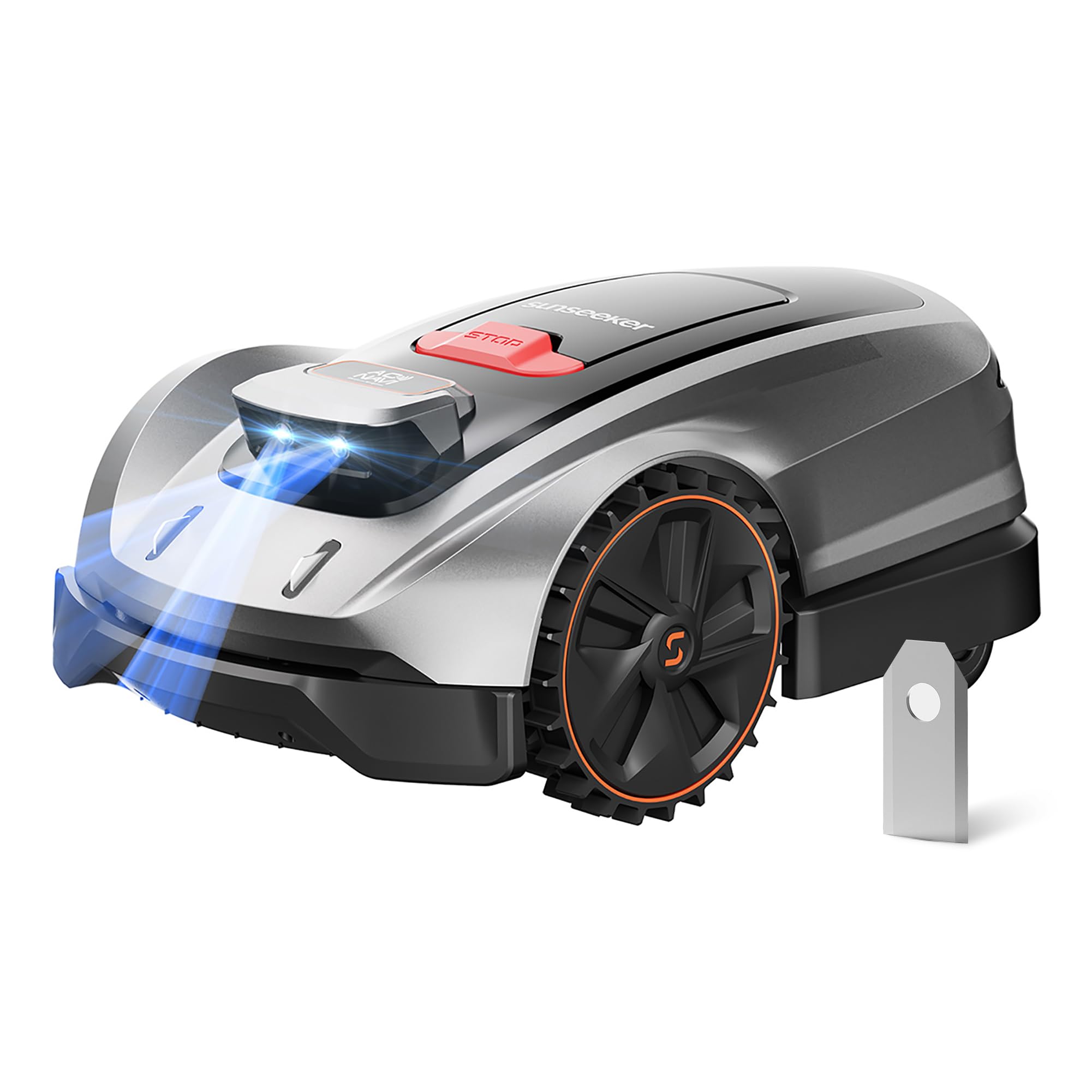
The edge specialist for tidy suburban yards with defined borders.
If your lawn has flower beds, fences, and walkways that demand clean lines, this mower focuses on that problem. Its ride-on-edge cutting uses an offset blade to get closer to hardscape and reduce the trimming you’ll do by hand. The 8-inch floating cut adjusts from 1.6 to 3.2 inches, giving you good range for seasonal changes.
It covers up to 0.3 acres across front, back, and side areas using RTK plus VSLAM navigation — a combination that creates a yard map and follows planned routes between common residential areas. In daylight, its camera and ultrasonic sensing detect common objects. It handles slopes up to 17° / 30% and lets you save 6 maps with zone-specific schedules.
Shoppers say the LUBA 2 cuts clean, even stripes when mowing up and down, and they praise the blade quality for staying sharp. Its navigation system gets strong feedback for dodging obstacles, and several owners say it “looks like a futuristic rover.” The main friction point is connectivity: signal can drop in certain areas, sometimes requiring a roof antenna mount. A few owners note it occasionally wanders toward curbs, and the plastic can show wear from falls.
Best if: you have a small-to-midsize yard with defined borders and you want the cleanest possible edges.
skip it if: your yard is mostly open with no edges to worry about — you’d be paying for a feature you don’t use.
9. WORX Landroid Vision WR320
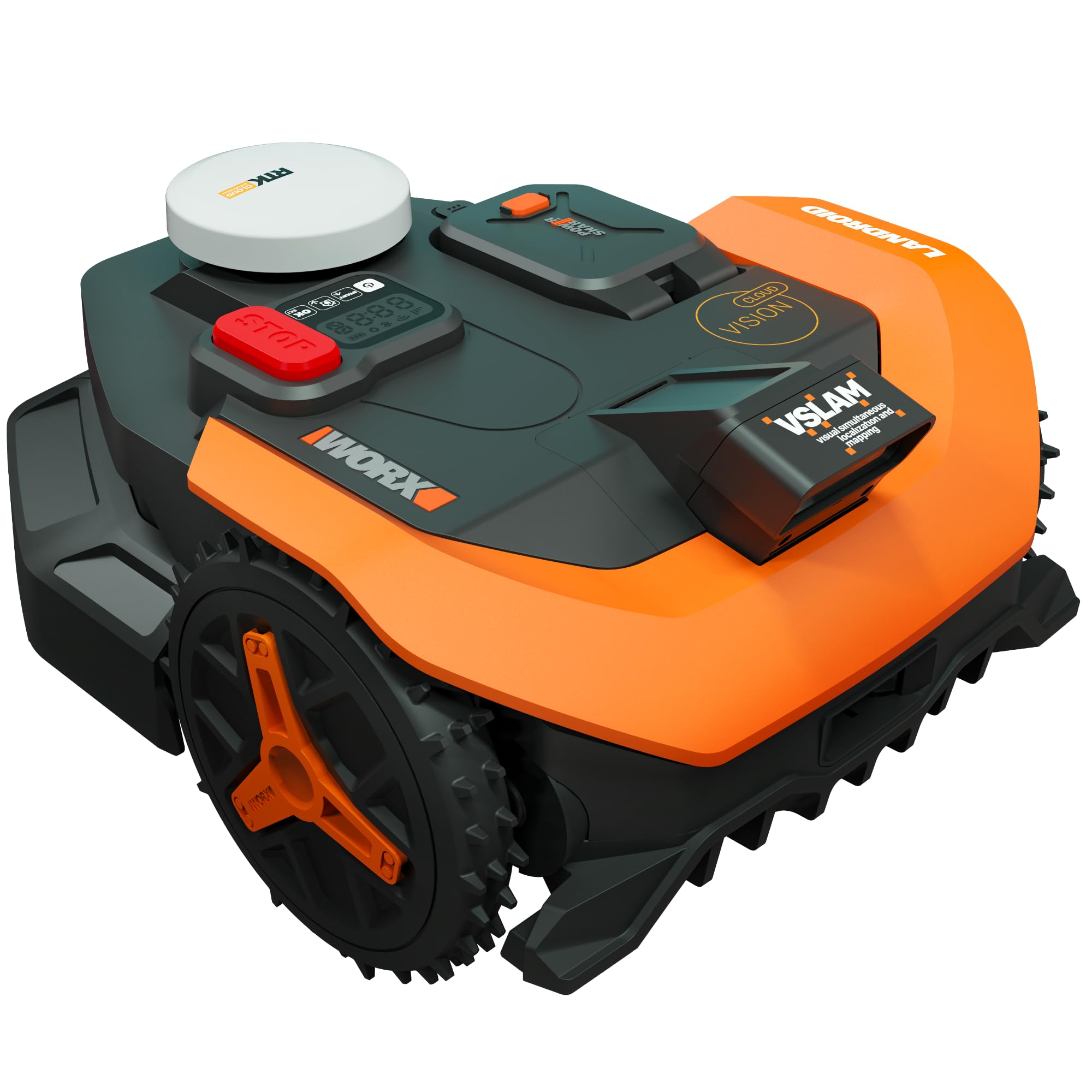
A no-perimeter-wire Landroid with cloud RTK and unlimited zones for bigger yards.
WORX brings its trusted Landroid name into the wire-free world with this model, and it’s aimed squarely at larger properties up to 1/2 acre. Its “Vision Cloud” system delivers commercial-grade RTK accuracy from the cloud, meaning no local antenna installation and no extra cloud fees. That’s a meaningful saving over rivals that charge for connectivity after the first year.
It handles up to 30% slopes and cuts at 8.7 inches wide — the widest among the non-premium picks here. The cutting height adjusts from 1.57 to 3.54 inches. Vision AI powers obstacle avoidance and edge-following, while V-SLAM sensor fusion takes over in shaded areas to maintain navigation. You get unlimited mowing zones with custom pathways and no-go areas, all managed from the app.
Owners who get it working love it — they report excellent cutting quality, quiet operation, and fast charging around an hour. The mapping feature works better than expected for many. However, setup gets mixed feedback: some find it simple, while others report difficulties without written instructions. A few owners describe the software as unreliable, with Wi-Fi/Bluetooth connectivity issues and occasional lockups. It also needs good daylight for the vision system, so low-light runs can produce errors.
The value play: you get a wide 8.7-inch cut and unlimited zones without paying a subscription for the RTK cloud service.
The gamble: software reliability is the most-discussed mixed point — your experience may depend heavily on your yard’s Wi-Fi coverage and your patience with setup.
10. eufy E15 Robotic Lawn Mower
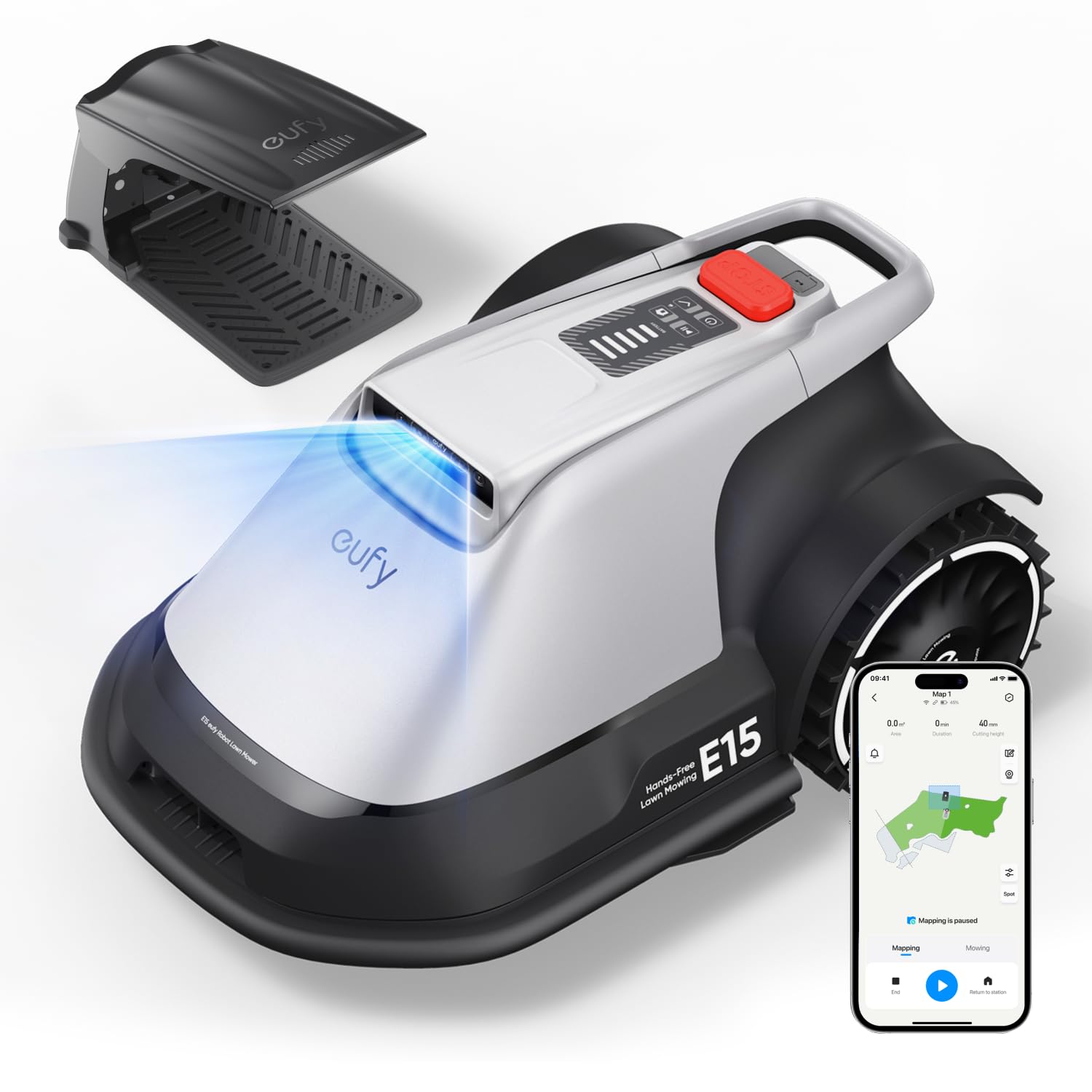
A wire-free, RTK-free mower that simplifies setup to just place, map, and go.
This is the simplest high-tech mower to set up because it doesn’t need any external station or RTK reference. Its Pure Vision Navigation uses stereo cameras and AI to see, map, and navigate entirely on its own — just place the base, open the app, and it figures out the rest. There’s no boundary wire to bury and no separate antenna to mount.
It’s designed for lawns up to 0.2 acres (about 8,700 sq ft) with slopes up to 18°. The cutting height adjusts from 1 to 3 inches, and the 8-inch cutting width with ride-on edge technology aims for clean corners. It features GPS anti-theft tracking and automatically recalls to the base during rain or low-light conditions, then resumes on schedule. The app lets you view live maps and adjust zones from anywhere.
Setup is a frequent praise point — one owner mapped a 840 sq ft area and mowed it in about 1.5 hours with 20% battery left. The obstacle avoidance is a highlight, with owners reporting it handles dog waste, sticks, and trees without issue. The recurring trade-off is mapping reliability: auto-map works best on full, lush grass, and some owners with sandy or partial lawns found the mapping frustratingly slow or unreliable. It also has notable limitations — it’s not suitable for St. Augustine grass or dense Zoysia, and it mows only in daylight.
Bottom line: for a small, flat, healthy lawn, this is the easiest path to hands-off mowing with the fewest setup headaches.
Caution: if your lawn is sandy, patchy, or has steep hills, you’ll hit the limits of a pure-vision system quickly.
Understanding the Specs
Slope Rating (Percent or Degrees)
This number tells you the steepest incline the mower can climb without stalling or slipping. A 45% grade means the mower climbs a hill that rises 45 feet for every 100 feet of horizontal distance — much steeper than it sounds. Most residential yards fall under 30%, but if you have a dramatic bank or terraced lawn, look for AWD models rated at 70% or higher.
Cutting Width & Height Range
Cutting width is how wide a strip the mower trims per pass — wider means fewer passes and faster coverage. Height range matters for lawn health: cutting too short stresses grass in summer heat. A range of 1.2 to 3.9 inches gives you the flexibility to keep grass longer during dry spells and shorter in spring.
FAQ
Will a programmable mower work on my lawn without a perimeter wire?
What is RTK and why does it matter for my mower?
How steep of a slope can a robot mower handle?
How long does it take to set up a wire-free robot mower?
Will a robot mower damage my lawn or get stuck often?
Can a programmable mower handle thick or overgrown grass?
What is a no-go zone and how do I set one up?
How much maintenance does a robot lawn mower need?
Final Thoughts: The Verdict
For most people, the programmable lawn mower winner is the ANTHBOT M5 because it delivers the best mix of wire-free convenience, smart obstacle avoidance, and slope capability at a price that doesn’t require a second mortgage. If you have a steep or large property, the Mammotion LUBA 2 AWD is the one to reach for. And if you’re on a tighter budget with a flat, small lawn, the eufy E15 offers the simplest path to hands-free weekends.
How We Picked
We do not accept paid placement. Every pick is matched to a real buyer and a real use-case; we do not hands-on test units.
Sources & Methodology
Specifications: manufacturer listings and product documentation. Review insights: verified customer reviews, as of August 2026. Pricing: not shown on this page (it changes often); check the current price via the retailer link.
As an Amazon Associate, Lawn Gear Lab earns from qualifying purchases. This does not affect which products we feature.