6 Best Professional Push Mower | Gas Power Without the Hype

Our readers keep the lights on and the potting soil stocked. As an Amazon Associate, I earn from qualifying purchases.

Specs are compiled from manufacturer listings and verified buyer reviews and can change over time — please confirm the key details on the product page before buying.

A gas push mower is your ticket out of tangled extension cords and battery swaps, but only if it starts on the first pull and chews through wet, overgrown grass without stalling. The real difference between a mower that fights you and one that finishes fast depends on three things: engine displacement (the cylinder size that creates torque), deck steel gauge (thickness that resists warping), and wheel diameter (how easily it rolls over bumps). Here is the short answer on which one to buy.

I’m Rikta — the founder and writer behind Lawn Gear Lab. This guide is built by comparing the manufacturers’ published specifications and the patterns across verified customer reviews, so you get each pick’s real strengths and trade-offs instead of marketing spin.

You are here because you want a straight answer on which professional push mower actually has the engine, deck, and build quality to handle weekly mowing on a property that does not take it easy on lawn equipment — no frills, no battery anxiety, just reliable gas power.
Our Picks at a Glance

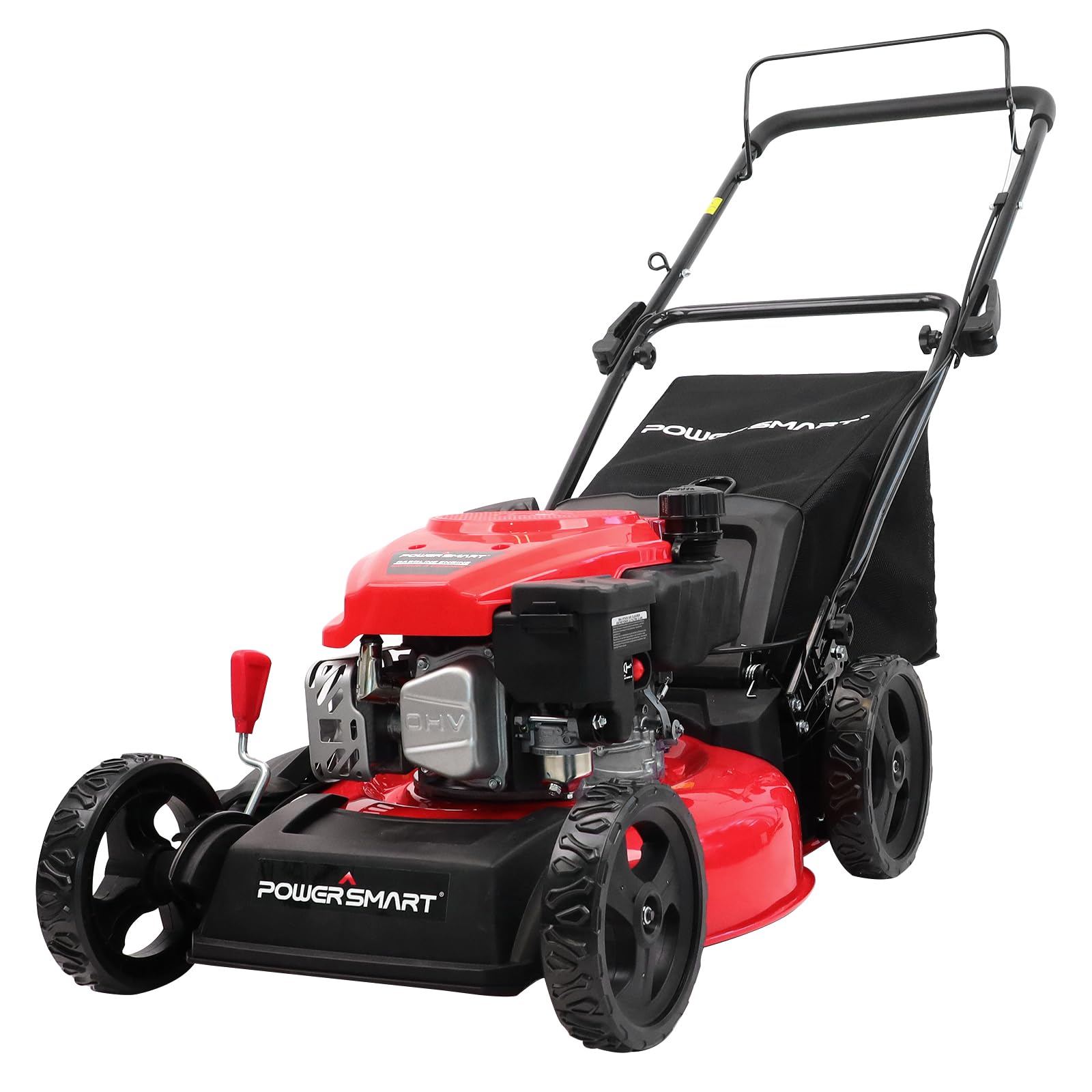
PowerSmart EasyCut 18-Inch Gas Lawn Mower
Best OverallPowerSmart EasyCut 18-Inch Gas Lawn Mower4.4★921 ratingsThe narrowest deck here (18 inches) lets you weave between flower beds and trees, and the handle folds without tools for compact storage — unlike the BILT HARD which requires unscrewing.Check Price on Amazon
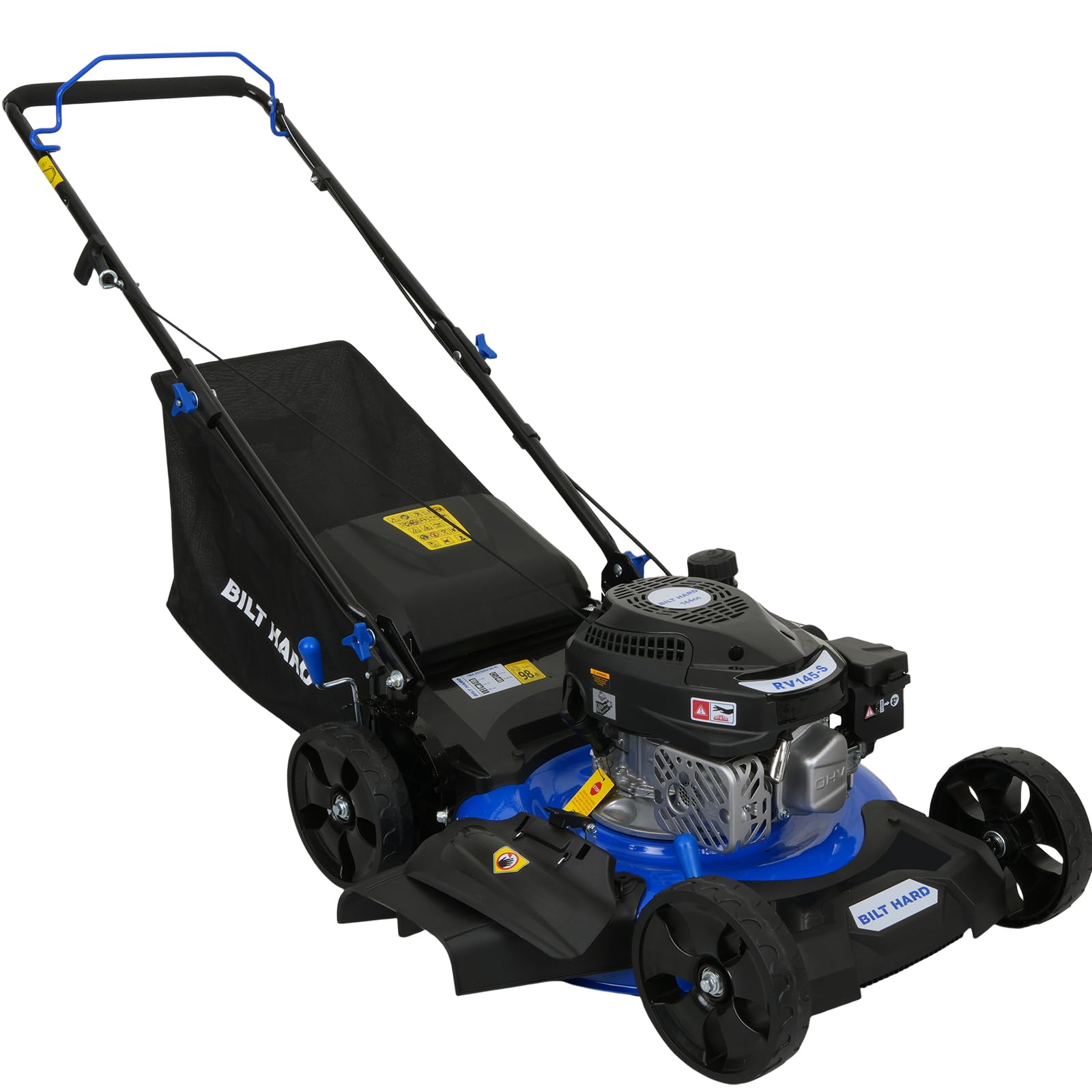
BILT HARD 21 Inch Lawn Mower Gas Powered
Top PerformerBILT HARD 21 Inch Lawn Mower Gas Powered4.1★433 ratingsThis gas mower gives you more height options than anything else here—8 positions from 1.2 to 3.75 inches—so you can dial in the exact cut for each season.Check Price on Amazon

How To Choose The Best Professional Push Mower

Every minute behind the handle counts when you mow for a living or care for a large yard. The right choice depends on a few key specs that separate a mower that fights back from one that gets the job done efficiently. Here is what matters most.

Cutting Width and Deck Material

Cut fewer passes and finish faster by choosing the right width. A 21-inch deck covers more ground per pass than an 18-inch model, which adds up to real time saved on any yard over a quarter acre. The deck material keeps the blade spinning true season after season: a reinforced steel deck resists warping and corrosion far better than stamped steel (thin pressed metal). This is the foundation of a durable push mower.

Engine Displacement and Cycle

Most professional-grade push mowers use a 144cc 4-cycle OHV (overhead valve) engine — meaning the valves sit above the piston for better fuel burn. The 4-cycle (or 4-stroke) design means you pour straight gas into the tank — no mixing oil, less smoke, and better fuel efficiency compared to older 2-stroke engines. The overhead valve layout gives you more torque (twisting force) at lower RPMs (revolutions per minute), which helps the mower power through tall or damp grass without bogging down. Stick with 144cc or larger for reliable cutting on any residential property.

Wheel Size and Maneuverability

Larger wheels, especially on the rear axle, make a huge difference in how easily the mower rolls over uneven ground, roots, and gentle slopes. Look for at least 7-inch front and 10-inch rear wheels. The bigger rear wheels reduce the rolling resistance and the force you need to push forward. A mower with 11-inch rear wheels, for example, will glide over bumps that stop a mower with 7-inch wheels dead in its tracks.

Cutting Height Range and Adjustability

A wide range of cutting heights lets you adapt to the season — a lower cut for spring cleanup, a mid-range setting for regular summer mowing, and a taller cut to protect the grass during hot, dry weather. The best mowers offer at least 6 positions, with a simple lever at each wheel so you set the height without tools. Look for a range from around 1.25 inches up to at least 3.75 inches to cover every condition your yard throws at you.

Quick Comparison

Model Best For Cutting Width Engine Height Positions Amazon
PowerSmart EasyCut 18-Inch★ Best Overall Compact handling for tight spaces 18 Inches 144cc 4-Stroke OHV 6 Amazon
BILT HARD 21-InchTop Performer Most adjustability & torque 21 Inches 144cc 4-Stroke (3.4 HP) 8 Amazon
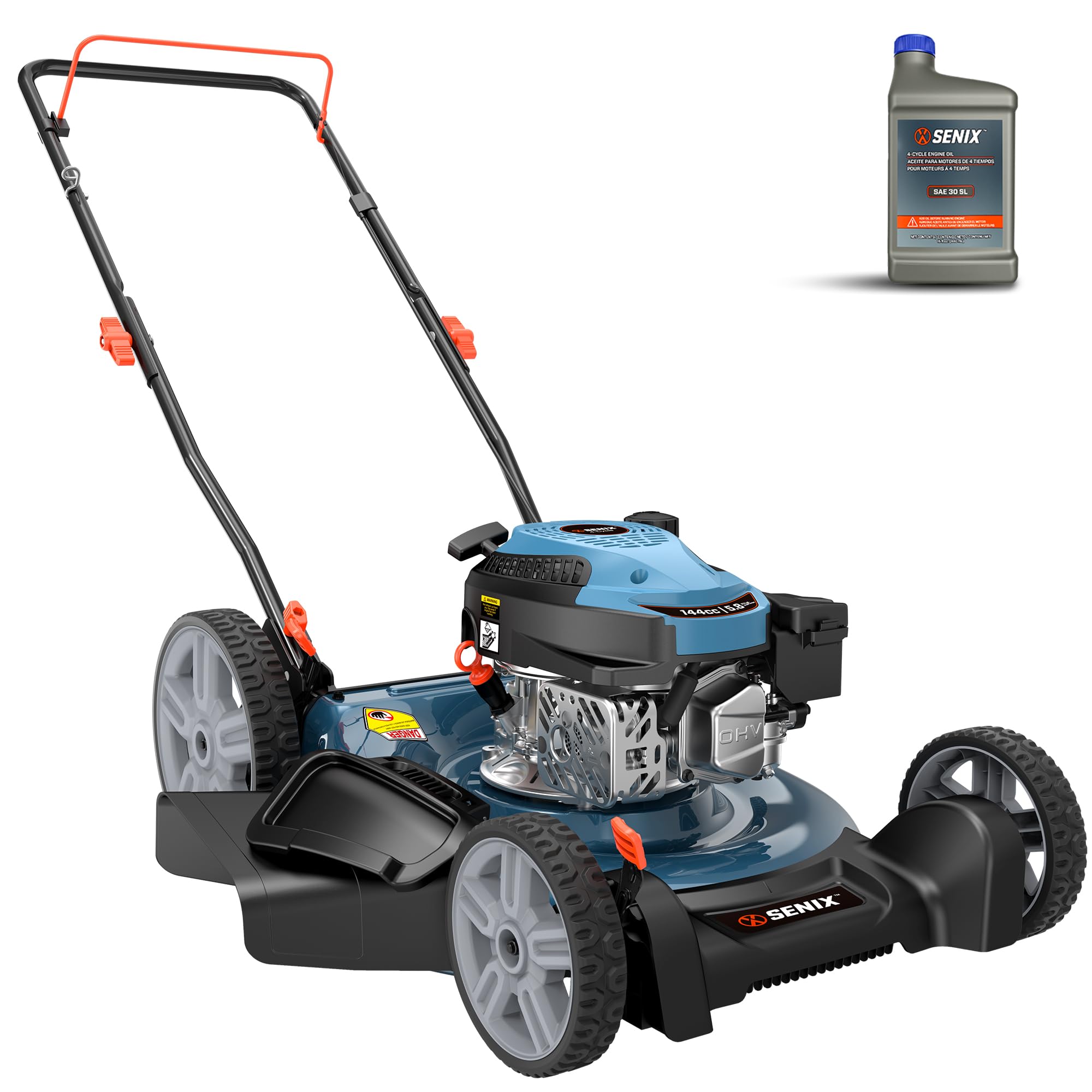
SENIX 21-Inch (L6) Easiest pushing on rough turf 21 Inches 144cc 4-Cycle 6 Amazon
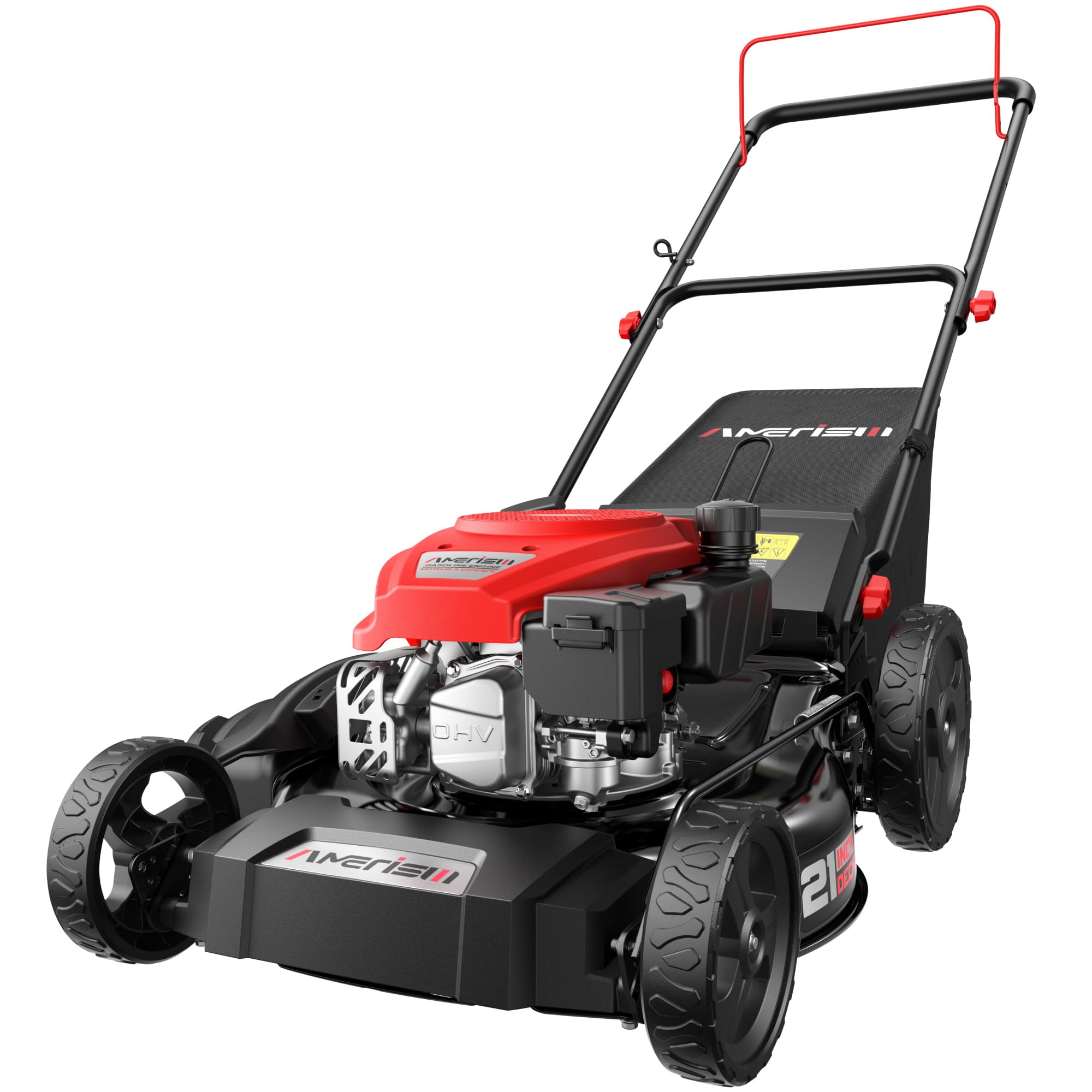
21″ Steel Deck (AMERISUN) Heavy-duty build & 3-in-1 21 Inches 144cc 4-Stroke OHV 6 Amazon
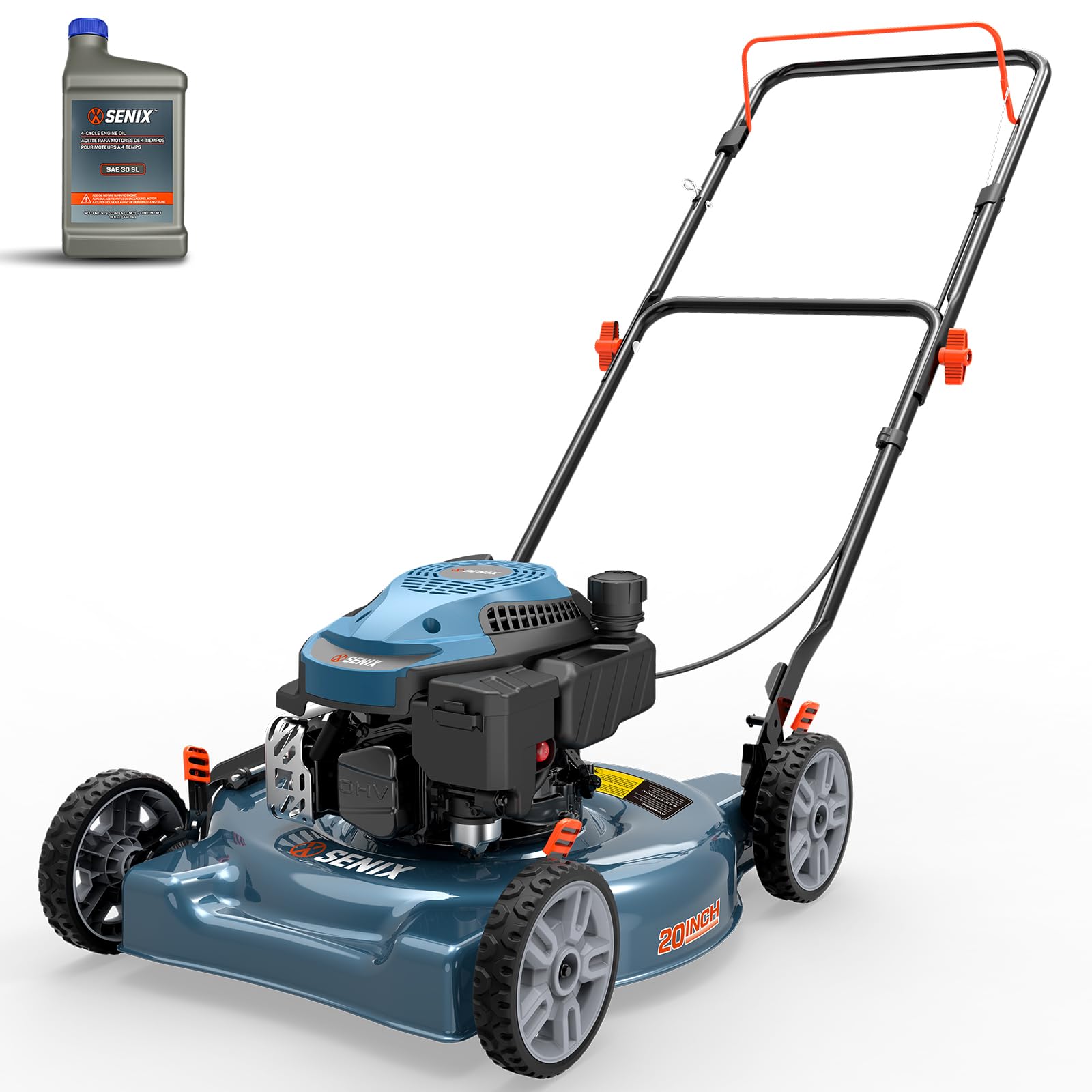
SENIX 20-Inch Lightest overall & budget-friendly 20 Inches 144cc 4-Cycle OHV 5 Amazon

In‑Depth Reviews

★ Best Overall

1. PowerSmart EasyCut 18-Inch Gas Lawn Mower

Our pick — over 4★ from 900+ verified ratings; the strongest balance of quality and price.

18″ Deck55 lbs

The narrowest deck here (18 inches) lets you weave between flower beds and trees, and the handle folds without tools for compact storage — unlike the BILT HARD which requires unscrewing.

The maker recommends this mower for properties up to 1/4 acre, where maneuverability matters more than raw speed. The 18-inch steel deck , compared to the 21-inch models, so you need more passes to cover the same area, but it fits into tighter corners. The 144cc 4-stroke OHV (overhead valve) engine and auto choke system are designed to start in 1-2 pulls. The 3-in-1 system (mulch, bag, side discharge) gives you full flexibility, and the 6-position height adjustment covers a good range. However, at 55 pounds, this mower is heavier than the 43.4-pound SENIX 20-inch despite having the smallest deck — a notable downside since that model is both lighter and wider. If you absolutely need tight turning and compact storage over efficiency, this is the one; otherwise, a 21-inch mower will save you time.

Space Saver

  • Foldable handle for compact storage — no tools required
  • 3-in-1 system (mulch, bag, side discharge) for versatile clipping management
  • Auto choke for reliable starts

Consider This

  • At 55 pounds, it is heavier than the 20-inch SENIX despite a smaller deck
  • 18-inch cut requires more passes to cover the same area as a 21-inch mower

Perfect for: a small, obstacle-filled yard where a narrow deck and foldable handle make storage and maneuvering easier than a wider mower.

Not the one for: anyone covering a quarter-acre or more — the extra passes and heavier weight will add time and effort compared to a 21-inch model.

Top Performer

2. BILT HARD 21 Inch Lawn Mower Gas Powered

21″ Deck8-Position Height

This gas mower gives you more height options than anything else here—8 positions from 1.2 to 3.75 inches—so you can dial in the exact cut for each season.

The BILT HARD earns the top spot because it combines the widest height range with a 144cc 4-stroke (straight gas, no oil mixing) engine rated at 3.4 HP and 5.75 ft.lb of torque (twisting force that keeps the blade spinning through thick grass without stalling). The 27.1 fl.oz (0.85-liter) fuel tank lets you cover medium to large yards on a single fill. Owners mention the mower is “amazingly easy to start,” often firing up on the first pull after priming, even after sitting in winter storage. The heavy-duty steel deck and oversized 10-inch wheels (front and rear) give you solid traction and roll smoothly over uneven ground — a clear improvement over the 7-inch wheels on the SENIX 20-inch. However, the handle does not fold; you have to unscrew it to collapse it for storage, which is less convenient than the PowerSmart EasyCut’s foldable design.

Cutting‑Edge Control

  • 8-position height adjustment (1.2″ to 3.75″) — most in this comparison
  • 3.4 HP / 5.75 ft.lb torque engine powers through dense growth
  • Oversized 10-inch wheels front and rear for superior traction
  • Includes grass bag, side chute, mulching plug, oil, and tools from the start

Heads‑Up

  • Handle does not fold for storage — requires unscrewing to collapse
  • A few reports of excessive vibration on some units

Reach for this if: you want the most height options (8 positions) and ample torque for a medium to large yard, all on a single fill of gas.

Look elsewhere if: compact storage is a priority — the non-folding handle takes up more garage space than foldable models.

Smooth Glide

3. SENIX 21-Inch Gas Lawn Mower (L6-01 Black)

11″ Rear WheelsDual‑Lever Height

You’ll spend less effort pushing this mower over rough ground than any other here, thanks to its 11-inch rear wheels.

The maker claims those 11-inch rear wheels reduce rolling resistance compared to standard 7-inch wheels (11 inches versus 7 inches), which translates to noticeably easier pushing over roots, rocks, and gentle slopes. The 144cc 4-cycle (gas-only, no oil mixing) engine handles up to half-acre lawns without stalling, and the 21-inch cutting deck covers more ground per pass than an 18-inch model (21 inches versus 18 inches) like the PowerSmart EasyCut — so you finish faster. The dual-lever height adjustment offers 6 positions from 1.25 inches to 3.75 inches, and you change it without any tools. Customers note it fires up on the first pull, and one owner notes it “ate up the tall grass for the first cut of the season” with no trouble. At 50 pounds, it is not the lightest, but the large rear wheels make it feel lighter than that number suggests — unlike the 68.3-pound AMERISUN. The two-year warranty adds confidence, though some reviewers point out customer support can be slow.

Ease of Motion

  • 11-inch high-rear wheels reduce pushing effort on bumpy terrain
  • 21-inch cutting deck covers 17% more ground per pass than an 18-inch deck
  • Dual-lever 6-position height adjustment — no tools needed
  • Quick assembly in under 30 minutes

Keep in Mind

  • At 50 pounds, it is mid-weight — not the lightest for carrying
  • Customer support responsiveness has mixed reviews

Your best bet for: tackling rough, uneven yards where standard 7-inch wheels would leave you straining against every bump.

Not the one for: buyers who need the lightest possible machine — the 20-inch SENIX is 6.6 pounds lighter.

Solid & Simple

4. 21″ Steel Deck Gas Lawn Mower (AMERISUN)

68.3 lbs1.4‑Bushel Bag

A reinforced steel deck (the thickest in this lineup) at 68.3 pounds gives you a mower that feels planted and built to last.

That weight is a trade-off: the reinforced steel deck resists warping and corrosion from rocks and sticks far longer than thinner stamped steel, but you will feel every pound on slopes. The 144cc 4-stroke OHV (overhead valve) engine uses an auto choke system — just prime and pull, no manual choke lever to fiddle with. The 21-inch cutting deck paired with a 10-inch high rear wheel and 7-inch front wheels creates a stable mowing platform. One buyer says it “went nonstop mowing a slightly overgrown yard of 3/4 of an acre” without stalling once. The 1.4-bushel (about 50-liter) grass catcher is larger than standard bags, so you empty it less often. The single-lever 6-position height adjustment goes from 1.5 inches to 3.9 inches — the tallest maximum cut in this roundup, great for protecting grass during hot, dry weather. A significant catch: several shoppers say trouble returning defective units, having to deal directly with the manufacturer for parts instead of a straight replacement.

Built Tough

  • Reinforced steel deck and auto choke for reliable starting
  • Highest maximum cutting height in this list (3.9 inches)
  • 1.4-bushel bag holds more clippings before needing emptying
  • Double ball bearings on wheels for smooth rolling

Watch Out For

  • Heaviest pick at 68.3 pounds — hard to push on steep slopes
  • Return policy challenges reported by some buyers

Choose this if: you prioritize a rugged steel deck and a tall maximum cut height (3.9 inches) for summer lawn protection.

skip it if: you need a lighter mower for hilly terrain or want a low-maintenance return policy — the 50-pound SENIX is easier to manage.

Light & Nimble

5. SENIX 20 inch Gas Push Lawn Mower (LSPG-L5-001A)

43.4 lbs20″ Cut

At 43.4 pounds, this is the lightest gas push mower here — lighter than the PowerSmart EasyCut 18-inch at 55 pounds — making it the easiest to lift, turn, and push through tight spots.

The 144cc 4-cycle OHV (overhead valve) engine still delivers reliable power, and the 20-inch cutting width covers more ground per pass than a 16-inch model (20 inches versus 16 inches), according to the manufacturer’s own comparison. Front and rear wheels are both 7 inches — adequate for flat to gently sloped lawns but noticeably less capable over bumps than the 11-inch rear wheels on the SENIX 21-inch (L6-01). One buyer sums it up: “It takes me a little while to get the job done because of the smaller deck, but it cuts well, its lightweight, easy to maneuver and does very well on gas.” The 5-position cutting height adjustment (1.25–3.75 inches) offers less granularity than the 6- or 8-position competitors, though it covers the same overall range. The steel deck resists corrosion, and customers note a Briggs & Stratton engine (a well-known reliable powerplant). Assembly instructions are reportedly poor, so expect to spend extra time figuring out the setup.

Why It Wins

  • Lightest in the roundup at 43.4 pounds — ideal for carrying or tight yards
  • Briggs & Stratton engine noted in reviews for reliability
  • Fuel-efficient (4-cycle design) and lower emissions than 2-stroke
  • Steel deck resists corrosion

Trade‑offs

  • Smaller 20-inch cut means more passes than a 21-inch mower
  • Only 5 height positions — less adjustability than 6- or 8-position models
  • Assembly instructions are difficult to follow

Best for: the homeowner who wants the lightest gas mower possible for a small, flat yard and values maneuverability over maximum cutting width.

Not for: anyone with a large or uneven property — the smaller deck and smaller wheels will slow you down and require more effort on bumps.

Understanding the Specs

Engine Displacement & Cycle

The “144cc” number you see on most professional push mowers refers to the engine’s displacement — the total volume of the cylinders, measured in cubic centimeters. A larger displacement generally means more torque (twisting force that keeps the blade spinning through thick grass without bogging down). A “4-cycle” or “4-stroke” engine means you pour straight gasoline into the tank (no mixing with oil), and it runs cleaner and more efficiently than the older 2-stroke design. The OHV (overhead valve) layout directs the fuel-air mixture more efficiently, giving you better power at lower engine speeds (RPMs) — exactly what you want when the grass gets tall and thick.

Cutting Height Adjustment

The number of height positions (5, 6, or 8) determines how precisely you can set the blade height. A wider range — from around 1.2 inches up to 3.9 inches — lets you adapt to grass conditions throughout the year. Lower cuts in spring remove winter debris and encourage dense growth, mid-range cuts (around 2.5–3 inches) are ideal for regular summer mowing, and taller cuts (3.5 inches and up) shade the soil and protect grass roots during hot, dry weather. The best mowers let you change the height with a simple lever at each wheel — no wrenches needed — so you can adjust on the fly as you move between shaded and sunny parts of the yard.

FAQ

Is a 144cc engine powerful enough for a professional push mower?
Yes, a 144cc 4-cycle engine is the standard powerplant for residential and light professional push mowers. It provides enough torque (typically around 5.75 ft.lb) to cut through thick grass and handle gentle slopes. For yards up to half an acre, a 144cc engine is perfectly adequate. Heavier commercial mowers often use 160cc or 190cc engines, but those are significantly heavier and more expensive.
What is the difference between 2-in-1 and 3-in-1 mowers?
A 2-in-1 mower allows you to switch between mulching (chopping clippings into fine pieces that return nutrients to the soil) and side discharge (blowing clippings out the side onto the lawn). A 3-in-1 adds rear bagging, which collects clippings in a grass catcher bag for disposal. If you prefer a clean, clippings-free lawn, look for a 3-in-1 mower. If you are fine with mulching or side discharge, a 2-in-1 saves some weight and complexity.
How do I know if a push mower will be easy to push on my sloped yard?
The two biggest factors are the mower’s weight and its rear wheel size. Lighter mowers (under 50 pounds) are easier to push uphill. Larger rear wheels — 10 inches or 11 inches — roll over bumps and roots with much less effort than 7-inch wheels. If your yard has significant slopes, prioritize a mower with an 11-inch rear wheel and a weight under 55 pounds.
Should I buy a push mower with a Briggs & Stratton engine?
Briggs & Stratton is a well-known and widely respected engine manufacturer. Mowers that use a Briggs & Stratton engine — such as some SENIX models — are generally considered reliable because parts and service are widely available. Many professional landscapers use them. However, the engine brand alone does not guarantee the quality of the deck, wheels, or overall build. Look at the mower as a whole.
How often do I need to change the oil in a 4-cycle push mower?
For a new 4-cycle gas mower, you should change the oil after the first 5 hours of use to remove any metal shavings from the break-in period. After that, change the oil every 25 hours of operation or at the start of each mowing season — whichever comes first. Always check the oil level before each use using the dipstick.
What size cutting deck is best for a push mower?
The three most common sizes are 18 inches, 20 inches, and 21 inches. A 21-inch deck is ideal for efficiency on medium to large yards because it covers more ground per pass. A 20-inch deck offers a good balance of speed and maneuverability. An 18-inch deck is best for small, obstacle-filled yards where tight turning and storage space are more important than raw speed.
Can I use a push mower on wet grass?
It is not recommended. Wet grass clumps together, clogging the deck and chute, and leaves uneven clumps on the lawn that can smother the grass. Many mowers, especially those with side discharge, struggle with wet grass. If you must mow wet grass, set the cutting height to the highest setting and only take half-width passes to reduce clogging.
How do I winterize my gas push mower?
At the end of the mowing season, run the engine until the fuel tank is empty (or add a fuel stabilizer if you leave gas in it). Change the oil, clean or replace the air filter, remove the blade for sharpening, and store the mower in a dry place. If the mower has a steel deck, consider wiping it down with a light oil to prevent rust.
What does “OHV” mean on a mower engine?
OHV stands for “overhead valve.” In an OHV engine, the valves that let fuel in and exhaust out are located in the cylinder head above the piston, rather than in the engine block. This design improves fuel combustion efficiency, produces more torque at lower RPMs, and runs cooler than older flathead (side-valve) engines. Most professional-grade push mowers use OHV engines.
Is a steel deck better than a plastic deck on a push mower?
Yes, a steel deck is significantly more durable and long-lasting than a plastic deck. Steel resists cracking, warping, and damage from rocks and sticks. It is heavier, but that weight also helps stabilize the mower on uneven ground. All of the mowers in this guide use a steel deck, which is the minimum standard for a professional-grade push mower.

Final Thoughts: The Verdict

For the majority of shoppers, the professional push mower winner is the BILT HARD 21-Inch because it combines the widest height range (8 positions from 1.2 to 3.75 inches) with a powerful 144cc engine (3.4 HP / 5.75 ft.lb torque) and a heavy-duty steel deck — all at a price that undercuts many 21-inch competitors. If you want the easiest pushing experience on rough terrain, grab the SENIX 21-Inch (L6-01) with its 11-inch rear wheels that the maker says reduce rolling resistance by 30%. And for a compact, budget-friendly option that fits small yards and tight storage, the SENIX 20-Inch gives you a reliable 144cc engine at just 43.4 pounds — the lightest in the roundup.

How We Picked

We do not accept paid placement. Every pick is matched to a real buyer and a real use-case; we do not hands-on test units.

Sources & Methodology

Specifications: manufacturer listings and product documentation. Review insights: verified customer reviews, as of July 2026. Pricing: not shown on this page (it changes often); check the current price via the retailer link.

As an Amazon Associate, Lawn Gear Lab earns from qualifying purchases. This does not affect which products we feature.

Related Guides

Please use a real email you check. If it's fake or mistyped, your message won't reach us and we can't reply — wrong addresses are rejected automatically.