
Specs are compiled from manufacturer listings and verified buyer reviews and can change over time — please confirm the key details on the product page before buying.
If you have ever fought a thick branch halfway up a tree and ended up with sore arms and a ragged cut, you know the real test of a lopper is not the twigs at eye level. You need a professional lopper that multiplies your strength, stays sharp through a full season of cutting, and does not leave your arms throbbing midway through the job. This article looks at the specific steel alloys, ratcheting gears (mechanisms that cut in steps to reduce effort), and handle lengths that actually make the difference between a clean snip and a wrestling match with a tree.
I’m Rikta — the founder and writer behind Lawn Gear Lab. This guide is built by comparing the manufacturers’ published specifications and the patterns across verified customer reviews, so you get each pick’s real strengths and trade-offs instead of marketing spin.
Clearing storm damage, maintaining an orchard, or just wanting to stop fighting with overgrown shrubs all hinge on one thing: matching the cutting mechanism and handle reach to your workload. This breakdown of the professional loppers worth your time and budget gives you exactly that.
Our Picks at a Glance


How To Choose The Best Professional Loppers
Picking the right lopper depends on matching the blade type and cutting mechanism to the wood you handle most often. A bypass blade (one sharp blade slides past a thicker hook, like scissors) is your go-to for green, living branches because it makes a clean, smooth cut that heals faster—so your fruit tree or shrub recovers quickly. An anvil blade (a single sharp blade pushes down onto a flat metal surface) crushes the branch against that surface and is better for dead, dry, or very hard wood where a little crushing does not matter. If you regularly cut branches thicker than 1.5 inches, a ratcheting or compound-action mechanism (a gear or lever system that multiplies your force) is a standout—it multiplies your force in steps so you are not fighting the branch at the end of the cut, which means you cut thicker wood with less hand strain.
Handle Length and Reach
The length of the handle determines both your reach and the leverage you can apply. A 26-inch handle gives you good portability and is easier to control for overhead cuts—so you can reach high branches from a ladder—but a 33-inch handle provides significantly more leverage for thicker branches near the ground, making it easier to slice through a 2-inch limb in one squeeze. If you work on a variety of trees, a telescoping handle (one that extends and locks at different lengths) that extends from 28 to 41 inches gives you the best of both worlds—short for control, long for reach—without needing a second tool.
Blade Material and Coating
High-carbon steel blades (like SK5 or SK-5, a type of hardened tool steel) hold an edge far longer than standard stainless steel and can be sharpened repeatedly, which is a must for professional-grade use so you are not buying new loppers every year. A Teflon or non-stick coating is worth looking for because it prevents sap and debris from building up on the blade, which reduces friction and keeps the cut easy slick through gummy branches. Aluminum or forged steel handles offer a good balance of weight and strength, with aluminum being lighter for overhead work and steel being more sturdy for heavy, ground-level cutting.
Quick Comparison
| Model | Best For | Cutting Width | Handle Length | Weight | Amazon |
|---|---|---|---|---|---|
| Jardineer Ratchet Anvil★ Best Overall | Budget Power for Dry Wood | 2 Inches | 30.5″ | 4.99 lbs | Amazon |
| Corona 33″ BypassAlso Great | Best Overall Power | 2 Inches | 33″ | 4.3 lbs | Amazon |
| FELCO F211-60 | Premium Precision | 1.2 Inches | 24″ | 1.7 lbs (est) | Amazon |
| Corona 26″ MAXFORGED | Lightweight Orchard Work | 2.75 Inches | 26″ | 2.4 lbs | Amazon |
| Kings County Tools | Double Ratcheting Reach | 2 Inches | 26″ – 40″ | 3.75 lbs | Amazon |
| STEELHEAD Gear-Bypass | Adjustable Leverage | 1.38 Inches | 27″ – 40″ | 3.0 lbs (est) | Amazon |
| YRTSH Compound Action | Light Telescoping Reach | 2 Inches | 28″ – 41″ | 3.2 lbs (est) | Amazon |
In‑Depth Reviews
1. Jardineer Ratchet Anvil Loppers – 30-Inch with 2″ Cutting Capacity
Our pick — over 4.5★ from 950+ verified ratings; the strongest balance of quality and price.
An anvil ratcheter that turns dead dry hardwood into manageable cuts with every squeeze.
If your yard is full of dead, dry branches that regular loppers struggle with, the Jardineer’s ratchet anvil mechanism (an anvil blade that crushes wood against a flat plate, with a gear that multiplies force in stages) is built specifically for that. The anvil design crushes the branch against a flat surface, and the ratcheting action multiplies your force with each squeeze, so you can cut through branches up to 2 inches thick without needing to swing or jerk the tool—perfect for clearing storm-killed limbs from the ground. The SK5 carbon steel blade (a tough tool steel) is coated with anti-rust Teflon to stay sharp and resist sticking, and it even comes with an extra SK5 spare blade to extend the tool’s life.
One owner reported owning these loppers for 4 years on a large Florida Keys lot with over 100 trees and plants, praising the extra blade as “real handy” and saying they simply sharpen it on a grinder or file. The 30-inch handle, made from thickened steel, provides good reach for high branches without needing a ladder.
The trade-off here is notable: at 4.99 pounds, the Jardineer is the heaviest lopper in this lineup—16% heavier than the Corona 33-inch, which is 4.3 pounds. That extra weight can be fatiguing for extended overhead use. Additionally, this is an anvil style, so it is not ideal for green, living branches where you want a clean, non-crushing cut. For the right job (dead wood, dry cleanup), it punches above its price point.
Biggest advantages
- Ratchet anvil system is perfect for dead, thick, and dry hardwood.
- Includes an extra SK5 spare blade for long-term service.
- Solid 30-inch steel handle provides good leverage.
A limitation
- At nearly 5 pounds, it is the heaviest lopper here—tiring for overhead use.
- Anvil blade crushes wood, not ideal for green pruning where cut quality matters.
Best for: Heavy brush clearing and deadwood cleanup where crushing the branch is fine and you want a ratchet boost for thick hardwood.
Avoid if: You prune live fruit trees or ornamentals—the anvil cut will crush the branch and harm the plant’s healing.
2. Corona Tools 33″ Bypass Loppers – Heavy-Duty Branch Cutter with DualLINK
The 33-inch lever that multiplies your power without wearing you out.
This Corona model delivers the best balance of cutting force and comfort for serious yard work. The DualLINK MAXFORGED mechanism (a linkage system that multiplies the force you apply to the handles) increases leverage so you can slice through branches up to 2 inches thick with less effort from your own arms—so you can finish a big trimming job without your shoulders screaming. The 33-inch length gives you both extended reach for higher branches and the leverage to handle tough, woody growth without needing to muscle through it.
Buyers report long-term durability here. One reviewer noted inheriting a set of loppers from their father that still gets the job done, crediting the Corona brand’s reputation for toughness. The steel blades are precision-ground and fully forged (made by heating and hammering metal for extra strength) to stay sharp, while the cushioned grips and built-in impact-reducing bumpers (rubber pads that soak up shock at the end of each cut) minimize hand and arm fatigue during extended use. At 4.3 pounds, it is heavier than the shorter FELCO F211-60 (which is 1.7 pounds), but the extra leverage makes that weight worth it for thick branches.
The trade-off is that at 33 inches long, it is not the most portable tool for quick jobs, and it lacks a telescoping handle. This is for you if you mostly work on branches at chest height or below and want the most reliable cutting power per squeeze.
What stands out
- DualLINK mechanism multiplies cutting force noticeably.
- Forged steel blades resist bending and hold their edge over time.
- Impact-reducing bumpers keep your hands from taking a beating.
A consideration
- Fixed 33-inch length is awkward for overhead precision work.
- A bit heavier than shorter or aluminum-handled competitors.
The right call if: You need a one-tool solution for heavy-duty trimming and landscape maintenance where maximum leverage matters more than portability.
Think twice if: You primarily prune high branches from a ladder and need a lighter, telescoping handle for overhead accuracy.
3. FELCO F211-60 Swiss Made Loppers – 24″ Lightweight Precision Loppers
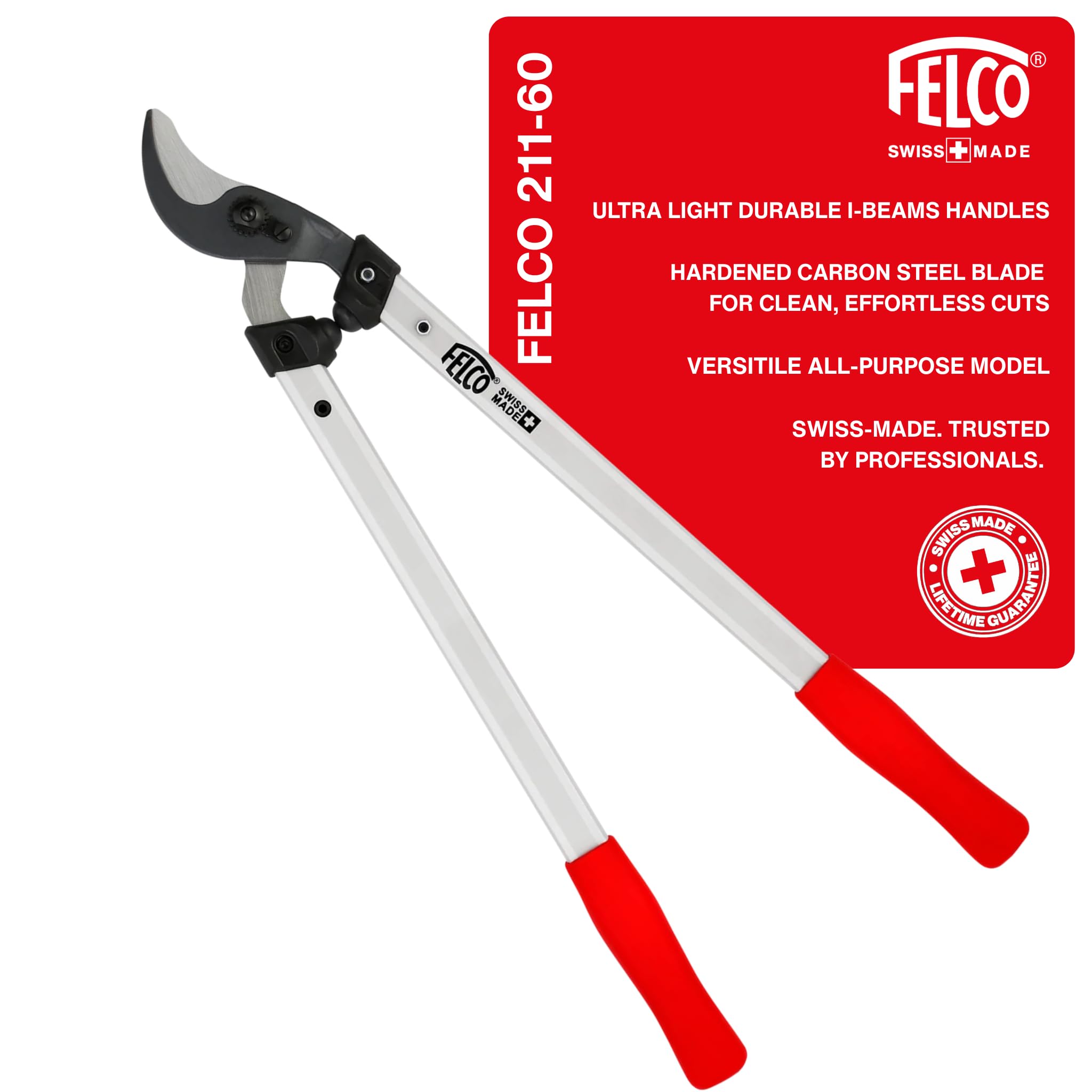
Swiss engineering that turns a cutting tool into a precise instrument.
If your work demands clean, surgical cuts on green wood—so the branch heals without dieback—and you value a tool that feels like an extension of your hand, this 24-inch lopper from FELCO is in a class of its own. The curved bypass blade made from carbon steel holds its edge far longer than standard steel, and the lightweight aluminum I-beam handles (shaped like an ‘I’ for maximum strength with minimum weight) keep the total weight down at just 1.7 pounds, so you can work overhead without your arms getting heavy—ideal for all-day pruning in a rose garden or vineyard.
One experienced reviewer noted that after using loppers for months straight in youth work programs, the FELCO 211-60 outperforms any they had used in the past, praising its sharpness and lightness. The micrometric adjustment mechanism (a tiny screw that lets you fine-tune blade alignment) allows you to replace or adjust the blade easily, and every part is replaceable and maintainable, so you are not throwing away a whole tool because of one worn bolt. Buyers also mention that the carbon steel blades require a light coat of oil when not in use to prevent corrosion—a small maintenance step for a premium tool that is not needed with the non-stick Teflon coating on the Jardineer.
The catch is that the cutting width is 1.2 inches, which is smaller than many competitors. It is not designed for heavy 2-inch dead limbs. For rose bushes, small orchard trees, and precise pruning where you want the branch to heal cleanly, this is the pick.
Why it excels
- Full carbon steel blade with exceptional edge retention.
- Ultra-light aluminum handles reduce fatigue during overhead work.
- All parts are replaceable and maintainable for years of service.
The limit
- 1.2-inch cutting capacity is too small for thick, dead hardwood branches.
- Higher upfront cost compared to most loppers.
Grab this for: Precision pruning on fruit trees, roses, and ornamental shrubs where cut quality and tool balance matter most.
Pass on it if: You need to regularly cut branches thicker than 1.5 inches—this tool is not built for brute force.
4. Corona Tools 26-inch Branch Cutter MAXFORGED Orchard Loppers (AL 8442)
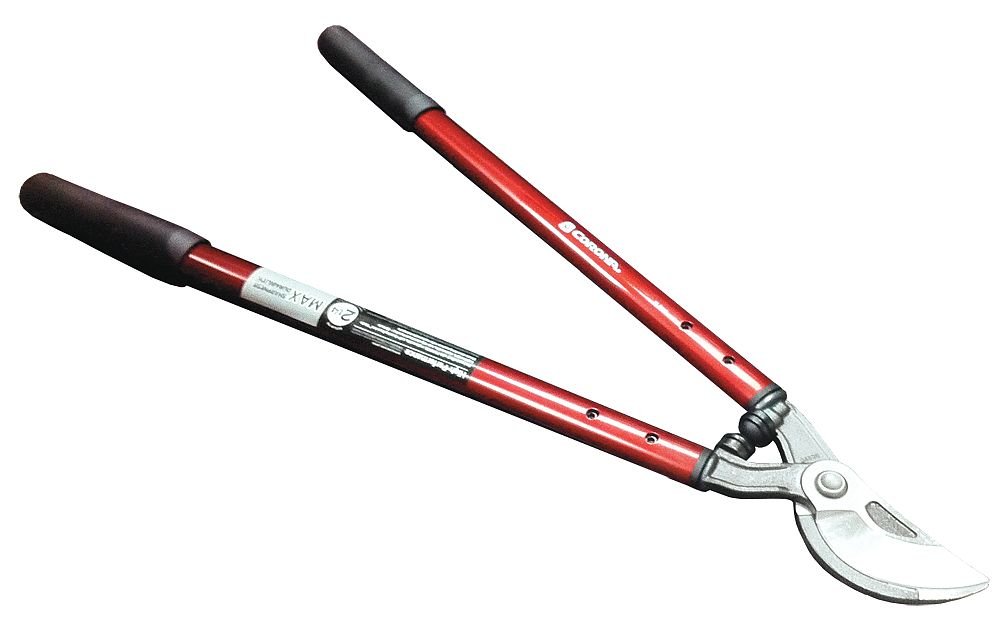
An orchard-sized capacity in a lightweight aluminum frame that reaches its target all day.
This model packs the largest cutting capacity on this list—at 2.75 inches—into a relatively light 2.4-pound package thanks to its high-strength elliptical aluminum handles. The MAXFORGED forging process (compacting steel molecules into a denser, tougher blade) makes a blade that holds a sharp edge longer and can be resharpened when it finally dulls—so you get years of cuts without buying a new tool. The forged, slant-ground hook includes a self-cleaning deep sap groove (a channel that funnels sticky tree sap away from the pivot point) so sticky pine or cherry residue does not gum up your cut.
One buyer mentioned their pair lasted 11 years before breaking from abuse, which speaks to the build quality. Another reviewer noted that it slices through green bamboo easily when used with precision rather than brute force. The 26-inch handle length makes it highly maneuverable for orchard work and less fatiguing for overhead cuts than longer models like the Corona 33-inch, though you lose some leverage compared to that model.
Where it falls short is that some users found it struggles with branches a full 1-inch thick, despite the listed 2.75-inch capacity—it performs best on green wood up to about 1.5 inches. For an orchard, vineyard, or serious hobbyist who prioritizes lightweight precision over raw power, this is a strong choice. The fixed 26-inch handle means you need to get closer to the branch compared to a telescoping model like the YRTSH, which extends to 41 inches.
Key strengths
- Industry-leading 2.75-inch cutting capacity in a lightweight design.
- Self-cleaning sap groove prevents blade sticking.
- Long-lasting MAXFORGED blade can be resharpened.
Consider this
- Some users find it struggles on full 2-inch hardwood despite the high spec.
- Fixed 26-inch handle means less leverage for ground-level thick branches.
Best suited for: Orchard pruning, orchard owners, and serious gardeners who need a light, precise tool for green wood and can avoid over-stressing the blade on oversized dead limbs.
Look elsewhere if: You need a ratcheting mechanism for arthritic hands or primarily cut thick, dead branches near the ground.
5. Kings County Tools Double Ratcheting Bypass Loppers – 26″ to 40″ Extendable
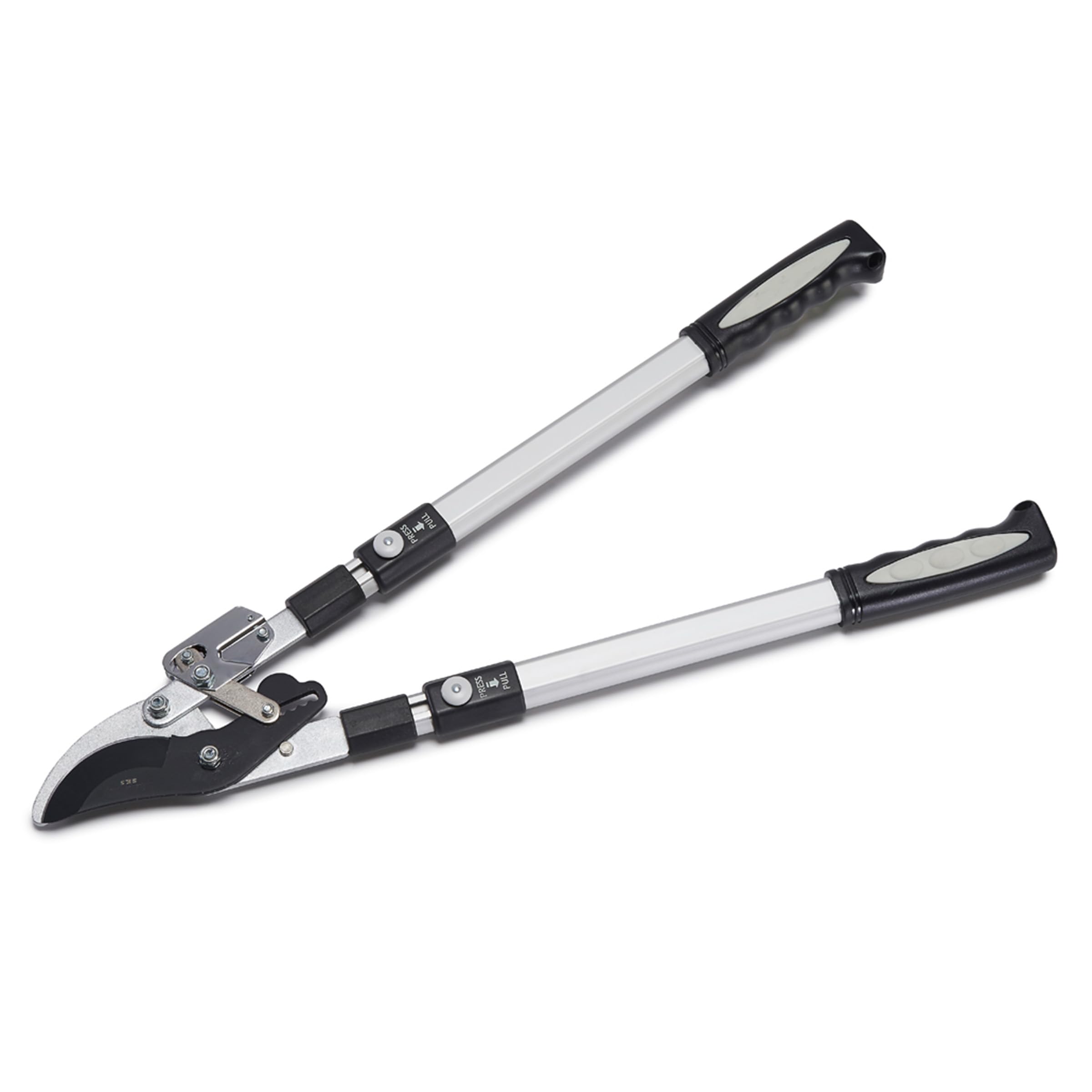
Double ratcheting action that cuts through thick branches step by step, saving your strength.
Ratcheting loppers are the secret weapon for anyone who struggles with cutting force, and the Kings County model takes it further with a double ratcheting bypass mechanism (two sets of gears that move the blade deeper into the branch with each squeeze). Each squeeze of the handles moves the blade deeper into the branch in steps, so you can cut through a 2-inch limb without needing one massive burst of strength—perfect for the gardener with arthritis or anyone pruning for hours. The telescoping handles extend from 26 inches to 40 inches, giving you flexibility to reach high limbs or collapse it down for storage.
Owners mention that the ratcheting action provides extra torque that makes cutting limbs very easy, with one user calling it a perfect tool for gardeners and homeowners. The tool is made from alloy steel and weighs 3.75 pounds, which is moderate for an extendable model. However, one reviewer did mention that the blade chipped on a small branch during a third use, so while the mechanism is strong, the blade quality may not match the premium brands like FELCO or Corona. That is the trade-off for the power-multiplying system and telescoping reach at this price.
Reasons to pick
- Double ratcheting mechanism lets you cut thick branches with less force.
- Telescoping handles give you 14 inches of extra reach.
- Bypass blade design is ideal for green wood and clean cuts.
Points to note
- Some reports of blade chipping on hard wood.
- Heavier than other telescoping models on the market.
Reach for this if: You have a mix of overhead branches and ground-level thick growth and need a ratcheting boost to get through tough cuts.
skip it if: You prioritize a premium blade that will never chip—this is a great value tool with a slight durability trade-off.
6. STEELHEAD Heavy-Duty 27-40″ Adjustable Gear-Bypass Limb & Branch Lopper

A telescoping gear-bypass lopper that swaps brute force for smart leverage.
This model stands out by combining a ratcheting gear-bypass mechanism (a gear system that multiplies your squeezing force) with tool-less telescoping arms that extend from 27 to 40 inches. The gear-bypass fulcrum (the pivot point that transfers your force to the blade) gives you up to 3 times the cutting force at the blade, so cutting through stubborn 1.38-inch branches requires much less effort from your hands and shoulders—your grip stays fresh for the whole tree. The high-carbon steel blade has a non-stick, corrosion-resistant finish that prevents sap and gunk from building up.
Buyers highlight the positive locking feature—a pin-lock system (a metal pin that clicks into holes along the handle) that customers note is much more durable than the twist-lock types found on cheaper tools. One reviewer called them “nice, positive locking feature, light weight, sharp.” The ergonomic DuraGrip handles are overmolded (a rubbery coating bonded over the hard plastic) to fit a wide range of hand sizes, which reduces slippage during wet or sweaty work. Compared to the Kings County Tools model, the STEELHEAD is lighter and has a smaller cutting width (1.38 vs 2 inches), which means it is better suited for medium branches rather than the thickest limbs.
If most of your work is on branches smaller than 1.5 inches and you value a lightweight, adjustable tool, this is a strong mid-range pick.
What works well
- Gear-bypass mechanism provides up to 3x cutting force.
- Tool-less telescoping adjust quickly to different heights.
- Positive pin-lock handle system is more durable than twist locks.
One caveat
- 1.38-inch cutting width is half the capacity of top competitors.
- Not designed for heavy, 2-inch plus dead limbs.
Ideal for: Homeowners and gardeners who need a versatile, adjustable lopper for medium-sized branches and overhead pruning without the bulk of a fixed long handle.
Not the pick for: Professional arborists who regularly cut 2-inch thick hardwood branches—you will max out this tool’s capacity too often.
7. YRTSH Loppers Branch Cutter Heavy Duty Tree Trimmer, Extendable 28-41″
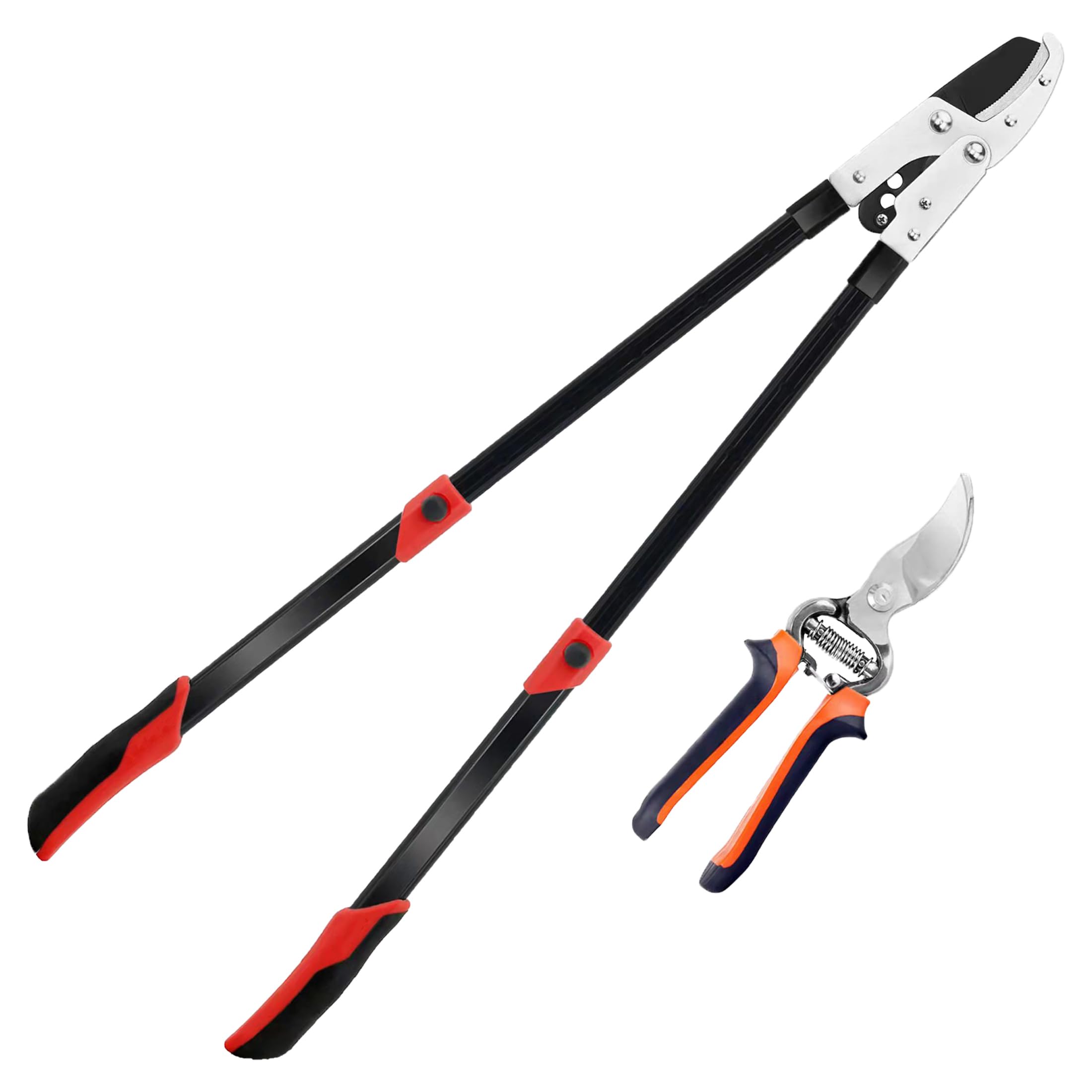
A compound-action telescoping lopper that reaches high and cuts clean without tiring you out.
This model uses compound action technology (a lever-and-pivot system that multiplies your squeezing force at the cutting head), so you can chop through branches up to 2 inches thick without needing as much force as a standard lopper—your shoulders last longer on big cleanup days. The 6-step telescoping handles adjust from 28 to 41 inches, making it the longest-reaching tool in this list—ideal for high branches where you do not want to drag out a pole saw. The alloy steel blade is coated with a Teflon low-friction finish to stay sharp and resist sap buildup.
Buyers on a half-acre in Hawaii reported it cuts hibiscus branches the diameter of a ping-pong ball like butter and handles tough dry banana leaves easily. The soft rubber, non-slip grip is designed to keep you comfortable during long pruning sessions. One customer observed that while it excels on 1.25-inch live oak green limbs, it struggles to cut 2-inch green wood when fully extended overhead, with handles bending under that load.
The main limitation is that over-extending the handles to the full 41 inches reduces the cutting leverage significantly—you might not get a clean cut on a 2-inch branch at that length. Its item dimensions (27.8″ x 9.1″) are notably more compact than the Corona 33-inch (33″ x 13″) when collapsed, making it easier to store in a garage or shed. For most medium-sized trimming jobs, though, the reach and compound action make it a very capable tool.
What it does well
- Compound action provides extra cutting power with less effort.
- Fully telescoping to 41 inches for the longest reach on this list.
- Lightweight aluminum handle with ergonomic grip.
Where it struggles
- Cannot cut full 2-inch branches when fully extended; handles flex.
- Small included pruner has a poor locking mechanism.
Grab this for: Homeowners with tall trees who need a lightweight, extendable tool for medium branches and can avoid forcing it on oversized limbs at full stretch.
Pass on it if: You regularly cut 2-inch hardwood from the ground—the handles lack the rigidity for that job at full extension.
Understanding the Specs
Cutting Width (Capacity)
This number tells you the thickest branch the lopper can cleanly cut in one go. A 2-inch capacity is standard for heavy-duty work, but be aware that cutting capacity often drops when you are working at full handle extension on a telescoping model. Bypass blades tend to have a slightly smaller effective capacity than anvil blades on the same spec because they need to squeeze past the branch rather than crush it.
Blade Type: Bypass vs Anvil
A bypass blade works like scissors—one sharp blade slides past a thicker hook—and makes the cleanest cut for living wood. An anvil blade crushes the branch against a flat surface and is better for dead or dry wood where you do not care about a clean cut edge. For most professional work on live trees, bypass is the right choice; for deadwood clearing, anvil can actually be faster and handle harder branches without dulling as quickly.
Ratcheting Mechanism
A ratcheting lopper moves the blade deeper into the branch in stages each time you squeeze the handles. This lets you cut through a thick branch with several smaller squeezes instead of one huge burst of force, which is a standout for users with arthritis or anyone pruning for hours. Compound action uses a gear or linkage to multiply your input force, giving similar benefits through a different mechanical design.
Handle Length and Material
Longer handles (30 inches and above) give you more leverage, meaning less effort to cut the same branch, but they add weight. Aluminum handles keep the tool light for overhead work, while steel handles are more durable for ground-level cutting against hard wood. Telescoping handles let you adjust length on the fly, but the locking mechanism must be sturdy enough to not slip under load.
FAQ
Should I choose a bypass or anvil lopper for professional use?
What is the best handle length for tree trimming?
How thick of a branch can professional loppers cut?
What is a ratcheting lopper and do I need one?
Can I sharpen my professional loppers at home?
What is the difference between MAXFORGED and DualLINK?
Are telescoping handles as strong as fixed handles?
How do I prevent sap from sticking to the blade?
What is a compound action lopper?
How long should a good pair of professional loppers last?
Final Thoughts: The Verdict
If you want one dependable pick, the professional loppers winner is the Corona Tools 33″ Bypass Loppers because its DualLINK MAXFORGED mechanism gives you the best combination of cutting force, reach, and durability for heavy-duty yard work while staying affordable on a premium brand. If you want the Swiss precision of a lightweight, surgical-grade tool for orchard work, grab the FELCO F211-60. And for a budget-friendly telescoping option that reaches high and cuts medium branches cleanly, the YRTSH Loppers offers the best reach-to-value ratio.
How We Picked
We do not accept paid placement. Every pick is matched to a real buyer and a real use-case; we do not hands-on test units.
Sources & Methodology
Specifications: manufacturer listings and product documentation. Review insights: verified customer reviews, as of July 2026. Pricing: not shown on this page (it changes often); check the current price via the retailer link.
As an Amazon Associate, Lawn Gear Lab earns from qualifying purchases. This does not affect which products we feature.