
Specs are compiled from manufacturer listings and verified buyer reviews and can change over time — please confirm the key details on the product page before buying.
Cleaning a concrete driveway or patio isn’t just about blasting water — you need enough force (measured in PSI) and enough volume (measured in GPM) to lift embedded dirt and oil stains without spending all day. A pressure washer that’s great for cars or vinyl siding often falls short on concrete, where the grime is baked in and the surface is porous. The machines here are vetted to deliver at least 3000 PSI and 2.5 GPM, which is the real starting point for concrete work.
I’m Rikta — the founder and writer behind Lawn Gear Lab. This guide is built by comparing the manufacturers’ published specifications and the patterns across verified customer reviews, so you get each pick’s real strengths and trade-offs instead of marketing spin.
If your concrete driveway has oil stains, moss, or tire rubber marks that a garden hose won’t touch, you need a machine that can handle it. This roundup of the pressure washer for concrete choices will help you pick the machine that actually gets the job done.
Quick Picks
- Westinghouse WPX4400 Gas Pressure Washer — Best Overall
- Simpson ALH3425 Gas Pressure Washer — Pro-Grade Engine
- Westinghouse WPX3200 Gas Pressure Washer — Best Value
- Simpson CM61248-S Gas Pressure Washer — Surface Cleaner Bundle
- Kärcher G 3600 P Gas Pressure Washer — Triplex Durability
- BILTHARD 3500 PSI Gas Pressure Washer — Budget Gas
- Imdot 5000 PSI Electric Pressure Washer — Power Surge
- AIVOLT 4800 PSI Electric Pressure Washer — Stable Electric
How To Choose The Best Pressure Washer For Concrete
Concrete is tough, but it is also porous, which means dirt gets trapped deep inside the surface rather than sitting on top. You need a machine that combines high pressure to dislodge the grime with high water volume to wash it away before it resettles. Here is what to look for.
PSI and GPM — The Power Pair
PSI (pounds per square inch) measures how hard the water hits the surface — think of it as the force behind the blast. For concrete, you need at least 3000 PSI to shift heavy stains like oil and tire marks. GPM (gallons per minute) measures how much water flows out — this determines how fast you clean and how well the dirt is rinsed away. A machine with 2.5 GPM or higher creates a sweeping action that prevents muddy water from drying back onto the slab, leaving a cleaner finish.
Pump Type — Axial Cam vs. Triplex
The pump is the heart of a pressure washer. Most residential gas models use an axial cam pump, which is light and maintenance-free but best for occasional use. If you plan to clean concrete regularly or for long sessions, a triplex plunger pump (often found on commercial-grade machines) is more durable and handles heat better. Electric models typically use a wobble or axial pump that is fine for light-duty patios but may struggle with large driveways.
Hose Length and Mobility
A concrete driveway or patio can be long, and dragging the whole machine every few feet is tiring. Look for a hose length of at least 25 feet — longer hoses (30 to 50 feet) let you cover more area without moving the unit. Wheel size also matters: small hard wheels get stuck on expansion joints and gravel, while large pneumatic (air-filled) tires roll smoothly over rough concrete and curbs.
Quick Comparison
| Model | Best For | PSI / GPM | Hose Length | Pump Type | Amazon |
|---|---|---|---|---|---|
| Imdot 5000 PSI Electric | Budget-friendly raw power | 5000 / 4.0 | 33 ft | Axial cam | Amazon |
| AIVOLT 4800 PSI Electric | Stable rolling on uneven ground | 4800 / 3.0 | 25 ft | Axial cam | Amazon |
| BILTHARD 3500 PSI Gas | Entry-level gas for driveways | 3500 / 2.6 | 30 ft | Axial cam | Amazon |
| Westinghouse WPX3200 Gas | Balanced value and reliability | 3200 / 2.5 | 25 ft | Axial cam | Amazon |
| Simpson CM61248-S Gas | Homeowner kit with surface cleaner | 3400 / 2.5 | 25 ft | Axial cam | Amazon |
| Kärcher G 3600 P Gas | Triplex pump durability | 3600 / 2.6 | 35 ft | Triplex / Crankshaft | Amazon |
| Simpson ALH3425 Gas | Pro-grade Honda engine | 3600 / 2.5 | 35 ft | Triplex plunger | Amazon |
| Westinghouse WPX4400 Gas | Extreme flow for large slabs | 4400 / 4.2 | 50 ft | Triplex brass head | Amazon |
In‑Depth Reviews
1. Westinghouse WPX4400 Gas Pressure Washer
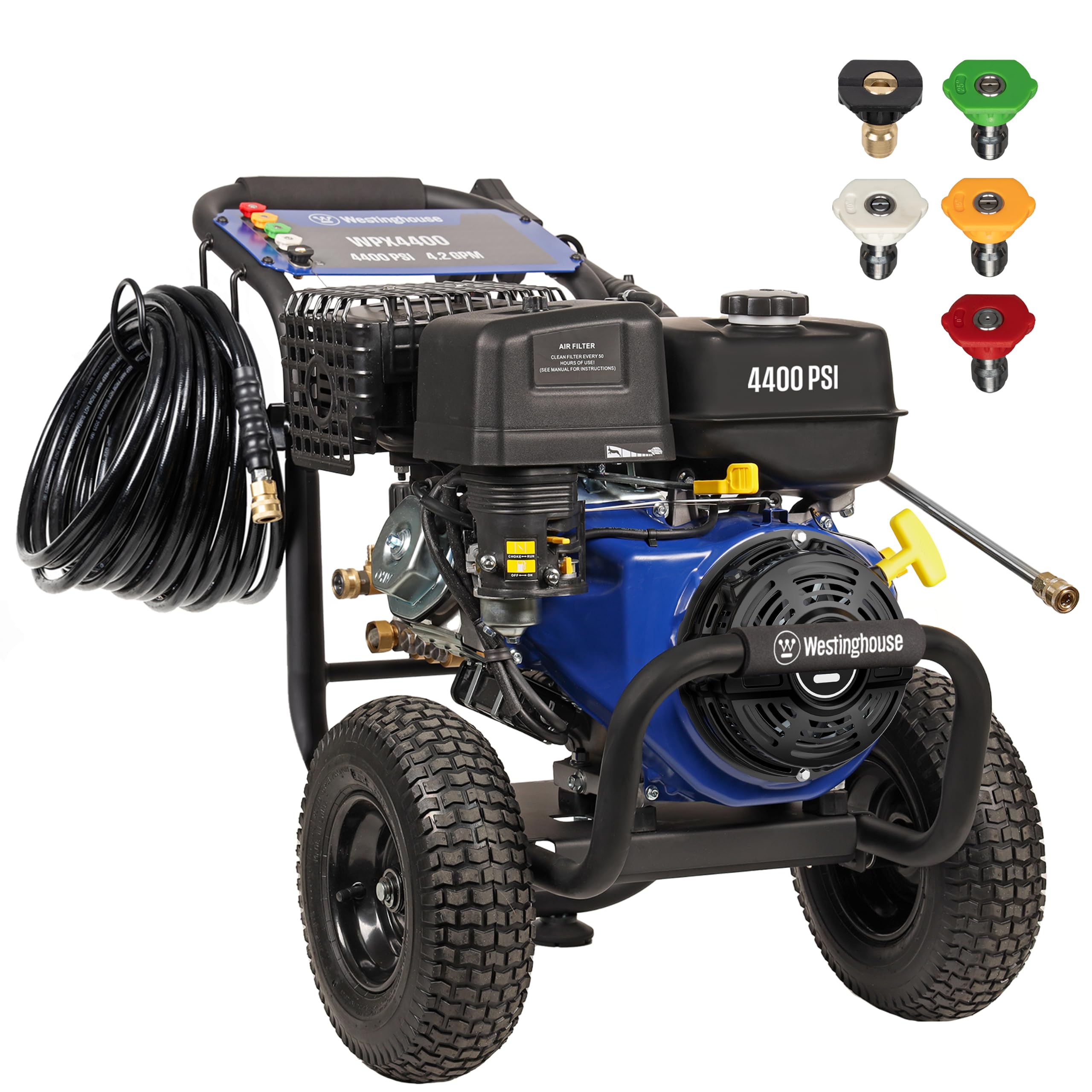
The beast that turns a long afternoon of concrete cleaning into a quick lunch-break task.
Concrete cleaning is a game of water volume — high GPM is what rinses the suspended dirt away before it settles back into the pores. The WPX4400 delivers a massive 4.2 Gallons Per Minute at 4400 PSI, making it the fastest rinsing machine here. To put that in perspective, it flows at 4.2 GPM versus the Westinghouse WPX3200’s 2.5 GPM.
Its 50-foot abrasion-resistant hose lets you reach the far end of a long driveway without moving the cart. The 420cc 4-stroke engine and commercial-grade triplex brass head pump (a heavy-duty pump with three plungers that lasts longer under sustained use) are built for tough jobs. Buyers report that “the ability to adjust the pressure is very helpful in preventing damage” on painted surfaces while still having “plenty of power” for stripping old paint. The 12-inch pneumatic tires roll over expansion joints and gravel easily. The 1.7-gallon gas tank keeps you running through a full driveway session without stopping for a refill.
The trade-off is the price of entry — this is firmly in prosumer territory — and some buyers received units with shipping damage or wheel assembly issues, though the manufacturer’s customer service was praised for sending replacements quickly.
Powerful gas engine: Anyone with a large concrete surface — a wide driveway, a multi-car garage floor, or a commercial property — who values speed and wants to cut cleaning time in half. Heavy to move: At 142 lbs, this is a heavy machine to move around; if you only have a small patio slab, the weight and storage footprint may feel like overkill.
2. Simpson ALH3425 Gas Pressure Washer
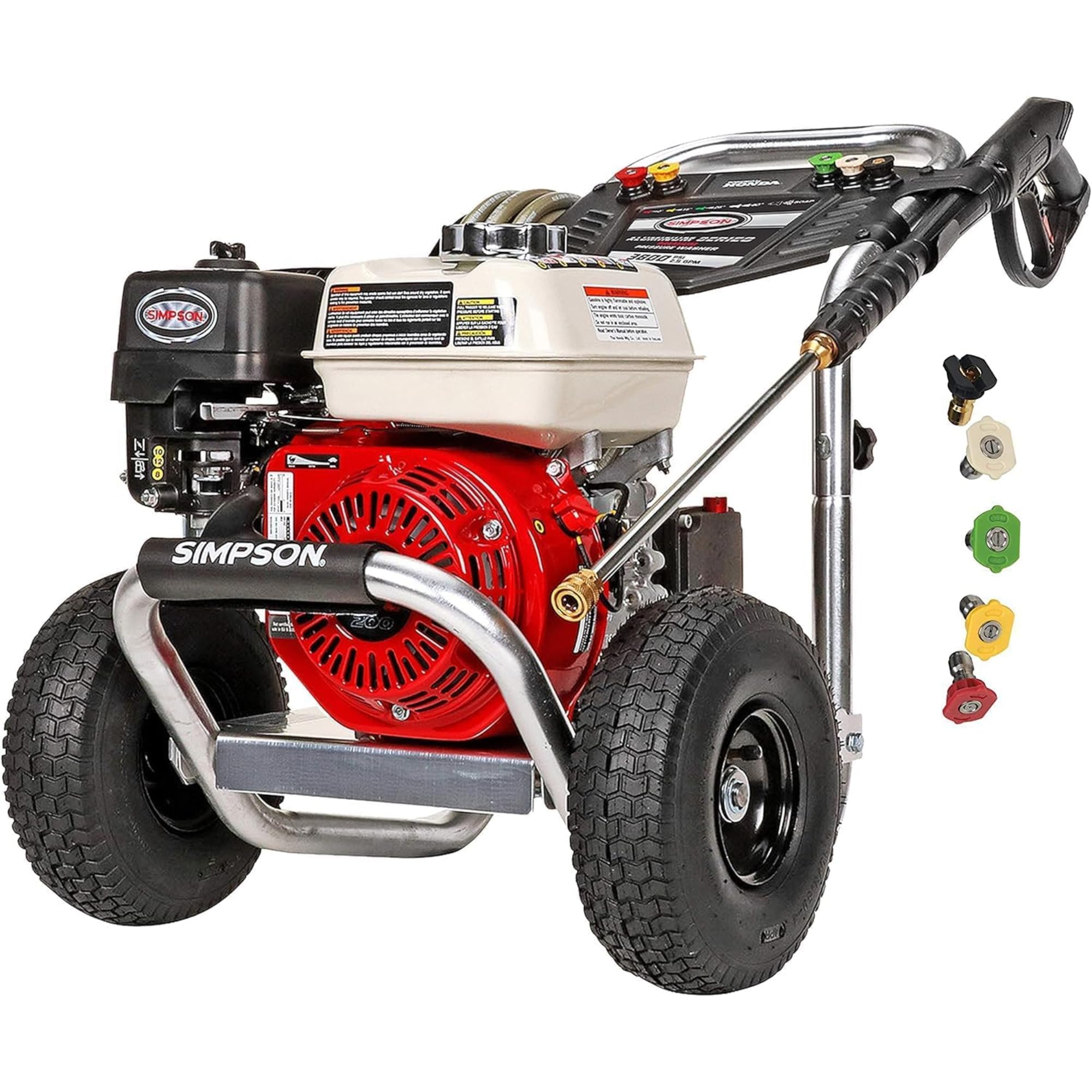
A Honda GX200 heart that starts on the first pull, year after year.
If you have ever struggled with a pressure washer that won’t start after sitting in the garage for six months, you will appreciate the Simpson ALH3425. It uses a Honda GX200 engine, widely considered among the most reliable small engines made — it has a low-oil shutdown to protect itself and starts easily even for infrequent users. This machine delivers 3600 PSI (pounds per square inch of water pressure) and 2.5 GPM (gallons per minute of water flow), which is solid concrete-cleaning territory.
The big difference from the value-tier Simpsons is the pump. This unit uses an AAA triplex plunger pump (not an axial cam) designed for longer service life, and it features PowerBoost Technology that owners mention “provides higher pressure at the nozzle”. The 35-foot Morflex series hose is flexible even in cool weather and resists abrasion against rough concrete edges. The aircraft-grade aluminum frame keeps the total weight at a manageable 78 lbs — significantly lighter than the steel-frame competitors — while the 10-inch pneumatic tires roll easily across gravel and grass.
Customers note the triplex pump and Honda engine make this “a heavy duty machine that is worth the price” and confirm it “starts right up with strong power to remove grease and oil.” The one hiccup: the hose ends lack quick disconnects (fittings that let you swap tools without tools), so you may need to buy adapters to use your existing surface cleaner.
Durable build: Someone who wants a commercial-grade machine without the full commercial price — the Honda engine alone makes this a 10+ year purchase if maintained. Skip if quiet: You need higher than 2.5 GPM for large slabs, or you want quick-disconnect fittings included from the start.
3. Westinghouse WPX3200 Gas Pressure Washer
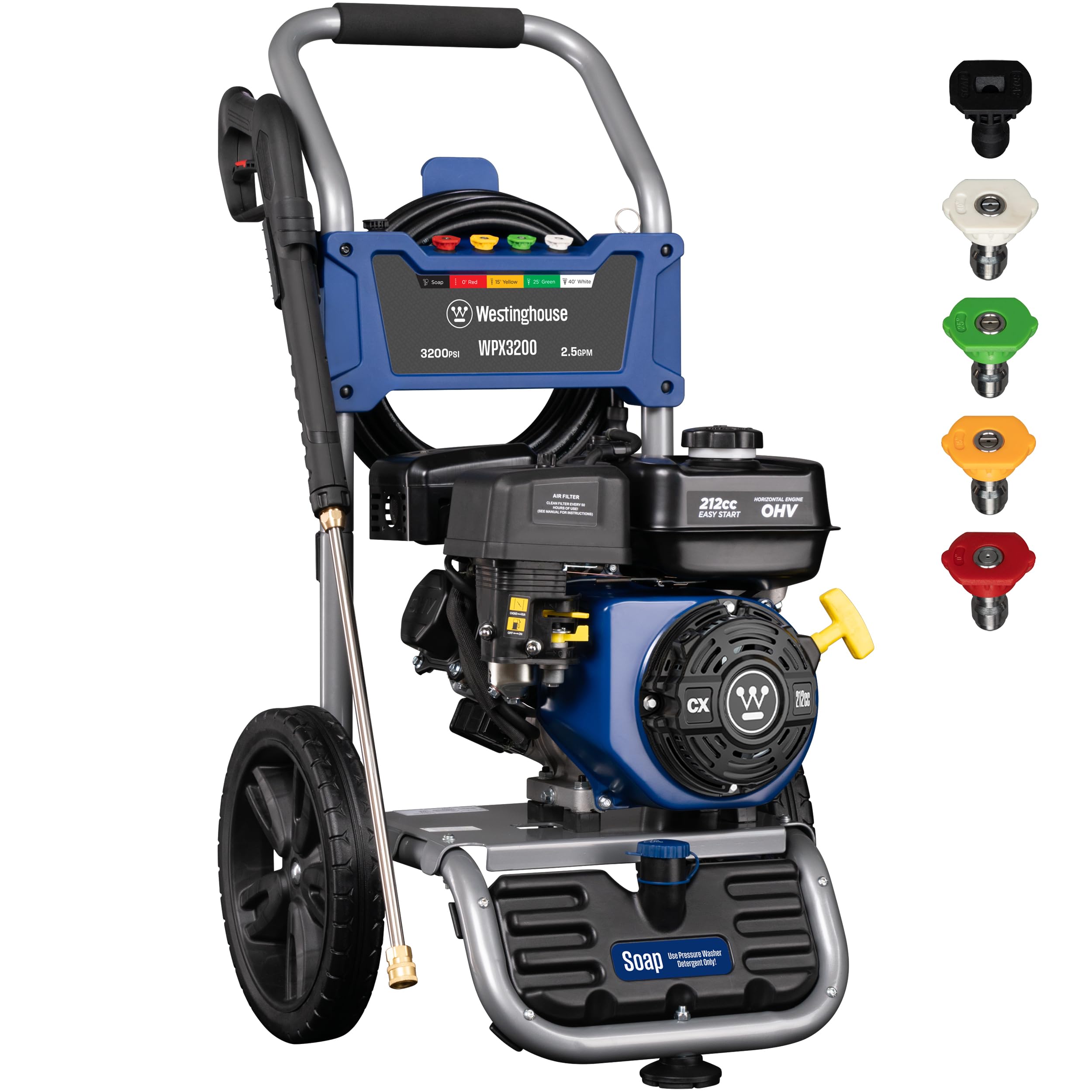
The go-to gas washer for the homeowner who needs reliable concrete cleaning at a fair price.
This Westinghouse hits the concrete threshold at 3200 PSI and 2.5 GPM, and it has proven itself over years on the market as a consistently reliable unit. The 212cc 4-stroke OHV engine starts with recoil and runs smoothly, and the maintenance-free axial cam pump keeps things simple — no oil changes or complex upkeep. Buyers consistently call it “easy to assemble” and note it is “powerful, easy to maneuver” with a pressure “comparable to commercial car wash sprayer.”
The 25-foot abrasion-resistant hose is standard length for this class, and the 12-inch never-flat wheels make it easy to roll over concrete joints and uneven terrain without stopping. It includes a full five-nozzle set (0°, 15°, 25°, 40°, and soap), so you can switch between stripping heavy deposits on a driveway and washing patio furniture without buying extra parts. The half-gallon onboard soap tank is built right into the frame.
A recurring complaint in reviews is that the water intake and outlet are on the same side as the hot engine exhaust, which can shorten hose life over time — some owners route the hose away from the muffler to compensate.
Space saver: You are a homeowner cleaning a standard two-car driveway, patio, and sidewalks — it gives you proven performance without stepping up to a premium price. Skip for large areas: You need to clean multiple large concrete areas in one session; the 0.9-gallon gas tank will need a refill for bigger jobs.
4. Simpson CM61248-S Gas Pressure Washer
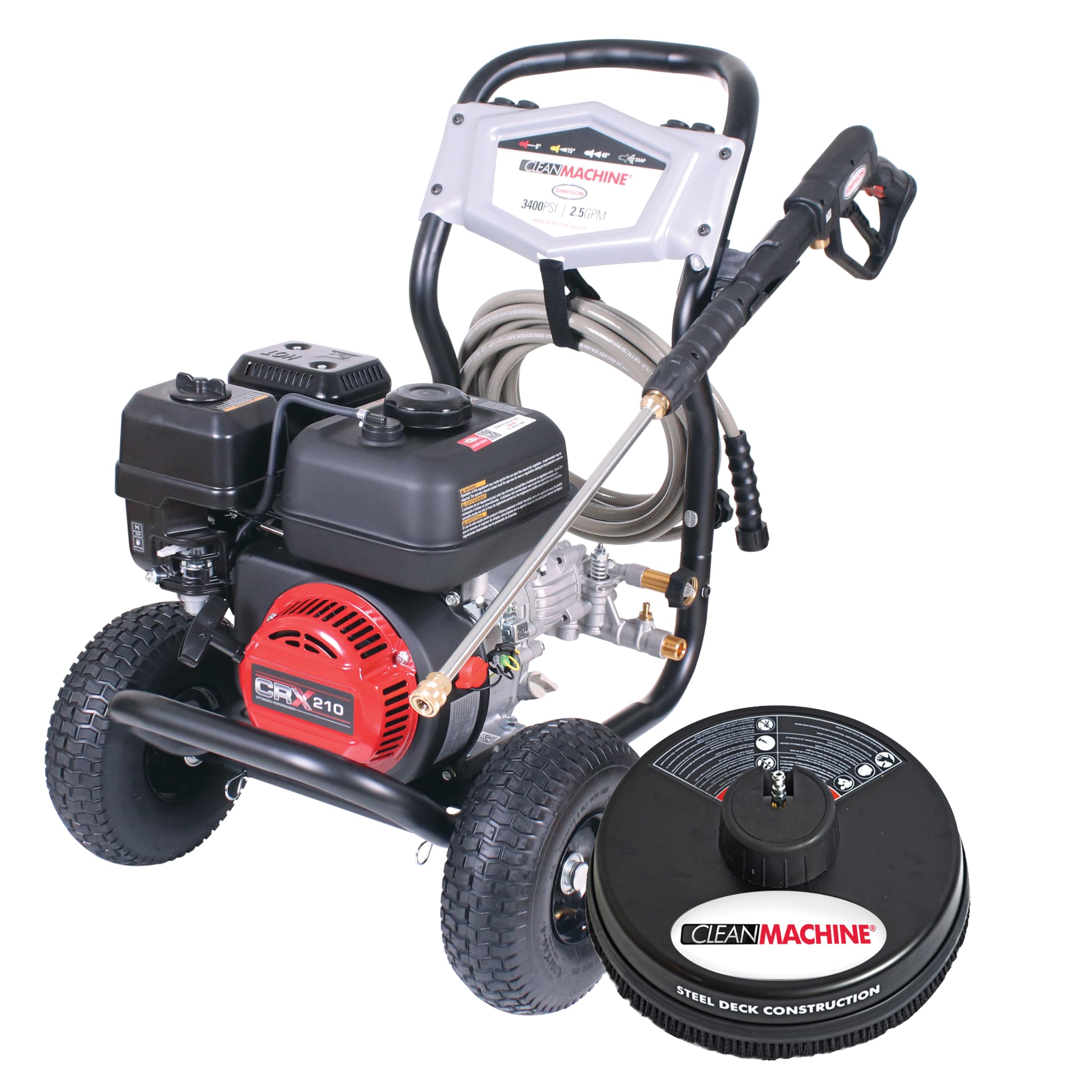
The Simpson Clean Machine that bundles a surface cleaner right in the box — ready to clean concrete streaks-free on day one.
A standard spray nozzle tends to leave tiger-striping (alternating clean and missed lines) on concrete because you cannot keep the fan perfectly even at arm’s length. A surface cleaner solves this by spinning two high-pressure jets under a shroud, covering more area evenly. This Simpson package includes a 15-inch surface cleaner with dual stainless steel nozzles that provides more coverage than a standard spray nozzle and reduces cleaning time, as buyers confirm.
The power washer itself delivers 3400 PSI at 2.5 GPM from a 208cc CRX engine that starts easily and includes a low-oil shutdown for protection. The pump is an OEM Technologies axial cam with a thermal relief valve to prevent overheating during longer concrete sessions. The 25-foot non-marring hose and four quick-connect tips round out the kit. The welded steel frame with a powder-coated finish resists rust, and the 10-inch pneumatic tires roll smoothly over grass and gravel alike.
Some owners reported that the included surface cleaner wand leaked from the start or that the spray gun was a different brand than expected, though the pressure washer itself earned consistent praise for starting “on the first pull” and running “like a champ.”
Fast cleaning: The 15-inch surface cleaner that makes the difference between a driveway that takes two hours and one that takes 45 minutes. Skip on budget: Anyone who wants a single all-in-one package — the surface cleaner included is good, but a few units had fitment issues that required a warranty claim.
5. Kärcher G 3600 P Gas Pressure Washer

The Kärcher with a triplex crankshaft pump that is built for the long haul.
Most residential gas washers use an axial cam pump, which is fine for occasional use but can wear out faster under the sustained load of scrubbing a big concrete slab. The Kärcher G 3600 P uses a triplex (or crankshaft) pump, a design found on commercial machines that handles heat and continuous runtime much better. It delivers 3600 PSI at 2.6 GPM, powered by a 5.9 HP 212cc engine.
The 35-foot high-pressure hose gives you a longer reach than the typical 25-foot hose found on competitors — a real advantage when you are cleaning a long driveway and want to avoid dragging the whole cart every few feet. The four quick-connect nozzles (0°, 15°, 25°, 40°) cover everything from stripping concrete stains to washing delicate surfaces. At 64 lbs, it is comparable in weight to the Simpson CM61248-S but with a more sturdy pump and a slightly longer hose.
Reviewers point out it “covers large areas well” and that the triplex pump feels “substantial” compared to axial cam units, although some found the 2.6 GPM to be on the lower side for really fast rinsing on extra-large slabs.
Reliable brand: Someone who plans to use their pressure washer frequently (multiple times per season) and wants a pump that can take that pace without failure. Skip if rugged: If you need the absolute fastest rinse on a very large concrete area, the lower GPM means you may need more time versus the high-flow Westinghouse or Imdot electric.
6. BILTHARD 3500 PSI Gas Pressure Washer
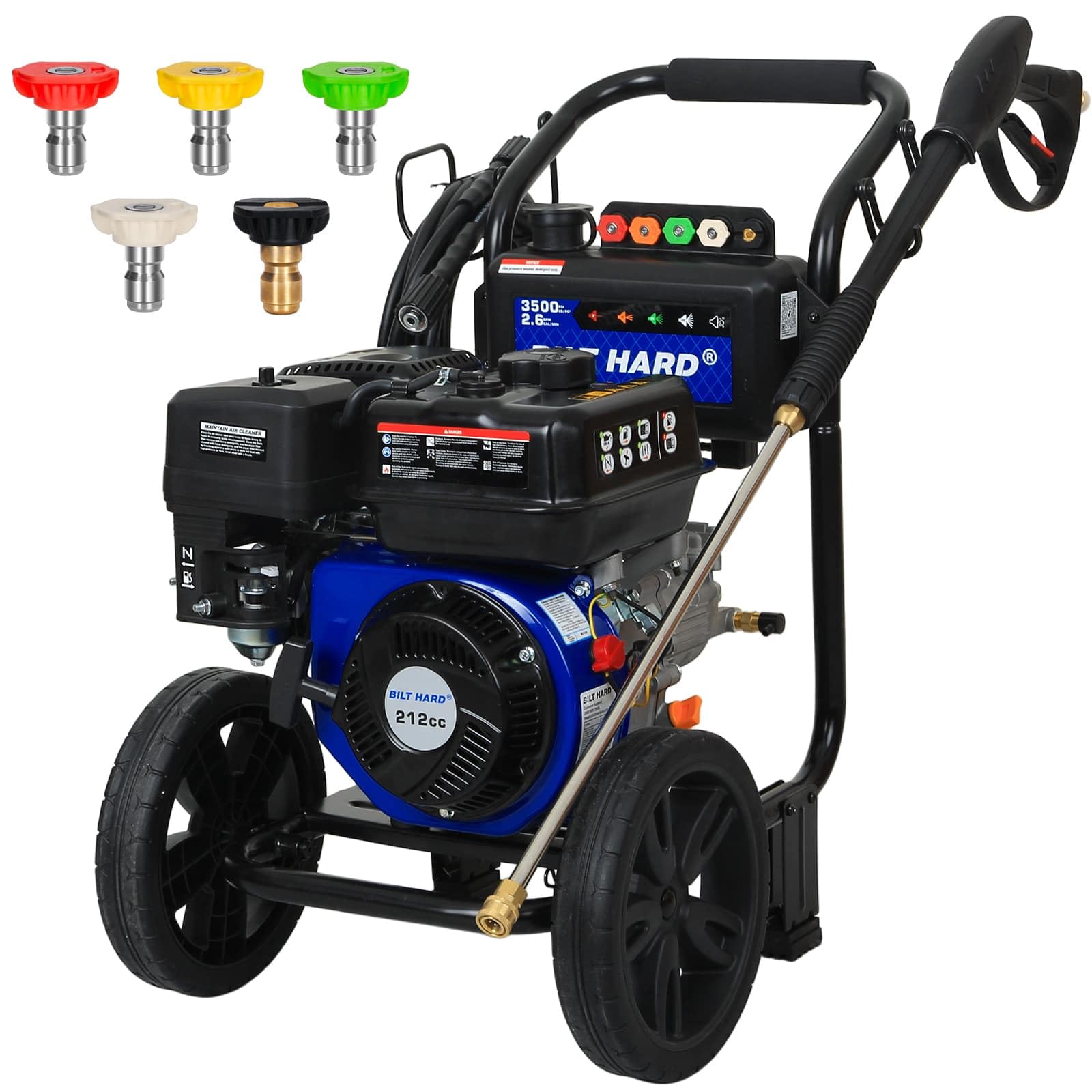
The budget gas option that punches above its weight with 3500 PSI and a 30-foot hose.
If you want gas power without the premium price tag, this BILTHARD delivers with a 212cc 4-cycle OHV engine that puts out 3500 PSI and 2.6 GPM. The 30-foot steel-braided hose is also longer than many competitors in this class and is designed for kink resistance and abrasion resistance.
The five quick-connect nozzles (0°, 15°, 25°, 40°, and soap) give you the full range for concrete stripping, general cleaning, and detergent application. The 10-inch never-flat wheels and a soft-grip handle make it easy to move across pavement and uneven ground. The 0.63-gallon fuel tank with a 1-gallon soap tank means you can work through a full driveway without stopping to refill. Buyers confirm it “starts on the first pull and performs flawlessly” for typical home use.
However, a few owners experienced quality control issues — one reported a loose on/off switch, and another had a broken flywheel after light use. While many units work great, the consistency is not at the level of the more established Westinghouse or Simpson brands.
Value pick: You are on a tight budget but want gas power for concrete, and you are comfortable with the potential for minor assembly adjustments. Skip for reach: You rely on your pressure washer for income or cannot afford downtime — the Westinghouse WPX3200 costs more but has a stronger track record for reliability.
7. Imdot 5000 PSI Electric Pressure Washer
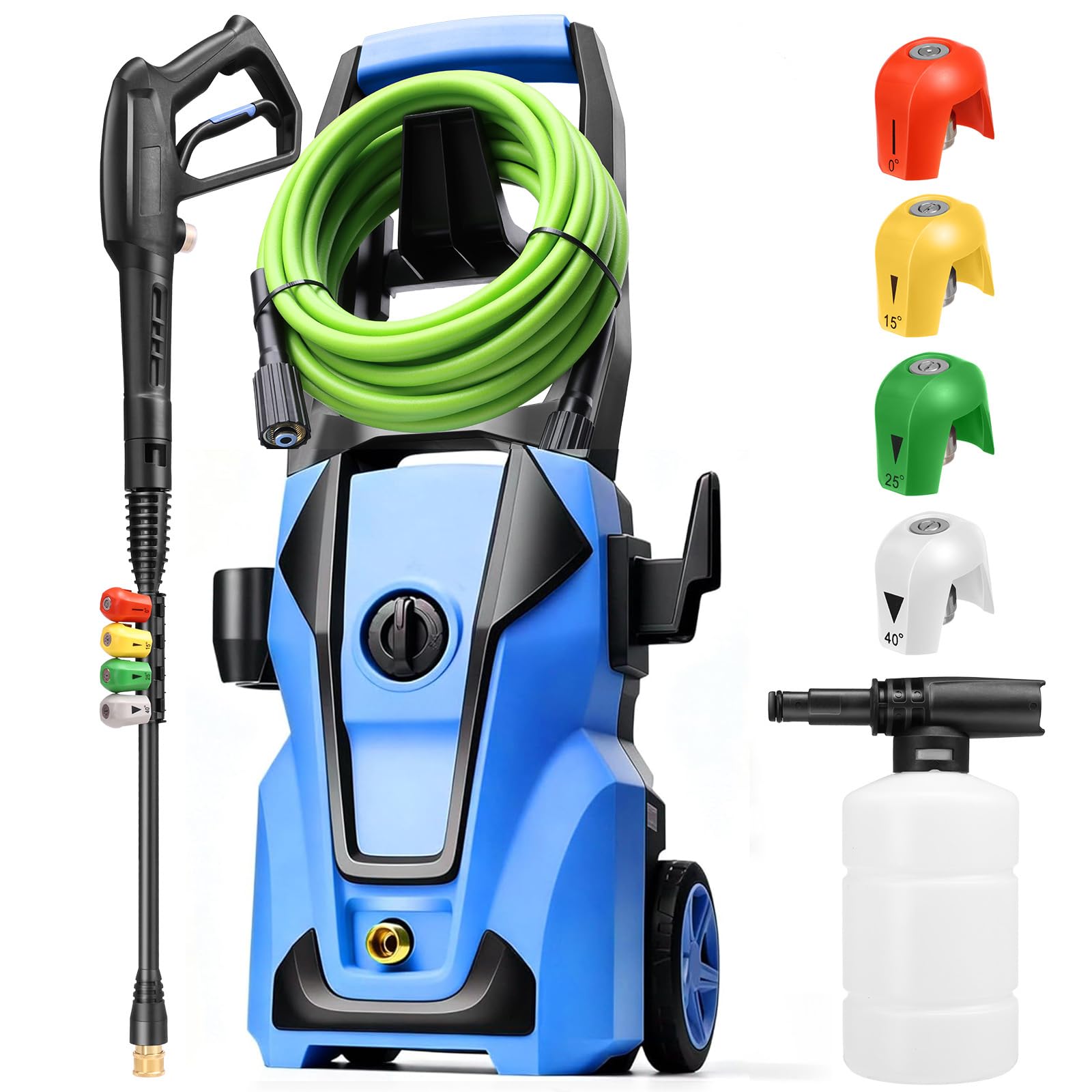
Hard numbers that defy the price point — 5000 PSI and 4.0 GPM in an electric package.
Here is the electric outlier that challenges the gas-powered status quo. The Imdot delivers a claimed 5000 PSI and 4.0 GPM, which would put it ahead of many gas washers in both pressure and flow. The 4.0 GPM is higher flow than the 2.6 GPM found on the BILTHARD gas unit — in practice that means faster rinsing across a concrete slab. The 33-foot hose paired with a 34-foot power cord gives you a 67-foot cleaning radius without moving the machine.
It includes four quick-connect nozzles (0°, 15°, 25°, 40°) and a foam cannon, plus an extension wand. The total stop system (TSS) automatically shuts the motor off when the trigger is not pulled, reducing wear and saving electricity. The 19-pound weight makes it far easier to move than any gas model, and the compact 13″ x 11″ x 17″ dimensions store easily in a small garage corner. It is also quieter than a gas engine and produces no exhaust fumes, so you can use it in enclosed spaces like a basement garage without worry.
The big caveat: electric motors in this price range rarely sustain 5000 PSI at the nozzle in real use. The high numbers come from a low-flow axial pump design that often peaks at theoretical pressure with the nozzle closed. For light-to-moderate concrete cleaning (tire marks, light oil, dirt), it will outperform many cheaper electrics, but for heavy caked-on grime that needs sustained high pressure, a gas machine is still more reliable.
Quiet power: Someone who wants maximum specs on paper and only has electric power available, or who needs a quieter, fume-free option for cleaning concrete in attached garages. Skip for heavy grime: Anyone with heavily stained commercial concrete or large areas — the gas machines above will deliver more consistent real-world pressure over longer sessions.
8. AIVOLT 4800 PSI Electric Pressure Washer
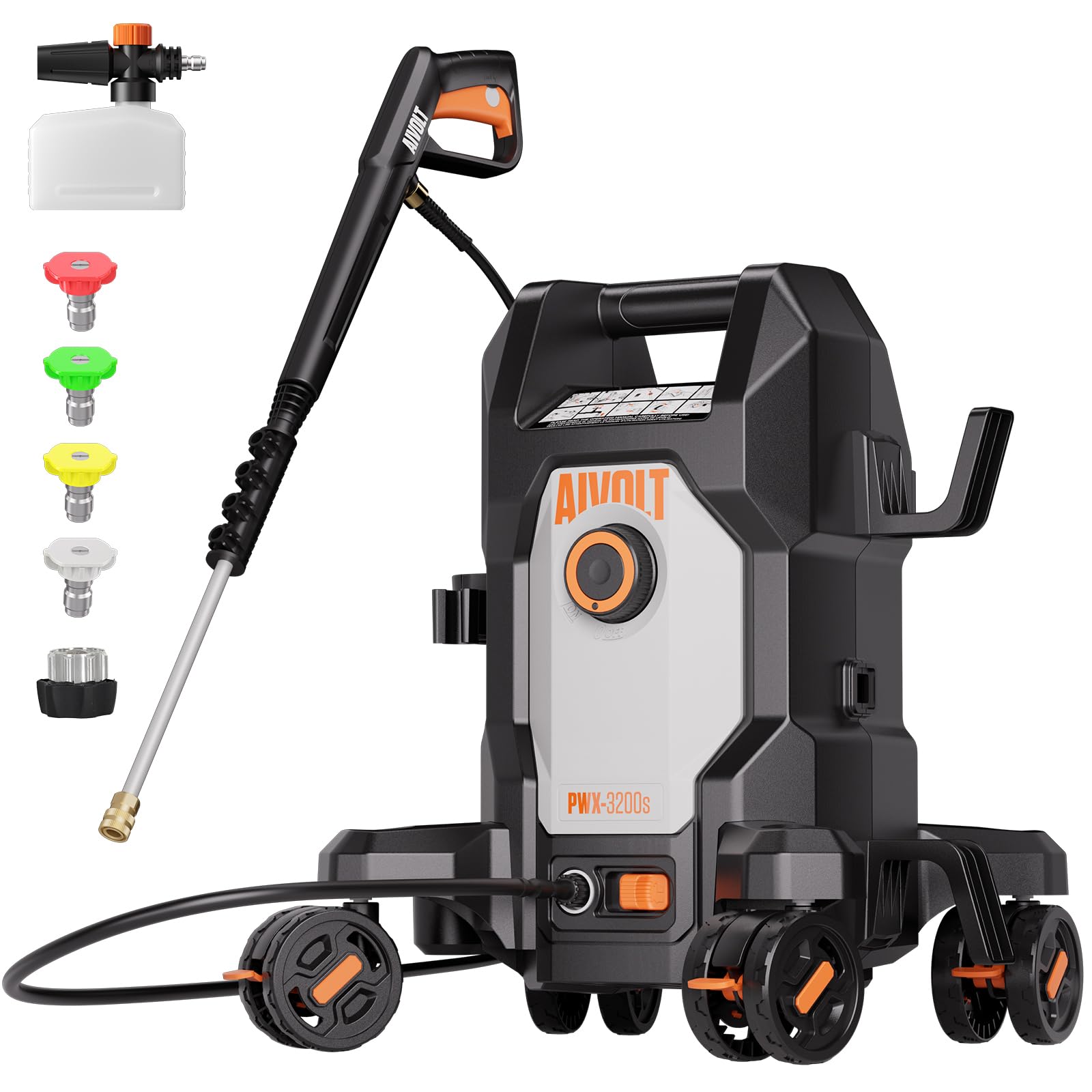
Stable on uneven concrete — the four-wheel chassis that does not tip.
Most electric pressure washers sit on a wobbly two-wheel base that tips over when you tug the hose sideways. The AIVOLT uses a four-wheel design with a low center of gravity and 360-degree swivel wheels, so it stays put on uneven driveways and patios. It delivers 4800 PSI at 3.0 GPM, which is strong enough for concrete stains and driveway grime.
The 25-foot hose and 36-foot power cord give decent reach, and the includes four quick-connect nozzles (0°, 15°, 25°, 40°) plus a foam cannon and cleaning brush. The soap tank is built in, and the unit packs into a compact frame that stores easily on a shelf. It has UL and CSA certifications for safety, GFCI protection, and an auto-shutoff TSS that stops the motor when the trigger is released. Shoppers say “it packs a punch with its pressure—almost as strong as a gas-powered or heavy-duty washer” and that the soap dispenser “gives off a great amount of soap.”
The 25-foot hose is noticeably shorter than the 33-foot hose on the Imdot, meaning more machine repositioning on long driveways. Some owners also reported that the compact design means hoses and cords tangle together, requiring lifting the unit instead of rolling it freely.
High psi: Someone who cleans concrete on sloped or uneven surfaces and values a stable machine that will not tip over. Skip for mobility: Your driveway is long — the 25-foot hose means you will be moving the unit several times to reach the far end.
Understanding the Specs
PSI — The Force Behind the Spray
PSI (pounds per square inch) is the pressure that pushes water into the pores of concrete. For concrete, 3000 PSI is the minimum because oil, tire marks, and moss are baked into the surface. At 3200–4400 PSI, you can strip old paint and thick grime in a single pass. The higher the PSI, the faster you can clean — but also the greater the risk of etching or chipping softer concrete, so you need to adjust the nozzle angle and distance.
GPM — The Speed of Rinsing
GPM (gallons per minute) is the water volume moving through the nozzle. This matters for concrete because high volume sweeps away the dirt that the PSI has loosened — without it, the muddy water dries back onto the surface and leaves streaks. Most concrete-ready machines run 2.5 GPM to 4.2 GPM. More GPM means faster cleaning and fewer passes. A 4.0 GPM machine will clear a driveway faster than a 2.5 GPM machine at the same PSI.
Pump Type — Axial Cam vs. Triplex
The pump pressurizes the water. An axial cam pump (a lightweight, maintenance-free design) is common on residential gas and electric washers: it is lighter, cheaper, and maintenance-free, but best for occasional use. A triplex plunger pump (found on commercial machines like the Kärcher G 3600 P and Simpson ALH3425) uses three plungers in a crankcase design, which is heavier but lasts longer under sustained heat and use — ideal if you clean concrete multiple times per season.
Hose Length and Surface Cleaners
A longer hose (30 to 50 feet) lets you clean a large concrete area without moving the machine, reducing fatigue. A surface cleaner attachment is a separate tool that spins two high-pressure jets under a shroud — it eliminates the streaking you get with a hand wand and covers a wider area per pass, cutting driveway cleaning time by more than half.
FAQ
Is 3000 PSI enough for concrete?
Can I use an electric pressure washer on concrete?
What is better for concrete — high PSI or high GPM?
How long does a gas pressure washer pump last on concrete jobs?
Can a pressure washer damage concrete?
Should I get a gas or electric pressure washer for concrete?
Do I need a surface cleaner for concrete?
What is the difference between 2.5 GPM and 4.0 GPM on concrete?
How do I prevent water from staying on the concrete after cleaning?
What nozzle should I use for concrete?
Final Thoughts: The Verdict
For most buyers, the best pressure washer for concrete overall is the Westinghouse WPX4400 because its 4.2 GPM flow rate and 4400 PSI deliver the fastest, most streak-free cleaning on large slabs. If you want the legendary reliability of a Honda engine, grab the Simpson ALH3425. For a proven value pick that is easy to roll and start, the Westinghouse WPX3200 gives you the concrete-cleaning essentials without the price jump.
How We Picked
We do not accept paid placement. Every pick is matched to a real buyer and a real use-case; we do not hands-on test units.
Sources & Methodology
Specifications: manufacturer listings and product documentation. Review insights: verified customer reviews, as of July 2026. Pricing: not shown on this page (it changes often); check the current price via the retailer link.
As an Amazon Associate, Lawn Gear Lab earns from qualifying purchases. This does not affect which products we feature.