
Specs are compiled from manufacturer listings and verified buyer reviews and can change over time — please confirm the key details on the product page before buying.
If you shop for a pressure washer near the 3000 PSI (pounds per square inch — the force the water jet hits with) mark, you face one main choice: gas or electric. Gas models deliver serious flow for the heaviest jobs like stripping paint or cleaning large concrete driveways. Electric models run quieter and need less maintenance. Picking the right one depends on if you need raw cleaning power or simple, cord-free convenience.
I’m Rikta — the founder and writer behind Lawn Gear Lab. This guide is built by comparing the manufacturers’ published specifications and the patterns across verified customer reviews, so you get each pick’s real strengths and trade-offs instead of marketing spin.
This breakdown of the best pressure washer 3000 psi models helps you match the right machine to your actual jobs — from a gas engine’s brute force to a battery-powered unit that cuts the cord.
Our Picks at a Glance
How To Choose The Best Pressure Washer 3000 PSI
Two numbers define how a pressure washer cleans: PSI (which measures the force of the water) and GPM (which measures how much water flows). A high-PSI machine with low GPM blasts a small area hard but takes forever to finish a driveway. Want a balance — so a 3000 PSI washer also moves at least 2.0 GPM. Look for at least 2.0 GPM alongside your 3000 PSI.
Gas Engine vs Electric Motor
A gas-powered washer (around 60 pounds or heavier) is the choice for frequent heavy stripping, large concrete pads, or commercial-like use where you cannot stop to recharge. An electric corded model is lighter, quieter, and starts instantly. It is perfect for smaller homes or neighborhoods where noise matters. Battery-powered units offer the most freedom from cords and gas fumes but require investment in spare batteries for longer jobs.
Quick Comparison
| Model | Best For | Pressure (PSI) | Flow Rate (GPM) | Weight | Amazon |
|---|---|---|---|---|---|
| Westinghouse WPX3200★ Best Overall | Heavy stripping & deep-cleaning | 3200 | 2.5 | 63 lbs | Amazon |
| Westinghouse WPX3000 | Balanced gas performance | 3000 | 2.3 | 50.7 lbs | Amazon |
| Greenworks 80V (Tool-Only) | No-cord, no-gas portability | 3000 | 2.0 | 52.91 lbs | Amazon |
| Greenworks 3000 PSI Electric | Quiet electric cleaning | 3000 | 2.0 | 23 kg (~51 lbs) | Amazon |
In‑Depth Reviews
1. Westinghouse WPX3200 Gas Pressure Washer
Our pick — over 4.5★ from 11,000+ verified ratings; the strongest balance of quality and price.
Raw stripping power that still treats wood kindly when you choose the right nozzle.
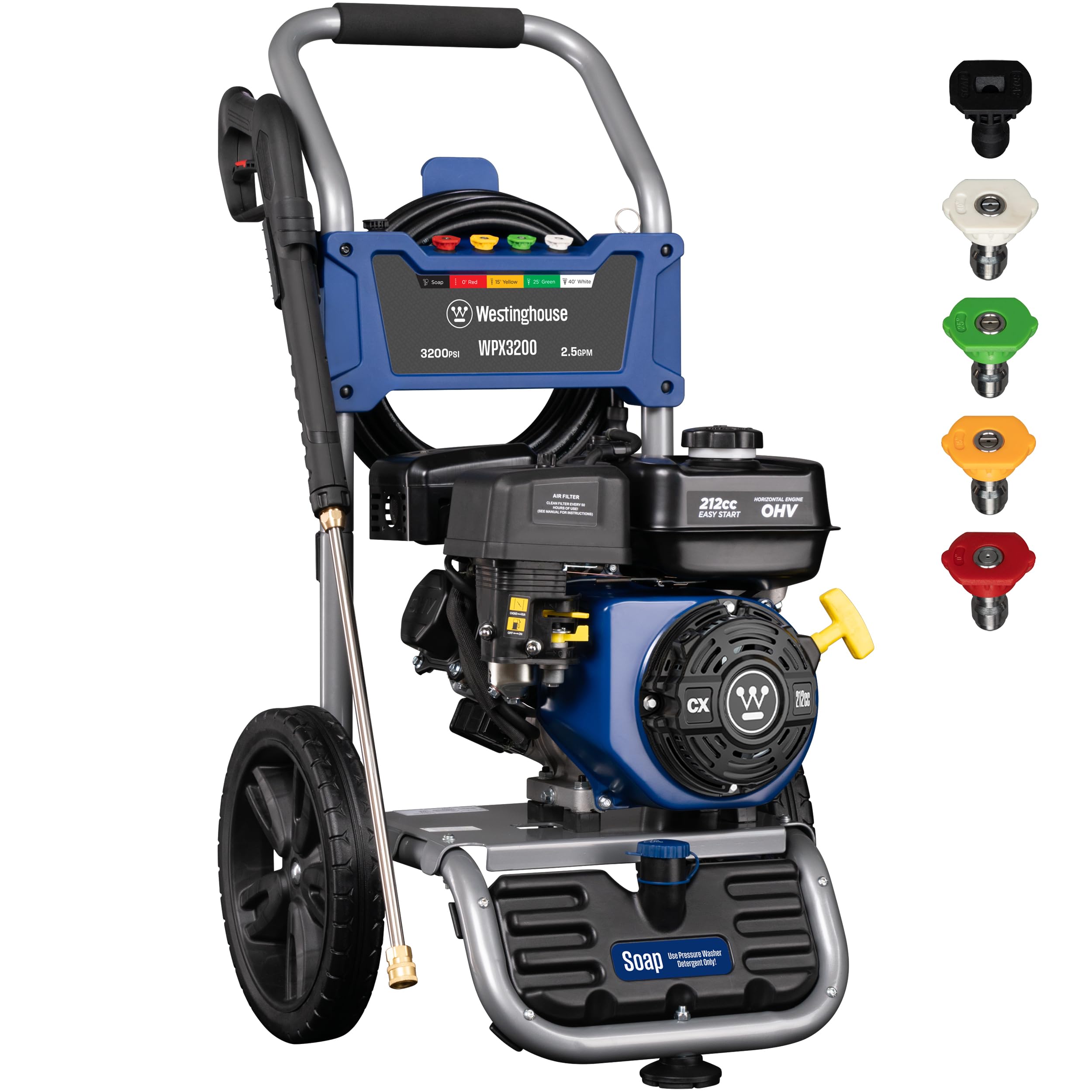
That extra half-gallon-per-minute makes a big difference when rinsing a large driveway: more water moving means you cover ground faster. The Westinghouse WPX3200 delivers 3200 PSI and 2.5 GPM — the highest pressure and flow rate in this comparison. The 0.9-gallon gas tank, 12-inch never-flat wheels, and 25-foot abrasion-resistant hose make it easy to roll around a property.
Buyers report that even with the lowest power nozzle they can strip old loose paint from wood siding without damaging the wood beneath. The machine includes a five-nozzle set (0, 15, 25, 40 degrees, plus soap) and a half-gallon onboard soap tank. You can dial in detergent for house siding or use a narrow jet for concrete stains. The main trade-off is the 63-pound weight — it is 12.3 pounds heavier than the WPX3000, so moving it up stairs takes some effort.
A 3-year limited warranty backs the engine and pump, and the manufacturer functionally tests each unit at the factory before shipping. If you are a homeowner tackling frequent heavy jobs — stripping paint, cleaning large patios, or maintaining a long fence line — this is the machine that earns its place in the garage.
What makes it the Best Overall
- 3200 PSI and 2.5 GPM — the highest pressure and flow in this comparison
- Heavy-duty steel frame with 12-inch never-flat wheels roll easily over uneven ground
- 5 quick-connect nozzles plus a dedicated soap tank give you control over every surface
What you should know
- Weighs 63 pounds — noticeably heavier than the 50.7-pound WPX3000
- Manual choke requires a starting procedure, unlike an electric push-button start
Reach for this if: You need maximum water flow and pressure for stripping paint, deep-cleaning concrete, and tackling large outdoor surfaces regularly.
Look elsewhere if: You want a lighter machine that is easier to lift into a truck bed or carry up steps.
2. Westinghouse WPX3000 Gas Pressure Washer
A gas-powered workhorse that fires up in one or two pulls and moves easily.
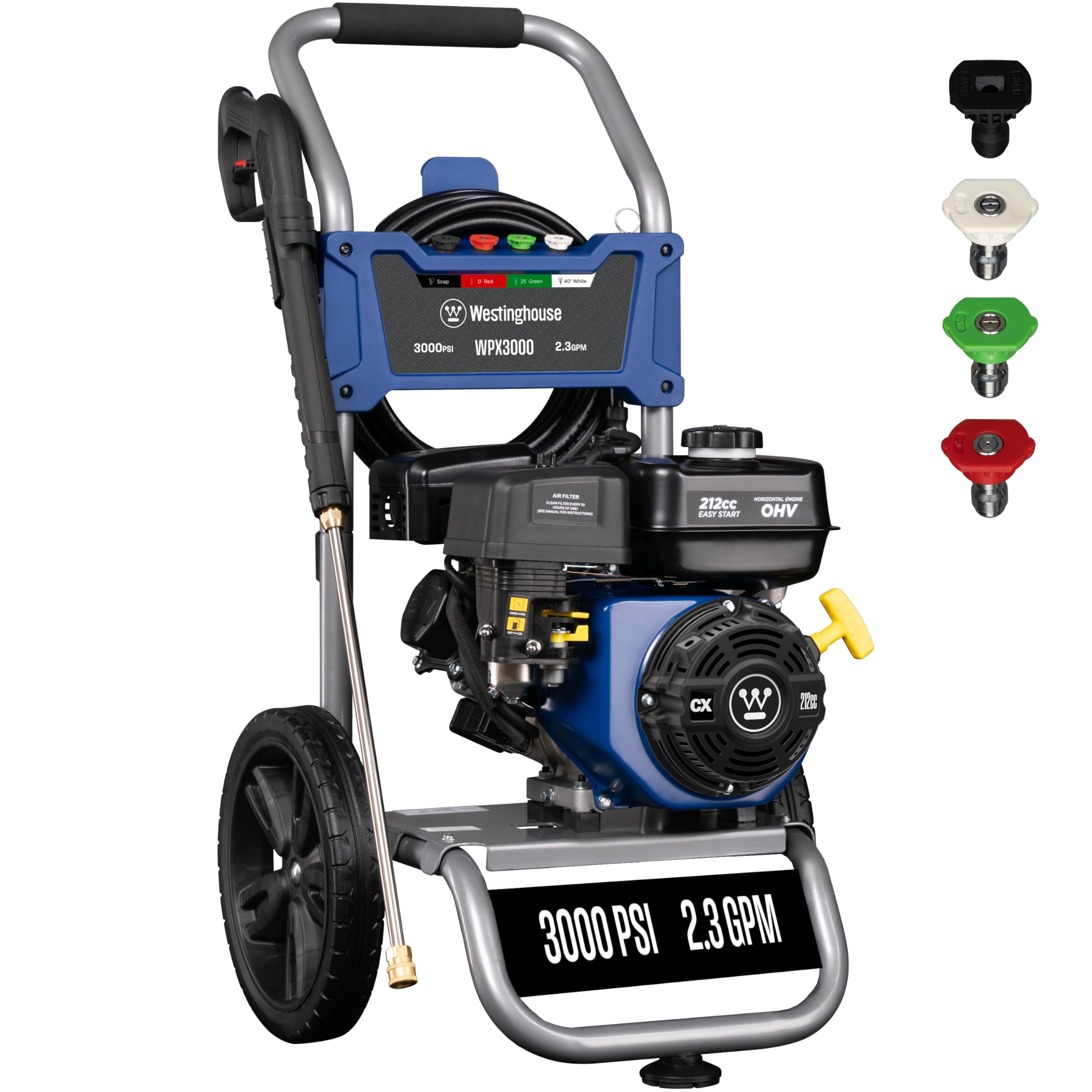
The WPX3000 uses the same 212cc Westinghouse OHV engine as the WPX3200 but delivers 3000 PSI at 2.3 GPM — a 7% lower maximum pressure and 0.2 GPM lower flow rate than the top pick. The payoff is significantly less weight: at 50.7 pounds it is 12.3 pounds lighter, and its dimensions are slightly taller (39.2 inches high) but narrower. That makes it easier to slide into a tight garage corner. The 0.95-gallon gas tank is slightly larger than the WPX3200’s 0.9-gallon tank, so you can clean a bit longer between refills.
Owners mention that assembly is simple and that the engine starts in just one or two pulls — a big relief if you have wrestled with a finicky pull-cord before. The 4-nozzle set (0, 25, 40 degrees, and soap) covers the basics, though you lose the 15-degree intermediate nozzle that the WPX3200 includes. Reviewers also noted that the oil fill location is a bit awkward and the hose can rub against the wheel during movement. A zip-tie fix helps prevent wear.
This is the pick for anyone who wants gas-level power — sufficient for cleaning concrete, siding, and cars — but does not need the absolute highest flow rate and wants to save over ten pounds of carrying weight. The 3-year warranty provides the same confidence as the bigger model.
Where it shines
- Starts consistently in 1-2 pulls, per buyer reports
- 50.7 pounds makes it much more portable than the 63-pound WPX3200
- Large 12-inch never-flat wheels provide smooth movement across yards
What to note
- Only four nozzles included — no intermediate 15-degree tip
- Some buyers found the oil fill location tight and the hose can rub against the wheel
Best suited for: The homeowner who wants dependable gas power and easy portability without paying for maximum flow they won’t use daily.
skip it if: You specifically need the extra 0.2 GPM for very large concrete driveways — the WPX3200 is the better choice.
3. Greenworks 80V 3000 PSI Dual-Port Pressure Washer (Tool-Only)

A battery-powered washer that cuts the cord and the gas can entirely.
This Greenworks runs on two 80V batteries (sold separately — this is a tool-only purchase). There is no extension cord to drag around, no gas to mix, and no engine noise to annoy neighbors. It generates 3000 PSI at 2.0 GPM, which is enough to clean siding, fences, and driveways. Its cast-aluminum axial cam pump (a pump type known for longer life than simpler wobble pumps) delivers power comparable to a gas unit. But it starts the instant you pull the trigger.
Customers note that two charged batteries last about one hour of cleaning time. That is fine for a driveway and patio but not enough for a full day of heavy stripping. The unit’s dimensions (20.28″L x 18.7″W x 24.21″H) make it slightly more compact than the Westinghouse gas models — 16% less height than the WPX3000 — so it tucks away into tighter storage spaces. A self-primed siphon hose also lets you draw water from a standing source like a bucket or tank. One reviewer used it to clean a boat hull at a marina with no power or running water.
The catch is runtime: once the batteries drain, you stop and wait for a recharge. If you own other Greenworks 80V tools, you can share batteries. But if you are starting from scratch, you must buy batteries and a charger separately. This machine is best for the person who values silence, zero emissions, and cordless freedom above the continuous runtime of a gas engine.
Biggest advantages
- No gas, no cords — operates entirely on 80V batteries for total portability
- Self-priming siphon hose pulls water from a bucket or tank, not just a hose
- Compact footprint (24.21 inches tall) for easy storage
Main drawbacks
- Tool-only — batteries and charger sold separately, adding to upfront cost
- Reviewers point out about one hour of runtime on two batteries; you will need spares for longer jobs
This is for you if: You want a quiet, fume-free machine for cleaning where extension cords or gas fumes are a hassle, like a boat dock or a small property near a shared wall.
Not for you if: You need all-day continuous run time for deep stripping or heavy commercial use — a gas engine will serve you better.
4. Greenworks 3000 PSI Brushless Electric Pressure Washer

A corded electric washer that calms the neighborhood with independently verified power.
Greenworks had the 3000 PSI and 2.0 GPM claims for this model independently tested and verified by an outside lab. So you are not guessing whether the specs are real. Its 14-amp TruBrushless motor (a brushless design that generates less heat and lasts longer than older brushed motors) powers a rugged metal spray gun and a 25-foot Uberflex hose that resists kinking. The soap nozzle, turbo nozzle, and 15, 25, and 40-degree tips cover everything from gentle car washes to high-pressure concrete cleaning.
Painting contractors and homeowners both report it is noticeably quieter than any gas pressure washer — one reviewer noted it quieted the neighborhood compared to their gas unit. The JettFlow Technology feature claims to deliver up to 50% more flow to reach higher areas like second-story siding. The machine uses an AC (wall outlet) power source, so you are tethered to a cord. But you never have to pull a starter rope or refill a gas tank. Assembly takes about ten minutes with a Phillips screwdriver, though the printed instructions are small.
Some buyers felt the actual cleaning force was closer to 2000 PSI than the rated 3000, even though the spec is verified. The cord also limits your range to the length of your extension cable. This is the best pick for someone who wants solid, independently-confirmed pressure in a quiet package that is easy to start every time and avoids the seasonal maintenance of a gas engine.
Why it stands out
- PSI and GPM claims independently lab-tested and verified for accuracy
- 14-amp TruBrushless motor runs quieter than any gas unit
- Rugged metal gun and kink-resistant Uberflex hose feel built to last
What to consider
- Requires an AC wall outlet and extension cord, limiting your range
- Some buyers felt the real-world pressure felt softer than the rated 3000 PSI
Ideal for: Homeowners in noise-sensitive neighborhoods who want lab-verified power, instant electric start, and zero gas maintenance.
Consider something else if: You cannot work within range of a wall outlet or you prefer the fully cord-free experience of a battery-powered unit.
Understanding the Specs
PSI (Pounds per Square Inch)
PSI is the force of the water jet. A 3000 PSI machine can strip paint, clean oil stains from concrete, and blast mud off heavy equipment. A lower PSI (around 1500-2000) is gentler for cars and wood. Always pair the nozzle angle to the surface. A 40-degree nozzle distributes that pressure over a wider area, while a 0-degree nozzle concentrates it into a tiny spot that can damage wood.
GPM (Gallons per Minute)
GPM is the volume of water flowing. This number determines how quickly you cover a large surface. A machine with 2.5 GPM cleans a driveway noticeably faster than a 2.0 GPM model because more water moves the grime away. Think of PSI as the “punch strength” and GPM as the “rinse speed” — you need both working together for efficient cleaning.
FAQ
What is the main difference between gas and electric pressure washers at 3000 PSI?
Can a 3000 PSI pressure washer damage my car paint or wood siding?
How do I know if a pressure washer’s PSI rating is accurate?
Is 2.0 GPM enough for a 3000 PSI pressure washer?
How long does a gas engine pressure washer last?
Can I use a battery-powered pressure washer if I don’t have a garden hose?
What size extension cord do I need for a 3000 PSI electric pressure washer?
What is the difference between a soap nozzle and a regular nozzle?
Can a 3000 PSI gas pressure washer be used for commercial business?
How do I winterize a gas pressure washer to prevent freeze damage?
Final Thoughts: The Verdict
For the majority of shoppers, the best pressure washer 3000 psi winner is the Westinghouse WPX3200 because it delivers the highest pressure and flow (3200 PSI / 2.5 GPM) in a durable steel frame with five nozzles and a soap tank. If you want a lighter gas machine that starts in one or two pulls, grab the Westinghouse WPX3000 at 50.7 pounds. And for cord-free, fume-free cleaning where silence matters, the Greenworks 80V battery model frees you from gas and extension cords entirely.
How We Picked
We do not accept paid placement. Every pick is matched to a real buyer and a real use-case; we do not hands-on test units.
Sources & Methodology
Specifications: manufacturer listings and product documentation. Review insights: verified customer reviews, as of July 2026. Pricing: not shown on this page (it changes often); check the current price via the retailer link.
As an Amazon Associate, Lawn Gear Lab earns from qualifying purchases. This does not affect which products we feature.