
Specs are compiled from manufacturer listings and verified buyer reviews and can change over time — please confirm the key details on the product page before buying.
You put in the work to get a thick, green lawn, only to watch crabgrass, clover, and dandelions muscle their way in before summer hits. The real trick to winning that fight is timing — stopping those weed seeds before they ever sprout. A pre-emergent weed killer creates a chemical barrier in the soil that keeps annual weeds from germinating, saving you the frustration of pulling and spraying all season long.
I’m Rikta — the founder and writer behind Lawn Gear Lab. This guide is built by comparing the manufacturers’ published specifications and the patterns across verified customer reviews, so you get each pick’s real strengths and trade-offs instead of marketing spin.
Crabgrass, clover, and dandelions muscle into your lawn before summer hits. Stop their seeds from sprouting with the right pre emergent weed killer, and your pick depends on your lawn size, grass type, and how much effort you want to put into mixing and spreading.
Quick Picks
- The Andersons Barricade 50 lb Bag — Pro Grade
- Prodiamine 65 WDG (Generic Barricade) — Best Concentrate
- The Andersons 18-0-4 Barricade Fertilizer with Pre Emergent — Best Combo
- Preen Lawn Crabgrass Control 15 lb. — Smart Timing
- Hi-Yield Turf & Ornamental Weed & Grass Stopper (12 lbs.) — Budget Champion
How To Choose The Best Pre Emergent Weed Killer
Picking the right pre-emergent depends on three things: what kind of grass you have, which weeds you hate most, and how much lawn you need to cover. Here is what to look for.
Active ingredient — Prodiamine vs Dithiopyr
These two chemicals are the workhorses of the pre-emergent world. Prodiamine (the active compound in Barricade products) offers the longest residual control — you can get a full season from one early-spring application. Dithiopyr (the active compound in some Preen products) has a short window of post-emergent activity, meaning it can kill very young crabgrass that has already sprouted. If you want low-maintenance convenience, go with prodiamine. If you sometimes miss the perfect spring window, dithiopyr gives you a little grace.
Coverage area and bag size
Pre-emergents are sold by weight, and the coverage depends on the concentration of active ingredient. A 15 lb bag that covers 5,000 sq ft is a standard homeowner size. A 50 lb professional bag can cover over 14,000 sq ft. Match the bag size to your lawn so you do not end up with a half-empty bag in the garage next spring, or worse — running out halfway through the yard.
Granule size and spreader type
Most pre-emergent weed killers come as dry granules that you spread with a walk-behind spreader. Some brands use patented dispersible granule (DG) technology — those tiny particles dissolve fast when you water them in, moving the chemical straight into the soil. This means you get even coverage without the white clumps of undissolved product sitting on top of the grass. Always check the product label for spreader settings; a mismatch means patchy control.
Quick Comparison
| Model | Best For | Coverage | Active Ingredient | Item Weight | Amazon |
|---|---|---|---|---|---|
| The Andersons Barricade 50 lb Bag | Large lawns, 2-year control | 14,200 sq ft | Prodiamine (0.48%) | 50 lb | Amazon |
| Prodiamine 65 WDG | DIY spray application | Varies by rate | Prodiamine (65%) | 5 lb | Amazon |
| The Andersons Barricade Fertilizer 18-0-4 | Fertilizer + weed control combo | 5,000 sq ft | Prodiamine (0.426%) | 18 lb | Amazon |
| Preen Lawn Crabgrass Control | Post-emergent grace period | 5,000 sq ft | Dithiopyr | 15 lb | Amazon |
| Hi-Yield Turf & Ornamental Weed & Grass Stopper | Budget-friendly crabgrass control | 5,000 sq ft | Dimension (Dithiopyr) | 12 lb | Amazon |
In‑Depth Reviews
1. The Andersons Barricade 50 lb Bag
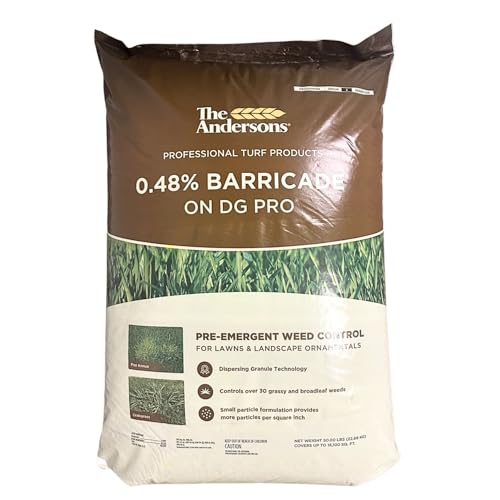
The heavy lifter that stops weeds for up to 2 years on a single spread.
If you have a large lawn and want the longest residual control available in a granular product, this 50 lb bag of Barricade is the one. It contains 0.48% prodiamine — the same active ingredient trusted by professional turf managers — and covers 14,200 square feet. That is 14,200 sq ft versus the 5,000 sq ft covered by most standard 15 lb homeowner bags. Buyers report it is “effective for 2 years” and that it “outperforms Preen,” with some areas needing no reapplication after two full seasons.
This is a straight pre-emergent with no fertilizer mixed in, which is ideal for fall applications or when you already have a separate fertilizer schedule. The DG Pro formulation means the granules break down quickly when you water them in, so you get even distribution without visible white chunks on your lawn. One reviewer noted that crabgrass was limited after the first summer, though clover remained a problem — so you may still need a post-emergent broadleaf spray for specific weeds like clover.
Season-Spanning Control
- Covers 14,200 sq ft — the largest coverage in this list
- Owners mention weed control lasting up to 2 years from a single application
- 0.48% prodiamine stops 30+ grass and broadleaf weeds
Not a Full Weed Killer
- Will not eliminate existing weeds — must apply before they sprout
- 50 lb bag is heavy to carry and store
- One buyer mentioned clover still came through
Grab this for: large lawns where you want to apply once every year or two and forget about crabgrass.
Look elsewhere if: you need a product that handles existing broadleaf weeds like clover alongside pre-emergent prevention.
2. Prodiamine 65 WDG (Generic Barricade)
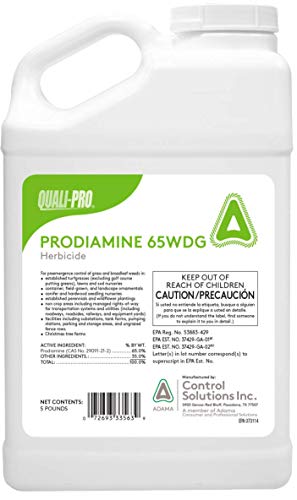
Professional-grade concentrate that turns a 5 lb bag into years of supply.
This is the same active ingredient (prodiamine) that makes Barricade a household name among turf pros, but at a much higher concentration — 65% compared to the 0.48% in granular products. The 5 lb bag of this wettable dispersible granule (WDG) (a powder that mixes with water and applies as a spray) gives you immense flexibility in how much you use per 1,000 sq ft. At 80.0 oz total, it is 80.0 oz versus the 800.0 oz Andersons Barricade bag, but the concentration means you get far more applications per pound.
One buyer on Long Island applied it in early March and reported zero dandelions, clover, or poa annua (annual bluegrass) by June 1st. You do need a sprayer and careful measuring — the label recommends 0.185 to 0.55 oz per gallon per 1,000 sq ft depending on the target weed. This is the most cost-effective option for homeowners with a sprayer who want to rotate active ingredients between seasons.
Concentrated Power
- 65% prodiamine — extremely high concentration for precise application
- Huge cost per application savings vs granular products
- Can use on Bermuda and St. Augustine without damage
Requires Equipment
- Needs a sprayer and careful mixing — not for beginners
- Coverage varies by rate; you must calculate for your lawn size
- Rain or watering-in needed within hours for best results
Reach for this if: you already own a sprayer and want the cheapest per-square-foot cost for weed prevention.
skip it if: you prefer walking around with a spreader and do not want to mix chemicals yourself.
3. The Andersons 18-0-4 Barricade Fertilizer with Pre Emergent
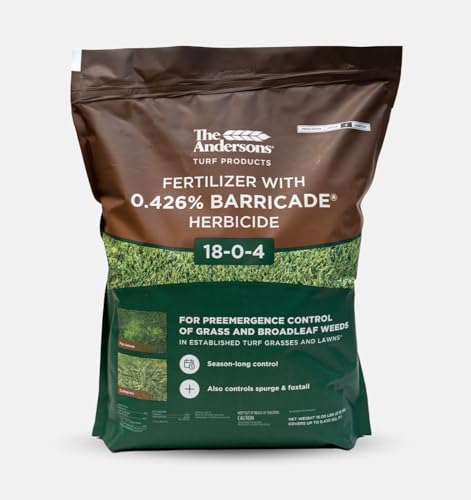
One pass that feeds your lawn and stops weeds before they start.
This bag saves you a trip around the yard by combining a 18-0-4 fertilizer blend with 0.426% prodiamine pre-emergent. At 18 lbs, it covers 5,000 sq ft — the same coverage as most standard homeowner bags, but you get the added benefit of a nitrogen boost that promotes a thick, healthy lawn. A reviewer in Texas reported using it on zoysia grass with great results, calling it an “annual must do yard treatment.”
The DG (dispersible granule) technology is the standout feature here. Unlike some granules that sit on top of the soil, these tiny particles dissolve rapidly when you water them in, pushing the prodiamine down into the root zone where it needs to be. One owner reported “just applied 3 weeks ago — no weeds and mowed 3 times all at 6 inch tall grass.” Keep in mind this is a pre-emergent only; it will not kill existing weeds, and at 18 lbs it is lighter than the 50 lb Barricade bag.
Feed and Protect in One
- Fertilizer (18-0-4) and pre-emergent in one convenient bag
- DG granules dissolve quickly for fast soil penetration
- Effective on crabgrass, poa annua, goosegrass, and henbit
Not a Standalone Weed Killer
- Will not eliminate existing weeds already visible in the lawn
- Some buyers found it overpriced for the coverage provided
- No post-emergent activity — you need a separate product if you miss the spring window
Perfect for: homeowners who want a simple early-spring application that feeds the lawn and prevents weeds in one step.
Not ideal if: you already use a separate fertilizer schedule and only need a straight pre-emergent for fall.
4. Preen Lawn Crabgrass Control 15 lb.

The forgiving pre-emergent that still works after crabgrass has popped up.
Most pre-emergents demand perfect timing, but Preen Lawn Crabgrass Control uses dithiopyr, an active ingredient that kills crabgrass seeds before they sprout and also takes out very young crabgrass that has already germinated. This gives you a crucial 4-week grace period after the typical spring window — a lifesaver if a rainy weekend kept you off the spreader. It prevents crabgrass all season and handles over 40 common lawn weeds, including clover, according to one buyer who reports “Preen effectively prevents clover and crabgrass when applied pre-emergence.”
The 15 lb bag covers 5,000 sq ft and works on cool-season grasses (Kentucky bluegrass, fescue, ryegrass) and warm-season grasses (bermudagrass, St. Augustine, zoysia). One reviewer in New Jersey has used it for four years with nearly weed-free results, specifically preferring it over Scotts because “Scotts nourishes weeds.” The trade-off is that dithiopyr has a shorter residual period than prodiamine, so you may need a second application in late summer for season-long control.
Forgiving Window
- Can be applied up to 4 weeks after crabgrass emerges — unique among pre-emergents
- Prevents 40+ weeds including clover and crabgrass
- Safe on most cool and warm-season grass types
Shorter Residual
- May require a second application in late summer for full season control
- Some users report needing a follow-up after 4 weeks
- Not as strong on broadleaf weeds as prodiamine-based products
Choose this if: you tend to apply a little late in spring and want a product that can still stop young crabgrass.
Look at another option if: you prefer a longer-lasting single application that does not require a second round.
5. Hi-Yield Turf & Ornamental Weed & Grass Stopper (12 lbs.)

The entry-level spread that packs Dimension for dual pre-and post-emergent action.
This 12 lb bag uses the active ingredient Dimension (dithiopyr) — the same chemical found in Preen, giving it the same ability to kill crabgrass that has already sprouted. It covers 5,000 sq ft and is intended for ornamental landscape areas and established lawns. what separates it is the price: it is the most budget-friendly option on this list, yet contains the same core chemistry as products costing significantly more. Buyers confirm it “works amazing but timing matters,” and one user who dealt with henbit, crabgrass, and goosegrass saw them all disappear after two applications.
The trade-off is consistency. One buyer reports ordering a 12 lb bag but receiving a 9.6 lb bag — a potential packaging issue that means you should check the weight when it arrives. The granular form applies easily with a standard spreader, and it can be applied up to 4 weeks later than other pre-emergent crabgrass products, giving you the same forgiving window that Preen offers. For a small lawn or a tight budget, this is a solid entry point into pre-emergent weed control.
Budget-Friendly Chemistry
- Contains Dimension (dithiopyr) for pre- and post-emergent action
- Can be applied up to 4 weeks later than standard pre-emergents
- Covers 5,000 sq ft at a low per-bag cost
Packaging Inconsistency
- One buyer received a 9.6 lb bag instead of the listed 12 lbs
- Requires correct timing across spring, summer, and fall for full results
- Less effective on broadleaf weeds compared to prodiamine products
Go for it if: you have a small lawn and want the most affordable entry into dithiopyr-based pre-emergent control.
pass on it if: you need guaranteed bag weight consistency or prefer prodiamine for longer residual control.
Understanding the Specs
Prodiamine vs Dithiopyr
These two active ingredients dominate granular pre-emergents. Prodiamine (Barricade) is the long-haul champion — it sits in the soil for months, stopping weed seeds from germinating all season. Dithiopyr (Dimension) has a shorter residual but offers a unique advantage: it can kill very young crabgrass that has already sprouted. If you apply early and want season-long coverage, prodiamine wins. If you sometimes miss the spring window, dithiopyr gives you a second chance.
Coverage and Concentration
A product’s coverage area (like 5,000 sq ft or 14,200 sq ft) tells you how much ground one bag treats at the labeled application rate. Higher-concentration products, like 65% prodiamine WDG, let you treat far more square footage per pound than a 0.48% granular product, but they require a sprayer to mix and apply. Straight granular products are easier for beginners — just fill your spreader, walk the yard, and water it in.
Dispersible Granule (DG) Technology
Some brands, especially The Andersons, use a patented DG formulation. These granules are tiny and dissolve very quickly when they hit water. This means the active ingredient moves into the soil fast instead of sitting on top of the grass blades, where it could get mowed off or washed away by rain. For the same coverage, DG products often provide more uniform weed control than standard granules.
FAQ
When should I apply pre-emergent weed killer in spring?
Can I use pre-emergent on a new lawn or overseeded grass?
Do I need to water in pre-emergent after applying it?
Will pre-emergent kill existing weeds like dandelions?
How often do I need to reapply pre-emergent each year?
Is pre-emergent safe for pets and kids after it dries?
Can I use pre-emergent on St. Augustine or Bermuda grass?
What is the difference between granular and liquid pre-emergent?
Can I apply pre-emergent in the fall?
How long does pre-emergent stay active in the soil?
Final Thoughts: The Verdict
For most people, the pre emergent weed killer winner is the The Andersons 18-0-4 Barricade Fertilizer with Pre Emergent because it combines a balanced 18-0-4 fertilizer with professional-grade prodiamine in an easy-to-spread DG granule that covers a standard 5,000 sq ft lawn. If you have a large property, the The Andersons Barricade 50 lb Bag delivers the best coverage-per-dollar and shoppers say two seasons of control. And for DIY spray enthusiasts who want precise application at the lowest per-square-foot cost, the Prodiamine 65 WDG is your best bet.
How We Picked
We do not accept paid placement. Every pick is matched to a real buyer and a real use-case; we do not hands-on test units.
Sources & Methodology
Specifications: manufacturer listings and product documentation. Review insights: verified customer reviews, as of July 2026. Pricing: not shown on this page (it changes often); check the current price via the retailer link.
As an Amazon Associate, Lawn Gear Lab earns from qualifying purchases. This does not affect which products we feature.