
Succulents store water in their leaves, which means the quickest way to kill them is with a pot that holds moisture against the roots. The difference between a thriving rosette and a mushy mess often comes down to what you plant it in — not the soil, not the sunlight, but the container itself. Matching the right vessel to your plant’s biology is the single most important decision you can make.
I’m Rikta — the co-founder and writer behind Lawn Gear Lab. I spend my time comparing vessel dimensions, drainage architecture, and glaze formulations across dozens of manufacturers, then cross-referencing those specs against thousands of verified owner experiences to separate functional designs from decorative hazards.
This guide breaks down the material science, drainage requirements, and sizing logic that separate a healthy succulent from a root-bound, overwatered casualty. Here is the research-backed breakdown of the best pots for succulents.
How To Choose The Best Pots For Succulents
Succulents need a container that dries out completely between waterings. That rules out anything without drainage, anything with a narrow opening that traps humidity, and anything made from materials that absorb and hold moisture internally. Here is the specific criteria that matter.
Drainage Hole Count and Diameter
One small hole at the center is often not enough. Multiple openings or a wide single hole at least a quarter inch in diameter allow water to exit freely. Pots with a single tiny pinhole create surface tension that locks water inside the soil, directly counteracting the drying cycle succulents need.
Material Porosity and Glaze Coverage
Unglazed terracotta breathes — water evaporates through the walls, helping soil dry faster. Glazed ceramic, glass, and metal trap moisture inside, making them riskier for beginner growers. If you choose glazed, you must reduce watering frequency to compensate for the reduced evaporation rate. Resin and plastic sit somewhere in the middle but lack the thermal regulation of clay.
Interior Volume vs Root Ball Size
A pot that is too large leaves wet soil far from the roots, which stays moist and breeds fungus. The ideal container leaves roughly half an inch to an inch of space around the root ball. For a 2-inch succulent, a 2.5 to 3-inch diameter pot is the correct range.
Quick Comparison
On smaller screens, swipe sideways to see the full table.
| Model | Category | Best For | Key Spec | Amazon |
|---|---|---|---|---|
| D’vine Dev Set of 4 (Product 7) | Premium Set | Matched multi-pot displays | 4.7″ diameter with mesh net | Amazon |
| LE TAUCI Set of 4 (Product 6) | Premium Set | Embossed decor with saucers | 4″ wide, glazed ceramic | Amazon |
| EPFamily 6 Inch Bonsai (Product 5) | Single Premium | Shallow wide plantings | 6.3″ outer x 2.6″ tall | Amazon |
| Chez JuJu Geometric (Product 4) | Mid-Range Set | Modern desk decor | 3.3″ wide geometric shape | Amazon |
| SHECIPIN Mini 8-Pack (Product 3) | Budget Set | Mass propagation trays | 2.5″ wide with bamboo tray | Amazon |
| D’vine Dev Embossed (Product 1) | Mid-Range Single | Single statement accent | 4″ inner diameter stoneware | Amazon |
| UMESONG Smily Face (Product 2) | Novelty Single | Novelty gifts for kids | 4.1″ wide resin, multi-hole | Amazon |
In‑Depth Reviews
1. D’vine Dev Set of 4 (4.7 Inch)
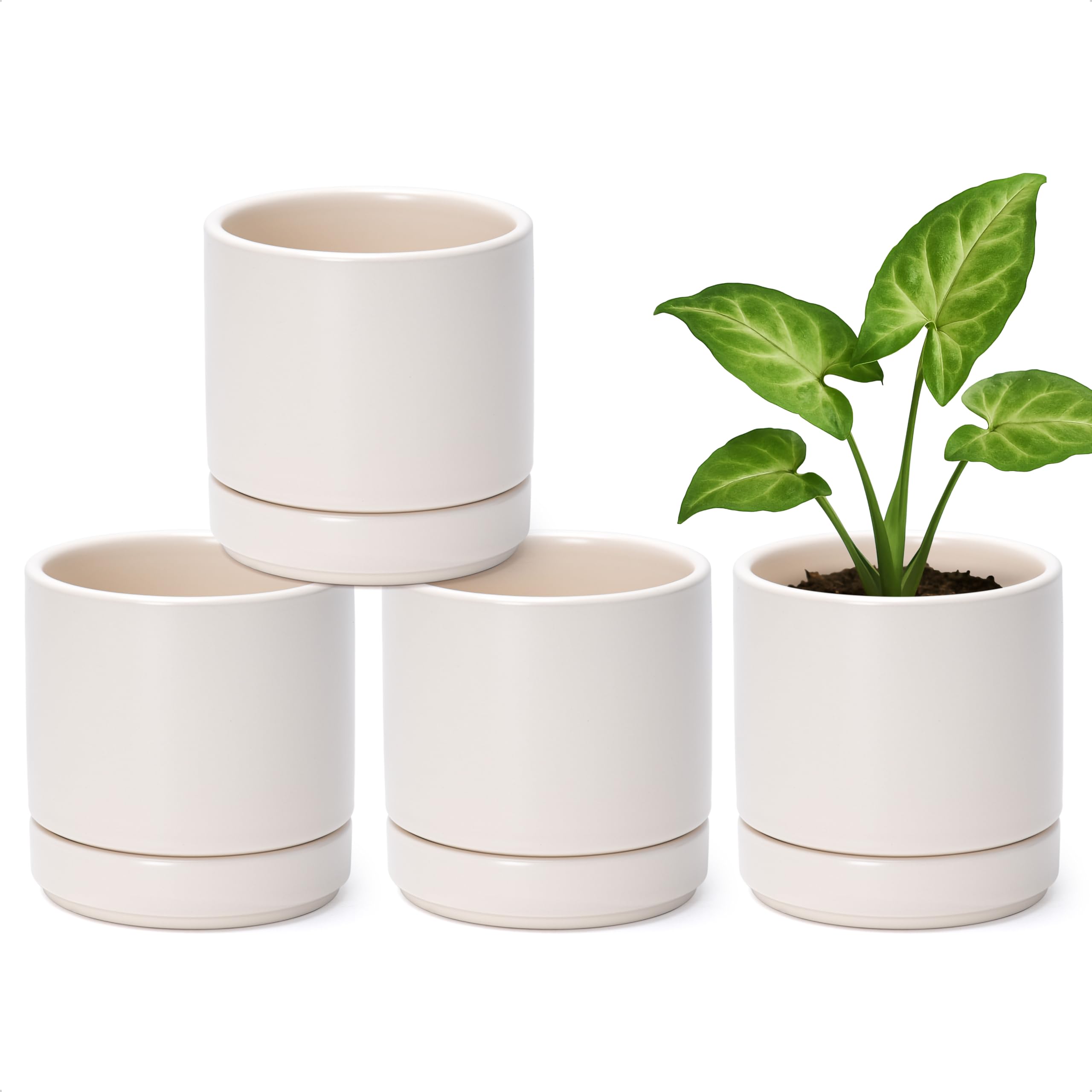
This four-piece set from D’vine Dev hits every spec point a serious succulent grower needs: 4.7-inch outer diameter with a 4.2-inch inner opening that fits most 4-inch nursery pots without excess soil volume, a soft matte oatmeal glaze that pairs with any interior, and individual ceramic saucers that detach completely for thorough cleaning. The 0.2-gallon capacity gives enough depth for root balls up to 3.5 inches tall without creating a moisture trap at the bottom.
What sets this set apart from cheaper multi-packs is the accessory package. Each pot ships with a stainless steel drainage mesh net that prevents soil from washing out through the hole, plus a felt tabletop pad that stops the saucer from scratching wood or painted surfaces. The ceramic itself is heavyweight at 8.3 pounds for the set, which means the pots stay planted when you brush against them — important for top-heavy succulents like jade or aloe.
Owner feedback consistently highlights the packaging quality and the fact that all four pots arrive intact with no hairline cracks. The oatmeal color reads slightly warm beige in person, matching the minimalist aesthetic buyers expect from mid-century modern or Scandinavian-style shelves. For growers who want a coordinated collection without mismatched sizes or cheap plastic saucers, this is the most complete package available.
What works
- Drainage nets prevent soil washout through the hole
- Heavy ceramic resists tipping from top-heavy plants
- Felt pads protect delicate furniture surfaces
What doesn’t
- Glazed interior reduces evaporation rate
- Saucers are glazed ceramic, not absorbent
2. LE TAUCI Ceramic Succulent Pots Set of 4

LE TAUCI brings a distinct embossed pattern to each of the four pots — raised leaf motifs and geometric textures that catch light differently throughout the day. At 4 inches wide with a 3-inch top opening, these are sized for compact rosette succulents like echeveria, haworthia, or lithops. The arctic white glaze has a weathered, slightly vintage finish that avoids the sterile look of pure white ceramic.
The drainage system is straightforward: each pot has a central hole matched with a shallow ceramic saucer. The saucers are shallow enough that they do not trap standing water for long, and the glazed interior means moisture does not wick into the pot walls. For growers who prefer a drier container, the embossed texture adds surface area that may help with evaporation from the exterior, though the effect is marginal compared to unglazed terracotta.
Multiple owners note that the size runs slightly smaller than expected — the 4-inch measurement refers to the body height, and the top opening is closer to 3 inches across. That makes these ideal for 2-inch to 3-inch nursery pot transplants. The packaging is thick foam with individual compartments, and all four pots arrive without chips or cracks even after cross-country shipping.
What works
- Unique embossed patterns differentiate each pot
- Vintage off-white glaze hides water spots
- Compact size fits tightly on windowsills
What doesn’t
- Top opening is only 3 inches wide
- Single drainage hole per pot
3. EPFamily 6 Inch Ceramic Bonsai Pot
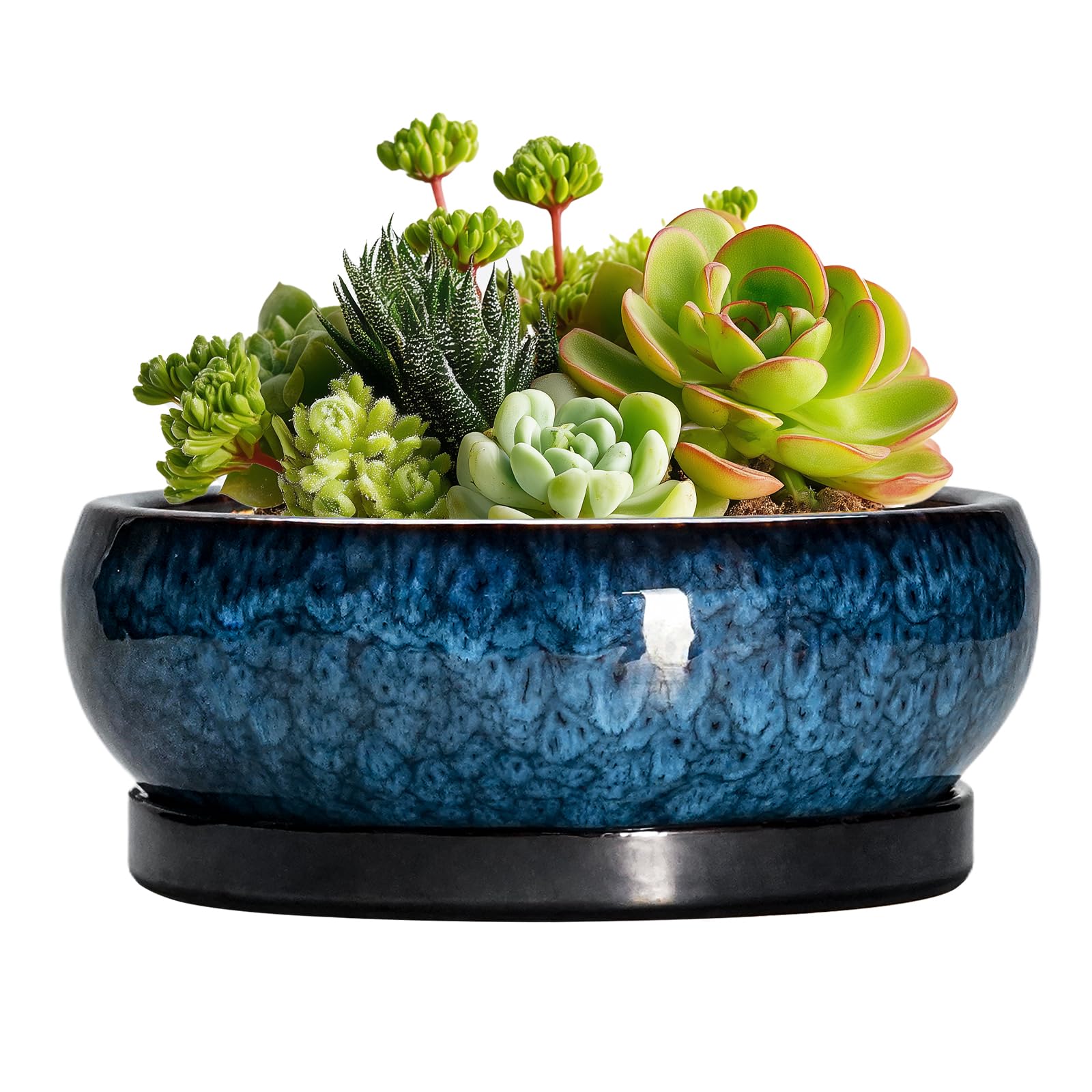
The EPFamily bonsai pot breaks from the standard cup shape with a wide, shallow profile that mimics the natural growing conditions of desert succulents. With a 6.3-inch outer diameter and just 2.6 inches of height, this design forces roots to spread horizontally rather than diving deep — exactly what echeveria, sedum, and sempervivum prefer. The 5.3-inch inner opening gives plenty of surface area for a cluster planting of multiple small rosettes.
The blue glaze is a rich, consistent color applied over high-fired ceramic. A 9mm drainage hole sits at the center, paired with a matching blue ceramic saucer and a small mesh screen to keep soil in place. The low center of gravity means this pot is extremely stable on a tabletop, and the wide opening makes it easy to arrange plants without squeezing them through a narrow neck.
Buyers consistently compare this favorably to traditional bonsai pots that cost significantly more. The glaze has no bubbles or thin spots, and the ceramic body rings like stone when tapped. For succulent arrangements where you want three or four plants sharing one container, this shallow bowl format outperforms a tall narrow pot every time.
What works
- Shallow depth prevents deep water pooling
- Wide opening allows easy cluster planting
- Stable base resists tipping
What doesn’t
- Single drainage hole for a wide surface area
- Blue glaze may clash with neutral decor
4. Chez JuJu Modern Geometric (3-Pack)

The Chez JuJu set brings angular, faceted shapes to the succulent pot category, with each of the three pots having a distinct geometric silhouette in white, black, or grey matte paint. At 3.3 inches wide and 3.5 inches tall, these sit at the smaller end of the range — appropriate for single 2-inch to 3-inch nursery pots. The bamboo saucers are a smart addition, absorbing minor drip moisture without promoting rot.
Each pot includes a drainage hole at the bottom and a plastic mesh grid to prevent soil from spilling during watering. The narrow top opening makes direct potting difficult — several buyers note that you need to carefully position a pre-potted succulent rather than trying to place soil and roots through the opening. The low weight of 7 ounces per pot makes these suitable for wall shelves or glass tables where heavier ceramic could be a concern.
Color accuracy is a minor point to consider: the white reads slightly warmer than the product images, with a subtle yellow-green undertone that some owners mention. The black and grey pots match expectations. For the price of a single premium pot, you get three distinct shapes that coordinate without being identical — a smart solution for a kitchen windowsill or office desk.
What works
- Three distinct geometric silhouettes in one set
- Bamboo saucers absorb minor drips
- Lightweight for shelf placement
What doesn’t
- Narrow top opening complicates repotting
- White color runs warmer than photos
5. D’vine Dev 4 Inch Embossed Stoneware Planter
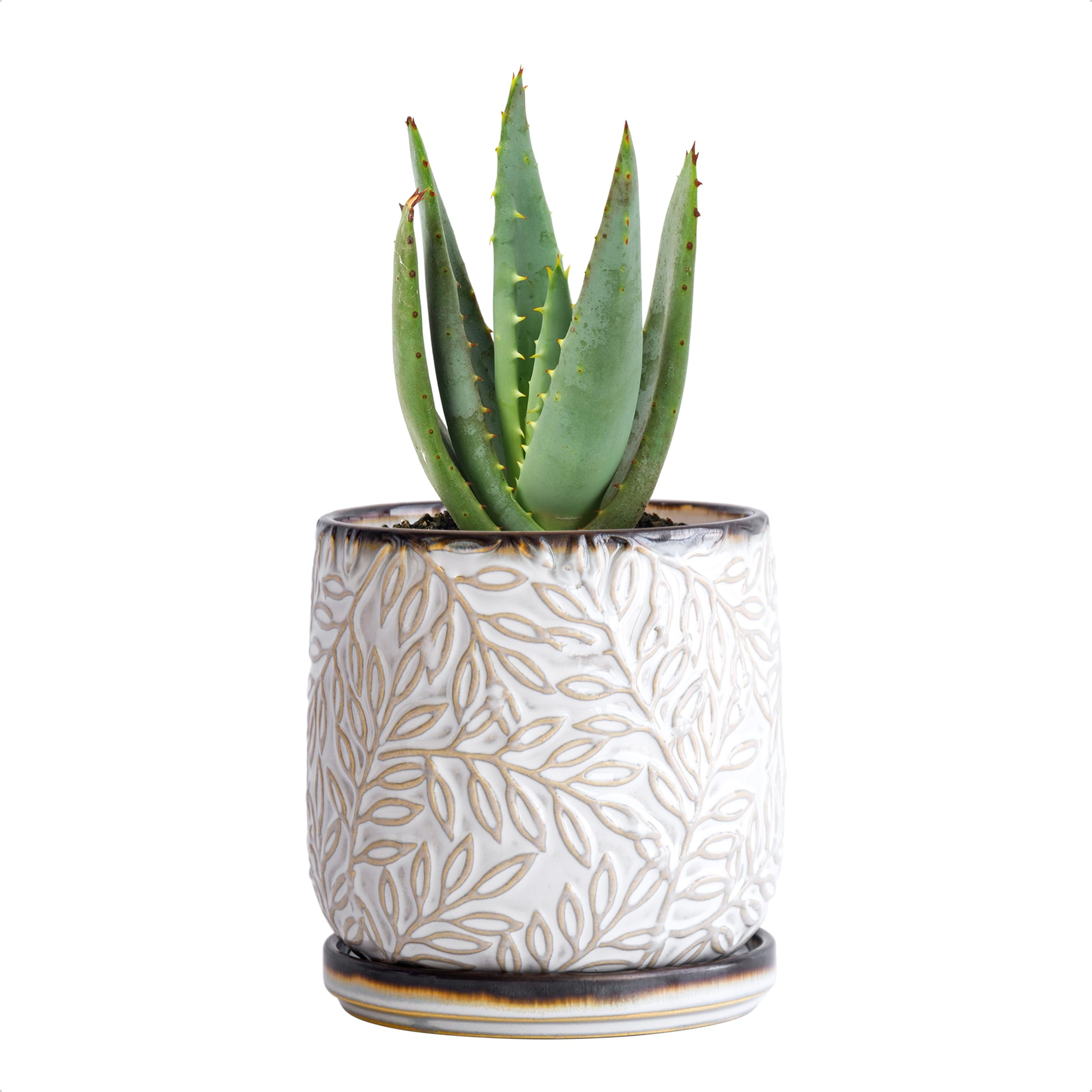
D’vine Dev’s embossed leaf planter delivers a heavyweight stoneware body that feels substantial in the hand — 1.9 pounds for a 4-inch pot that holds only 0.2 gallons of soil. The raised leaf motif wraps around the entire circumference, creating a textured grip surface and a visual depth that plain matte pots lack. The smoked white finish is a warm off-white with subtle grey undertones that complements green foliage without competing for attention.
The drainage package is complete: a pre-drilled hole, a stainless steel mesh to stop soil loss, and a padded felt disc that prevents the saucer from sliding or scratching. The matching ceramic saucer clips snugly underneath without wobbling. For a single accent pot on a coffee table or nightstand, this gives you the visual statement of a premium ceramic piece at a price that undercuts boutique brands.
Owner feedback emphasizes the packaging as exceptional — double-boxed with foam inserts that survive rough handling. The only trade-off is the capacity limit: at 0.2 gallons and a 4-inch inner diameter, you cannot fit a large jade or mature snake plant. This is strictly for small single rosettes, cuttings starting to root, or compact cacti.
What works
- Heavy stoneware resists accidental knocks
- Complete accessory kit with mesh and pad
- Embossed texture adds visual depth
What doesn’t
- 0.2-gallon capacity limits plant size
- Glazed interior retains more moisture
6. SHECIPIN Mini 2.6 Inch 8-Pack

When you need to pot up a tray of leaf propagations or give each cutting its own container, the SHECIPIN 8-pack delivers the lowest per-unit cost in this comparison. Each pot measures 2.5 inches wide by 2.75 inches tall — just enough room for a single 1.5-inch to 2-inch succulent with a tight root ball. The white polished ceramic with a removable bamboo tray creates a clean, uniform look across all eight pots.
The drainage hole is present, but it is a single small opening that could potentially clog with fine succulent soil over time. The bamboo tray sits underneath the entire row of pots, not individually — if you water one pot heavily, the runoff spreads across the tray and can wick back into adjacent pots through capillary action if they sit in the pooled water for hours. Keep the tray dry between waterings to avoid this.
Buyers should note the actual size: at 2.5 inches, these are genuinely tiny, and some owners were surprised by the small footprint. They are ideal for Lithops, Haworthia cooperi, or small Astrophytum seedlings. For anything larger than a 2-inch nursery plug, you will need the next size up. The value proposition is undeniable for bulk propagation, but these are not primary display pots.
What works
- Lowest per-unit cost in this guide
- Uniform white finish for clean displays
- Bamboo tray catches drips
What doesn’t
- Single small drainage hole may clog
- Shared tray allows cross-wicking
7. UMESONG Smily Face Rocking Chair Planter

The UMESONG Smily Face planter trades traditional ceramic for lightweight resin formed into a smiling face seated in a rocking chair — a novelty piece that works as a gift for children or as a conversation starter on a shelf. The design is a single molded piece with no assembly required, and the resin construction means it will not crack or chip if dropped. At 4.1 inches tall and 4 inches wide, it fits a single small succulent or a string-of-pearls trailing over the edge.
Drainage is handled through a series of small holes arranged in a row at the bottom — an unusual configuration that actually prevents the single-hole clogging problem seen on many budget ceramic pots. These multiple openings allow water to exit even if one gets blocked by a root. The beige color and solid pattern keep the pot from looking busy, letting the face shape do the visual work.
Owner reviews consistently mention the sturdy one-piece feel and the novelty appeal. The resin does not degrade in sunlight, so it can sit on a windowsill or outdoors without fading. The main limitation is the rocking chair base — it sits on two curved rockers that create an unstable platform on uneven surfaces. On a level tabletop, the slight rocking motion is part of the charm, but curious pets or children can easily tip it over.
What works
- Multiple small drain holes prevent clogs
- Lightweight resin is shatterproof
- Novelty design makes a unique gift
What doesn’t
- Rocking base is unstable on soft surfaces
- Resin does not breathe like ceramic
Hardware & Specs Guide
Drainage Hole Diameter
The size of the drainage hole determines how quickly excess water exits the pot. A hole smaller than 6mm creates surface tension that holds water in the soil. Look for a single hole of at least 9mm or multiple 5mm holes arranged in a pattern. The EPFamily 6-inch bonsai pot uses a single 9mm hole, while the UMESONG face planter uses a row of small holes that collectively provide equivalent flow.
Glaze vs Unglaze
Unglazed terracotta allows water vapor to pass through the pot walls, reducing soil moisture by roughly 30 to 40 percent compared to glazed ceramic of the same volume. Glazed pots trap moisture inside, requiring a longer drying cycle between waterings. Buyers using glazed pots should reduce watering frequency and use a grittier soil mix with more perlite or pumice to compensate.
FAQ
Should I choose a pot with a drainage hole or a closed bottom for succulents?
Does the pot material affect how often I water succulents?
How do I match pot size to my succulent?
Final Thoughts: The Verdict
For most gardeners, the pots for succulents winner is the D’vine Dev Set of 4 because it combines the right 4.7-inch size with drainage nets, felt pads, and heavy ceramic that preserves proper drying cycles. If you want a shallow, wide vessel for cluster plantings, grab the EPFamily 6 Inch Bonsai Pot. And for the best budget multi-pack that handles propagation work, nothing beats the SHECIPIN 8-Pack.