
Specs are compiled from manufacturer listings and verified buyer reviews and can change over time — please confirm the key details on the product page before buying.
If your tomatoes taste bland, your lawn looks tired, or your fruit trees keep dropping their crop before it ripens, the missing piece is often potassium — the “K” in the NPK ratio on fertilizer bags. This guide sorts through the best straight-potash products so you can stop guessing and pick the one that matches your soil and your growing style.
I’m Rikta — the founder and writer behind Lawn Gear Lab. This guide is built by comparing the manufacturers’ published specifications and the patterns across verified customer reviews, so you get each pick’s real strengths and trade-offs instead of marketing spin.
Below, only the purest potassium sources made the cut, ranked by how well they deliver on the promise of a potassium-rich fertilizer for your garden.
Our Picks at a Glance


How To Choose The Best Potassium-Rich Fertilizer
Potassium is the plant’s regulator. It controls water movement, builds strong stems, and drives the sugars that make fruit sweet. But not all “high-K” bags are the same, and the wrong one can do more harm than good.
Match the Source to Your Soil
Muriate of Potash (0-0-60) is the cheapest and most concentrated form, but it carries chloride. Sulfate of Potash (0-0-50) swaps that for sulfur, making it safer for sensitive crops like grapes, beans, and strawberries. If you garden organically, look for the OMRI Listed badge.
Test Before You Treat
Guessing wastes money. A simple soil test tells you whether your potassium is actually low — and if it is, how much to add. Over-applying a straight-K product can lock out other nutrients and stress plants.
Quick Comparison
| Model | Best For | NPK Ratio | Form | Size | Amazon |
|---|---|---|---|---|---|
| Cz Garden Muriate of Potash★ Best Overall | Maximum K per dollar | 0-0-60 | Granules | 5 lb | Amazon |
| PowerGrow LangbeiniteBest Value | Organic K + magnesium | 0-0-22 | Granules | 5 lb | Amazon |
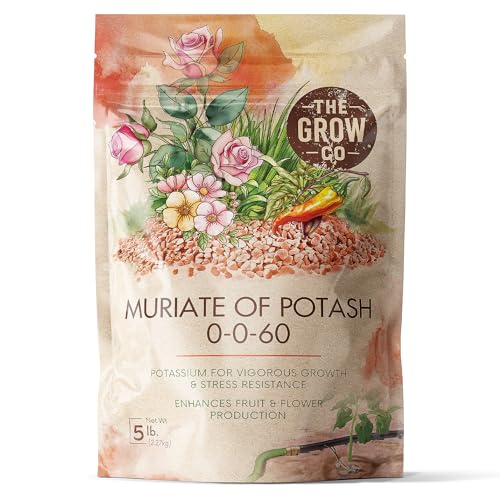
| The Grow Co MuriateBest for Fruiting Trees | Fast fruiting fixes | 0-0-60 | Granules | 5 lb | Amazon |
| Espoma Potash | Trusted brand versatility | 0-0-60 | Granules | 6 lb | Amazon |
| Southern Ag Sulfate of Potash | Chlorine-free feeding | 0-0-50 | Granules | 5 lb | Amazon |
| Alpha Chemicals Potassium Sulfate | Hydroponics & liquid feeding | 0-0-50 | Powder | 5 lb | Amazon |
| Cz Garden Organic Sulfate | OMRI-certified organic gardens | 0-0-50 | Powder | 3 lb | Amazon |
| Greenway Biotech Potassium Chloride | Pure water-soluble K | 0-0-62 | Powder | 3 lb | Amazon |
| Alpha Chemicals 10 lb Potassium Sulfate | Big gardens & long-term stock | 0-0-50 | Powder | 10 lb | Amazon |
In-Depth Reviews
1. Cz Garden Supply Muriate of Potash 0-0-60
Our pick — over 4.5★ from 900+ verified ratings; the strongest balance of quality and price.
The straightest shot of potassium you can pour, at a strength that goes further.
This is the crowd favorite — 4.7 stars across 900+ owners. What wins people over is plant health: dozens of gardeners single out better fruit production and flower bud development after a single application. The 0-0-60 ratio means it is pure potassium with no nitrogen or phosphorus, so you can fix a K deficiency without throwing off your soil’s other numbers.
You can pour what you need from the heavy-duty 5 lb pouch and reseal it, so the rest stays dry and clump-free. Buyers report it dissolves easily in water for a liquid feed, and one gardener’s apple and peach trees “got the full treatment this spring” with the fruit “really coming on.” This is a targeted potassium boost, not a complete fertilizer — pair it with a balanced feed for best results.
Do a soil test first, though. Because it is so concentrated, overuse can harm plants, and reviewers stress that correct timing and rate matter. If you want a focused potassium boost without spending much, this pouch delivers.
What wins people over
- Concentrated 0-0-60 formula for maximum K
- Improves root strength and drought tolerance
- Resealable, easy-pour 5 lb pouch
What to watch
- No nitrogen or phosphorus included
- Overuse can harm plants without a soil test
The verdict: The best all-around pick if you have confirmed low potassium and want the most concentrated fix.
Think twice if: You need sulfur or magnesium along with K — look at the langbeinite or sulfate options instead.
2. PowerGrow Systems Langbeinite 0-0-22
The organic mineral that feeds potassium, magnesium, and sulfur in one pass.
If you garden organically, this is the pick that keeps giving. Langbeinite carries a 0-0-22 NPK and is gentle enough that it “will not burn plants,” making it forgiving for beginners. The real magic is the trio it delivers: readily available potassium, sulfur, and magnesium — all from a natural mineral.
Fruit production is the thing everyone raves about here, with owners reporting tomatoes that are nothing short of “prolific” and Banana trees finally set multiple bunches after years of failure with a 10-10-10 blend.. One grower’s palms also thickened up beautifully. It is a long-lasting mineral supplement that rebuilds depleted soil over time, not just for a season.
The 0-0-22 number is lower than the muriate options, so you need more product to hit the same K level — but you get magnesium and sulfur your soil likely wants anyway. It is the smart value play for organic gardeners who want a whole-mineral fix.
Why it stands out
- Will not burn plants even with heavy use
- Adds magnesium and sulfur, not just K
- Excellent for fruiting trees and vegetables
Keep in mind
- Lower K percentage means more product per application
- Shipping bags can puncture in thin envelopes
Reach for this if: You want an organic, burn-safe way to push fruit production and rebuild soil minerals at once.
Look elsewhere if: You need a quick, highly concentrated liquid feed for hydroponics.
3. The Grow Co Muriate of Potash 0-0-60
The crystal potash that turns dropping fruit trees into heavy holders.
This one is built for the gardener whose trees keep shedding fruit every year. The 0-0-60 ratio is concentrated, and owners mention mango, avocado, and citrus trees “holding fruit STRONG” when used alongside seaweed extract. It is a targeted rescue for a specific problem, and it delivers.
The brand positions it as a stress protector, too — promoting thicker outer cell walls so plants resist drought, heat, and cold. Application is straightforward: mix 1/2 lb (1.25 cups) per 1,000 sq ft into the top inch of soil, or use 1 tsp near the drip line for individual plants.
The honest caveat is patience. Some users note you need to wait to see the full effect, and a soil test is the wise first step. If your fruiting trees are dropping their crop, this crystal potash is the direct answer.
Your best bet when: You have fruit trees that drop their crop early — this is the direct, concentrated fix.
The trade-off: Results take time to show, and it is a K-only supplement, not a complete feed.
4. Espoma Potash 0-0-60

A trusted name in a bigger bag, ready to sprinkle straight from the pouch.
Espoma is a brand built on reputation, and this 6 lb bag of 0-0-60 potash carries that trust. It needs no mixing — just sprinkle it around the drip line and water thoroughly. Spring and fall application works best, and it suits trees, shrubs, flowers, and vegetables alike.
Effectiveness is what wins people over here, with over 40 owners praising how it perked up their plants and kept them blooming with abundant flowers. One gardener saw slow-growing gourds look healthier and more vibrant within days. It is clean, filler-free potash with “no sludges or fillers,” and the resealable bag keeps it fresh.
At 6 lb it is slightly heavier than the 5 lb competitors, giving you a touch more product for your money. The versatility across all plant types makes it the easy all-rounder for home gardens that grow a bit of everything.
The easy choice for: Mixed gardens with trees, flowers, and vegetables all needing a K boost at once.
The honest note: It is a straight-K supplement, so you still need nitrogen and phosphorus from elsewhere.
5. Southern Ag Sulfate of Potash 0-0-50

The potassium boost that skips chlorine for salt-sensitive crops.
Avocado, beans, corn, cherries, citrus, grapes, palms, and roses — this is the list Southern Ag targets for potassium correction. The 0-0-50 sulfate form is the go-to when you want to avoid chlorine entirely, making it the right call for sensitive plants that would balk at muriate of potash.
The granules are easy to scatter and water in, with a rate of 0.5 lb per 100 sq ft. Customers note mango trees blooming gloriously — One gardener applied 5 lb under a mango tree in August and saw thousands of flowers by January.. It strengthens plants so they resist disease and winter stress better.
The quality and effectiveness earn consistent praise, though the pebble size gets mixed feedback and a few note quantity questions. If your soil test flags low potassium and you grow chlorine-sensitive crops, this is the safer, gentler ticket.
Pick this when: Your garden is full of chlorine-sensitive plants like grapes, beans, and citrus.
Fair warning: Water-solubility requires some stirring if you plan to dissolve it in a watering can.
6. Alpha Chemicals Potassium Sulfate 0-0-50

A fine powder that melts into a liquid feed for lawns, hydroponics, and blooms.
This is the powder form that dissolves almost fully in hot water, making it a favorite for liquid applications. One lawn owner divides it into 1 lb bags, applies monthly at 1 lb per 1,000 sq ft, and One lawn owner watched centipede grass spread and fill bare spots within a month.. The sulfur content even gave even greening with no streaks.
Hydroponic and aquarium gardeners love it too — it works beautifully as a fertilizer in a 125-gallon planted tank. It is a straight potassium sulfate source, so you are adding K and sulfur without the nitrogen that messes up precise nutrient profiles.
Some find the powdery texture messy, and the bag (rather than a canister) is the recurring complaint. But for solubility and clean K delivery, this is the standout. It is a wonderful bloom enhancer for flowering plants when dissolved and sprayed.
Its superpower
- Highly water-soluble for sprays and reservoirs
- Adds sulfur along with potassium
- No nitrogen — keeps nutrient profiles clean
The reality
- Powdery texture can be messy to handle
- Needs hot water and stirring to fully dissolve
The go-to for: Hydroponic growers and anyone who wants to dissolve K into a spray or reservoir feed.
Skip if: You prefer a no-mix granular scatter for garden beds.
7. Cz Garden Organic Sulfate of Potash 0-0-50
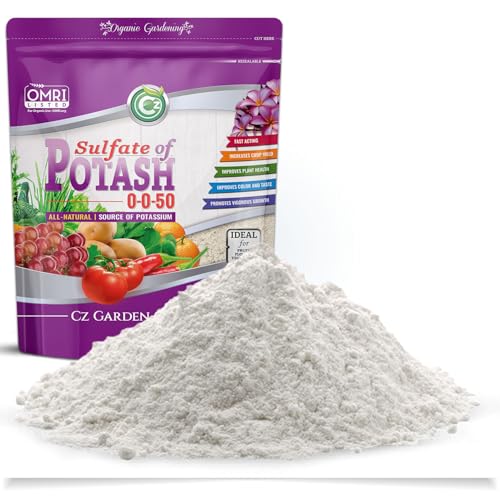
The OMRI-listed powder that keeps certified organic gardens in the clear.
For certified organic growers, the badge matters. This Cz Garden sulfate of potash is OMRI Listed, meaning it is allowed in certified organic production under USDA National Organic Program rules. The 0-0-50 ratio and low chlorine content — less than 0.5% — make it gentle on sensitive crops that need heavy feeding without chloride burn.
The fine, pH-neutral powder is water soluble, so it works in hydroponic reservoirs, drip irrigation, foliar sprays, and standard soil applications. Reviewers point out great harvests of potatoes, tomatoes, and peppers, and one gardener noted foliage that deepened and densified after use. It strengthens stalks and promotes bigger blooms, which is exactly what a high-K feed should do.
At 3 lb it is a smaller bag than the others, and one owner found it pricey for the size. But for an OMRI-certified, low-chlorine, fully water-soluble potassium source, this is the cleanest organic choice on the list.
The clean choice for: Certified organic gardens and sensitive crops needing low-chlorine K.
The one catch: The 3 lb bag is smaller, so heavy feeders will reorder sooner.
8. Greenway Biotech Potassium Chloride 0-0-62

The strongest K punch on this list, fully soluble for soil or hydro.
At 0-0-62, this muriate of potash from Greenway Biotech is the most concentrated potassium source here. The 100% water solubility means it mixes into a liquid feed cleanly for soil, hydroponic systems, or foliar sprays. The mix ratio is simple: 1 teaspoon per gallon of water.
The results speak quickly. One flower grower used it at half strength “just to test it out” and One flower grower watched blooms double in size almost overnight.. It is especially useful in the last three weeks of flowering. Lawn owners use it on newly seeded fescue with great results, and fruit tree growers swear by it for getting pomegranate seeds to turn properly red.
Because it is so strong, start at 1/4 or half strength and work up based on how your plants react. It is a chloride-based product, so avoid it on chlorine-sensitive plants. For pure, fast, water-soluble K at the highest ratio available, this is the powerhouse.
The powerhouse for: Fast, measurable K fixes in flowers, lawns, and fruit trees — in soil or hydro.
The caution: Chloride content means it is not for salt-sensitive crops.
9. Alpha Chemicals 10 lb Potassium Sulfate 0-0-50
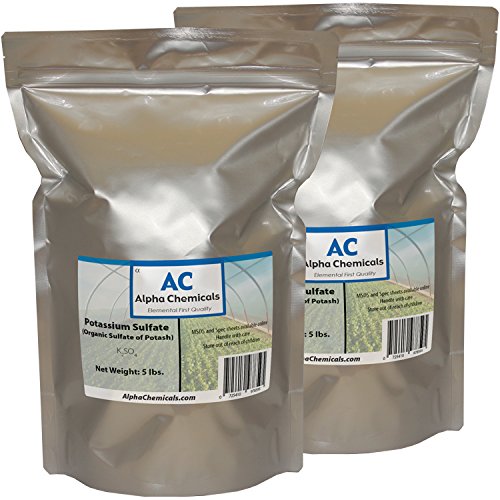
Double the powder, same quality — the stock-up choice for big gardens.
If you have a large lawn, many fruit trees, or just hate reordering mid-season, this 10 lb bag is the bulk buy that makes sense. It is the same quality potassium sulfate as the 5 lb version from Alpha Chemicals, just double the quantity for your money.
It is a coarse powder, which owners generally like — one described it as a “nice granular size” with no debris in the package. It is a great organic option for feeding banana plants, and lawn owners grab it when their local extension soil test flags low potassium. The resealable bag keeps it dry for the long term.
The texture gets mixed feedback — some find it very fine, others very refined — but the quality is consistently praised. It is an excellent high-K fertilizer for the price, especially if you are amending a large area and want to make one purchase last multiple seasons.
The stock-up for: Big gardens, multiple fruit trees, or anyone following a soil test recommendation for a large area.
The note: It is a powder, so expect a fine texture — that is what makes it dissolve readily.
Understanding the Specs
The NPK Ratio, Decoded
The three numbers on a fertilizer bag stand for nitrogen (N), phosphorus (P), and potassium (K). A 0-0-60 product contains only potassium — no nitrogen, no phosphorus. That makes it a targeted supplement, not a complete feed. You use it to fix a specific deficiency without messing with the other nutrients your soil already has.
Muriate vs. Sulfate of Potash
Muriate of Potash (0-0-60) is cheaper and more concentrated but contains chloride, which can harm sensitive plants like grapes, beans, and strawberries. Sulfate of Potash (0-0-50) replaces the chloride with sulfur, making it gentler and adding a nutrient many soils lack. If your plants are salt-sensitive, sulfate is the safer route.
Water Solubility
Granules are spread on the soil and water in slowly, giving a steady release. Powders dissolve in water for liquid feeding — perfect for hydroponics, foliar sprays, and drip irrigation. If you want a quick fix, go powder. If you want a slow, steady release, granules win.
OMRI Listed vs. Conventional
OMRI Listed means the product is allowed in certified organic production under USDA National Organic Program rules. If you maintain an organic certification, this badge is non-negotiable. If not, you can save money with a conventional product that has the same NPK.
FAQ
What does 0-0-60 mean on a fertilizer label?
Should I use muriate or sulfate of potash in my garden?
How do I know if my soil actually needs potassium?
Can I use potassium fertilizer on tomatoes and fruit trees?
What happens if I use too much potassium fertilizer?
Is sulfate of potash safe for organic gardening?
Can I dissolve granular potash in water for liquid feeding?
What is the difference between langbeinite and sulfate of potash?
Final Thoughts: The Verdict
For most gardeners, the potassium-rich fertilizer winner is the Cz Garden Muriate of Potash because it delivers the most concentrated K per application, backed by a crowd of happy owners. If you garden organically and want a burn-safe mineral boost, grab the PowerGrow Langbeinite. And for hydroponic or liquid feeding, the Alpha Chemicals Potassium Sulfate is the one to reach for. Test your soil first, match the source to your crops, and your plants will thank you.
How We Picked
We do not accept paid placement. Every pick is matched to a real buyer and a real use-case; we do not hands-on test units.
Sources & Methodology
Specifications: manufacturer listings and product documentation. Review insights: verified customer reviews, as of August 2026. Pricing: not shown on this page (it changes often); check the current price via the retailer link.
As an Amazon Associate, Lawn Gear Lab earns from qualifying purchases. This does not affect which products we feature.