
Specs are compiled from manufacturer listings and verified buyer reviews and can change over time — please confirm the key details on the product page before buying.
You spot a dandelion, then a clover patch, and within days your lawn looks like a weed farm. The difference between a quick fix and a lawn that stays clean depends on picking the right post-emergent weed killer — one that targets the weed without torching the grass around it. After sorting through the specs and thousands of real buyer experiences, the winner is not always the most expensive bottle.
I’m Rikta — the founder and writer behind Lawn Gear Lab. This guide is built by comparing the manufacturers’ published specifications and the patterns across verified customer reviews, so you get each pick’s real strengths and trade-offs instead of marketing spin.
This deep dive into the best post-emergent weed killer breaks down the options by their active ingredients, coverage area, and speed of results so you can match a product to your specific weed problem and lawn type.
Quick Picks
- SpeedZone EW Lawn Weed Killer — Best Overall
- Select Source Triad TZ 4-Way Combination — 4-Way Power
- Ortho WeedClear Lawn Weed Killer Ready-to-Use — Grab & Go
- Liquid Harvest Mesotrione Bundle — Selective Science
- ALLIGARE 2,4-D Amine Weed Killer Concentrate — Farm Grade
- Primesource Quinclorac 1.5L Select Liquid — Crabgrass Killer
- Sedgehammer Herbicide – 1.33 oz Bottle — Nutsedge Destroyer
How To Choose The Best Post-Emergent Weed Killer
Post-emergent means the weed is already poking out of the soil — you are killing an active plant, not preventing a future seed. To pick the right one, you need to match the herbicide to your specific weed type, your grass species, and how much area you are treating.
Match the Active Ingredient to the Weed
2,4-D and Dicamba are the go-to combo for broadleaf weeds like dandelion and clover. Quinclorac shines on crabgrass. Mesotrione works on both grassy and broadleaf weeds but turns them white before they die. If you have nutsedge, you need a specialized chemical like Halosulfuron (found in Sedgehammer) which targets the underground tuber.
Check Your Grass Type
Most broadleaf herbicides are safe on cool-season grasses like Kentucky Bluegrass, Fescue, and Perennial Ryegrass. Warm-season grasses like St. Augustine and Centipede are more sensitive — Mesotrione is one of the safer bets there, but only on sodded St. Augustine. Bermuda grass is tough and tolerates most treatments, but avoid Mesotrione on actively growing Bermuda.
Ready-to-Use vs. Concentrate
A ready-to-use bottle with a wand, like the Ortho WeedClear, is the easiest grab-and-go option for spot treatments. Concentrates (like SpeedZone or Quinclorac) require you to mix with water and a surfactant, but they cover far more area per dollar and give you control over the strength of the mix.
Quick Comparison
| Model | Best For | Active Ingredient | Volume | Grass Safety | Amazon |
|---|---|---|---|---|---|
| SpeedZone EW | Fast action on broadleaf weeds | 2,4-D, Dicamba, Carfentrazone | 20 fl oz | Bermuda, Fescue, Zoysia | Amazon |
| Select Source Triad TZ | 4-way broadleaf control | 2,4-D, Dicamba, Triclopyr, Sulfentrazone | 32 fl oz | Tall Fescue, Bluegrass | Amazon |
| Ortho WeedClear RTU | Instant spot treatment | 2,4-D, Quinclorac, Dicamba | 128 fl oz | Bermuda, Fescue, Zoysia | Amazon |
| Liquid Harvest Mesotrione | Selective pre & post control | Mesotrione | 8 fl oz | Fescue, Bluegrass, St. Augustine | Amazon |
| ALLIGARE 2,4-D Amine | Farm-grade bulk treatment | 2,4-D 47.2% | 128 fl oz | Pasture, Lawns, Aquatic sites | Amazon |
| Primesource Quinclorac 1.5L | Crabgrass eradication | Quinclorac 18.92% | 64 fl oz | Most turfgrasses | Amazon |
| Sedgehammer Herbicide | Nutsedge & tough perennials | Halosulfuron | 1.33 oz | Zoysia, Mondo, Day lilies | Amazon |
In‑Depth Reviews
1. SpeedZone EW Lawn Weed Killer

You see visible weed curling within hours — even when temperatures drop — and results are done in a week.
SpeedZone EW is the pick for anyone who wants results, not waiting. It controls over 90 listed weeds, including white clover, dandelion, ground ivy, and spurge. The active blend includes 2,4-D, Dicamba, Carfentrazone-ethyl, and Mecoprop-p, which together provide a rapid burndown. Buyers report that nearly all weeds were dead in a week on a 13,000 square foot lawn applied with a mower-mounted boom sprayer. It is rainfast in as little as 3 hours, so you do not have to worry about an unexpected shower washing away your work.
The SpeedZone bottle holds 20 Fluid Ounces, which is enough to mix several tank loads. Compared to the Ortho WeedClear’s 128 Fluid Ounces, SpeedZone is a concentrate that covers far more ground per ounce when mixed correctly. For cool-season grasses, you mix 1.5 fl oz per gallon of water to treat 1000 square feet, and for warm-season grasses, mix 1.8 fl oz per gallon for the same area.
One thing to note: it does not come with a measuring cup, so you will need to measure your own. And while it kills the weed, persistent types like spurge may require a follow-up application if the conditions allow regrowth. Owners mention that instructions are clear and only a small amount of product is needed per treatment, making it economical for mid-size to large lawns.
What it delivers
- Visible weed curling within hours
- Reseed in as few as 7 days after application
- Safe for most common grass types including tall fescue and Bermuda
What to watch
- No measuring cup included in the bottle
- Spurge may return within a couple months in some yards
Reach for it if: you want the fastest visible knockdown and need a concentrate that works in cool spring or fall temps.
Look elsewhere if: your main problem is nutsedge or crabgrass — this broadleaf formula is not designed for those specific targets.
2. Select Source Triad TZ 4-Way Combination Herbicide

Four active ingredients attack tough perennial weeds like wild violet and buttonweed that two-ingredient mixes leave behind.
Triad TZ brings four active ingredients — 2,4-D, Dicamba, Triclopyr, and Sulfentrazone — to the fight, making it among the most comprehensive formulas for broadleaf weeds on the market. It is designed for use on residential lawns, athletic fields, golf courses, and even commercial sod production. The label covers dandelion, spurge, white clover, plantains, ground ivy, Virginia buttonweed, and wild violet, along with suppression of yellow nutsedge.
Customers note that while you see leaf withering the next day, full results can take about a month for deep-rooted weeds like dandelion. One reviewer noted that the leaves of broadleaf plants began to curl and wither within 24 hours. The liquid volume is 32 Fluid Ounces, making it compared to Liquid Harvest Mesotrione’s 8 Fluid Ounces, giving you more mix-ready product per purchase. It weighs 1.16 Kilograms (about 2.6 pounds), which feels substantial in hand.
Because it is a concentrate, you need to mix it yourself. Users recommend adding a surfactant like a drop of dish soap to help the spray adhere to waxy weed leaves. The weed growth ceases within hours of application, but full death occurs between 1 and 4 weeks depending on the weed and weather conditions.
Strengths
- Four active ingredients attack weeds through multiple pathways
- Kills tough weeds like wild violet and ground ivy
- Suitable for large areas including parks and golf courses
Drawbacks
- Requires patience — full kill can take up to a month
- Overspray can be hazardous; wear full protective gear as noted by buyers
Best for: homeowners battling persistent perennial broadleaf weeds that cheaper two-ingredient mixes cannot handle.
Skip if: you need an immediate cosmetic fix for a party this weekend — the visible results take a day, but total death is slow.
3. Ortho WeedClear Lawn Weed Killer Ready-to-Use with Comfort Wand
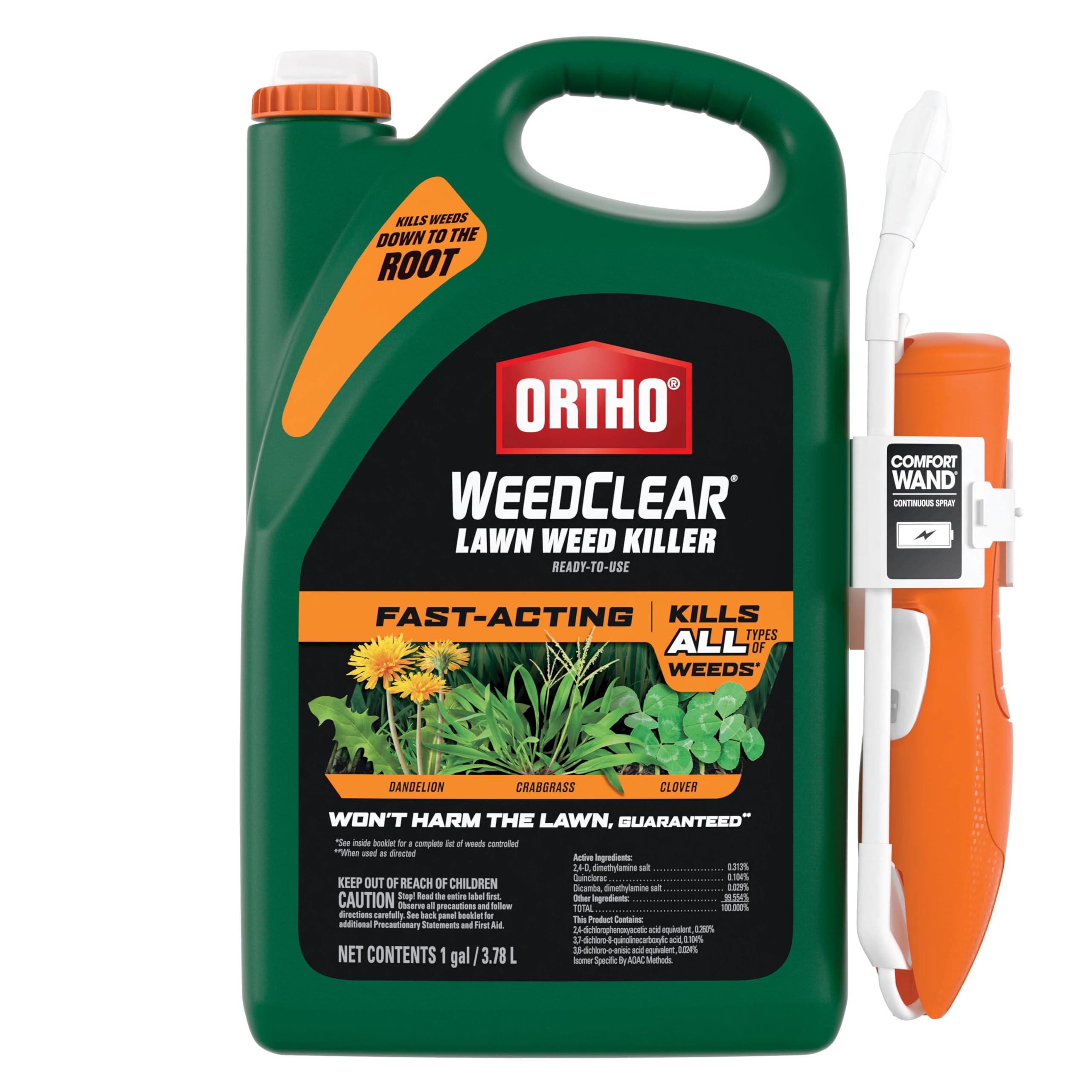
No mixing, no measuring — you just aim the battery-powered wand and spray dandelions down to the root.
If you do not want to mix chemicals or carry a pump sprayer, the Ortho WeedClear Ready-to-Use with its battery-powered Comfort Wand is your answer. It comes pre-mixed in a 1-gallon container that holds 128 Fluid Ounces, and the wand has two spray settings so you can switch between a stream for isolated weeds and a wider fan for patches. It kills crabgrass, dandelion, clover, chickweed, and creeping charlie down to the root with a single application.
Reviewers point out it as a lifesaver for yards overrun with dandelions. One buyer mentioned, “I sprayed a section in our backyard and this item worked great,” noting the two nozzle settings made application easy. It is labeled safe for use on Bermudagrass, Buffalograss, Fescues, Kentucky Bluegrass, Ryegrass, and Zoysiagrass — so it covers most common lawn types. The 128 Fluid Ounce unit count is a 6.4x gap larger than the SpeedZone EW’s 20 Fluid Ounces, though SpeedZone is a concentrate and Ortho is ready-to-use, meaning Ortho covers less total area per bottle.
The catch is consistency. Some reviews note that stubborn crabgrass may need extra applications. And while most users see dandelions shrivel within hours and disappear in about two weeks, one reviewer called it the worst weed killer ever because it took too long. Because there is no mixing, you pay for convenience — you get less total coverage per dollar compared to buying a concentrate.
Why it is convenient
- Battery-powered wand eliminates pumping and reaches under shrubs
- Ready-to-use — unscrew the cap and spray
- Won’t harm listed lawn grasses when used at the directed rate
Limitations
- More expensive per square foot than a concentrate
- May not fully kill crabgrass in one application
Ideal for: the casual homeowner with a few dozen dandelions who wants to solve the problem in one afternoon without buying extra gear.
Not ideal for: large lawns over 5,000 sq ft where a concentrate would be far more economical.
4. Liquid Harvest Mesotrione Bundle – 8 Oz Concentrate with Surfactant
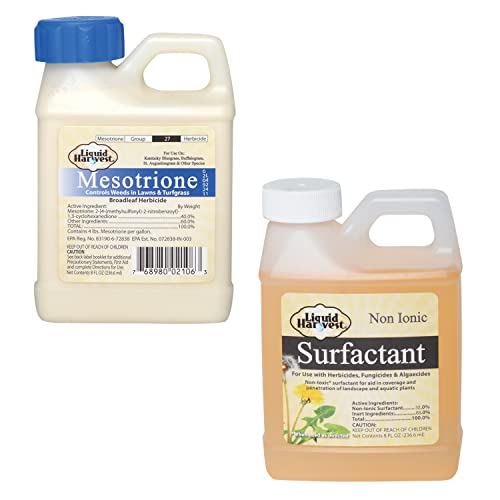
It turns weeds white before they die — and it is safe on St. Augustine sod where many other herbicides burn the lawn.
Mesotrione is unique: it inhibits photosynthesis in susceptible plants, causing them to turn a striking white color before dying. The Liquid Harvest bundle comes with an 8-ounce bottle of Mesotrione concentrate and an 8-ounce bottle of surfactant (a soap-like additive that helps the spray stick to leaves). It targets 46 broadleaf and grass species, including barnyard grass, carpetweed, chickweed, clover, crabgrass, and dandelion.
One buyer report says it “bleached out crab grass white” after application. It is one of the few post-emergents that is safe for St. Augustine grass (sod only), which is notoriously sensitive to many herbicides. Activation requires water — if no rainfall occurs within 10 days of application, you need to water it in with about 0.15 inches. The 8 Fluid Ounce bottle might seem small, but because it is concentrated at 1 teaspoon per gallon, it covers a decent area. Its weight is 8.32 Ounces, which is a 4% more gap heavier than the SpeedZone EW’s 8 ounces.
Full weed death takes 2-3 weeks, which is slower than SpeedZone’s visible effect in hours. Also, avoid using this on Bentgrass, Poa annua, kikuyugrass, zoysiagrass, seashore paspalum, and actively growing bermudagrass — it can damage those. Buyers mention it is “extremely potent” and recommend sticking to the label rates to avoid stressing the lawn.
Unique advantages
- Safe for St. Augustine sod and fine fescue
- Acts as both a pre-emergent and post-emergent
- Includes surfactant for better leaf adhesion
Things to know
- Slower visible results than carfentrazone-based products
- Not safe for zoysia or actively growing Bermuda
Choose this for: St. Augustine or Fescue lawns where you need a gentler selective herbicide that also prevents new weeds.
Pass on it if: you have a Bermuda or Zoysia lawn and want fast results — this will either damage the grass or work too slowly.
5. ALLIGARE 2,4-D Amine Weed Killer Concentrate – 1 Gallon
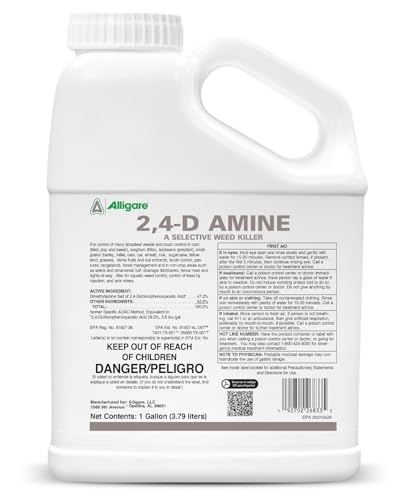
The highest-concentration 2,4-D on this list — 47.2% active ingredient — for pasture-size weed jobs.
ALLIGARE 2,4-D Amine is a straight-a workhorse for anyone with large acreage. It contains 47.2% active ingredient, making it one of the strongest concentrates on this list. It is formulated to tackle pigweed, thistle, ragweed, and a wide range of broadleaf weeds. The 1-gallon container (128 Fluid Ounces) is ideal for pastures, fence rows, and larger landscapes. It is even labeled for use in aquatic environments like drainage ditches, which is rare for a household herbicide.
Buyers confirm it “works great, killed weeds within a few days” when mixed correctly. The key warning across reviews is to follow the mixing instructions precisely — using too strong a mix can “fry your grass.” Unlike the Ortho WeedClear which is ready-to-use, this is a concentrate that requires measuring and mixing with water. The item weight is 128 Ounces, and its unit count matches the Ortho bottle at 128.0 Fluid Ounces, but as a concentrate it will treat a much larger area.
One limitation is that the sale of this product is restricted in some states (buyers in Texas report they can no longer purchase it). Always check local regulations before ordering. Also, while it works on a broad spectrum, it is not selective in the same way as a lawn blend — it can kill desirable broadleaf plants in flower beds if drift occurs.
Where it shines
- Highest active ingredient concentration on this list
- Approved for use on pasture, turf, and aquatic sites
- Bulk 1-gallon size for large properties
Watch out
- State-level sales restrictions may apply
- Mix accurately or risk damaging your lawn
Meant for: rural property owners, farmers, or anyone managing more than an acre of weeds who wants the strongest active ingredient per dollar.
Not for: small suburban lawns with delicate St. Augustine or Centipede grass — too risky without precise mixing.
6. Primesource Quinclorac 1.5L Select Liquid Crabgrass Killer – 64 Oz
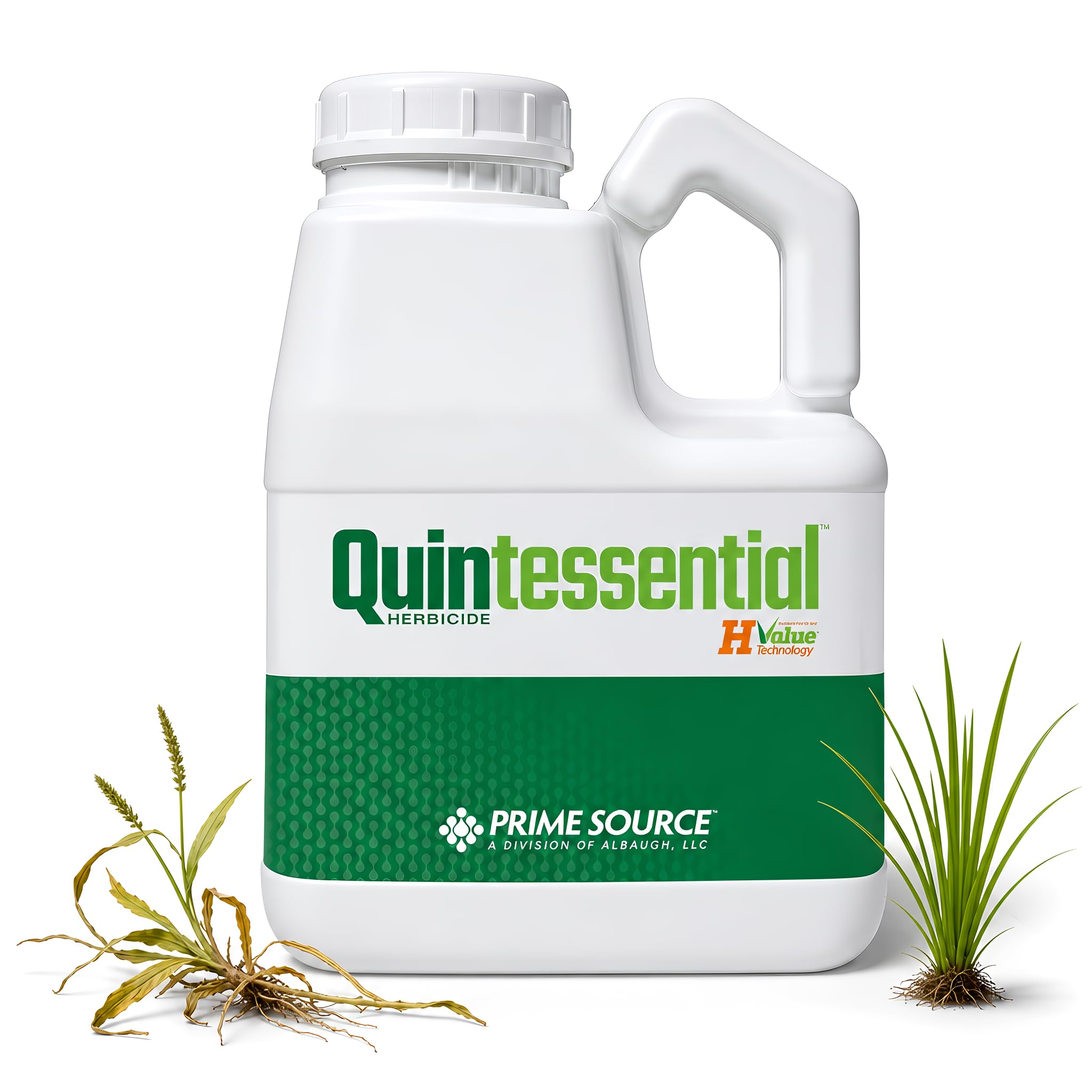
It kills crabgrass in 3 days while leaving your lawn grass untouched — a targeted solution when SpeedZone broadleaf formulas cannot help.
If crabgrass is your nemesis, Quinclorac is the chemical you need. Primesource Quinclorac 1.5L Select contains 18.92% Quinclorac as its active ingredient and is a selective, post-emergent herbicide safe on many types of turf. It controls large and smooth crabgrass, foxtail (giant, green, and yellow), kikuyugrass, signalgrass, torpedograss, and also a wide list of broadleaf weeds like dandelion, clover, and morningglory.
Shoppers say remarkable results. One user mixed 4 oz with 2 gallons of water and a bit of Dawn dish soap, and the crabgrass died within 3 days with no harm to the lawn grass. Another reviewer saw death signs in 24 hours with the help of an MSO (methylated seed oil) surfactant, and the weeds were completely brown within a week. The 64 Fluid Ounces bottle provides ample concentrate for multiple treatments.
Performance can vary. One buyer who sprayed half an acre reported killing about 70% of the crabgrass after two rounds of application. The product works best when applied with a surfactant to ensure the spray droplets stick to the waxy crabgrass leaves. It allows overseeding after 7-10 days, so you can fill bare spots quickly after the weeds die. For the best results, combine with a pre-emergent application at the right soil temperature the following spring.
Performance highlights
- Works well on both crabgrass and foxtail
- Can overseed just 7-10 days after treatment
- Safe for most turfgrasses when mixed to label rates
Considerations
- Requires a surfactant for maximum effectiveness
- May not eradicate all crabgrass in a single application on heavy infestations
Grab this if: your lawn is being overrun by crabgrass and you want a specialized chemical that will not hurt the rest of your grass.
Avoid if: your primary weed is broadleaf (dandelion, clover) — a 2,4-D blend will be more cost-effective for that job.
7. Sedgehammer Herbicide – 1.33 oz Bottle

It travels down to kill the underground tubers that make nutsedge return year after year — something SpeedZone cannot do.
Nutsedge (often called nutgrass) is one of the toughest weeds to kill because it grows from underground tubers that resist common herbicides. Sedgehammer uses Halosulfuron as its active ingredient, which is absorbed by the plant within 24-48 hours and travels down to destroy the hidden rhizomes and tubers. It comes in a compact 1.33-ounce bottle, but because it is a concentrated powder, it mixes into a significant amount of spray solution.
Buyers report it is extremely effective on yellow nutsedge, especially in warm climates like Arizona. One user saw nutsedge blades yellowing and dying within a day after application with a surfactant. Another homeowner on a 0.52-acre lot achieved over 95% eradication using 7.5 gallons of mixed solution. It also works on horsetail and kyllinga, making it a versatile tool for tough perennial weeds. Proudly made in the USA, according to the manufacturer.
The main caution is that the formula is potent. One owner reported it “traumatized the lawn for a while” after treatment, though the grass recovered. You must use a surfactant with it for the spray to stick to the waxy leaves of the sedge. The label allows a maximum of 4 applications per year, spaced at least 6 weeks apart. The bottle covers about 1,000 square feet per treatment at the standard mix rate.
Why it stands out
- Penetrates and kills underground nutsedge tubers
- Safe for use on Zoysia, Mondo grass, and Day Lilies
- Fast uptake — visible effects within 24-48 hours
Be aware
- Requires a surfactant for effective adhesion
- Limited to 4 applications per year
Buy this for: the specific and stubborn nutsedge problem that nothing else has solved — it targets the underground source.
Do not buy if: your issue is common dandelions or crabgrass — this chemical is overkill and underperforms for those weeds.
Understanding the Specs
Active Ingredients Matrix
2,4-D and Dicamba are the standard broadleaf duo found in most lawn weed killers. Triclopyr adds strength against woody and vine-type weeds (like wild violet). Sulfentrazone targets sedges. Mesotrione is the oddball — it turns weeds white and works as both a pre- and post-emergent but is picky about grass types. Quinclorac is your crabgrass specialist. Halosulfuron (in Sedgehammer) is the nutsedge specialist that hits the underground tubers.
Concentration & Coverage
A 20-ounce bottle of concentrate (like SpeedZone EW) will treat thousands of square feet when mixed at 1.5 oz per gallon of water. A 128-ounce ready-to-use bottle (like Ortho WeedClear) treats far less total area because it is already diluted. The active ingredient percentage (e.g., 47.2% for ALLIGARE vs. 18.92% for Quinclorac) tells you how much straight chemical is in the bottle — higher percentage means you use less product per gallon of spray mix.
FAQ
What is the difference between pre-emergent and post-emergent weed killer?
Can I spray post-emergent weed killer on my St. Augustine grass?
How long does it take for post-emergent weed killer to work?
Will post-emergent weed killer kill my grass too?
What is a surfactant and do I need it?
Can I mix different weed killers together?
How long after spraying can I let my kids and pets on the lawn?
Will rain wash away my weed killer application?
Final Thoughts: The Verdict
For most people, the best post-emergent weed killer winner is the SpeedZone EW because it delivers the fastest visible results across the widest range of common broadleaf weeds and works reliably even in cooler temperatures. If you want a targeted crabgrass solution, grab the Primesource Quinclorac. And for the specific and stubborn problem of nutsedge, the standout is the Sedgehammer Herbicide for reaching the underground tubers.
How We Picked
We do not accept paid placement. Every pick is matched to a real buyer and a real use-case; we do not hands-on test units.
Sources & Methodology
Specifications: manufacturer listings and product documentation. Review insights: verified customer reviews, as of July 2026. Pricing: not shown on this page (it changes often); check the current price via the retailer link.
As an Amazon Associate, Lawn Gear Lab earns from qualifying purchases. This does not affect which products we feature.