
Specs are compiled from manufacturer listings and verified buyer reviews and can change over time — please confirm the key details on the product page before buying.
Overwatering kills more houseplants than underwatering, and poking a finger into damp soil only tells you about the top inch — not what is happening deep in the pot where the roots live. A plant moisture meter gives you an instant read on the moisture level at root depth, so you stop guessing and start watering on the plant’s actual schedule, not your own.
I’m Rikta — the founder and writer behind Lawn Gear Lab. This guide is built by comparing the manufacturers’ published specifications and the patterns across verified customer reviews, so you get each pick’s real strengths and trade-offs instead of marketing spin.
Below I break down seven of the most popular options on the market, from simple analog probes to dual-screen models that also check pH, fertility, and light — everything you need to find the right plant moisture meter for the way you actually care for your plants.
Quick Picks
- Sustee Aquameter (2 Green, Medium) — Best Overall
- HSLGOVE 7-in-One Soil Test Kit — Top Performer
- Luster Leaf 1818 Rapitest 4-in-1 — Versatile Classic
- AiGerdinn 4-in-1 Soil Tester — Best Value
- Dr.meter Soil Moisture Meter S10Plus — Deep Probe Pick
- XLUX Soil Moisture Sensor Meter 2 Pack — Value Pack
- Luster Leaf Rapitest 1885 Digital Soil Analyzer — Digital Specialist
How To Choose The Best Plant Moisture Meter
The right moisture meter depends mostly on how many types of readings you need and if you want to leave the meter in the soil or take it out after each use. Here are the three factors that separate a usable meter from a frustrating one.
Single Probe vs Multiple Probes
A single-probe meter pushes into the soil with minimal disturbance to the roots. Double- or triple-probe designs give more data points at once but uproot more soil and risk damaging delicate root systems each time you insert or remove them. For houseplants in small pots, a single probe is usually the gentler choice.
Analog vs Digital Readout
Analog meters use a needle over a printed dial (red for dry, green for moist, blue for wet) and need no batteries at all. Digital meters run on small batteries and show exact numbers, often including temperature and humidity as well. Analog is simpler and never runs out of power; digital gives you more precision if you track conditions closely.
Leave-In vs Test-and-Remove Design
Most meters warn you to remove them after 5 minutes because the metal probe corrodes if left in damp soil. A few models, like the Sustee Aquameter, are designed to stay in the pot permanently, so you can glance at the color indicator anytime. Decide if you want a quick check or continuous monitoring.
Quick Comparison
| Model | Best For | Measurements | Probe Type | Batteries Needed | Amazon |
|---|---|---|---|---|---|
| Sustee Aquameter (2 Pack) | Leave-in continuous monitoring | Moisture only | Single, leave-in stick | No | Amazon |
| HSLGOVE 7-in-1 | Full digital data (moisture, pH, temp, humidity, light, fertility) | Moisture, pH, fertility, light, soil temp, air temp, air humidity | Single probe | Yes (3 batteries) | Amazon |
| Luster Leaf 1818 4-in-1 | Quick pH and moisture checks for garden soil | Moisture, pH, fertility, light | Triple probe | No | Amazon |
| AiGerdinn 4-in-1 | Large-dial analog readings for beginners | Moisture, pH, fertility, light | Single probe | No | Amazon |
| Dr.meter S10Plus | Long probe for deep pots and raised beds | Moisture only | Single, long probe | No | Amazon |
| XLUX 2 Pack | Value pack for multiple pots | Moisture only | Single probe each | No | Amazon |
| Luster Leaf 1885 Digital | Digital readout with separate probe for hard-to-reach spots | Moisture, pH, temperature, light | Corded probe | Yes | Amazon |
In‑Depth Reviews
1. Sustee Aquameter (2 Green, Medium)
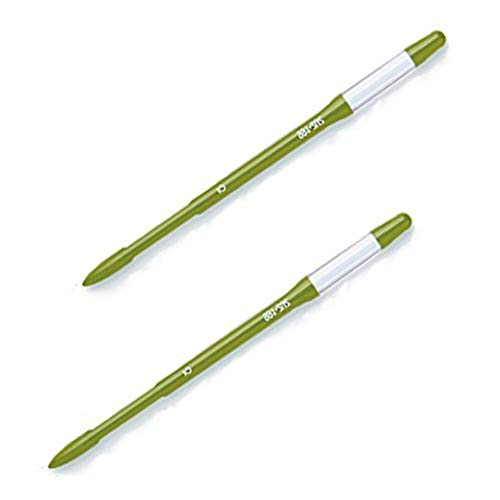
A leave-in sensor that changes color at root level so you never poke or guess.
Most moisture meters require you to insert them, wait, then remove and wipe them. The Sustee Aquameter flips that routine entirely: you leave it in the pot permanently, and a white-to-blue color change tells you at a glance whether the plant needs water. It senses moisture right where the roots are, so you do not have to dig around or damage the root system to get a reading. The medium size is made for pot sizes of 3.5, 4, 5, and 6 inches, making it a natural fit for common houseplant containers.
Another angle that separates it from the rest is that Sustee collaborated with Tokyo University of Agriculture to refine the design. According to the maker, it is also an award-winning product, and buyers report that each stick will last for approximately 6-9 months before the refillable core needs replacing. At just 0.01 Kilograms, it is much lighter than the typical analog meter — a noticeable difference if you have several pots and want one stick per plant. The trade-off is that it only measures moisture: you get no pH, fertility, or light data. If you want a comprehensive read on soil health, you will need a separate meter for those tests.
Continuous monitoring advantage
- Leave-in design — no removing after each use
- Color indicator (white = dry, blue = wet) is instantly readable
- Environmentally friendly and creates little waste
One-trick specialist
- Moisture only — no pH or light readings
- Core lasts only 6-9 months before replacement
- Not suitable for very small or very large pot sizes outside the 3.5″–6″ range
Grab these if: you want a no-fuss, always-on moisture check for a handful of medium-sized houseplants and hate the ritual of inserting and removing a probe.
Look elsewhere if: you need a multi-function tool that also tests pH, fertility, and light, or you want a meter you can use across many pot sizes.
2. HSLGOVE 7-in-One Soil Test Kit
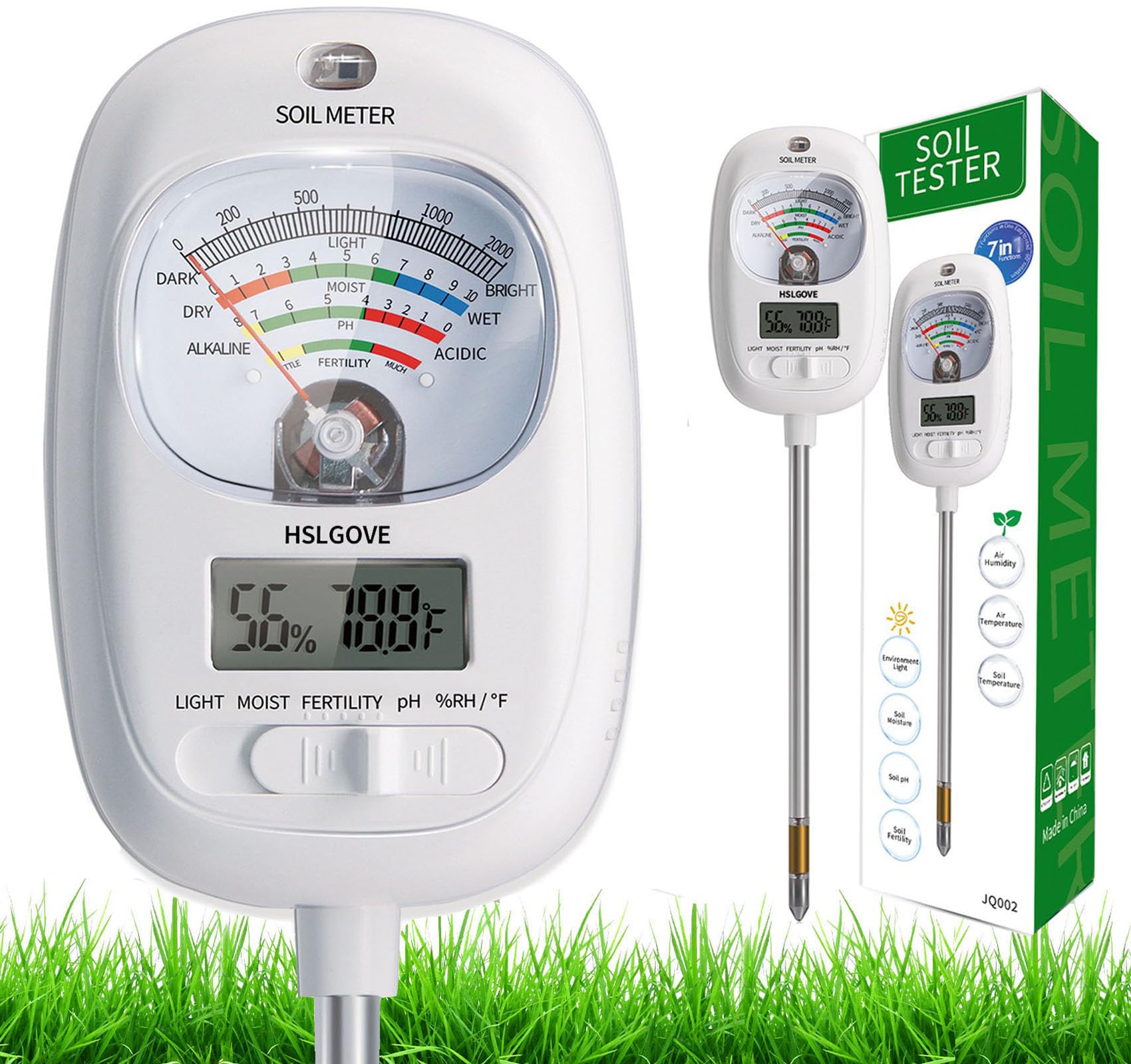
A dual-screen meter that logs seven different soil and air factors at once.
While most meters stop at moisture, pH, and light, the HSLGOVE 7-in-1 also reads soil temperature, air temperature, and air humidity — seven measurements total using a single probe. It pairs an analog dial with an LCD (liquid crystal display) screen, so you see the traditional zone-based moisture reading next to a digital display of the exact temperature and humidity numbers. The probe length is about 6.8 inches, deep enough for medium to large potted plants to check conditions well below the surface.
The catch is that it requires three batteries for the digital functions, and the instructions say to insert the probe more than 3 inches into the soil and then wait 3-5 minutes for the LCD results, which is slower than instant-read analog models. One reviewer who identified as a professional agronomist noted that the light sensor failed and the pH reading was inaccurate (too acidic), though other verified buyers found it accurate and easy to use. If you want a single tool that covers nearly every environmental variable a plant responds to, the HSLGOVE gives you the broadest data set in this lineup — just be prepared for a short learning curve and battery changes.
Complete environmental picture
- Measures 7 factors: moisture, pH, fertility, light, soil temp, air temp, air humidity
- Dual dial + LCD (liquid crystal display) screen for both zones and precise numbers
- Single probe design is less harmful to plant roots
Battery-dependent and slower
- Requires 3 batteries; no reading if they die
- LCD results take 3-5 minutes to stabilize
- Mixed accuracy reports on pH and light sensors
Choose this for: a detailed, multi-parameter look at your plant’s environment — especially if tracking soil and air temperature matters to you.
skip it if: you want instant, no-wait readings and prefer a simple battery-free tool you can grab and use in seconds.
3. Luster Leaf 1818 Rapitest 4-in-1

A three-pronged tester that gives you pH, fertility, and moisture in seconds when the soil is moist.
The Luster Leaf 1818 is the closest thing to a classic gardening tool in this list — an analog meter with three stainless steel probes and a rotary switch that lets you pick between moisture, pH, fertility, and light readings. It requires no batteries, and experienced owners mention you can get accurate pH (potential hydrogen) /fertility/moisture readings in seconds when the soil is moist. The fertility test is calibrated for N, K, and P (nitrogen, potassium, phosphorus), which is useful for vegetable gardeners correcting deficiencies.
The honest limits: the moisture test measures only at the probe tip, and many customers note the light meter is useless. The instructions recommend removing the top 2 inches of soil, using distilled water, and polishing the pH probe to get reliable pH readings — so it is not a simple plug-and-play device. The probes are also thin and bend easily; you should not leave the meter in the soil long-term. The old-school shape (1″W x 1″H) and attached probes make it awkward to read at ground level, unlike the corded digital version from the same brand. Stick with it if you need a battery-free multi-tester for occasional garden use and are willing to follow the manual closely.
Battery-free multi-tester
- Measures moisture, pH, fertility, and light with one device
- Three stainless steel probes provide a wide reading area
- Compact and simple — no batteries to replace
Quirky and fragile
- Prongs bend easily; not for long-term or heavy use
- Light meter is ineffective; fertility test is not plant-specific
- Requires specific preparation (distilled water, polishing) for accurate pH
Reach for this if: you are a hobby vegetable gardener who wants a cheap, no-battery way to spot-check pH and NPK (nitrogen, potassium, phosphorus) fertility in the garden bed.
Move on if: you want a low-maintenance tool, quick instant-read moisture without prep work, or a meter that works reliably in dry soil.
4. AiGerdinn 4-in-1 Soil Tester
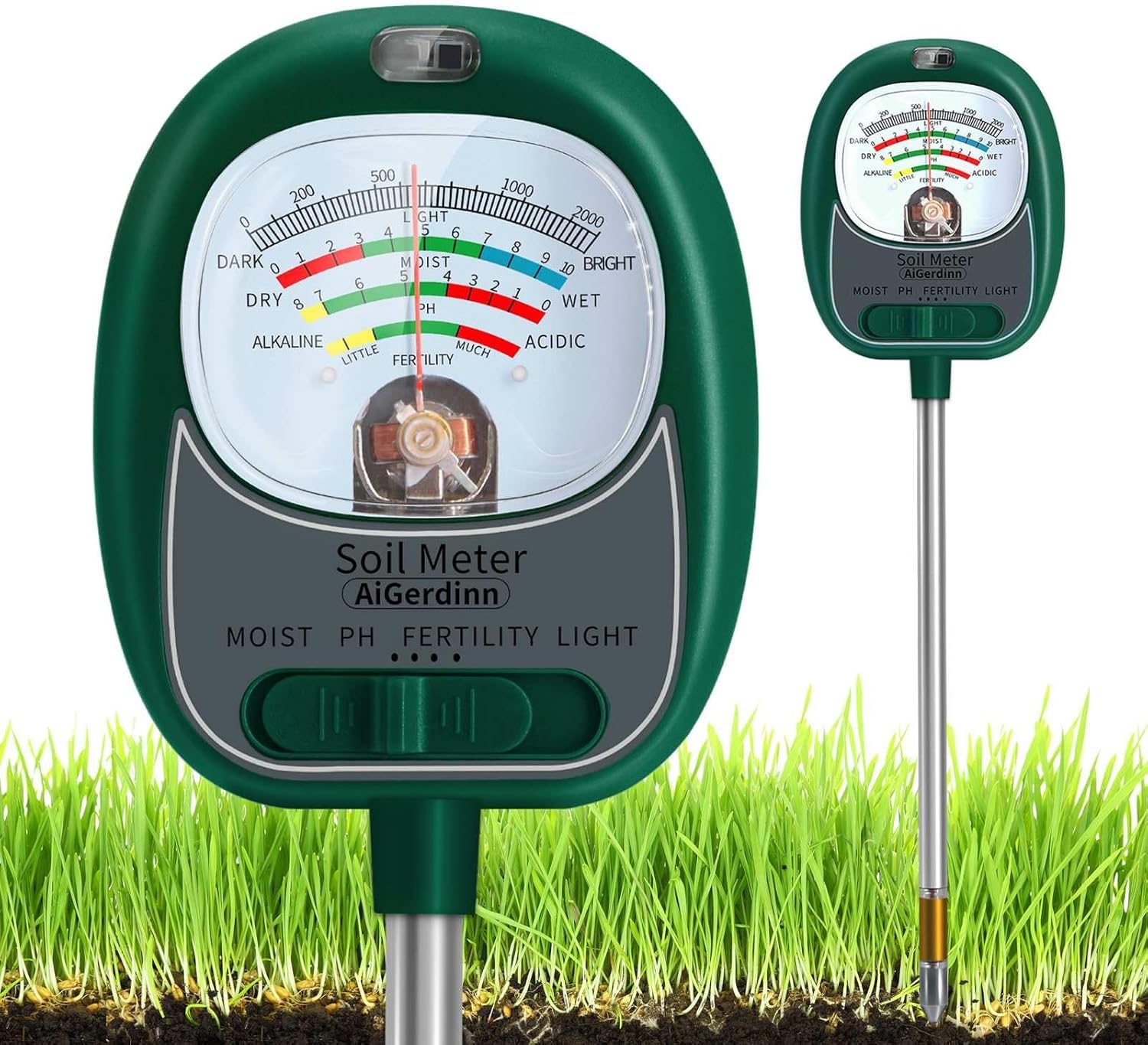
A wide-eyed analog dial that is easier to read for older gardeners or anyone with less-than-perfect vision.
The AiGerdinn 4-in-1 uses a patented 1.95-inch oversized dial that is noticeably larger than the traditional small analog face. That extra window makes it much easier to see where the needle falls in the red/green/blue zones without squinting or bending down awkwardly. It measures soil moisture, pH, fertility, and sunlight levels through a single probe, so you can switch between functions with one button and get results without swapping tools. The packaging is a color-designed box suitable for gifting.
It is important to note that the instructions list several unsuitable soil types — water, slurry soil, red clay soil, hard soil, plant ash, and liquid — so the meter has clear limits. You also need to compact the surrounding soil around the probe and make sure the sensor does not reach the bottom of the pot. Unlike the Sustee, this is a test-and-remove meter: do not leave it in the soil. It weighs 3.84 ounces, which is similar to other mid-range analog testers. The single-probe design puts less stress on roots than the triple-probe Luster Leaf, but you get a smaller sampling area with each test.
Beginner-friendly display
- Large 1.95″ dial is easier to read than standard analog meters
- 4-in-1 function on a single probe — no battery needed
- Less root disturbance than multi-prong testers
Pick your soil type
- Not compatible with hard soil, red clay, slurry, or liquid
- Requires soil to be moist before testing
- Must remove after each use to avoid probe damage
Best for: a beginner or someone who wants a big, clear dial to quickly check four different soil factors on standard potting mix without buying batteries.
Not for: heavy clay soils, very hard ground, or anyone who prefers to leave a sensor in the pot full-time.
5. Dr.meter Soil Moisture Meter S10Plus

The long, thin probe reaches deep into pots and raised beds to check moisture far below the surface.
The Dr.meter S10Plus stands out in this list for its long, slender probe, which reviewers point out works well for checking deep watering in large pots and for worm composting bins. The ten-scale dial with color coding (red, green, blue) makes it simple to see whether the soil is dry, moist, or wet at a glance. It requires no battery — just plug it in and get a reading — and the single probe design barely disturbs roots when you insert or remove it. The model name is S10Plus and it weighs 0.13 Kilograms.
The trade-off is that several shoppers say the probe arrived slightly bent or bent when pushed into soil, and one noted that it worked initially then failed. Because the metal probe can corrode, you should not leave it in the soil. The manufacturer explicitly says it is designed only for soil testing and should be kept away from rocks and extremely hard soil. Compared to the XLUX 2 Pack below, the Dr.meter has a longer probe that is better for tall pots, but the build seems less durable overall, so handle it gently and clean the probe after every use.
Reach advantage
- Long, thin probe ideal for deep pots and raised garden beds
- Color-coded ten-scale dial is intuitive to read
- No batteries or electricity needed
Fragility warning
- Some units arrive bent or bend during use
- Cannot be left in the soil — tip will corrode
- Not suitable for rocky or very hard soil
Consider it if: you have tall planters or a raised bed and need a probe that goes deeper than a standard 3-inch meter to check for deep watering.
Pass if: you want a rugged, bend-proof probe or prefer a meter you can leave in the soil for continuous monitoring.
6. XLUX Soil Moisture Sensor Meter 2 Pack
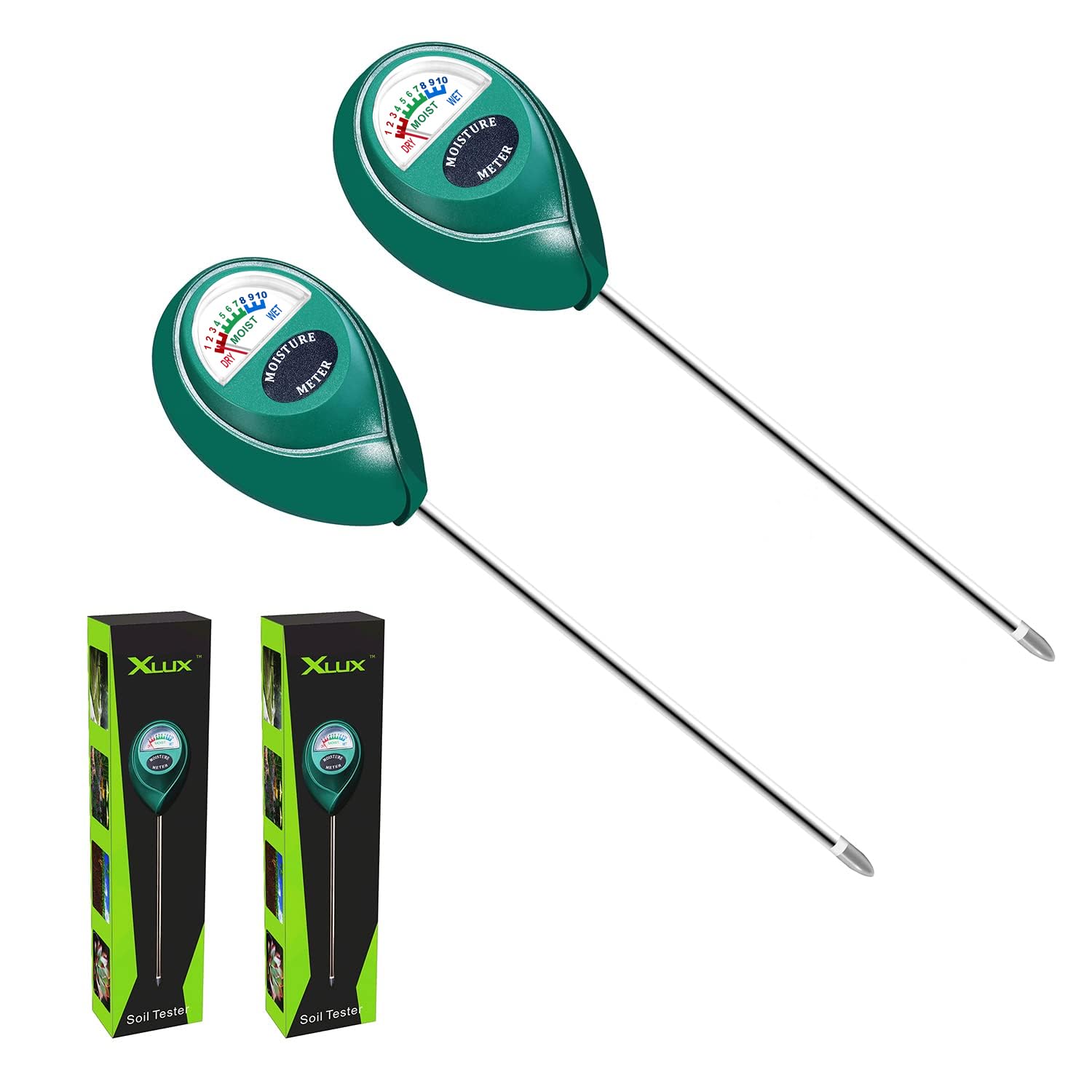
A no-nonsense 2-pack that gives you an instant moisture read on two pots at the same time.
The XLUX meter is the definition of simple and fast: you insert the single probe into the soil and the large dial immediately shows the reading in three zones (dry, moist, wet) across ten scales. Each meter in the 2-pack is individually packaged in its own retail box, so you can keep one and gift the other. The dial is easy to read without bending too far, and the single probe is less damaging to roots than multiple-prong designs. The 2-pack is priced at a point that makes it very accessible for anyone starting out.
The main thing to remember is clearly stated in the instructions and echoed by happy customers: do not leave this moisture meter in the soil for more than 5 minutes, as the metal tip will gradually corrode. The device is also limited to moisture only — no pH or fertility readings — so it is not a replacement for a multi-function tester. Some buyers report that having to bend over to read the dial at ground level is a minor nuisance. It weighs 3.5 ounces (2″W x 1.6″H per unit) and fits easily in a drawer. If you need two meters to cover multiple rooms or want to test a pot without moving it, this pack delivers reliable, instant readings at a budget-friendly price.
Two meters, one purchase
- Instant read — no waiting for results
- Large dial with clear red/green/blue zones
- Single probe causes less root disturbance
Strict removal needed
- Must remove after 5 minutes or probe corrodes
- Moisture only — no pH, light, or fertility
- Requires bending to read dial at ground level
Pick this pack if: you have a bunch of plants in different rooms and want a dedicated meter for each spot without buying two separate products, and you always remember to remove the probe.
Skip if: you need more than moisture data or want a leave-in sensor you can check at a glance.
7. Luster Leaf Rapitest 1885 Digital Soil Analyzer
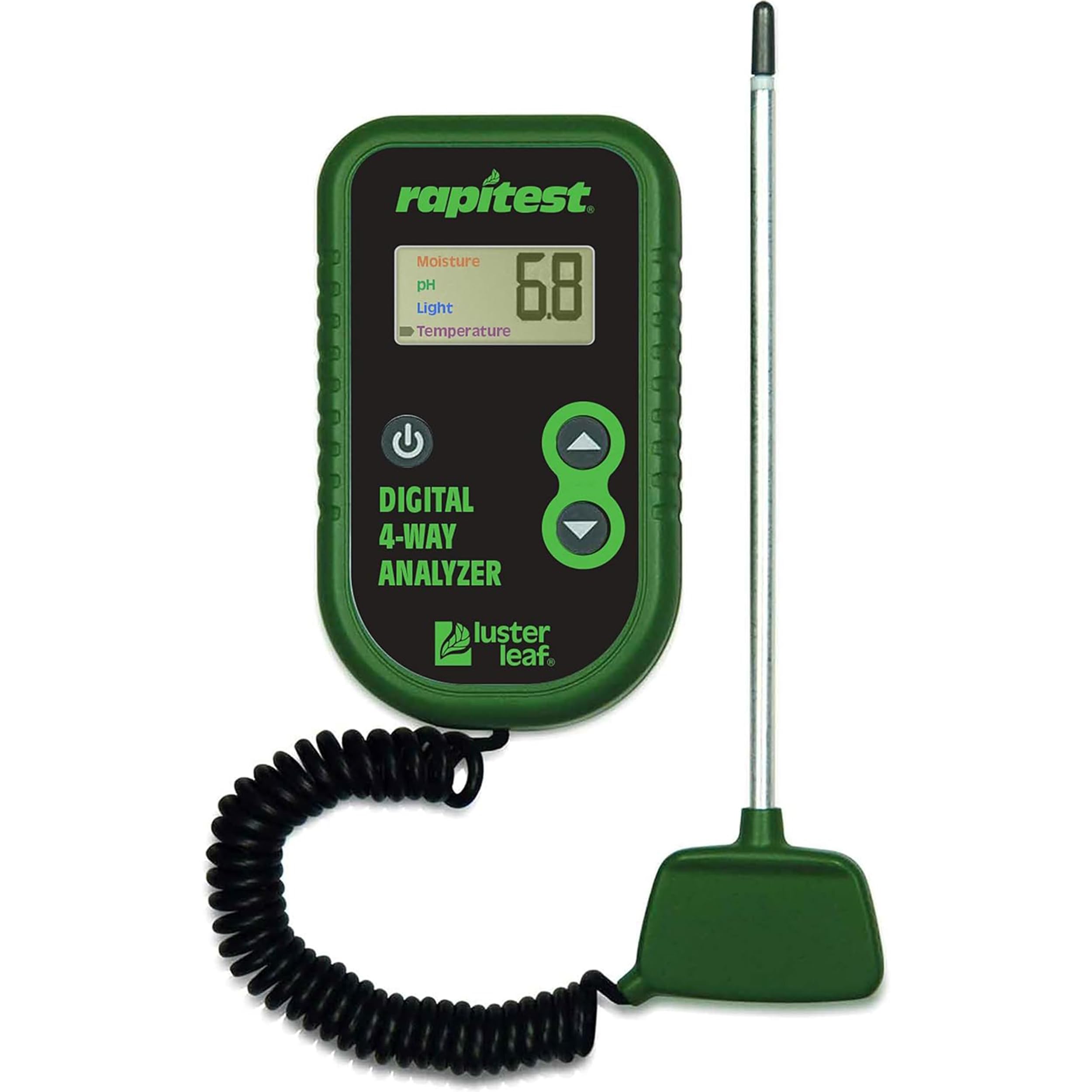
A digital meter with a corded probe so you can read the display without crouching by the pot.
Most analog meters force you to bend down and squint at the dial where it meets the soil. The Luster Leaf 1885 solves that with a corded probe that stays in the pot while the digital display rests in your hand at eye level. It tests for soil pH, moisture, temperature, and light, and gives you a modern digital output instead of a needle over a printed scale. The package includes a full pH plant list for over 450 plants, plus thorough instructions and gardening tips, all from the Rapitest line that has long been a familiar name in home soil testing.
This unit weighs 7 ounces and has dimensions of 12 x 7 x 2 inches, making it bulkier than the simple analog probes. It also requires batteries for the digital display — a fact to keep in mind if you prefer grab-and-go, no-power tools. While the digital readout reduces interpretation errors compared to analog scales, the product is designed and engineered in the USA, and the corded design adds convenience for larger gardens where you might be testing several spots in a row. If you want precise, numeric results rather than zone-based guesses, the 1885 is the most user-friendly way to get them — especially if your back appreciates not having to lean over every plant.
Corded convenience
- Digital readout on a hand-held display — no bending to read
- Tests pH, moisture, temperature, and light with one device
- Includes full pH plant list for 450+ plants
Power and bulk
- Requires batteries for the digital screen
- Larger and heavier (7 oz) than analog probes
- Cord between probe and display is another part to manage
Get this if: you want a digital, no-squint reading for multiple soil factors and a corded probe makes it easier to test many pots in one session.
Pass if: you want a compact, battery-free tool you can toss in a drawer and use anywhere without worrying about battery life or a cable.
Understanding the Specs
Moisture Reading Scale (Analog Dial Zones)
Most analog meters use a color-coded dial split into three zones: red (dry), green (moist), and blue (wet). The scale typically runs from 1 to 10, with numbers 1-3 in the red zone, 4-7 in green, and 8-10 in blue. A reading in the green zone usually means the plant has adequate moisture and does not need watering yet. The ten-scale system gives you a rough sense of how far into each zone the moisture sits, which helps you adjust watering gradually rather than flooding a dry pot.
Single Probe vs Multiple Probes
A single stainless steel probe creates a small hole in the soil, which causes minimal root disturbance and brings up very little soil when you remove it. Double- or triple-probe designs gather readings from a wider area but are more disruptive to the root system — especially in small pots where roots are dense. For delicate houseplants, a single probe meter is almost always the safer choice. The trade-off is that with a single probe you get a reading from just one spot, so you may want to test two or three locations to get an average.
FAQ
Can I leave a moisture meter in the soil permanently?
How deep should I insert a plant moisture meter?
Why does my moisture meter read differently in different spots of the same pot?
What is the difference between a fertility meter and a pH meter?
Can I use a moisture meter to test the moisture of liquids like water or fertilizer solution?
What does the red, green, and blue color coding mean on an analog dial?
Does soil temperature affect the moisture reading?
How do I clean and store a moisture meter after use?
Which meter is best for a worm composting bin?
How long do the refillable cores on the Sustee Aquameter last?
Final Thoughts: The Verdict
For most houseplant owners, the best plant moisture meter is the Sustee Aquameter 2 Pack because you leave it in the pot and see the white/blue indicator at a glance — no inserting, timing, or cleaning. If you need a full environmental picture including soil temperature and air humidity, the HSLGOVE 7-in-1 gives you the most data in one tool. For a simple, budget-friendly pair of meters you can use across many pots and then put away, the XLUX 2 Pack is a reliable, no-fuss choice that delivers instant readings every time.
How We Picked
We do not accept paid placement. Every pick is matched to a real buyer and a real use-case; we do not hands-on test units.
Sources & Methodology
Specifications: manufacturer listings and product documentation. Review insights: verified customer reviews, as of July 2026. Pricing: not shown on this page (it changes often); check the current price via the retailer link.
As an Amazon Associate, Lawn Gear Lab earns from qualifying purchases. This does not affect which products we feature.