
Specs are compiled from manufacturer listings and verified buyer reviews and can change over time — please confirm the key details on the product page before buying.
You want weeds gone — not just singed above the soil, but wiped from root to leaf tip, so you are not respraying the same patch next week. The trouble is that not every bottle lives up to that promise; some just knock the tops off while the roots regroup underground. This guide cuts through the label claims to find the ones that actually finish the job.
I’m Rikta — the founder and writer behind Lawn Gear Lab. This guide is built by comparing the manufacturers’ published specifications and the patterns across verified customer reviews, so you get each pick’s real strengths and trade-offs instead of marketing spin.
Whether you are clearing a fence line, reclaiming a gravel driveway, or fighting poison ivy along a trail, the right plant killer depends on matching the active ingredients to the specific type of growth you are up against.
Quick Picks
- Martin’s Eraser Max Super Concentrate – 32oz — Farm-Grade Power
- Roundup Dual Action Weed & Grass Killer Plus 4 Month Preventer Concentrate, 32 fl. oz. — Best Overall
- Spectracide Weed and Grass Killer Concentrate, 32 Ounces, With Accumeasure System — Fast-Acting Value
- Ortho GroundClear Weed and Grass Killer Super Concentrate1, 32 fl. oz. — Tall-Grass Terminator
- Control Solutions 82004318 1 Quart Eraser & Grass Killer Concentrate — Budget-Champion Concentrate
- Roundup Poison Ivy Plus Tough Brush Killer₂ Concentrate, 32 fl. oz. — Vine Specialist
How To Choose The Best Plant Killer
Before you grab any bottle off the shelf, you need to know two things: what kind of plant you are targeting (broadleaf weeds, grass, woody vines) and where you are spraying (lawn, garden bed, driveway, or fence line). A formula that works great on crabgrass can leave poison ivy untouched, and a heavy-duty brush killer can sterilize the soil where you want flowers next month.
Active ingredients: glyphosate vs. triclopyr vs. diquat
Glyphosate is the workhorse — it moves through the leaves down into the roots and kills the whole plant. Triclopyr is better at woody, stubborn species like poison ivy and blackberry vines. Diquat works fast on leaf surfaces but does not travel deep into the root system, so it is best for quick knockdown on annual weeds. Many premium concentrates use a blend of two or three ingredients for broader control.
Concentrate vs. ready-to-use
Concentrates require you to mix the product with water in a tank sprayer, which gives you more control over strength and far more coverage per dollar. Ready-to-use bottles are convenient for small spot treatments but run out fast. Every product on this list is a concentrate, meaning you will need a sprayer — but you also get more square feet per bottle.
Coverage area and rainfast timing
The label will list a coverage area in square feet (e.g., 1,120 sq ft or 1,500 sq ft). That tells you how much ground one bottle treats at the recommended mix rate. Rainfast time is how long the spray needs to stay on the leaves before a rain shower washes it off.
Quick Comparison
| Model | Best For | Active Ingredients | Coverage | Weight | Amazon |
|---|---|---|---|---|---|
| Martin’s Eraser Max Super Concentrate | Farm-scale / tough brush | Glyphosate 43.6%, Imazapyr 0.78% | — | 2.6 Pounds | Amazon |
| Roundup Dual Action Weed & Grass Killer Plus 4 Month Preventer | Long-term prevention | Glyphosate-based + preventer | 1,600 sq ft | 8 ounces | Amazon |
| Ortho GroundClear Weed and Grass Killer Super Concentrate | Fast knockdown on tall grass | Glyphosate-based | 1,120 sq ft | 2 Pounds | Amazon |
| Control Solutions Eraser & Grass Killer Concentrate | Budget-friendly all-purpose | Glyphosate 41% | Annual | 2 Pounds | Amazon |
| Spectracide Weed and Grass Killer Concentrate | Speed on driveways & walkways | Diquat Dibromide | 1,350 sq ft | 32 Ounces | Amazon |
| Roundup Poison Ivy Plus Tough Brush Killer₂ Concentrate | Woody vines & poison ivy | Triclopyr 2.50%, Fluazifop-P-Butyl 2.00%, Diquat 1.50% | 1,500 sq ft | 0.5 Pounds | Amazon |
In‑Depth Reviews
1. Martin’s Eraser Max Super Concentrate – 32oz
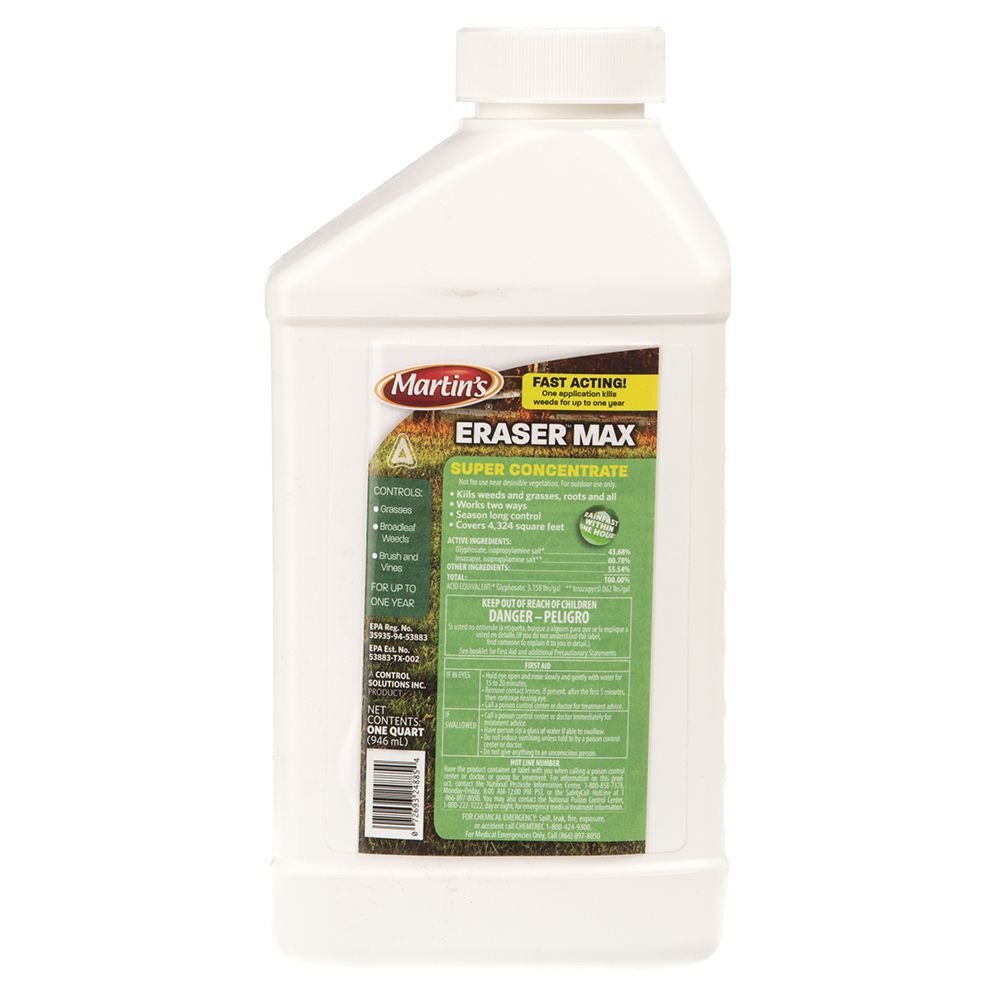
The heavy lifter that wipes out kudzu where lighter mixes quit.
This is the strongest active-ingredient concentration on the list by a wide margin: 43.6% Glyphosate plus 0.78% Imazapyr. You mix it per the label ratio and it keeps working even if it rains a few hours after you spray — something a lot of weed killers cannot promise. At 2.6 pounds versus the 0.5-pound Roundup brush killer, this bottle is heavier.
Buyers report that they “mix this to the correct per gallon ratio and you will be happy with the results.” One long-time user in the South says this is the only product that has controlled kudzu on their property after two years of trying other brands. The catch is that results take up to two weeks to show on tough perennial weeds, so you have to be patient. This is not the pick for a quick weekend cleanup.
The farm-tested workhorse: Choose this if you own acreage, fight stubborn invasive vines, or want a single concentrate that handles everything from fence-line grass to woody brush without needing to re-spray.
The patience trade-off: It can take up to two weeks to see full results on tough weeds, so if you need a fast cosmetic fix, look at the Spectracide option below.
Reach for this if: you manage a large property or have failed with other formulas on persistent weeds like kudzu or blackberry thickets.
Look elsewhere if: you want visible results in under a week and do not mind a slightly slower, less potent mix.
2. Roundup Dual Action Weed & Grass Killer Plus 4 Month Preventer Concentrate, 32 fl. oz.

Kills what is there and then blocks regrowth for a full season.
The standout feature here is the built-in preventer: after wiping out existing weeds and grass down to the root, it keeps new ones from popping up for up to 4 months. That means you treat a fence line or gravel driveway once instead of every few weeks. It covers 1,600 square feet, versus 1,350 sq ft for Spectracide and 1,120 sq ft for Ortho.
Owners mention it is “potent concentrate” that kills small trees quickly and handles “stubborn greenbriar” well. The formula is rainproof in 30 minutes and shows visible results in about 6 hours. The trade-off is price — this is the most expensive bottle here, and you cannot plant any ornamentals, sod, or seed in the treated area for 4 months after application.
Why it wins
- Coverage area: 1,600 sq ft.
- Rainproof in 30 minutes with visible results in as fast as 6 hours.
- Prevents regrowth for up to 4 months in a single application.
The one catch
- Cannot plant anything in the treated area for 4 months after spraying.
- Higher upfront cost than entry-level concentrates.
Grab it for: driveways, patios, fence lines, and gravel areas where you want a single application to last the whole summer.
Pass on it if: you plan to plant flowers, shrubs, or sod in the same spot within 4 months.
3. Spectracide Weed and Grass Killer Concentrate, 32 Ounces, With Accumeasure System
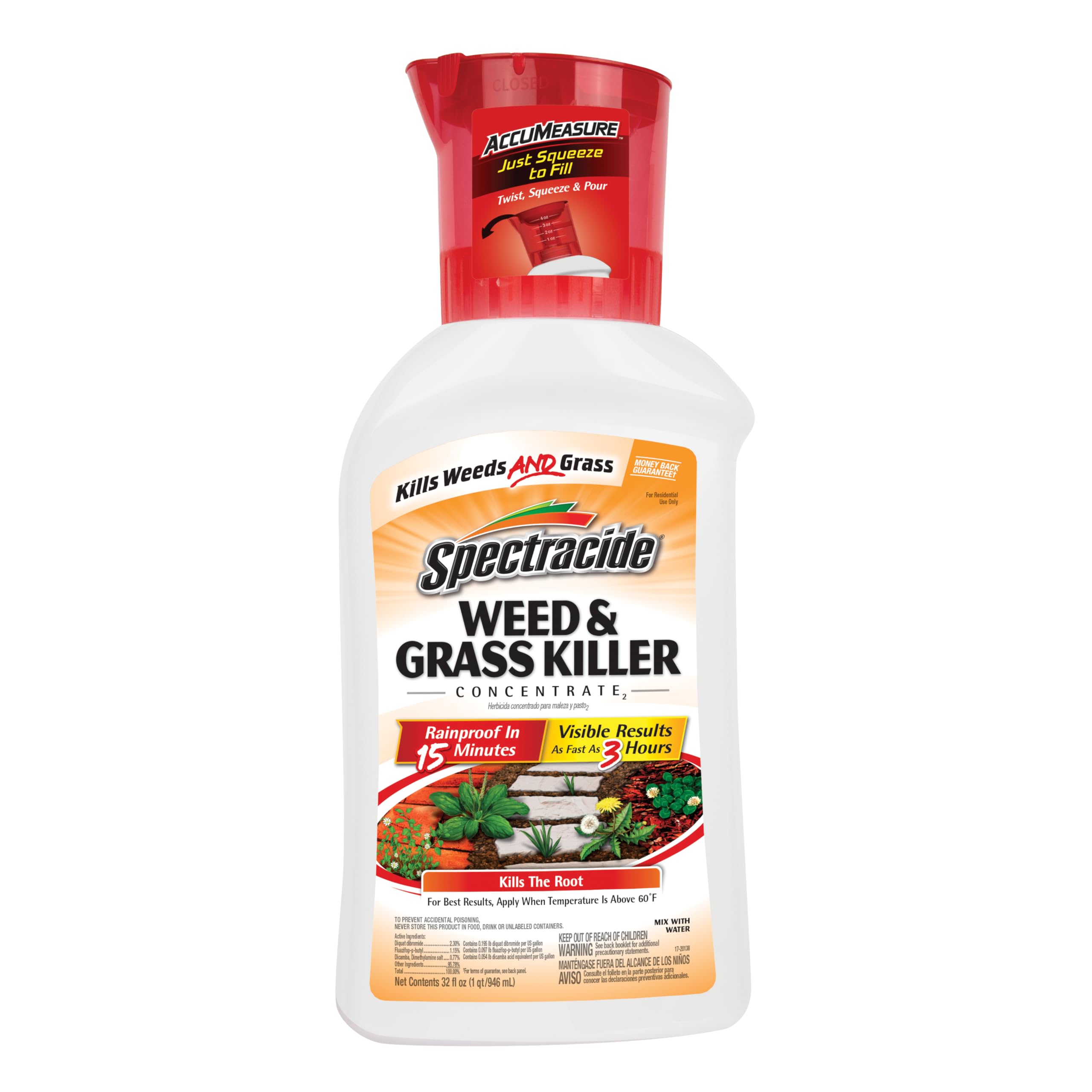
Visible wilting in hours, not days — perfect for a same-weekend fix.
If you want to see results before the weekend is over, this is the pick. Spectracide uses Diquat Dibromide, which acts on the leaf surface quickly — customers note seeing results “within a day” when applied along their curb.
The Accumeasure cap is meant to make measuring less messy, though several reviewers point out the cap is frustrating and end up swapping it with an older bottle lid instead. It is rainfast in 15 minutes, so you can spray even when a quick shower is forecast. Keep in mind that Diquat does not travel deep into root systems the way glyphosate does, so this works best on annual weeds and grassy growth rather than deep-rooted perennial vines.
Speed advantage
- Visible results in as fast as 3 hours.
- Rainfast in 15 minutes — the fastest on this list.
- Covers 1,350 square feet per bottle.
Know before you buy
- Diquat is less effective on deep-rooted weeds and woody vines.
- Several buyers find the Accumeasure cap difficult to use.
Best for: visible-to-the-neighbor areas like driveways, curbs, and walkways where fast cosmetic results matter.
Not the one for: poison ivy, kudzu, or any woody perennial that needs a root-system kill.
4. Ortho GroundClear Weed and Grass Killer Super Concentrate1, 32 fl. oz.
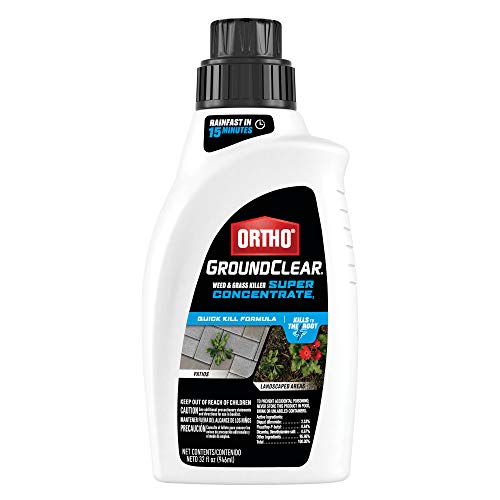
A solid, no-nonsense concentrate for overgrown fence lines and paths.
One buyer described using Ortho GroundClear on a fence line where the grass was “probably a foot tall” and reported visible die-off in about 3 or 4 days. That matches the formula’s fast-acting glyphosate base, which starts working immediately on contact and is rainfast in 15 minutes. The bottle makes up to 5 gallons of finished spray solution and treats up to 1,120 square feet.
It covers 1,120 sq ft, while Spectracide covers 1,350 sq ft, but several shoppers say they get better long-term results on tough broadleaf weeds like Silverleaf Nightshade. The instructions recommend spraying when the air temperature is above 60°F for best absorption, which is a useful detail for early-spring or late-fall applications.
A dependable all-rounder: Great for general weed and grass cleanup around trees, shrubs, patios, and fence lines where you want reliable results without a complicated mix process.
Pick this for: above-ground reclamation projects — overgrown beds, foot-high grass, or paths that need a clean slate.
Consider something else if: you need maximum coverage per bottle (the Spectracide covers more ground for a similar price).
5. Control Solutions 82004318 1 Quart Eraser & Grass Killer Concentrate
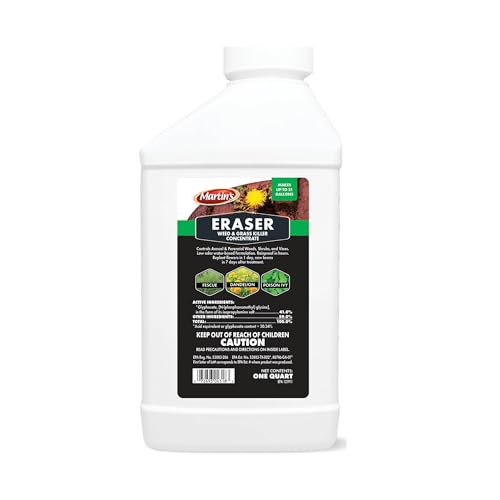
17 years of buyer loyalty — the no-frills glyphosate that simply works.
This is a straightforward 41% Glyphosate concentrate with a water-based, low-odor formula that buyers have relied on for nearly two decades — one reviewer wrote they have “been happy with this product for about 17 years.” The standard mix is 8 ounces per gallon of water, and buyers confirm it “kills 100% of green plants (weeds, grass, clovers, flowers) in 1-2 weeks.”
The catch is patience: unlike the Spectracide or Ortho formulas that show surface results in hours, this one takes 4 to 7 days to start yellowing and up to 14 days for full death. A buyer notes that poison ivy may need a reapplication, and adding a surfactant (a spreader-sticker) helps on waxy leaves. It has no residual soil activity, so you can replant as soon as the dead vegetation is cleared.
Why it earns repeat buyers
- 41% Glyphosate gives reliable total-plant kill for a budget-friendly price.
- No residual soil activity means you can replant right after clearing dead growth.
- Low-odor formula is easier to work with than harsh-smelling concentrates.
Slower than the competition
- Results take 1-2 weeks, which is slower than diquat-based or fast-acting formulas.
- Poison ivy and woody weeds may need a second application.
Reach for this if: you want the best dollar-to-kill ratio and you are okay waiting up to two weeks for complete results.
Look elsewhere if: you need a fast weekend fix or you are specifically targeting poison ivy without wanting to reapply.
6. Roundup Poison Ivy Plus Tough Brush Killer₂ Concentrate, 32 fl. oz.

The triple-blend that specifically targets poison ivy, poison oak, and blackberry.
This is not a general-purpose grass killer — it is formulated for the woody, waxy-leafed plants that laugh at straight glyphosate. The three active ingredients (Triclopyr 2.50%, Fluazifop-P-Butyl 2.00%, Diquat Dibromide 1.50%) are a custom mix for poison ivy, poison sumac, wild blackberry, and kudzu. Buyers report it “kills plants with leaves; most die with 1 application, tough ones need a few,” and one user in a forest setting calls it “the best stuff I’ve ever used.”
At 0.5 pounds versus the 2.6-pound Martin’s Eraser, it is the lighter bottle here. But do not let the weight fool you: each gallon of mixed solution covers 300 square feet, and the total bottle covers 1,500 square feet. It is rainproof in 30 minutes and shows visible results in hours. The main limitation is that you cannot replant in the treated area for 1 to 30 days depending on the plant type, so read the booklet before putting anything new in the ground.
Purpose-built for problem weeds
- Triple-active formula is designed specifically for poison ivy, poison oak, kudzu, and wild blackberry.
- Rainproof in 30 minutes; visible results in hours.
- Covers 1,500 square feet per bottle.
Not a generalist
- Overkill and more expensive than basic glyphosate if you only need to kill lawn grass.
- Replanting window ranges from 1 to 30 days depending on what you sprayed.
Choose this for: any woody vine — poison ivy, blackberry, kudzu — that has resisted standard weed killers in the past.
skip it if: you just need a basic grass-and-dandelion killer for your lawn or garden beds.
Understanding the Specs
Active Ingredients
This is the chemical engine. Glyphosate is the most common broad-spectrum herbicide — it moves through the leaves down to the roots. Triclopyr is added for woody brush and vines that have tough, waxy leaves. Diquat works fast on leaf surfaces but does not penetrate deep roots. A higher percentage (like 43.6% in Martin’s Eraser) means a more concentrated dose per ounce of product.
Coverage Area (Square Feet)
This is the total area one bottle can treat at the label’s standard mix rate. A larger number like 1,600 sq ft (Roundup Dual Action) means fewer bottle refills for big jobs, while 1,120 sq ft (Ortho GroundClear) covers a typical driveway and fence line. Always check this number against your total square footage before buying.
Rainfast Time
This is how long the spray must stay on the leaves before rain or watering can wash it off. A shorter time (15 minutes for Spectracide) is useful in unpredictable weather. A longer time (30 minutes for Roundup) is still manageable but requires a bit more planning. If rain hits before the window closes, the spray loses most of its effect.
Item Weight
Weight is not just about shipping — it is also a rough indicator of how much active chemistry is in the bottle relative to water and filler. A 2.6-pound bottle (Martin’s Eraser Max) contains more concentrated active ingredients than a 0.5-pound bottle (Roundup Poison Ivy). Heavier does not always mean better, but it does mean a higher chemical load per bottle.
FAQ
Can I use a plant killer concentrate in any sprayer?
How long after spraying can I plant new flowers or shrubs?
Will a plant killer kill everything it touches?
What is the difference between glyphosate and triclopyr?
Does rain after spraying wash away the plant killer?
How much area does a 32-ounce concentrate bottle cover?
Can I use these concentrates on poison ivy safely?
Which plant killer works fastest on visible weeds?
Is a higher percentage of active ingredient always better?
Can I use a plant killer in flower beds without killing my flowers?
Final Thoughts: The Verdict
For most people, the plant killer winner is the Roundup Dual Action Weed & Grass Killer Plus 4 Month Preventer because it kills existing growth to the root and then prevents new weeds for up to 4 months, with 1,600 sq ft of coverage. If you want fast visible results on driveways and walkways, grab the Spectracide Weed and Grass Killer Concentrate. And for poison ivy, blackberry, or kudzu that has resisted everything else, the standout is the Roundup Poison Ivy Plus Tough Brush Killer₂.
How We Picked
We do not accept paid placement. Every pick is matched to a real buyer and a real use-case; we do not hands-on test units.
Sources & Methodology
Specifications: manufacturer listings and product documentation. Review insights: verified customer reviews, as of July 2026. Pricing: not shown on this page (it changes often); check the current price via the retailer link.
As an Amazon Associate, Lawn Gear Lab earns from qualifying purchases. This does not affect which products we feature.