
Specs are compiled from manufacturer listings and verified buyer reviews and can change over time — please confirm the key details on the product page before buying.
You want greener, healthier plants indoors, but the last thing you want is a bulb that turns your living room into a purple disco. The right bulb delivers the specific light waves plants need for photosynthesis while looking like a normal, pleasant white light to you. This guide focuses on that balance, sorting through the real specs and owner experiences so you can pick a bulb that actually makes your monstera or herbs thrive.
I’m Rikta — the founder and writer behind Lawn Gear Lab. This guide is built by comparing the manufacturers’ published specifications and the patterns across verified customer reviews, so you get each pick’s real strengths and trade-offs instead of marketing spin.
You want your plants to thrive indoors without turning your living room into a neon grow-op. The right plant grow light bulb screws into a standard lamp, delivers real light, and keeps your greenery healthy through every season.
Our Picks at a Glance


How To Choose The Best Plant Grow Light Bulb
Picking a grow bulb is about matching the light to your plant’s needs and your room’s reality. You are not just looking for “bright” — you are looking for the right kind of light, in the right concentration, without turning your home into a sauna.
Understand PPF and the Red-Blue Mix
Plants use specific parts of the light spectrum. Blue light supports leafy growth and seedlings, while red light encourages flowering and fruiting. A bulb’s PPF (Photosynthetic Photon Flux) tells you how much of that usable light it puts out every second, measured in micromoles (µmol/s). A higher PPF number means more food for your plant, but you have to balance that against the bulb’s beam angle to know how much actually reaches your leaves.
Match the Beam Angle to Your Setup
A wide beam angle (like 230 degrees) spreads light over a broad area, making it ideal for a big shelf or a plant in a corner. A narrow beam (like 60 degrees) concentrates the light into a focused spot, which is better for a single tall plant in a standing lamp. If you put a narrow-beam bulb too close to a shelf, you might miss the lower leaves entirely.
Prioritize Low Heat and a Standard Base
Most of these bulbs screw into a standard household E26 medium base, so they fit your existing lamps. Since plants need light for many hours a day, a bulb that runs hot can warm up a small grow tent or risk burning foliage that leans against it. Look for bulbs that mention low heat generation and a long rated lifespan, often around 25,000 hours, so you are not constantly replacing them.
Quick Comparison
| Model | Best For | Light Output (PPF) | Wattage | Beam Angle | Amazon |
|---|---|---|---|---|---|
| GE BR30 (2-Pack)★ Best Overall | Natural white light & wide coverage | 16 µmol/s | 9W | 110° | Amazon |
| SANSI 300W Equiv.Powerhouse Pick | High-intensity single-plant focus | 220.42 µmol/s/㎡ @ 1ft | 30W | 60° | Amazon |
| ALIDE A19 (3-Pack)Wide-Angle Value | Wide-angle & multi-pack value | 23 µmol/s | 10W | 230° | Amazon |
| Necgemlex Smart (2-Pack) | Timer & remote control convenience | — | 9W | 120° | Amazon |
| GE A19 (2-Pack) | Simple, regular-bulb look | 16 µmol/s | — | — | Amazon |
| Bioluz LED A19 (3-Pack) | Warm 3000K & ultra-low heat | — | 9W | 120° | Amazon |
| Dubofu A19 (6-Pack) | Budget multi-pack for seed starting | — | 11W | — | Amazon |
| Philips PAR38 | Premium, durable focused spotlight | — | 15.5W | 50° | Amazon |
| SANSI 32W | High-PPFD serious indoor growers | 423 µmol/s/㎡ @ 1FT | 32W | 60° | Amazon |
In‑Depth Reviews
1. GE Grow Lights BR30 (2-Pack)
Our pick — over 4.5★ from 19,000+ verified ratings; the strongest balance of quality and price.
The crowd-pleasing floodlight that hides in plain sight.
This is the bulb to grab when you want your indoor garden to thrive without announcing itself to every guest. It delivers a genuinely natural white light that fits your decorative lamps, with a balanced red-blue spectrum that has owners reporting success with everything from Meyer lemon trees to hostas in dark corners of the home.
The numbers back up the hype. It puts out 16 µmol/s of PPF (the usable light for plants) while drawing just 9 watts, rated to last up to 25,000 hours. That efficiency, combined with a crowd-favorite 4.6-star rating, makes it the most convincing all-rounder here. Buyers report the light is effective from about 18 inches away, though the larger BR30 shape means it needs a lamp with a bit of breathing room.
This bulb wins fans by pairing serious power with a discreet look. Owners mention: “The grow lights are very bright and seem to be strong.” A few owners warn it can burn plants that sit too close, so keep your leaves a safe distance away.
Why it leads the list
- Natural white light, no purple glow
- Strong 4.6-star reputation from thousands of owners
- Energy-sipping 9W with a 25,000-hour lifespan
The practical trade-offs
- Bulky BR30 shape needs a larger lamp
- Bright enough to burn leaves that touch it
Your pick if: you want a balanced, reliable, natural-looking light for mixed houseplants and herbs in a standard ceiling or floor lamp.
Look elsewhere if: you have a tiny shelf with tight clearance, since the wider floodlight shape can be awkward to fit.
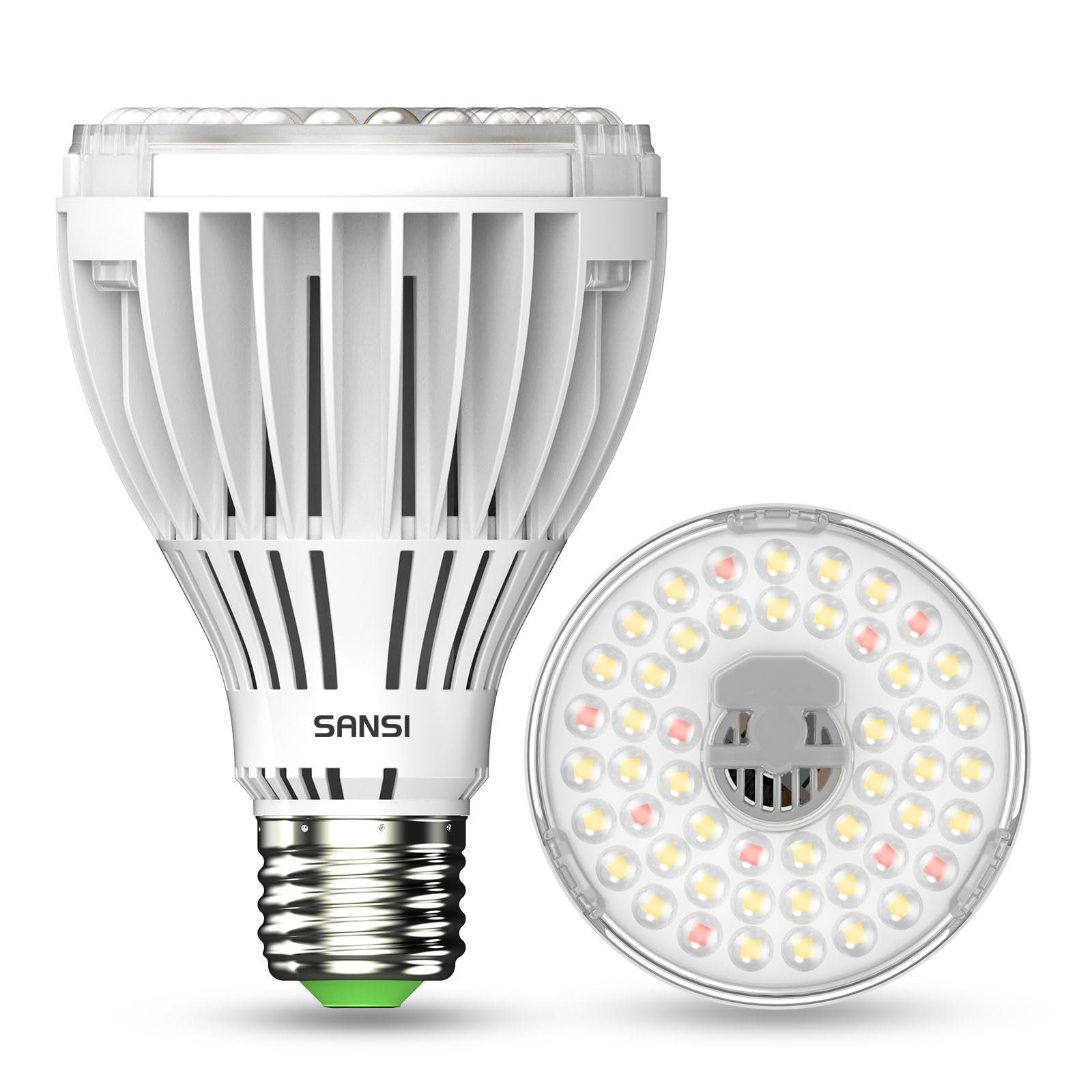
2. SANSI 300W Equiv. Full Spectrum (30W)
A focused beam of serious intensity for one special plant.
If you have a single struggling specimen that needs a dramatic intervention, this SANSI is your specialist. Its 60-degree beam angle concentrates a huge amount of light — equivalent to a 300-watt incandescent — into a tight spot, making it perfect for a standing lamp aimed at a fiddle-leaf fig or a small grow tent.
Owners praise its measurable brightness: a PPFD (photosynthetic photon flux density, or the light intensity hitting your plant’s leaves) of 220.42 µmol/s/㎡ at 1 foot feeds plants like a dose of sunshine. The trade-off is heat. Customers note: “Hot hot hot so don’t let it lean on anything.” Keep it clear of leaves and anything flammable, and you’ll see growth — one Hoya owner spotted the first new growth in over a year.
The ceramic body and patented Chip on Ceramic (COC) technology are designed to pull heat away fast, which helps the 25,000-hour lifespan. But unlike the GE above, which spreads a gentle 110 degrees, this bulb’s narrow focus means it’s not the choice for lighting a whole shelf of small plants evenly.
What owners praise most
- Measurable quality and brightness that revive struggling plants
- Cone-shaped beam concentrates light where you aim it
- Efficient ceramic cooling tech for reliability
What you must accept
- Runs hot — keep it off anything it could touch
- Focused beam needs careful positioning to avoid burning
Best for: the dedicated plant parent with one or two high-light plants that are begging for more intensity.
Not for: a wide bookshelf of low-light greens that need a gentle, broad wash of light.
3. ALIDE A19 Full Spectrum (3-Pack)
The budget-friendly triple-pack that floods a whole shelf with light.
For a long shelf of seedlings or many small pots, this is the smart pick. Its 230-degree beam angle — the widest here, about 3.8 times wider than the SANSI’s focused 60 degrees — spreads light across a broad area, so you can cover every plant in a row without shifting bulbs.
It’s also the strongest of the standard A19 bulbs here on paper, delivering 23 µmol/s of PPF against the GE BR30’s 16 µmol/s, while drawing just 10 watts. That combination of wide spread and solid output is why reviewers point out plants reviving within a week or two in low-light rooms.
The 3-pack is the real story for value. The one honest caveat is fit: these are described as “intermediate based” bulbs by some owners, so double-check they screw snugly into your specific fixtures before relying on them daily.
Why it earns its spot
- Highest PPF in the standard-size group at 23 µmol/s
- Ultra-wide 230° spread covers a whole shelf
- 3-pack value with proven multi-year reliability
Things to watch
- Some fixtures may need a snug fit check
- Not waterproof — keep it out of rain or add a fixture guard
Reach for this if: you are starting seeds or growing herbs across a long shelf and want even, broad coverage from multiple bulbs.
Look elsewhere if: you need one intense spot of light for a single tall plant, where the wide spread would be wasted.
4. Necgemlex Smart Grow Light (2-Pack)

The incognito bulb that dims and times itself like real sunshine.
These bulbs solve the two biggest grow-light hassles: remembering to turn them on and off, and wanting them to look normal. The built-in infrared remote lets you set a daily timer from 2 to 22 hours, plus a “Sunshine Mode” that automatically changes brightness from sunrise to sunset, mimicking a real day cycle.
Owners love the disguise factor — the 4500K light looks like an ordinary bulb in a sconce or fireplace lamp, with no purple tint. The remote also offers dimming levels, so you can match the intensity to your plant. One delighted owner saw a three-year-old kaffir lime tree push out new leaf buds within three weeks of switching to these.
The efficiency spec stands out at 135.56 lumens per watt, making it a very energy-lean 9W bulb. The main quirk owners flag is the schedule can drift earlier by a few minutes each day, requiring a periodic reset. It’s a minor annoyance against the convenience of automatic on/off, and a far easier experience than the dumb bulbs above that run all day manually.
What makes it clever
- Programmable timer (2–22 hours) with remote control
- Sunshine Mode simulates a natural sunrise-to-sunset cycle
- High efficiency at 135.56 lumens/watt
The small print
- Schedule can drift a few minutes daily over weeks
- Do not use with external dimmers, which can cause flickering
Best for: the “low-maintenance” plant owner who wants automation and a clean, normal look in living spaces.
Not for: anyone who wants a simple dumb bulb with zero programming and no remote to keep track of.
5. GE A19 Grow Light (2-Pack)

A regular-looking A19 bulb with proven GE grow cred.
If you liked the idea of the GE BR30 but need a slimmer profile, this A19 version is the answer. It keeps the same balanced, natural white light that owners say “actually looks like a regular light bulb,” with the same 16 µmol/s of PPF output, but in a compact shape that fits tighter lamps and desk fixtures.
The brightness is the thing owners praise most, and the physical spec backs it up — a color rendering index of 90 means colors look vibrant and true, not washed out. One owner’s monstera grew huge in an otherwise dark room, and wintering plants in a garage stayed healthy through the cold months on these.
Placement is the key to success. GE’s guidance is to keep the bulbs about 9 inches from your plants and run them 18 hours a day for most growth stages. That is a longer daily cycle than the 6 hours some owners of the BR30 use, so be ready to commit to a bit more electricity, even at this efficient LED wattage.
Why it works
- Compact A19 shape fits standard lamps easily
- High 90 CRI for natural, vibrant color rendering
- Shoppers say strong growth in dark rooms
What to know
- Needs 18 hours a day for best results, which adds energy use
- Some buyers received a bulb damaged in shipping
Your pick if: you want the trusted GE performance in a slimmer bulb that fits a desk lamp or tighter sconce.
Think twice if: you cannot commit to running the light for the full recommended 18-hour cycle daily.
6. Bioluz LED A19 Full Spectrum (3-Pack)

The soft, warm-white bulb that is as easy on your eyes as it is on plants.
Most grow bulbs blast a cool, clinical daylight, but this Bioluz runs at a warm 3000K, making it genuinely pleasant to have on in a bedroom or cozy living space. Despite the warm tint, it still delivers a full spectrum designed for plant growth, and buyers report everything from revived 20-year-old shamrock plants to philodendron cuttings sprouting roots within 10 days.
Heat output is the standout here — it is engineered to stay extremely cool, which owners confirm, meaning you can tuck it into a small confined space without worrying about overheating the room or the plant. It’s also a certified safe choice, carrying FCC, RoHS, and UL Listed marks.
In a 3-pack, it’s a smart, low-risk way to cover several dark corners. The 9W draw and 120-degree beam angle make it versatile. While some owners note the warm color is a touch dimmer than they expected for reading, that’s a feature, not a flaw, if you want a grow light that doubles as a soft ambient lamp for your bedroom.
What stands out
- Warm 3000K light feels like a normal household bulb
- Extremely low heat, safe for tight, enclosed spaces
- UL Listed and FCC/RoHS compliant for safety confidence
What to keep in mind
- Warm tone is dimmer than a cool daylight bulb
- A few owners saw one arrive broken, though the seller replaced it easily
Reach for this if: you want grow lighting that blends into a cozy, warm-lit room and runs cool in small spaces.
Look elsewhere if: you need maximum brightness and a cool daylight color for serious seed starting.
7. Dubofu A19 Grow Light (6-Pack)

The six-pack that turns every dark corner into a mini greenhouse.
This is the pick for the person who wants to experiment with grow lights across multiple rooms without spending a fortune. For the cost of a single premium bulb, you get six 11-watt full-spectrum lights rated at 100 watts equivalent, delivering 1000 lumens each of bright 5000K daylight.
Owners mention instant results — limp, small plants “took right off” once these were screwed in, and the bulbs stay cool enough to touch, a major plus if you are running them for long hours. The standard E26 base means they fit anywhere a normal bulb goes.
There’s an honest trade-off in longevity. Some customers note these lasting well past a year, but the data shows mixed feedback on lifespan and reliability, with an occasional unit failing early. For the price per bulb, that’s a risk many are willing to take to light up an entire plant collection at once.
The value play
- Six bulbs cover a whole home for one low price
- Bright 1000-lumen output at 11W each
- Runs cool, safe for long daily use
The honest caveat
- Lifespan has mixed reviews; some fail before a year
- Not a premium build, so handle with care
Best for: the plant collector who wants to scatter light across many shelves and rooms immediately on a strict budget.
Not for: anyone who needs one guaranteed, long-lasting workhorse bulb and is willing to pay more for it.
8. Philips PAR38 Grow Light

The premium, heavy-duty spotlight with a superb color rating.
When you need focused light for a single plant, this is the serious tool. The Philips PAR38 packs 1325 lumens into a 50-degree beam — a tight, even spot that owners say grows plants well from 6 to 20 inches away, reviving even dying echeveria and bringing out blushing red tips on succulents. Its daylight 5000K color is bright, clean, and runs cool.
Its color rendering index of 92 is among the best here, beating the SANSI 300W’s 80, which means your plants and room look naturally vibrant under it, not washed out. The beam angle is even narrower than the SANSI’s 60 degrees, making it a precision spot for a single plant in a pendant or clamp fixture.
The trade-off is physical heft. Owners consistently note this is a heavy bulb that needs a sturdy fixture — it won’t work in flimsy clip-on lamps, and some owners found it needs a stand rated for 1-2 pounds. It’s also dimmer per watt than the SANSI 32W below for intense growth, so match it to your plant’s actual light needs. It carries a 25,000-hour rated lifespan and a Title 20 certification.
Why it stands apart
- Excellent 92 CRI for natural, vivid color
- Focused 50° beam perfect for single-plant spotlights
- Runs cool with a 25,000-hour lifespan
What to plan for
- Heavy build demands a sturdy, rated fixture
- Narrow beam not suited for wide shelf coverage
Your pick if: you have a dedicated, sturdy lamp and want premium build quality plus natural color for a prized plant.
Think twice if: your plant needs maximum intensity for heavy fruiting, where the higher-PPFD SANSI below is stronger.
9. SANSI 32W Grow Light (350W Equiv.)

The serious-intensity bulb that turns a clamp lamp into a grow station.
For the home grower chasing serious results, this is the heavyweight. The 32-watt SANSI delivers a PPFD (light intensity on your leaves) of 423 µmol/s/㎡ at 1 foot — nearly double its 300W sibling — thanks to a secondary optical lens that focuses every photon where your plant can use it. Reviewers point out jade and cactus thriving from 10-12 inches away, and a lemon tree flourishing through winter.
It’s also a leap ahead in color quality, with a color rendering index of 95, edging out the Philips’s 92 for the most natural light in this list. The 4000K daylight tint is bright and clean, and the ceramic Chip on Ceramic (COC) heat sink keeps it running cooler than many cheaper bulbs.
The honest cost of that power is heat. Owners say it’s cooler than an incandescent, but it still runs noticeably warm — “a bit hot” as one put it — so keep it clear of leaves. It comes with a 5-year protection plan and ETL (a safety certification) listing, so you get confidence for a serious investment in your plants.
The performance case
- Highest PPFD here at 423 µmol/s/㎡ @ 1ft
- Top-tier 95 CRI for natural color
- ETL listed with a 5-year protection plan
The power cost
- Runs warm — needs clearance from plant leaves
- Higher energy draw at 32W than most bulbs here
Best for: the indoor gardener who needs maximum usable light for high-light plants, fruiting, or winter survival and wants the warranty to back it.
Not for: casual houseplant owners who just want a subtle boost for a low-light philodendron.
Understanding the Specs
PPF and PPFD
PPF (Photosynthetic Photon Flux) is the total usable light a bulb emits every second, measured in micromoles per second (µmol/s) — it’s the bulb’s overall “plant food” output. PPFD (Photosynthetic Photon Flux Density) is that same light measured over a specific area at a set distance, like 423 µmol/s/㎡ at 1 foot — this tells you how intense the light actually is on your plant’s leaves. A wide-beam bulb spreads its PPF thin over a big area, while a narrow-beam bulb concentrates it.
Color Temperature (Kelvin) and CRI
Color temperature, measured in Kelvin (K), describes whether the light looks warm and yellow (3000K) or cool and blue-white (5000K). Warmer light suits cozy living spaces; cooler daylight mimics the sun more closely for seed starting. The Color Rendering Index (CRI) measures how accurately colors appear under the light on a scale up to 100. A CRI of 90 or above looks natural and vibrant to your eye and makes your plants look their best.
Beam Angle and Wattage
Beam angle is the width of the cone of light spreading from the bulb, measured in degrees. A 230-degree beam is a broad flood for shelves; a 50-degree beam is a focused spot for a single tall plant. Wattage is simply how much electricity the bulb draws — a 9W bulb is far more efficient than a traditional 65W equivalent incandescent, meaning you get strong plant light for a fraction of the energy.
Lifespan and Heat Output
Grow bulbs are rated for a lifespan in hours, typically 20,000 to 25,000 hours, which translates to years of daily use. Heat output is just as important — a bulb that runs hot can burn leaves that lean on it and warm up a small grow tent. Efficient LED designs with ceramic or aluminum heat sinks run cooler, letting you place the light closer to your plants safely.
FAQ
What is the difference between PPF and PPFD for grow bulbs?
Will a grow light bulb fit my regular lamp?
Why does the light from some grow bulbs look purple and others look white?
How many hours a day should I run my grow light bulb?
How close should my grow light bulb be to the plant?
Are grow light bulbs safe to leave on when I’m not home?
Can I use these bulbs for starting seeds indoors?
What makes a grow bulb better for flowering and fruiting plants?
Why does my grow light bulb get hot, and is that a problem?
Final Thoughts: The Verdict
For most buyers, the plant grow light bulb winner is the GE BR30 2-Pack because it combines the most balanced natural white light, a strong 4.6-star reputation, and a user-friendly 9W design that fits everyday lamps. If you want maximum intensity for a single high-light plant, grab the SANSI 32W for its class-leading PPFD. And for automating your plant care with timers and remote dimming, the Necgemlex Smart 2-Pack is the one to reach for. Whatever your setup, there is a bulb here that will keep your green friends thriving through the darkest months.
How We Picked
We do not accept paid placement. Every pick is matched to a real buyer and a real use-case; we do not hands-on test units.
Sources & Methodology
Specifications: manufacturer listings and product documentation. Review insights: verified customer reviews, as of August 2026. Pricing: not shown on this page (it changes often); check the current price via the retailer link.
As an Amazon Associate, Lawn Gear Lab earns from qualifying purchases. This does not affect which products we feature.