
Specs are compiled from manufacturer listings and verified buyer reviews and can change over time — please confirm the key details on the product page before buying.
A lush, healthy shrub starts with the right N-P-K ratio. The key choice is between liquid food for a fast green-up and granules that release slowly over months. This guide ranks the best plant food for shrubs by N-P-K ratio, form, and plant type.
I’m Rikta — the founder and writer behind Lawn Gear Lab. This guide is built by comparing the manufacturers’ published specifications and the patterns across verified customer reviews, so you get each pick’s real strengths and trade-offs instead of marketing spin.
Vibrant growth and colorful blooms start with the right N-P-K ratio. The right plant food for shrubs makes all the difference in your landscape this season.
Our Picks at a Glance


How To Choose The Best Plant Food For Shrubs
The three numbers on any fertilizer bag are the N-P-K ratio. The three numbers on any fertilizer bag are the N-P-K ratio — nitrogen (N) for leafy green growth, phosphorus (P) for roots and blooms, and potassium (K) for overall health and disease resistance.
Match the formula to your shrub type
If your yard is full of hydrangeas, azaleas, rhododendrons, and evergreens, you need a specialized acid-loving formula. These plants thrive in acidic soil and won’t absorb nutrients well from a generic all-purpose mix. A balanced 5-3-3 or 10-10-10 works for a mixed bed of flowering shrubs and ornamentals.
Liquid, granular, or spikes
Fast-acting liquids are great for a quick green-up but need reapplication. Granules break down slowly and feed for weeks. Spikes are the set-and-forget option — you hammer them into the soil and they release nutrients over the season. Choose a form based on how often you want to reapply.
Quick Comparison
| Model | Best For | Form | N-P-K Ratio | Weight | Amazon |
|---|---|---|---|---|---|
| Alaska Fish Fertilizer★ Best Overall | Quick organic green-up | Liquid | 5-1-1 | 8.8 lb | Amazon |
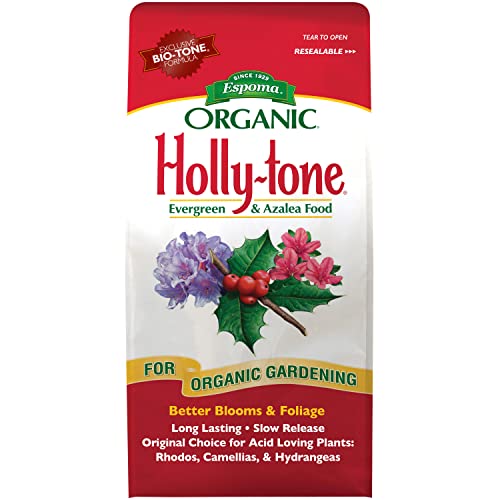
| Espoma Holly-ToneAcid-Loving Pick | Acid-loving shrubs | Granules | 4-3-4 | 4 lb | Amazon |
| Espoma Plant-ToneMost Versatile | All-purpose shrub beds | Granules | 5-3-3 | 4 lb (x2) | Amazon |
| Jobe’s Fertilizer Spikes | No-mess tree & shrub feeding | Spikes | 16-4-4 | 8.5 lb | Amazon |
| GreenView 10-10-10 | Large yards & mixed beds | Granules | 10-10-10 | 33 lb | Amazon |
| Jobe’s Organics Granular | Organic vegetable & shrub gardens | Granules | 4-4-4 | 16 lb | Amazon |
| Hi-Yield Super Phosphate | Boosting blooms & roots | Granules | 0-18-0 | 15 lb | Amazon |
| Farmer’s Almanac Spikes | Tough, long-lasting feeding | Spikes | 13-3-3 | 6 lb (24 spikes) | Amazon |
In‑Depth Reviews
1. Alaska Fish Fertilizer OMRI Listed 5-1-1
Our pick — over 4.5★ from 950+ verified ratings; the strongest balance of quality and price.
The liquid organic staple that turns shrubs lush within weeks of the first watering.
This is the pick for gardeners who want dramatic green-up and don’t mind a mixing step. It’s a liquid concentrate you dilute with water, and buyers report it produces “10+ years trusted organic 5-1-1 fish fertilizer” results — faster early growth and stronger stems, especially on greenhouse starts. The formula is OMRI-listed, so it fits organic growing practices and won’t burn plants when used as directed.
The nitrogen-heavy 5-1-1 ratio is the engine here. Nitrogen pushes lush foliage and vigor, which is exactly what a tired shrub needs. Owners apply it every 3 weeks during the growing season, and the 115 fluid ounces covers up to 1000 square feet. The bottle weighs in at 8.8 pounds, while the Espoma Holly-Tone bag is 4 pounds — a different feeding style entirely, but comparable commitment for a season.
What wins people over is effectiveness — the single most-praised aspect by far. But the honest trade-off is smell: buyers describe an intense fish odor that lingers for about a day after application. A few found it pungent enough to notice neighborhood-wide. It dissipates, and most say it’s a fair price for what it delivers, but it’s the catch to know before you pour.
What owners love
- Fast visible growth and stronger stems in young plants
- OMRI-listed for organic gardening
- Easy to mix with water and apply with a hose sprayer
What to know
- Strong fishy odor for about a day after feeding
- Low phosphorus and potassium — supplement during flowering
- Leaf burn possible if splashed on foliage undiluted
Reach for this if: you want quick, organic, nitrogen-driven green growth on shrubs, trees, and container plants.
Look elsewhere if: you can’t tolerate a fishy smell near your patio for a day.
2. Espoma Organic Holly-Tone 4-3-4
The original acid-lover’s fix for hydrangeas that just won’t bloom.
If your yard runs on hydrangeas, azaleas, rhododendrons, blueberries, and evergreens, this granular formula is the crowd favorite — and the numbers back it up. The 4-3-4 analysis with 5% sulfur targets the acidic soil these plants need. Buyers put it simply: “I use this fertilizer on my hydrangeas every season and it never disappoints.”
It’s a slow-release organic granule, so you scatter it around the drip line of the plant and water it in — no mixing required. The long-lasting reservoir of nutrients is why plant benefits stand as the most-praised aspect. A gardener with a 25-year-old holly tree watched it green up fast and push bright red berries. Another saw azaleas still vibrant while neighbors’ blooms faded.
The catch is value perception. Some owners find the 4-pound bag a bit pricey for the size, even as others call it good value. It’s a mid-range investment in a bag that asks you to feed twice a year, in spring and fall. For acid-loving shrubs, there’s a reason this is the original.
The one-liner: feed it spring and fall around the drip line and water thoroughly — that’s the whole routine.
The honest note: the 4-pound bag is lighter than it looks; large yards may need two.
Best for: anyone with hydrangeas, azaleas, rhododendrons, or evergreens that need acidic soil.
skip it if: you only grow neutral-soil shrubs and don’t want the acid-specific formula.
3. Espoma Organic Plant-Tone 5-3-3 (Pack of 2)
The two-bag organic workhorse that feeds everything from roses to shrubs.
This is the all-purpose answer when your garden is a mix of flowers, vegetables, trees, and shrubs and you want one product to cover it all. The 5-3-3 analysis with 5% calcium feeds everything from annuals and perennials to tomatoes, peppers, and roses. The pack of 2 gives you 128 ounces total, a solid value for the organic gardener.
What stands out is how it works across the whole yard. Owners mention it’s “fast-acting” with “quick Spring growth,” and it’s the go-to when planting perennials to give new plants a healthy start. It’s the preferred organic fertilizer for plant organizations — a registered Organic Input Material, so it meets organic production requirements.
The honest catch is the smell. Buyers describe it as “foul smelling as chicken poop” and advise standing upwind when applying. The effectiveness keeps them coming back — one says using it twice a year “works like a champ” on landscaping and foliage. The 4-pound bags go fast on a big property, so the two-pack is the practical buy.
The strengths
- True all-purpose — flowers, veggies, trees, and shrubs
- Organic and approved for organic gardening
- Fast-acting response in spring and summer
The trade-offs
- Strong chicken-manure-like odor on application
- 4-pound bags are small for large landscapes
Grab this for: a mixed garden where one organic granule should feed everything.
Think twice if: you’re sensitive to manure smells during application.
4. Jobe’s Tree Fertilizer Spikes 16-4-4 (30 Count)

Hammer-in feeding that runs the whole season with zero measuring or mixing.
When you don’t want to haul a spreader or measure granules, spikes are the answer. This package brings 30 spikes with a 16-4-4 formulation — heavy on nitrogen for leafy growth — designed for all deciduous trees and shrubs. There’s no wasteful runoff, no mess, and no smell, which is the whole point.
Customers note year-long effects, with one drought-stressed tree recovering after a single season of use. It’s hard to over-fertilize with these, which makes them forgiving for beginners. The one-piece design feeds continuously below the surface where active roots grow. Since it won’t burn trees, it’s safe for young specimens getting established.
The practical catch is installation. Buyers find best results in damp soil and recommend pre-drilling holes with a metal rod or pipe to avoid rocks. A few note the price climbs year over year, even as they keep reordering. For young trees and shrubs that need a strong start, this is the low-effort path.
The verdict: the easiest way to feed trees and shrubs, with a year-long effect that buyers trust.
The fine print: damp soil and a pre-drilled hole make installation far smoother.
Choose this if: you want set-and-forget feeding with no smell, runoff, or measuring.
Pass if: you have rocky or hard-packed soil and don’t want to pre-drill holes.
5. GreenView Multi-Purpose Fertilizer 10-10-10

The 33-pound balanced feeder that covers a huge yard in one pass.
For large properties, this is the workhorse. The 33-pound bag covers 3300 square feet — the most ground-covering option in this lineup. With a balanced 10-10-10 formulation, it’s a complete all-purpose fertilizer for vegetables, flowers, trees, shrubs, and ornamental gardens. A balanced 10-10-10 suits most shrubs and trees.
Buyers consistently praise the value, calling it a “good value and does the job in many areas.” It’s non-dusty and easy to apply, which matters when you’re covering a lot of ground. One gardener in Hawaii switched to it after 16-16-16 became hard to source, and another says grass greened up within days. A delivered 33-pound bag saves a trip to the store.
The catch is the weight — it’s genuinely heavy, which is the trade-off for that coverage. But the balanced ratio means you can use it almost anywhere: yard, garden, flower beds. If you want one bag that handles every shrub and tree on the property, this is the most efficient choice.
The take: the best square-footage per dollar — a balanced, easy, non-dusty granule for large mixed landscapes.
Reach for this if: you have a big yard and want one bag that covers 3300 square feet.
Skip if: you need a specialized acid-loving formula — this is the generalist.
6. Jobe’s Organics Granular All Purpose Fertilizer 4-4-4

The organic granule that made neighbors ask how one yard got so lush.
This 16-pound bag is the organic answer for vegetables, flowers, shrubs, and trees, with a balanced 4-4-4 NPK. It’s OMRI-listed for organic gardening by the USDA, so no synthetic chemicals touch your soil. The formula even helps plants resist disease, insects, and drought during the growing season.
The results speak loudly. One gardener turned it into liquid fertilizer — steeping 1 cup of granules per gallon of dechlorinated water for 24 hours — and weekly root feeding produced huge squash, cucumber, and pepper harvests. Flowers opened within 48 hours. Another owner says “neighbors kept asking us how we did it.” Effectiveness and quality are the most-praised aspects, and it’s easy to measure to avoid over-fertilizing.
The honest downside is the smell — a strong chicken-house odor that can linger for days. It’s milder than raw manure, but it’s real. The granules break down in about a week, so you’ll feed every 2-3 weeks during the growing season. The 16-pound bag moves fast on a big garden, but the results justify the reorder.
Why it wins
- OMRI-listed organic with no synthetic chemicals
- Visible results in days, from blooms to harvests
- Works as granules or steeped into liquid feed
The trade-off
- Strong chicken-house odor that lingers
- Needs reapplication every 2-3 weeks
Pick this for: organic gardeners who want a versatile granule that feeds shrubs, veggies, and flowers alike.
Avoid if: you’re feeding only acid-loving plants — you want a specialized formula.
7. Hi-Yield Super Phosphate 0-18-0
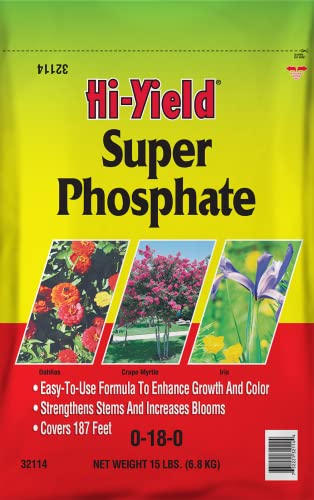
The targeted phosphorus push for bigger blooms and stronger root systems.
This isn’t a complete fertilizer — it’s a specialist. With a 0-18-0 analysis, it delivers 18% phosphate derived from Super Phosphate, a readily available form plants use during photosynthesis. If your shrubs are leafy but stingy with blooms, this is the supplement that pushes flowers and fruit.
Reviewers point out a clear “uptick in blooms on both my vegetable and wildflower plants.” One gardener saw record harvests in year two — stalks larger than normal, plants over 6 feet tall, and almost 100 pounds harvested from 9 plants. The 15-pound bag covers serious ground for trees, shrubs, and vegetables.
The catch is that it’s not a stand-alone feed. You’ll pair it with a balanced fertilizer since it has zero nitrogen and zero potassium. And it will stain concrete, so keep it off hardscapes. For serious gardeners targeting root development and flowering, this is the precision tool.
The strong point: concentrated phosphorus for root strength and flowering — the thing most balanced feeds lack.
The caution: stains concrete, so apply away from patios and walkways.
Use this if: your shrubs need a bloom and root boost and you already feed a balanced formula.
Not for: anyone wanting a complete one-bag feed — this is a supplement.
8. The Old Farmer’s Almanac Tree & Shrub Fertilizer Spikes
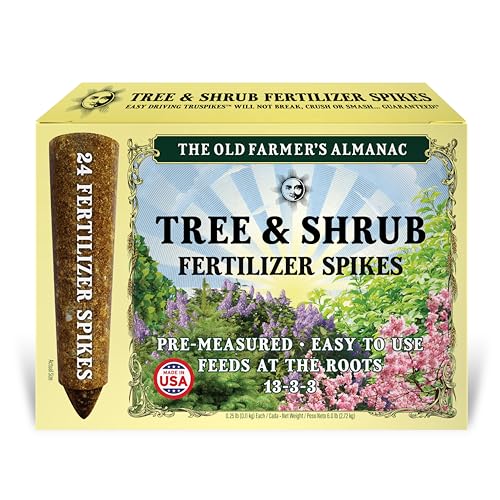
The 5-inch spike that stays intact in clay soil and feeds for a full season.
This box of 24 spikes takes the spike concept further. The 5-inch TruSpikes are packed with a nutrient-rich 13-3-3 formula — 13% nitrogen for growth and color, 3% phosphorus for blooms, and 3% potassium for strong roots. They’re engineered to be hammered in with no cap required, and they won’t break, crush, or shatter.
The durability is the headline. Buyers hammer them into clay soil with a mallet and they stay intact — a genuine advantage over flimsier spikes. One owner fertilized a Japanese Stewartia and a fountain beech; the Stewartia produced more flowers than ever, and the beech filled out with leaves sooner. After a hurricane, another saw trees green up nicely.
The natural ingredients, like molasses, release nutrition directly into the root zone. Feed once per season in early spring and late fall for continuous fertilization. The main friction point is hard soil — some owners pre-dig holes for best results, as driving spikes into packed clay takes effort. The 6-pound box is the premium spike option for serious tree and shrub care.
The edge: the toughness — these spikes hold up in clay where cheaper ones crumble.
The reality: pre-dig holes in hard soil; it makes installation far easier.
Best for: tree and shrub owners with tough soil who want a durable, long-lasting spike.
Consider another if: you want the lowest-effort install — softer spikes go in quicker in loose soil.
Understanding the Specs
The N-P-K Ratio
The three numbers on every bag stand for nitrogen, phosphorus, and potassium — in that order. Nitrogen drives leafy green growth, which is why formulas like Alaska’s 5-1-1 and Jobe’s 16-4-4 are high on the first number. Phosphorus supports roots and blooms, which is why the Hi-Yield 0-18-0 is all middle number. Potassium keeps the whole plant healthy and disease-resistant.
OMRI Listed
When a fertilizer is OMRI-listed, it means the product meets the standards for organic production and contains no synthetic chemicals. This matters if you garden organically or want to avoid chemical runoff. The Alaska liquid, Espoma granules, and Jobe’s Organics all carry this certification — a strong signal of natural, earth-friendly ingredients.
FAQ
How often should I feed my shrubs?
What does the N-P-K ratio mean for my shrubs?
What’s the difference between liquid and granular fertilizer?
How do I use fertilizer spikes on my shrubs?
What’s the best fertilizer for hydrangeas and azaleas?
Can I use an all-purpose fertilizer on my shrubs?
Why does my organic fertilizer smell so bad?
What is 0-18-0 fertilizer used for?
Final Thoughts: The Verdict
For most gardeners, the plant food for shrubs winner is the Alaska Fish Fertilizer because it delivers fast, visible organic green-up with the backing of the strongest owner enthusiasm — a 4.7-star crowd favorite. If you want set-and-forget feeding with no smell, grab the Jobe’s Spikes for a season of steady nutrition. And for the hydrangea and azalea crowd, the Espoma Holly-Tone is the one to reach for.
How We Picked
We do not accept paid placement. Every pick is matched to a real buyer and a real use-case; we do not hands-on test units.
Sources & Methodology
Specifications: manufacturer listings and product documentation. Review insights: verified customer reviews, as of August 2026. Pricing: not shown on this page (it changes often); check the current price via the retailer link.
As an Amazon Associate, Lawn Gear Lab earns from qualifying purchases. This does not affect which products we feature.