
Your Monstera’s iconic split leaves and deep green color don’t happen by accident — they demand a specific balance of nitrogen, phosphorus, and potassium that generic all-purpose blends rarely deliver. Without the right NPK ratio, you get leggy stems, pale foliage, and a plant that refuses to fenestrate no matter how much light it gets.
I’m Rikta — the co-founder and writer behind Lawn Gear Lab. I spend countless hours analyzing fertilizer chemistries, comparing micronutrient profiles, and cross-referencing owner results to identify which formulas actually deliver the large, glossy leaves and structural root strength serious Monstera collectors expect.
Whether you’re rehabbing a yellowing Deliciosa or pushing an Adansonii toward its first mature split, the right formula makes the difference between a surviving plant and a thriving centerpiece. This guide breaks down the plant food for monstera options that deliver measurable results without guesswork.
How To Choose The Best Plant Food For Monstera
Monstera varieties — Deliciosa, Adansonii, Obliqua — share a tropical epiphytic heritage that demands higher nitrogen for leaf mass and sufficient potassium for structural strength and root anchorage. A low-phosphorus formula (the middle NPK number) prevents salt buildup in potting mixes and mimics the natural nutrient profile these plants evolved under. Here is what to prioritize when scanning the label.
Understand the NPK Ratio That Matches Monstera Physiology
Look for a nitrogen-dominant ratio near 3-1-2 or 5-2-3. Nitrogen fuels chlorophyll production and leaf expansion, while potassium drives cell wall integrity and root vigor. Phosphorus should be the smallest number — Monstera roots are sensitive to excess phosphate, which can lock out calcium and magnesium over time. A ratio like 6-2-4 or 5-2-3 delivers the right balance for pushing new leaves without burning tender root tips.
Choose a Form That Fits Your Watering Routine
Liquid concentrates dissolve instantly and allow you to adjust dosage per watering based on the plant’s growth phase — ideal for collectors who feed weekly during spring and summer. Water-soluble powders offer the largest coverage per dollar but require precise measuring and can leave residue if not fully dissolved. Self-dissolving tablets remove all measuring guesswork but limit flexibility if your plant needs a stronger or weaker dose during recovery.
Evaluate Organic vs Synthetic Formulations
Organic formulas derived from fermented plant extracts or mineral sources release nutrients more slowly and are gentler on soil microbiology, reducing the risk of chemical burn in small pots. Synthetic formulas deliver immediate uptake and are better for correcting acute nutrient deficiencies, but demand strict adherence to dilution rates. For Monstera kept in chunky aroid mixes, a gentle organic liquid with low salt index often produces the most consistent fenestration.
Quick Comparison
On smaller screens, swipe sideways to see the full table.
| Model | Category | Best For | Key Spec | Amazon |
|---|---|---|---|---|
| Houseplant Resource Center Monstera Food | Premium Monstera-Specific | Fenestrated leaves & root strength | 5-2-3 NPK, Chelated | Amazon |
| HiThrive Monstera Plant Food | Monstera-Specific Liquid | Value per gallon & beginner ease | 6-2-4 NPK, 96 Gal Coverage | Amazon |
| Espoma Organic Indoor Plant Food | Organic Liquid | Pet-safe organic feeding | Organic, 2-Pack, 8 oz | Amazon |
| EZ-Gro Liquid Monstera Food | Professional Concentrate | Soil pH regulation | 3:1:2 Ratio, Acidic | Amazon |
| Instant Biologics Tablets | Tablet | No-mess, pre-portioned feeding | 4-3-6 NPK, 4 Tablets | Amazon |
| Miracle-Gro All Purpose | Water-Soluble Powder | High-volume multi-plant feeding | 24-8-6 NPK, 3 lbs | Amazon |
| Lush Leaf Plant Food | Indoor Liquid Concentrate | Rescue & revival feeding | Liquid, 8 oz Concentrate | Amazon |
In‑Depth Reviews
1. Houseplant Resource Center Monstera Plant Food
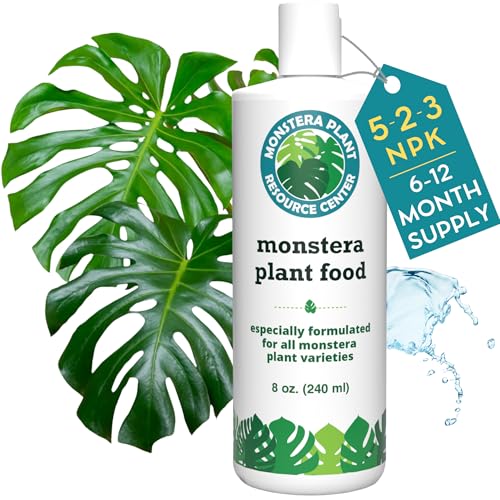
This 5-2-3 NPK liquid formula from a family-run plant science company is the closest you can get to a tailored Monstera diet without custom-mixing your own salts. The nitrogen front-loads chlorophyll production for deep green leaves, while the chelated delivery system ensures phosphorous and potassium reach the root zone without precipitating out in hard tap water — a common problem in urban apartments with alkaline supply.
Users consistently report that a single season of weekly 1-tsp-per-quart feedings transforms slow-growing Deliciosa and Adansonii into plants that throw larger, more frequent fenestrated leaves. The formula is mild enough to avoid leaf-edge burn even on sensitive Thai Constellation and Albo Borsigiana cuttings, which is rare in the mid-range market. Each 8-ounce bottle stretches to about 16 gallons at standard dilution, making the per-feeding cost competitive despite the higher upfront price.
The only friction point is the labeling — the instructions say “at least 2 cups” per teaspoon, which leaves some users unsure whether they should adjust for pot size. Most experienced growers settle on 1 teaspoon per quart for consistent results, and once that ratio is dialed in, the growth response is reliably visible within two weeks.
What works
- Precise 5-2-3 ratio matches Monstera’s natural nitrogen demand
- Chelated nutrients prevent lockout in hard water
- Gentle enough for rare variegated cultivars without burn
- Concentrated formula offers strong per-ounce value
What doesn’t
- Dilution instructions are ambiguous for new growers
- Higher price point than generic all-purpose blends
2. HiThrive 16oz Monstera Plant Food
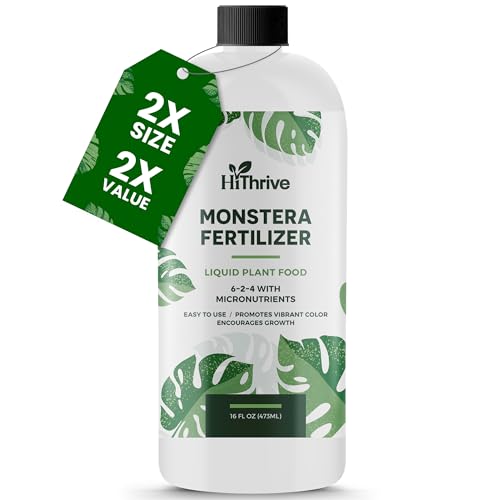
The HiThrive formulation delivers a 6-2-4 NPK profile that mirrors the growth-stage demands of mature Monstera with an emphasis on potassium for climbing stem strength — a trait often neglected in all-purpose houseplant fertilizers. The liquid concentrate is suspension-stable, meaning you don’t have to shake aggressively before each use, and it mixes clear with no sediment that could clog fine-nozzle watering cans.
The 16-ounce bottle makes a whopping 96 gallons at the standard feed rate of 1 teaspoon per gallon, making it one of the lowest cost-per-gallon options in the Monstera-specific category. Owner reports from central Florida growers highlight that the formula revived outdoor Monstera after a hard winter freeze, pushing new green growth within two weeks. The absence of artificial dyes keeps the solution clear, so you won’t stain terracotta pots or light-colored saucers.
Some users note that the bottle’s cap-dosing system (half cap = 1 teaspoon) is convenient but can drip if over-tightened. The scent is neutral — no fishy or manure notes — which makes it comfortable for indoor kitchen or living room application. For growers managing multiple aroids on a budget, this stretches further than almost any competitor.
What works
- 96 gallons per bottle delivers exceptional volume per dollar
- Potassium-heavy ratio supports climbing habit and stem thickness
- Clear mixing with no staining residue
- No perceptible odor during indoor application
What doesn’t
- Cap can drip if not seated perfectly after pouring
- Nitrogen level slightly high for winter dormancy feeding
3. Espoma Organic Indoor Plant Food (2-Pack)

Espoma’s organic liquid is built on a fermented base that feeds soil microbes alongside the plant itself — critical for Monstera kept in chunky, bark-heavy aroid mixes where microbial activity drives nutrient cycling. The 2-pack gives you two 8-ounce bottles, effectively doubling the feeding cycle without a second purchase. The NPK profile is balanced toward gentle maintenance rather than aggressive growth, making it a strong choice for growers who prefer slow, steady development over forced leaf flushes.
Users over 70 years of experience with the brand consistently call this the most reliable organic option for indoor tropicals, noting that the manure-like odor dissipates within minutes of soil drenching — not a dealbreaker for most, but worth knowing if you’re feeding in a closed office. The “less is more” principle applies here: half a cap per quart every two to four weeks maintains dark foliage without salt buildup, even in pots without drainage holes.
The organic certification means this is safe around curious pets and toddlers, which is a primary concern for many indoor gardeners. The downside is that organic liquids are less effective for correcting acute nitrogen deficiencies compared to synthetic concentrates — this is a maintenance tool, not a rescue remedy. For establishing a sustainable feeding rhythm, it performs reliably.
What works
- Organic formulation supports soil microbiology in aroid mixes
- Pet-safe and child-safe when used as directed
- Two-bottle pack extends run time between replacements
- Gentle enough for every-watering use during growing season
What doesn’t
- Manure-like odor noticeable during mixing
- Organic release is too slow for rapid deficiency correction
4. EZ-Gro Professional Liquid Monstera Plant Food
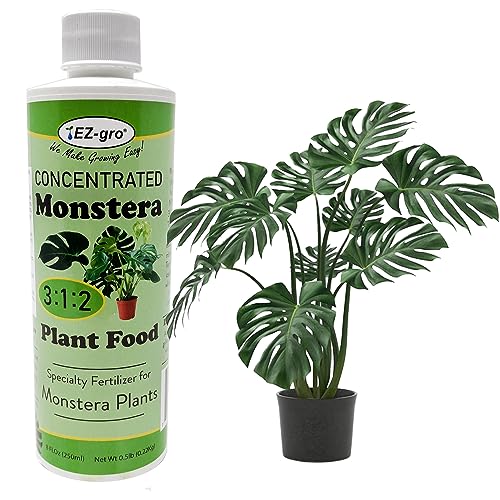
Founded by agronomist Ray DeBruhl, EZ-Gro brings a professional greenhouse background to the consumer market with a 3:1:2 ratio that emphasizes nitrogen for leaf mass while keeping phosphorus intentionally low. The formula’s acidity actively helps lower soil pH when used with alkaline tap water — a hidden advantage for Monstera growers battling chlorosis from high-pH irrigation. An 8-ounce bottle mixes into about 4 gallons at the recommended 2-tablespoon-per-gallon rate.
The liquid concentrate is crystal-clear after mixing and leaves no salt crust on the soil surface, even after repeated weekly applications. Users report that fussy plants like fiddle leaf fig and snake plant also respond positively, confirming the formula’s versatility beyond just Monstera. The dosing is straightforward: one capful per half gallon every other watering during active growth keeps foliage dark and stems firm.
The main consideration here is the smaller bottle size — 8 ounces at 2 tablespoons per gallon means you’ll reorder more frequently than with the HiThrive or Miracle-Gro options. For single-plant households, this is manageable; for a full collection of aroids, the cost per feeding adds up. Still, the pH-buffering benefit alone justifies the premium for growers with consistently hard tap water.
What works
- Low pH formula counteracts alkaline tap water chlorosis
- 3:1:2 ratio is scientifically matched to tropical foliage needs
- Clear mixing with zero salt residue on soil
- Developed by a professional agronomist with greenhouse credentials
What doesn’t
- Small bottle requires more frequent reordering for large collections
- Higher per-ounce cost compared to bulk powder options
5. Instant Biologics Houseplant Fertilizer Tablets
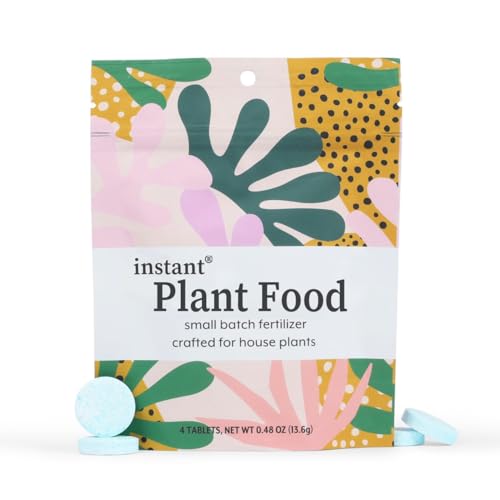
These self-dissolving tablets eliminate the two biggest friction points in liquid feeding: measuring and mixing. Drop one tablet into a standard watering can, let it effervesce for about a minute, and you have a fully dissolved 4-3-6 NPK solution. The formula skews slightly higher in potassium than typical houseplant blends, which supports the structural stems and root vigor Monstera needs as it climbs — particularly useful for Adansonii and Deliciosa staked on moss poles.
Each tablet feeds a large Monstera or several smaller plants for up to three months at the recommended monthly schedule, making this a set-and-forget solution for plant parents who travel or prefer low-maintenance care. The ingredients are derived from naturally occurring minerals and a live fermentation process, placing this in the naturally sourced category rather than fully synthetic. Certified vegan and cruelty-free, with 1% of sales going to environmental organizations.
The limitation is lack of dosage flexibility — you cannot easily adjust the strength for a plant in recovery or one that needs a stronger push during active growth. The 4-tablet pack covers roughly four months for a single large Monstera before you need to reorder. For growers who want absolute precision dialed in per watering, a liquid concentrate remains the better tool.
What works
- Zero measuring or mixing required — drop and water
- High potassium content supports climbing stem development
- Naturally sourced minerals reduce chemical burn risk
- Portable and travel-friendly for irregular feeding schedules
What doesn’t
- Fixed dose prevents custom strength adjustment
- Only 4 tablets per pack — frequent reordering needed
6. Miracle-Gro All Purpose Plant Food

The 3-pound water-soluble powder of Miracle-Gro’s classic 24-8-6 formulation covers about 1,200 square feet of garden area — an absurd amount of feeding power for the price. While the NPK ratio is far more aggressive than what Monstera specifically needs, experienced growers can use it effectively by diluting to half or quarter strength (approximately 1/4 teaspoon per gallon instead of the label’s 1/2 teaspoon for indoor feeding). The chelated iron and five trace elements address common micronutrient gaps in potting mixes.
The powder dissolves rapidly in lukewarm water with minimal stirring, though it does produce a blue tint that can stain light colored pots if splashed. Users report visible greening within a week on nitrogen-starved plants, and the 3-pound box will outlast a year of weekly feeding for a multi-plant household. The main risk is over-application — the high nitrogen formulation can push excessive soft growth at the expense of fenestration if used at full strength on Monstera.
For growers managing a mixed collection of houseplants and outdoor containers, this is the most cost-effective single product to have on the shelf. Just be prepared to mentally halve the recommended indoor dosage and monitor for salt buildup in pots without drainage. The blue staining on hands and clothing is a minor but consistent annoyance.
What works
- Massive coverage volume per dollar — best cost per feeding
- Fast-acting nitrogen greens pale leaves within days
- Contains chelated iron plus five trace micronutrients
- Works across all plant types for mixed-collection households
What doesn’t
- Full-strength NPK is too aggressive for Monstera without dilution
- Blue powder stains hands, clothing, and terra cotta pots
- Fine powder can blow in wind during outdoor mixing
7. Lush Leaf Plant Food (Monstera)
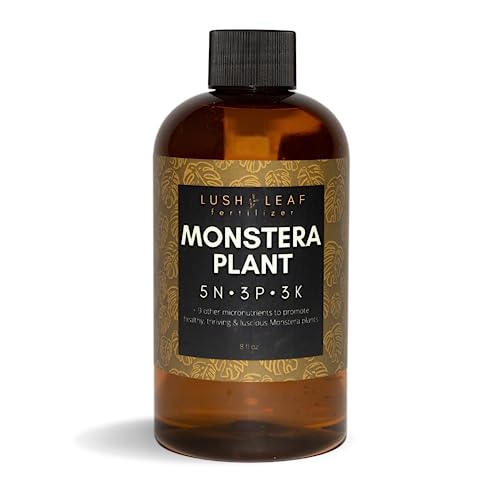
Lush Leaf’s liquid concentrate is marketed broadly for indoor plants but its formulation is specifically weighted toward root development and leaf vibrancy, making it a strong choice for Monstera that have suffered transplant shock, root restriction, or pest stress. The liquid is suspension-stable and mixes with a mild earthy scent that users describe as subtle rather than overpowering — a plus for indoor application in living spaces. An 8-ounce bottle at the recommended half-capful dose stretches longer than the small package suggests.
Owner reports frequently mention that the formula revived struggling plants within two weeks, with new growth appearing faster than on the same plant before treatment. The balanced nutrient profile is gentle enough for sensitive species like fiddle leaf fig and calathea, confirming that the formulation avoids the burn risks of high-salt synthetics. The packaging is minimalist and attractive, which matters for growers who keep their fertilizer on open shelves.
The trade-off is that this is not optimized specifically for Monstera’s fenestration needs — it’s a general indoor plant tonic that works well rather than a targeted aroid formula. Growers chasing maximum split-leaf development may get faster results from a Monstera-specific ratio like the Houseplant Resource Center or HiThrive options. For general maintenance and revival, it performs without drama.
What works
- Gentle formulation is safe for stressed or recovering plants
- Mild earthy scent is pleasant and fades quickly after watering
- Effective on a broad range of indoor tropicals beyond Monstera
- Concentrated bottle lasts longer than 8-ounce volume suggests
What doesn’t
- Not specifically formulated to push fenestration in Monstera
- Higher per-ounce cost than bulk powder alternatives
Hardware & Specs Guide
NPK Ratio Interpretation
The three numbers on every fertilizer label represent Nitrogen (leaf growth), Phosphorus (root and bloom development), and Potassium (overall health and stem strength). For Monstera, the ideal profile is nitrogen-dominant with phosphorus as the smallest number — ratios like 5-2-3, 6-2-4, or 3-1-2. High-phosphorus formulas (middle number over 5) can accumulate in potting soil and block calcium uptake, leading to curled new leaves and brown tips. Always check the middle number before buying.
Liquid vs Water-Soluble Powder vs Tablets
Liquid concentrates offer the fastest absorption and easiest dose adjustment — you can vary strength from week to week based on leaf color and growth rate. Water-soluble powders like Miracle-Gro provide the lowest cost per gallon but require pre-dissolving and can settle out of solution if not used immediately. Self-dissolving tablets remove all mixing steps but lock you into a fixed dose. For a single Monstera, a liquid concentrate gives you the most control with the least waste.
Dosage and Frequency Guidelines
Monstera is a moderate feeder during its active growing season (spring through early fall). Most liquid concentrates recommend 1 teaspoon per gallon of water every 7 to 14 days during this period. In winter, when light levels drop and growth slows, reduce feeding to once a month or stop entirely to prevent salt accumulation. Start at half the recommended strength for the first two applications to gauge your plant’s response, especially if your potting mix already contains slow-release fertilizer.
Signs of Over-Fertilization in Monstera
Brown leaf edges with yellow halos, white crust on the soil surface, and sudden leaf drop are classic symptoms of excess salts from over-feeding. If you see these signs, flush the pot thoroughly with distilled or rain water — run at least three times the pot volume through the soil — and skip feeding for at least four weeks. Monstera with root damage from over-fertilization often produce smaller, distorted new leaves that lack fenestration even after recovery. Always err on the side of under-feeding when in doubt.
FAQ
How often should I feed my Monstera during winter dormancy?
Can I use cactus fertilizer on my Monstera?
What does it mean when my Monstera leaves are yellowing despite regular feeding?
Is organic or synthetic fertilizer better for Monstera fenestration?
Should I feed my Monstera right after repotting?
Final Thoughts: The Verdict
For most gardeners, the plant food for monstera winner is the Houseplant Resource Center Monstera Plant Food because its 5-2-3 NPK ratio delivers the nitrogen punch needed for large, fenestrated leaves while keeping phosphorus low enough to avoid root salt stress in aroid mixes. If you want maximum value per gallon for a multi-plant collection, grab the HiThrive Monstera Plant Food — 96 gallons of 6-2-4 formula at a fraction of the cost of boutique bottles. And for pet-safe organic feeding that supports soil health in chunky bark mixes, nothing beats the Espoma Organic Indoor Plant Food 2-Pack.