
Specs are compiled from manufacturer listings and verified buyer reviews and can change over time — please confirm the key details on the product page before buying.
Walk down any garden path and you spot them — the one house on the block where every flower head is a showstopper, the window box that looks like it belongs on a magazine cover. It is the NPK ratio on the back of a bag. The right plant food for flowers feeds the bloom cycle directly, not just the leaves. Most general-purpose fertilizers are built for stems and greenery, pushing your plants tall but flower-starved. You need a formula that is deliberately heavy on phosphorus (the middle number) and light on nitrogen (the first number) to signal to your plants that it is time to put on a display. This is the shortcut that experienced growers use and everyone else misses.
I’m Rikta — the founder and writer behind Lawn Gear Lab. This guide is built by comparing the manufacturers’ published specifications and the patterns across verified customer reviews, so you get each pick’s real strengths and trade-offs instead of marketing spin.
Whether you are coaxing a stubborn orchid into reblooming or turning a patch of annuals into a neighborhood spectacle, the right NPK ratio makes every drop of water count. These nine picks represent the current best plant food for flowers across every feeding style and budget, ranked by the real-world results that buyers report back season after season.
Our Picks at a Glance


How To Choose The Best Plant Food For Flowers
Picking the right flower food starts with ignoring the pretty label on the front and reading the three hyphenated numbers on the back. Every fertilizer label carries a three-digit NPK ratio — nitrogen (N), phosphorus (P), and potassium (K). Nitrogen drives green leafy growth, phosphorus boosts root and flower development, and potassium strengthens the plant overall. For flowers, you want a middle number (phosphorus) that is noticeably higher than the first number (nitrogen). A ratio like 10-54-10 tells your plant to stop making leaves and start making petals.
Powder vs. Liquid vs. Granules
Powdered concentrates dissolve in water and let you dose exactly what each watering can needs. They cost less per application and store easily. Liquids skip the mixing step — you pour a capful into your watering can and go — but they cost more per ounce and weigh more. Granules are set-and-forget: you sprinkle them into the soil every few weeks and let rain or regular watering activate them. Each form works; the right one depends on how hands-on you want to be with each feeding.
Organic vs. Synthetic
Synthetic formulas are fast and precise — the nutrients are already broken down and available the moment you water. You see results in days. Organic options, like fish emulsion or compost extracts, feed the soil microbes first, and those microbes release nutrients to the roots more gradually over weeks. The trade-off is a slower start, richer long-term soil health, and — with fish-based products — a strong smell that lingers for a day after application.
Quick Comparison
| Model | Best For | NPK Ratio | Form | Weight | Amazon |
|---|---|---|---|---|---|
| Carl Pool BR-61★ Best Overall | Maximum bloom production | 9-58-8 | Powder | 3 lbs | Amazon |
| Gardenwise 20-20-20Best Value | All-purpose feeding | 20-20-20 | Powder | 1 lb | Amazon |
| Schultz Bloom PlusTop Performer | Big, dramatic blooms | 10-54-10 | Powder | 1.5 lb | Amazon |
| Jack’s Classic Blossom Booster | Orchids and potted blooms | 10-30-20 | Powder | 8 oz | Amazon |
| Espoma Organic Orchid! | Organic orchid care | N/A (liquid) | Liquid | 16 fl oz (pack of 2) | Amazon |
| Miracle-Gro Performance Organics | Quick organic results | 5-7-10 | Granules | 2.5 lbs | Amazon |
| Great Big Roses and Flowers | Reviving tired rose bushes | N/A (liquid) | Liquid | 32 fl oz | Amazon |
| Alaska Fish Fertilizer | Organic all-purpose feeding | 5-1-1 | Liquid | 115 fl oz | Amazon |
| The Grow Co Organic Fish | Large-scale organic gardening | 2-3-1 | Liquid | 128 fl oz | Amazon |
In‑Depth Reviews
1. Carl Pool BR-61 Plant Food 9-58-8 3 Lbs
Our pick — over 4.5★ from 900+ verified ratings; the strongest balance of quality and price.
The bloom booster that makes even the shyest flowering plants go all out.
This is the powder the crowd backs — it holds the highest rating and the most glowing consensus in the category. The NPK ratio of 9-58-8 is a deliberate punch of phosphorus that tells your plants to stop leafing and start flowering. You mix one tablespoon per gallon of water and apply it regularly. The 3-pound bag covers a lot of ground, and owners mention that the difference shows up fast: plants that had been lagging suddenly throw blooms like they never did before. One long-time buyer says this product has made their flowering plants “grow like they never did before,” a sentiment that echoes across hundreds of reviews.
What makes this pick stand out is the sheer volume of praise around quality and bloom growth — those two patterns dominate the owner feedback overwhelmingly. People who have used other bloom boosters for years switch to this one and don’t look back. The powder dissolves cleanly, and the 48-ounce bag lasts a full season for most gardens.
The only honest hesitation is that this powder is a bloom specialist. It is not a general-purpose feed. If your plants also need a leaf-and-stem boost or you are growing heavy feeders like tomatoes that want a more balanced ratio, you might want to rotate in a different formula every few weeks. But for pure flower production, this is the one that earns the top spot.
What wins people over
- Extremely high phosphorus (58) drives abundant, visible blooms
- Large 3-pound bag outlasts smaller containers from competitors like Jack’s Classic (8 oz)
- Simple mixing — 1 tablespoon per gallon, no guessing
The trade-off
- Heavy phosphorus means it is less suited for leafy greens or plants needing balanced nutrition
- Powder form requires a separate mixing step at each watering
Who this wins for: Anyone with flowering annuals, perennials, or potted bloomers who wants the highest-rated formula backed by the strongest owner consensus.
skip it if: You need one feed for everything — this is a specialist, not an all-purpose.
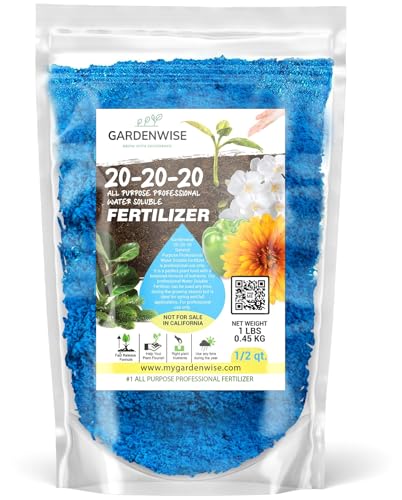
2. Gardenwise 20-20-20 Water-Soluble Fertilizer 1/2 Quart (1 lb)
One bag that feeds everything from the orchid pot to the vegetable bed.
If you are the kind of gardener who has a mix of houseplants, outdoor flowers, and a few vegetable containers, a balanced 20-20-20 formula is the smartest single purchase you can make. This one dissolves instantly in water — owners consistently note how well it dissolves “no problem” — and the 1-pound bag is small enough to tuck into a cabinet but concentrated enough to last. The versatility is the headline: you use half a teaspoon per gallon for indoor plants and a full tablespoon per gallon for outdoor ones, so one bag covers every pot and bed.
The owner feedback leans heavily on effectiveness and plant health, with many reporting noticeable new leaves and unfurling growth within days of the first feeding. The resealable Ziploc-style bag is a small detail that owners genuinely appreciate — it keeps the powder dry and clump-free between uses. One review captured the value well: “outperforms viral TikTok plant food. Noticeable growth in days.”
The catch is that a balanced 20-20-20 is not a dedicated bloom booster. While it supports flowers, it also pushes leaf growth equally. For a plant that is stubbornly refusing to flower, a higher-phosphorus formula like the Carl Pool above would be a sharper tool. But for mixed gardens, this is the most cost-effective single solution.
Why it earns a spot
- Balanced 20-20-20 ratio works for indoor plants, flowers, vegetables, and lawns alike
- Dissolves quickly with no residue left in the watering can
- Two dosing levels (indoor vs. outdoor) give you total control
The compromise
- Equal NPK means it is not a dedicated bloom booster — flowers share nutrients with leaves
- 1-pound bag runs out faster than larger options if you have a big garden
Reach for this if: You have a mix of plants and want one bag that does everything without needing separate formulas.
Look elsewhere if: You only care about maximizing flower production and do not mind buying a specialist.
3. Schultz Bloom Plus Water Soluble Plant Food 10-54-10, 1.5-Pound
The formulation that keeps Christmas cactuses blooming all winter long.
Schultz Bloom Plus carries a 10-54-10 ratio — again that enormous middle number — and it shows in the results owners describe. The brand uses a slow-release approach where nutrients dissolve evenly into the soil every time it rains or you water, so you are not chasing the plant with constant reapplications. Owners have used this for years and report that their flowers are “the envy of the neighborhood.” Christmas cactus owners, in particular, swear by it: one owner says their cactuses “LOVE IT” and all their house plants grow “extremely well” and bloom great.
The 1.5-pound bag is heavier than the Jack’s Classic option (which is 8 oz) and gives you more feedings per purchase. Owners consistently call out effectiveness and bloom quality as the standout traits, and the formula includes micronutrients that support overall plant health beyond just the NPK push. One buyer who has used this for years says their flowers “always look fabulous.”
The main caution from owners is that this is not suitable for bushes, trees, or cactus. Stick to flowering plants, vegetables, and houseplants. A few owners also note that the delivery packaging could be better — an occasional bag arrives with a tear, so inspect it on arrival.
Its strengths
- 10-54-10 ratio is tune for big, continuous blooms
- Concentrated formula includes vital micronutrients for overall plant health
- 2.0x heavier than Jack’s Classic 8 oz — more feedings per purchase
Heads up
- Not formulated for bushes, trees, or cactus despite some owner success
- Occasional packaging damage during delivery reported
The fit: Flower gardeners who want a proven bloom booster with a track record of year-round performance, especially for winter-blooming houseplants.
Not the pick if: You need a single feed for an entire landscape including trees and shrubs.
4. Jack’s Classic 10-30-20 Blossom Booster Water-Soluble Fertilizer, 8oz
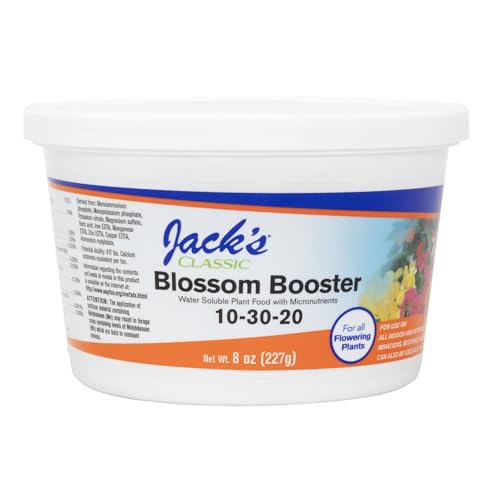
The small tub that punches way above its weight for flowering plants.
Jack’s Classic Blossom Booster uses a 10-30-20 ratio — a bit less phosphorus than the top two picks, but still clearly skewed toward bloom production. This is a favorite among orchid owners, who report that it works within days and keeps flowers blooming all summer. The powder comes with a measuring spoon inside the tub, which is a small but meaningful convenience — you do not have to hunt for a teaspoon. You can use it as a root drench or spray it directly onto the leaves as a foliar feed, giving you two delivery methods in one product.
Owners are clear that the effectiveness and bloom quality are excellent. Hydrangea and lilac growers report noticeable results. One owner called it “the best I have ever used” and noted their flowers had beautiful blooms. The micronutrients included mean you do not need to supplement with additional feedings.
The honest caveat is the container size. The 8-ounce tub is small — one owner describes it as a “sample size” and says the whole tub might fill a watering can only about 10 times for an outdoor flower bed. If you have a large garden, you will go through this fast. It is best suited for a small collection of potted flowering plants or a few prized orchids where precision matters more than volume.
What makes it special
- Works as both a root drench and a foliar spray for flexible feeding
- Convenient measuring spoon included in every tub
- Added micronutrients eliminate the need for extra supplements
The size reality
- 8 oz container is small — expect about 10 watering can fills for outdoor use
- Value for money is a mixed point among owners
Best for: Orchid enthusiasts and collectors of potted flowering plants who want a proven formula in a compact, precise-dosing package.
Think twice if: You have large flower beds that require gallons of mixed feed each time.
5. Espoma Organic Orchid! 8-Ounce Concentrated Plant Food, Pack of 2

The liquid that turns a stubborn orchid into a bloom machine.
Orchids have unique needs that standard flower food does not satisfy, and Espoma built this specifically for them — as well as bromeliads. It is an organic liquid formula, which means no granules to dissolve and no waiting for the soil microbes to break things down. You simply add half a capful to a quart of water and water your orchid every two to four weeks. Customers note that orchids that had not bloomed in years suddenly produce 12 blooms on a single spike. The pack contains two 8-ounce bottles, giving you a full season of feedings for a typical collection.
This is made in the USA by a company that has been in the organic gardening space since 1929, so the formulation is backed by decades of refinement. Owners consistently praise how easy it is — there is no mixing spoon, no measuring scale. Just the cap. The brand claims it is safe around kids and pets, which adds confidence for indoor orchid growers.
The consistent honesty in the owner feedback is that this product has a noticeable odor. If you are sensitive to smells or plan to use it indoors, the organic base has a natural earthy-fishy scent that some find objectionable. A few owners mention it outright, so it is worth ventilating the room after feeding.
Why orchids love it
- Organic liquid formula is specifically formulated for orchids and bromeliads
- Easy cap-based dosing — half a cap per quart of water
- Pack of two bottles gives a full season of feeding for most collections
What to know
- Noticeable odor is a recurring point — use in a ventilated area
- Not suitable for general garden flowers or vegetables
Grab this for: Orchid owners who want an organic, easy-to-use liquid that produces visible bloom results without complex mixing.
pass on it if: You dislike any organic smell in your living space or grow mixed garden flowers.
6. Miracle-Gro Performance Organics Blooms Plant Nutrition Granules, 2.5 lbs
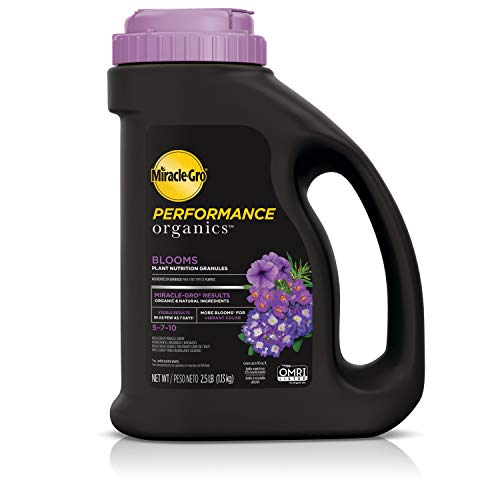
The set-and-forget organic feed that delivers visible blooms in under two weeks.
Not everyone wants to mix a powder every time they water. For those who prefer a more hands-off approach, this is the answer. These granules are OMRI-listed for organic use, so they meet organic gardening standards, and you simply sprinkle them into the soil around your flowering plants. The 5-7-10 ratio is still tilted toward bloom production (the middle number is higher than the first), though not as aggressively as the top bloom boosters. You reapply every four to six weeks, and each 2.5-pound bag covers up to 165 square feet of garden space.
Reviewers point out that this stuff works within one to two weeks, producing “ginormous blooms” on everything from butterfly bushes to Black-Eyed Susans. One owner said it turned a slow Mandevilla into a showpiece where “the blooms really popped.” The organic and natural ingredients appeal to gardeners who want to avoid synthetic chemicals but still want the reliability of the Miracle-Gro brand.
The trade-off is a lower phosphorus punch compared to the dedicated bloom boosters above. If you have a plant that absolutely refuses to flower, a powder with a phosphorus number in the 50s would be a stronger intervention. Also, a few owners note that the paper seal under the lid can be loose, so check the bottle when it arrives.
Why it stands out
- OMRI-listed for organic gardening — meets organic standards
- Granules are a true set-and-forget application, no mixing required
- Covers up to 165 sq. ft. per bag, making it efficient for larger beds
Weaknesses
- 5-7-10 ratio is milder than specialist bloom boosters
- Occasional packaging issues reported with the inner seal
Go here if: You want an organic, low-maintenance granular feed that handles a whole flower bed with minimal effort.
Not if: You need maximum phosphorus to force blooms from a very stubborn plant.
7. Great Big Roses and Flowers Liquid Fertilizer Booster, 32 Ounce
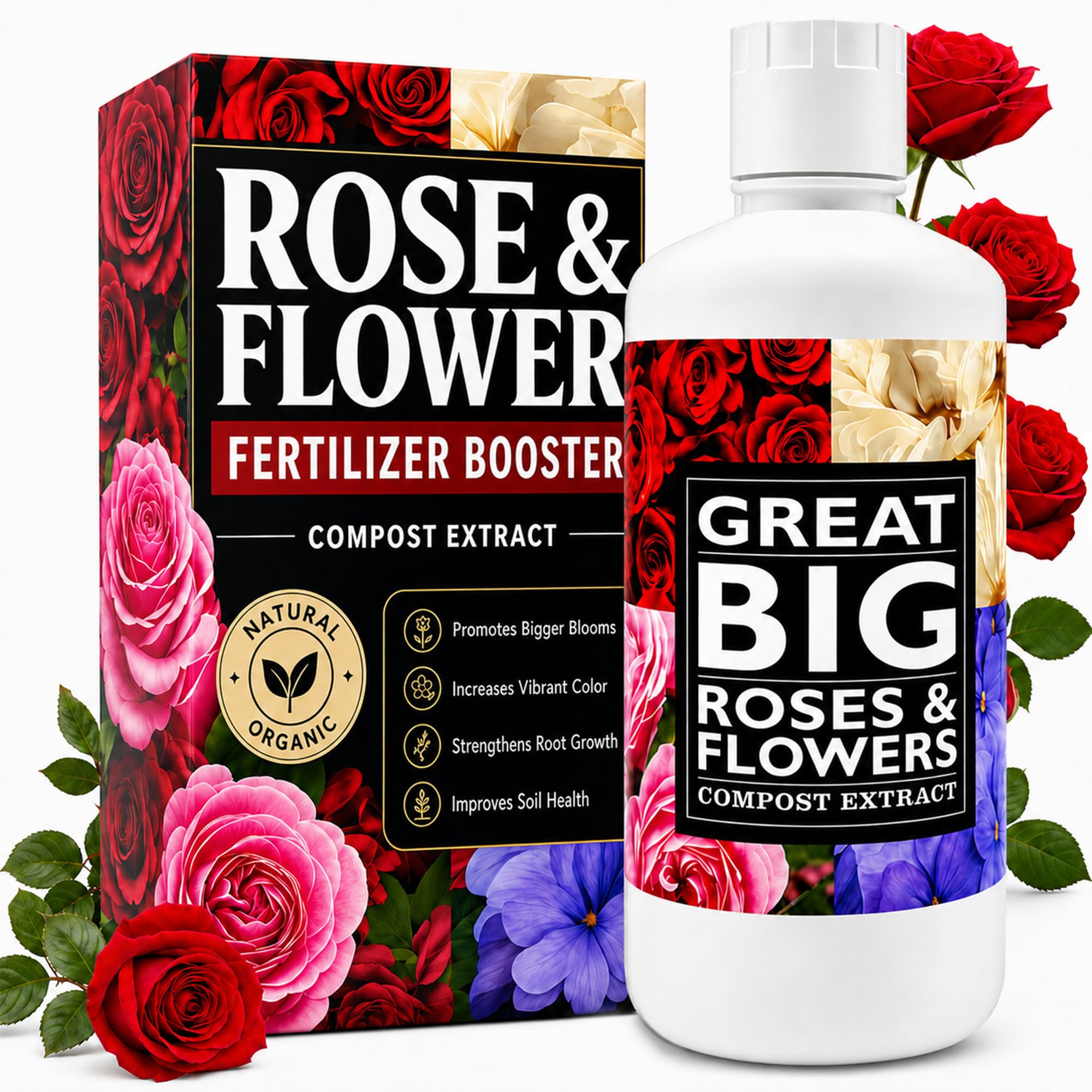
The soil activator that resurrects rose bushes that have not bloomed in years.
This is not a fertilizer in the traditional sense — it is a booster that activates nutrients already in your soil. The formula delivers humic acids, seaweed, and over 70 chelated trace minerals into the root zone. It works alongside whatever fertilizer you already use (fish emulsion, bone meal, worm castings) to open up those nutrients and make them plant-available. The result, shoppers say, is dramatic: rose bushes that had not produced a single bloom in years suddenly put out “big, beautiful flowers” within weeks. One owner noted blooms after a harsh winter that were “abundant and large.”
You mix 4 ounces of the liquid concentrate with a gallon of water and pour it around the base of each plant. No digging, no tilling. The 32-ounce bottle makes about 8 gallons of feed, which owners say covers an entire growing season for most gardens. The plant growth results are consistent — buyers report “vigorous growth” and “continuous flowering” even in the heat of summer. The formula also addresses black spot, a common rose disease, with one owner delighted to report “NO black spot.”
The catch, honestly, is the cost. Owners consistently flag value for money as a negative point — this is a premium product at a premium price. It also works best as a supplement to an existing feeding program rather than a standalone fertilizer, so your total cost includes whatever base fertilizer you use underneath it.
What makes it unique
- Over 70 chelated trace minerals plus humic acids and seaweed activate dormant soil nutrients
- Owners mention resurrecting rose bushes that had not bloomed for years
- Works alongside any existing fertilizer program to amplify results
What holds it back
- Higher cost per bottle compared to powder concentrates
- Best used as a booster with another base fertilizer, increasing total expense
Perfect for: Rose and flowering shrub owners who are frustrated with lackluster results and want a high-mineral soil activator to complement their existing feed.
Skip if: You are on a tight budget or prefer a single-product solution.
8. Alaska Fish Fertilizer OMRI Listed 5-1-1, 115 fl oz

The fishy powerhouse that has been a gardener’s secret for over a decade.
Alaska’s 5-1-1 fish fertilizer is an OMRI-listed organic that has earned a loyal following — one owner reports using it for over 10 years on hundreds of plants. The formula is built around a high-nitrogen ratio (5-1-1) that is ideal for vegetative growth, pushing out lush foliage, strong stems, and vibrant leaves. You see results fast: customers note faster growth, stronger stems, and visible new growth within one to two weeks of first application. The 115-fluid-ounce bottle is a generous size that covers a lot of garden ground.
The fish emulsion feeds the soil microbes, improving the long-term health of your garden soil. It is gentle enough that it will not burn plants when used as directed, and it is safe around pets and kids once watered in. The nitrogen-rich formula makes it a standout for green growth early in the season before your plants shift into bloom mode.
The honest reality every owner mentions: the smell. Multiple reviews describe it as “pungent” and “very aromatic” with a strong dead-fish odor that lingers for about a day. The deodorized formula helps, but it is still unmistakably fish. You will want to use this outdoors or in a well-ventilated space. Also, because it is high in nitrogen and low in phosphorus, you may need a bloom-specific supplement later in the season if your main goal is flowers.
Why it endures
- OMRI-listed organic formula trusted by long-time gardeners for a decade or more
- High nitrogen content drives rapid, lush vegetative growth
- Generous 115 oz bottle offers good value for the volume
The downsides
- Strong fishy odor lingers for about a day after application
- Low phosphorus means you will need a separate bloom booster for flower production
Reach for this if: You prioritize organic gardening and want a natural nitrogen boost for early-season green growth, or you are growing leafy plants.
Look elsewhere if: Your primary goal is maximizing flower blooms and you prefer one product for the whole season.
9. Organic Fish Fertilizer for Vegetable Garden, Fruits, and Flowers, 1 Gallon | The Grow Co

The organic fish emulsion that finally gets the phosphorus ratio right.
Most fish emulsions, including the Alaska above, are heavily skewed toward nitrogen (5-1-1). That is great for leaves but not ideal for flowers. The Grow Co flips that script with a 2-3-1 NPK ratio, where phosphorus is the highest number. That makes this a better match for flowering plants than a standard fish fertilizer. The gallon-sized bottle (128 fluid ounces) covers over 160 gallons of mixed feed, making it the most cost-per-feed option among the liquid fertilizers here.
The formula is sustainably sourced and 100% cold-pressed, retaining the vitamins, amino acids, and micronutrients that synthetic fertilizers strip out. Reviewers point out that it works wonderfully — “I cannot believe how great this stuff works!” is a common refrain. One reviewer, a gardener with over 50 years of experience, noted vigorous growth and abundant vegetables and figs when using this in a mix with kelp and tomato food.
The unavoidable trade-off is the smell. The brand is refreshingly honest about this: “it smells like fish because it’s made from fish.” If the bottle does not smell, it is not real fish emulsion. You will want to use this outdoors and water it in well to reduce the odor. A few owners also note that the consistency is thinner than some other fish emulsions, so shake the bottle well before each use to ensure the nutrients are evenly suspended.
Why it wins
- 2-3-1 NPK ratio is uncommon among fish emulsions — higher phosphorus supports flowers
- Gallon size covers 160+ gallons of mixed feed, offering great value for large gardens
- Sustainably sourced and cold-pressed to retain full nutrient profile
The realities
- Strong fish odor requires outdoor use and thorough watering in
- Thinner consistency than some alternatives — shake well before each use
Best for: Organic gardeners with large outdoor beds who want a fish-based feed with a phosphorus boost for flowers, not just leaves.
Not for: Indoor growing or anyone sensitive to strong organic smells.
Understanding the Specs
NPK Ratio
The three numbers on every fertilizer label stand for nitrogen (N), phosphorus (P), and potassium (K) — in that order. Nitrogen makes leaves grow big and green. Phosphorus drives root development and flower production. Potassium strengthens the plant overall, helping it resist disease and stress. For flowers, you want a ratio where the middle number (phosphorus) is higher than the first number (nitrogen). A 10-54-10 formula is a true bloom booster. A balanced 20-20-20 supports everything equally but does not push blooms the same way.
Water-Soluble vs. Granular vs. Liquid
Water-soluble powders dissolve into your watering can and deliver nutrients immediately to the roots. They are the most cost-effective form. Granules are sprinkled onto the soil and break down slowly over weeks with regular watering — set them and forget them. Liquid concentrates are pre-dissolved; you just add a capful to water and pour. They are the easiest but the most expensive per feeding. The best form depends on your routine: powders for precision, granules for laziness, liquids for speed.
Organic Certification (OMRI)
OMRI (Organic Materials Review Institute) listing means the product meets the standards for organic gardening and farming. It does not mean the product is more powerful — synthetic fertilizers often work faster — but it means the nutrients come from natural sources like fish, bone meal, or plant extracts rather than chemical manufacturing. Organic fertilizers feed the soil microbes, which then gradually feed the plant, building long-term soil health at the cost of slower initial results.
Bloom Booster vs. All-Purpose
All-purpose fertilizers like 20-20-20 feed every part of the plant equally. They are good for general maintenance but do not deliver the phosphorus punch that triggers a heavy bloom cycle. Bloom boosters have a deliberately high middle number (30, 54, or even 58) that signals to the plant to redirect energy into flower and fruit production. If your plant is healthy but not blooming, a bloom booster is the correction. If you are starting seeds or growing leafy greens, an all-purpose is the better choice.
FAQ
What is the best NPK ratio for flowering plants?
Can I use all-purpose 20-20-20 fertilizer on my flowers?
How often should I feed my flowering plants?
Is organic plant food better for flowers than synthetic?
Why does fish fertilizer smell so bad?
Can I use orchid food on other flowering plants?
What does OMRI listed mean on a fertilizer label?
Will a high-phosphorus fertilizer burn my plants?
What is the difference between a bloom booster and a plant starter?
Can I mix different plant foods together?
Final Thoughts: The Verdict
If you want one dependable pick, the best plant food for flowers is the Carl Pool BR-61 because it combines the highest phosphorus ratio (9-58-8) with the strongest owner consensus around quality and bloom production — a combination no other pick matches. If you want one feed that works across your whole mixed garden, grab the Gardenwise 20-20-20. And for the orchid lover who wants a simple organic liquid, the Espoma Organic Orchid! is the one to reach for. All nine products here earn their spot, but the Carl Pool holds the highest owner satisfaction in the category — 900+ ratings averaging 4.8 stars — making it the safest first purchase for anyone serious about flower production.
How We Picked
We do not accept paid placement. Every pick is matched to a real buyer and a real use-case; we do not hands-on test units.
Sources & Methodology
Specifications: manufacturer listings and product documentation. Review insights: verified customer reviews, as of July 2026. Pricing: not shown on this page (it changes often); check the current price via the retailer link.
As an Amazon Associate, Lawn Gear Lab earns from qualifying purchases. This does not affect which products we feature.