
Specs are compiled from manufacturer listings and verified buyer reviews and can change over time — please confirm the key details on the product page before buying.
You want dark green needles, not yellowing ones, and strong growth every year. To get that, your evergreens need a steady supply of acidifying nutrients that match their natural soil preference. Pick the wrong plant food and you get yellowing needles, sparse growth, or a tree that just sits there. This guide cuts through the bag labels to find the fertilizers that actually deliver dark green foliage, strong roots, and season-long vigor for pines, spruces, arborvitae, and acid-loving shrubs.
I’m Rikta — the founder and writer behind Lawn Gear Lab. This guide is built by comparing the manufacturers’ published specifications and the patterns across verified customer reviews, so you get each pick’s real strengths and trade-offs instead of marketing spin.
Knowing which plant food for evergreens works best for your specific trees and shrubs means you get faster establishment, richer color, and fewer wasted bags of fertilizer.
Our Picks at a Glance


How To Choose The Best Plant Food For Evergreens
Evergreens are not heavy feeders like tomatoes or roses, but they need a specific nutrient balance to keep needles green and roots strong. The wrong ratio pushes leafy growth that softens the tree, while the right one builds dense, winter-hardy tissue.
N-P-K Ratio and Acidifying Power
Evergreens prefer a fertilizer with a higher nitrogen number relative to phosphorus and potassium — something in the 4-3-4 (4% nitrogen, 3% phosphorus, 4% potassium) or 5-4-4 (5% nitrogen, 4% phosphorus, 4% potassium) range seen across most products here. They also need sulfur or other acidifying agents to keep soil pH low (around 5.0 to 6.5) so micronutrients like iron stay available. If you apply a general 10-10-10 blend (10% each of N, P, K), the needles may yellow from iron lockup — meaning iron gets chemically bound in alkaline soil and your tree cannot absorb it.
Granular vs. Liquid vs. Water-Soluble
Granular feeds (Espoma, Dr. Earth, FoxFarm) break down slowly with soil microbes and last several months — ideal for established trees you feed twice a year. Water-soluble powders (Miracle-Gro) give fast green-up in 7-14 days but need more frequent application. Liquid concentrates (TPS Nutrients) are useful for spot-treating struggling trees and mixing in a watering can, but require monthly effort across a large yard.
Organic Certification and Soil Life
Organic granular fertilizers (Espoma, Dr. Earth, True Organic, FoxFarm) feed soil biology that supports long-term root health. OMRI-listed (Organic Materials Review Institute approved) products like Dr. Earth and brands with proprietary Bio-tone (Espoma) or mycorrhizal fungi (FoxFarm) help roots extract nutrients from low-pH soil more efficiently. If you garden near children or pets, the non-toxic formulations (Dr. Earth) add confidence — Dr. Earth states it uses “people and pet safe” ingredients, according to the brand.
Quick Comparison
| Model | Best For | N-P-K Ratio | Item Form | Item Weight | Amazon |
|---|---|---|---|---|---|
| Miracle-Gro Water Soluble Azalea, Camellia, Rhododendron Plant Food★ Best Overall | Quick green-up for acid-loving plants | — | Powder | 5 lb | Amazon |
| Espoma Organic Evergreen-Tone 4-3-4Also Great | Feeding all needle-leaf and broadleaf evergreens | 4-3-4 | Granules | 8 lb | Amazon |
| Dr. Earth Acid Lovers Azalea, Camellia, Rhododendron & Maple Fertilizer | Non-GMO organic feeding for acid-lovers | — | Granules | 1 lb | Amazon |
| FoxFarm Happy Frog Japanese Maple Fertilizer | Low-pH feeders needing mycorrhizal support | 4-3-4 | Powder | 4 lb | Amazon |
| True Organic Berry Food | Berry plants and acid-loving shrubs | 5-4-4 | Granules | 4 lb | Amazon |
| Espoma Organic Holly-Tone 4-3-4 (Pack of 2) | Two-pack value for acid-loving landscapes | 4-3-4 | Granules | 4 lb each | Amazon |
| TPS Nutrients Arborvitae Tree Fertilizer Liquid | Liquid rescue for struggling arborvitae | — | Liquid | 32 oz | Amazon |
In‑Depth Reviews
1. Miracle-Gro Water Soluble Azalea, Camellia, Rhododendron Plant Food, 5 lb
Our pick — over 4.5★ from 600+ verified ratings; the strongest balance of quality and price.
A water-soluble powder that dissolves completely and greens up acid-lovers fast with a 7-14 day schedule.
Unlike the granular slow-release Espoma feeds, this 5-pound powder mixes into water at a ratio of 1:144 (one part powder to 144 parts water) for indoor plants and 1:18 (one part powder to 18 parts water) for outdoor feeding. You see green-up in 7 to 14 days, which is faster than any organic granule here. It targets azaleas, camellias, rhododendrons, gardenias, hibiscus, hollies, hydrangeas, and orchids — all acid-loving plants that thrive on the same low-pH nutrients evergreens need. Because you apply it every 7-14 days with a watering can or a Miracle-Gro sprayer, you can adjust the dose based on what you see. Buyers report it “dissolves completely and easily,” loved by their azaleas and rhododendrons and blueberries. One buyer flagged a practical annoyance: the “moisture-resistant resealable closure is useless” because the soft Velcro on both sides does not stick well once powder gets on it. Some use wooden clothespins to keep the bag shut. The formula itself is reliable — a reviewer called it the “best fertilizer used for 30+ years” — but the packaging is not storage-friendly for a product you dip into every week or two. If you want a conventional (non-organic) option that delivers visible green-up within days and works on indoor acid-lovers too, this is your pick. The synthetic formula lacks the soil-biology benefits of organic granules.
Speed over sustainability: fast absorption through leaves and roots means you see results quickly, but the synthetic formula lacks the soil-biology benefits of organic granules.
Ideal for: impatient gardeners who want green in a week and do not mind a weekly feeding routine.
skip it if: bag-seal frustrations would drive you crazy, or you insist on all-organic ingredients.
2. Espoma Organic Evergreen-Tone 4-3-4 Natural & Organic Fertilizer and Plant Food for Evergreen Trees & Shrubs. 8 lb. Bag
The 8-pound granular workhorse formulated specifically for needle-leaf and broadleaf evergreens.
You only need to feed twice a year — early spring and late fall — because the Evergreen-Tone granules release nutrients slowly over months. Its 4-3-4 (4% nitrogen, 3% phosphorus, 4% potassium) analysis plus 5% sulfur keeps soil acidic, matching the natural pH preference of pines, fir, spruce, juniper, and arborvitae. The granules go down dry (no mixing required), so you can scatter them around the base of your trees. The 8-pound bag covers a lot of ground, and because it is built around Bio-tone (Espoma’s proprietary microbe blend), roots get a biological kick that helps them mine nutrients from the soil. One buyer reports applying it “just before fall” and seeing plants thrive into November — with stronger spring growth the following year. Another reviewer notes their entire yard “grew so much stronger.” One honest note: the natural ingredients produce a noticeable odor for a couple of days after application, which is a typical trade-off with organic fertilizers. Compared to the TPS liquid, which demands biweekly mixing, Evergreen-Tone delivers hands-off feeding across all your evergreens. The catch is that if you are on a tight schedule, the smell and the wait for microbial breakdown might not suit someone looking for instant needle greening.
What makes it the top pick
- 8 lb bag — holds significantly more product per dollar than smaller organic alternatives
- Bio-tone formula feeds soil microbes for longer root efficiency
- Approved for organic gardening, no synthetic sludge
Trade-offs to consider
- Strong odor for a few days after application, noted by multiple reviewers
- Results appear over weeks as microbes break down granules, not instantly
Reach for it if: you have multiple evergreens (pines, spruce, junipers, arborvitae) and want one organic granular feed that lasts spring through fall.
Look elsewhere if: you need a fast-acting liquid like the TPS Nutrients for a struggling tree that needs rescue within days.
3. Dr. Earth Acid Lovers Azalea, Camellia, Rhododendron & Maple Fertilizer 1 lb

The only Non-GMO Project Verified fertilizer in the U.S., handcrafted from human and feed grade ingredients.
Dr. Earth Acid Lovers is a granular organic blend with multi-minerals, proteins, carbohydrates, humic acids (natural organic compounds that improve nutrient uptake), and trace elements — everything a low-pH root system needs to thrive. The 1-pound bag is small compared to the 8-pound Espoma Evergreen-Tone , so you pay for purity rather than bulk. It holds certifications from OMRI (Organic Materials Review Institute), OIM (Organic Input Materials), CCOF (California Certified Organic Farmers), and Non-GMO Project Verified, which matters if you want the highest transparency for soil inputs around children or pets. Dr. Earth markets itself as using “people and pet safe” ingredients. One reviewer applied it to a rhododendron that “hadn’t bloomed for two years” and saw it “sprang to life and was covered with huge pink flowers” in no time. Buyers also note you can simply “toss and water” without digging it in, making it easy for quick feeding of a few shrubs. This is the best choice for gardeners who prioritize purity certifications over bag size, especially for specimen rhododendrons, azaleas, or gardenias that need a gentle organic boost.
Purity perks
- Non-GMO Project Verified and OMRI-listed organic
- People and pet safe — Dr. Earth states it contains no synthetic chemicals or toxic ingredients
Size note
- 1 lb bag means you cover far less area than a typical 4 lb or 8 lb bag
Best for: a few treasured acid-loving shrubs where certification and purity are your top priority.
Consider another if: you need to feed a whole hedge line and do not want to buy multiple small bags.
4. FoxFarm Happy Frog Japanese Maple Fertilizer – 4-3-4 Blend with Soil Microbes & Mycorrhizal Fungi, 4 lb

A 4-3-4 powder with beneficial microorganisms and mycorrhizal fungi to boost root efficiency at low pH.
FoxFarm Happy Frog is formulated for Japanese maples, hydrangeas, evergreens, junipers, dogwoods, and other low-pH feeders that “struggle with standard fertilizers,” according to the brand. The 4-3-4 (4% nitrogen, 3% phosphorus, 4% potassium) blend contains beneficial microorganisms and mycorrhizal fungi (root-enhancing fungi that expand root surface area) — a biological advantage not every granular feed offers. Mix 2 tablespoons per 1 gallon of water for a monthly feeding during the growing season. One buyer reports a 1-foot-tall Japanese maple reaching “over 7 foot tall and 5 foot round” in two years of use, calling it “simply amazing.” Unlike the Evergreen-Tone that targets broad evergreens, this FoxFarm formula is more specialized for ornamental low-pH shrubs and trees. The powder form means you need to mix it each month, whereas the Espoma granules just sit on the soil. If you have Japanese maples, dogwoods, or other fussy low-pH ornamentals that need root-building support, this is the targeted feed to use.
Fungi advantage: mycorrhizal fungi increase root surface area, so your tree gets more from each feeding — especially useful in poor or sandy soils.
Grab this for: Japanese maples, dogwoods, or any ornamental low-pH tree you want to push into vigorous growth.
Pass on it if: you just need a general evergreen feed for a row of pines; the Evergreen-Tone or Holly-Tone covers that better.
5. True Organic Berry Food – Organic Fertilizer for Acid-Loving Plants – 4lb Bag Covers 58 Sq. Ft.

A 5-4-4 organic granular mix with seabird guano and crab shell meal that also lowers soil pH.
True Organic Berry Food uses seabird guano (dried seabird droppings rich in nitrogen), shrimp and crab shell meal, and other natural ingredients to deliver a 5-4-4 (5% nitrogen, 4% phosphorus, 4% potassium) analysis. It contains sulfur to lower soil pH, making it a solid choice for acid-loving berry plants and evergreens alike. The 4-pound bag covers up to 58 sq. ft., and you apply it monthly during the growing season. One buyer says the mix “brought life back to the older plants” in a neglected raspberry patch, and they “are starting to produce beautiful berries.” Another reviewer with struggling zinnias saw flowers “pushing 4 feet tall” with giant blossoms two weeks after a single application. The name says “Berry Food,” but the ingredients work for any acid-loving plant — the sulfur adjustment benefits evergreens too. The smell from the seafood-based ingredients is noticeable, as multiple reviewers mention, but it fades after watering. If your garden mixes berry bushes with evergreen shrubs, this dual-purpose feed saves you buying separate fertilizers.
Dual-purpose feed
- 5-4-4 ratio with sulfur — good for both berry plants and evergreens
- Seabird guano and crustacean meal provide a diverse nutrient profile
Consider
- Fishy/earthy odor that some reviewers find strong for a few days
Best for: a mixed garden of acid-loving shrubs and berry plants where you want one organic bag.
pass on it if: you need a pure evergreen-specific feed without the berry-focused label.
6. Espoma Organic Holly-Tone 4-3-4 Evergreen & Azalea Plant Food; 4 lb. Bag; Pack of 2
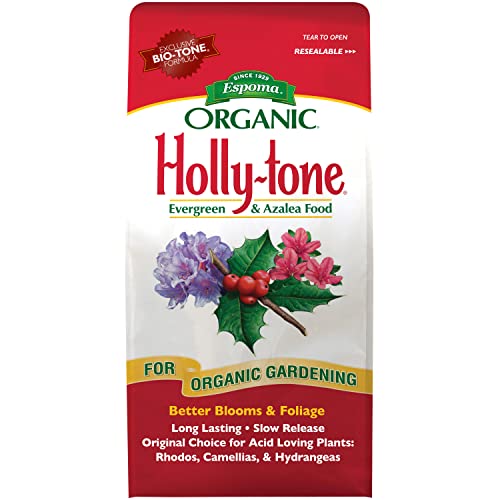
Two 4-pound bags of the original organic fertilizer for all acid-loving plants, from azaleas to evergreens.
Holly-Tone is Espoma’s classic formula — a 4-3-4 analysis with 5% sulfur, the same Bio-tone microbial enhancement, and the same OMRI-eligible organic credentials as the Evergreen-Tone. The difference is the target range: Holly-Tone covers azaleas, hydrangeas, rhododendrons, blueberries, evergreens, strawberries, camellias — “all plants that thrive in acidic soils,” according to the brand. This pack gives you two 4-pound bags, which is convenient for splitting between spring and fall applications or for sharing with a neighbor. Owners mention that if used on hydrangeas, blueing the flowers takes multiple seasons, but their blueberry bushes and azaleas respond well. The key trade-off vs. the 8-pound Evergreen-Tone: Holly-Tone comes in two smaller bags rather than one large one, so if you prefer a single bag to feed everything, the Evergreen-Tone at 8 pounds is more straightforward. The odor is strong, as one reviewer notes the bag “smells horrific,” though it dissipates after a few waterings. If you already use Espoma for acid-lovers and want the two-bag format for convenience or gifting, this is a natural buy.
Split convenience: two 4 lb bags mean you can use one in spring and one in fall without storing a giant open bag.
Choose this if: you like Espoma’s formula and want the two-pack format for sequential seasonal feeding.
Prefer the other if: you want the largest single-bag evergreen feed — the 8 lb Evergreen-Tone gives you more product in one go.
7. TPS Nutrients Arborvitae Tree Fertilizer – Liquid Plant Food for Fuller Green Foliage, Faster Growth & Stronger Root Development, 32 oz
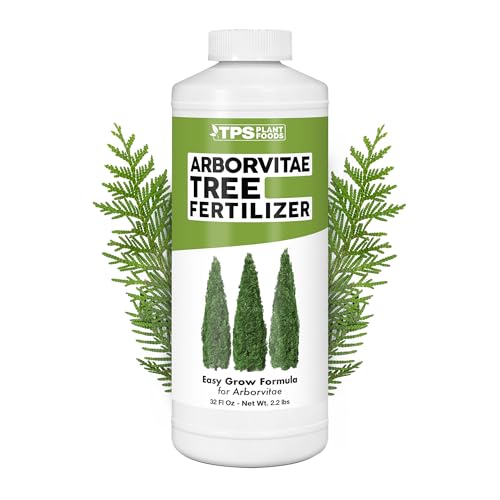
A liquid concentrate formulated specifically for arborvitae and evergreen hedges, mixed 2 tablespoons per gallon.
This 32-ounce liquid from TPS Nutrients is the only non-granular, non-powder entry here — you measure 2 tablespoons per gallon of water and apply directly to the root zone every two weeks. Compared to the twice-a-year granular Espoma feeds, this liquid delivers visible results in weeks, not months, making it ideal for a struggling arborvitae hedge. One buyer reports that after using it, their evergreens “look so much better,” with branches that were dying now covered by new green growth. Another notes that a neighbor planted the same arborvitae trees without feeding them — “they all died” — while his survived a Chicago winter with the help of this liquid. Liquid feeding requires more frequent effort: monthly or biweekly applications vs. the twice-a-year granular schedule. One reviewer cautions that it “didn’t help on those thuja arborvitae that were already in the dying process,” so it is a rescue tool for struggling trees, not a miracle for dead ones. If you have arborvitae hedges that need a quick turnaround or you prefer to control feeding with a liquid schedule, this is your best bet. For a hands-off approach, stick with granules.
Liquid advantages
- Visible results in weeks, not months — good for struggling trees
- Adjustable dose per plant for precision feeding
Effort required
- Biweekly mixing and application vs. twice-yearly granular feeding
Best for: arborvitae and evergreen hedges that need fast, targeted nutrition — especially after neglect or a harsh winter.
Not for: anyone who wants a low-maintenance fertilizer; the liquid schedule demands consistency.
Understanding the Specs
N-P-K Ratio
The three numbers on a bag (like 4-3-4 or 5-4-4) represent Nitrogen-Phosphorus-Potassium percentages. For evergreens, the first number (Nitrogen) should be highest because nitrogen drives green needle growth. The second (Phosphorus) supports root development, and the third (Potassium) builds winter hardiness. A 4-3-4 or 5-4-4 ratio matches what most evergreens need without pushing excessive leaf growth that attracts pests.
Organic vs. Synthetic
Organic fertilizers use natural ingredients like bone meal, feather meal, and sulfate of potash that break down slowly with soil microbes. They improve soil structure over years. Synthetic fertilizers like water-soluble Miracle-Gro give plants immediately available nutrients for fast green-up but do not feed the soil biome. For long-term evergreen health, organic granules reduce the risk of salt burn and build a more resilient root system.
Sulfur Content
Sulfur is an acidifying agent that lowers soil pH. Most evergreen-specific feeds include around 5% sulfur, seen in both Espoma formulas. If your soil pH is above 6.5, iron and manganese become locked up, and needles turn yellow. Sulfur helps keep pH in the 5.0-6.5 balance where evergreens can access those micronutrients. A soil test kit can confirm if you need it.
Form: Granules vs. Liquid vs. Powder
Granules (Espoma, Dr. Earth, True Organic) are scattered on the soil surface and work slowly with each rain or watering — best for twice-yearly feeding. Liquid concentrates (TPS Nutrients) are mixed with water and absorbed instantly through roots and leaves, requiring monthly or biweekly application. Powders (Miracle-Gro, FoxFarm) dissolve in water for quick feeding but need more frequent mixing. For established evergreens, granules save time; for struggling trees, liquids deliver rescue faster.
FAQ
When should I fertilize my evergreens?
Can I use a general 10-10-10 fertilizer on evergreens?
How long does granular evergreen fertilizer take to work?
Can I overfeed my evergreens with plant food?
What does sulfur do in evergreen fertilizer?
Is it safe to use fertilizer near children and pets?
Can I use berry fertilizer on my evergreens?
How much area does an 8-pound bag of evergreen fertilizer cover?
Should I fertilize newly planted evergreens?
What is the difference between Espoma Evergreen-Tone and Holly-Tone?
Final Thoughts: The Verdict
For most buyers, the plant food for evergreens winner is the Espoma Organic Evergreen-Tone 4-3-4 because its 8-pound bag, Bio-tone microbes, and 5% sulfur cover all your needle-leaf and broadleaf evergreens with just two applications per year. If you want a certified organic option for a few specimen shrubs, grab the Dr. Earth Acid Lovers. And for arborvitae hedges that need immediate recovery, the TPS Nutrients Arborvitae Liquid Fertilizer is the fast-acting rescue option.
How We Picked
We do not accept paid placement. Every pick is matched to a real buyer and a real use-case; we do not hands-on test units.
Sources & Methodology
Specifications: manufacturer listings and product documentation. Review insights: verified customer reviews, as of July 2026. Pricing: not shown on this page (it changes often); check the current price via the retailer link.
As an Amazon Associate, Lawn Gear Lab earns from qualifying purchases. This does not affect which products we feature.