
Specs are compiled from manufacturer listings and verified buyer reviews and can change over time — please confirm the key details on the product page before buying.
If your banana tree’s leaves are pale, curling, or just not growing, the problem is almost always a lack of the right nutrients. Banana trees are hungry plants — they need a steady supply of nitrogen, phosphorus, and potassium to pump out those giant leaves and sweet fruit. The wrong plant food for banana trees will leave you with a sad, stunted tree no matter how much you water or how much sun it gets.
I’m Rikta — the founder and writer behind Lawn Gear Lab. This guide is built by comparing the manufacturers’ published specifications and the patterns across verified customer reviews, so you get each pick’s real strengths and trade-offs instead of marketing spin.
So which liquid formula actually revives a dying tree and keeps your harvest coming? We looked at six concentrated options to find the best plant food for banana trees that delivers visible results fast.
Quick Picks
- Wellspring Gardens Banana Fuel Liquid Fertilizer — Top Performer
- HiThrive 32oz Plant Food for Banana Trees Live Plants — Best Value
- Gardenera Plant Growth Superfood for Banana Trees (32oz) — Organic Power
- TPS Nutrients Banana Tree Fertilizer (32oz) — Leaf-Focused
- HiThrive 16oz Plant Food for Banana Trees Live Plants — Starter Pack
- Gardenera Plant Growth Superfood for Banana Trees (8oz) — Compact Organic
How To Choose The Best Plant Food For Banana Trees
Banana trees are heavy feeders — they gulp down nutrients to produce big leaves and fruit. You need a fertilizer that matches that appetite without burning the roots. Here is what to zero in on.
N-P-K Ratio: Potassium Is King
The three numbers on every fertilizer bottle stand for nitrogen (N), phosphorus (P), and potassium (K). For banana trees, you want a formula where potassium is higher than both nitrogen and phosphorus — something like a 3-1-6 or a 1-1-2. Potassium drives fruit development and overall plant vigor. Nitrogen supports leaf growth, but too much nitrogen with too little potassium gives you huge leaves and almost no fruit.
Liquid Concentrate vs Granular
For established banana trees, liquid fertilizers work faster than granular ones because the nutrients reach the roots right away. A concentrated liquid you mix with water lets you control the exact dose. Granular or slow-release options break down more slowly and work fine for in-ground trees, but the liquids in this guide deliver a faster response — great if your tree is struggling.
Micronutrients Make the Difference
Beyond the big three N-P-K numbers, look for a formula that includes calcium, magnesium, and zinc. Calcium prevents blossom-end rot and strengthens cell walls. Magnesium is the core of chlorophyll molecules — without it, leaves yellow. Zinc supports enzyme function and new shoot growth. These extra elements separate a basic plant food from a truly complete banana tree fertilizer.
Quick Comparison
| Model | Best For | Bottle Size | Bottles per Gallon | Key Nutrients | Amazon |
|---|---|---|---|---|---|
| Wellspring Gardens Banana Fuel | Potassium-focused fruiting | 32 fl oz | 1 tbsp per 2 gal | 3-1-6 | Amazon |
| Gardenera Superfood 32oz | Organic micronutrient boost | 32 fl oz | 2 tbsp per 1 gal | 18 vitamins & minerals | Amazon |
| HiThrive 32oz | Budget value per gallon | 32 fl oz | 1 oz per 1 gal | N-P-K + Ca, Mg, Zn | Amazon |
| HiThrive 16oz | Compact buy for 1 tree | 16 fl oz | 1 oz per 1 gal | N-P-K + Ca, Mg, Zn | Amazon |
| TPS Nutrients Banana Fertilizer | Fast leaf & root growth | 32 fl oz | 2 tsp per 1 gal | Banana-specific blend | Amazon |
| Gardenera Superfood 8oz | Small-space organic care | 8 fl oz | 2 tbsp per 1 gal | 18 vitamins & minerals | Amazon |
In‑Depth Reviews
1. Wellspring Gardens Banana Fuel Liquid Fertilizer
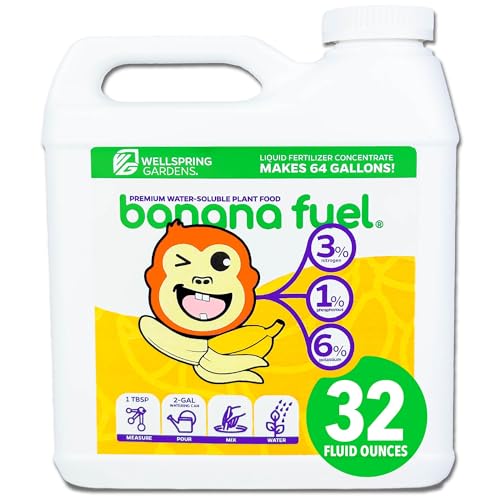
The potassium-packed formula that puts fruit on your banana tree, not just leaves.
The standout spec on this bottle is the 3-1-6 N-P-K ratio — that “6” is potassium, the single most critical nutrient for banana trees. Wellspring Gardens claims this exact ratio is what the University of Florida recommends for bananas, and it shows in how the plants respond. You mix just 1 tablespoon of the concentrate into 2 gallons of water and apply it. That means a 32 fl oz bottle stretches further than most competitors on a per-dose basis.
Buyers report that potted banana plants bounced back from heat stress within a week, with leaves perking up and new growth appearing. One reviewer noted their plants had “lush green leaves and promising fruit development” after a single month of use. The 35-ounce item weight (the bottle itself plus the liquid) makes it feel substantial in hand, but the mixing ratio is what keeps the bottle alive for many treatments.
Unlike the HiThrive 32oz, which focuses on broad macronutrients, this formula targets potassium first and gives phosphorus a smaller role at just 1%. If your tree is already leafy but refuses to fruit, this is the direction you want to go. The trade-off: at a premium price tier, it costs more upfront than the value bottles, but the low dose per gallon means each feeding is inexpensive.
Banana-Specific Edge
- 3-1-6 ratio matches UF recommendations for banana fruiting
- Low mixing ratio (1 tbsp per 2 gal) makes the bottle last
- Owners mention rapid leaf recovery and fruit set
Consider This Trade-off
- Upfront cost is higher than entry-level options
- Only 1% phosphorus may not help severely depleted soil
Reach for it if: your banana tree has big leaves but little to no fruit — the potassium-heavy 3-1-6 pushes the plant toward blooming and fruiting.
Look elsewhere if: you need a budget pick today or want an all-organic formula with 18 trace minerals instead of a focused N-P-K approach.
2. HiThrive 32oz Plant Food for Banana Trees Live Plants
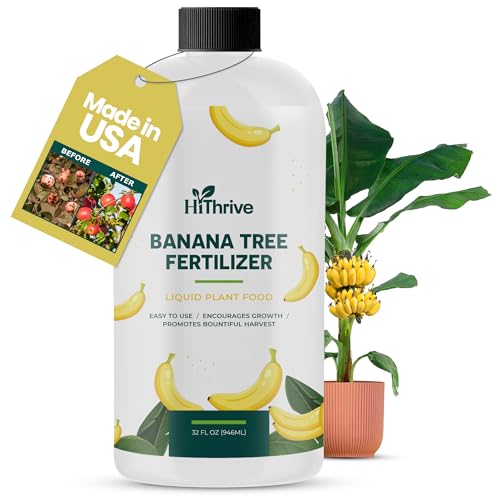
32 ounces of liquid concentrate that makes a full 32 gallons of feed — one bottle, a whole season.
HiThrive positions this as the bigger sibling to their 16oz bottle, and the math is simple: 32 fluid ounces at 1 ounce per gallon of water equals 32 gallons of ready-to-use fertilizer. That is 32 gallons, versus the 16oz version that makes 16 gallons, and the 2.6-pound item weight reflects the larger container. The formula includes nitrogen for leafy growth, phosphorus for root strength, and potassium for fruit quality, plus calcium, magnesium, and zinc to fix nutrient deficiencies.
Customers note a dramatic turnaround: one buyer mentioned their banana tree “had died but after one application it started putting out leaves.” Another noted they feed at a rate of 1 ounce to a gallon of water and the trees love it. The recommendation is to apply every 1-2 weeks during the growing season and every 4 weeks in cooler months, so a 32-gallon supply covers a few months for a single large tree.
The biggest advantage over the Wellspring Gardens pick is price — you get more total gallons for less money upfront. But the 32oz HiThrive does not have the 3-1-6 potassium-heavy profile that fruiting-focused growers want; its N-P-K is more balanced. That makes it a better fit if your tree needs overall recovery or if you are feeding multiple types of tropical plants.
Why It Wins on Value
- 32 fl oz makes 32 gallons — lowest cost per gallon in this list
- Includes calcium, magnesium, and zinc for complete nutrition
- Works for all banana varieties including Dwarf Cavendish and Plantain
One Real Catch
- Balanced N-P-K is good for growth but not tune for heavy fruiting
The best budget-friendly gallon-stretcher: if you are feeding a single recovering banana tree and want the lowest cost per dose, the 32oz HiThrive gives you 32 gallons of feed for a mid-range price.
Not your pick if: your tree already has huge leaves and you specifically need a potassium boost to trigger fruit development — look at the Wellspring Gardens instead.
3. Gardenera Plant Growth Superfood for Banana Trees (32oz)
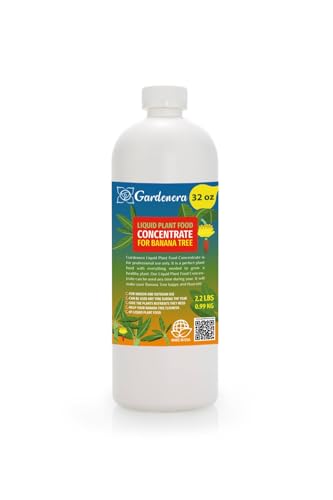
18 ingredients from bat guano to kelp meal — a full organic spectrum, not just N-P-K numbers.
Gardenera calls this a “liquid vitamin superfood” rather than a standard fertilizer, and the ingredient list backs that up. It contains poultry litter, rabbit manure, bat guano, cricket fras, worm castings, oyster shell, mycorrhizae, kelp meal, alfalfa meal, and 10 other ingredients plus a proprietary mineral blend. The maker claims it takes over five years to complete the Zymology Process that breaks everything down into absorbable elements, so the product never expires in concentrated form.
The recommended mixing ratio is 2 tablespoons per 1 gallon of water. That is a higher concentration than the HiThrive (1 oz, which is 2 tablespoons, per gallon — actually the same ratio), but at a premium price tier per bottle. Reviewers point out that money tree plants and begonias “perked up after one dose” and that the colored water absorbs readily into soil. One reviewer who keeps many plants noted the bottle “does NOT last long if you have many plants,” which is a fair point — at 2 tablespoons per gallon, a 32oz bottle gives you 32 feedings.
Unlike the TPS Nutrients Banana Fertilizer, which is a simpler banana-specific blend, the Gardenera Superfood is as close to a complete soil amendment as you can get in a liquid. It is also pet-safe and fish-safe according to the maker. The catch is the price per bottle — it sits at the premium end of this range, so it makes the most sense if you already value organic inputs and have multiple plants that can share the bottle.
Organic Advantage
- 18 distinct organic ingredients from bat guano to kelp meal
- Pet-safe, fish-safe, non-GMO, no odors or chemicals
- Shoppers say major visible improvement in plant health
The Practical Limit
- 2 tbsp per gal means a 32oz bottle goes fast with multiple plants
- Premium cost per bottle vs simpler N-P-K formulas
Go organic, go comprehensive: this is for you if you want a single bottle that feeds your banana tree plus your entire garden, and you prefer ingredients you can pronounce.
skip it if: you just need a basic banana fertilizer for one tree and do not want to spend at the premium tier for organic extras.
4. TPS Nutrients Banana Tree Fertilizer (32oz)
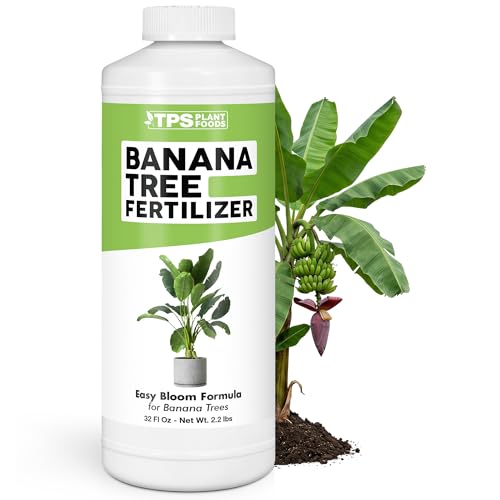
A super-efficient concentrate that grows big leaves fast — 2 teaspoons make a full gallon.
TPS Nutrients makes a formula specifically for banana trees and it is the most concentrated in this roundup by dose. You mix only 2 teaspoons of the liquid into 1 gallon of water for watering, or 1 teaspoon per quart if you are foliar-misting the leaves. That extreme efficiency means a 32 fl oz bottle contains 96 teaspoons — enough for 48 gallons of ready-to-use feed. The item weight is 32 ounces and it is made in the USA.
Buyers report that a banana tree “the size of my pinky finger 3 or 4 weeks ago now has three decent size leaves” after using this every two weeks. Another reviewer said their tree “grew about a foot in height” since starting. Those are fast results for a houseplant or container-grown banana. The formula targets both root strength and leaf development with a balanced but banana-tune blend of essential nutrients.
The trade-off relative to the HiThrive 32oz is that the TPS bottle costs more upfront for a similar total volume (32 fl oz), but the 2-teaspoon-per-gallon ratio yields about 48 gallons per 32 oz bottle, while the HiThrive at 1 ounce per gallon yields 32 gallons per 32 oz bottle. You pay more per bottle but less per feeding if you do the math. It is the best pick if your banana tree is small and you want visible leaf expansion fast.
Efficiency Highlights
- 2 tsp per gallon gives ~48 gallons per 32 oz bottle
- Owners mention leaf growth and height increase within weeks
- Can be used as a foliar mist (1 tsp per quart)
One Thing to Know
- Premium price per bottle compared to value-tier options
The efficiency champion: if you want a banana-specific formula that stretches further per drop, the 2-teaspoon ratio makes this the longest-lasting bottle in the list.
Pass if: you want an all-organic multi-plant superfood or the lowest possible upfront price — the Gardenera and HiThrive serve those goals better.
5. HiThrive 16oz Plant Food for Banana Trees Live Plants
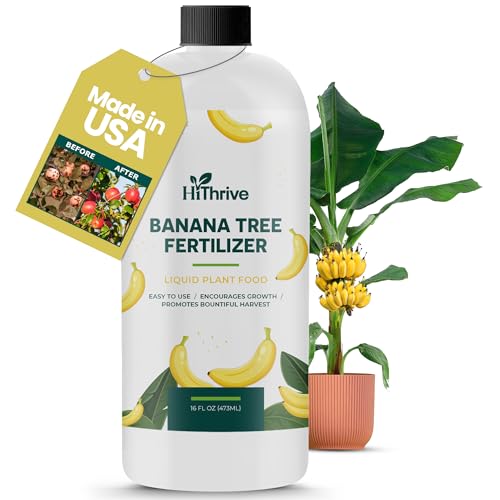
Same effective formula — 16 ounces makes 16 gallons — weighing 1.3 pounds.
This is the smaller 1.3-pound sibling of the 32oz HiThrive. The formula is identical — nitrogen for leafy growth, phosphorus for root strength, potassium for fruit quality, plus calcium, magnesium, and zinc. The difference is scale: 16 fluid ounces at the same 1-ounce-per-gallon mixing rate yields 16 gallons of feed. It fits into a smaller space and costs less upfront, making it a low-commitment entry point if you have only one small container tree.
Buyers share the same experience as the bigger bottle. One owner reported they “thought my banana tree had died but after one application it started putting out leaves.” Another said “1 ounce of this to a gallon of water the trees love it.” Because the formula is identical to the 32oz version, you get the same broad-spectrum N-P-K (nitrogen-phosphorus-potassium) plus micronutrients — just in a smaller, lighter package.
The practical limitation is obvious: the 32oz HiThrive makes 32 gallons and this 16oz makes 16 gallons. If you have more than one banana tree or plan to feed through a full growing season, the larger bottle is the smarter buy. But for a single houseplant banana tree or if you want to test the formula before committing to the big bottle, this 16oz size is the way to go.
Who It Fits
- Low upfront cost for testing the formula
- Same proven micronutrient blend as the 32oz version
- 1 oz per gallon is easy to measure even without a dropper
Size Reality
- Makes 16 gallons; the 32oz version makes 32 gallons
- 1.3 lb item weight is lighter but you will repurchase sooner
Grab this if: you have one potted banana tree and want to try the HiThrive formula without buying the full 32oz bottle — it is an affordable trial size.
Go bigger if: you already know the formula works or you have multiple trees — the 32oz version gives you 32 gallons versus the 16oz’s 16 gallons, for just a few dollars more.
6. Gardenera Plant Growth Superfood for Banana Trees (8oz)

The same 18-ingredient organic superfood in an 8 oz bottle — small, potent, and pet-safe.
This is the mini version of the Gardenera Superfood we covered at 32oz. The formula is exactly the same: 18 essential nutrients from poultry litter to alfalfa meal, built through the Zymology Process that takes over five years per batch. The difference is the bottle size — 8 fluid ounces vs 32 fluid ounces in the larger Gardenera bottle. The item weight is just 8 ounces, making it a lightweight option for a single small banana plant.
Customers note similar results: money tree plants “perked up after one dose” and the liquid absorbs readily into soil. However, one reviewer pointed out the practical math: at 2 tablespoons per gallon, an 8oz bottle goes fast if you have multiple plants. That is the same general feedback the 32oz Gardenera received, but magnified on this smaller container. For one indoor banana tree in a pot, though, an 8oz bottle could last a month or two of weekly feedings.
The biggest difference between this and the HiThrive 16oz starter size is the organic depth — the Gardenera product is a full-spectrum organic amendment that you could use for houseplants, hydroponics, and terrariums, not just bananas. That versatility adds value if you have a mixed collection of plants.
Why the Small Bottle Works
- All 18 organic ingredients in a compact 8oz package
- Pet-safe, fish-safe, non-GMO, no chemical odors
- Great for multi-use feeding (bananas, houseplants, hydroponics)
The Catch
- At 2 tbsp per gal, the 8 oz bottle empties quickly
- Higher cost per ounce than the 32oz Gardenera
Ideal for the one-plant organic grower: if you have a single banana tree and want the safest, broadest organic supplement available, the 8oz Gardenera is a low-risk entry point.
Upgrade to the 32oz if: you have more than one plant or expect to feed for a full growing season — the larger bottle is more economical per feeding.
Understanding the Specs
N-P-K Ratio
The three numbers on every fertilizer label represent nitrogen (N), phosphorus (P), and potassium (K) by percentage. For banana trees, potassium is the most critical because it drives fruit production and overall plant hardiness. A ratio like 3-1-6 (three parts nitrogen, one part phosphorus, six parts potassium) is ideal for fruiting. A balanced 1-1-1 formula works better if your tree needs general recovery from poor soil.
Mixing Ratio
This tells you how much concentrate to add per gallon of water. A 2-tablespoon-per-gallon ratio is common for organic superfoods, while the 1-ounce-per-gallon rate (about 2 tablespoons) is typical for standard liquid fertilizers. The lower the dose per gallon, the more total gallons you get from one bottle. A 2-teaspoon-per-gallon ratio, like the TPS Nutrients uses, stretches a 32oz bottle to nearly 50 gallons — the most efficient in this guide.
Micronutrients
These are elements your banana tree needs in tiny amounts, but their absence causes big problems. Calcium strengthens cell walls and prevents leaf tip burn. Magnesium is the central atom in chlorophyll — without it, leaves turn yellow between the veins. Zinc is essential for new shoot and leaf development. Formulas that list these on the label (as HiThrive does) offer more complete nutrition than basic N-P-K-only mixes.
Bottle Size vs Total Yield
A 32 fl oz bottle sounds like 32 fl oz versus 16 fl oz, but the actual number of gallons you get depends on the mixing ratio. For example, the HiThrive 32oz at 1 oz per gallon makes 32 gallons, while the Gardenera 32oz at 2 tbsp per gallon also makes about 32 gallons. The TPS at 2 tsp per gallon makes roughly 48 gallons from the same bottle volume. Always look at the mixing ratio to compare true value between bottles.
FAQ
Can I use a general all-purpose fertilizer on my banana tree?
How often should I fertilize my banana tree during the growing season?
Is liquid or granular fertilizer better for banana trees?
What happens if I use too much banana fertilizer?
Do I need a special fertilizer for a dwarf Cavendish banana tree?
Can I use these banana fertilizers on other tropical plants?
How do I know if my banana tree has a nutrient deficiency?
Can I mix banana fertilizer with water in a spray bottle for foliar feeding?
How long does an opened bottle of liquid banana fertilizer last?
Should I fertilize my banana tree in winter?
Final Thoughts: The Verdict
Across the board, the best plant food for banana trees is the Wellspring Gardens Banana Fuel because its 3-1-6 ratio matches the university-recommended potassium profile that drives real fruit production. If you want the most gallons per dollar for a single recovering tree, the HiThrive 32oz is a solid budget-friendly choice. And for organic growers who want a full-spectrum soil amendment that works on every plant in the house, the Gardenera Superfood 32oz gives you 18 trace ingredients in one bottle.
How We Picked
We do not accept paid placement. Every pick is matched to a real buyer and a real use-case; we do not hands-on test units.
Sources & Methodology
Specifications: manufacturer listings and product documentation. Review insights: verified customer reviews, as of July 2026. Pricing: not shown on this page (it changes often); check the current price via the retailer link.
As an Amazon Associate, Lawn Gear Lab earns from qualifying purchases. This does not affect which products we feature.