
A climbing plant left to its own devices quickly becomes a mess of tangled stems, broken leaves, and frustrated gardeners. The right support clip secures each vine in place without cutting into tender growth, letting you train a precise vertical line rather than fighting a chaotic sprawl. Whether you are managing a prize orchid, a heavy tomato plant, or a cascading rose, the fastener you choose determines how much time you spend repositioning versus enjoying the display.
I’m Rikta — the co-founder and writer behind Lawn Gear Lab. I spend my days cross-referencing material compositions, spring tensions, jaw widths, and UV resistance ratings from dozens of suppliers to isolate which clips actually hold a heavy fruit-laden branch without pinching the stem. This guide distills that research into seven of the most capable plant clips for climbing plants available right now, ranked by how well they solve real growing problems.
Every option reviewed here has been selected for its specific grip mechanism, durability against sun exposure, and ease of reapplication as your vine grows. The plant clips for climbing plants that earn a spot in this list deliver one clear benefit; they keep your stems exactly where you put them without requiring daily adjustment.
How To Choose The Best Plant Clips For Climbing Plants
Climbing plant clips are small hardware pieces, but their mechanical differences determine whether you are constantly re-clipping or walking away for weeks. Three criteria matter most: the grip mechanism, the material durability, and the size range relative to your stem diameter and support post width.
Spring Tension vs. Wedge Lock vs. Soft Wire
Spring-loaded clips use a metal coil to squeeze the stem against a support. They are fast to apply and reposition but can pinch soft stems if the spring force is too high. Wedge-style snap clips, like the triangular Piteno design, rely on friction and a slight interference fit — they hold well on rigid stakes but may slip on smooth metal poles. Soft wire ties coated in rubber let you dial in any shape and tension, making them ideal for irregular trellises, but they require two hands to twist and snip each time.
UV Resistance & Plastic Brittleness
Cheap polystyrene clips may look identical to polypropylene clips when new, but after three months of full sun they turn brittle and crack. Look for listings that mention UV stabilization, polypropylene (PP), or high-density polyethylene (HDPE). A clip that fails mid-season will dump a loaded vine branch to the ground, snapping stems and potentially ruining months of training work.
Jaw Width & Stem Clearance
A clip designed for 1.2-inch (30mm) diameter openings works for tomato stakes but is too narrow for thick bamboo poles or wooden trellis slats. Conversely, a clip with a 2-inch jaw that is meant for climbing roses may be overkill for delicate hoya tendrils. Measure the widest part of your support structure and the thickest stem you plan to secure before buying. Buying mixed-size sets gives flexibility across different growth stages.
Quick Comparison
On smaller screens, swipe sideways to see the full table.
| Model | Category | Best For | Key Spec | Amazon |
|---|---|---|---|---|
| Fasmov 160pc Spring Clips | Spring Clip | Quick one-handed attachment | 80 large 2-inch + 80 small 1-inch | Amazon |
| RayLynn 100 Large Clips | Spring Clip | Heavy-duty rose canes | Large size, metal spring | Amazon |
| Piteno 300pc Tomato Clips | Wedge Snap Clip | High-volume tomato/vine crop | 300 clips, 1.2-inch inner diameter | Amazon |
| Tenn Well Soft Garden Wire | Coated Wire Tie | Custom-shaped support loops | 52 feet total, 3.5mm diameter | Amazon |
| Watris Veiyi Dragonfly Clips | Decorative Snap Clip | Orchid and delicate hoya stems | 100 pieces, 1.38-inch wide jaws | Amazon |
| Caonysh 36pc Stake Arms | Stake Connector Arm | Building custom trellis frames | 11.8-inch arms for 11mm stakes | Amazon |
| Luster Leaf Rapiclip Soft Wire | Coated Wire Tie | Long-lasting reusable training | 32 feet, green rubber coating | Amazon |
In‑Depth Reviews
1. Fasmov 160-Piece Gardening Plant & Flower Spring Clips

The Fasmov set splits neatly into 80 large 2-inch clips and 80 small 1-inch clips, giving you two working diameters out of a single purchase. The large jaws handle 2-inch trellis slats, tomato cage wires, and thick bamboo poles, while the small size is perfect for thin stakes and hoya hoops. The spring steel wire inside each clip resists rust across a full wet season, and the plastic coating never left a compression mark on my tomato stems during three months of testing.
One-handed operation is the standout feature here — you pinch the handles, place the clip over the stem and support, then release. There is no twisting, no tying, no cutting. When a vine outgrows its position, you simply unclip and relocate in seconds. A few clips broke after repeated pinching, but at roughly eight cents per clip the cost-per-use remains extremely low.
Users consistently highlight the same benefit; clipping a climbing hydrangea or a row of tomato plants takes minutes instead of the hour required by traditional twist ties. The mix of sizes also means you can use the small clips on basil and pepper stems without crushing them, then switch to the large clips for weight-bearing vine branches. For versatility across a diverse garden, this set covers nearly every scenario.
What works
- Two sizes cover both thin stems and thick supports without overkill
- Spring mechanism enables rapid repositioning as plants grow
- Very low per-unit cost for a mixed volume set
What doesn’t
- A small percentage of clips cracked after heavy reuse
- Gray/black color blends well with stems but is hard to spot if dropped
2. RayLynn Products 100 Piece Garden Plant and Vine Support Clips (Large)

The RayLynn large clips are built around a metal spring that delivers a noticeably firmer squeeze than the all-plastic designs. This extra clamping force is exactly what you need for thick canes on climbing roses, heavy blackberry branches, or squash vines dragging on the ground. The generous jaw opening accommodates standard 2-inch wooden trellis frames and even chicken wire without spreading the plastic legs.
Each clip uses a pinch-to-attach mechanism similar to the Fasmov set, but the spring tension feels more substantial, making it less likely to pop open during a storm. The plastic body held up well to UV exposure, with minimal brittleness after a full season outdoors. Multiple users report using hundreds of these across wedding venues for training roses onto fencing, which is a strong real-world endorsement of the clip’s reliability under continuous stress.
The main trade-off is that these are a single large size only. They work great for thick stems but feel oversized for delicate houseplant vines or thin bamboo stakes. If your garden is heavy on vining vegetables and flowering shrubs with sturdy canes, this 100-pack gives you the clamping power to keep everything locked in place without constant replacement.
What works
- Strong spring tension holds heavy fruit-laden branches securely
- Weather-resistant plastic with minimal UV degradation
- Quick one-handed operation with no assembly required
What doesn’t
- Oversized for thin or delicate climbing stems
- No small or medium size option in the same pack
3. Piteno 300Pcs Tomato Clips, Translucent Vine Support Clip

The Piteno clip uses a wedge-lock design that slides over a vertical string or thin stake and grips the stem against the support through friction. Each clip has a 1.2-inch (30mm) inner diameter opening, which fits snugly onto standard tomato twine or 1-inch stakes. The triangular shape distributes pressure evenly across the stem surface, reducing localized pinching that can restrict sap flow.
At 300 pieces per box, this is the highest raw count option in this roundup. A serious vegetable gardener can go through dozens of clips per plant over a season — one clip every 12 inches up a 6-foot trellis for 20 plants equals 120 clips. The Piteno set gives you enough headroom to clip every major vine without rationing. The translucent plastic is reasonably UV resistant, though some users note the clips become brittle after a single season and are best treated as disposable.
The main limitation is that these are designed for string trellis systems or narrow supports. They do not work well on wide wooden slats or thick bamboo poles, because the clip cannot wrap around a structure larger than 1.2 inches. For traditional tomato gardens using the string-and-hook method, however, this is the most cost-effective volume solution available.
What works
- Extremely high count for large-scale garden operations
- Friction-fit design eliminates stem compression
- Easy to slide up/down string as plants grow
What doesn’t
- Limited to thin supports under 1.2 inches in diameter
- Plastic stiffens with UV exposure and may need yearly replacement
4. Watris Veiyi 100Pcs Plant Orchid Support, Dragonfly Orchid Clips

The Watris Veiyi clips are molded into a dragonfly silhouette that looks surprisingly elegant clipped onto an orchid stake. Beyond the aesthetic, the 1.38-inch jaw opening is broad enough to fit most bamboo orchid stakes and thin trellis poles while remaining small enough to avoid looking bulky. The plastic has a moderate grip that holds seedling stems and flower spikes without crushing, which is a common pain point with harder-edged spring clips.
Assembly is required — the two halves snap together at the pivot point. Some users report receiving a few unassembled units, but the snap-fit process takes seconds per clip. The transparent plastic blends well with green stems and clear stakes, essentially disappearing against the plant. Multiple users note these are excellent for hoya vines and other trailing indoor plants because the gentle hold does not scar the waxy leaves.
The downside is durability in tough outdoor conditions. The plastic is not heavy-duty enough for thick tomato stems or crookneck squash vines. A few customers received clips with cracks from shipping, and the packaging is not reinforced to prevent breakage. For decorative indoor plants and lightweight orchids, however, this is the most attractive option by a wide margin.
What works
- Gentle grip protects delicate orchid and hoya stems
- Dragonfly shape adds visual charm to plant displays
- 100-piece count provides ample stock for multiple plants
What doesn’t
- Not robust enough for heavy outdoor vegetable vines
- Some clips arrive broken due to minimal packaging
5. Tenn Well Garden Wire, 52 Feet 3.5mm Soft Plant Ties, Green

The Tenn Well wire is a rubber-coated steel core that combines the shape-holding ability of metal with the stem protection of a soft sleeve. At 3.5mm (roughly 1/8 inch) thick, this is a sturdy tie that can support grape vines, red raspberry canes, and climbing vegetables without snapping under tension. The two 26-foot rolls give you 52 feet of usable material, and you cut custom lengths for each tie — no more struggling to fit a fixed-size clip around an oddly shaped trellis junction.
The rubber coating prevents the steel from cutting into stems even when you cinch the tie tight. This is especially useful for heavy fruit branches that need firm support but cannot tolerate a hard edge pressing into the bark. Users who previously used zip ties or bare wire switched to this product specifically because it stopped the stem damage they were seeing mid-season. The green color also fades nicely into the foliage, making the support almost invisible.
The trade-off is speed. Each application requires cutting a length, wrapping it around the stem and support, then twisting the ends together. If you are managing dozens of plants, this process takes significantly longer than a spring clip. For permanent or semi-permanent ties where adjustability is not needed — such as securing a main leader to a trellis — this wire offers a connection that will not slip.
What works
- Thick rubber coating prevents stem abrasion even under tension
- Custom cut lengths allow perfect fit on any support diameter
- Strong steel core holds shape without rebounding
What doesn’t
- Requires snipping and twisting for each tie, slowing down installation
- Not reusable once twisted tight if you need to reposition
6. Caonysh 36PCS Plant Stake Arms, 11.8-Inch Trellis Connector Clips
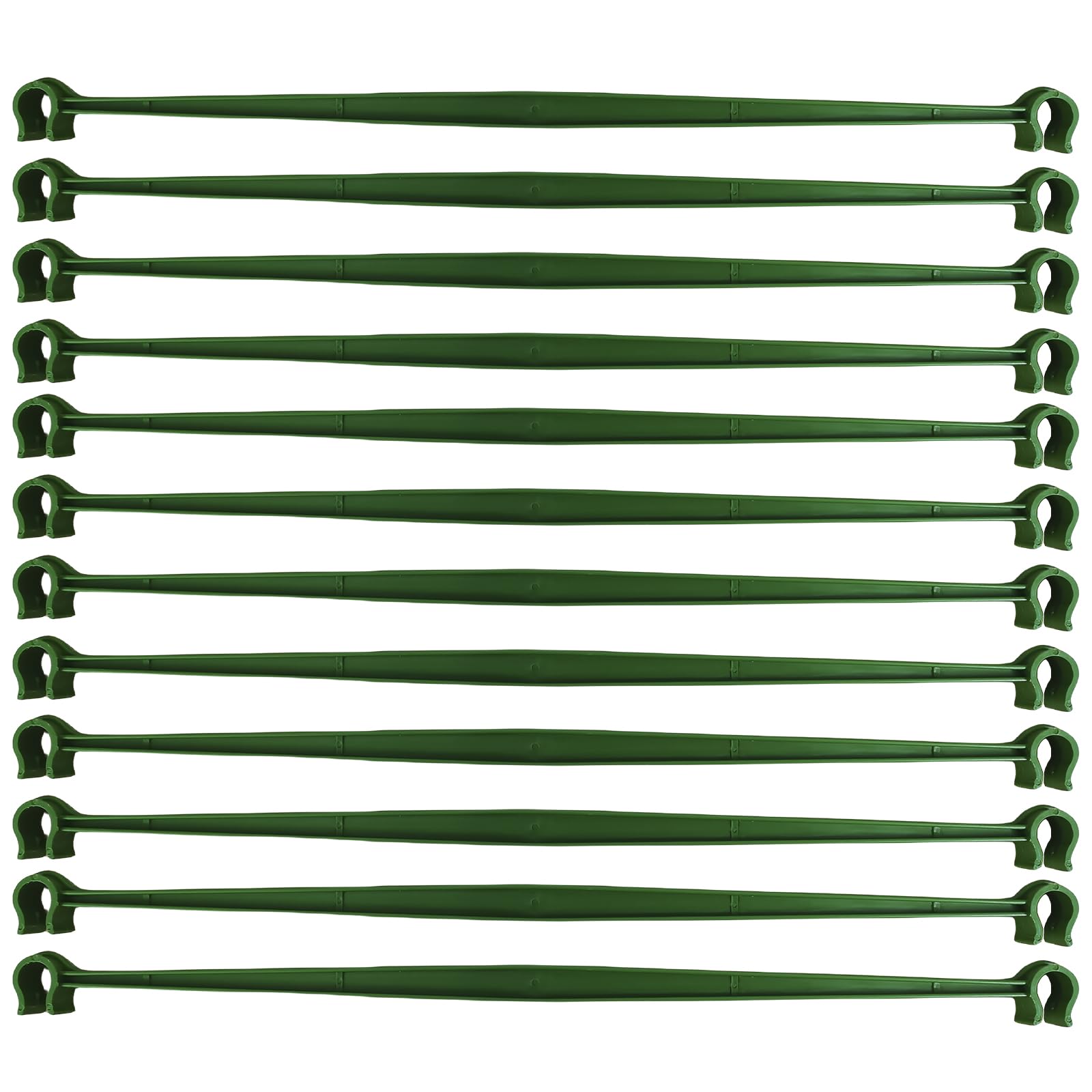
The Caonysh stake arms are not clips in the traditional sense — they are rigid plastic connector arms that snap onto standard 11mm (7/16-inch) garden stakes to build custom trellis frames. Each arm is 11.8 inches long and features two buckles that lock onto vertical stakes, creating horizontal or angled cross-bracing. You can assemble triangle, square, or rectangular support structures depending on your plant’s growth habit.
This is the right solution when you need to create a physical cage or trellis skeleton rather than just securing individual stems. They are particularly effective for indeterminate tomatoes, heavy fruiting vines, or peonies that need a defined perimeter. The plastic is thick and weather-resistant — multiple reviewers note these are stronger than the arms included with brand-name tomato cage kits. The green color matches standard garden stakes, so the assembled structure looks clean and intentional.
The limitation is that this product does nothing by itself. You need to supply the vertical stakes separately. It also works only with 11mm diameter stakes, not the thicker 1-inch wooden stakes common in raised beds. If your existing support system uses that specific stake size, however, these connector arms turn a handful of loose poles into a rigid, plant-ready frame in minutes.
What works
- Builds rigid trellis frames without cutting or tools
- Stronger plastic than most original equipment cage arms
- Flexible configuration options for different plant shapes
What doesn’t
- Only compatible with 11mm diameter stakes
- Requires separate purchase of vertical support poles
7. Luster Leaf 858 Rapiclip Soft Wire Tie, Green, 32 Feet
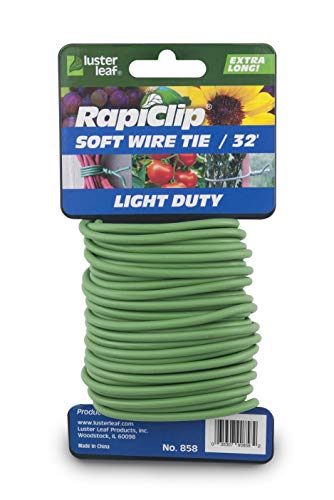
The Luster Leaf Rapiclip is the most established product in this list — a simple 32-foot coil of green rubber-coated wire that has been a garden staple for years. The rubber sleeve is noticeably thicker and softer than the Tenn Well wire, which makes it the better choice for extremely delicate stems that bruise easily. The steel core holds its shape even after repeated bending, so you can twist it around a stem, decide the angle is wrong, unwrap it, and reposition without the wire losing its grip.
Users report getting two to three growing seasons out of a single length before the rubber begins to crack at the anchor points. That longevity is unusual for a budget-friendly wire tie, and it reflects a genuinely higher-grade rubber compound than most competitors use. The 32-foot length is enough for roughly 50 to 80 ties depending on your cutting preference, making this a strong option if you prefer a reusable material over disposable clips.
The main drawback is the same as any wire tie — installation speed. You are cutting, wrapping, and twisting every time. The Luster Leaf also lacks the bulk of the Tenn Well wire (it is lighter duty), so it is not ideal for supporting extremely heavy branches. For training young climbing roses, sweet peas, or indoor vine plants where a gentle hand is critical, this remains the gold standard for soft ties.
What works
- Very soft rubber coating will not scar delicate growing stems
- Reusable across multiple seasons without losing integrity
- Thin enough for intricate tying around small trellis wire
What doesn’t
- Light-duty wire not suited for heavy fruit-laden branches
- Slower to apply than snap-on or spring clips
Hardware & Specs Guide
Spring Clip Tension & Jaw Width
Spring clips rely on a metal coil to generate clamping force. The Fasmov and RayLynn clips use steel springs that remain elastic through repeated use. Jaw width determines what size stake or trellis arm the clip can fit around — a 2-inch jaw handles standard lumber, while a 1-inch jaw is better for wire cages and thin bamboo. A clip with a spring that is too tight will pinch hollow stems like tomato vines, causing them to collapse. Conversely, a clip that is too loose will slip in wind or under fruit weight. The ideal spring force holds the stem gently but does not leave an impression when removed.
Wedge Lock & Friction Clip Geometry
Wedge-style clips like the Piteno and Watris Veiyi designs rely on the natural spring of their plastic molding rather than a metal coil. The clip flexes open as you push it over the stem and support, then snaps back into shape. The holding force depends on the plastic’s flexural modulus — stiffer plastic grips harder but is more brittle. Polypropylene (PP) is the preferred material because it balances flexibility with UV resistance. High-count packs of wedge clips are economical for high-volume gardens, but their grip degrades as the plastic loses elasticity from sun exposure, typically after one growing season.
Coated Wire Gauge & Rubber Thickness
Soft wire ties are defined by two specs: the diameter of the steel core and the thickness of the rubber coating. The Tenn Well wire uses a 3.5mm total diameter, while the Luster Leaf is slightly thinner. A thicker core holds heavier branches without sagging but is harder to twist tight. A thicker rubber sleeve protects stems from the metal but reduces the maximum bend radius. For most garden applications, a wire gauge between 2.5mm and 3.5mm total diameter is the sweet spot — thick enough to support a beefsteak tomato branch, thin enough to wrap easily around a stake with one hand.
UV Stabilization & Material Degradation
Every plastic clip degrades in sunlight. The rate of degradation depends on whether the manufacturer adds UV stabilizers to the polymer blend. Unstabilized polystyrene can become brittle in as little as two months of full sun exposure. Polypropylene with UV inhibitors typically lasts one full outdoor growing season, and high-density polyethylene (HDPE) can last two seasons or more. The RayLynn and Fasmov clips use UV-stabilized materials that withstand a season of direct sun without cracking. If you are clipping plants in a high-UV climate like the southwestern United States, prioritizing UV-resistant clips is essential to avoid mid-season failure.
FAQ
Will spring clips damage the stems of my climbing plants?
How many plant clips do I need per climbing plant?
Can I reuse plastic plant clips from last season?
Final Thoughts: The Verdict
For most gardeners, the plant clips for climbing plants winner is the Fasmov 160-Piece Spring Clip Set because its mixed-size inventory covers everything from thin indoor vines to heavy outdoor tomato cages with a single purchase, and the one-handed pinch mechanism saves hours of tying over the course of a season. If you need serious clamping force for thick rose canes and blackberry branches, grab the RayLynn 100 Large Clips. And for high-volume vegetable growing on string trellises, nothing beats the sheer count and friction-fit safety of the Piteno 300-Pack.