
Specs are compiled from manufacturer listings and verified buyer reviews and can change over time — please confirm the key details on the product page before buying.
You walk out to your tomato patch ready to pick a ripe one, only to find holes chewed through the fruit and leaves stripped to the veins. That sinking feeling is exactly why you need a pesticide that actually works on the bugs attacking your plants — without hurting the tomatoes you plan to eat. This guide cuts through the label confusion to match you with the right spray for your specific pest problem, whether you are fighting caterpillars, aphids, or beetles.
I’m Rikta — the founder and writer behind Lawn Gear Lab. This guide is built by comparing the manufacturers’ published specifications and the patterns across verified customer reviews, so you get each pick’s real strengths and trade-offs instead of marketing spin.
The right pesticide for tomatoes depends on one simple choice: a broad-spectrum contact killer that wipes out everything on contact, or a selective biological spray that only targets the caterpillars while leaving bees and earthworms alone.
Quick Picks
- Neudorff Garden Insecticide Spray for Roses and Flowers (32 oz) — Best Overall
- Monterey B.t. Bundled with Measuring Spoon (8 oz) — Selective Striker
- Monterey BT Bacillus Thuringiensis (16 oz) — Best Value
- Bonide Malathion Insect Control (16 oz Concentrate) — Heavy Hitter
How To Choose The Best Pesticide For Tomatoes
The biggest mistake gardeners make is grabbing any spray off the shelf without checking whether it is labeled for tomatoes. Some pesticides will damage the leaves or leave residue that is not safe for edible crops. Always look for the tomato mention on the label first, then match the active ingredient to the bug you actually see.
Match the Pesticide to Your Specific Pest
Caterpillars and worms (like the tomato hornworm or cabbage looper) need a different treatment than sap-sucking insects like aphids or spider mites. A broad-spectrum contact spray works fast on everything it hits, while a biological like B.t. (Bacillus thuringiensis, a natural soil bacterium that makes a protein only caterpillars can digest) targets only caterpillars and leaves beneficial bugs alone. If you are not sure what is chewing your tomatoes, a broad-spectrum option gives you the widest safety net.
Know Your Application Style
Ready-to-use sprays come in a bottle with a trigger nozzle, so you just point and spray. They are convenient for small patches but get expensive fast on a bigger garden. Concentrates you mix yourself cost less per batch and let you adjust the strength, but they require a separate sprayer and careful measuring. Pick the format that matches how many tomato plants you actually have.
Check the Harvest Interval
Some pesticides let you spray right up to the day you pick the fruit, while others have a waiting period. If your tomatoes are already ripening, a spray you can use on the day of harvest keeps you from losing the early fruit. That is a big deal for anyone who has been watching a tomato turn red for a week and does not want to wait another few days to eat it.
Quick Comparison
| Model | Best For | Active Ingredient | Liquid Volume | Form | Amazon |
|---|---|---|---|---|---|
| Neudorff Garden Insecticide Spray | Broad‑spectrum contact kill | Pyrethrins + Canola Oil | 32 oz | Ready‑to‑Use Spray | Amazon |
| Monterey B.t. (8 oz) | Caterpillar & worm control | Bacillus thuringiensis (B.t.) | 8 oz | Concentrate | Amazon |
| Monterey B.t. (16 oz) | Larger caterpillar infestations | Bacillus thuringiensis (B.t.) | 16 oz | Concentrate | Amazon |
| Bonide Malathion Insect Control | Heavy‑duty outdoor garden pests | Malathion | 16 oz | Concentrate | Amazon |
In‑Depth Reviews
1. Neudorff Garden Insecticide Spray for Roses and Flowers (32 oz)

A 32-ounce ready-to-use spray that kills over 100 insect types on contact, including eggs.
You grab this spray when you spot damage on your tomatoes but are not sure which bug is the culprit. It combines pyrethrins (a botanical insecticide from chrysanthemums) and canola oil to kill fungus gnats, aphids, beetles, caterpillars, moths, mites, fruit flies, stink bugs, and many more. The standout feature is that it works as an ovicide (kills eggs along with larvae and adults), so you stop the next generation from hatching — giving you a longer break between sprays. You can use it up to and including the day of harvest, which means you do not lose a single red tomato you have been waiting on.
Buyers report that it “killed all 12/12 tested bugs,” a clean kill rate from real use. One reviewer noted it saved their butterfly plants from aphids with low smell and easy application. The 32-ounce bottle holds 4 times as much as the smaller Monterey B.t. bottles, so you can cover a decent row of tomato plants without running out mid-spray. That makes it a stronger choice than the selective B.t. sprays if you have multiple bug species.
The catch is that because it is a contact killer, you have to spray the insect directly for it to work. It is labeled for vegetables like tomatoes, potatoes, and cucumbers, but it is not selective — it can also harm beneficial insects like bees if you spray them directly. Stick to evening or early-morning application when bees are not active.
Why It Leads the List
- Kills over 100 listed insects plus their eggs in all life stages
- Safe to use up to day of harvest on tomatoes
- 32 oz ready-to-use spray — no mixing needed
- Botanical ingredients (pyrethrins + canola oil) for organic gardening
The Real Trade-off
- Must hit the insect directly for it to work
- Not selective — can harm bees if sprayed directly
- Arrived with a broken spray top for one reviewer
Best for broad coverage: If you spot a mix of bugs on your tomatoes — aphids, beetles, and the occasional caterpillar — this spray covers them all in one bottle without needing to identify each pest.
Worth noting: It is not for you if you only have caterpillars and want to protect every single bee in your garden; a targeted B.t. spray would be a better fit.
2. Monterey B.t. Bundled with Measuring Spoon (8 oz)
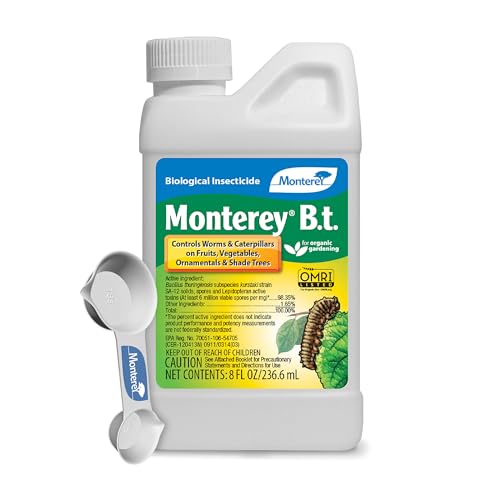
A biological concentrate that only kills caterpillars and worms, leaving bees and earthworms safe.
If you have identified the enemy as caterpillars — the tomato hornworm, cabbage looper, or bagworm — this Monterey B.t. concentrate is the most surgical tool in your shed. The active ingredient, Bacillus thuringiensis (a naturally occurring soil bacterium), produces a protein that only destroys the gut of caterpillar-type insects. It is OMRI Listed (reviewed and approved under the USDA’s National Organic Program), so it fits certified organic gardens. When used as directed, it has no effect on birds, earthworms, or beneficial insects like honeybees and ladybugs — a critical difference from the broad-spectrum Neudorff spray.
Owners mention that “BT effectively controls cabbage loopers” and that it saved their flower seedlings and cilantro in Southern California. Another reviewer said it got rid of the little caterpillars eating their Texas Laurel. The bundle includes a measuring spoon, which takes the guesswork out of mixing the concentrate with water in a trigger spray bottle or pressure tank sprayer.
The trade-off is the total volume. At 8 fluid ounces of concentrate, this bottle makes fewer batches than the 16 oz Monterey B.t. option — a 4x gap in concentrate volume compared to the Neudorff’s ready-to-use 32 oz. You will need to re-mix more often if you have a large tomato patch. Also, B.t. breaks down in sunlight within a day or two, so you should mix it fresh and spray in the evening for the best results.
What Makes It Special
- Selective: kills only caterpillars and worms, spares bees
- OMRI Listed for certified organic gardening
- Comes with a measuring spoon for easy mixing
- Safe for edible plants like tomatoes up to harvest
The Limitation
- Only 8 oz of concentrate — goes fast on big gardens
- Breaks down in sunlight; needs evening application
- Only works on caterpillars, not on aphids or beetles
Reach for this if: You see hornworms, loopers, or other caterpillars on your tomatoes and want to protect your bees and earthworms completely. It is the safest choice for an organic garden with a specific pest.
Look elsewhere if: You are dealing with multiple bug types (aphids, beetles, and caterpillars all at once) or have a very large garden where 8 oz of concentrate will not last long. The Neudorff spray covers more ground on a mixed infestation.
3. Monterey BT Bacillus Thuringiensis (16 oz)

The same selective caterpillar-killing B.t. but with double the concentrate for larger gardens.
This is the bigger sibling to the 8 oz Monterey B.t. above. The active ingredient, liquid volume, target species, and organic certification are identical — it is the same Bacillus thuringiensis concentrate in the same OMRI Listed formulation. The only difference is the bottle size: 16 fluid ounces instead of 8, which means you get twice as much mixable product for a similar price point. It includes a measuring spoon as well, helping you mix precisely without wasting any concentrate. For a medium to large tomato patch, this bottle stretches further than the 8 oz version without requiring you to reorder as often.
Reviewers highlight how well it handles pickleworm and tomato-specific pests. One buyer wrote: “After spraying my tomatoes following the directions on the bottle, two days later I found several caterpillars dead.” That is a direct real-world result showing exactly how fast this works on tomato plants. Another reviewer noted that B.t. only targets caterpillars and spares beneficial insects, but warned that it is short-lived in sunlight and recommended mixing fresh for evening use.
It still shares the same limits: it only fights caterpillars and worms, not aphids, beetles, or mites, and it must be mixed fresh for each application because the bacteria degrade in UV light within about 24 hours. Unlike the Neudorff spray, this will not touch a beetle or aphid infestation.
The Upside
- 16 oz concentrate — twice the volume of the smaller Monterey B.t.
- Same safe, selective caterpillar control that spares bees
- OMRI Listed for organic gardening
- Verified effective on tomato caterpillars in customer reviews
The Downside
- Only kills caterpillars and worms, not broad-spectrum
- Needs fresh mixing for evening sprays due to UV breakdown
- Price is higher than the 8 oz but gives better value per ounce
Best pick for bigger organic gardens: If you have a serious tomato patch and already confirmed that caterpillars are your main pest, the 16 oz bottle gives you more spray for the money and keeps the bees safe.
skip it if: You need to kill aphids, beetles, or mites — you will need a broad-spectrum spray from this list instead.
4. Bonide Malathion Insect Control (16 oz Concentrate)

A potent concentrate that makes up to 50 gallons of spray for tough outdoor garden pests.
When you need serious firepower for a large garden or orchard, this Bonide Malathion concentrate delivers a volume that the other picks cannot match. It targets aphids, spider mites, mosquitoes, scales, thrips, leafhoppers, Japanese beetles, and codling moths on tomatoes, lettuce, melons, squash, blackberries, and citrus fruits. The concentrated formula means one 16 oz pint makes up to 50 gallons of finished spray — which is a massive volume advantage over the ready-to-use Neudorff or the smaller B.t. concentrates. You are essentially getting a whole season of pest control in one bottle.
Customers note that it is “very effective” on bag worms and that a single pint helped clear two houses of bed bugs (though it is labeled for outdoor garden use only). One buyer mentioned the strong smell — describing it as “like H3LL” — and raised concerns about toxicity to pets, which is worth taking seriously. It is designed for outdoor use only and should not be sprayed indoors or near open windows.
The trade-off is that Malathion is a synthetic organophosphate (a chemical insecticide, not a botanical or biological option). It is not OMRI Listed for organic gardening, and the strong odor lingers for a while after application. You need to follow the label directions carefully for safe mixing and application on edible crops like tomatoes. But if you have a big garden with a persistent, multi-species bug problem, the volume-per-dollar value here is hard to match — far more coverage than the 32 oz Neudorff bottle.
What It Does Best
- One pint makes up to 50 gallons of spray — unbeatable coverage
- Kills a wide range of pests: aphids, spider mites, beetles, moths
- Works on tomatoes and many other vegetables and fruits
- Effective on tough infestations that resist lighter sprays
Real Concerns
- Strong chemical smell that lingers
- Not suitable for organic gardening programs
- Toxicity concerns around pets; outdoor use only
- Needs careful mixing and measuring
Best for big, tough gardens: If you have a large vegetable patch or fruit orchard with persistent aphid, mite, or beetle infestations, the sheer volume of spray you get from 16 oz concentrate outweighs any other option here.
Not ideal if: You garden organically, have pets that roam the garden, or just need to deal with a few caterpillars — the biological B.t. sprays would be safer and more appropriate.
Understanding the Specs
Active Ingredient Type
This is the real dividing line between all tomato pesticides. Botanical ingredients like pyrethrins and canola oil (in the Neudorff spray) kill by direct contact and break down quickly in sunlight. Biological ingredients like Bacillus thuringiensis (B.t.) produce a protein that only caterpillars can digest, making it harmless to bees and earthworms. Synthetic chemicals like Malathion are broad-spectrum and persistent, giving you longer control but with a stronger odor and no organic certification. Pick the ingredient type that matches both your pest and your gardening philosophy.
Liquid Volume and Form
Ready-to-use sprays come pre-mixed in a bottle you just point and spray — convenient for small patches, but you pay for water weight. Concentrates require a separate sprayer and careful measuring, but a 16 oz bottle can make 50 gallons of finished spray (as the Bonide Malathion does), stretching your dollar much further across a big garden. The volume number on the bottle tells you the concentrate amount, not the finished spray. Read the label dilution rate to understand how much total coverage you actually get.
FAQ
Can I spray any of these on tomatoes that are already ripening?
Which pesticide kills tomato hornworms the fastest?
Will these sprays kill bees?
How do I mix the Monterey B.t. concentrate with water?
Is the Bonide Malathion safe for organic gardening?
What if I have both aphids and caterpillars on my tomatoes?
How long does B.t. last after I spray it on my tomato plants?
Can I use these pesticides on other vegetables besides tomatoes?
Final Thoughts: The Verdict
For most gardeners, the pesticide for tomatoes winner is the Neudorff Garden Insecticide Spray because it covers over 100 insect types including eggs in a ready-to-use 32 oz bottle, works up to harvest day, and uses botanical ingredients for organic gardening. If you are only battling caterpillars and want to protect your bees, grab the Monterey BT 16 oz Concentrate for the best volume-to-value ratio in a selective spray. And for a huge garden with tough, multi-species infestations where organic certification is not a priority, the standout is the sheer coverage of the Bonide Malathion Concentrate with its 50-gallon output per pint.
How We Picked
We do not accept paid placement. Every pick is matched to a real buyer and a real use-case; we do not hands-on test units.
Sources & Methodology
Specifications: manufacturer listings and product documentation. Review insights: verified customer reviews, as of July 2026. Pricing: not shown on this page (it changes often); check the current price via the retailer link.
As an Amazon Associate, Lawn Gear Lab earns from qualifying purchases. This does not affect which products we feature.