
Nothing ruins a quiet evening faster than the loud, low buzz of a stink bug finding its way inside — or the sharp, grassy odor it releases when you try to shoo it out. These shield-shaped invaders don’t bite or damage your home’s structure, but their sheer numbers and stubborn persistence turn every window sill and light fixture into a battleground. You need a solution that works as both a barrier and a knockout punch, not a temporary fix that leaves you chasing survivors minutes later.
I’m Rikta — the co-founder and writer behind Lawn Gear Lab. My approach to this guide involved cross-referencing active-ingredient profiles (lambda-cyhalothrin, beta-cyfluthrin, bifenthrin, fipronil) against real-world owner experiences, focusing on residual longevity, safety profiles near food prep areas, and application ease for both perimeter spraying and interior spot treatments.
After sifting through hundreds of verified reviews and comparing concentration ratios, dilution yields, and label restrictions across seven top contenders, I’ve built a clear, no-nonsense breakdown of the pesticide for stink bugs that actually holds up against an infestation.
How To Choose The Best Pesticide For Stink Bugs
Stink bugs — especially the brown marmorated variety — are uniquely tough because they don’t nest in the open; they hide in wall voids, attic eaves, and under siding. A spray that only kills on contact won’t reach the core population. Here is what separates a mediocre treatment from one that actually ends the invasion.
Residual Activity Duration
Stink bugs migrate in waves, often over several weeks. A spray that degrades after a few hours in sunlight is useless for long-term defense. Look for formulations that advertise 30 to 90 days of residual protection on non-porous surfaces. Microencapsulated formulas (EnduraCap or cellulose entrapment technologies) typically outperform basic emulsifiable concentrates because they release the active ingredient slowly instead of breaking down all at once.
Active Ingredient Selection
Three chemistries dominate this category: lambda-cyhalothrin and beta-cyfluthrin (fast knockdown, strong initial barrier), bifenthrin (broad-spectrum with good UV stability), and fipronil (slow-acting, colony-killing — ideal if stink bugs are breeding inside your walls). Products with a single active ingredient are easier to rotate if you suspect resistance. Combination formulas that mix a pyrethroid with a growth regulator or a second active ingredient can cover both adults and eggs, but they increase the cost per gallon of mixed spray.
Application Method & Coverage
Stink bugs enter through gaps around window frames, soffits, and foundation cracks. A concentrate that you mix and apply with a pump sprayer gives you the control to hit these specific voids at the right pressure. Ready-to-use trigger sprays work for quick spot treatments on a single window, but you will burn through cans fast during a full invasion. Concentrates that yield 15 to 30 gallons of mixed spray per bottle offer the best cost-per-square-foot for perimeter treatments.
Safety & Label Limitations
Many potent stink bug pesticides are not registered for sale in states like California, New York, Vermont, Connecticut, and New Hampshire due to aquatic toxicity concerns. Always check the label for your state’s restrictions before buying. For indoor use near kitchens and living areas, look for low-odor, non-staining formulas that dry clear and are labeled safe for pets and children once the treated surface is dry — typically within 1 to 2 hours.
Quick Comparison
On smaller screens, swipe sideways to see the full table.
| Model | Category | Best For | Key Spec | Amazon |
|---|---|---|---|---|
| Tempo SC Ultra | Premium Concentrate | Fast knockdown & 90-day barrier | 11.8% Beta-cyfluthrin, 240 mL | Amazon |
| Fipronil Plus C | Professional Colony Kill | Eliminating hidden nests & colonies | 0.65% Fipronil, makes 21 gal. | Amazon |
| Atticus Devito CS | Mid-Range Concentrate | Extended release (EnduraCap) | 9.7% Lambda-cyhalothrin, 8 oz. | Amazon |
| Bifenthrin Plus-C | Professional Concentrate | UV-stable outdoor perimeter spray | Bifenthrin, 16 oz., low odor | Amazon |
| Ortho Home Defense (1 Gal. 2-Pack) | Ready-to-Use Barrier | Easy indoor perimeter protection | RTU trigger spray, 12-month barrier | Amazon |
| Ortho Home Defense MAX (2-Pack) | RTU Value Pack | Compact spot treatment & entry points | 24 oz. cans, odor-free, non-staining | Amazon |
| Hi-Yield Broad Use | Budget Concentrate | Large-area garden & lawn treatment | 32 oz., treats 1,000 sq. ft./0.5 oz. | Amazon |
In‑Depth Reviews
1. Tempo SC Ultra Insecticide Concentrate (240 mL)
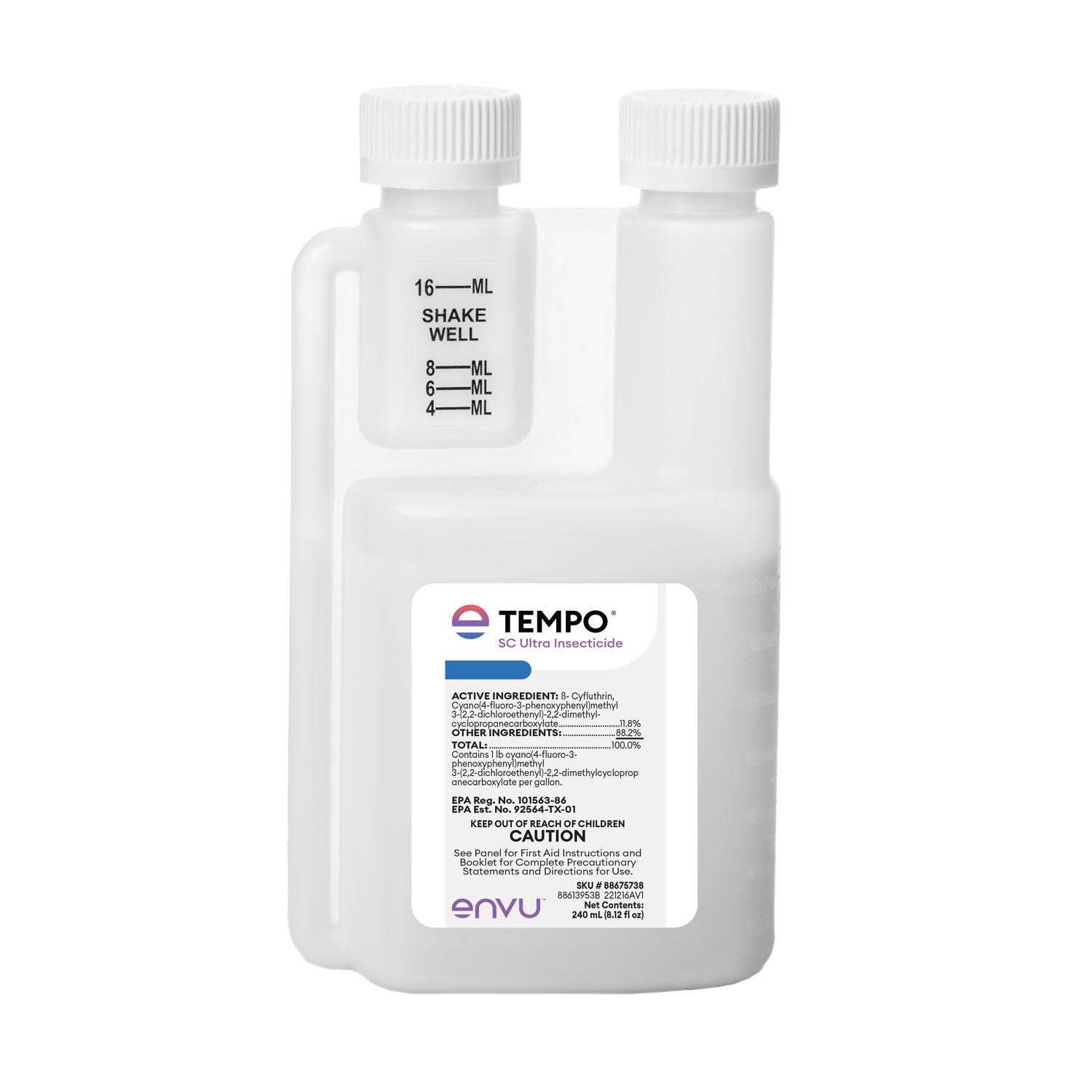
Tempo SC Ultra delivers the fastest knockdown among the insecticides in this roundup thanks to its 11.8% beta-cyfluthrin suspension concentrate. The built-in 16 mL measuring chamber on the bottle eliminates guesswork — you dilute just 8 to 16 mL per gallon of water for a long-lasting perimeter barrier. Multiple owners report using it as their sole treatment against Asian lady beetles and boxelder bugs, two pests that share the same overwintering behavior as stink bugs, with visible dead insects within hours of spraying.
Residual activity holds up to 90 days on exterior surfaces, even through rain events, because the microencapsulated formulation resists UV degradation better than older emulsifiable concentrates. The concentrate is odorless and leaves no visible white residue, making it suitable for spraying around door frames, window sills, and siding without cosmetic concerns. At the standard maintenance rate of 8 mL per gallon, the 240 mL bottle produces 30 gallons of mixed spray — enough to treat the full perimeter of an average two-story home three or four times over.
Some users noted that the bottle is small for the price, but the low dose rate per treatment makes the cost-per-gallon highly competitive with professional pest control services. A few reviewers in high-humidity regions (Florida, Gulf Coast) recommended reapplying every 60 days instead of 90 during peak stink bug pressure. The product is not registered for sale in California, New York, or Vermont, so check state restrictions before ordering.
What works
- Extremely fast knockdown — visible kill within hours for stink bugs and Asian beetles
- Built-in measuring chamber eliminates guesswork and spills
- Odorless and non-staining, safe for interior perimeter use after drying
What doesn’t
- Small 240 mL bottle may seem expensive until you calculate the dilution yield
- Not available in CA, NY, CT, NH, or VT — check your state before purchasing
2. Fipronil Plus C Pest Control Concentrate (16 oz.)
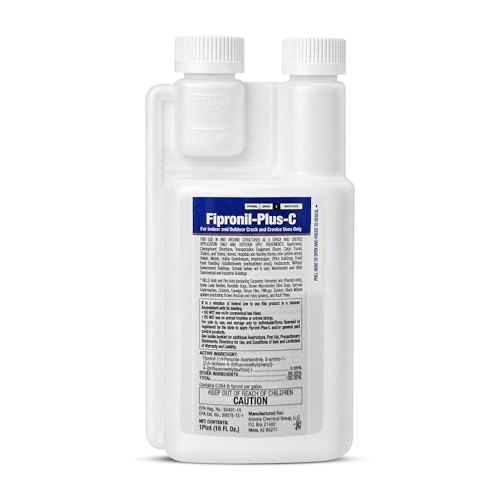
Fipronil Plus C uses a fundamentally different approach from pyrethroid-based sprays. Instead of killing on contact, the 0.65% fipronil formula is undetectable to insects — stink bugs walk through the treated zone, pick up the active ingredient on their legs and bodies, and carry it back to their harborage sites inside wall voids and attic spaces. The slow kill time (24 to 36 hours) ensures the toxicant spreads to nestmates before the original carrier dies, collapsing breeding populations that a fast-acting contact spray would miss entirely.
The patented cellulose entrapment technology protects the fipronil from UV breakdown and microbial degradation, maintaining residual activity for 30 to 90 days on outdoor surfaces even in direct sunlight. Three dilution rates (0.25 oz/gal for maintenance, 0.75 oz/gal for initial treatment, 1.5 oz/gal for severe infestations) let you tailor the concentration. A single 16 oz. bottle yields up to 21 gallons at the maintenance rate or 10.5 gallons at the moderate rate — enough to cover an entire home interior, foundation perimeter, and yard multiple times. The formula is labeled for use in food-handling facilities, hospitals, and schools, which speaks to its safety profile once dry.
Owners with entrenched cockroach and ant infestations reported total elimination after two to three applications spaced two weeks apart, with zero survivors after 30 days. Some users found the slow initial kill disconcerting — they expected to see immediate corpses, but the lack of bodies is actually the sign that the transfer mechanism is working. The concentrate is expensive per bottle relative to bifenthrin products, but the cost-per-gallon is lower than many premium pyrethroids when you factor in the higher dilution rates needed for the same knockdown speed.
What works
- Slow-acting colony kill reaches stink bugs hiding in wall voids and eaves
- Three dilution rates provide flexibility from maintenance to severe infestations
- UV-resistant cellulose encapsulation ensures 90-day residual even in direct sun
What doesn’t
- No immediate knockdown — expect 24-36 hours before visible results
- Toxic to aquatic life — avoid spraying near ponds, streams, or storm drains
3. Atticus Devito CS Insecticide (8 oz.)
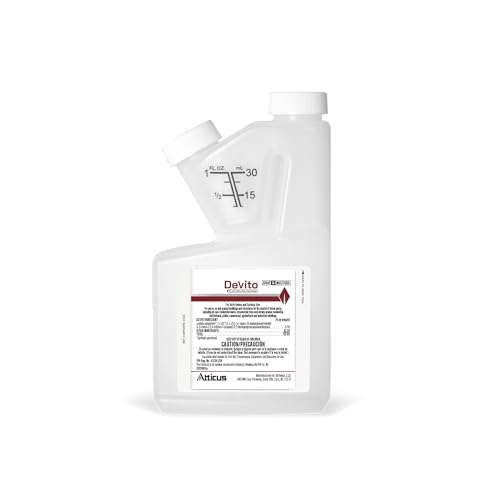
Atticus Devito CS packs 9.7% lambda-cyhalothrin inside EnduraCap microcapsule technology, which splits the active ingredient into quick-release and slow-release capsules. The fast capsules give you a rapid knockdown of stink bugs that are already on your exterior walls, while the slow capsules continue releasing lambda-cyhalothrin over the following 90 days to intercept new arrivals. This dual-release mechanism is especially valuable during the autumn invasion window when stink bugs swarm in waves over several weeks.
The 8 oz. bottle treats a substantial area — at the standard outdoor rate for perimeter spray, you get approximately 16 to 24 gallons of mixed solution, depending on the pest pressure. Owners in southern Texas reported effective control against roaches, ants, and spiders for three months with a single application, even during the hot, humid summer when most pyrethroids degrade quickly. The formula is labeled for use in kitchens, restaurants, and residential interiors, which gives you the flexibility to treat indoor entry points like baseboards and window tracks without leaving a messy residue.
Several reviewers noted that Devito CS works best when paired with a second active ingredient like bifenthrin to prevent resistance buildup over multiple seasons. The product is not available for sale in California, Connecticut, New Hampshire, New York, or Vermont — a common restriction for lambda-cyhalothrin concentrates. A small number of users felt the 8 oz. bottle is expensive for the volume, but the concentrated dose means you are paying for the active ingredient, not for water weight in a larger jug.
What works
- Dual-release microcapsules provide both immediate knockdown and 90-day residual
- Effective in hot, humid climates where UV degradation is a concern
- Suitable for indoor kitchens and living spaces after drying
What doesn’t
- Not registered for sale in CA, CT, NH, NY, or VT
- Best results require rotation with a second active ingredient to prevent resistance
4. Bifenthrin Plus-C Insecticide (16 oz.)
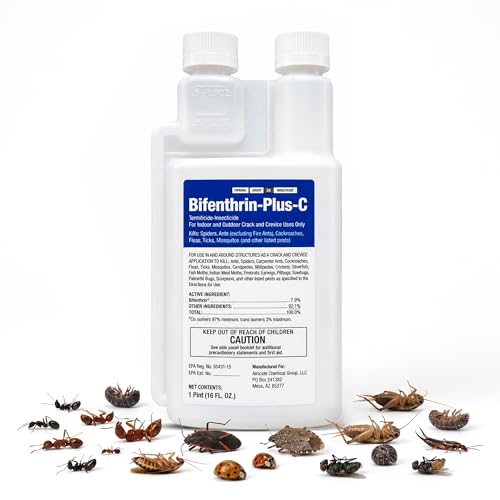
Bifenthrin Plus-C is a straight bifenthrin concentrate that prioritizes UV stability and low odor over fancy encapsulation technology. Bifenthrin is one of the most photostable pyrethroids available, meaning it holds up well against sunlight degradation — a critical advantage when you are spraying south-facing walls and sun-exposed window frames where stink bugs congregate. The 16 oz. bottle mixes at a standard rate of 0.5 to 1 oz. per gallon, yielding 16 to 32 gallons of ready-to-spray solution depending on the pest pressure.
The formula dries to an invisible film that does not stain siding, brick, or painted wood. The low-odor profile means you can spray interior baseboards and crack-and-crevice areas without driving your family out of the house — an important consideration when treating for stink bugs that may have already overwintered inside wall cavities.
A few users noted that bifenthrin alone is a contact and ingestion poison, not a slow-acting transfer poison like fipronil. For stink bugs that are already hiding deep inside wall voids, bifenthrin will only kill the ones that cross the treated zone. This makes it excellent as a preventive barrier but less ideal for eliminating an active interior infestation that has already established itself. For best results, combine it with a fipronil-based product for the first treatment season, then use bifenthrin alone for quarterly maintenance.
What works
- Superior UV stability — holds residual potency on sun-exposed walls for 60+ days
- Low-odor, non-staining formula safe for indoor use around living areas
- Cost-effective per gallon compared to microencapsulated alternatives
What doesn’t
- No colony-transfer effect — stink bugs must cross treated surface to die
- Less effective against deep-wall infestations without a slow-acting partner product
5. Ortho Home Defense Insect Killer (1 Gal. 2-Pack)
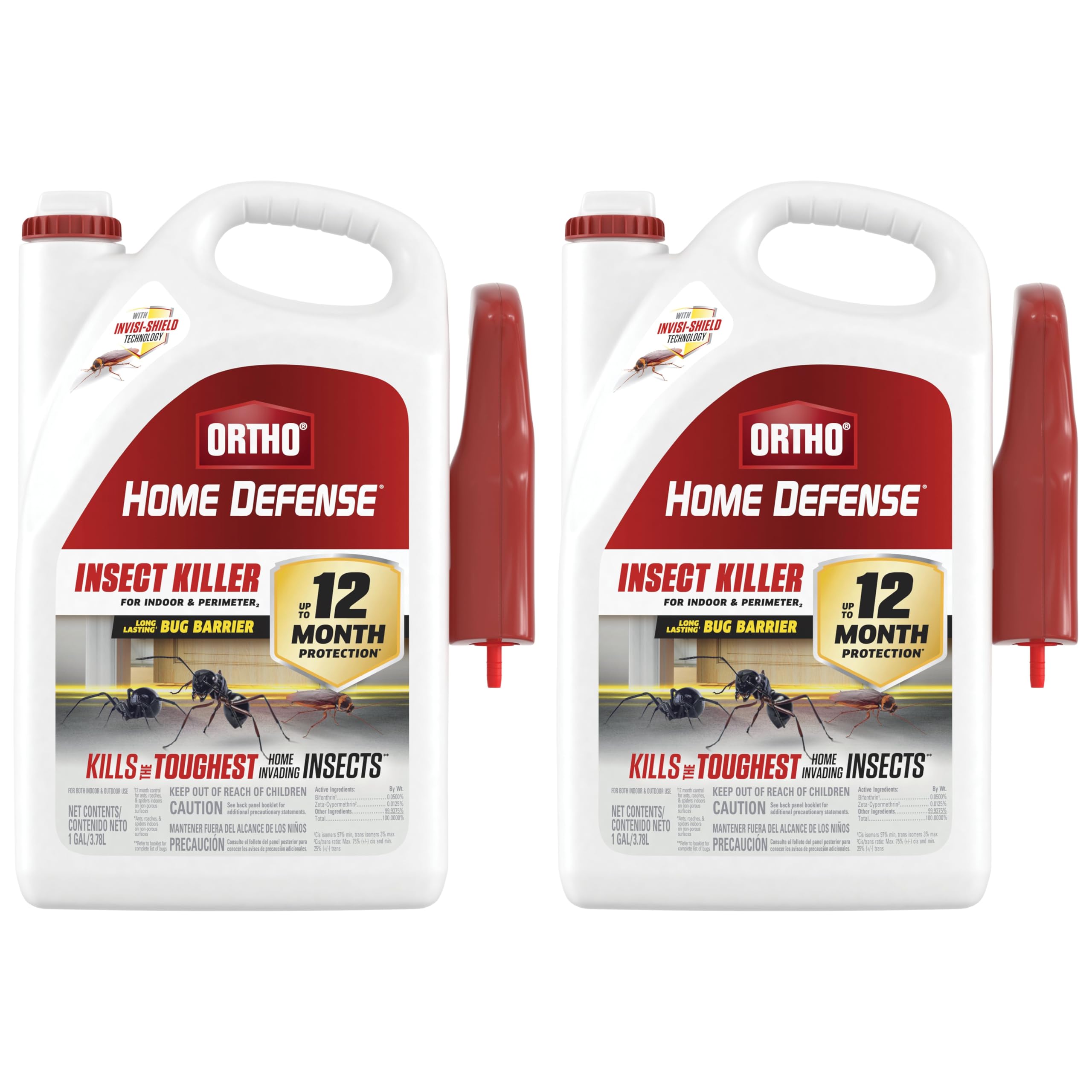
The Ortho Home Defense 1-gallon twin pack is the most convenient entry point for homeowners who want a no-mix, no-measure stink bug barrier. Each bottle comes with a built-in trigger sprayer, so you simply twist the nozzle and walk the perimeter. The active ingredient (bifenthrin plus zeta-cypermethrin in the current formulation) provides up to 12 months of protection on non-porous indoor surfaces and several months outdoors, depending on weather exposure. Owners consistently report that a single spring application around doors, windows, and foundation cracks eliminates ants, spiders, and stink bugs for the entire summer.
The biggest advantage of the gallon size is coverage — one bottle covers approximately 500 to 800 linear feet of perimeter, depending on how heavily you spray. The 2-pack essentially secures a full season for a typical 2,000-square-foot home with a crawl space or slab foundation. Users with pets and young children appreciate that the formula dries clear within one to two hours and has no lingering chemical odor. Several long-term owners noted that they switched from professional pest control services to this product and saved hundreds of dollars per year with equal or better results.
On the downside, outdoor control periods are shorter than the label suggests — rain and UV exposure can reduce efficacy to 30 to 60 days on sun-baked southern walls. Some customers reported leaking bottles during shipping, which creates a sticky mess in the box. The pre-mixed formula also costs more per gallon than concentrates, so if you have a large property or plan to treat your entire yard, the concentrate route is more economical.
What works
- Zero mixing required — trigger sprayer makes it easy to treat entry points
- Long 12-month indoor barrier claim on non-porous surfaces
- Dries clear and odor-free within 2 hours, safe around pets and kids
What doesn’t
- Outdoor residual is shorter than concentrate options in direct sun and rain
- Pre-mixed formula costs more per gallon than concentrates for large properties
6. Ortho Home Defense MAX (24 oz. 2-Pack)

The Ortho Home Defense MAX 2-pack is the smallest-format option in this guide, but its compact size makes it practical for quick spot treatments — exactly what you need when you spot a single stink bug crawling across a window screen. Each 24 oz. can includes a precision trigger nozzle that delivers a tight stream or a wide fan spray, letting you target cracks, gaps, and corners without overspraying onto furniture or walls. The odor-free, non-staining formula means you can treat interior frame corners and baseboards in a rental or apartment without leaving marks.
Despite the smaller volume, the MAX formulation contains the same bifenthrin-based active that Ortho uses in its larger gallons, and owners report the same 12-month indoor protection on non-porous surfaces. Multiple verified reviewers have been using these cans for years as a seasonal perimeter treatment, spraying a band around windows, doors, and the bottom of garage entry doors once in the spring and again in the fall. The compact size also fits easily into a kitchen cabinet or utility drawer for quick access when stink bugs appear during dinner.
The trade-off is coverage area — each 24 oz. can covers roughly 150 to 200 linear feet, so the 2-pack handles a small to medium home or a single floor of a larger house. For a full two-story home with a wrap-around porch and a basement, you will likely need three or four packs per season. A few users noted that the spray does not kill roaches as quickly as Raid — it takes 10 to 15 seconds of direct contact to bring down a roach — but for stink bugs, which are less resilient to pyrethroids, the knockdown is faster and more reliable.
What works
- Compact trigger cans are ideal for quick spot treatments on windows and doors
- Odor-free and non-staining — safe for interior living spaces
- Proven 12-month barrier performance on indoor non-porous surfaces
What doesn’t
- Small coverage area — large homes will need multiple packs per season
- Slower knockdown on roaches; acceptable but not instant for stink bugs
7. Hi-Yield (32010) Indoor/Outdoor Broad Use Insecticide (32 oz.)
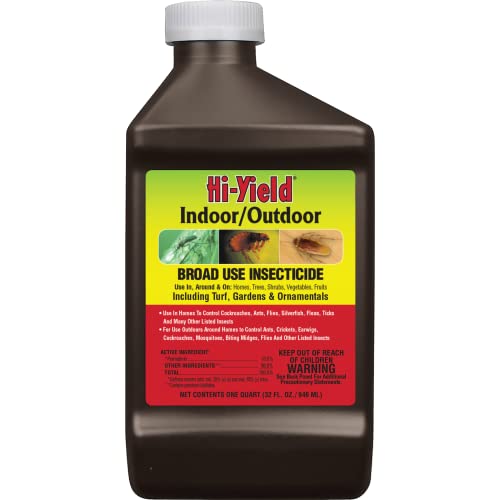
Hi-Yield’s broad use insecticide is the most cost-effective concentrate in this lineup, which makes it a strong choice for large-scale perimeter spraying on acreage, orchards, or multi-building properties. The 32 oz. bottle treats up to 1,000 square feet per 0.5 ounce of concentrate, translating to a total coverage area of roughly 64,000 square feet if you push the dilution to 1 oz. per gallon for heavier pressure. The active ingredient (permethrin-based in this formulation) provides broad-spectrum control against stink bugs, mosquitoes, ticks, and fleas in a single pass.
Users who applied it to fruit trees and garden vegetables reported excellent results against stink bugs that were damaging ripening fruit. The liquid concentrate mixes easily with water and works in both tank-type and power sprayers, so it’s a practical option for owners who already own a backpack sprayer or hose-end sprayer for lawn treatments. Several long-term owners described it as the “holy grail” of bug control, noting that it dropped flying cockroaches in Alabama on their backs within 30 seconds of direct contact.
The biggest drawback is the smell — multiple reviewers described the odor as “loud” and strong enough that you should spray when you plan to leave the house for several hours. The product also lacks the microencapsulation technology of premium concentrates, so the residual outdoor lifespan is shorter, typically 2 to 4 weeks instead of 90 days. The bottle itself does not come with a spray nozzle — you must mix it in a separate sprayer, which is an extra step for users who are accustomed to ready-to-use trigger cans.
What works
- Exceptional value per square foot — 32 oz. covers up to 64,000 sq. ft.
- Kills stink bugs on contact in under 30 seconds with direct spray
- Effective on garden vegetables and fruit trees as well as home perimeters
What doesn’t
- Strong chemical odor requires you to vacate the treated area for several hours
- Short residual outdoors (2-4 weeks) compared to microencapsulated alternatives
Hardware & Specs Guide
Pyrethroid vs. Fipronil Chemistry
Pyrethroids (lambda-cyhalothrin, beta-cyfluthrin, bifenthrin) attack the insect’s nervous system on contact, causing immediate paralysis and death. They are ideal for creating a fast barrier around windows and doors where stink bugs enter. Fipronil, by contrast, is a slow-acting poison that interrupts GABA-gated chloride channels — the insect does not detect the toxin, walks through it, and carries it back to harborage sites inside walls. Both chemistries have their place; the best strategy is to use a pyrethroid for perimeter spraying and fipronil for crack-and-crevice treatments into wall voids where stink bugs breed.
Microencapsulation vs. Emulsifiable Concentrate
Microencapsulated formulas (EnduraCap, cellulose entrapment) encase the active ingredient in polymer or cellulose shells that release over weeks. This extends residual activity from the typical 2 to 4 weeks of standard EC formulas out to 60 to 90 days, even in direct sunlight and rain. The trade-off is higher cost per bottle. For stink bugs that invade in waves from August through November, a microencapsulated product saves you from reapplying every two weeks. Standard EC concentrates are more affordable and work fine for a rapid one-time knockdown, but they require diligent reapplication scheduling.
FAQ
Why do some stink bug sprays say they are not for sale in certain states?
How long should I wait before re-entering a room after spraying for stink bugs indoors?
Can I use the same mix for stink bugs outside and inside my home?
Final Thoughts: The Verdict
For most gardeners, the pesticide for stink bugs winner is the Tempo SC Ultra because it combines the fastest knockdown of any concentrate in this review with a 90-day residual that holds up through rain and UV exposure — meaning you apply once in early fall and stay protected through the entire invasion window. If you want colony-killing power that reaches stink bugs already breeding inside your walls, grab the Fipronil Plus C. And for a no-mix, ready-to-trigger solution that a homeowner can apply in 15 minutes without measuring or mixing, nothing beats the convenience of the Ortho Home Defense 1-Gallon 2-Pack.