
You notice fine webbing on your tomato leaves, and the leaves look speckled and pale — that is the first sign spider mites have moved in. Many products either fail to stop these tiny pests or rely on harsh chemicals you do not want near your vegetables. This guide compares five proven options so you can pick the one that fits your garden and your peace of mind.
I’m Rikta — the co-founder and writer behind Lawn Gear Lab. This guide is built by comparing the manufacturers’ published specifications and the patterns across verified customer reviews, so you get each pick’s real strengths and trade-offs instead of marketing spin.
You will find the most reliable and effective formulas for your home garden, from ready-to-use sprays to powerful concentrates, in this guide to the best pesticide for spider mites.
How To Choose The Best Pesticide For Spider Mites
Choosing the right miticide — a pesticide formulated to kill mites — means matching the product to your specific garden setup and your tolerance for effort. You have to weigh how much area you need to cover, whether you want an organic option, and if you are okay with mixing a concentrate yourself.
Ready-to-Use vs. Concentrate
Ready-to-use sprays (like the Athena IPM and Monterey Neem Oil) come pre-mixed. You simply shake the bottle and spray, which is perfect if you have a few houseplants or a small raised bed. Concentrates (like both Bonide Captain Jack’s products) require you to mix a small amount with water, but a single 32-ounce bottle can produce several gallons of finished spray, making them far better value for large gardens or multiple fruit trees.
Active Ingredients and Safety
The active ingredient determines how the product kills spider mites and how safe it is for you and your plants. Spinosad-based options like Captain Jack’s Deadbug Brew use a naturally occurring bacteria (Spinosad) that targets insects but has a low impact on beneficial predatory mites and bees once dry, according to the manufacturer. Neem oil-based products, found in the Garden Safe and Monterey sprays, work by suffocating mites and coating leaves to prevent fungal spores from landing. Both are approved for organic gardening, but you should always check the label to see if you can apply it on the day of harvest for edible crops.
Application and Coverage
Spider mites live on the undersides of leaves, so you need a spray pattern that reaches those hidden spots. A product like the Garden Safe Fungicide3 comes in a gallon-sized container with a built-in sprayer, which is convenient for large areas but buyers report the sprayer hose is very short — about 4 inches. For tall fruit trees, a concentrate applied with a hose-end or tank sprayer is far more practical than a trigger bottle.
Quick Comparison
On smaller screens, swipe sideways to see the full table.
| Model | Category | Best For | Key Spec | Amazon |
|---|---|---|---|---|
| Athena IPM | Ready-to-Use | Indoor plants & small gardens | 32 oz spray | Amazon |
| Bonide Captain Jack’s Deadbug Brew | Concentrate | Organic gardens and edible crops | Spinosad concentrate | Amazon |
| Bonide Captain Jack’s Orchard Spray | Concentrate | Fruit trees and large gardens | Fungicide & miticide | Amazon |
| Garden Safe Fungicide3 | Ready-to-Use | Roses, flowers, and ornamentals | 1 gallon, neem oil | Amazon |
| Monterey Neem Oil RTU | Ready-to-Use | Versatile fungal & insect control | 32 oz, neem oil | Amazon |
In‑Depth Reviews
1. Athena IPM Plant Pest Control Ready-to-Use Spray
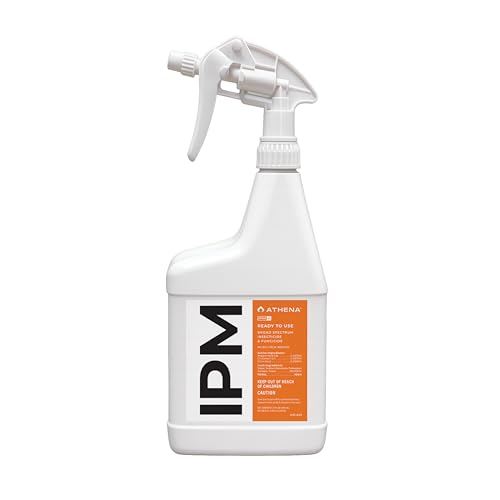
32 ounces, ready-to-use, no mixing — that is why this Athena IPM spray earns the top spot for most people. You just shake the 32-ounce bottle and spray, which makes it the easiest option when spider mites show up on your indoor plants or patio garden. Owners mention that it “zaps mites as well as all the other critters that cause problems,” meaning it also handles aphids and thrips — small sap-sucking insects — in the same pass.
The formula is made with EPA 25(b) minimum risk ingredients — an Environmental Protection Agency designation for ingredients that pose little to no risk to human health — which translates to peace of mind: it is safe around pets and children when used as directed, according to the manufacturer. It also works on houseplants, vegetable gardens, and even hydroponic systems, so you are not stuck buying separate products for different parts of your home. The single real limit here is that a 32-ounce bottle will run out quickly if you need to treat a large number of plants or a big orchard.
Stick with this one if you value convenience and safety for small-scale growing.
Why it’s great
- Ready to use straight from the bottle with no dilution steps
- Safe for pets and people when applied as directed
- Pleasant smell, unlike many other pesticides
Good to know
- 32 oz size is best for small to medium gardens
- Not a concentrate, so higher cost per treatment for large areas
2. Bonide Captain Jack’s Deadbug Brew, 32 oz Concentrate

Compared to the top-pick Athena spray, this Bonide Captain Jack’s Deadbug Brew concentrate costs less per gallon of finished spray because a single 32-ounce bottle makes many gallons when you dilute it yourself. Its active ingredient is Spinosad, a naturally occurring bacteria that controls spider mites, leaf miners (larvae that tunnel inside leaves), and caterpillars, while having a low impact on beneficial predatory insects once the spray dries, according to the brand.
Buyers specifically report that it was “effective on citrus leaf miners; weekly evening spraying eliminated them without harming bees.” That real-world feedback backs the manufacturer’s claim that it targets pests without significantly harming helpful bugs like bees and spiders when applied correctly. The catch here is that you must mix it with water and use a separate sprayer — plus, some customers note measuring the concentrate is tricky because bubbles in the cap make the level hard to read.
Choose this concentrate over the top pick if you have a large vegetable garden or a collection of fruit trees and want the lowest cost per gallon of finished spray.
Where it shines
- One bottle creates many gallons of finished spray for large areas
- Organic Spinosad is safe for edible plants and low-impact on bees when dry
- Controls a wide range of pests beyond just spider mites
Worth noting
- Requires mixing with water and a separate sprayer
- Measuring the concentrate can be tricky due to bubbles in the cap
3. Bonide Captain Jack’s Citrus, Fruit & Nut Orchard Spray, 32 oz Concentrate

If you have a few established apple, lemon, or avocado trees that attract every pest and disease in the neighborhood, this Orchard Spray from Bonide bundles three jobs into one bottle. It works as a fungicide (kills fungal diseases), insecticide (kills insects), and miticide (kills mites) in one concentrate — far more efficient than the single-purpose Deadbug Brew if you also deal with powdery mildew or rust. Reviewers point out it “kills Japanese beetles in ~1 hour, tent caterpillars, white flies (2 apps), cucumber beetles, cabbage moths,” which gives you a powerful arsenal against the most common orchard invaders.
Each pint (16 fluid ounces) of this concentrate makes up to 6.4 gallons of finished spray, making it extremely economical for covering multiple trees. One happy reviewer noted their apple trees were “fairly yellow looking overall” before using this product, and after a few applications, “the leaf spots on my apple tree are disappearing and it is noticeably greener.” That direct feedback confirms the disease control works alongside the pest control. The key trade-off is the sulfur content in the formula, which can leave a slight powdery white residue on leaves and may need reapplication after heavy rain. This is not the spray for someone with just a few houseplants — that buyer should grab the Athena IPM instead. But if you tend a home orchard or a large garden of fruiting plants, this 3-in-1 concentrate saves you time and shelf space.
One pint of concentrate yields 6.4 gallons of finished spray — enough to cover a small orchard without needing a second bottle.
What stands out
- Fungicide, insecticide, and miticide in one bottle simplifies garden care
- Economical concentrate makes up to 6.4 gallons of spray
- Effective against Japanese beetles in about one hour
The trade-offs
- Sulfur formula may leave a slight white residue on leaves
- Not long-lasting; must reapply after rainfall
4. Garden Safe Brand Fungicide3, 1 Gallon
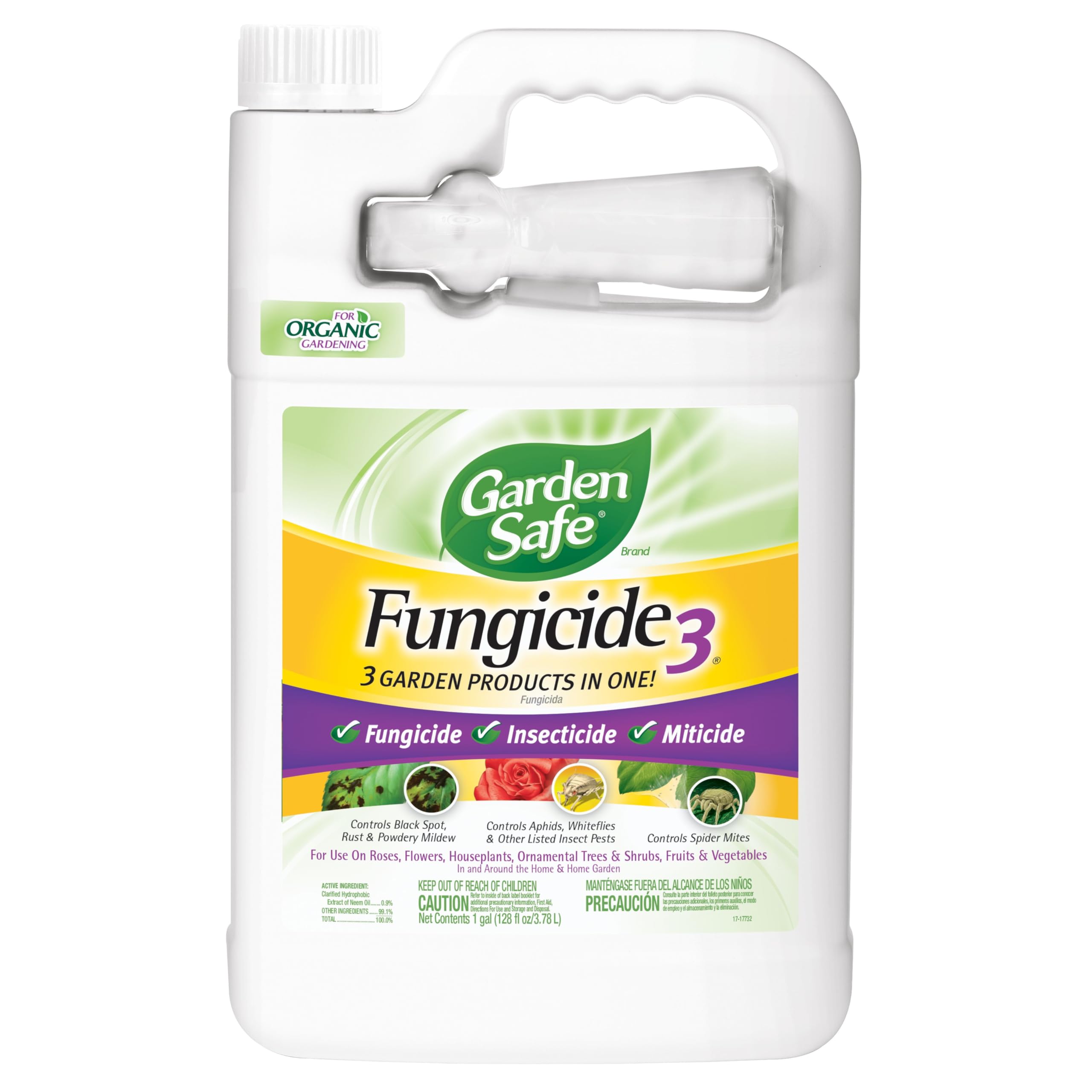
The most important number for a budget-conscious gardener is total liquid volume, and this Garden Safe Fungicide3 gives you 128 fluid ounces — four times the amount of the Athena IPM spray for roughly the same price. That massive gallon container makes it the clear best value if you have a large rose garden, many potted ornamentals, or a big vegetable patch to protect from spider mites and fungal diseases like black spot and rust — a common fungus that leaves dark spots on leaves.
The downside you accept is that the built-in sprayer is frustrating: reviewers complain it has “about 4 inches of coiled product to reach out to your plant,” which makes covering large bushes difficult. Also, the product contains neem oil extract — an oil pressed from neem tree seeds that suffocates small insects — and some users found it “works too well; use less than half recommended dose, avoid daytime use” after it burned a few of their plants. You need to be cautious with application timing and dilution. If you are okay transferring the liquid to a better sprayer and you are willing to test a weaker mix on a single leaf first, this gallon jug gives you the most bang for your buck.
skip it if you want a grab-and-go sprayer that works perfectly out of the box, but for the volume delivered, the price-to-value read is unmatched in this guide.
The upsides
- Gallon size offers the lowest cost per treatment
- Neem oil kills eggs, larvae, and adult spider mites
- Works as a fungicide to prevent powdery mildew and rust
Keep in mind
- Integrated sprayer has a very short hose, making it awkward to use
- Can burn plants if applied in direct sunlight or at full strength
5. Monterey Neem Oil RTU – 32oz
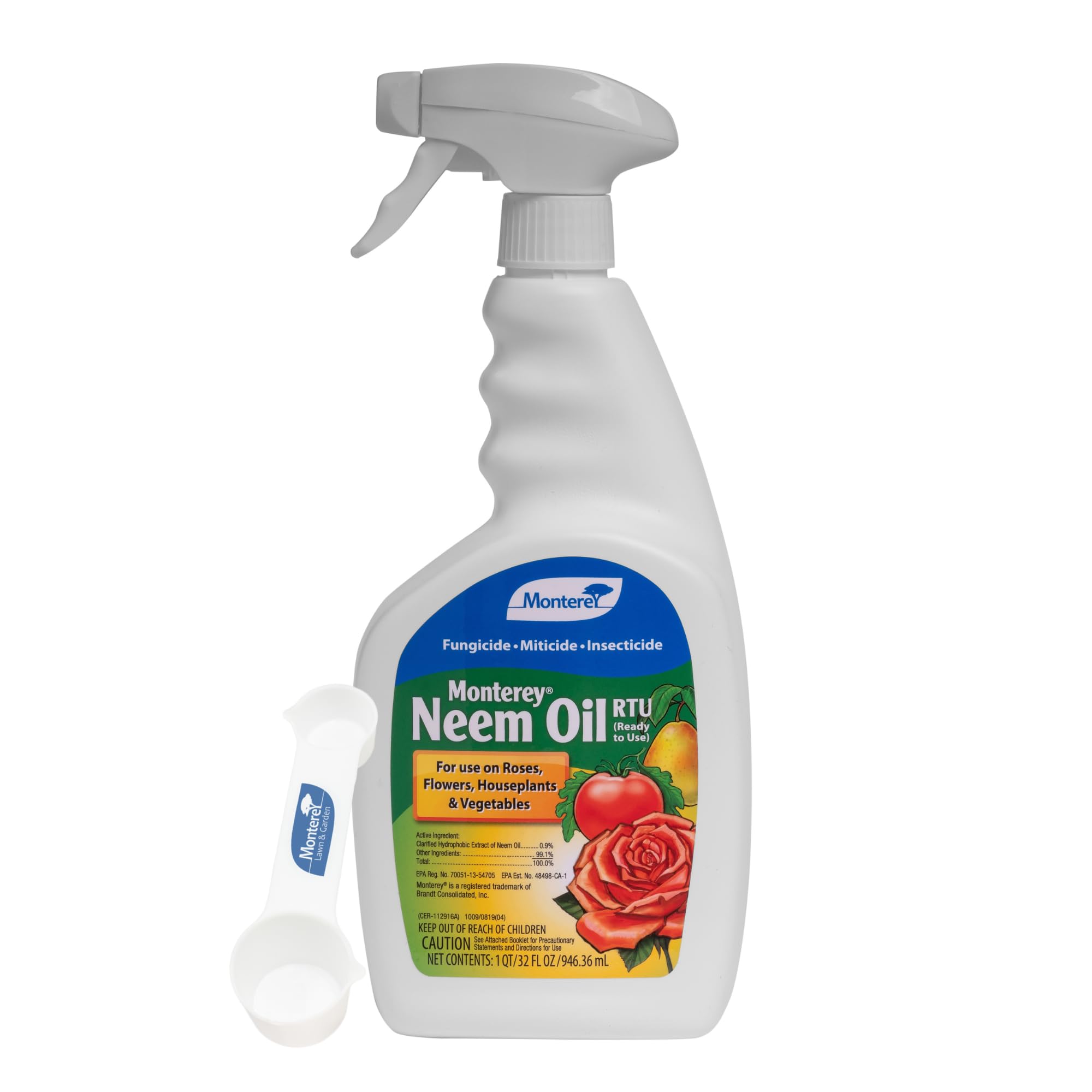
At this lower price, you get a well-formulated neem oil spray from a trusted brand (Monterey) that is ready to use right out of the bottle and is safe to apply on fruits and vegetables up to the day of harvest — you just need to wait 24 hours. This is an excellent entry-level miticide for someone just starting to battle spider mites and powdery mildew on a small container garden or a few tomato plants.
What you give up is effectiveness against heavy spider mite infestations. One reviewer with experience using neem oil explicitly warns that this product was “ineffective against spider mites” and recommends “stronger miticides” for them. The same reviewer, however, praised the Monterey formula for how well it controls black spot, powdery mildew, aphids, and whiteflies (small winged insects that suck sap), and said it “halts fungus gnat cycle by sterilizing adults.” It is a fantastic all-rounder for general garden issues, but it may disappoint if spider mites are your primary and only enemy.
This is the perfect pick for the casual gardener who wants a single, simple spray for common problems like mildew and aphids, and who is okay with a “smells like a dirty diaper” odor that fades after the spray dries. It is not the strongest spider mite killer, but for the price and convenience, it is a solid choice for light-duty use — making it the exact budget buyer it is perfect for.
Why we’d pick it
- Ready to use with no mixing, perfect for small gardens
- Safe on edible plants up to the day of harvest
- Costs less than many other branded neem oils for the same volume
A few caveats
- May be ineffective against serious spider mite infestations
- Strong smell that some compare to a dirty diaper
Understanding the Specs
Ready-to-Use vs. Concentrate
A ready-to-use (RTU) spray comes premixed in its bottle so you simply aim and spray. A concentrate is a thick liquid that you must dilute with water in a sprayer, but it gives you many more gallons of finished product per bottle. For a few houseplants, RTU is easiest; for a large garden, a concentrate works out far cheaper.
Active Ingredients: Spinosad vs. Neem Oil
Spinosad is a natural bacteria that paralyzes and kills insects after they eat it, but it breaks down quickly in sunlight and is low-risk for bees once the spray dries, according to the manufacturer. Neem oil works by coating and suffocating small insects and mites, and it leaves a residue that prevents fungal spores from landing. Both are approved for organic gardening, but Spinosad is generally more effective for heavy caterpillar and leaf miner pressure, while Neem oil is better for soft-bodied pests and disease prevention.
FAQ
Can I use these pesticides on vegetables right up to harvest?
How often should I spray for spider mites?
Will these sprays hurt my bees and butterflies?
Why do some reviews say neem oil burned their plants?
Final Thoughts: The Verdict
For most people, the best pesticide for spider mites winner is the Athena IPM Plant Pest Control because it is the simplest reliable option — no mixing, safe for pets, and it smells pleasant. If you have a large vegetable garden and want the most economical organic option, grab the Bonide Captain Jack’s Deadbug Brew Concentrate. And for anyone with fruit trees who needs to control both pests and diseases with one spray, the standout is the Bonide Captain Jack’s Orchard Spray.