
Specs are compiled from manufacturer listings and verified buyer reviews and can change over time — please confirm the key details on the product page before buying.
You spot a Japanese beetle on your rose bush, then another. Within days, your leaves look like lace. The fight is real, but the right solution stops not just the adult beetles you see but also the white grubs (the C-shaped larvae) in your soil that turn into next year’s swarm. The best pesticide for japanese beetles targets that hidden life stage to break the cycle for good.
I’m Rikta — the founder behind Lawn Gear Lab. This guide compares each product’s published specs and patterns from verified buyer reviews, so you get real strengths and trade-offs instead of marketing spin.
You will find a natural long-term soil builder, a fast-acting chemical knockdown, and a systemic (a chemical absorbed by the plant so it protects the entire tree from the inside) that shields trees from pests. Each pick here is tailored to a different yard and a different approach.
Quick Picks
- St. Gabriel Organics Milky Spore Powder, 10oz — Best Overall
- Ortho Bug B Gon Insect Killer for Lawn and Gardens Concentrate — Wide Coverage
- Monterey Once A Year Insect Control II — Systemic Power
- Pro Grub Control – 32oz (Liquid Harvest) — Concentrated Knockdown
- St. Gabriel Organics – 15 Pound Milky Spore Granular — Big Bag Organic
How To Choose The Best Pesticide For Japanese Beetles
Japanese beetles have two main life stages you need to handle differently. The C-shaped white grubs live underground and eat grassroots, so your lawn develops brown patches. The adult beetles fly up and eat leaves and flowers, ruining your ornamentals and fruit trees. Your choice depends on if you want to stop next year’s beetles at the source in the soil or kill the ones currently chewing your plants.
Biological vs. Chemical Control
Biological options like milky spore use a naturally occurring bacterium (Bacillus popilliae — a microbe that is harmless to everything except Japanese beetle grubs) that infects and kills grubs in the soil. It is safe for pets, worms, and beneficial insects but takes time to build up. Chemical options like imidacloprid (a synthetic insecticide that attacks the nervous system of insects) provide a faster knockdown and can be used as a foliar spray (sprayed directly on leaves) or soil drench (poured around the roots).
Coverage and Application Method
Granules are easiest to spread over a large lawn with a standard spreader so you can treat a whole property quickly. Powders require a dispenser or hand application, which works for smaller areas. Liquid concentrates mix with water for a hose-end sprayer or a bucket for a root soak, so you can reach into tree canopies and shrubs. Each method suits a different yard size and effort level.
Quick Comparison
| Model | Best For | Active Ingredient | Form | Coverage | Amazon |
|---|---|---|---|---|---|
| St. Gabriel Organics Milky Spore Powder | Long-term natural soil building | Bacillus popilliae | Powder | 2,500 sq ft (10 oz) | Amazon |
| Ortho Bug B Gon Insect Killer | Broad-spectrum foliar and perimeter spray | — | Liquid Concentrate | Up to 42 gal mixed | Amazon |
| Monterey Once A Year Insect Control II | Systemic tree and shrub protection | — | Oil-based liquid | 1 Quart | Amazon |
| Pro Grub Control (Liquid Harvest) | Fast-acting concentrated chemical knock-down | 21.4% Imidacloprid | Liquid Concentrate | 32 fl oz | Amazon |
| St. Gabriel Organics Milky Spore Granular | Large-lawn organic grub control | Bacillus popilliae | Granules | 240 oz (15 lb) | Amazon |
In‑Depth Reviews
1. St. Gabriel Organics Milky Spore Powder, 10oz
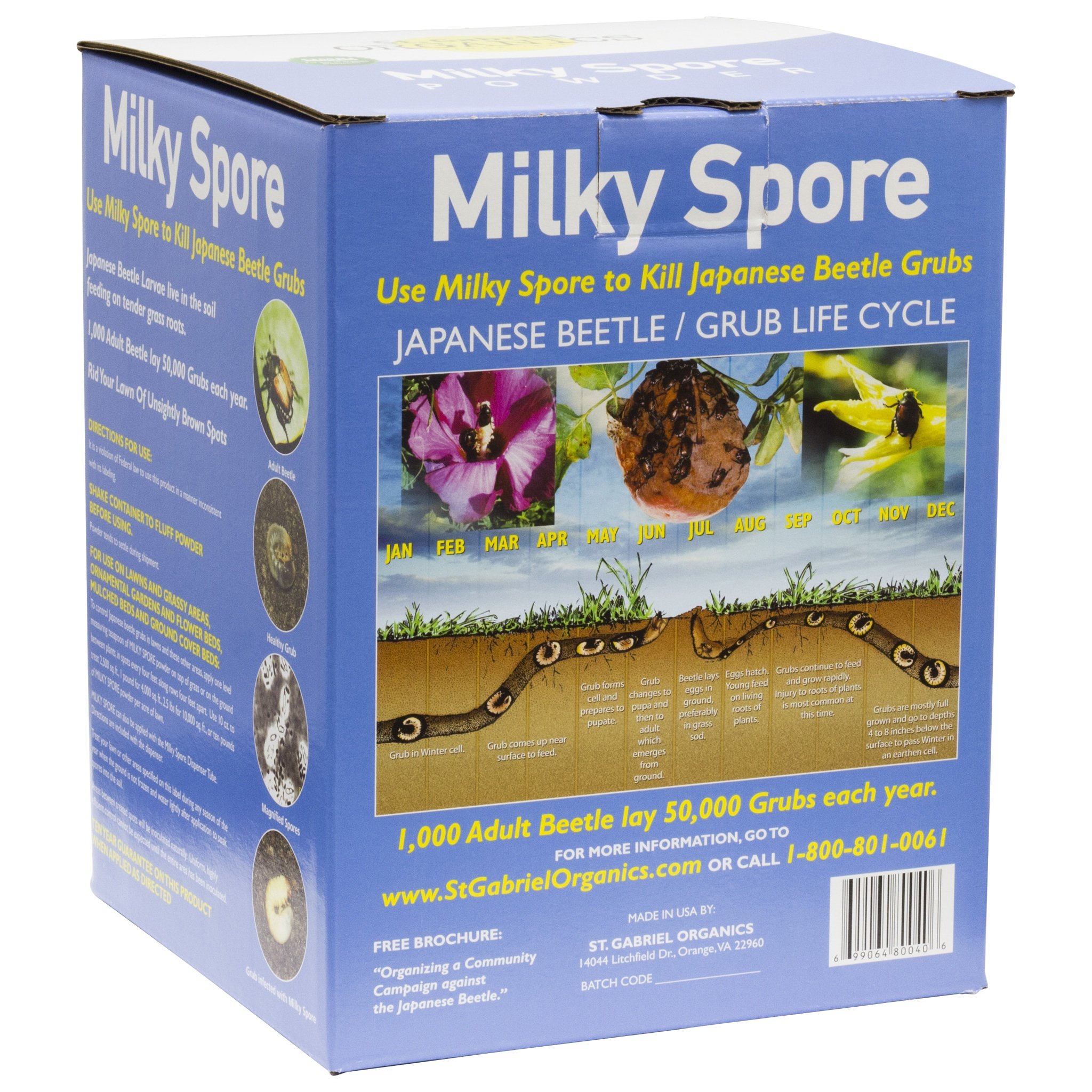
The natural grub killer that keeps working for years without harming your soil life.
This powder uses Bacillus popilliae, a natural bacterium that infects Japanese beetle grubs as they feed in the soil. Once the spores multiply, they stay active in the ground for season-after-season protection — you do not need to reapply every year. A single 10-ounce bag covers up to 2,500 square feet, and you apply just 1 teaspoon every 4 feet along rows.
Buyers report that milky spore killed grubs without harming beneficial soil organisms like worms or fireflies. The main trade-off is that it only targets grubs — it will not control adult beetles that fly in from neighboring properties. It weighs 0.7 pounds versus the 15-pound granular version, so this is more portable but covers a smaller area per bag.
The powder is safe to use around pets, beneficial insects, and food crops. One reviewer noted the instructions are not in the bag, so check online before applying. Once watered in, the bacteria need soil temperatures above 50°F to activate.
milky spore powder: For a gardener who wants to stop next year’s beetles without spraying chemicals, this powder builds lasting protection in the soil.
slow acting: The biological action is not instant — you must wait for the spores to build up, and it does nothing against adult beetles already in your trees.
organic long-term: you want a natural, safe, long-term grub solution and can plan ahead for next season.
immediate results: you need an immediate fix for adult beetles swarming your plants right now.
2. Ortho Bug B Gon Insect Killer for Lawn and Gardens Concentrate

The multipurpose spray that wipes out adult beetles and 234 other pests on contact.
This liquid concentrate kills 235 listed insects, including spiders, ants, fleas, ticks, mosquitoes, and of course Japanese beetles. A single 32-fluid-ounce bottle makes up to 42 gallons of spray, so it goes a long way. Use it on lawns, around house foundations, on roses, ornamentals, flowers, trees, shrubs, and even vegetable gardens.
Owners mention that a single annual spray at a cabin eliminates mosquitoes for 2-3 months. For Japanese beetles, you spray directly onto the leaves and flowers where they feed. It provides up to 6 months of protection for spiders (excluding black widow, brown recluse, and hobo spiders) when applied correctly.
The trade-off is that this is a broad-spectrum chemical spray, so it will kill beneficial insects too if they contact the treated surfaces. It is best used as a perimeter and foliar treatment rather than a grub control in the soil.
fast chemical control: When adult beetles are already eating your plants, this concentrate hits them fast and covers a wide area.
broad spectrum: Use it selectively and only on target plants to avoid harming pollinators that visit after the spray dries.
quick knockdown: you want one product that handles Japanese beetles plus mosquitoes, ants, and ticks around your whole yard.
eco-friendly: you prefer an organic approach or need a grub-specific treatment for next year.
3. Monterey Once A Year Insect Control II
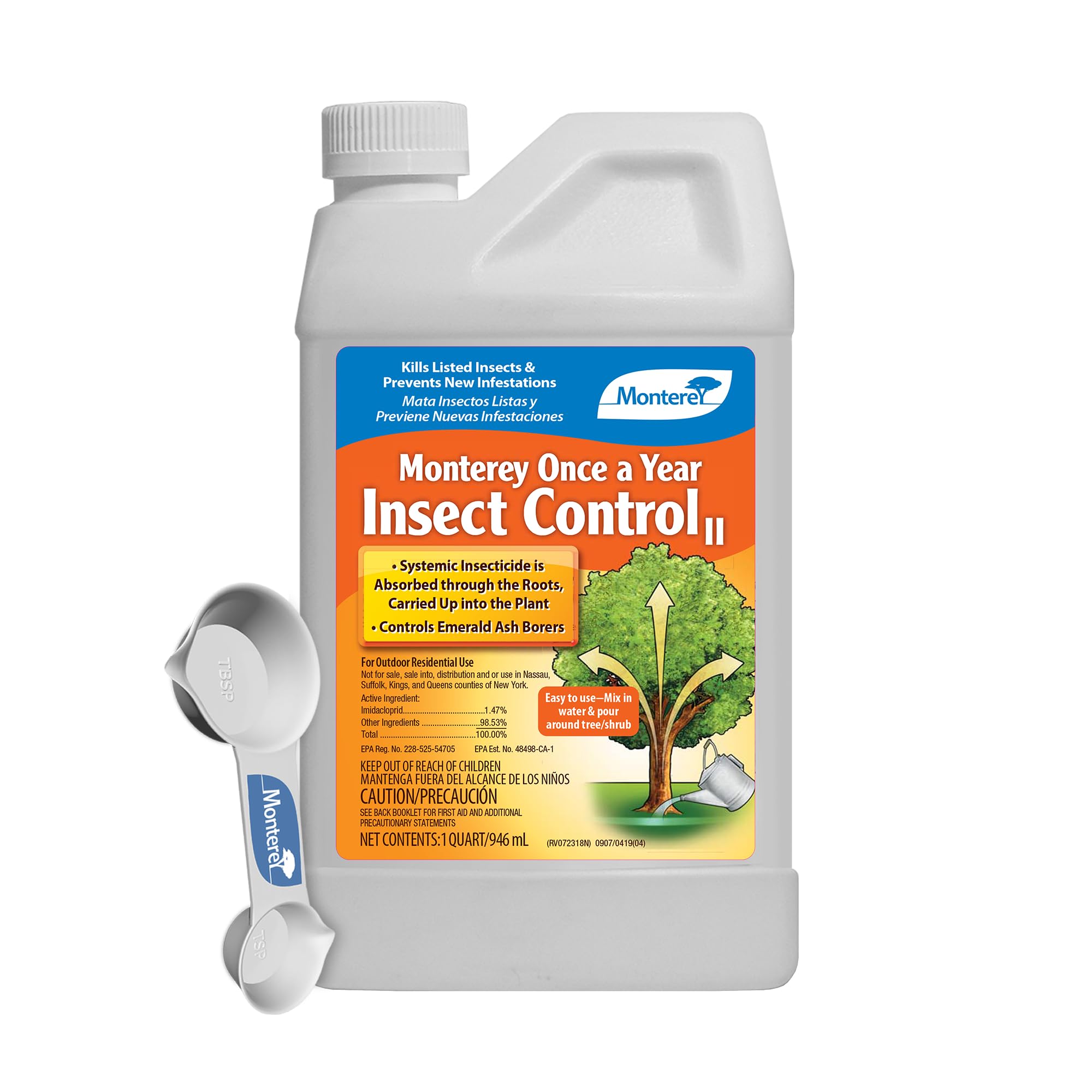
The systemic that moves through the whole tree, protecting new growth from beetles and borers.
This is a systemic insecticide — you mix it in a bucket of water and pour it around the roots of your trees and shrubs. The plant absorbs it through the roots, and it moves up into every leaf and branch, including new growth. It targets adelgids, aphids, leaf beetles, leafhoppers, mealy bugs, scale, whiteflies, borers, and Japanese beetles.
Customers note that a nursery recommended this product, and it eliminated borers and scale within days, with no new infestations in 9 months. One quart makes enough to treat several mature trees for a full year. It is designed for outdoor trees and shrubs including apple, loquat, pear, pecan, crabapple, mayhaw, and quince.
The catch is you must read the label carefully for mixing rates — one buyer received a defective bottle that had curdled from freeze-thaw damage, so inspect the emulsion before use.
year-long protection: For a prized Japanese maple or fruit tree that gets ravaged every year, this one root drench provides year-long protection.
soil check needed: Inspect the liquid for clumping, and always measure precisely to avoid runoff into unintended areas.
single application: you have valuable trees or shrubs that suffer from Japanese beetles, borers, or scale every year.
flexible timing: you need to protect a lawn area or vegetable garden where root drenching is impractical.
4. Pro Grub Control – 32oz (Liquid Harvest)

The professional-grade chemical that hits grubs, aphids, and adult beetles with one powerful active ingredient.
This concentrate packs 21.4% imidacloprid, a well-known systemic insecticide that works on contact and through ingestion. It is labeled for turfgrass, foliar spray on ornamentals, and soil drench for trees and shrubs. At 32 fluid ounces, a single bottle drenches multiple plants over several treatments — one buyer mentioned they probably have a lifetime supply for their hemlocks.
Reviewers point out it is economical compared to local retailer alternatives, but they also mention it takes a couple of weeks to see full results — “seems to be working, but it’s been two weeks, still have a ways to go,” one owner reported. For turfgrass, use up to 0.6 fluid ounces per 1,000 square feet. For a soil drench on a tree, mix up to 0.4 fluid ounces in a gallon of water per inch of trunk diameter.
The main drawback is the bottle design — buyers find it not very user-friendly and recommend double-gloving and wearing long sleeves when handling it.
liquid grub killer: if you need a lawn grub treatment, a foliar spray, or a soil drench, this concentrated formula does all three jobs.
toxic to bees: The imidacloprid is strong, so use full protective gear and read the label rates for each specific pest.
targeted use: you want a single concentrated product that can switch between turf, foliar, and soil applications.
safe for pets: you prefer a natural or non-chemical approach, or if you want an instant-results spray.
5. St. Gabriel Organics – 15 Pound Milky Spore Granular

The giant granular bag that protects a whole acre of lawn for up to 15 years.
This is the same milky spore concept as the powder, but in a 15-pound granular form that contains 240 ounces, versus 10 ounces for the powder. You apply it with a standard lawn spreader, which makes it far more practical for large lawns. It uses the same natural Bacillus popilliae bacteria and is USDA-certified organic and non-toxic.
Shoppers say it is very easy to use — just put it in a spreader — and they saw only one beetle after a spring application. Some note the granules can clog a spreader at lower settings; one reviewer used a setting of 4-1/2 instead of the lower number. The manufacturer claims up to 15 years of protection once established in the soil.
Because this is a biological product, you must apply it multiple times (3 times per year for 2 years is a common recommendation) to build a strong spore population that self-replenishes. It is harmless to wildlife, pets, and other insects.
granular organic: If you have a large property and want a hands-off natural solution, this granular spreader-friendly bag is the most efficient way to go.
heavy coverage: You will need to reapply for two seasons before the spore population is fully established, and you still need to manage adult beetles flying in.
large lawns: you have over 10,000 square feet of lawn and want the most economical natural grub control per square foot.
small areas: you need instant results or only have a small garden — the powder is more practical for small areas.
Understanding the Specs
Active Ingredient
The chemical or biological agent that actually kills the insect. Milky spore uses Bacillus popilliae, a bacterium that infects grubs. Imidacloprid is a synthetic chemical that attacks the insect’s nervous system. Knowing the active ingredient tells you how fast it works, how long it lasts, and what safety steps you need.
Formulation Type
Whether the product comes as a powder, granules, or liquid concentrate. Powders and granules are soil-applied for grubs. Liquid concentrates can be mixed for foliar spray or soil drench. Each form suits a different part of your garden — spray for leaves, granules for soil, drench for tree roots.
FAQ
What is the best time to apply milky spore for Japanese beetles?
Will a spray kill adult Japanese beetles on contact?
How long does milky spore take to work?
Is imidacloprid safe for bees and pollinators?
Can I use a systemic insecticide on my vegetable garden?
Do granular products clog a broadcast spreader?
How many times a year should I apply grub killer?
Will any of these products kill other pests like mosquitoes or ticks?
What should I do if the milky spore bag does not have instructions?
Is it safe to use these products around pets and children?
Final Thoughts: The Verdict
Across the board, the pesticide for japanese beetles winner is the St. Gabriel Organics Milky Spore Powder because it solves the problem at the source — the grubs — using a natural, self-sustaining method that is safe for your yard. If you need to knock out adult beetles that are already eating your plants, grab the Ortho Bug B Gon Insect Killer. And for protecting a prized tree from the inside out, the standout is the Monterey Once A Year Insect Control II.
How We Picked
We do not accept paid placement. Every pick is matched to a real buyer and a real use-case; we do not hands-on test units.
Sources & Methodology
Specifications: manufacturer listings and product documentation. Review insights: verified customer reviews, as of July 2026. Pricing: not shown on this page (it changes often); check the current price via the retailer link.
As an Amazon Associate, Lawn Gear Lab earns from qualifying purchases. This does not affect which products we feature.