
Getting a peach tree to set heavy, sweet fruit starts with a feeding schedule that matches the tree’s demanding nitrogen-to-potassium curve. Most balanced all-purpose plant foods push vegetative growth at the expense of flowering — the wrong NPK ratio leaves you with a bushy tree and a handful of small, watery peaches.
I’m Rikta — the co-founder and writer behind Lawn Gear Lab. I deep-dive into soil science, compare NPK delivery mechanisms, and analyze hundreds of verified owner reports to identify which formulations actually shift leaf color and brix levels in stone fruit orchards.
This guide cuts through the bag-to-bag confusion to help you pick the right best peach tree fertilizer for your variety, soil type, and growth stage without wasting money on nitrogen bombs or overpriced boutique blends.
How To Choose The Best Peach Tree Fertilizer
Selecting the wrong peach tree fertilizer wastes time and can burn roots or push leaves at the expense of fruit. Focus on the delivery form, the specific NPK numbers for stone fruit, and the presence of secondary nutrients like calcium.
NPK Ratio: The Peach Sweet Spot
Peach trees need a middle-of-the-road nitrogen level (5 to 8), low phosphorus (2 to 4), and moderate to high potassium (4 to 8). Too much nitrogen produces excessive shoot growth, soft wood, and delayed fruit maturation. Potassium drives flower bud formation and fruit size. A ratio like 6-2-4 or 3-5-5 is ideal for established trees; a higher potassium tail number is better during fruit set.
Granular, Spike, or Liquid Delivery
Granular formulas (like 19-10-5 or 6-2-4) provide a slow, season-long release and are best broadcast under the canopy in early spring and again after harvest. Spikes (like 3-5-5) are mess-free and deliver nutrients directly to the root zone without runoff, but they require careful spacing to avoid root burn. Liquid concentrates offer fast correction of visible deficiencies (yellowing, slow growth) but need repeated applications every 2-4 weeks during active growth.
Calcium and Micronutrient Content
Peach trees are prone to split pits and brown rot when calcium levels are low. Look for fertilizers with added calcium (listed as Ca on the label) or a separate calcium supplement. Organic sources like bone meal, langbeinite, and kelp meal supply the trace minerals (zinc, manganese, iron) that keep foliage dark green and fruit firm.
Quick Comparison
On smaller screens, swipe sideways to see the full table.
| Model | Category | Best For | Key Spec | Amazon |
|---|---|---|---|---|
| Dr. Earth Natural Wonder Fruit Tree | Organic Granules | Non-GMO purity & pet safety | Non-GMO Project Verified | Amazon |
| Espoma Organic Tree-Tone 6-2-3 | Organic Granules | Shade & fruit trees, spring/fall feed | Bio-tone formula + 5% Ca | Amazon |
| Down To Earth Fruit Tree 6-2-4 | Organic Powder | Backyard organic orchards | 6-2-4 + kelp & alfalfa meal | Amazon |
| Nelson NutriStar 12-10-10 | Granular | Citrus, stone fruit & avocado | 12-10-10 high-potassium blend | Amazon |
| Fertilome Fruit, Citrus & Pecan 19-10-5 | Synthetic Granules | Mature high-yield orchards | 19-10-5 + zinc for rosette | Amazon |
| Jobe’s Organics Fruit & Citrus 3-5-5 Spikes | Organic Spikes | No-mess targeted root feeding | 3-5-5 time-release organic spikes | Amazon |
| TPS Nutrients Peach Tree Liquid 32oz | Liquid Concentrate | Quick green-up & deficiency fix | 2 tbsp/gal liquid concentrate | Amazon |
In‑Depth Reviews
1. Dr. Earth Natural Wonder Fruit Tree Fertilizer 25 lb

Dr. Earth’s Natural Wonder is the only Non-GMO Project Verified fertilizer on this list, handcrafted from human and feed-grade ingredients with no synthetic chemicals, GMO-infested chicken manure, or toxic fillers. The 25-pound bag delivers a broad spectrum of multi-minerals, proteins, carbohydrates, humic acids, and trace elements that build soil biology rather than just feeding the tree directly. Milo Shammas’s formulation is designed to create the healthiest rhizosphere possible for fruit and berry production.
Peach trees treated with this blend often show deeper green leaf color within a week and improved flower bud count the following spring. Owners consistently report faster growth after transplanting and noticeably richer fruit flavor compared to synthetic alternatives. The slow-release organic granules require spring and fall application, but they feed the soil microbiome — a long-term advantage for perennial orchards that rely on consistent annual yields.
The main drawback is the cost per pound, which runs well above standard organic granulars. A single bag covers multiple trees for a season, but the upfront investment is steep for a single backyard peach tree. Some users also note that the bag size (25 lb) is physically smaller than expected for the price, though the concentration of active ingredients is higher than commodity blends.
What works
- Highest purity certification (Non-GMO, OMRI, CCOF) for organic growers
- Rich in trace minerals and humic acids for long-term soil health
What doesn’t
- Premium price point is hard to justify for a single tree
- Bag feels smaller than expected for the cost
2. Espoma Organic Tree-Tone 6-2-3 (Pack of 2)
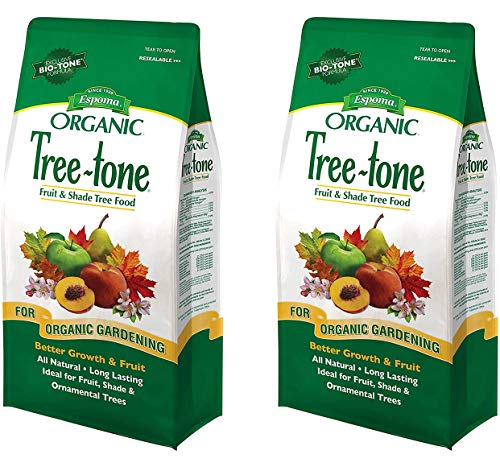
Espoma’s Tree-Tone has been a staple in the organic tree care market for decades, and the 6-2-3 NPK ratio combined with 5% calcium makes it an excellent match for peach trees. The Bio-tone formula includes beneficial microbes that help break down organic matter at the root zone, improving nutrient uptake. This is a ready-to-use, no-mix granular that works for all shade, fruit, and ornamental trees — including peach and apple.
Verified buyers consistently report visible leaf-out improvements within one week of early-spring application, especially on slow-to-leaf trees. The two-bag pack provides 8 total pounds, which is enough for one mature peach tree or two younger specimens across the spring and fall feeding windows. The organic composition means no chemical smell, no risk of synthetic runoff, and it is safe to use around pets when lightly worked into the soil.
A few owners noted that dogs are attracted to the organic smell and may dig up and eat the granules, causing vomiting. The fix is simple: water the product in lightly or bury it under a thin layer of soil after broadcasting. This is a minor nuisance for an otherwise reliable, affordable organic that delivers exactly the nutrient package a peach tree needs.
What works
- Proven Bio-tone microbial enhancer speeds leaf-out
- Calcium content helps prevent split pits and brown rot
What doesn’t
- Organic smell can attract digging dogs
- Small bag size requires multiple purchases for larger orchards
3. Down To Earth Fruit Tree 6-2-4 (5 lb)

Down To Earth’s Fruit Tree blend uses a 6-2-4 NPK ratio sourced from feather meal, fish bone meal, langbeinite, potassium sulfate, alfalfa meal, and kelp meal. This is a pure organic powder with no synthetic carriers or GMO ingredients, and it is listed by OMRI for organic production. The calcium carbonate addition supports fruit firmness and storage life — a critical detail for peach crops destined for canning or fresh eating.
Growers report that this formula revived crabapple and peach trees after frost damage, with visible leaf recovery and renewed fruiting within two growing seasons. The 5-pound box is compact but concentrated; a little goes a long way when broadcast under the drip line. Because it is a dry powder with no mixing required, application is straightforward — just scatter and water in. The product has an indefinite shelf life if stored in a cool, dry place, making it a practical pantry staple for orchard owners.
On the downside, the box is just 5 pounds — heavier users will need multiple boxes for large orchards, which pushes the effective cost higher than bulk granular options. The fine powder consistency can also drift in windy conditions during application, making it less ideal for open field work.
What works
- Clean organic ingredient list with kelp and alfalfa meal
- Indefinite shelf life in cool storage — no expiration worry
What doesn’t
- Powder can drift in wind during application
- Small 5-pound box requires repurchase for multiple trees
4. Nelson NutriStar 12-10-10 (2 lb)
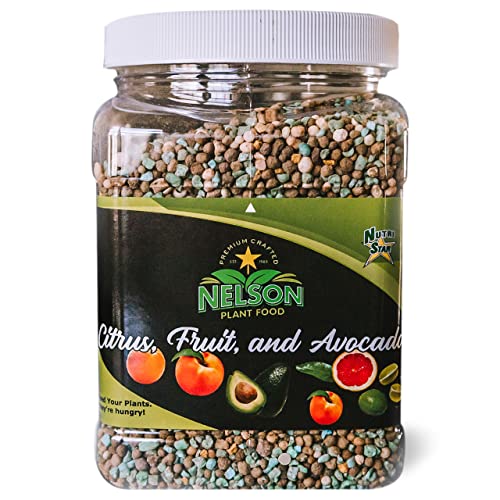
Nelson’s NutriStar 12-10-10 pushes a higher nutrient concentration than the organic options, with 12% nitrogen, 10% phosphate, and 10% soluble potash — plus added calcium for trunk and limb strength. This is a synthetic granular formula designed for citrus, avocado, and stone fruits including peaches. The high potassium content is particularly useful for helping peach trees survive colder winter temperatures and for boosting fruit set.
Verified owners note immediate green-up after application, and many report a full flush of new leaves within two months on trees that were struggling. The every-30-day feeding schedule during the growing season is straightforward, and the 2-pound bag can cover several container-grown or in-ground trees. Nelson has built a reputation as a landscaper’s choice brand for over 30 years, so the formulation is vetted for commercial-level performance.
The main limitation is that this is a synthetic fertilizer, so it does not feed soil biology the way organic options do. Over-application can lead to salt buildup in the root zone, and the 12-10-10 ratio is more nitrogen-heavy than ideal for mature peach trees that have already established canopy. It works best as a boost for young trees or those showing nitrogen deficiency symptoms.
What works
- Fast-acting nitrogen drives rapid green-up and leaf growth
- High potash content supports winter hardiness and fruit set
What doesn’t
- Synthetic formula doesn’t improve long-term soil biology
- Risk of salt buildup if over-applied to container trees
5. Fertilome Fruit, Citrus & Pecan Tree Food 19-10-5 (16 lbs)
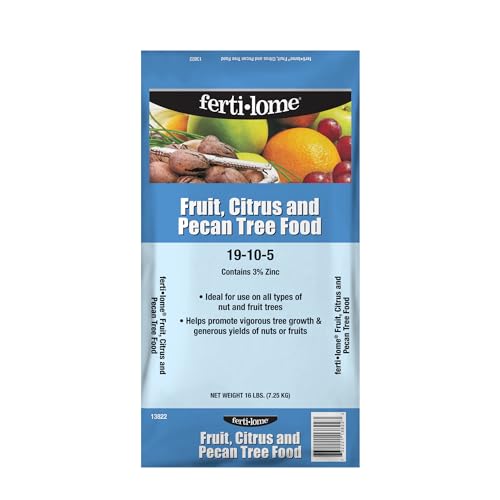
Fertilome’s 19-10-5 is a high-nitrogen synthetic granular designed for mature fruit, citrus, and nut trees that need a dense feeding program. The 19-10-5 analysis delivers a large nitrogen hit for canopy expansion, while the added zinc controls rosette — a common issue in pecan trees that can also affect stone fruit. This is a specialized commercial-grade product for growers who want a single bag that covers multiple tree types across a large property.
Longtime users report feeding peach and cherry trees with Fertilome for over 20 years with consistent yields. The16-pound bag is the largest volume option in this guide, making it the most economical for owners of multiple trees or small home orchards. Application is twice per year (spring and fall) with simple granular broadcast under the drip line.
The 19-10-5 ratio is very nitrogen-heavy. For established peach trees that already have full canopies, this level of nitrogen can push excessive vegetative growth at the expense of flower buds and fruit quality. It is better suited to young, fast-growing trees or those recovering from stress. The synthetic nature also means it provides no long-term organic matter or microbial benefit to the soil.
What works
- Best value per pound for multi-tree feeding
- Zinc additive helps prevent pecan rosette and similar issues
What doesn’t
- High nitrogen can reduce fruit set on mature peach trees
- Synthetic formulation offers no soil-building benefit
6. Jobe’s Organics Fruit & Citrus 3-5-5 Spikes (3 Pack)

Jobe’s Organics Spikes deliver a 3-5-5 NPK ratio that prioritizes phosphorus and potassium over nitrogen — exactly what a flowering and fruiting peach tree needs once it has established canopy. Each spike is pre-measured, OMRI listed, and contains Jobe’s proprietary Biozome archaea that aggressively breaks down organic material for faster nutrient release. There is no measuring, mixing, or broadcasting involved: just hammer the spikes into the soil around the drip line.
Owners who use these on potted Meyer lemon trees and in-ground heritage apple trees report visible growth improvement after following the correct spacing guidelines (placement too close to the trunk can cause initial leaf burn). The time-release design prevents waste and runoff, making it ideal for environmentally conscious backyard growers. The three-pack provides 18 total spikes, enough for three small to medium peach trees for one season.
The spikes are more expensive per feeding than granular bags, and they cannot be customized for partial feeding. If your soil test shows a specific deficiency in calcium or micronutrients, the spikes do not allow you to supplement those elements separately. They also require proper timing (late fall or early spring) and placement (at least 18 inches from the trunk) to avoid root burn.
What works
- No-mess application with pre-measured spikes
- 3-5-5 ratio is perfectly balanced for fruit set on mature trees
What doesn’t
- Higher cost per feeding compared to bulk granulars
- Placement and timing are critical to avoid root burn
7. TPS Nutrients Peach Tree Liquid 32 oz
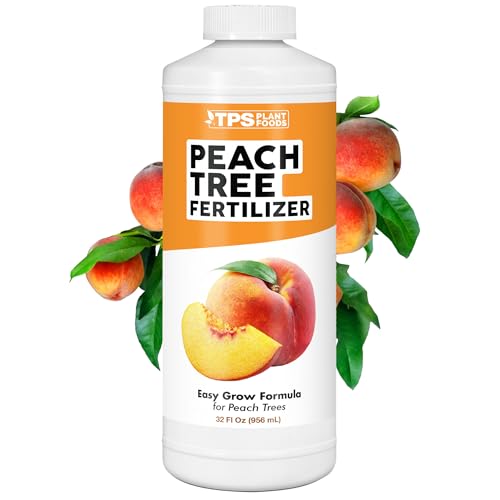
TPS Nutrients formulated this liquid specifically for peach and stone fruit trees, with a feeding schedule of 2 tablespoons per gallon of water applied every two to four weeks during the growing season. It is a fast-acting liquid concentrate designed to correct visible deficiencies — especially yellowing leaves, slow growth, and poor flower set. One 32-ounce bottle makes up to 18 gallons of finished solution, suitable for several trees.
Verified buyers report dramatic results: a potted peach tree with yellow, droopy leaves turned green and perked up within four days of the first application. Another user revived a crabapple tree suffering from apple scab after two applications spaced eight weeks apart. Because it is applied as a soil drench, the nutrients are available to the roots immediately — great for trees that need a rescue feeding or are showing stress after transplanting.
The liquid form requires repeated applications throughout the season, which means more labor than a single granular application. It also has no residual soil-building effect; the organic matter and microbial additions found in granular organics are absent. If you forget to reapply every 2-4 weeks, the tree can slip back into deficiency faster than it would with a controlled-release spike or granular.
What works
- Fast visible recovery for leaf yellowing and stress
- Specifically formulated for peach/nectarine stone fruit
What doesn’t
- Requires frequent reapplication every 2-4 weeks
- No long-term soil biology improvement
Hardware & Specs Guide
NPK Ratio Interpretation
The three numbers on every bag stand for Nitrogen (N), Phosphorus (P), and Potassium (K). For peach trees, a ratio with lower N (3-8) and equal or higher K (4-8) is ideal. High N like 19-10-5 pushes leaves; a 3-5-5 or 6-2-4 pushes fruit. Always read the guaranteed analysis, not just the marketing copy. A bag labeled “for fruit trees” might still be N-heavy if intended for citrus.
Organic vs Synthetic Delivery
Organic inputs (feather meal, bone meal, kelp) release nutrients slowly as soil microbes break them down. They improve cation exchange capacity and water retention over time. Synthetics (ammonium nitrate, potassium chloride) are immediately plant-available but can leach out of the root zone and deplete organic matter. For peach trees in sandy soil, organics are gentler; for clay-heavy soil, synthetics can work faster but risk salt accumulation.
FAQ
How often should I fertilize a mature peach tree?
Can I use a general fruit tree fertilizer on peach trees?
Final Thoughts: The Verdict
For most gardeners, the peach tree fertilizer winner is the Espoma Organic Tree-Tone because it provides the perfect 6-2-3 ratio with added calcium and beneficial Bio-tone microbes at a fair price. If you want the absolute highest organic purity and non-GMO certification, grab the Dr. Earth Natural Wonder. And for a zero-mess, pre-measured option ideal for container-grown peach trees, nothing beats the Jobe’s Organics 3-5-5 Spikes.