
The crackle of powdery mildew spreading across your prized tomato leaves is a sound no gardener wants to imagine. Choosing the wrong organic pesticide wastes your time, harms beneficial insects, and leaves your plants vulnerable to the very diseases you set out to stop.
I’m Rikta — the co-founder and writer behind Lawn Gear Lab. My process involves dissecting the active ingredient ratios, cross-referencing OMRI and EPA listings, and analyzing hundreds of verified owner experiences to find the formulations that deliver real, repeatable results.
Whether you’re battling aphids on your roses or blight in your vegetable patch, this guide breaks down the seven most effective options to help you find the best organic pesticide for your specific garden challenge.
How To Choose The Best Organic Pesticide
Selecting an organic pesticide isn’t about grabbing the first bottle with a leaf on the label. You need to match the active ingredient to the specific pest or disease cycle you’re interrupting. Broad-spectrum claims sound appealing, but they can also harm pollinators if applied during bloom.
Match The Active Ingredient To The Problem
Copper octanoate (copper soap) is your go-to for fungal diseases like blight, powdery mildew, and peach leaf curl — it works by disrupting spore germination on leaf surfaces. Neem oil, especially cold-pressed formulations, smothers soft-bodied insects (aphids, mites, whiteflies) at egg, larval, and adult stages while also offering fungicidal properties. Spinosad targets chewing insects — caterpillars, thrips, leafminers, and beetles — by overstimulating their nervous systems. Peppermint oil-based sprays repel spiders and ants through strong aromatic disruption, but they lack the residual knockdown power for established infestations.
Understand Application Strategy
Concentrates offer better value per gallon but require precise mixing and a separate sprayer. Ready-to-use (RTU) bottles are convenient for spot-treating a few plants but become expensive for large gardens. Pay attention to the “pre-harvest interval” — some organic products allow spraying up until harvest day, while others require a waiting period. For fungal diseases, preventative applications timed before wet weather are far more effective than curative spraying after symptoms appear.
Check Certification & Safety Claims
OMRI Listing (Organic Materials Review Institute) verifies a product is allowed in certified organic production. USDA specification claims on conventional products may indicate ingredient safety standards without full organic certification. For indoor use around pets and children, look for EPA 25(b) minimum-risk ingredients — these exempt the product from full EPA registration because their active components (certain natural oils and soaps) pose minimal risk when used as directed.
Quick Comparison
On smaller screens, swipe sideways to see the full table.
| Model | Category | Best For | Key Spec | Amazon |
|---|---|---|---|---|
| Bonide Captain Jack Neem Max | Neem Oil | Multi-pest & fungal control | Cold Pressed Neem Oil, 16 oz RTU | Amazon |
| Fertilome Spinosad Concentrate | Spinosad | Chewing insects on fruit trees | Spinosad 0.5%, 32 oz Concentrate | Amazon |
| Athena IPM | Natural Oils | Indoor grow rooms & hydroponics | EPA 25(b) ingredients, 32 oz | Amazon |
| Bonide Captain Jack Copper Fungicide | Copper Soap | Fungal disease prevention | Copper Octanoate, 16 oz Concentrate | Amazon |
| DR EARTH Garden Insect Killer | Oil Blend | Soil drench systemic protection | 100% organic oil blend, 24 oz | Amazon |
| Fertilome Spinosad Soap RTU | Spinosad+Soap | Quick contact on soft-bodied pests | Spinosad 0.005%, 32 oz RTU | Amazon |
| Waspika Peppermint Oil Spray | Essential Oil | Indoor spider & ant repellent | Peppermint Oil, 16 oz RTU | Amazon |
In‑Depth Reviews
1. Bonide Captain Jack’s Neem Max, 16 oz Ready-to-Spray
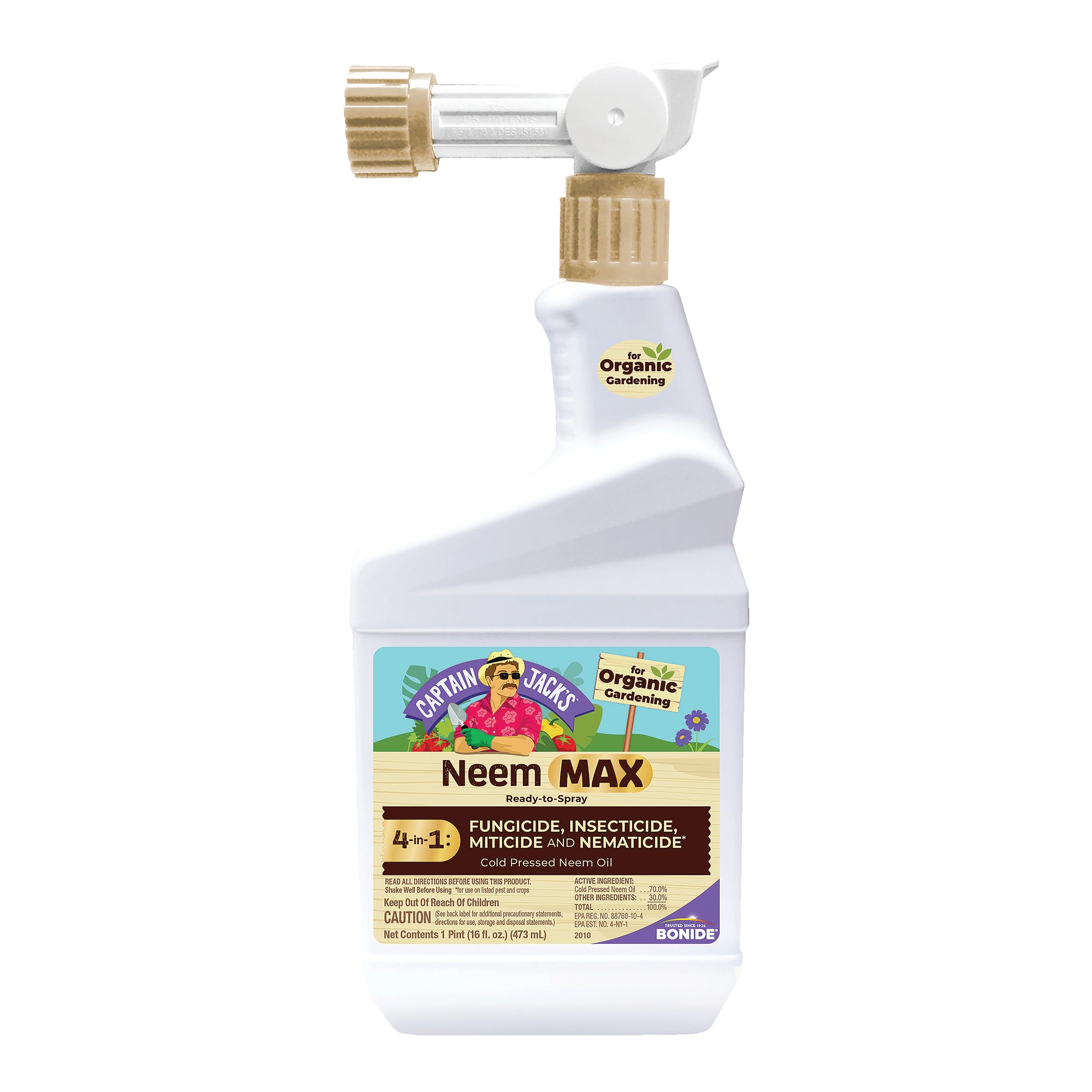
Captain Jack’s Neem Max occupies the premium sweet spot because it uses cold-pressed neem oil — the most biologically active form of neem — rather than the hydrogenated or clarified versions found in cheaper products. The azadirachtin content in cold-pressed neem disrupts the hormonal systems of insects at egg, larval, and adult stages, providing true four-way coverage as an insecticide, fungicide, miticide, and nematicide. The ready-to-spray hose-end format delivers the correct dilution automatically, eliminating the guesswork that plagues concentrate mixing.
Owner reports confirm its effectiveness against Japanese beetles on apple trees, with one user noting that a single bottle treated both the canopy and surrounding turf. Another grower revived over half a dead lawn within two days of application, attributing the recovery to the neem’s fungicidal action against root-level pathogens. The slight earthy scent dissipates quickly and doesn’t linger on edible crops.
The hose-end aspirator design requires careful handling — several users reported cross-threaded caps or leaking bottles upon arrival. If the bottle fails to aspirate properly, holding the bottle upside down to let gravity feed the tube resolves the issue. For gardeners with large yards, the 16-ounce concentrate may require multiple bottles for complete coverage across trees and lawns.
What works
- Cold-pressed neem oil retains maximum azadirachtin potency for life-cycle pest control
- Hose-end sprayer eliminates dilution errors and speeds large-area application
- Effective across four pest classes — insects, fungi, mites, and nematodes
What doesn’t
- Bottle leakage and cross-threaded caps reported in transit
- Hose-end aspirator can struggle with viscous oil — gravity-feeding may be required
- Single bottle may not cover extensive orchard or lawn areas
2. Fertilome (16063) Spinosad Insecticide Concentrate, 32 oz

Fertilome’s Spinosad concentrate is the definitive choice for gardeners who need sustained protection against chewing insects without reapplying after every rain. Spinosad is a naturally occurring soil bacterium metabolite that attacks the nervous system of caterpillars, thrips, leafminers, Colorado potato beetles, and bagworms — it remains active on leaf surfaces for five to seven days after drying. The 32-ounce bottle dilutes at 4 tablespoons per gallon of water, yielding roughly 30 gallons of finished spray, making it the most cost-effective option for orchards and large vegetable gardens.
Orchard owners report that this product prevents worms from affecting apple crops, significantly increasing usable yields for processing into butter and cobbler. Another long-term user applies it through a battery-operated backpack sprayer around the perimeter of the house and yard to suppress webworms, crickets, and ants, noting consistent results over several seasons. When combined with neem oil in an integrated pest management rotation, it covers both chewing insects and fungal threats without overlap resistance.
Spinosad can be toxic to bees if applied directly to open blooms or during active foraging hours — apply only in the early morning or evening when pollinators are less active. The concentrate requires a separate sprayer and careful measurement; the label lacks a built-in measuring cap, so keep a dedicated tablespoon on hand. Some users noted that the oil-based formulation can leave a slight residue on fruit if applied close to harvest without washing.
What works
- Five-to-seven-day residual activity reduces reapplication frequency
- Excellent cost-per-gallon value for large gardens and orchards
- Works synergistically with neem oil in broader IPM programs
What doesn’t
- Toxic to bees if sprayed on open flowers during daylight hours
- No measuring cap included — requires separate mixing equipment
- Oil residue may remain on fruit skins if applied near harvest
3. Athena IPM Plant Pest Control Solution, 32 oz
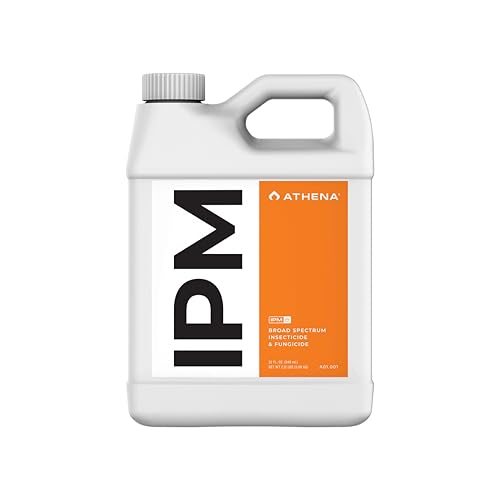
Athena IPM stands apart because it formulates its active natural oils under the EPA 25(b) minimum-risk exemption — meaning the ingredients are so low in toxicity that the product doesn’t require full EPA registration, yet it still delivers contact knockdown of spider mites, aphids, thrips, and powdery mildew. The concentrate dilutes with water in a standard pump sprayer, and the clear labeling eliminates the guesswork that frustrates indoor growers. Users describe the scent as pleasant and non-irritating, making it suitable for enclosed grow rooms and basement hydroponic setups.
Home growers in rural, high-pest-pressure areas report that Athena IPM is “the best of the best” for zapping mites that emerge from dormant stages in contaminated grow medium. One verified buyer with extensive indoor experience stated it was the final product they needed — they stopped searching after seeing complete elimination of pest pressure. The formula’s dual fungicidal and insecticidal action covers the two most common indoor garden crises: spider mites and powdery mildew, which often appear together in humid conditions.
As a contact spray, Athena IPM has no systemic activity — it must directly hit the pest to work, requiring thorough coverage of leaf undersides and stem crevices. The 32-ounce concentrate treats a moderate number of plants; heavy infestations may exhaust the bottle quickly. Some users found that while it kills adult mites on contact, a follow-up application 7 days later is necessary to catch newly hatched eggs.
What works
- EPA 25(b) minimum-risk ingredients are safe around pets and children when used as directed
- Instant contact kill on spider mites, aphids, and thrips
- Pleasant scent and clear mixing instructions suit indoor grow environments
What doesn’t
- Contact-only action requires thorough spray coverage to be effective
- No systemic or residual activity — eggs may require follow-up treatments
- 32-ounce concentrate may be insufficient for large-scale outdoor gardens
4. Bonide Captain Jack Copper Fungicide, 16 oz Concentrate

Copper octanoate, the active ingredient in this Bonide concentrate, is specifically formulated to bind to leaf surfaces and release copper ions that inhibit fungal spore germination — it’s the go-to preventative for blight, black spot, powdery mildew, and peach leaf curl on fruit trees, ornamentals, and vegetables. Because copper soap is a contact fungicide, it must be applied before infection takes hold; once powdery mildew colonies are visible, the product stops further spread but won’t reverse existing damage. The 16-ounce concentrate mixes with water at a rate that covers a medium-sized garden, and the USDA specification ensures it meets federal standards for organic production.
Tomato growers in the humid Southeast report that applying this concentrate four times per week (as recommended for active outbreaks) completely eliminated blight and powdery mildew across the season, with fewer leaves requiring removal compared to aggressive pruning or baking soda solutions. Redbud tree owners in North Carolina use it as a seasonal preventative against fungal colonization during hot, humid summers — one bottle lasts a full season. The product is also approved for use up until harvest day, which is critical for vegetable gardeners who need late-season disease control without sacrificing their crop.
Over-application risks leaf burning, particularly under full sun or on tender new growth — the label instructions for dilution must be followed exactly. The bottle lacks a built-in measuring cap, requiring a separate mixing tool. The copper smell, while not overpowering, is distinct and may be noticeable on foliage for a day after application.
What works
- Copper octanoate provides reliable preventative protection against major fungal diseases
- Approved for application up to and including harvest day
- One bottle lasts a full season for typical home garden use
What doesn’t
- Leaf burn risk if over-applied or used under intense sunlight
- No measuring cap included — separate measuring tool required
- Contact-only action — cannot cure established fungal infections
5. DR EARTH INC Dr. Earth 1022 Garden Insect Killer, 24 oz

Dr. Earth 1022 is unique among organic pesticides because its mode of action relies on a soil drench — you apply it to the root zone, and the plant absorbs the oil blend systemically, making the entire plant unpalatable to sucking and chewing insects. This approach eliminates the need for perfect spray coverage and protects new growth as it emerges, which foliar sprays cannot do. The 100% organic and natural crafted blend targets thrips, mealybugs, fungus gnats, aphids, scale, and even deters field mice and flies when applied per instructions.
Verified users report elimination of aphids and thrips overnight after a single soil application on severely infested houseplants and outdoor tomatoes. One grower who was ready to abandon gardening after squash bugs and aphids decimated their crop found that Dr. Earth not only resolved the infestation but also left the soil microbiome visibly healthier. The product has the most pleasant scent of any insecticide on this list — a light botanical aroma that doesn’t signal “chemical” to your nose.
Rain washes the systemic protection away quickly — users note that the product is effective only until the next significant rainfall, at which point reapplication is necessary. It is ineffective against hard-shelled beetles (cucumber beetles) and slugs, which require a different mode of action. The oil blend also displayed poor adhesion on waxy cabbage leaves, rolling off instead of absorbing, and leaving the plants vulnerable to subsequent insect attacks.
What works
- Systemic soil drench protects entire plant including new growth
- Pleasant botanical scent — no harsh chemical smell during application
- Effective against a wide range of soft-bodied insects and soil gnats
What doesn’t
- Rain quickly washes away systemic protection — frequent reapplication needed
- Ineffective against hard-shelled beetles, slugs, and waxy-leaf crops
- Poor adhesion on cabbage-family plants — slides off without penetrating
6. Fertilome (16076) Spinosad Soap Insecticide RTU, 32 oz

Fertilome’s ready-to-use Spinosad Soap combines the neurotoxic action of Spinosad (0.005%) with potassium salts of fatty acids (0.940%) that break down the waxy outer cuticle of soft-bodied insects on contact. The soap component provides instant knockdown, while the Spinosad delivers residual protection for days afterward. This dual-action formula is particularly effective against thrips, aphids, caterpillars, and leafminers, with the potassium soap also acting as a spreader-sticker that improves coverage on slick leaf surfaces.
Gardeners treating thrips report that this product became their “go-to” after just one application — pests that were visible on leaf undersides disappeared by the next morning. One user noted that rotating this RTU with a neem oil spray prevented insects from building resistance, a strategy that aligns with integrated pest management best practices. The trigger-spray bottle makes spot-treatment instant and precise, ideal for catching small outbreaks before they explode into full infestations.
The ready-to-use format becomes expensive for large gardens — you’ll drain this 32-ounce bottle quickly when spraying multiple raised beds or fruit trees. Because Spinosad can harm bees on contact, avoid spraying open flowers and apply only during early morning or evening. The bottle’s trigger mechanism produced uneven spray patterns for some users, requiring an extra pass to fully wet leaf undersides.
What works
- Potassium soap provides immediate contact kill while Spinosad offers residual control
- No mixing required — trigger-spray bottle targets specific outbreak zones
- Ideal for IPM rotation with neem oil to prevent resistance buildup
What doesn’t
- RTU bottle is cost-inefficient for large-area spraying
- Hazardous to bees if applied to open flowers during foraging hours
- Trigger nozzle may produce uneven spray coverage on leaf undersides
7. Waspika Peppermint Oil Insect and Spider Repellent Spray, 16 oz

Waspika’s Peppermint Oil Spray fills a specific niche: indoor perimeter defense where chemical residues are unacceptable. The formula relies on concentrated peppermint essential oil, which overwhelms the sensory receptors of spiders, ants, and roaches, causing them to avoid treated areas rather than killing existing populations. The 16-ounce RTU bottle is designed for baseboards, windowsills, door thresholds, and patio perimeters — it dries clear and leaves no greasy film or visible residue on surfaces.
Homeowners with children and pets appreciate that this spray reduces ant and spider activity after the first application without requiring evacuation of the treated room. The fresh peppermint aroma is described as crisp and pleasant, a stark contrast to the petroleum-based fumes of conventional indoor insecticides. One user noted that applying the spray to the outside of window sills created an effective barrier — spiders that previously congregated at entry points were noticeably absent after a few days.
This product is a repellent, not an insecticide — it won’t eliminate an established infestation of aphids, caterpillars, or fungal diseases. The peppermint oil evaporates relatively quickly, requiring reapplication every few days in high-traffic pest zones. Some users found the scent too strong in enclosed spaces, particularly if applied near seating areas or bedrooms where the menthol notes can be overwhelming.
What works
- Safe around children and pets when used as directed — no toxic residues
- Fresh peppermint scent improves indoor air quality compared to chemical sprays
- Dries clear and stain-free on baseboards, windowsills, and door thresholds
What doesn’t
- Repellent-only action — cannot treat established pest infestations
- Frequent reapplication required due to rapid oil evaporation
- Strong menthol scent may be overpowering in small or enclosed rooms
Hardware & Specs Guide
Active Ingredient Types
Organic pesticides rely on three primary active ingredient categories. Copper octanoate and copper soap compounds release copper ions that disrupt fungal spore germination on leaf surfaces — effective only as a preventative, not a cure. Neem oil (cold-pressed, clarified, or hydrogenated) contains azadirachtin that acts as an insect growth regulator and antifeedant across egg, larval, and adult life stages. Spinosad, derived from the soil bacterium Saccharopolyspora spinosa, overstimulates insect nervous systems and is most active against chewing pests like caterpillars, thrips, and leafminers. Essential oil formulations (peppermint, rosemary, clove) work primarily as repellents through sensory disruption rather than direct toxicity.
Application Format: Concentrate vs. RTU
Concentrates (Bonide Copper Fungicide, Fertilome Spinosad, Dr. Earth 1022) require mixing with water before use — they offer the lowest cost per gallon of finished spray and are essential for covering large gardens, orchards, or multiple raised beds. Ready-to-use (RTU) products (Fertilome Spinosad Soap, Waspika Peppermint, Bonide Neem Max hose-end) eliminate mixing errors and are convenient for small gardens or spot-treating specific outbreaks. The trade-off is cost: RTU formats typically cost 2–3x more per ounce of active ingredient. Hose-end sprayers (like the Neem Max) auto-dilute at a fixed ratio, simplifying large-area application but limiting control over concentration.
Certification Labels: OMRI, USDA, EPA 25(b)
OMRI Listing is the gold standard for certified organic production — it verifies that every ingredient in the product meets the National Organic Program’s strict criteria for allowed substances. USDA specification claims on non-OMRI products indicate the active ingredient itself meets federal purity standards, but the inert carriers and adjuvants may not be fully organic. EPA 25(b) exemption applies to products whose active ingredients (certain mineral oils, plant oils, and soaps) pose “minimum risk” to humans and the environment — these products are exempt from full EPA registration but are still regulated for labeling accuracy. Always check the label for your specific certification needs.
Mode of Action: Contact vs. Systemic
Contact pesticides (copper fungicides, Spinosad Soap RTU, Athena IPM, Waspika Peppermint) must physically hit the pest or disease to be effective — thorough coverage of leaf tops, undersides, stems, and soil surfaces is critical. Systemic pesticides (Dr. Earth 1022) are absorbed by the plant through roots or leaves and translocated throughout the tissue, protecting new growth and hard-to-reach areas. Systemic action is advantageous for sucking insects like aphids and thrips that feed on plant sap, but it provides no protection against external chewing that doesn’t ingest the treated tissue. Contact sprays typically require more frequent reapplication than systemic products, especially after rain.
FAQ
Can I use copper fungicide and neem oil together in the same spray tank?
How long should I wait after spraying Spinosad before harvesting vegetables?
Will organic pesticides kill beneficial insects like ladybugs and bees?
Why did my organic pesticide leave white or brown spots on my plant leaves?
How often should I reapply organic pesticide after rain?
Final Thoughts: The Verdict
For most gardeners, the best organic pesticide winner is the Bonide Captain Jack’s Neem Max because its cold-pressed neem oil formulation provides four-way protection (insecticide, fungicide, miticide, nematicide) in an easy hose-end spray format that covers multiple plant types and sizes. If you need targeted, long-lasting protection against chewing pests in your orchard, grab the Fertilome Spinosad Concentrate. And for indoor safety around pets and children, nothing beats the Waspika Peppermint Oil Spray for creating a pleasant, residue-free pest barrier.