
Specs are compiled from manufacturer listings and verified buyer reviews and can change over time — please confirm the key details on the product page before buying.
If you have ever stood in a garden center staring at bags of powder and granules, wondering why one says 5-1-1 and another says 3-4-4, you know the real problem: there is no obvious “right” bottle. The plants do not care about marketing promises — they care about nitrogen, phosphorus, and potassium numbers. Picking the wrong one can mean leggy tomato plants or a blueberry bush that refuses to fruit. This guide cuts through the alphabet soup of NPK ratios and lists only certified or clearly organic formulas that actually do what the label claims, so you stop burning money on bags that sit in the shed.
I’m Rikta — the founder and writer behind Lawn Gear Lab. This guide is built by comparing the manufacturers’ published specifications and the patterns across verified customer reviews, so you get each pick’s real strengths and trade-offs instead of marketing spin.
Whether you are feeding a backyard vegetable patch, coaxing roses into a second bloom, or saving a struggling blueberry bush, these picks cover your soil without synthetic chemicals. This is your real-world shortlist for the best organic garden fertilizer that delivers healthy results you can actually see.
Our Picks at a Glance


How To Choose The Best Organic Garden Fertilizer
The first rule is simple: match the NPK ratio to what your plants actually need at that moment. A 5-1-1 mixture is heavy on nitrogen, which pushes leafy green growth. A 3-4-4 blend shifts focus to phosphorus and potassium, which boost flowers and fruits. Using the wrong ratio is like feeding a runner a Thanksgiving dinner the night before a sprint.
Liquid vs Granular: The Texture Trade-Off
Liquid options, like the fish-emulsion bottles, deliver nutrients fast. Your plants absorb them almost immediately through the roots and leaves. The catch is that liquids require mixing and reapplication every few weeks. Granular formulas, by contrast, break down slowly into the soil. You sprinkle them once and let rain or watering do the work over a month. If you forget to water, the granules just sit there — they do not burn roots the way a concentrated liquid can.
The “Stink” Test for Real Organics
A genuinely organic fish fertilizer smells like fish. It is a pungent, unmistakable sign that the ingredients are whole and unprocessed, not chemically deodorized. If the bottle smells like nothing, the fish has been heavily treated or stripped of the micronutrients that make organic matter work. The smell disappears within a day or two after watering in. The same principle applies to blood meal and manure-based mixes: real organics have an earthy, sometimes sharp odor that tells you microbes are alive and working.
Quick Comparison
| Model | Best For | NPK Ratio | Form | Size | Amazon |
|---|---|---|---|---|---|
| The Grow Co Fish Fertilizer★ Best Overall | General garden & high yields | 2-3-1 | Liquid | 128 fl oz | Amazon |
| Espoma Garden-toneTop Performer | Vegetables, tomatoes & peppers | 3-4-4 | Granule | 2 x 4 lb | Amazon |
| True Organic Berry FoodSpecialty Pick | Acid-loving berries | 5-4-4 | Granule | 4 lb | Amazon |
| Down To Earth All Purpose | Versatile garden feeding | 4-6-2 | Granule | 5 lb | Amazon |
| FoxFarm Happy Frog | Container plants & ornamentals | 6-4-5 | Granule | 4 lb | Amazon |
| Great Big Roses Liquid | Blooms on roses & flowers | N/A | Liquid | 32 fl oz | Amazon |
| Alaska Fish Fertilizer | Lush foliage & green growth | 5-1-1 | Liquid | 115 fl oz | Amazon |
| Down To Earth Blood Meal | Heavy nitrogen for greens | 12-0-0 | Granule | 4 lb | Amazon |
| Espoma Land and Sea Compost | Soil amendment & transplants | N/A | Granule | 1 cu ft (24 lb) | Amazon |
In‑Depth Reviews
1. The Grow Co Organic Fish Emulsion Fertilizer
Our pick — over 4.5★ from 600+ verified ratings; the strongest balance of quality and price.
A single gallon that feeds over 160 gallons of garden with a single bottle.
You get more flowers and fruit without a leafy mess, thanks to the 2-3-1 NPK ratio (nitrogen-phosphorus-potassium) in this fish emulsion. Most fish fertilizers are heavy on nitrogen (the first number), which pushes leaf growth. This one gives you extra phosphorus (the middle number) to boost blooms and fruit development. It uses whole, sustainably sourced fish that are cold-pressed — a process that keeps natural vitamins, amino acids, and oils intact instead of cooking them out. Buyers report it smells less fishy than other emulsions, making it easier to use on patio plants.
The 1:100 mixing ratio means a single 128-fluid-ounce bottle makes over 160 gallons of finished fertilizer. That kind of coverage makes it a serious value for anyone with a mid-sized or larger garden. The smell is authentic — it is a fishy, pungent aroma because, as the brand puts it, “if it doesn’t smell, then it’s not real fish.” That smell fades after watering in, usually within a day.
Owners mention that it is thin enough to use in a sprayer without clogging, which solves the common problem of thick emulsions that gum up nozzles. The real draw, though, is the balance: it is gentle enough to use as a weekly feeding during the growing season, and the phosphorus content makes it ideal for boosting vegetable yields and flower counts.
What wins people over: The sheer versatility of the 2-3-1 ratio handles everything from leafy greens to fruiting crops without needing a second bottle.
The only honest trade-off: The fish smell is strong when applying — this is not a fertilizer for indoor plants or a balcony near an open window.
Grab this if: you want a single liquid feed that covers your whole garden — vegetables, fruits, flowers — without needing to buy separate blends for each crop type.
2. Espoma Organic Garden-tone 3-4-4
The granular workhorse that turned an urban plot into 400 pounds of tomatoes.
This is a dry, no-mix fertilizer that you simply sprinkle around the drip line of your plants once a month and water in. The NPK of 3-4-4 is ideal for vegetables and herbs because it prioritizes phosphorus and potassium, which drive flowering and fruit set, over nitrogen, which just makes leaves. It also contains 5% calcium — a detail that prevents blossom-end rot on tomatoes and peppers.
Espoma has been in the organic game since 1929, and the Garden-tone formula is built around their proprietary Bio-tone, a blend of beneficial microbes that help roots access nutrients more efficiently. One buyer in zone 10b reported that switching to this fertilizer kept annuals and vegetables thriving well into early September, yielding 400 pounds of tomatoes and 100 pounds of carrots in a small urban garden.
The use-case is straightforward: it works on cool-season crops like lettuce and kale, and on warm-season heavy feeders like tomatoes, peppers, squash, and melons. The granules have a mild earthy smell that disappears after watering — much less offensive than liquid fish emulsions.
The standout feature: The calcium content and Bio-tone microbes make this the go-to for preventing blossom-end rot, which is the single most common disappointment with homegrown tomatoes.
The catch: Granules require a few days to break down, so do not expect the instant green-up you get from a liquid feed.
Best for: vegetable gardeners who want a slow-release, monthly feed that builds soil health over a whole season.
3. True Organic Berry Food 5-4-4
The formula that brought a dying blueberry bush back to life.
Berry bushes are picky — they need acidic soil, and most general-purpose fertilizers raise the pH instead of lowering it. This bag solves that problem with added sulfur, which naturally reduces the soil pH so blueberries, raspberries, and strawberries can access the iron and other micronutrients they need. The NPK is 5-4-4, giving a solid nitrogen kick for foliage while keeping phosphorus high enough for fruit production.
The ingredient list reads like a marine biology class: seabird guano, shrimp shell meal, and crab shell meal. Those crustacean shells also contain chitin, which some gardeners find helps suppress soil-borne pests. The 4-pound bag covers 58 square feet when applied monthly during the growing season, making it easy to plan for a handful of bushes.
Customers note dramatic turnarounds: one blueberry bush that was dying after transplant — with brown leaves and dropping foliage — was back to pushing new green growth within days of application. Another owner noted that their raspberry and strawberry yields increased noticeably since switching to this brand.
What makes it unique: The built-in sulfur adjuster means you do not need a separate acidifier for blueberries — this one bag does both jobs.
The honest downside: It has a distinct natural odor (think fish and shellfish) that some gardeners find strong for a day or two after application.
Reach for this if: you grow any acid-loving plants — blueberries, raspberries, strawberries, or ornamentals like azaleas — and you want a targeted feed instead of guessing with a general mix.
4. Down To Earth All Natural All Purpose 4-6-2

A five-pound box of premium ingredients that replaces fifteen separate bottles.
This is the multi-tool of the organic fertilizing world. The ingredient list alone is impressive: fish bone meal, blood meal, feather meal, rock phosphate, langbeinite, greensand, humates, and kelp meal. Those are not fillers — each one brings a different mineral or micronutrient to the soil. The NPK of 4-6-2 leans heavily into phosphorus, which makes this excellent for heavy-feeding vegetables like tomatoes, peppers, and eggplants that need strong root systems and plenty of flowers.
It is OMRI-listed, meaning it meets the strict standards for organic production. One reviewer noted that a single 15-pound bag lasted them nearly a year and let them replace over a dozen separate products they had been buying. The granules are gentle — formulated to be non-burning, so even if you over-apply slightly, the risk of damaging roots is low.
The trade-off is the smell. It has a noticeable fishy odor when fresh, which buyers describe as “unpleasant but tolerable,” and it dissipates within a few days. A few gardeners also note that the smell can attract raccoons and other animals if not thoroughly watered in.
Why it stands out: The eight-ingredient formula provides a broader mineral spectrum than most all-purpose blends, which means fewer deficiencies over the season.
The real-world catch: It is a bit more expensive per pound than synthetic equivalents, though the organic ingredients justify the difference for organic gardeners.
Choose this if: you want a comprehensive, OMRI-certified granular feed that covers vegetables, flowers, container plants, and even trees from a single box.
5. FoxFarm Happy Frog All Purpose 6-4-5

Slow-release granules packed with living soil microbes for pots and raised beds.
If you grow leafy ornamentals or heavy-feeding vegetables in containers, this granular fertilizer delivers more nitrogen (the first number) than most other dry options here — its 6-4-5 NPK ratio (nitrogen-phosphorus-potassium) matches plants that need steady leaf growth. It also includes beneficial soil microbes and mycorrhizal fungi (living organisms that colonize the root zone and help roots absorb water and nutrients). This makes it a stronger pick than the Espoma Garden-tone for container gardeners who want a single product that feeds both the plant and the soil biology. Reviewers point out that it works well as a top-dress for potted tomatoes and peppers, though it needs monthly reapplication.
Shoppers say fast results: one owner noted that their yellowing tomato and zucchini plants revived within a week of application, and monthly feeding led to what they called their best garden ever. Happy Frog is also OMRI-listed, so it is safe for organic vegetable production. Users with container gardens and Green Stalk tower systems report great results, though they caution that dry powder can settle in watering caps.
The biggest downside is the smell — buyers describe it as a strong “manure-like” odor that can linger for days after watering, especially in containers kept on a patio or balcony. That is the price of using real organic matter in tight spaces.
The microbe advantage: The mycorrhizal fungi in this bag help container plants access nutrients more effectively than a simple NPK granular, which matters when you are confined to a pot.
The limitation: The strong manure smell makes it less ideal for indoor use or for gardeners who are sensitive to barnyard aromas.
Best for: container gardeners and raised-bed growers who want a gentle, microbe-boosted feed that works on vegetables, flowers, and ornamentals alike.
6. Great Big Roses and Flowers Liquid Booster
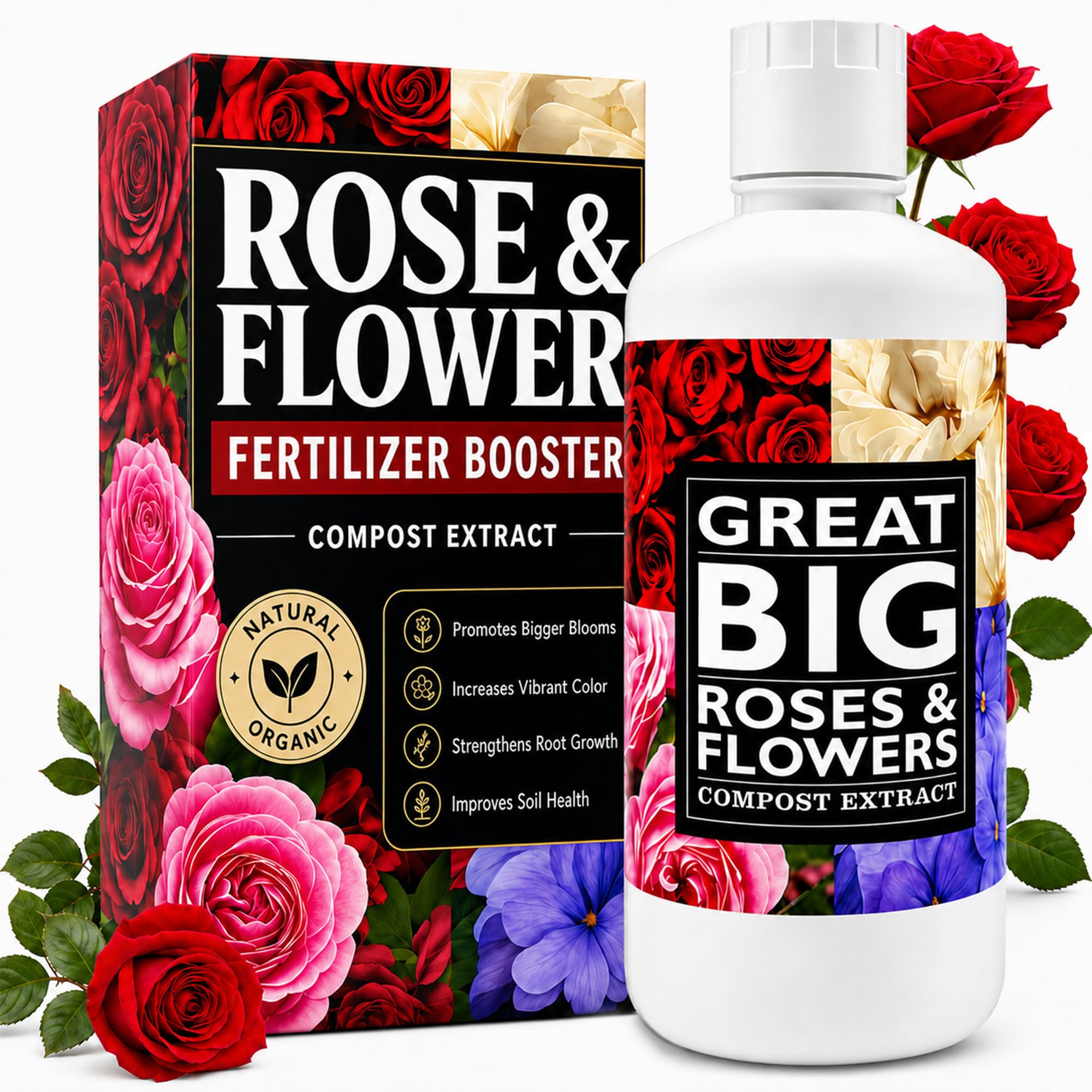
The liquid concentrate that woke up a rose bush that had not bloomed in years.
This is not a standard NPK fertilizer — it is a soil activator and bloom booster designed to work alongside whatever organic base you already use. The formula delivers humic acids, seaweed, chelated iron, and over 70 trace minerals directly to the root zone. Those minerals convert existing soil nutrients into forms the plant can actually absorb, which is why buyers report rose bushes that had not bloomed in years suddenly producing flowers within weeks.
Each 32-ounce bottle makes about 8 gallons of finished solution. The mixing ratio is 4 ounces per gallon of water, applied at the base of each plant. It works on roses, hydrangeas, citrus, hibiscus, fruit trees, and perennials. One long-term buyer shared that their roses showed early, abundant blooms even after a harsh winter, and the overall bush health improved steadily over three seasons.
The value question comes up honestly here: a single bottle is priced higher than a bag of granular all-purpose, and some gardeners find that the 8-application coverage feels lean for a large garden. But for rose enthusiasts who want to push maximum bloom performance, the results are hard to argue with.
The defining spec: The 70 chelated trace minerals and humic acids transform locked-up soil nutrients into plant-available food, which is a fundamentally different approach than adding more NPK.
The honest trade-off: It is expensive per bottle compared to all-purpose fertilizers, and you may need it alongside a base feed for complete nutrition.
Reach for this if: you are a rose or flower grower who wants to coax more blooms out of existing plants and you already have a basic fertilizer program in place.
7. Alaska Fish Fertilizer 5-1-1

A classic 5-1-1 fish emulsion that has been trusted by gardeners for over a decade.
Alaska’s fish fertilizer is the reference standard for a high-nitrogen organic feed. The 5-1-1 formula is all about pushing green growth — think leafy vegetables, lush foliage on ornamentals, and strong vegetative development before your plants shift into flowering. It is OMRI-listed, so it is certified for organic gardens, and it is made from whole fish that have been cold-processed to preserve the micronutrients that synthetic nitrogen lacks.
The gallon-sized bottle (115 fluid ounces) provides wide coverage, with the manufacturer stating it covers up to 1,000 square feet. Users apply it every three weeks during the growing season for best results. It is plant-safe when diluted, meaning it will not burn roots if you follow the mixing instructions, and it supports the microbial life in the soil by adding organic matter. The smell, as with all fish emulsions, is noticeable but owners mention that the deodorized formula of the Alaska brand dissipates faster than some competitors.
Buyers with over a decade of experience report using it on hundreds of plants with steady, reliable growth. The one caveat is the specificity: at 5-1-1, this is a nitrogen specialist. For blooming and fruiting stages, you will need a different feed or a supplement to provide the phosphorus and potassium that flowers demand.
The standout spec: The 5-1-1 NPK ratio delivers a high, fast-acting dose of nitrogen that greens up plants within a week — ideal for spinach, lettuce, and other leafy greens.
The practical limitation: The low phosphorus and potassium numbers mean you cannot rely on this alone for flowering vegetables like tomatoes and peppers — you will need to rotate with a higher-phosphorus feed.
Grab this if: your main goal is rapid green growth for foliage-heavy plants, leafy greens, or recovering plants that need a nitrogen boost early in the season.
8. Down To Earth Blood Meal 12-0-0

A 12-0-0 quick-release nitrogen that greens up plants in a matter of days.
Blood meal is the most concentrated organic nitrogen source you can buy, and at 12-0-0, Down To Earth’s version is a pure, potent feed for plants that need to go green fast. It is a granular product that breaks down quickly in moist soil — much faster than feather meal or alfalfa meal — so you see visible results in a week or two. This is the tool you reach for when corn stalks are pale, broccoli leaves are yellowing, or a spring lawn needs a wake-up call.
It is OMRI-certified for organic use, and the 4-pound box is a manageable size for smaller gardens. Customers note instant responses: one gardener noted “vigorous” vegetative growth on their plants within days, and another described how their “tomato” plants (the quotes in their wording) thrived during the vegetative stage. The granules are easy to apply dry, and there is no mixing or liquid handling involved.
The serious caution is nitrogen burn. Because it is so concentrated, applying too much can scorch roots. Buyers warn about the strong smell, which can attract animals like raccoons and dogs if not watered in thoroughly. A few owners also noted the box is physically small for the price, though the potency means you use less per application than with a 5-1-1 liquid.
The key spec: A 12-0-0 ratio gives you the fastest organic nitrogen fix available — ideal for correcting yellowing leaves in the middle of the growing season.
The major caution: Over-application burns plants, and the smell can attract curious animals, so precise measuring and deep watering are essential.
Best for: vegetable growers and gardeners who need a targeted, high-nitrogen organic solution for leafy greens, corn, and heavy-feeding plants during their vegetative phase.
9. Espoma Organic Land and Sea Compost

A lobster-and-crab-meal compost that gives new transplants a head start.
This is not a fertilizer in the traditional sense — it is a concentrated compost that you mix into the soil when planting or transplanting. The 1-cubic-foot bag weighs 24 pounds and is packed with lobster meal and crab meal, ingredients that add slow-release nitrogen and chitin (a natural compound that some gardeners believe supports soil biology). Espoma adds their proprietary Myco-tone, a blend of endo and ecto mycorrhizae, which are beneficial fungi that attach to plant roots and improve water and nutrient uptake.
The use case is straightforward: work a handful into the planting hole when putting in new plants or mix it into containers and window boxes to recharge tired potting mix. It works on vegetables, flowers, trees, and shrubs. Reviewers point out that hostas, in particular, respond dramatically well — one owner noted “extremely well” growth after using this at planting time.
The value discussion is real: for the bag size, it is the premium option on this list. Some buyers find it pricey compared to a standard bag of manure or mushroom compost. But for its intended role — giving high-value transplants a nutrient-rich, microbe-dense start — the results are difficult to replicate with a simpler product.
The stand-out feature: The lobster and crab meal provides a unique blend of trace minerals and organic matter that you cannot get from standard compost or manure.
The real-world trade-off: It is expensive for its bag size, so it makes the most sense for targeted planting holes and containers rather than amending a whole garden bed.
Reach for this if: you are installing new shrubs, trees, or perennials and want to give them the richest possible start with living mycorrhizae and marine-based nutrients.
Understanding the Specs
NPK Ratio — The Three Numbers That Tell Everything
The three numbers on any fertilizer bag (for example, 3-4-4) stand for nitrogen, phosphorus, and potassium — the primary nutrients plants need. Nitrogen fuels green leaves and stems. Phosphorus drives root growth, flowers, and fruit. Potassium supports overall plant health, disease resistance, and water regulation. A 2-3-1 ratio is a balanced feed with a slight push toward flowers; a 12-0-0 is pure nitrogen for a rapid green-up when leaves are yellowing. Matching the ratio to your plants’ current stage is the single most important skill in organic fertilizing.
Liquid vs Granular — Speed vs Longevity
Liquid fertilizers, like the fish emulsions on this list, are absorbed within hours and show results in days. They are best for quick corrections and weekly feeding schedules. Granular fertilizers, like the Espoma and Down To Earth products, need moisture and time to break down, feeding plants over weeks. They are easier to apply once and forget, and they are less likely to cause a burn if you accidentally over-apply. The trade-off is speed — a granule will not fix a nitrogen deficiency by tomorrow.
FAQ
Can I use organic fish fertilizer on my vegetable garden?
What does the NPK ratio 3-4-4 mean for my tomato plants?
Will my blueberry bushes need an acidifier if I use the True Organic Berry Food?
How often should I apply granular organic fertilizer to my garden?
Is it safe to use fish emulsion around my pets?
Can I mix granular and liquid organic fertilizers together?
What is the difference between organic and synthetic fertilizer?
How do I stop my organic fertilizer from smelling?
Is it necessary to use an OMRI-listed product for organic gardening?
How long does a bag of granular organic fertilizer last in storage?
Final Thoughts: The Verdict
For most gardeners, the organic garden fertilizer winner is the The Grow Co Fish Emulsion because its 2-3-1 NPK ratio (nitrogen-phosphorus-potassium) handles vegetables, fruits, and flowers from a single gallon bottle that stretches to 160 finished gallons. If you prefer the set-and-forget approach of a dry granular that feeds monthly, grab the Espoma Garden-tone, which has the calcium and Bio-tone microbes (beneficial soil organisms) that keep tomatoes and peppers thriving all season long. And for acid-loving blueberry bushes that need a pH adjustment alongside nutrients, the True Organic Berry Food is the one to reach for.
How We Picked
We do not accept paid placement. Every pick is matched to a real buyer and a real use-case; we do not hands-on test units.
Sources & Methodology
Specifications: manufacturer listings and product documentation. Review insights: verified customer reviews, as of July 2026. Pricing: not shown on this page (it changes often); check the current price via the retailer link.
As an Amazon Associate, Lawn Gear Lab earns from qualifying purchases. This does not affect which products we feature.