
Specs are compiled from manufacturer listings and verified buyer reviews and can change over time — please confirm the key details on the product page before buying.
Your tomato plants are hungry. If they are not getting the right food, you will get lots of leaves and very few fruits — the single most frustrating thing for any tomato grower. The difference between a so-so harvest and bowls of plump, deep-red tomatoes depends on one thing: what you feed the soil around them, and this guide picks the very best organic options so you do not have to guess.
I’m Rikta — the founder and writer behind Lawn Gear Lab. This guide is built by comparing the manufacturers’ published specifications and the patterns across verified customer reviews, so you get each pick’s real strengths and trade-offs instead of marketing spin.
Every fertilizer here is a real certified or labeled organic product fit for your garden — this is the definitive breakdown of the organic fertilizer for tomatoes that actually delivers a harvest you can taste.
Our Picks at a Glance


How To Choose The Best Organic Fertilizer For Tomatoes
Tomatoes are heavy feeders, meaning they pull a lot of nutrients out of the soil over a season. Choosing the wrong bag means you are paying for filler and getting foliage instead of fruit. Here is what to look for.
Start with the NPK Ratio, Especially the Middle Number
The three numbers on a fertilizer bag (like 3-4-6) stand for Nitrogen (N) for leaves, Phosphorus (P) for roots and flowers, and Potassium (K) for overall plant health. For tomatoes, you want a lower first number and a higher second and third number too much nitrogen gives you a giant green bush with almost no tomatoes. A ratio like 3-4-6 or 4-6-2 is a strong sign the fertilizer was designed for fruiting plants.
Granules vs Liquid: Pick Your Routine
Granular fertilizers like Espoma’s bags are sprinkled onto the soil and break down slowly over weeks — you apply them every two weeks or once a month. Liquid fertilizers like fish emulsion are mixed with water and hit the roots fast, but you need to reapply more often (every one to two weeks). Granules are lower effort; liquids give you quicker control if you spot a deficiency.
Check for the OMRI Label
OMRI (Organic Materials Review Institute) listing means the product has been reviewed and approved for use in certified organic production. If a bag says “natural” but does not have the OMRI seal, it could still contain prohibited synthetic ingredients. For real organic gardening, look for the OMRI listed mark or a clear “approved for organic gardening” statement from the manufacturer.
Quick Comparison
| Model | Best For | NPK Ratio | Form | Size / Weight | Amazon |
|---|---|---|---|---|---|
| Down To Earth 4-6-2★ Best Overall | Gentle & versatile all-season | 4-6-2 | Granules | 5 lb | Amazon |
| Espoma Tomato-tone 3-4-6Top Performer | Serious fruit production | 3-4-6 | Granules | 18.1 lb | Amazon |
| Espoma Garden-tone 3-4-4 | Whole vegetable garden | 3-4-4 | Granules | 4 lb (pack of 2) | Amazon |
| The Grow Co Fish Emulsion 2-3-1 | Quick boost & value per gallon | 2-3-1 | Liquid (concentrate) | 128 fl oz (1 Gallon) | Amazon |
| Big A Tomato Fertilizer | Tomato-specific soluble powder | 1:1 (balanced) | Powder | 13.5 oz | Amazon |
| True Organic Liquid All Purpose | Easy liquid for all plants | 3-2-2 | Liquid (concentrate) | 32 fl oz | Amazon |
In‑Depth Reviews
1. Down To Earth All Natural Fertilizers Organic All Purpose Tomato & Vegetable Mix 4-6-2
Our pick — over 4.5★ from 900+ verified ratings; the strongest balance of quality and price.
The gentle granular powerhouse that feeds your soil life as much as your plants.
With a 4-6-2 mixing ratio, this 5-pound box from Down To Earth puts phosphorus (P) at the front — a 25% more phosphorus focus than the Espoma Garden-tone’s 3-4-4 ratio — which means stronger root development and more flower clusters for your tomatoes. It is a non-burning formula, so you can apply it around transplants and established plants without worrying about shocking the roots. Reviewers give it a 4.7 out of 5 stars from 948 ratings.
Inside the box you will find Fish Bone Meal, Blood Meal, Feather Meal, Rock Phosphate, Langbeinite, Greensand, Humates and Kelp Meal — a diverse blend that does more than just feed the plant; it feeds the soil microorganisms too. It is OMRI listed (Organic Materials Review Institute certified) for organic production, so you can use it with full confidence on your vegetable garden.
What makes it versatile
- Gentle enough for transplants, strong enough for full-grown tomatoes, peppers, herbs, and even row crops
- OMRI listed — meets strict organic production standards
- 5 lbs of granules go a long way; you get more physical weight than the Big A powder (12 oz) for a similar price point
What to consider
- Not tomato-specific — it is labeled for all vegetables, so the NPK is good but not tune for heavy fruiting the way the 3-4-6 Tomato-tone is
- Granules break down slower than liquids, so you need patience for the first feeding
Your go-to for all-season feeding: This is the best-balanced choice if you grow multiple types of vegetables alongside your tomatoes and want one fertilizer to rule them all.
Not perfect if you are a tomato purist: If you want a fertilizer dialed in specifically for maximum fruit set, the Espoma Tomato-tone with its 3-4-6 ratio and 8% calcium is a better match.
2. Espoma Organic Tomato-tone 3-4-6 with 8% Calcium
The heavyweight bag designed from the ground up for one job: plump, abundant tomatoes.
This is the 18.1-pound bag from Espoma that serious tomato growers come back to year after year. The NPK ratio (the three numbers for nitrogen, phosphorus, and potassium) is 3-4-6 — notice the lowest number is nitrogen (N), so your plant puts energy into roots, flowers, and fruit, not just a bush of leaves. It also packs 8% calcium, which directly helps prevent blossom end rot (that dark, leathery spot on the bottom of the fruit that ruins a whole tomato). Buyers report that “tomatoes and peppers do well with this,” and one reviewer who has been using it for years says it delivers “bumper amounts of tomatoes.” Unlike the Garden-tone (3-4-4) from the same brand, this formula is tailor-made for tomatoes specifically, not just general vegetables.
You sprinkle the dry granules around the drip line of the plant and water them in — no mixing required. Apply it every two weeks throughout the growing season. The 18.1-pound bag lasts a long time even if you have a big patch of plants.
Built for the harvest: This is the one to reach for if your main goal is big, healthy tomatoes in high volume. It skips the general-purpose approach and targets fruit production directly — and at 18.1 lbs, you are not buying a tiny sample bag.
Heavy bag, heavy commitment: If you only have a couple of patio tomato plants in pots, this amount of granular fertilizer might be more than you need for a single season. The Down To Earth 5 lb box is a smaller alternative.
The tomato specialist: You want the highest-performing organic feed tuned specifically for heirloom and hybrid tomatoes, and you are okay buying a larger bag.
Portion size check: The 18.1 lb bag is a lot of fertilizer — perfect for in-ground gardens with many plants, but oversized for a handful of containers on a balcony.
3. Espoma Organic Garden-tone 3-4-4 (Pack of 2)

The proven, crowd-favorite bag that one reviewer called a “standout” for their garden.
This pack of two 4 lb bags gives you 64 total ounces of Espoma’s Garden-tone, with an NPK ratio of 3-4-4 and 5% calcium built into the blend. One buyer wrote “I’m an avid gardener and Espoma products have been a standout for me the past few years … my garden has thanked me by the show of growth, blooms and beauty.” The granular formula is designed for both cool-season vegetables like kale and cabbage and warm-season crops like tomatoes, peppers, squash, and melons. Because it is 4 lb per bag (versus the Espoma Tomato-tone’s 18.1 lb bag), it is much easier to haul around the garden.
You apply it monthly around the drip line and water it in — ready to use, no mixing required.
The whole-garden solution: If you are feeding a mix of tomatoes, peppers, lettuce, and squash all in one season, this single bag handles it all. It is slightly lower in potassium (K) than the Tomato-tone (4 vs 6), but for a general vegetable garden that is a fine trade-off.
Calcium is present but lower: At 5% calcium, it helps fight blossom end rot, but if you have had rot problems before, the Tomato-tone with 8% calcium is a stronger defense.
The great all-rounder: Anyone with a mixed vegetable bed who wants a simple monthly granular feed that is already proven by thousands of gardeners.
Not the maximum fruit feed: If your singular passion is growing record-breaking tomatoes, the 3-4-6 Tomato-tone is the more aggressive choice for fruiting.
4. The Grow Co 1 Gallon Organic Fish Emulsion Fertilizer 2-3-1

124 fluid ounces more than the Down To Earth box — and the smell tells you it is real.
This is a full gallon (128 fluid ounces) of concentrated liquid fish emulsion with a 2-3-1 NPK ratio — noticeably higher in phosphorus than many fish emulsions (which often lean toward 5-1-1). The Grow Co uses a 100% cold-pressed, hydrolyzed process that retains vitamins and amino acids. One 50+ year gardener who bought it four times notes “so little is needed that it goes a long way.” At this volume, you get 25.6 times the liquid volume of the Down To Earth 5-ounce bag, making it the most economical option for liquid feeders.
The catch is the smell. The manufacturer is honest about it: “this fertilizer smells like fish because it’s made from fish!” Most buyers use it outdoors only. You mix 1 part fertilizer with 100 parts water (1:100 ratio) and apply it as a soil drench or a foliar spray for a quick nutrient boost.
Why it is a value champion
- A single gallon makes over 100 gallons of ready-to-use fertilizer — incredible coverage for the price
- The 2-3-1 ratio is well suited for tomatoes, fruits, and flowers without dumping excess nitrogen
- Gentle enough to use as a foliar spray (sprayed directly on leaves)
What holds it back
- The fishy odor is strong — do not use this on houseplants or near open windows
- Liquid form requires mixing each time you feed, which is more work than a granular sprinkle
Best for the bulk buyer who likes quick results: You have a large garden and want to feed a lot of tomatoes without spending a lot per feeding, and you are fine with the smell.
skip it if you want low-effort feeding: If you dislike measuring and mixing liquids, or you have a small patio garden, a granular bag like the Espoma Garden-tone is far more convenient.
5. Big A Tomato Premium Organic Fertilizer with Kelp 13.5 oz

The highly soluble powder that one zone-7 gardener credits with a frost-beating tomato harvest.
Big A’s formula is a powder made with North Atlantic sea kelp for added nutrient uptake, plus amino acids, humic acid, and secondary nutrients like calcium and magnesium. The bag is small — 13.5 ounces, which is 2.7 times lighter than the True Organic liquid (32 ounces) — but because it is a highly soluble powder, a little goes a long way. One buyer in zone 7 wrote they “started a new set of tomatoes from SEED in July … fed them this stuff weekly. All 6 plants took off and have monsters tomatoes.” Just one scoop at the base of each plant once a week did the trick, according to that buyer.
The brand calls it suitable for all vegetables, but the formulation is clearly built around tomatoes. It dissolves fast in the soil and delivers nutrients quickly.
The week-by-week booster: If you want to feed weekly and see fast results, this powder dissolves quickly and gives plants a rapid hit of nutrients. It is perfect for the hands-on gardener who checks their plants every few days.
The big caveat is the small bag: At 13.5 oz, you are paying a premium for the concentrated formula. Multiple buyers mention the bag size is small for the price — one reviewer noted “it works great, just wish it was more for the price.”
The weekly feeder: You are diligent about fertilizing every week and prefer a fast-acting powder over slow-release granules. You have a moderate number of plants — this is not the bag for a giant patch.
Not for bulk feeding: If you want to cover many plants or mulch in a heavy feeding, the Down To Earth 5 lb box or The Grow Co fish gallon give you far more volume for your money.
6. True Organic Liquid All Purpose Plant Food 32 fl. oz.
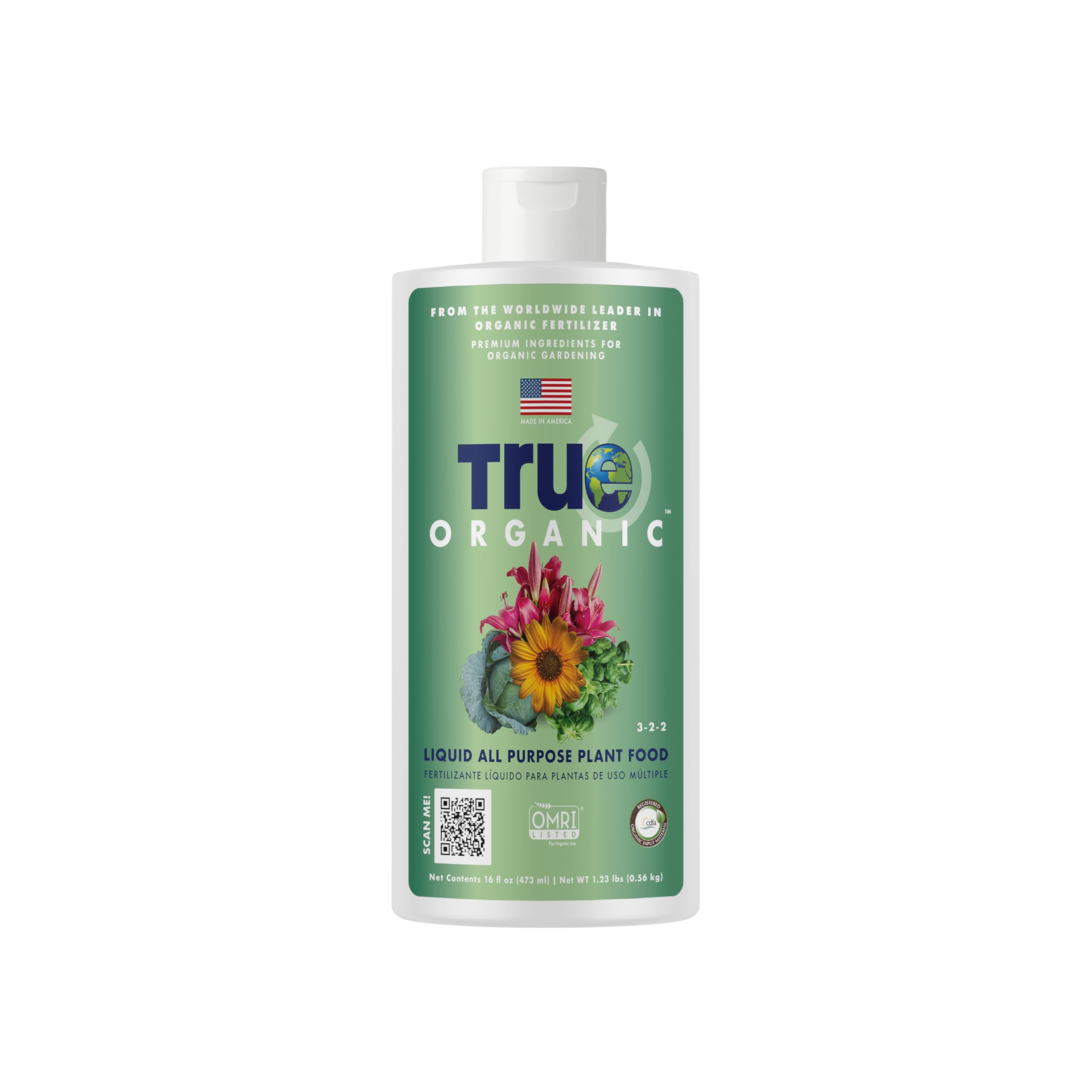
A straightforward, safe liquid food for beginners who want a simple “mix and pour” routine.
True Organic’s 32-fluid-ounce bottle has a 3-2-2 NPK ratio, made from fish solubles, soy protein hydrolysate, and kelp extract. It is a general all-purpose plant food, not a tomato-specific formula, so the phosphorus (the middle number that helps with flowers and fruit) is lower than the 4-6-2 Down To Earth or the 3-4-6 Espoma Tomato-tone. You mix 2 oz per gallon of water and apply every two weeks. It covers roughly 60 square feet total per bottle.
At 32 ounces it is 2.7 times heavier in item weight than the Big A powder (12 oz), but because it is a diluted liquid (not a concentrate you mix at 1:100 like the fish gallon), one bottle covers less total area. It is made in the USA and uses organic inputs.
Great for getting started
- Very easy to measure and pour — the 2 oz per gallon rule is simple and the bottle is manageable
- Made in the USA with organic inputs; no harsh chemicals
- Safe for indoor and outdoor use — the fish smell is present but less intense than the full gallon fish emulsion
Where it comes up short
- 3-2-2 is not tune for tomato fruiting — it provides balanced nutrition but not the phosphorus push your tomatoes need for heavy yields
- Small coverage area (60 sq ft) for the price compared to granular options that feed for weeks
Best for the new organic gardener: You want a fuss-free liquid feed that works on all your plants, and you are not ready to commit to a 5 lb bag of granules or a stinky gallon of fish.
Not ideal for heavy harvests: If maximizing your tomato yield is the goal, the phosphorus level is too low — look at the Down To Earth (4-6-2) or the Espoma Tomato-tone (3-4-6) for a better fruit ratio.
Understanding the Specs
NPK Ratio — The Three Numbers That Decide Your Harvest
The three numbers on the label (like 3-4-6) stand for Nitrogen (N), Phosphorus (P), and Potassium (K). For tomatoes, you want the middle number (phosphorus) to be higher than or equal to the first number (nitrogen). Too much nitrogen gives you giant green plants with hardly any fruit. A ratio like 4-6-2 or 3-4-6 is a good sign for fruiting crops. A ratio like 5-1-1 is excellent for leafy greens but will disappoint you on a tomato plant.
Granules vs Liquid vs Powder
Granular fertilizers (like Espoma and Down To Earth) are dry pellets you sprinkle on the soil. They break down slowly over weeks and require less frequent application. Liquid fertilizers (like The Grow Co fish emulsion and True Organic) mix with water and work fast — you see results in days, but you need to reapply every one to two weeks. Powder fertilizers (like Big A) are a middle ground — they dissolve fast and act quickly, but come in smaller quantities.
FAQ
Can I use an all-purpose organic fertilizer on tomatoes or do I need a tomato-specific blend?
What is the best NPK ratio for growing tomatoes?
How often should I apply organic fertilizer to my tomato plants?
Is granular or liquid organic fertilizer better for tomatoes?
Does organic fertilizer for tomatoes smell bad?
Will organic fertilizer burn my tomato plants if I use too much?
What is the difference between OMRI listed and just “natural” fertilizer?
How long does a 5 lb bag of granular organic fertilizer last for tomatoes?
Can I use fish emulsion on tomato seedlings?
Why does my tomato fertilizer label say “no mixing required?”?
Final Thoughts: The Verdict
Across the board, the organic fertilizer for tomatoes winner is the Espoma Organic Tomato-tone 3-4-6 because it delivers the exact NPK balance tomatoes need plus 8% calcium for blossom end rot prevention. If you want a more versatile granular feed for a mixed vegetable garden, grab the Down To Earth 4-6-2. And for the budget-conscious bulk feeder who wants fast results, the standout is the sheer volume and value of The Grow Co Fish Emulsion gallon.
How We Picked
We do not accept paid placement. Every pick is matched to a real buyer and a real use-case; we do not hands-on test units.
Sources & Methodology
Specifications: manufacturer listings and product documentation. Review insights: verified customer reviews, as of July 2026. Pricing: not shown on this page (it changes often); check the current price via the retailer link.
As an Amazon Associate, Lawn Gear Lab earns from qualifying purchases. This does not affect which products we feature.