
Fig tree roots spread wide but hate synthetic salt buildup; the right granular organic blend feeds the soil microbiome while delivering balanced nitrogen, phosphorus, and potassium for vigorous top growth and plump, sweet fruit. Without it, trees often drop fruit early, suffer from chlorosis, or produce bland, watery figs that never reach their full sugar potential.
I’m Rikta — the co-founder and writer behind Lawn Gear Lab. I spend my days comparing fertilizer NPK ratios, analyzing OMRI listings for purity, and cross-referencing real-world grower feedback to find which organic formulations actually move the needle on fig tree performance in varied climates and soil types.
After evaluating dozens of NPK profiles, customer outcome reports, and ingredient transparency documents, I’ve narrowed the field to the seven most effective options. This is your data-backed guide to choosing the best organic fertilizer for fig trees based on real formulation science and proven owner results.
How To Choose The Best Organic Fertilizer For Fig Trees
Fig trees are heavy feeders during active growth but sensitive to over-fertilization, especially from synthetic nitrogen that triggers excessive leaf growth at the expense of fruit. The right organic product delivers nutrients gradually, supports soil life, and keeps the NPK profile tilted toward phosphorus and potassium for fruit set and sugar development.
NPK Ratio — The Critical First Check
Fig trees perform best with a balanced or slightly lower middle-to-last-number ratio, such as 6-2-4 or 5-3-3. High first numbers (nitrogen) push leafy growth and reduce fruit sweetness. The second number (phosphorus) supports flowering and fruit development, while the third (potassium) improves fruit size, sugar content, and disease resistance. Avoid anything above 8 in the first number unless the tree is severely nitrogen deficient.
OMRI Listing and Ingredient Transparency
For edible fruit production, an OMRI (Organic Materials Review Institute) listing guarantees the product contains no synthetic chemicals, sewage sludge, or prohibited fillers. Reputable brands like FoxFarm and Espoma list every ingredient — feather meal, fish bone meal, kelp meal, langbeinite — so you know precisely what is entering your soil. Labels that hide behind “proprietary blend” without specifying sources should be treated with skepticism.
Application Format — Granules vs. Spikes vs. Powders
Granular formulas you scratch into the root zone and water in provide even, slow-release feeding over 4-6 weeks. Spikes (like Jobe’s) deliver a concentrated source at a single point and work well for container trees where root spread is confined. Powders that require mixing offer faster availability but demand precise measurement — too concentrated risks root damage even with organic ingredients. For in-ground fig trees, a dry granular or powder top-dress is the most forgiving and effective approach.
Beneficial Additives — Mycorrhizae and Soil Microbes
Mycorrhizal fungi and beneficial soil bacteria (like those in FoxFarm’s Happy Frog line) form symbiotic relationships with fig roots, extending their reach into the soil and improving water and phosphorus uptake. This matters especially for fig trees in sandy or compacted soils where native mycorrhizal populations are low. These additives do not replace proper NPK feeding but amplify the efficiency of every nutrient you apply.
Quick Comparison
On smaller screens, swipe sideways to see the full table.
| Model | Category | Best For | Key Spec | Amazon |
|---|---|---|---|---|
| Down To Earth Fruit Tree 6-2-4 | Premium Granules | In-ground fig orchards | 6-2-4 NPK + Calcium | Amazon |
| Espoma Plant-Tone 5-3-3 | Premium Granules | Established trees & shrubs | 5-3-3 NPK + Bio-tone | Amazon |
| FoxFarm Happy Frog Fruit & Flower 5-8-4 | Mid-Range Granules | Heavy fruiting & flowering | 5-8-4 NPK + Mycorrhizae | Amazon |
| Espoma Tree-Tone 6-3-2 | Mid-Range Granules | Shade & fruit trees | 6-3-2 NPK + 5% Calcium | Amazon |
| Jobe’s Organics Fruit & Citrus Spikes 3-5-5 | Spikes | Container & indoor figs | 3-5-5 NPK + Biozome | Amazon |
| FoxFarm Happy Frog All Purpose 6-4-5 | Mid-Range Granules | General garden feeding | 6-4-5 NPK + Soil Microbes | Amazon |
| FoxFarm Happy Frog Japanese Maple 4-3-4 | Acid-Forming Granules | Low-pH feeding | 4-3-4 NPK + Mycorrhizae | Amazon |
In‑Depth Reviews
1. Down To Earth All Natural Organic Fruit Tree 6-2-4

The 6-2-4 NPK ratio hits the ideal macronutrient balance for fig trees: enough nitrogen for canopy development without triggering excessive leafy growth, ample phosphorus for root and fruit initiation, and elevated potassium to boost sugar accumulation and fruit firmness. Calcium carbonate is included to prevent blossom-end issues in developing figs, a detail many all-purpose blends omit.
Ingredients like feather meal, fish bone meal, langbeinite, and kelp meal break down at different rates, providing a staggered nutrient release over roughly 6-8 weeks. Owner reports confirm that trees treated with this formula show noticeable improvement in leaf color and fig size within one growing season, even on trees that had stalled after cold stress or poor soil conditions.
The 5-pound box (larger than most competitors’ 4-pound bags) offers better per-pound value for multi-tree orchards. The label explicitly lists fig trees as a target species, which is rare — most fruit tree fertilizers only mention apples, pears, and plums. This specificity signals a formulation tuned for fig physiology.
What works
- Ideal 6-2-4 ratio calibrated for fig fruit development and sugar
- Added calcium supports proper fruit formation on young figs
- Larger 5 lb bag at mid-range price tier
- OMRI listed with full ingredient transparency
What doesn’t
- Powder form can clump if stored in humid conditions
- Some users wish for a slower 3-month release window
2. Espoma Organic Plant-Tone 5-3-3

Espoma’s Plant-Tone uses the proprietary Bio-tone formula — a consortium of beneficial microbes that accelerate organic matter breakdown and make nutrients available to roots faster. The 5-3-3 analysis is slightly higher in nitrogen than some fig-specific options, but the slow-release microbial mediation prevents the nitrogen surge that causes fig trees to drop fruit.
This is a two-pack of 4-pound bags, offering 8 pounds total at a per-pound cost below most single-bag competitors. For gardeners feeding multiple fig trees plus surrounding ornamentals, the bulk packaging eliminates mid-season reordering. The granular texture spreads evenly and integrates into soil without dust clouds, unlike some powder formulations.
Owners consistently report visible greening within two weeks of spring application and sustained vigor through the season. The inclusion of 5% calcium mirrors the Down To Earth formula, providing an additional safeguard against fruit deformities. The Bio-tone microbes also help fig trees planted in poor, compacted clay soils where native biology is weak.
What works
- Two-bag pack provides excellent per-pound value for multiple trees
- Bio-tone microbes improve nutrient uptake in poor soils
- Granular consistency avoids dust and clumping issues
- 5% calcium supports fruit integrity and prevents crack
What doesn’t
- Higher nitrogen ratio may require careful spring-only dosing
- Chicken-manure base produces strong odor during application
3. FoxFarm Happy Frog Fruit & Flower 5-8-4

With an 8 in the phosphorus position, this is the highest middle-number formula on the list. Phosphorus drives flower initiation, fruit set, and root development — three processes that directly determine fig yield. For fig trees that are already established with good leaf cover but producing few fruits, this profile shifts the tree’s energy toward reproductive growth.
Mycorrhizal fungi are pre-bagged into the granules, so every application introduces symbiotic organisms that extend the root system’s reach into soil pores. This is particularly beneficial for fig trees in containers, where roots are confined and cannot naturally forage for phosphorus, which is immobile in soil. The fungi effectively act as an extension of the root system.
Users report that fig trees treated with this formula produce noticeably larger and sweeter fruit within the first fruiting season, especially when applied at bud break and again after fruit set. The downside of the high phosphorus is that it should not be used on young, non-fruiting trees still building canopy — those need a more balanced or nitrogen-leaning feed to establish structure first.
What works
- High phosphorus (8) specifically targets fruit set and root growth
- Pre-loaded mycorrhizal fungi aid potted fig trees
- OMRI listed with greenhouse-tested consistency
- Easy monthly granular top-dress application
What doesn’t
- Too phosphorus-heavy for establishing young, non-fruiting trees
- Single 4 lb bag is smaller than some alternatives
4. Espoma Organic Tree-Tone 6-3-2 (2-Pack)
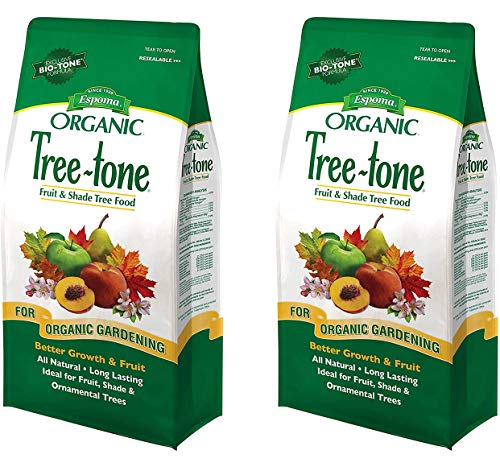
The 6-3-2 analysis delivers more nitrogen than most fig-specific recommendations, but the 5% added calcium helps offset the risk of excessive vegetative push by strengthening cell walls and fruit structure. This formula is designed for all tree types (shade, ornamental, and fruit) so it is a generalist, but its strength is value — two 4-pound bags for a combined 8 pounds at the entry-to-mid price tier.
Tree-Tone requires no mixing — you simply scatter the granules around the drip line of the fig tree, scratch into the top inch of soil, and water. The Bio-tone microbes again feature here, breaking down the feather meal and fish bone meal into plant-available forms over roughly 4-6 weeks. Spring and fall application cycles are recommended, which aligns well with the two-bag format (one bag per application).
Owner feedback highlights that the product has no chemical odor (a common complaint with manure-based organics) and shows visible results within two weeks on trees that were slow to leaf out after winter. The nitrogen content makes it a stronger choice for figs that are still establishing canopy or have suffered dieback, rather than mature trees already at full fruiting capacity.
What works
- Two-bag value pack lasts a full season for one mature tree
- Bio-tone microbes improve soil biology over repeated use
- No mixing — dry granular that works straight from the bag
- Very mild odor compared to manure-based fertilizers
What doesn’t
- Higher nitrogen may reduce fig sweetness if over-applied
- General tree formula, not specifically tailored to figs
5. FoxFarm Happy Frog All Purpose 6-4-5

The 6-4-5 analysis sits in the middle of the fig-friendly range — not as high in phosphorus as the Fruit & Flower blend, but higher in potassium, which plays a direct role in fig sugar transport and water regulation within the fruit. This makes the All Purpose formula a strong maintenance feed for established fig trees that are already producing but could benefit from improved fruit sweetness and drought tolerance.
Active soil microbes are included in the bag, though FoxFarm does not specify the exact species or colony count. Owner reports indicate that this fertilizer revived yellowing tomato and zucchini plants within a week, suggesting the microbial package and nutrient release are fast-acting despite the slow-release granular base. The same effect translates to fig trees showing interveinal chlorosis from mid-season nutrient depletion.
The primary trade-off is the strong organic smell (described as manure-like and pungent), which makes it less pleasant for gardeners who prefer odorless synthetic options or the nearly scent-free Espoma formulas. It also contains no added calcium, so fig growers in acidic, calcium-poor soils may need a separate calcium supplement.
What works
- Balanced NPK with elevated potassium for fruit sweetness
- Fast-acting soil microbes correct nutrient deficiencies quickly
- Versatile for fig trees and surrounding garden plants
What doesn’t
- Strong manure odor during and after application
- No added calcium for fruit structure support
6. Jobe’s Organics Fruit & Citrus Tree Fertilizer Spikes 3-5-5

Spikes are the most hands-off feeding method: you hammer them into the soil around the drip line, and the pre-measured nutrients wick outward over several weeks. The 3-5-5 NPK is the lowest nitrogen option on this list, which makes it ideal for fig trees that are already at full mature size and need only a gentle boost to support fruit production without throwing new vegetative growth.
Jobe’s Biozome — a proprietary archaea microorganism — is embedded in each spike to accelerate organic decomposition at the point of placement. For container-grown fig trees, where root space is limited and soil biology is easily depleted, the localized microbial activity helps keep the root zone active. Each pack of 6 spikes covers a single small-to-medium fig tree; the listing includes 3 packs (18 spikes total) so you have a full year’s supply for one container tree or three applications for an in-ground tree.
The downside is that spikes deliver nutrients to a concentrated zone rather than broadcasting evenly across the root system. For large, in-ground fig trees with extensive root zones, spikes may miss outer feeder roots, leading to uneven results. Timing and placement matter — users who placed spikes too close to the trunk saw less benefit than those who spaced them at the drip line.
What works
- No measuring, mixing, or mess — push into soil and done
- Very low nitrogen prevents excessive leaf growth on mature figs
- Biozome microbes keep potted fig root zones active
- Three packs provide full-season feeding for one tree
What doesn’t
- Concentrated delivery may miss outer feeder roots in large trees
- Requires timing and correct spacing for best results
7. FoxFarm Happy Frog Japanese Maple 4-3-4

Do not let the name confuse you — this 4-3-4 formula is formulated for low-pH feeders, and fig trees grown in naturally alkaline soils (common in western US climates) benefit from its acidifying effect. Iron chlorosis — yellowing between leaf veins caused by high soil pH locking up iron — is a frequent problem in fig trees planted near concrete foundations or in limestone-rich soil, and this blend helps correct it.
The balanced NPK (equal nitrogen and potassium, moderate phosphorus) provides steady all-season nutrition without pushing explosive growth. Mycorrhizal fungi are again present, helping the root system scavenge for micronutrients in alkaline conditions where iron, zinc, and manganese are less available. The instructions call for monthly feeding during the growing season, and owner reports confirm improvement in leaf color and overall tree vigor after 2-3 applications.
This is a niche pick — you should only reach for it if your fig tree shows signs of iron chlorosis or if your soil pH tests above 7.5. For fig trees in neutral or acidic soil, the acidifying effect is unnecessary and could actually lower pH too far over repeated applications.
What works
- Acidifying formulation corrects iron chlorosis in alkaline soils
- Mycorrhizae improve micronutrient uptake in tough conditions
- Balanced 4-3-4 NPK is gentle and hard to over-apply
What doesn’t
- Unnecessary for figs in neutral or acidic native soil
- Niche application — not a general-purpose fig fertilizer
Hardware & Specs Guide
NPK Analysis
The three numbers on the bag represent Nitrogen (N), Phosphorus (P), and Potassium (K) percentages by weight. For fig trees, the middle (phosphorus) and last (potassium) numbers matter most during fruiting, while the first (nitrogen) should be kept moderate (under 7) to avoid excessive leaf production. A 6-2-4 or 5-3-3 is ideal for established trees; 3-5-5 works for maintenance feeding.
Mycorrhizal Fungi & Soil Microbes
These beneficial organisms colonize root systems and extend the soil volume the roots can access, effectively acting as a biological extension of the root system. They are particularly useful for fig trees in containers or degraded soils where native microbial populations are low. Not all organic fertilizers include them — check the label if your figs are in suboptimal soil conditions.
FAQ
How often should I apply organic fertilizer to my fig tree?
Can I use a general all-purpose organic fertilizer on my fig tree?
Should I use spikes or granules for a container-grown fig tree?
What does OMRI listed mean for fig tree fertilizer?
Final Thoughts: The Verdict
For most gardeners, the best organic fertilizer for fig trees winner is the Down To Earth Fruit Tree 6-2-4 because its NPK ratio is specifically tuned for fig tree physiology with added calcium for fruit development. If you want the highest phosphorus content to maximize fruit set on an already-established tree, grab the FoxFarm Happy Frog Fruit & Flower 5-8-4. And for a mess-free, set-and-forget solution perfect for container figs, nothing beats the Jobe’s Organics Fruit & Citrus Spikes 3-5-5.