
Specs are compiled from manufacturer listings and verified buyer reviews and can change over time — please confirm the key details on the product page before buying.
You have dumped a bag of organic compost and wondered if it will actually feed your soil or just weigh down your plants. That worry depends on three things: the ingredients, the certification (OMRI – Organic Materials Review Institute – is the third-party seal that guarantees no synthetics), and the particle size. This guide cuts through the guesswork.
I’m Rikta — the founder and writer behind Lawn Gear Lab. This guide is built by comparing the manufacturers’ published specifications and the patterns across verified customer reviews, so you get each pick’s real strengths and trade-offs instead of marketing spin.
Every product on this list is either certified organic or explicitly stated organic with no synthetic additives. That means you can shop the best organic compost knowing your soil is getting the real thing.
Our Picks at a Glance


How To Choose The Best Organic Compost
Organic compost is not just decomposed plant matter – it is a living soil food that feeds the microbes, improves structure, and delivers nutrients without burning roots. The right bag depends on what you are growing, where you are growing it, and how much labor you want out of your amendment.
Check for Certification First
OMRI (Organic Materials Review Institute) listing is the gold standard – it confirms no synthetic pesticides, GMOs (genetically modified organisms), or sewage sludge were used. Some brands state “organic” without the seal. That can be fine, but OMRI removes all doubt if you are managing a strict organic garden.
Match the Weight and Volume to Your Project
A 10-pound bag is convenient for a handful of containers or a small raised bed. A 24-pound bag covers more ground per trip, and a 32-35 pound bag can handle a whole bed overhaul. The data shows that smaller bags (3 gallons, 12-15 pounds) are perfect for city terraces and tight storage.
Know the Ingredient Base
Some composts are manure-based (dairy cow manure, composted manure), some are plant-based (recycled organic waste), and some get a boost from lobster and crab meal. Each feeds the soil differently – manure composts are rich in nitrogen, plant-based options improve aeration, and marine meals add trace minerals.
Quick Comparison
| Model | Best For | Bag Weight | Volume | Certification | Amazon |
|---|---|---|---|---|---|
| Espoma Organic Land and Sea Gourmet Compost★ Best Overall | All-purpose soil conditioning | 24 Pounds | 1 Cubic Foot | Organic (stated) | Amazon |
| Coast of Maine Organic & Natural Planting SoilBest for Veggies | Tomatoes & vegetables | — | 20 Quarts | OMRI Listed | Amazon |
| R&M Organics Premium Organic Compost | Small-to-medium gardens | 10 Pounds | 0.31 Cubic Feet | Organic (stated) | Amazon |
| Blue Ribbon Organics OMRI Certified Compost | Small-scale & city planters | 12.7 Pounds | 3 Gallons | OMRI Certified | Amazon |
| Old Potters Organic Compost | Heavy clay soil & harsh zones | — | 768 Fluid Ounces | Organic (stated) | Amazon |
| Blue Ribbon Organics OMRI Certified Compost (32-35 lb) | Large container gardens | — | 7.48 Gallons | OMRI Certified | Amazon |
In‑Depth Reviews
1. Espoma Organic Land and Sea Gourmet Compost with Lobster & Crab Meal
Our pick — over 4.5★ from 950+ verified ratings; the strongest balance of quality and price.
The 24-pound workhorse that brings ocean minerals and deep root fungi to every bed, earning the top spot for versatility.
This compost earns the top spot because it packs two unique ingredients into one bag: lobster meal and crab meal. Those marine ingredients add trace minerals and natural chitin (a compound that can help deter soil-dwelling pests) – a feature you do not get from plain manure or plant compost. The bag also contains Myco-Tone, a blend of endo and ecto mycorrhizae (beneficial fungi that attach to plant roots and help them absorb more water and nutrients). At 24 pounds, compared to the R&M Organics 10-pound bag, which means fewer trips to the garden and more coverage per purchase.
Buyers report using this for 3 years straight and remaining happy with the results. One reviewer noted their hostas “grow extremely well” after switching to it. The granules form is easy to sprinkle into planting holes or mix into container soil. Unlike the R&M Organics option, this one does not carry an OMRI seal, but it explicitly states “no synthetic plant foods or chemicals.” If you are starting a new bed or transplanting, you simply work it into the native soil and let the mycorrhizae do their job.
The catch is that the bag does not list an exact volume, only the 1 Cubic Foot coverage and 24-pound weight. A buyer who needs a precise gallon measurement for mixing may have to eyeball it. For most in-ground and container planting, though, that is a minor inconvenience against the marine-meal advantage.
What Stands Out
- Lobster and crab meal add natural trace minerals and chitin.
- Myco-Tone mycorrhizae support root-level nutrient uptake.
- No synthetic plant foods or chemicals stated.
- Versatile for flowers, vegetables, trees, and shrubs.
Trade-Offs
- No OMRI certification seal (organic claims are brand-stated).
- Granule form may need more blending than a fine soil texture.
- Exact gallon volume not listed – weight-only spec.
Who it fits: Gardeners who want a single bag that conditions soil, feeds roots, and adds marine-based nutrients – especially for vegetables, hostas, and shrubs.
Who might look elsewhere: Anyone who needs an OMRI-certified label for strict organic certification, or someone working with a precise volume-based mixing recipe.
2. Coast of Maine Organic & Natural Planting Soil for Vegetables & Tomatoes
An OMRI-listed 20-quart blend that balances moisture and drainage right out of the bag, designed for heavy feeders like tomatoes.
If you grow tomatoes or vegetables, this 20-quart bag is the most specific soil mix for the job. Unlike the Espoma Land and Sea, which targets general soil conditioning, Coast of Maine crafted this blend around the moisture and drainage needs of fruiting plants. It contains composted manure and sphagnum peat moss – the peat moss helps the soil hold water without getting soggy, while the manure feeds the heavy nitrogen demand of tomatoes and peppers. The OMRI (Organic Materials Review Institute) listing gives you confidence that every ingredient was reviewed for organic compliance.
Owners mention that the soil is noticeably lightweight – “lightweight, high-quality foil; one bag per 5-gallon pot,” one reviewer wrote – and that their vegetables are thriving with visible rapid growth. One buyer mentioned that it contains aromatic wood that appears to help deter insects. A few reviewers noted undecomposed twigs inside, which is worth knowing if you are planting fine-root crops like carrots where you want a smooth texture.
The bag size is practical: 20 quarts covers about one large raised bed or a set of containers. It is heavier to carry than the R&M Organics 10-pound bag, but the moisture-retention formula means you water less often. For container gardening on a deck or patio, this is the most balanced option.
Best for container veggie growers: If you grow heirloom tomatoes in pots, this bag gives you the drainage and nutrients they need without extra mixing. Use one bag per 5-gallon pot.
One real caveat: A few twigs may need sifting out if you are planting fine-root crops like carrots or lettuce.
Reach for this if: Your primary garden is tomatoes, vegetables, or container plants on a patio – the moisture retention and OMRI listing make it a safe, effective choice.
Look elsewhere if: You need a general-purpose soil amendment for flowers and shrubs rather than a veggie-specific blend.
3. R&M Organics Premium Organic Compost 10 lb Bag
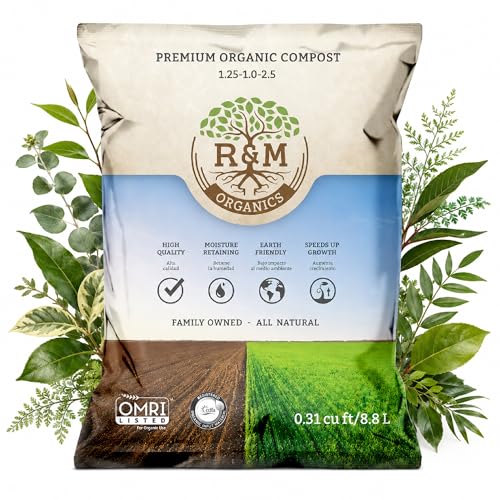
A 10-pound manure-based bag that packs a rapid recovery punch for struggling plants, backed by striking customer stories.
This compost has among the most striking customer stories in the data: a buyer reported that a tomato plant with yellow leaves turned green, produced new growth, and formed flower buds within a week after mixing this compost into a 27-gallon planter. That kind of quick turnaround is rare – and it lines up with the product’s claim of being fully composted through a continuous aeration process that reduces impurities and odor. It is made from dairy cow manure and comes in a compact 10-pound bag (0.31 cubic feet), compared to the Espoma Land and Sea 24-pound bag.
Buyers also note that the texture is fine and easy to work with – “fine topsoil texture, no smell, no clumps, manageable bag size,” one owner reported. Another Master Gardener recommended this compost to rescue azaleas from enzyme cleaner damage, and it worked. The low-odor claim is genuine: reviewers confirm it has a clean, earthy scent suitable for both indoor and outdoor use, unlike some manure composts that arrive pungent.
The main trade-off is the size: at 10 pounds, it is a small bag compared to the 24-pound Espoma option. For a single raised bed or a few containers, it is perfect. For a full vegetable garden or large in-ground beds, you will need multiple bags. The 5:1 mixing ratio means you blend one part compost with five parts soil, which stretches it further than using it straight.
Best for container rescues and small gardens: If you have one sickly tomato plant or a 27-gallon planter that needs a boost, this bag delivers noticeable results within days.
One real limit: The 10-pound weight means you will need multiple bags for anything beyond a few planters.
Who should pick this: Home gardeners who want a small, manageable bag with a proven track record of reviving ailing plants – especially tomatoes, azaleas, and honeysuckles.
Who should skip it: Anyone amending a large in-ground vegetable patch. You will save money with a bigger bag and a different base.
4. Blue Ribbon Organics OMRI Certified Organic Compost (3 Gallons, 12-15 Pounds)

An OMRI-certified 3-gallon bag sized for city planters and tight storage spots, weighing roughly 12.7 pounds.
Blue Ribbon Organics earned OMRI certification, which is the strictest organic standard you can look for. The 3-gallon bag weighs around 12.7 pounds and is explicitly designed for small-scale use – buyers call it “rich compost in easy-to-store amounts” and note it is “good for small-scale use like city terrace planters.” If you garden on a balcony, a patio, or a small raised bed, this bag will not crowd your storage shelf or your car trunk.
One reviewer pointed out the bag is smaller than typical big-box options, which makes it easier to handle and pour. Another said they ran out halfway through a project and had to buy a second brand, so measure your planter volume before ordering. The powder form mixes at a 1:6 ratio with soil, which stretches the 3 gallons into a usable amount for multiple containers. It pairs well with worm castings and other soil builders, as the brand mentions.
Compared to the Espoma Land and Sea bag, this one weighs 12.7 pounds, compared to the Espoma Land and Sea 24-pound bag, and carries the OMRI seal where Espoma does not. For a gardener who prioritizes certified organic integrity above all else, that seal is worth the smaller bag size.
What Works
- OMRI Certified for strict organic compliance.
- Small 3-gallon bag fits city apartment storage.
- Powder form mixes easily with soil at 1:6 ratio.
- Pairs with worm castings and other organic amendments.
What to Know
- One bag may not cover a medium raised bed – measure your volume first.
- Cost per pound is higher than bulk bags.
- Powder consistency can clump if stored damp.
Perfect for: Urban gardeners in apartments or condos who need certified organic compost in a size that fits under the sink or on a small shelf.
Not for: Large in-ground beds or anyone who wants to avoid buying multiple bags for a single project.
5. Old Potters Organic Compost – Plant Based Potting Soil
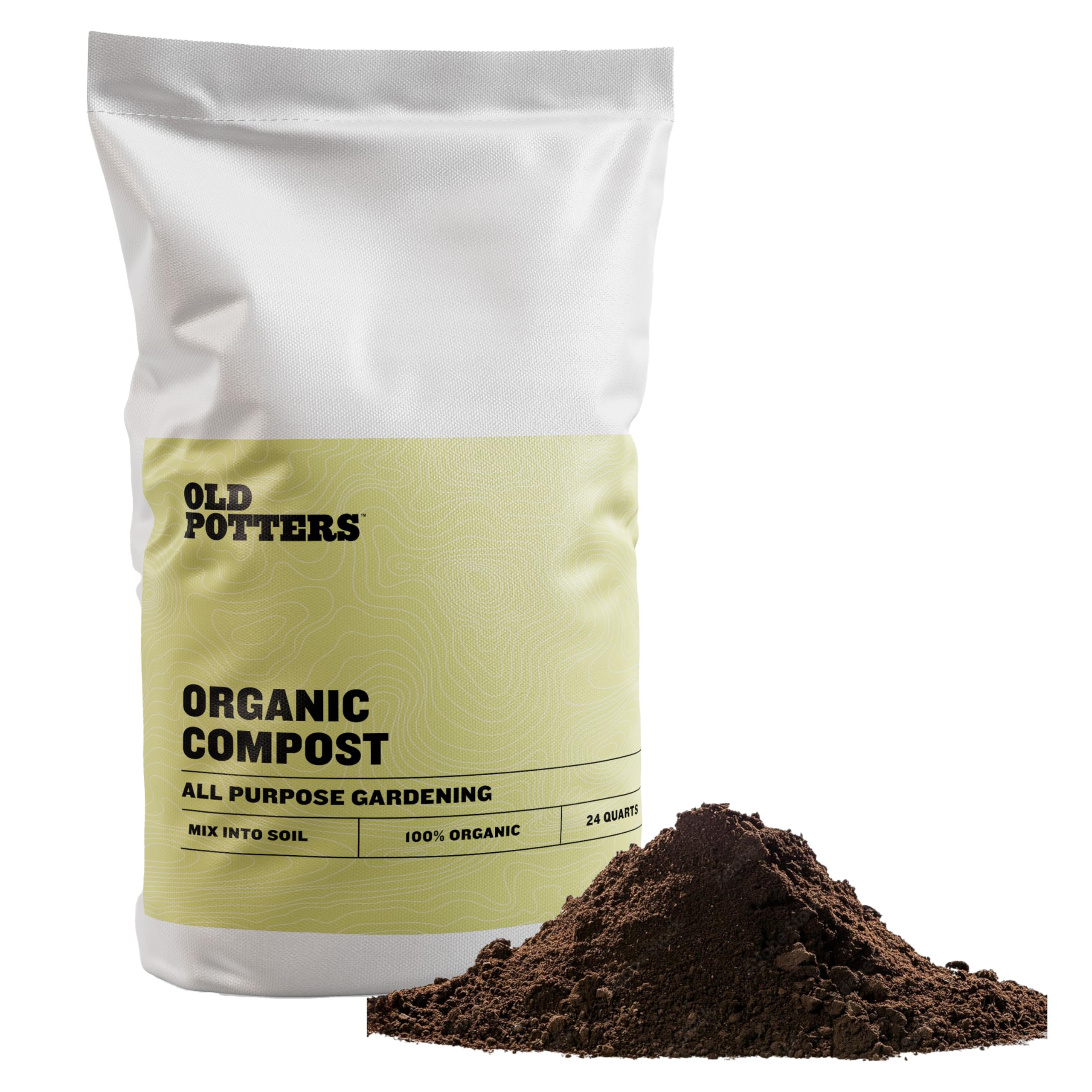
A plant-based 25-pound bag that takes on heavy clay and zone 7a weather without burning roots – the only 100% plant-based option here.
Old Potters is the only product on this list made from 100% plant-based materials (no manure), which makes it a smart choice if you want to improve soil aeration without adding animal waste. One buyer in zone 7a with heavy clay soil reported that this compost, combined with worm castings and mycorrhizae, turned 10 bare-root climbing roses into vigorous early bloomers – “all varieties grew vigorously and bloomed early,” they said. The brand states it is safe and will not burn roots, which matters when you are amending sensitive perennials.
The strong manure smell is a surprise here given the plant-based claim. Multiple buyers mentioned the odor – one called it an “awful smell but absolutely amazing product” – so if you plan to use this indoors or on a patio near open windows, be prepared. The volume is listed at 768 Fluid Ounces (24 quarts), which is a meaningful amount for a mid-sized bed. Some reviewers noted the compost was clumpy with clayish clods that needed manual crumbling before use.
At 601 ratings and 4.5 stars, the feedback is consistent: it works extremely well for heavy soil conditions and harsh climates, but it arrives with a strong smell and some clumpiness. That is a fair trade for a plant-based bag that can rescue bad soil.
Best for clay soil and harsh climates: If you garden in heavy clay or a tough zone, this plant-based compost gives you the aeration and nutrients to turn stiff dirt into workable soil.
One real catch: The manure-like smell is strong even in a sealed bag – plan for outdoor use or a well-ventilated mixing area.
Who it fits: Gardeners battling heavy clay soil, harsh weather, or bare-root roses – this compost is tough enough to make a difference where lighter blends fail.
Who should pass: Indoor gardeners or anyone sensitive to strong odors. Also skip if you want a fine, ready-to-use texture without clumps.
6. Blue Ribbon Organics OMRI Certified Organic Compost (7.48 Gallons)
The 7.48-gallon OMRI certified bag that loyal buyers call “black gold” – compared to the 3-gallon version.
This is the larger sibling of the 3-gallon Blue Ribbon bag, and it brings the same OMRI certification in a much bigger volume. At 7.48 gallons, it is more than double the 3-gallon version – enough to handle a medium raised bed or a set of large containers. Buyers rave about the quality: one reviewer calls it “hands down the BEST compost I have ever used,” describing it as black, rich, with an earthy smell and no contaminants like sticks, plastic, metal, or glass. Another buyer said it is the only compost they have used with no fungus gnats, unlike some big-box brands.
The main complaint is the cost. Multiple customers note it is expensive compared to bulk yard compost or big-box alternatives. One noted they wish they could afford it for an entire raised bed and instead use it to augment their soil each season. Another in Southern California said they “can NOT FIND ANY SOIL COMPOST CLOSE TO QUALITY” but acknowledged the price. If you are growing container plants like Clivias, Orchids, and Epiphyllums, this compost is worth the premium – one buyer mixes it with perlite and orchid bark for perfect moisture and air balance.
The 7.48-gallon size gives you a meaningful amount without committing to a full yard of bulk compost. For anyone who wants OMRI-certified, contaminant-free compost for their most important plants, this is the top-tier pick.
The High Points
- OMRI Certified with verified organic integrity.
- No contaminants reported – reviewers point out no sticks, plastic, or glass.
- Rich, dark texture with earthy smell; rehydrates easily.
- Works with any concentration safe for orchids, epiphyllums, and clivias.
The Trade-Offs
- Higher cost per bag than bulk yard compost.
- Smaller bag than what a large in-ground bed needs.
- Pricey for filling a whole raised bed.
Who this suits: Container gardeners who value OMRI certification and contaminant-free quality – especially for orchids, clivias, and other sensitive plants.
Who might choose differently: Anyone amending a large in-ground vegetable garden who needs a more affordable bag-per-cubic-foot ratio.
Understanding the Specs
OMRI Certification vs. Brand-Stated Organic
OMRI (Organic Materials Review Institute) independently verifies that every ingredient in the bag meets organic standards – no synthetic pesticides, GMOs (genetically modified organisms), or sewage sludge. Some brands, like Espoma, state “organic” without the seal. That can be legitimate, but OMRI removes any doubt. If you are a strict organic gardener or need certification for a program, go OMRI. If you just want natural ingredients, brand-stated is often fine.
Bag Weight and Volume
Compost weight varies wildly by moisture content and particle density. A 24-pound bag of Espoma Land and Sea does not hold the same volume as a 10-pound bag of R&M Organics. Always check the cubic feet or gallons, not just the pounds, to know how much soil you are actually getting. Small bags (3 gallons, 10-12 pounds) work for containers; larger bags (1 cubic foot, 7.48 gallons) handle raised beds.
Manure-Based vs. Plant-Based
Manure-based composts (like R&M Organics and Coast of Maine) are rich in nitrogen and are ideal for heavy feeders like tomatoes, squash, and leafy greens. Plant-based composts (like Old Potters) focus on improving soil structure, aeration, and water retention without adding animal waste. Marine-meal composts (like Espoma Land and Sea) add trace minerals and chitin (a compound found in shellfish shells that can help deter soil pests) from lobster and crab shells.
Mycorrhizae and Bio-Inoculants
Mycorrhizae are beneficial fungi that attach to plant roots and extend their reach into the soil – think of them as a root extension. The Espoma Land and Sea bag contains Myco-Tone, a blend of endo and ecto mycorrhizae. Not every compost includes these, but they can give a noticeable boost in transplant success and early root development, especially in poor or disturbed soil.
FAQ
Can I use organic compost straight out of the bag as potting soil?
How is OMRI Certification different from brand-stated organic?
What is the difference between lobster and crab meal compost and regular compost?
How much compost do I need per raised bed?
Can I use organic compost indoors?
Will compost burn my plants if I use too much?
Why does my bag of compost have twigs and clumps in it?
How long does an opened bag of compost last?
Can I mix different composts together?
Is the 10-pound R&M Organics bag enough for a full vegetable garden?
Final Thoughts: The Verdict
For most buyers, the best organic compost winner is the Espoma Organic Land and Sea Gourmet Compost because it combines lobster and crab meal with mycorrhizae for a unique all-around soil conditioner in a generous 24-pound bag. If you want an OMRI-certified option for container plants and sensitive orchids, grab the Blue Ribbon Organics 7.48-gallon bag. And for gardeners battling heavy clay soil or tough climate zones, the Old Potters Organic Compost delivers plant-based aeration without burning roots.
How We Picked
We do not accept paid placement. Every pick is matched to a real buyer and a real use-case; we do not hands-on test units.
Sources & Methodology
Specifications: manufacturer listings and product documentation. Review insights: verified customer reviews, as of July 2026. Pricing: not shown on this page (it changes often); check the current price via the retailer link.
As an Amazon Associate, Lawn Gear Lab earns from qualifying purchases. This does not affect which products we feature.