
Specs are compiled from manufacturer listings and verified buyer reviews and can change over time — please confirm the key details on the product page before buying.
Getting an orchid to rebloom is not about luck — it is about giving it the exact nutrients it craves at the right moment. Most generic plant foods are far too strong for an orchid’s sensitive roots, so you end up with burned tips and no flowers. This guide breaks down the top orchid fertilizers by form, nitrogen level, and real-world results so you can finally see new flower spikes instead of more green leaves.
I’m Rikta — the founder and writer behind Lawn Gear Lab. This guide is built by comparing the manufacturers’ published specifications and the patterns across verified customer reviews, so you get each pick’s real strengths and trade-offs instead of marketing spin.
Whether you are nursing a single phalaenopsis or running a small collection of tropicals, you need a formula that matches your watering routine and your water source. A good orchid fertilizer delivers that when you pick the right one for your setup.
Our Picks at a Glance
How To Choose The Best Orchid Fertilizer
Picking the right orchid food depends on three decisions: the form (spike, liquid, or powder), the N-P-K numbers (Nitrogen-Phosphorus-Potassium), and whether the nitrogen source is safe for bark-based potting mix. Here is what to look for.
Spikes vs Liquids vs Powders
Spikes are the easiest — you push them into the potting mix and they release nutrients slowly over about two months. Liquids give you full control over the dose and get absorbed faster, which helps when you are trying to push a bloom. Powders (water-soluble) are the most economical per gallon but require you to mix the right amount each time.
The N-P-K Ratio for Orchids
Orchids grown in bark need extra nitrogen because the bark itself breaks down and ties up nitrogen. A higher first number (like 30-10-10) supports leaf and root development, while a more balanced ratio (like 13-3-15) pushes flowers and maintains root health without forcing too much leafy growth. For a rebloom, you want a formula with a decent middle number (phosphorus) to encourage flower spikes.
Urea-Free and Water Source
Urea is a common nitrogen source that needs soil bacteria to break it down — but orchid bark has very few of those bacteria, so urea can build up and burn roots. Urea-free formulas use nitrate or ammonium nitrogen that orchids can absorb directly. If you water with tap water, look for a formula like MSU (Michigan State University) fertilizer that is designed specifically for tap, rain, or reverse osmosis water.
Quick Comparison
| Model | Best For | Form | N-P-K Ratio | Size | Amazon |
|---|---|---|---|---|---|
| Miracle-Gro Spikes★ Best Overall | No-mix convenience | Sticks | — | 20 spikes (2-pack) | Amazon |
| Tezula Plants MSUAlso Great | Consistent reblooming | Granules | 13-3-15 | 8 oz | Amazon |
| Jack’s Classic 30-10-10 | Bark-grown orchids | Powder | 30-10-10 | 8 oz | Amazon |
| TPS Orchid Liquid | Fast liquid feeding | Liquid | — | 32 fl oz | Amazon |
| Orchid Love (GS Plant Foods) | Organic feeding | Liquid | — | 32 fl oz | Amazon |
| Espoma Organic Orchid! | Kid/pet-safe organic | Liquid | — | 8 oz (pack of 2) | Amazon |
| SUPERthrive Orchid-Pro | Professional-grade urea-free | Liquid | 7-9-5 | 32 fl oz | Amazon |
In‑Depth Reviews
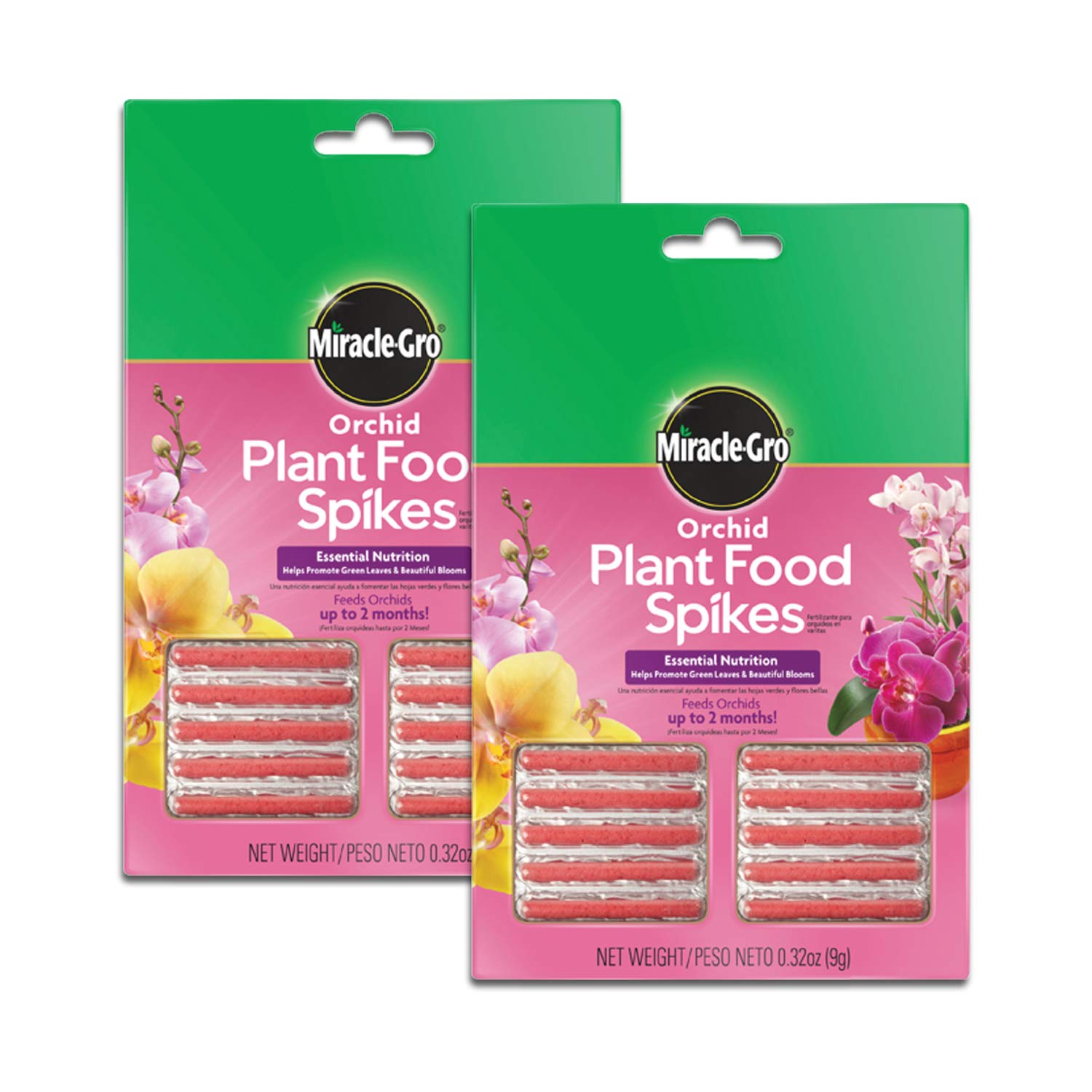
1. Miracle-Gro Orchid Plant Food Spikes
Our pick — over 4.5★ from 950+ verified ratings; the strongest balance of quality and price.
Press these sticks into the potting mix and ignore feeding for two whole months.
Not every orchid owner wants to mix liquids or measure powders — and that is exactly who Miracle-Gro Spikes are for. You simply cut the sticks in half, press them into the potting mix between the plant and the pot edge, and the nutrients release slowly for up to two months. Customers note the product is “great, easy to use,” with one mentioning they feed their orchids every two months with beautiful results. The 2-pack gives you 20 spikes total, which is enough for about 10 plants at a time.
Compared to the 8-ounce Tezula MSU bag, these spikes are tiny at just 1.12 ounces total, but they serve a different purpose. They are not a precision fertilizer — you cannot control the exact ratio or adjust for the growing season. But if you consistently forget to water-fertilize or you travel often, spikes keep a baseline of nutrition in the pot without any effort on your part. One reviewer noted there are “not many sticks for the money,” so if you have a large collection, the cost per plant can add up.
The spikes work best when the orchid is in active growth (flowering or pushing new shoots, leaves, or roots). During dormancy, you should skip feeding entirely. If your orchid is potted in coarse bark, the spikes dissolve more slowly than they would in fine mix, so you may need to replace them at the full 2-month mark.
The Easy Way
- Absolutely no measuring, mixing, or cleanup
- Feeds for up to two months from a single application
- Great starter option for new orchid owners
The Downside
- Some buyers felt 20 spikes were sparse for the price
- No control over nutrient ratio during bloom cycles
Who it serves: The casual orchid keeper who wants healthy plants without a feeding routine. Who should skip it: Collectors with many plants who need a cost-effective bulk feeding solution.
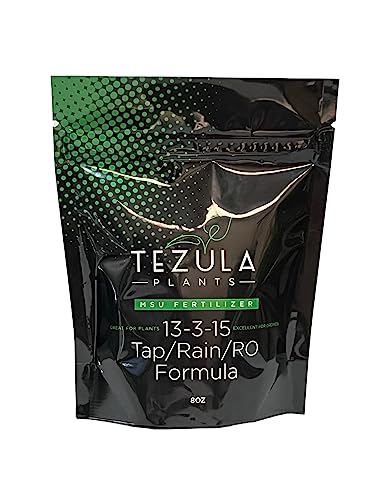
2. Tezula Plants MSU Orchid Fertilizer 13-3-15
One soak with these granules and buyers report new flower spikes in just a week.
Experienced orchid owners reach for this when they want predictable, fast results. The 13-3-15 MSU (Michigan State University) formula is designed for tap water, rain water, and reverse osmosis water (very pure water) — so you do not have to guess whether your local water chemistry will work against it. The granules are 100% water-soluble and urea-free (no urea, a nitrogen form that needs soil bacteria, which orchid bark lacks), meaning the nitrogen is available to your orchid immediately. Several owners mention that after just one soak with this product, all three of their orchids put up new bud stalks — an outcome they called unprecedented.
It also covers many tropicals: orchids, anthuriums, philodendrons, alocasia, monstera, and hoya all respond well. One reviewer with over 200 anthuriums noted the product goes a long way at just a third to half a scoop per gallon. Compared to the Jack’s Classic powder below, Tezula’s balanced 13-3-15 ratio is gentler on bark-based mixes and more flower-focused than high-nitrogen formulas.
The catch is that some buyers have reported the bag getting moist and clumpy after a few months in humid conditions. A resealable package is included, but you may want to transfer the powder to an airtight container if you live in a damp climate. For the price per gallon mixed, however, this is the most cost-effective and consistent formula on the list.
Why Orchid Growers Pick It
- Urea-free so it works safely in bark without buildup
- One teaspoon per gallon stretches the 8-ounce bag for dozens of feedings
- Buyers saw new flower spikes in as little as one week
The Only Headache
- Bag can clump if exposed to humidity over time
- Granules need measuring and mixing — not grab-and-go
The bottom line: This is the best choice for anyone who waters their orchids regularly and wants a proven, urea-free formula that works with tap water. If you want a low-maintenance spike that needs no measuring, the Miracle-Gro Spikes below are a better fit.
3. Jack’s Classic 30-10-10 Orchid Special

A 30-10-10 powder that pushes fast leaf growth in bark-heavy mixes, and one reviewer says it caused a “bloom explosion on new branch.”
Jack’s Classic is built specifically for orchids grown in fir bark, which tends to rob nitrogen from the plant as it decomposes. The 30-10-10 analysis delivers 30% nitrogen, so your orchid has enough fuel to push out new leaves and roots even in a bark-heavy medium. The powder dissolves instantly with no clumps — you just mix it with water, soak the roots, and let drain.
Unlike the Tezula MSU above, this formula is not urea-free; it uses a standard nitrogen source. That is fine for bark mixes as long as you are watering consistently, but it is note if you use a soilless medium like sphagnum moss. The 8-ounce bag includes a measuring spoon, so you never guess the ratio. Buyers also note the blue powder is odorless, which is a welcome relief compared to some organic liquid fertilizers.
One limitation: while this formula is excellent for leaf and root development, the high nitrogen can sometimes prioritize green growth over flowers if you do not give the plant enough light. A reviewer with experience noted that while they saw blooms, the product is “not a miracle” and still needs proper care. Use it as a foliar spray (a spray on the leaves) or root feed once a week for best results.
What It Does Best
- Dissolves instantly with no residue on roots
- High 30-10-10 ratio compensates for nitrogen loss in bark
- Buyers saw second blooms in shorter time than expected
One Trade-Off
- Not urea-free, so it may not suit every potting medium
- Requires weekly mixing — not a slow-release option
Reach for this if: Your orchids are in fir bark and you want aggressive leaf growth before pushing a bloom cycle. Look elsewhere if: You prefer a balanced formula that supports flowers without as much leafy growth, such as the Tezula MSU.
4. TPS Nutrients Orchid Fertilizer Liquid
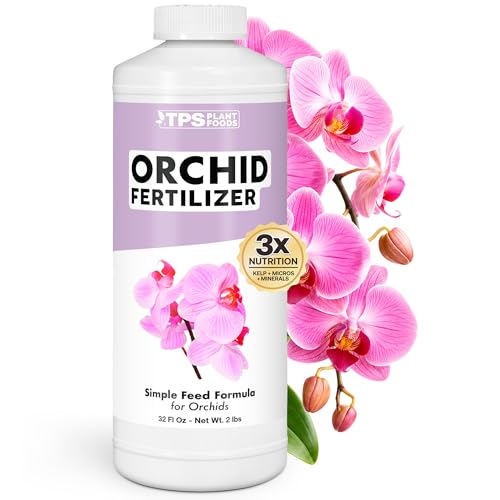
A buyer reports this liquid turned bare green leaves into “gorgeous huge budding” in just one week.
If you want a liquid that absorbs fast and gives results you can see within days, this is the bottle to grab. The TPS formula is made for reblooming — it supports longer-lasting flowers and strong root systems without the risk of root burn that comes with some powders. The mixing ratio is simple: one teaspoon per quart of room-temperature distilled water.
At 32 fluid ounces, this bottle is noticeably larger than the 8-ounce Espoma pack, and it costs about the same, so you get more product per dollar. The liquid is clear and leaves no residue on roots, which is a common complaint with some organic fertilizers. Buyers also mention that the formula is not too strong — one reviewer uses it every week during blooming season without any root damage. Compared to the Jack’s Classic powder above, the liquid form absorbs instantly and eliminates any mixing clumps.
The catch: you do not get a precise N-P-K ratio printed on the label like you do with the Tezula or Jack’s Classic powders, so if you are the kind of grower who calculates exact nutrient loads, the vagueness may bother you. For most home orchid owners, though, the simplicity and speed of results outweigh that detail.
Why Owners Love It
- Fast-absorbing liquid with no residue buildup on roots
- 32-ounce bottle delivers many feedings at 1 tsp per quart
- Buyers saw budding in as little as one week on bare plants
The Fine Print
- No N-P-K ratio listed on the label for precise control
- Liquid bottles are heavier to ship than powder packs
Best for: Someone who wants a simple, ready-to-mix liquid that delivers fast visible results without guessing. Not ideal for: Growers who need a specific N-P-K ratio for a scientific feeding schedule.
5. Orchid Love (GS Plant Foods) Liquid Concentrate

An organic formula that revived “survivor” orchids with new leaves, roots, and flower spikes after just one to two waterings.
Orchid Love is the product you turn to when your orchids are stubbornly refusing to grow. Made from liquid kelp, liquid fish, and beneficial plant substances, this organic formula targets root development and leaf color more aggressively than synthetic blends. One buyer with a collection of “survivors” — orchids that would rarely open a single bloom — started weekly feedings and saw new leaves, roots, and flower spikes after just one to two waterings. The concentrate mixes at 1 to 2 ounces per gallon, and a single 32-ounce bottle yields 16 to 32 gallons of mixed solution.
The trade-off is real: the smell. Multiple buyers warn that this fertilizer has a strong organic odor — one reviewer described it as enough to “gag a maggot.” The maker claims a new deodorized formula, but several recent reviewers point out the smell is still present. Another buyer recommends mixing fresh each time and keeping the orchid outside for a day after feeding. If you are sensitive to smells or keep orchids in a closed indoor space, this could be a dealbreaker.
However, the results are hard to argue with. A long-term user who has been feeding with Orchid Love for three years says it works great, and the smell fades within an hour if you open a window. The organic ingredients also make it safer for soil microbiology, though in bark mixes that benefit is less pronounced.
What Makes It Special
- Organic formula with kelp and fish for deep root growth
- Concentrate stretches to 16-32 gallons of mixed feed
- Shoppers say new spikes on previously stagnant plants
The Honest Trade-Off
- Strong organic smell — not ideal for indoor use without ventilation
- Needs weekly mixing and alternate watering with plain water
Best for: Organic-focused growers with a porch or outdoor spot where the smell can dissipate. Not for: Anyone keeping orchids on a desk or kitchen windowsill with no openable window.
6. Espoma Organic Orchid! Liquid Plant Food (Pack of 2)

An organic liquid that one buyer says made their orchid put out 12 blooms, safe enough for homes with children and pets.
Espoma has been making organic plant food since 1929, and their Orchid! formula reflects that experience. It is a liquid you simply add half a cap per quart of water, drench the soil, and repeat every two to four weeks. The organic ingredients are safe to use around kids and pets, which matters if your orchids sit on a low table where little hands or curious noses can reach. One buyer mentioned their orchid has 12 blooms after using this, and another says their orchids “constantly bloom” with twice-monthly feedings.
This pack gives you two 8-ounce bottles, so you get 16 fluid ounces total. A reviewer with a stressed orchid that had no blooms and yellowing leaves saw a full recovery after switching to Espoma — the plant started thriving again and the formula was easy to use with no dissolving needed.
The concentration means you need to be careful with the cap measurement: ½ cap per quart is the dose, and the label says 1 cap equals about 2 fluid ounces. If you are the kind of person who pours by eye, you may end up overfeeding. Also, while the organic base is gentle, it is not as fast-acting as the Jack’s Classic powder or the TPS liquid — expect results over a few weeks rather than a few days.
What Stands Out
- Certified organic and safe around children and pets
- Comes as a 2-pack so you have a backup bottle ready
- Buyers report consistent blooms every year with regular use
The Catch
- Slower results than high-nitrogen synthetic formulas
- Small 8-ounce bottles mean more frequent repurchasing for large collections
Reach for this if: You have kids or pets near your plants and want a gentle organic feed with decades of brand trust. Look elsewhere if: You need a big bottle for a large orchid collection — the 2-pack runs out faster than the 32-ounce options like the TPS or SUPERthrive.
7. SUPERthrive Orchid-Pro 7-9-5 Plant Food
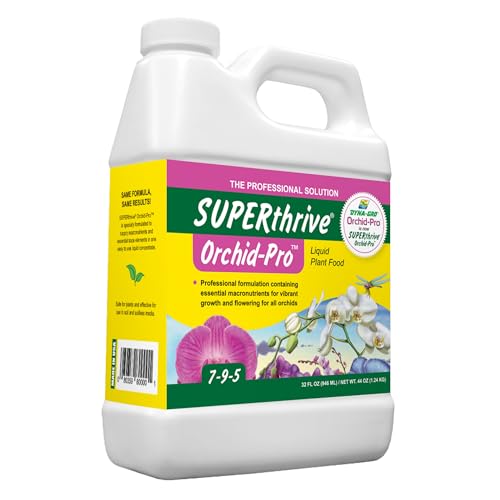
A buyer reports this urea-free liquid revived a stressed orchid in just 4 days.
SUPERthrive Orchid-Pro is a liquid formula built for serious orchid keepers who want a clean, urea-free nutrient source. The 7-9-5 ratio is lower in nitrogen than the Jack’s Classic but provides balanced macronutrients plus trace elements for both soil and soilless media. One owner reported that the product revived a stressed orchid in four days — droopy leaves improved after a fertilizer application combined with humidity. Another long-term user who has been feeding orchids and African violets for about a year called the product excellent.
The mixing instruction is refreshingly simple: half a teaspoon per gallon of water with every watering. At 32 fluid ounces per bottle, this is one of the best values on the list for the volume you get when you compare it to the 8-ounce Espoma pack. The liquid is clear and leaves no residue, and because it is urea-free, it works safely in bark and sphagnum alike. A hoya australis lisa owner saw 5 new leaves in a week after using it (though they noted a recent pot change may have contributed).
Where this falls slightly short is the lack of extreme results compared to the high-nitrogen Jack’s Classic or the fast-blooming TPS liquid. It is a well-rounded maintenance food rather than a bloom trigger. If your orchid is already healthy and you want to keep it that way, Orchid-Pro excels. But if you are trying to force a rebloom on a stubborn plant, you might get faster results with the Tezula MSU or Jack’s Classic first.
Why Pros Like It
- Urea-free formula works in any orchid medium without salt buildup
- 32-ounce bottle at a simple ½ tsp per gallon is very economical
- Owners mention revived stressed plants in under a week
Where It Is Just Okay
- Balanced 7-9-5 ratio is maintenance-focused, not a bloom booster
- Results are good but slower than high-nitrogen or specialized bloom formulas
Best for: Maintaining a healthy orchid collection with a stress-free, every-watering feeding schedule. Not ideal for: Forcing a quick rebloom on a plant that has not flowered in months.
Understanding the Specs
N-P-K Ratio
This is the three-number label on every fertilizer — for example 30-10-10 or 13-3-15. The first number is nitrogen (N), which drives leaf and stem growth. The second is phosphorus (P), which helps roots and flowers develop. The third is potassium (K), for overall plant health and disease resistance. For orchids grown in bark, a higher first number (like 30) compensates for nitrogen that bark consumes as it decomposes. A formula like 13-3-15 focuses more on root health and blooming than on pushing leaves.
Urea-Free
Urea is a common nitrogen source in general-purpose fertilizers, but it requires soil bacteria to convert it into a form orchids can use. Orchid bark has very few of those bacteria, so urea can sit in the pot, build up, and eventually burn the roots. A urea-free fertilizer uses nitrate or ammonium nitrogen that the orchid can absorb immediately. If your orchid is potted in bark or sphagnum moss, always choose a urea-free formula to avoid root damage.
FAQ
How often should I fertilize my orchid?
Can I use regular plant food on my orchid?
What is the MSU formula in orchid fertilizer?
Is liquid or powder orchid fertilizer better?
What does 30-10-10 mean on an orchid fertilizer?
Why does my orchid need a urea-free fertilizer?
Can orchid fertilizer cause root burn?
How do I apply liquid orchid fertilizer?
What is the best fertilizer for reblooming an orchid?
Should I fertilize my orchid in winter?
Final Thoughts: The Verdict
For most people, the best orchid fertilizer winner is the Tezula Plants MSU Orchid Fertilizer because its urea-free 13-3-15 formula works with any water source and produces visible bud stalks within a week. If you want a high-nitrogen powder that compensates for bark decomposition and pushes fast leaf growth, grab the Jack’s Classic 30-10-10. And for a zero-effort feeding routine that needs no mixing, the Miracle-Gro Orchid Spikes let you push and forget for two months.
How We Picked
We do not accept paid placement. Every pick is matched to a real buyer and a real use-case; we do not hands-on test units.
Sources & Methodology
Specifications: manufacturer listings and product documentation. Review insights: verified customer reviews, as of July 2026. Pricing: not shown on this page (it changes often); check the current price via the retailer link.
As an Amazon Associate, Lawn Gear Lab earns from qualifying purchases. This does not affect which products we feature.