
Specs are compiled from manufacturer listings and verified buyer reviews and can change over time — please confirm the key details on the product page before buying.
Non-selective weed killer is the blunt instrument of yard care: spray it on any green thing, and that green thing dies, roots and all. Unlike selective formulas that spare your lawn grass while attacking dandelions, this stuff makes no distinctions, so you reach for it when you want a clean slate—driveway cracks, fence lines, gravel paths, or the overgrown mess behind the shed you plan to reclaim next weekend. The catch is that picking the wrong concentrate means waiting weeks for dead weeds, wasting money on diluted bottles, or accidentally mixing a batch so weak it merely annoys the poison ivy.
I’m Rikta — the founder and writer behind Lawn Gear Lab. This guide is built by comparing the manufacturers’ published specifications and the patterns across verified customer reviews, so you get each pick’s real strengths and trade-offs instead of marketing spin.
The five concentrates below cover the spectrum from fast-acting formulas that show results within hours to heavy-duty gallons built for acres of brush and blackberries. The goal is to match your specific patch of unwanted vegetation to the exact chemistry and price point that makes sense, which is what a good non-selective weed killer should do without guesswork or empty promises.
Quick Picks
- Control Solutions 82004318 Eraser & Grass Killer Concentrate — Best Value
- Spectracide Weed and Grass Killer Concentrate, 32 oz, with Accumeasure — Fastest Visible
- Martin’s Eraser Max Super Concentrate – 32oz — Brush Buster
- Hi-Yield (32170) Killzall 365 (32 oz) — Long-Term Control
- Albaugh Gly Star Plus Herbicide (2.5 Gallons) Glyphosate Concentrate with Surfactant — Commercial Grade
How To Choose The Best Non-Selective Weed Killer
A non-selective weed killer sounds simple—spray, wait, dead—but the concentrate aisle at the store has enough confusing bottles to make you grab the wrong one. The key decisions come down to three things: which chemical does the job, how fast you need to see results, and how much area you need to cover. Here is what actually matters.
Glyphosate vs. Diquat Dibromide — The Main Chemistry Split
Most non-selective weed killers use one of two active ingredients. Glyphosate (the same chemistry in the original Roundup) is systemic: it soaks into the leaves, travels down through the stems, and kills the roots. This means you see results in about one to two weeks, but the weed is dead from the ground up, so it does not grow back from the root tip. Diquat dibromide (the active in Spectracide here) is a contact killer: it burns the plant tissue it touches on the spot. You see browning within hours to a day, but tough perennial weeds with deep roots may re-sprout because the chemical never hit the root system. Pick glyphosate for long-term cleanouts and perennial weeds; pick diquat for a fast cosmetic cleanup on annual weeds and grasses where you don’t mind a possible re-spray later.
Concentrate Mix Ratio and Coverage Area
Every concentrate bottle tells you how many ounces to mix per gallon of water, and that ratio determines the total square footage you can treat. A quart bottle that requires 6–8 ounces per gallon covers a lot less ground than the same size bottle mixed at 2 ounces per gallon. This is where the numbers on the label matter more than the size of the jug. The Hi-Yield Killzall 365, for example, treats up to 4,300 square feet from its 32-ounce bottle because of its per-gallon mix ratio. Check those instructions before you buy, so you don’t run out halfway through the fence line.
Rainfast Time — A Practical Dealbreaker
All weed killers need a dry period after application to soak into the leaves before rain washes the chemical onto the soil where it does nothing. Rainfast time is the number of minutes or hours the product needs without rainfall. Spectracide needs only 15 minutes of dry weather; Control Solutions Eraser needs “hours,” and Martin’s Eraser Max claims it still works even if rain comes “a few hours later.” If you live somewhere with unpredictable afternoon thunderstorms, the shorter the rainfast window, the fewer wasted weekends.
Quick Comparison
| Model | Best For | Active Ingredient | Bottle Size | Item Weight | Amazon |
|---|---|---|---|---|---|
| Control Solutions Eraser | Budget-friendly all-purpose kill | 41% Glyphosate | 32 fl. oz. | 2 lb | Amazon |
| Spectracide Weed & Grass Killer | Fast results, same-day replanting | Diquat Dibromide | 32 fl. oz. | 32 oz | Amazon |
| Martin’s Eraser Max | Hard-to-kill brush and perennials | 43.6% Glyphosate 0.78% Imazapyr | 32 fl. oz. | 2.6 lb | Amazon |
| Hi-Yield Killzall 365 | Bare-ground coverage on large areas | — | 32 fl. oz. | 2 lb | Amazon |
| Albaugh Gly Star Plus | Large-scale commercial use | 41% Glyphosate w/ Surfactant | 2.5 gal | 15 lb | Amazon |
In‑Depth Reviews
1. Control Solutions 82004318 Eraser & Grass Killer Concentrate
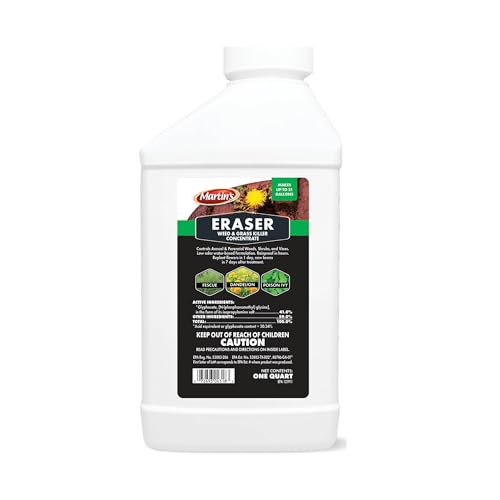
The cheapest dependable glyphosate concentrate that has earned trust over nearly two decades.
This is the no-frills workhorse for anyone who just wants dead weeds without paying for a brand name. The active ingredient is 41% Glyphosate, a classic systemic killer (it moves through the plant to the roots) in a low-odor, water-based mix. Buyers report that mixing 8 ounces per gallon in a sprayer kills everything—weeds, grass, clover, flowers—“100% dead in 1–2 weeks.” One reviewer noted they have reordered this exact product for about 17 years, which is a long track record for a commodity jug.
The formula is rainproof in just a few hours and leaves no residual activity in the soil, so the treated area is safe to replant once the dead stuff is cleared. It is effective against annual weeds, perennial weeds, trees, vines, and shrubs, giving you a single bottle for nearly every unwanted plant type you will find around the yard. The bottle weighs 2 pounds, versus 15 pounds for the Gly Star Plus—easier to handle for smaller jobs.
One honest trade-off: poison ivy may need a reapplication, and buyers recommend adding a surfactant (like Castille soap) to help the spray stick to waxy leaves. A reviewer specifically noted that if you are used to consumer-grade Roundup, you need patience—no effect for the first two days, yellowing at 4–7 days, full death at 7–14 days.
Seventeen-year repeater: This is the value pick for someone who understands glyphosate timing and wants the lowest price per ounce of active ingredient.
skip it if: You need visual results within 24 hours or you battle heavy brush that demands a dual-active formula like imazapyr plus glyphosate.
Reach for this if: You have a standard mix of annual and perennial weeds, don’t mind waiting 1-2 weeks for full kill, and want the most concentrate for your dollar.
Look elsewhere if: You need a faster-acting kill (a day or less) or you are tackling serious woody brush and vines.
2. Spectracide Weed and Grass Killer Concentrate, 32 oz, with Accumeasure
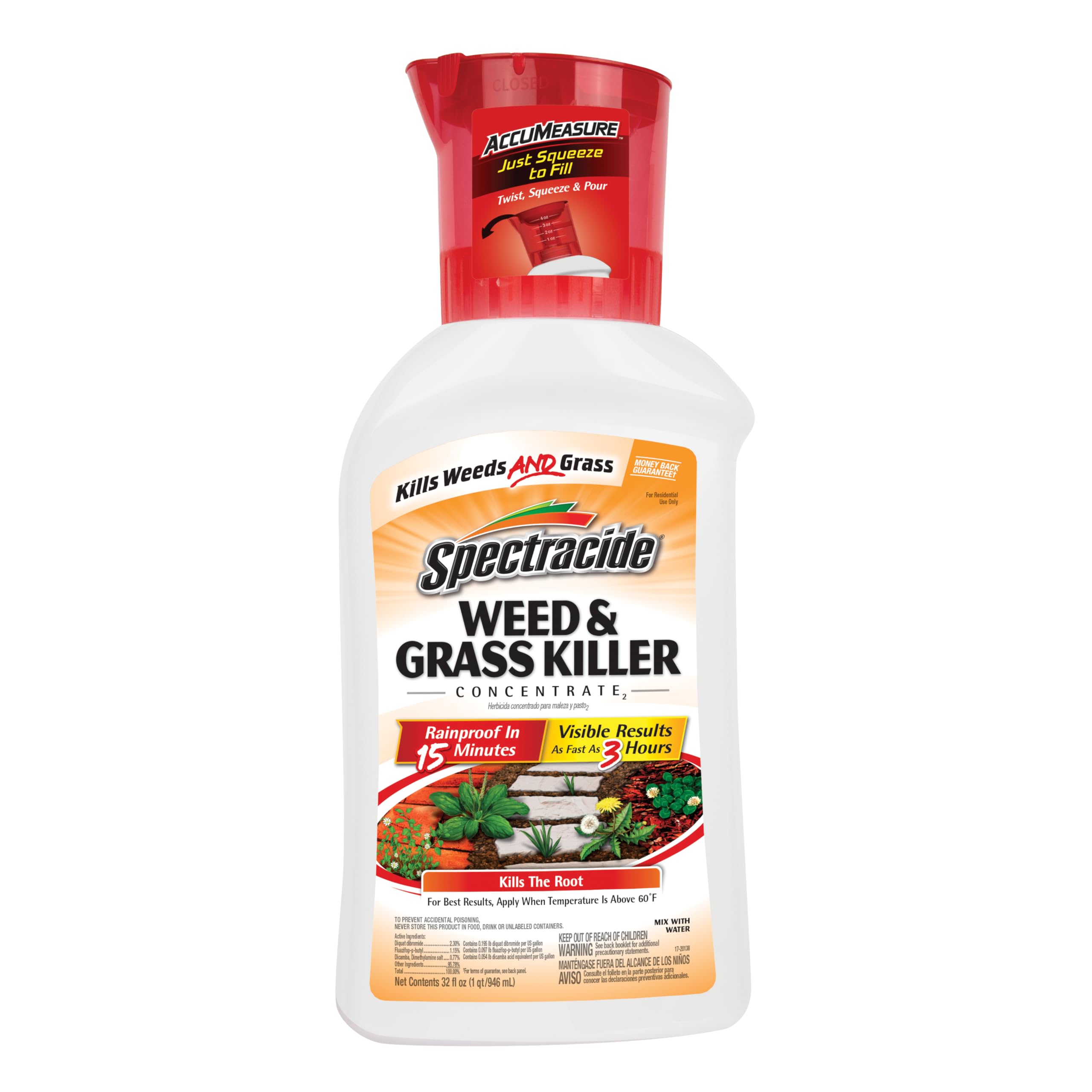
Visible results in hours means you see progress the same day you spray.
Unlike the systemic glyphosate formulas above, Spectracide uses Diquat Dibromide, a contact killer that burns the plant tissue wherever it lands. The main benefit is speed. The maker claims visible results as fast as 3 hours, and one reviewer confirmed that mixing it in a reusable 1-gallon sprayer “kills the weeds along my curb within a day.” That instant feedback is satisfying when you are cleaning up a walkway or patio edge and want to see the brown by dinner time.
The Accumeasure cap (which you simply twist, squeeze, and pour) takes the measuring guesswork out of mixing. A few buyers still found the cap gimmicky and swapped it for a standard lid, but the system is better than eyeballing it into the tank. The concentrate covers up to 1,350 square feet per bottle when mixed according to directions. It is also rainfast in just 15 minutes, so even a sudden afternoon shower will not wash it off.
Because it is a contact killer rather than a systemic, tough perennial weeds with deep taproots may grow back from the roots later. The trade-off is speed now versus completeness later. You can replant flowers, trees, and shrubs in the treated area the same weekend—there is no residual soil activity to worry about.
Same-day satisfaction: Ideal when you want fast cosmetic cleanup on annual weeds and grasses along curbs, driveways, and fences—especially if you have new plants ready to go in that weekend.
Watch for regrowth: If you are fighting deep-rooted perennials like poison ivy or established blackberries, a systemic glyphosate formula will give you a more permanent kill.
Best for quick visual wins: Grab this if you need to see brown weeds by tomorrow morning and you are okay with a possible re-spray on tougher plants.
Not your pick if: You want a one-and-done solution for woody brush, vines, or any deep-rooted perennial.
3. Martin’s Eraser Max Super Concentrate – 32oz
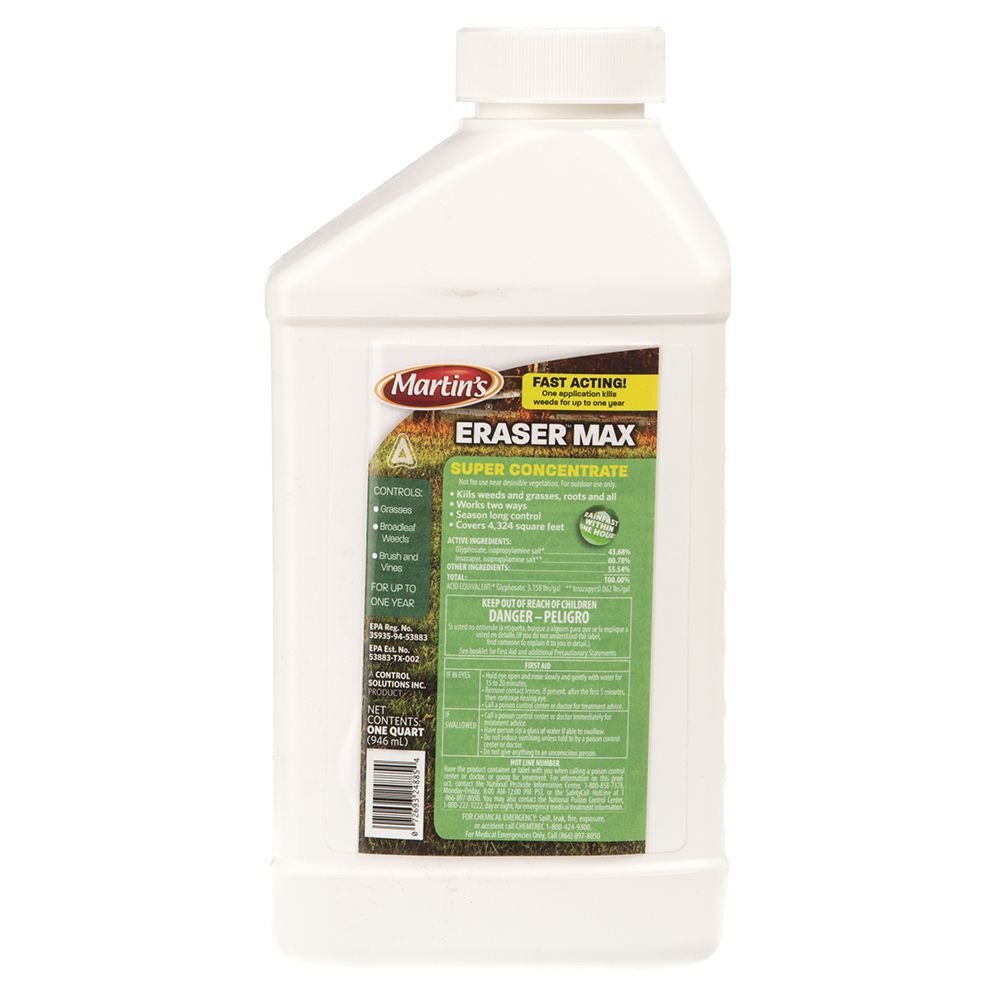
A dual-active formula that hits hard-to-kill brush with glyphosate and imazapyr.
Standard glyphosate alone can struggle against woody plants like blackberries, cudzu, and poison ivy. Martin’s Eraser Max adds 0.78% Imazapyr into a base of 43.6% Glyphosate—two different mechanisms of attack that work together on tough perennial vegetation. One reviewer with 30 years of spraying experience called this “the real deal” and said it works best out of everything they have tried. A farmer in the South noted it handles cudzu, a notoriously stubborn invasive vine, and makes yard work “so much easier to spray it and forget it.”
The rainfast claim here is particularly strong. Owners mention that even if it rains a few hours after spraying, it still works. This is a practical advantage over formulas that demand 6+ hours of dry weather. The concentrate also treats fence lines and gravel drives effectively, giving visible results in less than two days on grass and weeds, with full results on heavier brush taking around two weeks.
The imazapyr component means the product has longer soil residual activity than plain glyphosate. You should not use it in areas where you plan to plant desirable vegetation soon—check the label for replanting intervals. It also means you need to be more careful about overspray onto nearby lawns or flower beds because the soil stays active longer.
Where it shines
- Dual-active chemistry (glyphosate + imazapyr) kills woody brush and vines plain glyphosate cannot touch
- Rainfast in a few hours—works even with afternoon rain
- Trusted by a reviewer with 30 years of spraying experience
The careful part
- Longer soil residual—do not use where you plan to plant soon
- Overspray risk is higher because imazapyr stays active in the soil
Reach for this if: You are fighting woody brush, cudzu, blackberries, fence line overgrowth, or other perennial invaders that laugh at standard glyphosate.
Look elsewhere if: You want a formula with zero soil residual that lets you plant the same day, or you are treating areas right next to flower beds.
4. Hi-Yield (32170) Killzall 365 (32 oz)

Treats up to 4,300 square feet per bottle, making it the coverage champion of the quart-sized field.
This 32-ounce bottle from Hi-Yield promises a standout coverage area compared to other quart-sized concentrates. For spot control of brush, vines, and weeds, you mix 6 ounces per gallon of water. For bare-ground treatment where you want total vegetation control, you mix 7.4 ounces per 1 to 10 gallons of water. That larger coverage potential comes from the mix ratio being more concentrated per gallon, so the bottle stretches further across your property. The manufacturer explicitly warns: “Do not use on lawns.” This is for non-crop areas, driveways, fence lines, gravel paths, and abandoned lots.
Customers note it is “amazing in the battle of blackberry intrusion,” which matches the brand’s claim to control broadleaf weeds, grasses, trees, brush, and vine species. One buyer mentioned they needed to spray three or four times over the year and went through two full bottles of the pink solution, but still found it “much more cost-effective than going to Home Depot or Lowe’s or even Walmart.” The product is also praised for being rain-resistant the next day—if it rains the morning after spraying, the plants still die.
One limitation: it does not kill moss despite the “total vegetation control” label, so if moss is your problem, look elsewhere. The coverage claims also face a typical trade-off—one owner reported it “does not sterilize your ground for a year” as the name might imply, requiring reapplication for season-long control.
Most ground per quart: Ideal if you have a large area—along a long fence line or a wide gravel driveway—and want one bottle to cover more of it.
Patience required: The “365” name suggests year-long control, but real-world experience shows reapplication may be needed; it is more of a strong-seasonal option than a single-spray miracle.
Best for big-area bare ground: If you need to clear a wide stretch of overgrown land with one bottle, this gives you the most coverage per ounce.
Not your pick if: You need to kill moss, or you expect total bare ground for a full 12 months from a single spray session.
5. Albaugh Gly Star Plus Herbicide (2.5 Gallons) Glyphosate Concentrate with Surfactant

A 2.5-gallon professional jug that weighs 15 pounds and treats acres, not yards.
This is the heavy artillery on the list—literally. The active ingredient is 41% Glyphosate, the same percentage found in many generic concentrates, but the large volume and the included surfactant make it a professional-grade choice for large properties, farms, or commercial operations. The maker claims visible effects within 2–4 days on most annual weeds and 7 or more days on most perennial weeds, which aligns with the systemic timing reviewers point out.
One customer observed that for the price, the jug is worth the wait: “Takes about 10 days to two weeks to see everything dead, but for the price it’s worth it.” They mix 2.5 ounces per gallon of water. Another reviewer praised the detailed instruction booklet as “excellent,” covering many specific plant types. The formula also has no residual soil activity, so once the dead vegetation is removed, the area is safe for new planting.
There are two big practical catches. First, geographic restrictions: the product is NOT FOR SALE TO California, Montana, Nevada, Oregon, Washington, or Wyoming. Second, the product is “labeled for commercial applications” and “not labeled for residential use,” meaning it lacks dilution instructions for typical home-use sprayers on the bottle itself. A buyer noted that Amazon answers and user experiments suggest a 2–4 ounce per gallon mix rate for home-strength use, but the official label is aimed at commercial operators. If you want a product with explicit home-use instructions on the jug, this may be confusing.
Why you might buy big
- Massive 2.5-gallon jug (320 fluid ounces) is the largest volume on the list
- Built-in surfactant saves the cost and hassle of adding it separately
- No soil residual—replant after clearing dead vegetation
The hurdles
- Not for sale to CA, MT, NV, OR, WA, or WY
- Label is designed for commercial use, not home lawns—you may need to research your own mix ratio
- Jug weighs 15 pounds; carrying and pouring requires physical effort
Best for acreage or commercial-scale jobs: If you have a large farm, an overgrown lot, or a regular commercial spraying route, the volume and built-in surfactant justify the jug.
Not the right pick if: You live in one of the restricted states, prefer a product with simple home-use instructions on the bottle, or only need to treat a small fenceline once a season.
Understanding the Specs
Glyphosate vs. Diquat Dibromide
These are the two most common active ingredients in non-selective weed killers, and they behave completely differently. Glyphosate is a systemic herbicide: the plant absorbs it through the leaves and stems, and it moves down into the root system, killing the entire plant from the inside out. That is why it takes 7–14 days to see full results—the chemical is working through the whole plant, not just burning the surface. Diquat dibromide is a contact herbicide: it burns and desiccates the plant tissue it directly touches. You see browning in hours to a day, but roots and tissue the spray missed may survive. Diquat is excellent for a quick cosmetic cleanup on annual weeds; glyphosate is better for long-term elimination of perennials and deep-rooted plants.
Concentration Percentage and Mix Ratio
The percentage of active ingredient—like 41% Glyphosate or 43.6% Glyphosate plus 0.78% Imazapyr—tells you how potent the concentrate is, but the mix ratio (how many ounces per gallon of water) is the number that determines how much ground your bottle will actually cover. A 32-ounce bottle mixed at 2 ounces per gallon covers far more square footage than the same bottle mixed at 8 ounces per gallon. Always check the label’s per-gallon mixing instructions before you buy, so you do not overestimate how far the bottle will go. A bottle that covers 4,300 square feet (like the Hi-Yield Killzall 365) covers far more ground than one that covers 1,350 square feet (like Spectracide).
Rainfast Time
Rainfast time is the window of dry weather you need after spraying for the chemical to do its job. If rain hits before the product is rainfast, the chemical washes off the leaves onto the ground, and your spray session is wasted. For Diquat-based Spectracide, the rainfast window is just 15 minutes—extraordinarily fast. For glyphosate-based products, it ranges from “hours” to “rainproof in hours.” Martin’s Eraser Max claims rain a few hours later will not stop it. If you have afternoon storms in your forecast, rainfast time is the spec that saves your weekend.
Product Weight and Handling
On the smaller end, a quart bottle weighs 2 pounds and is easy to lift, pour, and carry. On the larger end, the Albaugh Gly Star Plus jug weighs 15 pounds for its 2.5 gallons. The difference between 2 pounds and 15 pounds matters when you are hauling a jug out to a far corner of the property or trying to decant concentrate into a backpack sprayer. Think about how far you will carry the bottle and whether a heavy commercial jug is practical for your uses.
Soil Residual Activity
Some formulas leave active chemical residue in the soil that prevents seeds from germinating or new plants from growing for weeks or months. Products with Imazapyr (like Martin’s Eraser Max) have longer soil residual—great for keeping a fence line bare for a long time, but dangerous if you later want to plant flowers or grass in that spot. Pure glyphosate formulas (like Albaugh Gly Star Plus) claim “no residual soil activity,” meaning you can safely replant the area after removing dead vegetation. If you plan to plant soon after spraying, look for “no residual” on the label.
FAQ
What is the difference between selective and non-selective weed killer?
How fast does a non-selective weed killer work?
Will a non-selective weed killer kill tree roots?
Can I plant flowers or grass after spraying non-selective weed killer?
How much water do I mix with a concentrated weed killer?
What does rainfast mean for weed killers?
Is a higher glyphosate percentage always better?
Can I use non-selective weed killer on my lawn?
How long does it take for rain to wash away weed killer after it dries?
Will non-selective weed killer kill moss?
Final Thoughts: The Verdict
For most buyers, the non-selective weed killer winner is the Control Solutions Eraser because it gives the lowest cost per ounce of active glyphosate with a 17-year track record from buyers who keep reordering. If you need faster visual results—dead weeds within a day—grab the Spectracide Weed and Grass Killer for its Diquat-based speed and 15-minute rainfast window. And for hard-to-kill brush like cudzu, blackberries, and woody vines, the standout is the dual-active punch of the Martin’s Eraser Max with glyphosate and imazapyr working together.
How We Picked
We do not accept paid placement. Every pick is matched to a real buyer and a real use-case; we do not hands-on test units.
Sources & Methodology
Specifications: manufacturer listings and product documentation. Review insights: verified customer reviews, as of July 2026. Pricing: not shown on this page (it changes often); check the current price via the retailer link.
As an Amazon Associate, Lawn Gear Lab earns from qualifying purchases. This does not affect which products we feature.