
Specs are compiled from manufacturer listings and verified buyer reviews and can change over time — please confirm the key details on the product page before buying.
Walking up to a patch of thistle, goldenrod, or briars that stand waist-high is a moment every property owner dreads. A standard push mower chokes, a weed whacker takes all afternoon, and you are left wondering if anything short of a brush hog actually works. This guide strips away the marketing to focus on the machines that honestly handle overgrown ground — string mowers, high-wheel riders, and remote-control tracked units that are built for the rough stuff.
I’m Rikta — the founder and writer behind Lawn Gear Lab. This guide is built by comparing the manufacturers’ published specifications and the patterns across verified customer reviews, so you get each pick’s real strengths and trade-offs instead of marketing spin.
If you are reclaiming a field, cutting a ditch bank, or taming a neglected back forty, you need a mower that can handle thick, tall growth without stalling. The best mower for tall grass and weeds for most buyers is the Earthquake 40314 — its 160cc engine and 22-inch cut take down three-foot weeds reliably, and buyers confirm it. Below are the top picks, each with real specs and honest trade-offs.
Quick Picks
- Earthquake Walk Behind String Mower 40314 — Best Overall
- DAREDEVIL MOWER SPYDER 761371709991 — Top Performer
- BILT HARD Self-Propelled String Trimmer — Best Value
- Earthquake 60V Walk Behind String Mower 44965 — Quiet Power
- AIWEIYA AWY-550 Remote Control Lawn Mower — Extreme Reach
- YARDMAX YG4761 24-Inch Self-Propelled Lawn Mower — Premium Range
How To Choose The Best Mower For Tall Grass And Weeds
Choosing the wrong machine for heavy growth means constant jamming, stalling, or hours of frustration. Focus on these few specs first, and you will end up with a tool that actually finishes the job.
Cutting Height Range is the Real King
A standard lawn mower tops out at around 4 inches. For tall grass and weeds, you want the deck to lift high enough so you are not shoving a wall of vegetation into the blade housing all at once. Look for a maximum cutting height of at least 4 inches or more. A wide range — ideally from a little over an inch up to 6 inches — lets you start high for the first pass and then drop lower to clean it up without clogging.
String vs. Blade — Two Very Different Approaches
String mowers use heavy-duty trimmer line (usually 0.155 inches thick) that spins fast enough to shred woody stalks and thick weeds. They are lighter and safer near fences and trees. Rotary blade mowers with a steel deck cut cleaner on grass but can clog or stall on vines and briars. Choose string for pure weed duty; choose a blade mower if you also need a decent lawn cut on the same machine.
Your Power Source Dictates Runtime
Battery models are quiet, start instantly, and need almost no maintenance, but their runtime is capped. A heavy-duty electric mower with two 4Ah batteries might last 45 minutes on a low setting — less when cutting thick growth. Gas engines run as long as you keep filling the tank, which matters on larger properties. The trade-off is noise, fumes, and yearly maintenance.
Propulsion Matters When the Ground is Rough
Pushing a 70- or 100-pound mower through tall weeds on a slope is exhausting. Self-propelled models or tracked remote-control units handle the movement for you. For steep hills (over 30 degrees), a tracked machine is the only safe option — a wheeled mower will struggle for traction and you will fight it constantly.
Quick Comparison
| Model | Best For | Cutting Width | Max Cutting Height | Weight | Amazon |
|---|---|---|---|---|---|
| Earthquake 40314 | Mid-size overgrown lots | 22 Inches | 3 Inches | 70 Pounds | Amazon |
| BILT HARD TJA-1054-01 | Hilly, self-propelled comfort | 22 Inches | 3.7 Inches | — | Amazon |
| YARDMAX YG4761 | Large flat lawns with tall grass | 24 Inches | 3.74 Inches | 103.5 Pounds | Amazon |
| Earthquake 44965 | Quiet battery weed control | 22 Inches | 4 Inches | 40 Pounds | Amazon |
| AIWEIYA AWY-550 | Steep slopes & ditches | 21.6 Inches | 5.9 Inches | 286 Pounds | Amazon |
| DAREDEVIL MOWER 761371709991 | Extreme terrain & safety | 24 Inches | 6 Inches | 325 Pounds | Amazon |
In‑Depth Reviews
1. Earthquake Walk Behind String Mower 40314

A hot-knife-through-butter performer for medium to large overgrown properties.
The Earthquake 40314 earns the top spot because its 160cc Viper 4-cycle engine (a four-stroke gas engine that uses separate oil and fuel, so you do not mix them) starts reliably — it has automatic compression release (a valve that reduces resistance when pulling the starter cord) — and powers a 22-inch cutting head that slices through three-foot weeds and thick vegetation. Buyers report it “knocked down three foot weeds and inch and half vegetation like using a hot knife in butter.” The 14-inch never-go-flat wheels (2.5 inches wide) roll over rough ground without going flat, and the adjustable handlebar lets you find a comfortable push angle on long days. This mower suits anyone with a large, overgrown property who wants gas power without the weight of a heavy machine — skip it if you need self-propulsion for steep hills.
At 70 pounds, the Earthquake 40314 is at 70 pounds versus the YARDMAX below at 103.5 pounds, so it is easier to load into a truck bed or push up a slope. The cutting height adjusts from 1.5 to 3 inches — a shorter range than the battery-powered Earthquake 44965, which reaches 4 inches — but the Viper engine has enough torque that you can take a high first pass and let the string flex through tall stalks without stalling. The one-piece extra-long steel deck slides under fences and low tree limbs, and the fold-down handlebars let you store it flat. Owners mention the 22-inch cut matches the BILT HARD below, but the Earthquake is lighter and simpler.
Drawbacks are minor: the cutting head wraps with grass every so often (customers note a 10-minute cleanup), and accessing the air filter behind the wheel is awkward. The 5-year limited warranty is industry-leading, and U.S.-based customer support backs the machine. For sheer cutting power per dollar, this is the one to beat.
Why it wins
- 160cc Viper engine starts easily every time
- Big 14-inch airless wheels roll over bumps and roots
- Fold-down handles for compact storage
Know before you buy
- Cutting height tops out at 3 inches — less than some string mowers
- Grass wraps around the head; expect occasional cleanup
- Not self-propelled — you push the full 70 pounds
Your best bet if: You need a gas string mower that starts on the first pull and chews through thick weeds on a mid-size property (under 2 acres).
pass on it if: You want a self-propelled machine or need to cut higher than 3 inches on the first pass — look at the BILT HARD or the battery Earthquake instead.
2. DAREDEVIL MOWER SPYDER 761371709991
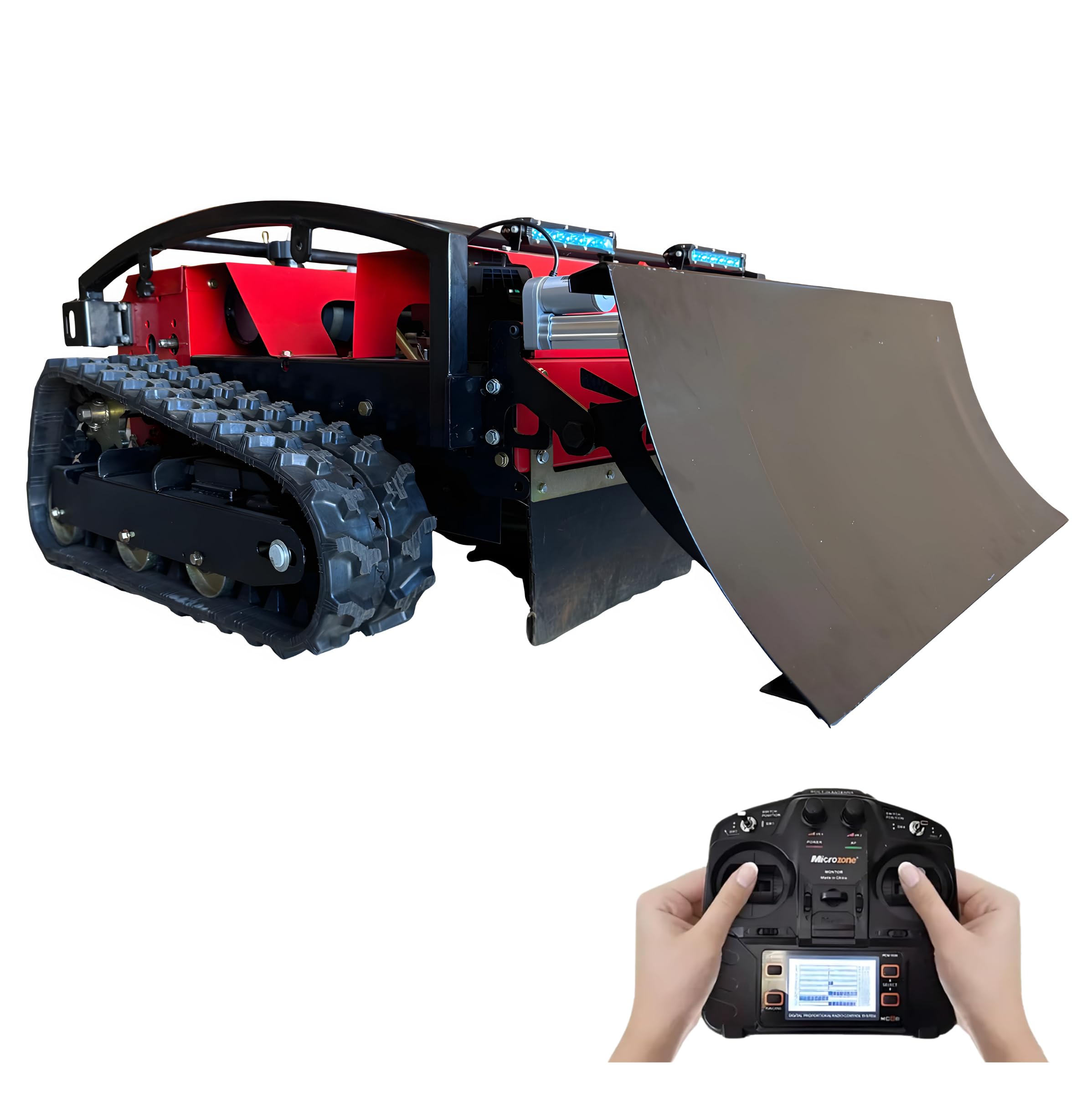
A tank-like tracked mower that handles 55-degree slopes and 4-foot weeds from a distance.
When the terrain gets dangerous — steep ditches, pond banks, poison ivy patches — the DAREDEVIL MOWER SPYDER is the choice that keeps you safe. Its 9HP gas engine spins a 24-inch dual-blade deck, and dual 700W track motors let it climb a 55-degree working slope. Buyers confirm it handles “4-foot weeds” and slopes over 45 degrees (one rolled at near-vertical; the roll bar saved it). The adjustable cutting height ranges from 0.72 to 6 inches — the widest in this roundup — and remote control works up to 200 meters away.
At 325 pounds, this is a serious piece of machinery. The hybrid gas-electric system uses a 6-liter fuel tank that delivers up to 6 hours runtime on light load or 4 hours on heavy cutting. The tracks provide traction where wheeled mowers spin out, but reviewers point out they “chew the ground on U-turns,” so straight-line passes are best. A 69-year-old reviewer switched to this for safety and mobility, reporting “less dust and sweating” compared to pushing a trimmer.
It is not fast — the tracks move at a careful pace by design — and the 24V dual-battery system (24Ah) powers the drive and remote, recharged via wall charger or the onboard generator. For extreme slopes, thick brush, or anyone who physically cannot push a string mower, the SPYDER is the ultimate tool. The optional snowplow attachment makes it a year-round investment.
Standout strengths
- Remote start/stop keeps you off dangerous slopes
- 6-inch max cutting height handles the tallest weeds
- Up to 6 hours runtime on a tank
What to consider
- 325-pound weight makes transport tough without a ramp
- Tracks tear up lawn turf on tight turns
- Not fast — deliberate pace by safety design
Reach for this if: You have steep slopes, thick brush, or limited mobility — the remote control eliminates physical strain and danger.
Look elsewhere if: You need a finish mow on a flat lawn, or your budget cannot stretch to premium tracked gear.
3. BILT HARD Self-Propelled String Trimmer TJA-1054-01
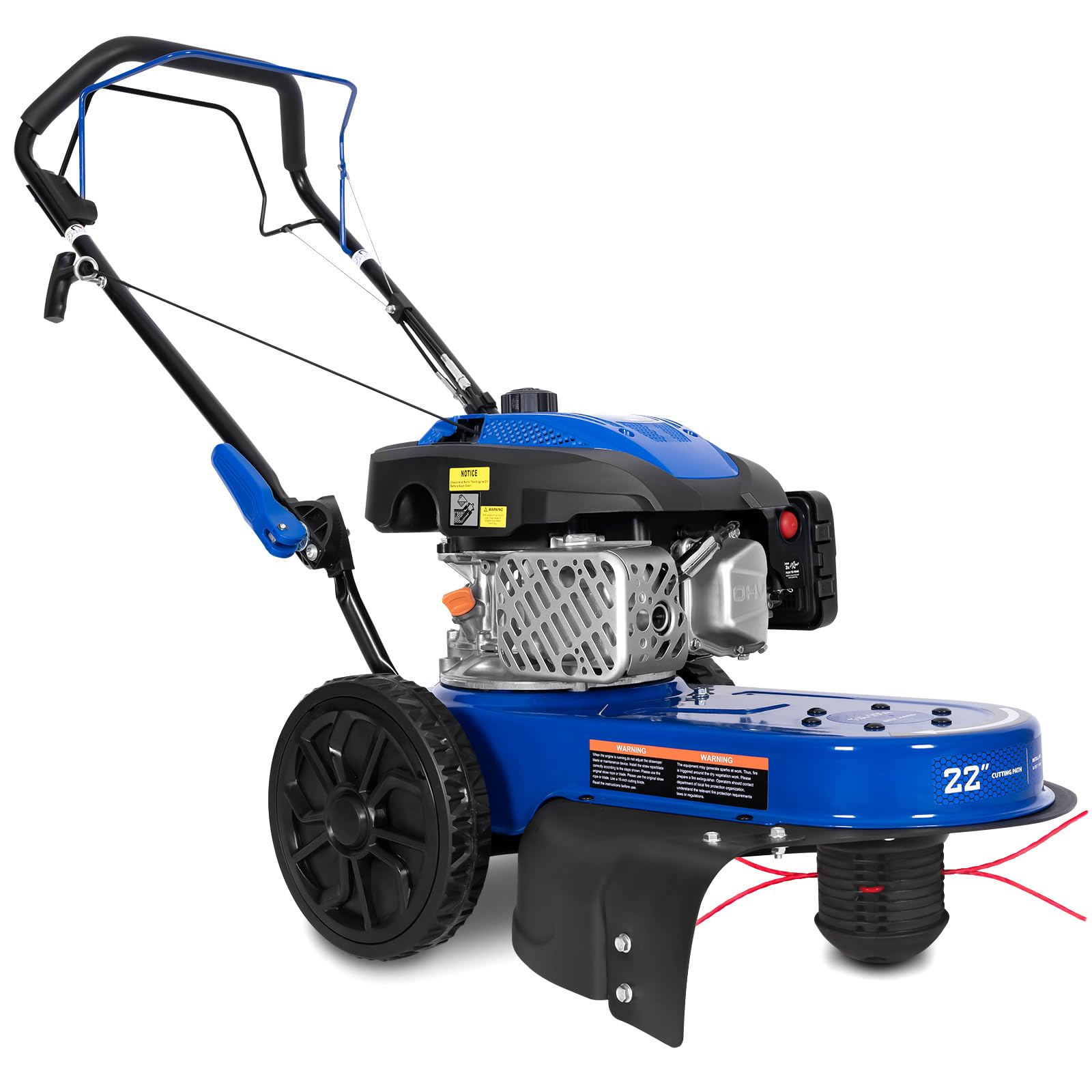
Self-propulsion and a wide cutting range for the price of a basic string mower.
The BILT HARD TJA-1054-01 stands out because it gives you a self-propelled walk-behind (1.9 mph — it moves forward on its own at that speed) at a mid-range price, which makes a big difference on slopes and large properties. The 170cc OHV 4-cycle engine (overhead valve design, which improves fuel efficiency and torque) has the power to rip through “dry and green vegetation like butter,” as one buyer put it. The 8-position height adjustment (1.6 to 3.7 inches) lets you start high on tall weeds and drop down for a cleaner second pass. The cutting width is 22 inches, matching the Earthquake 40314, but the self-drive system separates it for anyone with hilly ground. This mower is for you if you have slopes or a large yard and want to let the machine do the pushing — it’s not for you if you prefer a lighter, simpler push mower.
Shoppers say it starts easily and runs all day, though a few note it is “a little hard to restart when hot.” The heavy-duty one-piece steel deck and 10-inch never-flat wheels handle bumps and roots without issue. BILT HARD backs the trimmer with direct Amazon-based support — one reviewer had a worn air filter replaced free of charge after six months of heavy use. The foldable handle is a nice touch for garage storage.
The catch? Some buyers had significant issues from the start, including a unit that would not start at all and required a lengthy video-based return process with customer service in China. It is a roll of the dice on quality control. That said, the majority of reviews describe a solid, powerful machine that outperforms its price tier.
What works
- Self-propelled at 1.9 mph — a major relief on hills
- 8 cutting heights from 1.6 to 3.7 inches
- Buyers praise the engine power for tough vegetation
What to watch for
- Quality control varies — some units arrive dead
- No tilt feature for edge trimming
- Hot restart can be stubborn
Solid choice if: You want self-propulsion on a budget and are willing to accept some QC risk for the price.
Pass if: You need absolute first-pull reliability — the Earthquake 40314 is safer for that.
4. Earthquake 60V Walk Behind String Mower 44965
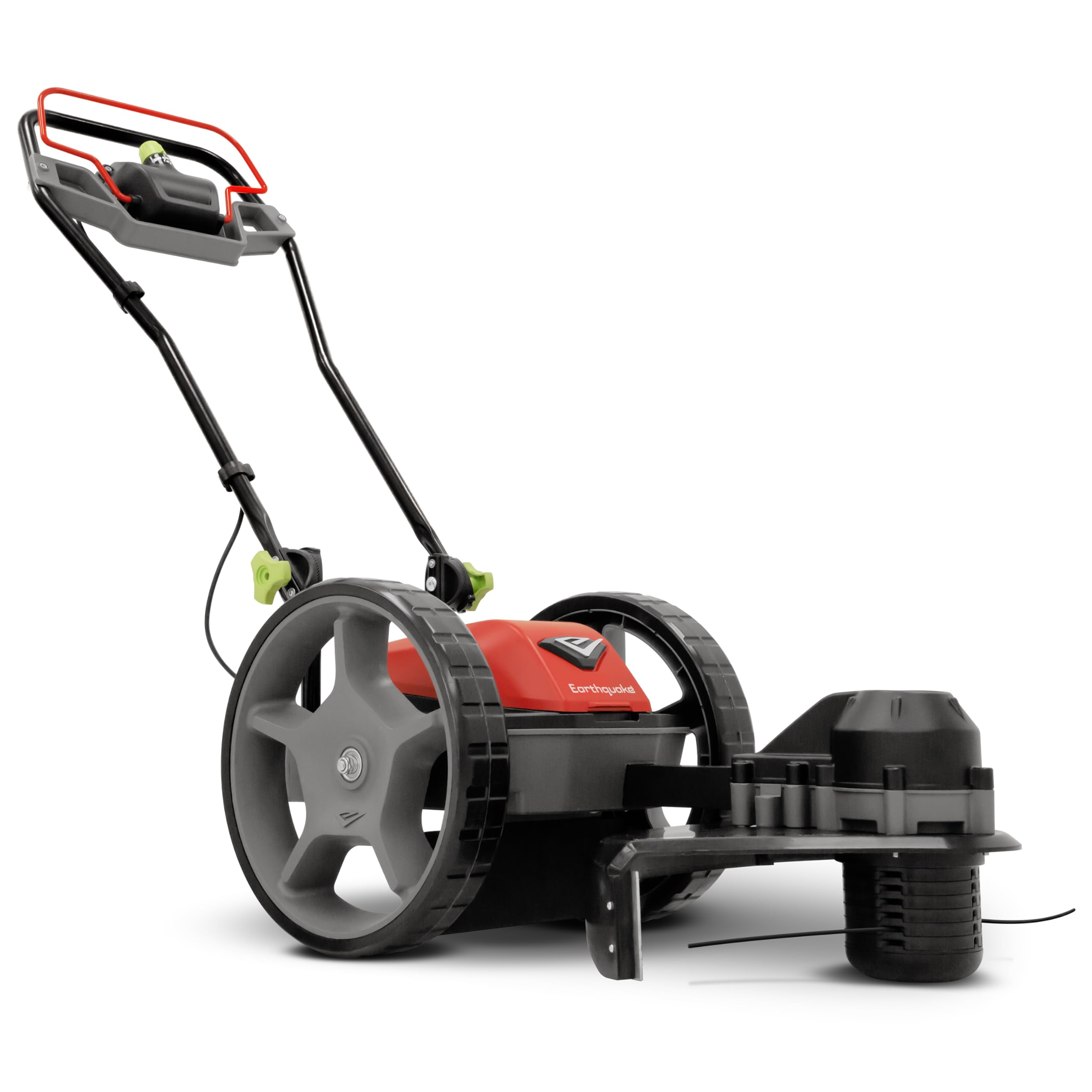
A lightweight, whisper-quiet string mower that beats gas on comfort and adjustability.
The battery-powered Earthquake 44965 is the lightest in the lineup at just 40 pounds — at 40 pounds versus the 103.5-pound YARDMAX gas mower, and at 40 pounds versus the Earthquake 40314 at 70 pounds. The 60V direct-drive brushless motor (an electric motor with no brushes, so it runs nearly silently and needs less maintenance) is much quieter than a gas engine. The tool-less cutting height adjusts from 1.5 to 4 inches — at 4 inches maximum versus the gas Earthquake’s 3 inches, giving you more room to clear first-pass tall growth. It comes with two 4Ah batteries (amp-hour, a measure of energy capacity), and the variable cutting speed dial lets you slow down to save battery or speed up for thick stalks. This mower is for you if you want near-silent operation and easy handling on small properties — look elsewhere if you need to mow more than half an acre of heavy growth in one go.
Buyers call it “the new workhorse of my yard” and say it “handles brush and overgrown areas like a champ.” But the batteries are the weak link: verified buyers report “45 min battery life on lowest setting; less with heavy cutting,” and the batteries can overheat, requiring a one-hour cooldown before a 2.25-hour recharge. That limits this mower to small properties (under half an acre of heavy growth) or those who can work in sessions. One buyer received a defective battery on arrival; the company replaced it quickly.
The innovative cutting head design reduces weed wrap, and the 14-inch extra-wide airless wheels roll smoothly. The 5-year tool warranty and 3-year battery warranty show confidence, but the runtime reality means this is best for light-to-medium overgrowth and smaller lots.
The big pluses
- Only 40 pounds — easily the lightest to lift and push
- 4-inch max cutting height leads the string mowers here
- No gas, no fumes, no pull-start issues
The trade-off
- 45-minute runtime on low setting; less in heavy growth
- Batteries overheat and need a cooldown before recharge
- Not suited for large acreage or continuous heavy cutting
Ideal for: A small, overgrown lot where you value quiet operation and easy lifting — and can work in 45-minute sessions.
Not for: Anyone with more than half an acre of thick weeds or a need to run continuously without battery swaps.
5. AIWEIYA AWY-550 Remote Control Lawn Mower
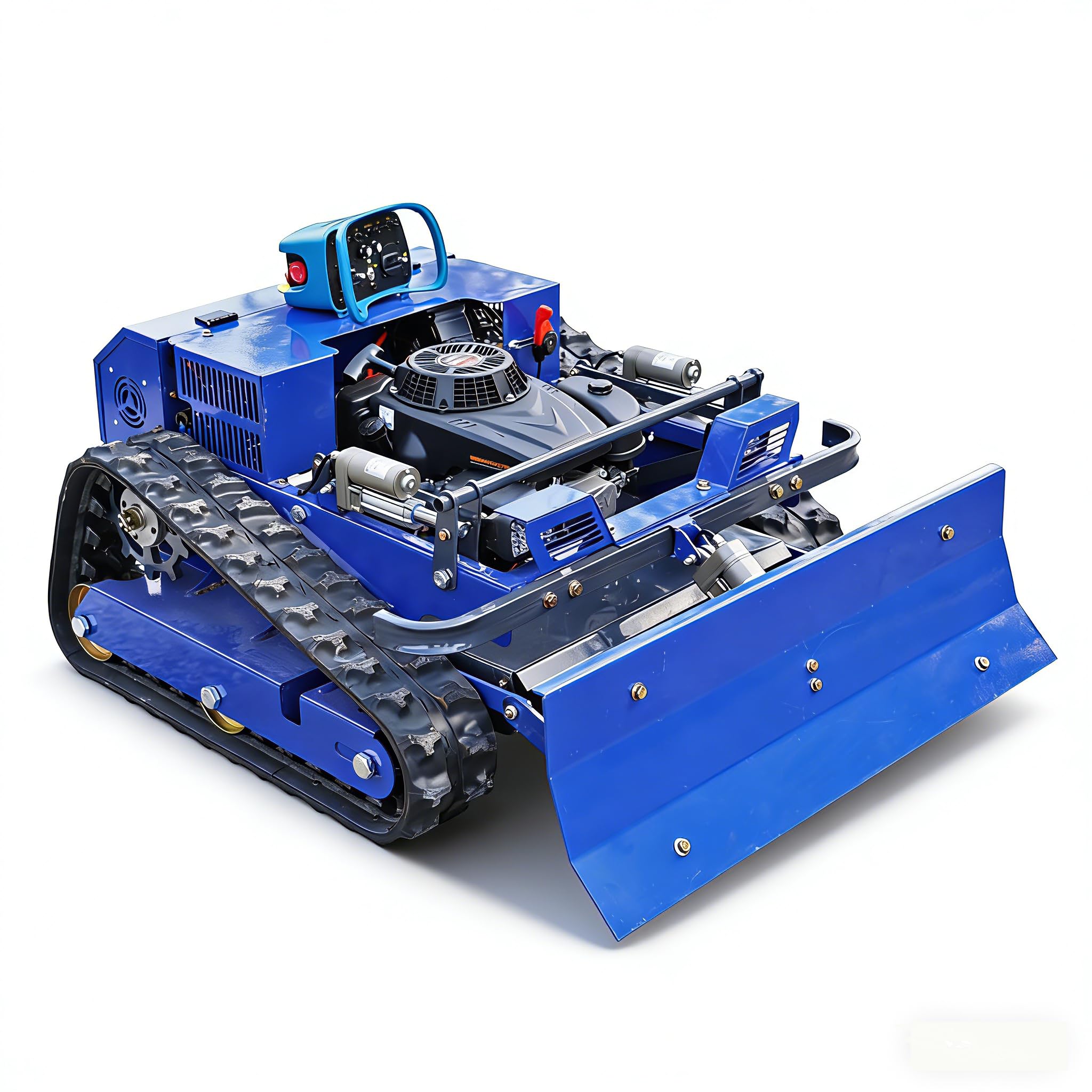
A crawler-track mower that lifts to nearly 6 inches for the nastiest, tallest weeds.
The AIWEIYA AWY-550 has the highest maximum cutting height in the lineup — 5.9 inches — and it adjusts remotely, meaning you can raise or lower the deck without walking over to it. That is a huge advantage when you are cutting in a swampy ditch or through a patch of poison ivy. The 1600W 24V brushless drive motor powers rubber tracks that climb a 100-percent slope (45 degrees), and the two-piece manganese blade (21.6-inch cut) delivers a fine chop that doubles as lawn fertilization. Buyers with one-acre properties report the mower “restored independence” for someone who could not push a trimmer anymore.
At 286 pounds, this machine is heavy and relies on its tracks for traction. The tank has a tiny fuel capacity — buyers consistently report 15 to 20 minutes of runtime, which means frequent refueling. The setup instructions are poor; buyers needed YouTube videos to find a hidden air switch. The starter assembly was fragile for at least one owner, failing after three pulls. Also, the tracks can tear up a manicured lawn, so this is strictly for rough terrain, not the front yard.
Hills, reeds, orchards, and waterlogged ground are where this machine shines. For those situations there is no better value than the AIWEIYA for its 5.9-inch lift and remote height control at a premium but not astronomical price.
Major advantages
- Remotely adjustable cutting height up to 5.9 inches
- Track drive climbs a 45-degree slope without slipping
- Dual manganese blade gives a clean, fine cut
Real downsides
- 15-20 minute runtime per tank — constant refueling
- Starter and plastic parts can fail early
- Poor assembly instructions; expect to find YouTube guides
Perfect for: Extreme terrain, swampy ground, or poison-ivy-infested areas where you never want to walk — the 5.9-inch lift (the height the mower raises off the ground) is class-leading by any other pick here.
Avoid if: You want a low-maintenance machine or need to cover more than an acre per tank.
6. YARDMAX YG4761 24-Inch Self-Propelled Lawn Mower
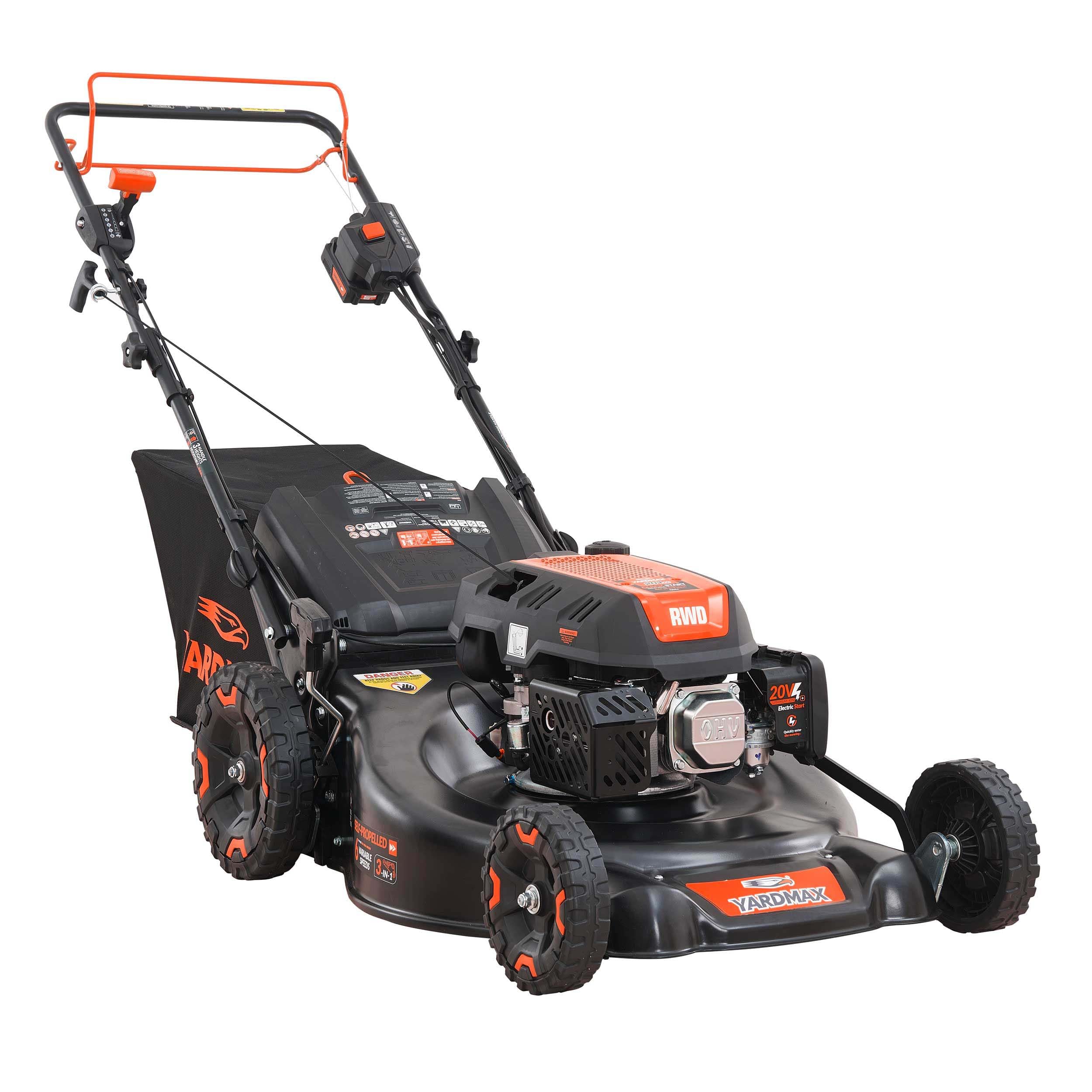
A wide-deck rider-style mower for large lawns that need both tall-grass grunt and a finish cut.
The YARDMAX YG4761 is a different animal from the string mowers above — it is a 24-inch, 201cc gas walk-behind with a 6-speed CVT (continuously variable transmission) that lets you match your walking speed without clutching. The electric start means no pull-cord frustration, and the 103.5-pound build gives it planted stability on flat ground. The cutting height adjusts from 1.57 to 3.74 inches across 7 positions, and the MAXFlow volute-spiral deck is designed for airflow and mulching. Buyers praise its “sturdy build, strong performance, wide mowing width, and powerful self-propelled” drive.
Here is the honest catch: the engine is underpowered for tall, thick weeds. One buyer reports it “struggles with tall grass, cuts off,” and another had the electric start fail on day one with broken handle hardware. The CVT speed control was also criticized as limited to effectively two speeds, not the six advertised. This is a lawn mower built for tall grass on a large, reasonably flat lawn, not a brush mower for briars or woody weeds.
The 24-inch steel deck (at 24 inches versus the 22-inch string mowers) covers ground fast, and the rear-wheel drive pushes well over gentle slopes. If your property is a big open lawn that got away from you — not a field of thistle and saplings — this machine will bring it back under control efficiently.
Where it excels
- 24-inch cutting width — the widest in the lineup
- Electric start with 6-speed CVT self-propulsion
- Sturdy 16-gauge steel deck with mulching airflow
Where it falls short
- Engine bogs down and stalls in truly tall, thick grass
- 103.5 pounds is the heaviest non-tracked mower here
- Speed control not as advertised; limited to two speeds
Good for: A large, flat lawn with consistently tall grass (not brush) — the wide deck and self-propulsion save time and effort.
Wrong tool for: Thick brush, woody weeds, or steep slopes — the string mowers or tracked units above are better choices.
Understanding the Specs
Cutting Height Range
This is the single most important number for tall grass and weeds. The deck needs to rise high enough that you are not cramming a foot-tall stalk into a 3-inch gap on the first pass. A max of 4 inches or more is ideal. A wider range — such as 1.5 to 6 inches — lets you scalp the top layer first, then drop down for a clean second pass without the engine working too hard.
String vs. Blade Deck
String mowers use heavy trimmer line (typically 0.095 to 0.155 inches thick) spinning at high speed. They handle woody stems, vines, and thick weeds better because the line flexes around obstacles and does not jam like a steel blade. Blade mowers (rotary decks) give a cleaner, more even cut on grass but stall or clog on fibrous weeds. Choose string for heavy weed duty; choose a blade mower if you also need a decent lawn finish.
Self-Propulsion and Traction
Pushing a 70- to 100-pound mower through thick weeds on uneven ground is exhausting. Self-propelled models (like the BILT HARD at 1.9 mph) do the moving for you. Tracked mowers (AIWEIYA and DAREDEVIL) provide traction on slopes over 30 degrees where wheels spin out. If your property is flat, a push mower saves weight and cost; if it is hilly, self-propulsion or tracks are essential.
Battery vs. Gas Runtime
Battery mowers like the Earthquake 60V offer quiet, instant-start operation and zero maintenance, but their runtime is capped. In practice, a pair of 4Ah batteries delivers about 45 minutes of actual cutting on low power — less when fighting thick growth. Gas engines run as long as the tank has fuel (the DAREDEVIL runs up to 6 hours per fill). Choose battery for small properties where quiet operation matters; choose gas for any property where you need to run continuously.
FAQ
Can a string mower cut through thick woody weeds like blackberry or saplings?
Will a battery-powered mower last long enough to clear an acre of tall weeds?
What is the difference between a string mower and a brush mower?
How often do I need to replace the string on a string mower?
Can I use a regular lawn mower for tall grass?
Do remote control mowers work on very steep hills?
How long does a gas mower engine last with regular maintenance?
What does “cutting height” mean and how do I choose the right height?
Are there safety concerns with tracked mowers on slopes?
Can I use a string mower as my only lawn mower?
Final Thoughts: The Verdict
For most buyers, the best mower for tall grass and weeds winner is the Earthquake 40314 because its 160cc Viper engine and 22-inch cut deliver reliable power at a mid-range price. If you want self-propulsion for hilly ground, choose the BILT HARD TJA-1054-01. And for dangerous slopes or extreme terrain where safety comes first, the remote-controlled DAREDEVIL MOWER SPYDER is the only pick that keeps you off the ground entirely.
How We Picked
We do not accept paid placement. Every pick is matched to a real buyer and a real use-case; we do not hands-on test units.
Sources & Methodology
Specifications: manufacturer listings and product documentation. Review insights: verified customer reviews, as of July 2026. Pricing: not shown on this page (it changes often); check the current price via the retailer link.
As an Amazon Associate, Lawn Gear Lab earns from qualifying purchases. This does not affect which products we feature.