
Specs are compiled from manufacturer listings and verified buyer reviews and can change over time — please confirm the key details on the product page before buying.
A floppy mature Monstera can wreck a room’s vibe fast — big, beautiful split leaves end up sagging over the pot’s edge, blocking light, and taking up twice the floor space. The fix isn’t just a random stick from the yard; you need a support system that matches the plant’s heft and lets you adjust as it climbs. This guide cuts through the moss vs. stake debate and shows you which ones actually keep a top-heavy plant upright without looking like an eyesore.
I’m Rikta — the founder and writer behind Lawn Gear Lab. This guide is built by comparing the manufacturers’ published specifications and the patterns across verified customer reviews, so you get each pick’s real strengths and trade-offs instead of marketing spin.
We break down the best Monstera support options into clear tiers — from extendable stakes that grow with your plant to self-assembled moss poles built for serious aerial roots — so you can match the right system to your specific plant’s size and your own setup patience. monstera support comes in more forms than most people realize, and the wrong choice means a toppled pot or a plant that refuses to climb.
Quick Picks
- HOLANHING D-Shape Moss Pole (60″/40″/24″) — Best Overall
- BOVITRO Extendable Plant Stakes (5-Pack) — Best Value
- Sproot Bendable Moss Pole (2-Pack) — Most Versatile
- Qaobo Stackable Plant Support Stakes (10-Pack) — Best for Tall Plants
- HOLANHING Metal Moss Pole (6-Pack 40″) — Budget Champion
- Linyona Plant Support Stakes (16-Pack) — Most Complete Kit
How To Choose The Best Monstera Support
The right support keeps your Monstera growing upward instead of sprawling across the floor. But with extendable stakes, metal mesh poles, and coco-coir wraps all on the market, the choice depends on your plant’s size and your willingness to assemble.
Adjustability vs. Fixed Height
An extendable stake (like the 17.9IN to 42.3IN adjustable fiberglass option) lets you lengthen the support as the plant grows taller, so you never have to buy a new one. A fixed-height moss pole requires you to stack or replace sections, which can mean disturbing the roots.
Material & Root Grip
Moss poles (metal mesh filled with sphagnum moss) give aerial roots something to dig into, which can lead to bigger leaves. Plastic or fiberglass stakes offer a smooth surface that works for simple upright support but don’t encourage the same climbing behavior. If you want your Monstera to size up, moss is usually the route.
Quick Comparison
| Model | Best For | Material | Max Height | Number of Pieces | Amazon |
|---|---|---|---|---|---|
| BOVITRO Extendable Plant Stakes | Easy adjustability | Fiberglass | 42.3 Inches | 5 | Amazon |
| HOLANHING Metal Moss Pole | DIY moss pole builders | Metal | 40 Inches | 6 | Amazon |
| Qaobo Stackable Plant Support Stakes | Tall, top-heavy plants | Plastic | 39.5 Inches | 10 | Amazon |
| HOLANHING D-Shape Moss Pole | Serious vertical growth | Iron | 60 Inches | 6 | Amazon |
| Sproot Bendable Moss Pole | Flexible shaping | Aluminum | 63 Inches | 2 | Amazon |
| Linyona Plant Support Stakes | Large quantity for many plants | Plastic | 27.5 Inches | 16 | Amazon |
In‑Depth Reviews
1. HOLANHING D-Shape Moss Pole (60″/40″/24″)

The D-shape design that holds moisture and gives roots a real grip.
You get a moss pole that doesn’t dry out in two days — the flat mesh front lets aerial roots latch on, while the thickened PP (polypropylene) curved back keeps the sphagnum moss damp longer. This set includes six poles in three heights (two 60-inch, two 40-inch, two 24-inch), so you can match each stage of Monstera growth without cutting or splicing. At 60 inches versus the Qaobo plastic stackable stakes at 39.5 inches, it gives a mature plant serious vertical room.
Assembly is required — unroll the metal mesh, zip-tie it around the plastic backing sheet, then stuff with moss (not included). Buyers report it takes time but produces a stable pole that supports large climbing aroids. Owners mention “The D-shaped design helps retain moisture, and the different height options are perfect as plants grow.” The pack also includes 300 zip ties, a roll of garden ties, and gloves so you aren’t fighting bare wire.
Why it earns the top spot
- Three height options (24″, 40″, 60″) let you stage supports for plants of any size
- D-shape holds moss moisture longer than round poles, encouraging root attachment
- Sturdy iron mesh + thick plastic back resists bending under a heavy Monstera
The catch
- Requires DIY assembly — you roll, zip-tie, and fill with sphagnum moss yourself
- At 1.45 kg it is noticeably heavier than fiberglass or plastic options
Reach for this if: You want a long-term moss-pole system that promotes bigger leaves and gives your Monstera a real climbing surface.
Look elsewhere if: You want zero-assembly, out-of-the-box support — this takes an hour of setup.
2. BOVITRO Extendable Plant Stakes (5-Pack)
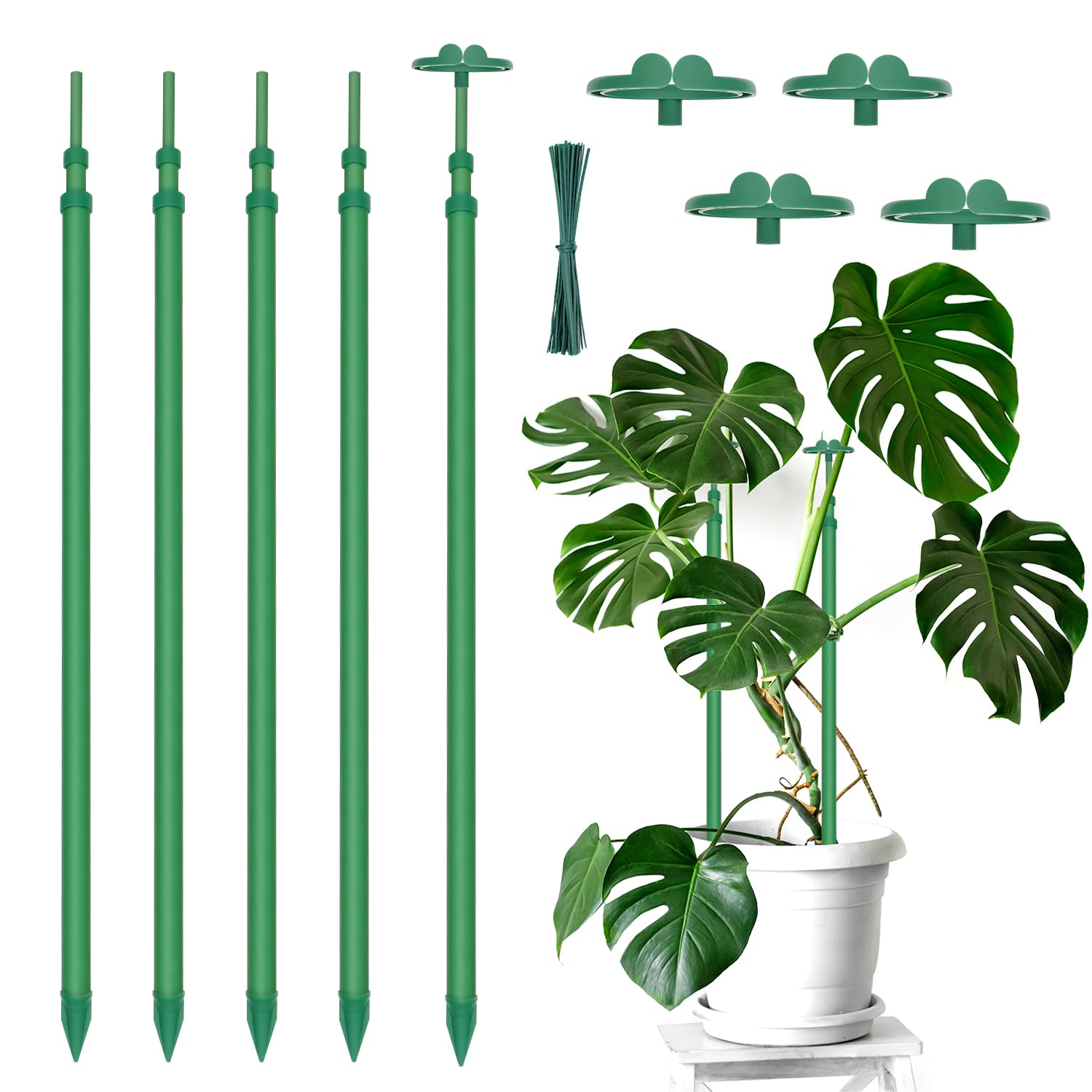
Extendable stakes you never outgrow, at a price that beats every moss pole.
These fiberglass stakes scale from 17.9 inches up to 42.3 inches by a simple telescoping mechanism — no cutting, no stacking, no mess. Each stake has a 0.51-inch-diameter base, thick enough to hold a top-heavy Monstera without wobbling. The 5-pack gives you enough for several plants, and the batch includes 5 detachable top clips and 10 green ties for securing stems. Unlike the Qaobo plastic stakes, these don’t rely on stacking pieces; you just twist and lock the desired length.
Customers note they are “sturdy, adjustable-height plant stakes” that are “easy to use, stable, and discreet in pot.” One Monstera owner specifically mentioned: “Extendable stakes for monsteras; adjustable length avoids swapping.” The green color blends into the foliage, so the support disappears visually. If you want a no-fuss, lightweight solution that grows with the plant, this is the one.
Simple and smart: The telescoping fiberglass design means you adjust the height in seconds — just pull to the length you need and lock it. No assembly, no extra hardware, no replacing stakes as the plant grows. For the modest price, this is the most flexible option for anyone who wants support without a DIY project.
Grab these if: You have young or medium Monsteras and want a support that extends with them — set it once, adjust as needed.
Pass on them if: You want a moss surface for aerial roots; the smooth fiberglass won’t encourage climbing the way a moss pole does.
3. Sproot Bendable Moss Pole (2-Pack)

The bendable pole that shapes to your space and your plant’s natural lean.
At 63 inches, this is the tallest ready-to-use option in the lineup — no assembly, no zip ties, no mess. The aluminum core lets you bend the pole into an S-curve, a gentle arc, or any shape that matches how your Monstera already leans, so you aren’t forcing a straight line onto a naturally sprawling plant. The outer wrap is sustainable coco coir, a natural fiber that holds moisture and gives roots something to grip, similar to sphagnum moss but without the dust.
Reviewers point out that it “works good but needed 2 for 1 plant” for a very large Monstera, meaning even at 63 inches some heavy specimens require both poles. The included 10 feet of plant ties are adjustable and soft enough to avoid stem damage. Unlike the HOLANHING metal poles, this one is ready from the start — no rolling, no cutting, no gloves needed. It is also a lot thinner at 1 inch wide compared to the D-shape metal pole, so it is less visible in the pot.
Set-and-shape design: You pull it from the box, bend it to the angle you need, and insert it into the soil. The coco coir wrap stays put without shedding, and the aluminum core is light enough (0.69 kg for the pair) that the pole won’t tip a plastic nursery pot. Great for renters or anyone who hates assembly.
Choose this if: You want a tall, flexible, ready-to-use support that can curve around furniture or follow a plant’s natural growth direction.
skip it if: You prefer a wide, thick moss-filled pole that roots can fully burrow into — this is slimmer than the DIY metal options.
4. Qaobo Stackable Plant Support Stakes (10-Pack)

Stackable plastic poles that grow as your Monstera does — no tools, no moss.
Each of the 10 stakes is 39.5 inches long, but the clever part is the stackable design: you snap sections together end-to-end to reach whatever height your plant demands. That means a single stake can become 79 inches or taller by linking multiples. The plastic is odorless and non-corrosive, so it holds up in humid indoor environments without rusting, unlike the metal mesh poles that need careful coating. One buyer called them “a life safer for taller flowering plants,” and another said they are “sturdy yet bendable” enough for potted roses and philodendrons.
Unlike the BOVITRO extendable stakes, these are not adjustable within a single piece — you add or remove full sections. That gives you more total height potential but less fine-tuning. The color is a natural green that blends well with leaves, and the set includes 10 green wires to tie stems. These stakes work best for top-heavy Monsteras that just need a vertical crutch rather than a climbing surface.
Why they stand out
- Stackable sections let you reach over 6 feet by combining multiple stakes
- 10 stakes in one pack cover a whole collection of plants
- Plastic is rust-proof and safe for high-humidity rooms
One real trade-off
- Smooth plastic surface doesn’t encourage aerial root attachment like a moss pole
- Not truly adjustable within a single stake — you snap whole sections on or off
Best for: Anyone with multiple tall indoor plants (Monstera, philodendron, pothos) who wants a simple, stackable system that blends into the foliage.
Not ideal for: Growers who want their plant to climb and produce fenestrated leaves — for that, you need a moisture-retaining moss pole.
5. HOLANHING Metal Moss Pole (6-Pack 40″)

A moss-pole kit for DIYers who want maximum length at minimum cost.
Six 40-inch metal mesh tubes that you shape into cylinders and zip-tie closed, then fill with sphagnum moss (sold separately). The vinyl coating on the iron helps resist rust, and the mesh is wide enough for aerial roots to push through while keeping the moss contained. One builder calculated that with the included moss, the pack “makes 4 thick poles (34qt sphagnum + 2qt pine bark).” The kit comes with 80 zip ties, a roll of garden tie, and a pair of gloves — everything but the moss.
Assembly is the main friction here. One reviewer called it “a pain to tie up in the cylinder shape” and said it took over an hour. But once assembled, the poles are sturdy and the closed back helps retain moisture, meaning less frequent watering. Compared to the D-shape HOLANHING set, these round poles are simpler in design but don’t have the PP plastic backing for extra moisture retention. If you are comfortable with DIY, this is a solid mid-range option that delivers six poles for a very low per-pole cost.
Build-your-own approach: You roll the flat mesh into a cylinder, secure it with zip ties, and fill it with moss. The result is a dense, root-friendly pole that supports heavy climbers. The green zip ties and garden ties blend in well, and the included gloves protect your hands from sharp wire edges.
Reach for this if: You don’t mind a bit of assembly and want the lowest-cost way to get multiple sturdy moss poles for a collection of climbing plants.
Pass on it if: You want a ready-to-use pole — the D-shape version above is easier to work with and retains moisture better, though it costs more.
6. Linyona Plant Support Stakes (16-Pack)
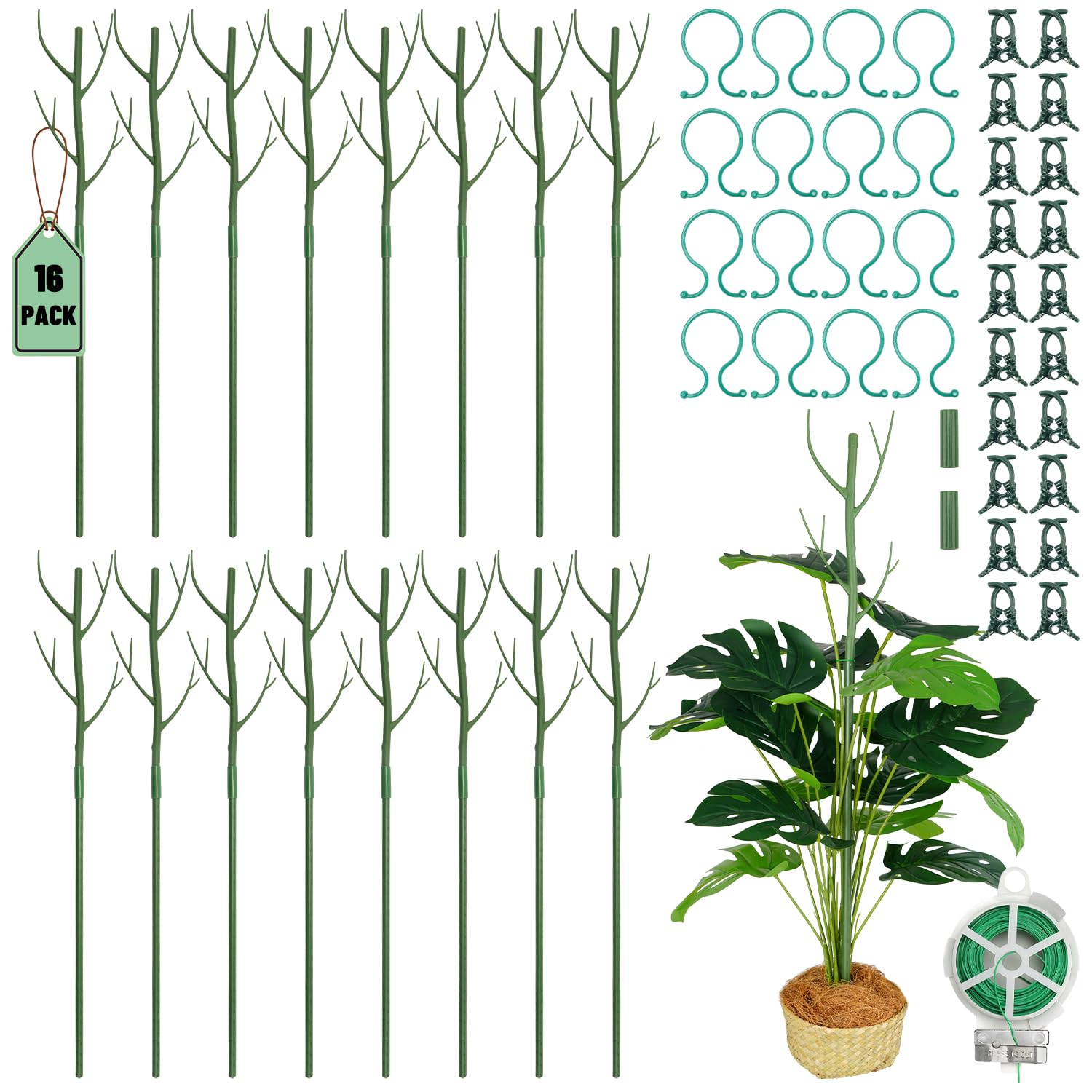
Sixteen detachable stakes plus clips and twist ties in one box — a full garden kit.
This is the highest-count set in the lineup: 16 stakes, each 27.5 inches, that screw together end-to-end using threaded metal splices. The plastic is fade-resistant and rust-proof, making it suitable for both indoor pots and outdoor garden beds. Alongside the stakes you get 65.5 feet of twist tie, 16 twist clips, and 20 orchid clips — enough hardware to secure an entire plant collection without buying extras. One reviewer noted that the adjustable height maxes out at about 32 inches with threaded extensions and that you can connect multiple half-round sections for custom shapes.
The main downside is that assembly requires screwing the metal splice connectors, which some people found fiddly without needle-nose pliers. Compared to the BOVITRO telescoping stakes, these are shorter per piece but offer more flexibility in connecting shapes and a far larger accessory bundle.
What makes it a full kit
- 16 stakes cover a whole plant collection or outdoor garden beds
- Includes 65.5ft of twist tie and 36 clips — no extra purchases needed
- Rust-proof plastic handles humid bathrooms and outdoor rain without issues
One thing to know
- Threaded assembly takes a few minutes per stake and may require pliers
- At 27.5 inches per section, individual stakes are shorter than the extendable or moss-pole options
Best suited for: Gardeners with many plants (indoors and out) who want a complete support kit with all the ties and clips included — no separate trips to the hardware store.
Think twice if: You need one single tall stake for a mature Monstera — the 27.5-inch sections require multiple connections to reach full height, which can feel less stable than a one-piece pole.
Understanding the Specs
Moss Pole vs. Plain Stake
A moss pole (metal or plastic mesh filled with sphagnum moss) gives your Monstera’s aerial roots a damp, textured surface to grip and grow into. This often results in larger leaves and more fenestrations — the iconic splits. A plain stake (fiberglass or plastic) simply props the stem upright; the roots have nothing to attach to, so the plant may not size up the same way.
Adjustable vs. Fixed Height
Extendable stakes (like the fiberglass telescoping type) let you increase support as the plant grows taller without disturbing the roots. Stackable systems require you to add or remove whole sections, which can mean pulling the stake out of the soil. Moss poles are typically fixed height unless you buy a multi-size set (e.g., 24″, 40″, 60″ combo) and swap them out.
FAQ
Do Monsteras really need a moss pole to grow big leaves?
What happens if I don’t give my Monstera any support?
Can I use a wooden stick instead of a moss pole?
How tall should my Monstera support be?
Do I need to keep the moss pole wet?
Will a 40-inch pole be tall enough for a large Monstera?
Can I leave the support in the pot permanently?
What is the difference between coco coir and sphagnum moss on a pole?
How do I attach my Monstera to the support without damaging the stem?
Final Thoughts: The Verdict
Across the board, the monstera support winner is the HOLANHING D-Shape Moss Pole because it combines moisture-retaining D-shape design, three height options, and enough material to support a massive climbing Monstera. If you want a quick, adjustable, no-mess solution, grab the BOVITRO Extendable Stakes. And for a ready-to-use, bendable option that you pull from the box and install in seconds, the Sproot Bendable Moss Pole is your best bet.
How We Picked
We do not accept paid placement. Every pick is matched to a real buyer and a real use-case; we do not hands-on test units.
Sources & Methodology
Specifications: manufacturer listings and product documentation. Review insights: verified customer reviews, as of July 2026. Pricing: not shown on this page (it changes often); check the current price via the retailer link.
As an Amazon Associate, Lawn Gear Lab earns from qualifying purchases. This does not affect which products we feature.