
Specs are compiled from manufacturer listings and verified buyer reviews and can change over time — please confirm the key details on the product page before buying.
Succulents are the unforgiving test of a plant parent’s restraint — they die faster from a kind-hearted splash than from neglect. A moisture meter for succulents stops the guesswork by showing you the truth below the surface, where root rot actually begins. The best ones are simple analog probes with no batteries to fail, giving you an instant dry/moist/wet read so you only water when the soil truly needs it.
I’m Rikta — the founder and writer behind Lawn Gear Lab. This guide is built by comparing the manufacturers’ published specifications and the patterns across verified customer reviews, so you get each pick’s real strengths and trade-offs instead of marketing spin.
Choosing the right moisture meter for succulents means understanding probe length, single-probe root safety, and honest durability limits before you commit.
Our Picks at a Glance

How To Choose The Best Moisture Meter For Succulents
Succulents store water in their leaves, so their roots are especially vulnerable to sitting in damp soil. A moisture meter helps you avoid that by measuring the soil at root level, not just the surface, which is where your finger and eyes fail you.
Probe length and pot depth
The probe needs to reach deep enough to read the moisture at the bottom of the pot, where water pools and root rot starts. Standard probes sit around 5 inches, while extended models can be significantly longer for bigger, deeper containers holding mature succulents.
Single probe versus multiple prongs
Multiple prongs measure a wider area but displace more soil and can nick fine root systems. Single-probe designs cause less damage to plant roots and, when you pull the probe out, they do not drag much soil with them — a real benefit for dense succulent arrangements.
The battery-free analog advantage
You get an instant reading the moment the probe touches soil, with no charging and no dead cells to worry about. The trade-off is that the metal tip will gradually corrode if you leave it buried, so the routine is insert, read, wipe, and store.
The honest durability reality
Simple construction keeps prices low, but it also means delicate inner connections. Owners frequently report that a dropped unit stops registering entirely, and pushing the probe into hard, dry soil can bend or collapse it. Treat the tool gently and it becomes a reliable years-long companion.
Quick Comparison
| Model | Best For | Probes Included | Probe Reach | Power Type | Amazon |
|---|---|---|---|---|---|
| XLUX Orange 2 Pack★ Best Overall | Best Overall — daily pot checks | 2 | Standard | Battery-Free | Amazon |
| XLUX Long ProbeDeep Pot Pick | Deep Pots & Larger Plants | 1 | 5.5 in (14 cm) longer | Battery-Free | Amazon |
| Tennedriv Green 2 PackBudget Two-Pack | Budget Two-Room Coverage | 2 | Standard | Battery-Free | Amazon |
| Dr.meter Long Probe | Cacti & Deep Containers | 1 | Long | Battery-Free | Amazon |
| UNIWA Soil Moisture Meter | Compact Storage & Beginners | 1 | 3-5 in insertion | Battery-Free | Amazon |
| AiGerdinn 4-in-1 Soil Tester | Multi-Function Soil Health | 1 | 2.5-3 in insertion | Battery-Free | Amazon |
| Sustee Aquameter (Large 2-Pack) | Leave-In Continuous Monitoring | 2 | 10.04 in (Large) | No Power Source | Amazon |
| IPPINKA Sustee (Set of 4) | Multiple Plants at Once | 4 | 7.09 in (Medium) | Battery-Free | Amazon |
| HSLGOVE 7-in-1 Soil Test Kit | Advanced Data & Beginners | 1 | 6.8 in | 3 Batteries | Amazon |
In‑Depth Reviews
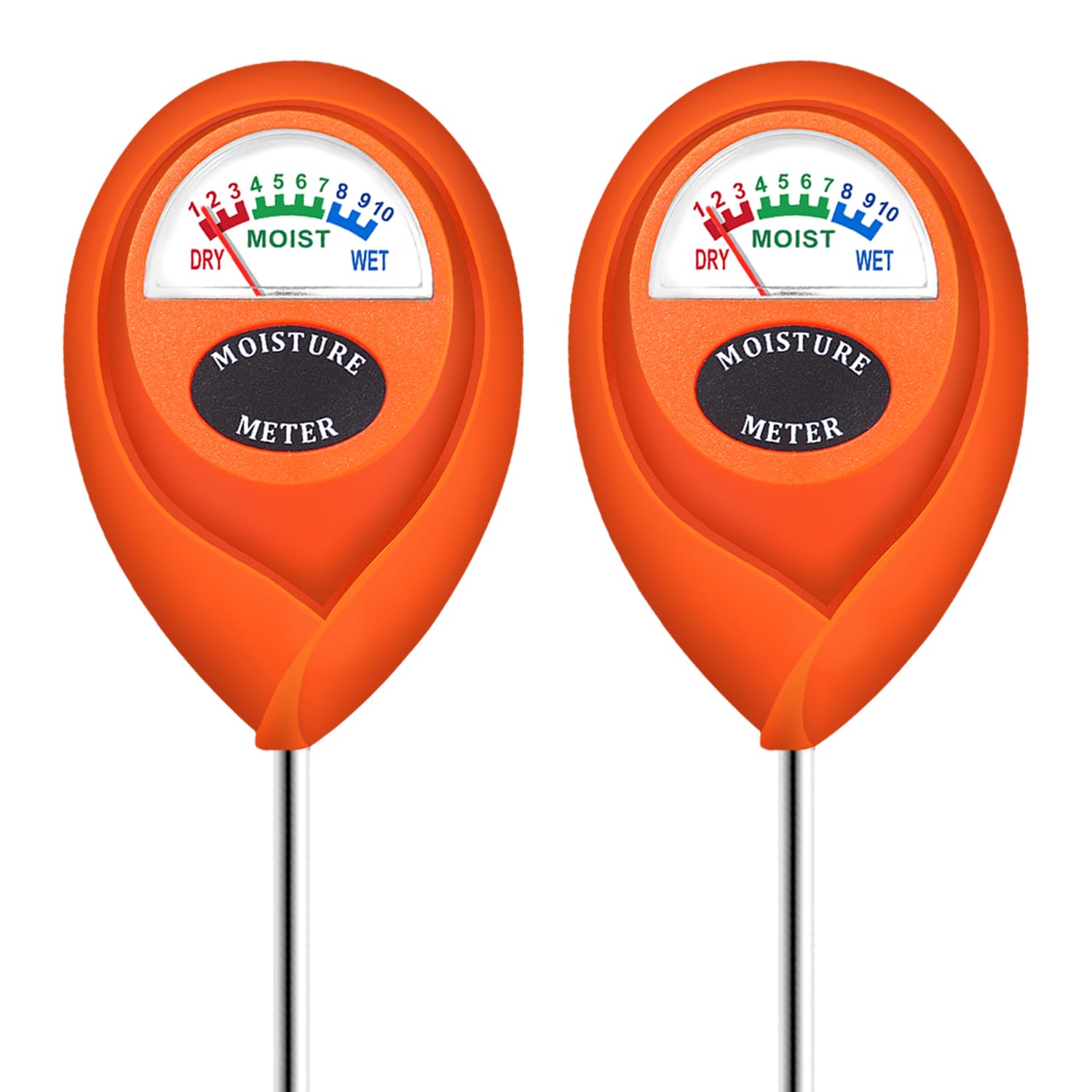
1. XLUX Orange 2 Pack Soil Moisture Meter
Our pick — over 4★ from 70,500+ verified ratings; the strongest balance of quality and price.
The crowd-pleaser that puts a battery-free meter in every pot you own.
Owning two meters means you can leave one at the window with your echeverias and keep another by the kitchen counter — a real convenience when you are checking daily. The large dial splits into three zones with ten scales, so you get a clear dry, moist, or wet answer at a glance instead of a vague guess. You push the single probe in and the needle moves immediately, with no wait and no batteries to fail.
What wins people over here is the sheer ease of use — it is the most-praised trait by a wide margin, with quality close behind. Owners describe it as a simple, effective tool that prevents overwatering by showing soil wetness at depth, which is exactly the life-or-death question for succulents. The single-probe design causes less damage to plant roots than multi-prong versions and pulls very little soil out when you remove it.
Buyers report that a dropped unit can stop working entirely — the internal probe disconnects and it reads dry forever. That is why the instructions stress wiping the probe after each check and never leaving it in the soil beyond 5 minutes to avoid corroding the metal tip. Treat it as a delicate instrument, not a garden trowel, and this two-pack delivers serious value.
Why owners reach for it
- Two meters included for the price of one — cover multiple rooms or pots
- No batteries means instant, always-ready readings
- Three-zone, ten-scale dial is straightforward to read
- Single probe is gentler on succulent roots
Where it asks for care
- Fragile internals — a drop can kill the reading permanently
- Must be wiped and removed within 5 minutes to avoid tip corrosion
- Not for very hard soil or liquids
Reach for it if: you are new to succulent care and want a cheap, battery-free safety net for multiple pots.
Look elsewhere if: you have deep, oversized planters — the standard probe may not reach the bottom, so step up to a long-probe model.
2. XLUX Long Probe Plant Soil Moisture Meter
A longer stem that reaches the bottom of deep pots where root rot hides.
When your succulent lives in a tall, deep planter, a standard probe only tells you what is happening near the surface — the dangerous zone is at the bottom, where water collects unseen. This XLUX solves that with a probe that is 5.5 inches (14 cm) longer than regular styles, letting you measure moisture at the base of larger and deeper flower pots. The anti-rust 304 stainless steel probe keeps the metal tip working cleanly over time, and the whole thing runs on zero batteries.
The standout praise here is functionality, with accuracy right behind it — this is the rare budget meter that owners say responds to varying soil moisture levels instead of getting stuck on one reading. It has transformed daily watering routines, with plants visibly responding to the corrected schedule. The dial still uses three zones with ten scales, so reading it is as easy as the standard model.
The catch is the same fragility that runs through every analog probe: it broke entirely after a drop, not shattered but internally dead. The reading head sits flat, so when the probe is buried deep, the dial is not tilted toward you and can be awkward to read. Push it gently into moist soil rather than jamming it into dry ground.
What it beats: the standard XLUX probes above on reach alone — 5.5 inches (14 cm) of extra stem means you can finally trust readings in tall planters.
Best for: anyone with deep pots, large potted plants, or outdoor garden beds where surface checks are useless.
Think twice if: your succulents live in shallow, wide bowls — the extra length is wasted and you will pay for reach you do not need.
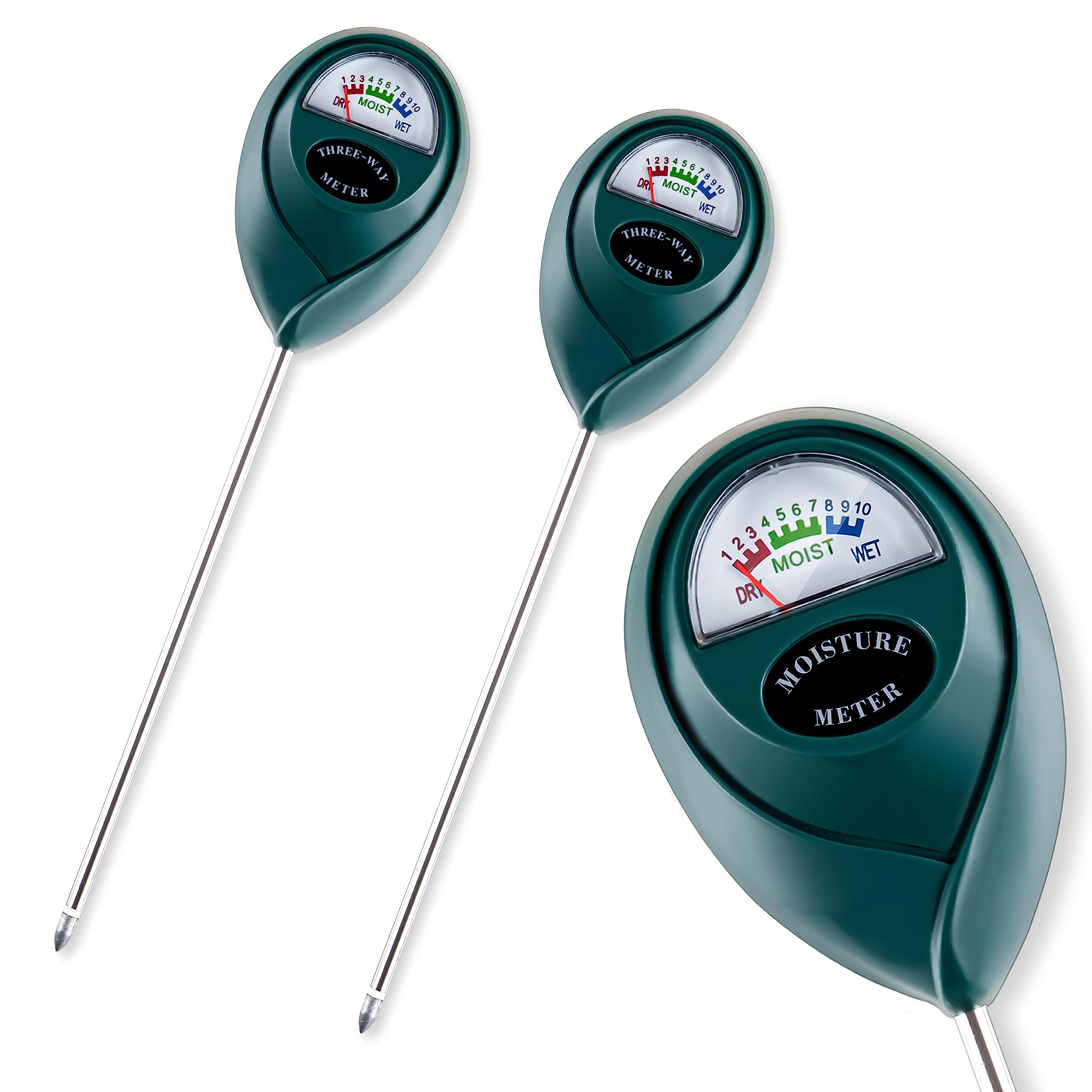
3. Tennedriv Green 2 Pack Soil Moisture Meter
Two lightweight meters for keeping separate rooms on different watering schedules.
Having two meters is the quiet luxury of this pick — you can keep one with the succulents on the bright shelf and another with the ferns in the bathroom, without carrying tools between rooms. Each unit is lightweight yet sturdy enough to penetrate mildly firm soil, and the gauge is large and extremely easy to read. No batteries are required; you just stick the probe in, read the dial, and wipe it off with a paper towel or rag.
The most-discussed trait is reliability, and it earns a mixed verdict — some owners find it works beautifully while others report it never works at all, which is the gamble of budget analog meters. The useful advice that emerges from the positive reviews is to insert the meter in several places in the pot before adding more water, giving you a fuller picture of the moisture across the whole root ball.
At just 7.2 ounces, it is easy to handle, but that lightness also hints at the fragility inside. The cautions repeat the standard rules: do not leave it stuck in the soil and never dip it into a cup of water, because both will ruin the meter. For the price of a single premium unit you get two meters, which is the real math that wins people over.
Honest read: a budget-minded two-pack where the value is in the count — two meters for the price of one premium — but batch quality varies, so test yours in a damp pot the day it arrives.
Reach for this if: you want meters in two separate rooms or a backup for when a drop inevitably kills one.
Look elsewhere if: you need guaranteed accuracy for a prized rare succulent collection — read the mixed reliability feedback as the signal it is.
4. Dr.meter Long Probe Soil Moisture Meter

The long, thin probe that slips into deep pots and reads cactus soil with zero experience.
If you have ever stuck a finger in the soil hoping to feel when it is time to water, this meter is the upgrade that keeps your hands clean and your judgment honest. The interface uses ten scales with a color-coded reading system that runs from red to green to blue, so even a complete beginner can tell dry from wet at a single glance. No batteries or electricity are needed — you plug the plant water meter into the ground and get a reading in no time.
Owners specifically call out how well it works for cactus plants and deep pots, with the longer probe singled out as especially useful for larger and deeper plantings. The thin and long probe is praised as good for house plants, and the single-probe design keeps roots intact so you are not digging up soil or disturbing sensitive root systems with every check.
The honest warning from the field is that this probe bends. It arrived slightly bent for one owner and eventually collapsed in half under too much pressure in wet soil, and there is a caution that pushing it straight into dry ground can fold it. The most serious feedback is blunt: do not leave it in the soil, because the bottom of the meter can disintegrate when left buried. Insert, read, remove, and it serves you well.
What earns its keep
- Color-coded red-to-blue dial is readable with zero experience
- Long, thin probe is ideal for deep pots and cacti
- Single probe keeps delicate roots undisturbed
How to keep it alive
- Probe bends and can collapse under pressure in hard or wet soil
- Never leave it buried — the meter bottom can disintegrate
- Best used in pre-moistened, loose soil
Best for: cactus keepers and anyone with deep containers who wants a gentle, color-coded reading.
skip it if: your soil is hard-packed or rocky — the probe needs soft ground and gentle pressure to survive.
5. UNIWA Soil Moisture Meter
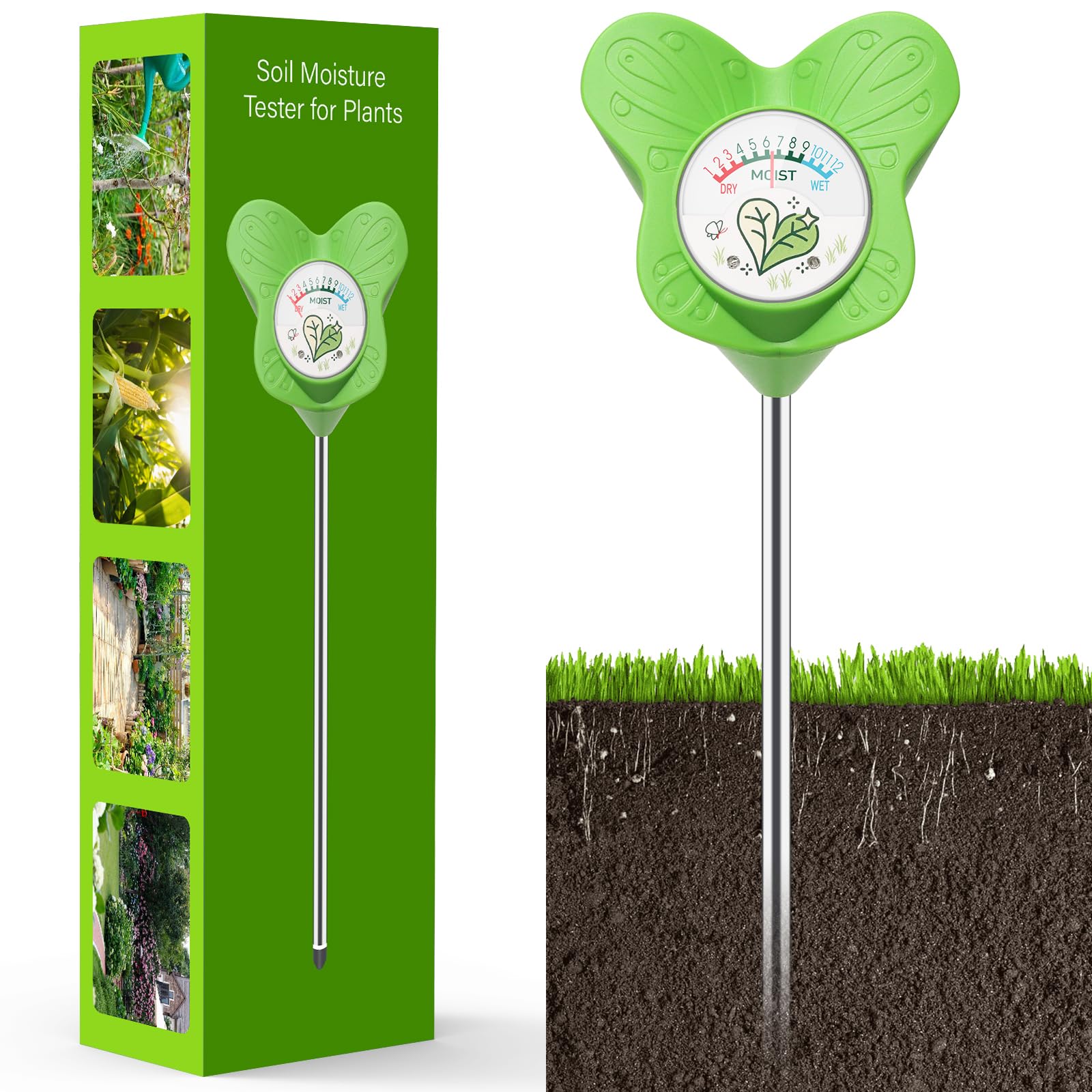
A featherlight 2.39-ounce probe that fits in a drawer and catches overwatering habits early.
At just 2.39 ounces, this meter is barely there when you pick it up, and it stores easily in a drawer between uses — a detail that matters more than you think when you check plants daily. The interface features twelve scales, which is more granular than the standard ten, giving you a finer read on exactly where your soil sits between bone dry and soaked. You insert the probe 3-5 inches into the soil and wait 10 seconds for the immediate result, with no experience needed.
The standout praise is functionality, with owners noting it takes the guesswork out of watering and even revealing that they had been overwatering all along. The single-probe design is less harmful to roots, so you are not churning up your succulent’s delicate root ball with every check. Its versatility across indoor pots, gardens, lawns, and farms makes it a one-tool solution for anyone with mixed plant collections.
The mixed feedback centers on the moisture measurement itself — some owners mention it stays stuck in the dry zone even on freshly watered soil, and a few found it stopped working entirely after the first week. The instructions are clear about the limits: prolonged insertion in moist conditions can soften the metal and cause the probe to detach. Keep your checks quick, and this compact meter earns its drawer space.
Where it shines: as a low-commitment first meter for beginners who want a twelve-scale read, it is a gentle entry point that reveals overwatering patterns you did not know you had.
Reach for this if: you want an ultra-light, easy-storing meter for casual daily checks across many plants.
Look elsewhere if: you need a meter you can leave in the soil for continuous monitoring — this one demands quick insert-and-remove use.
6. AiGerdinn 4-in-1 Soil Tester
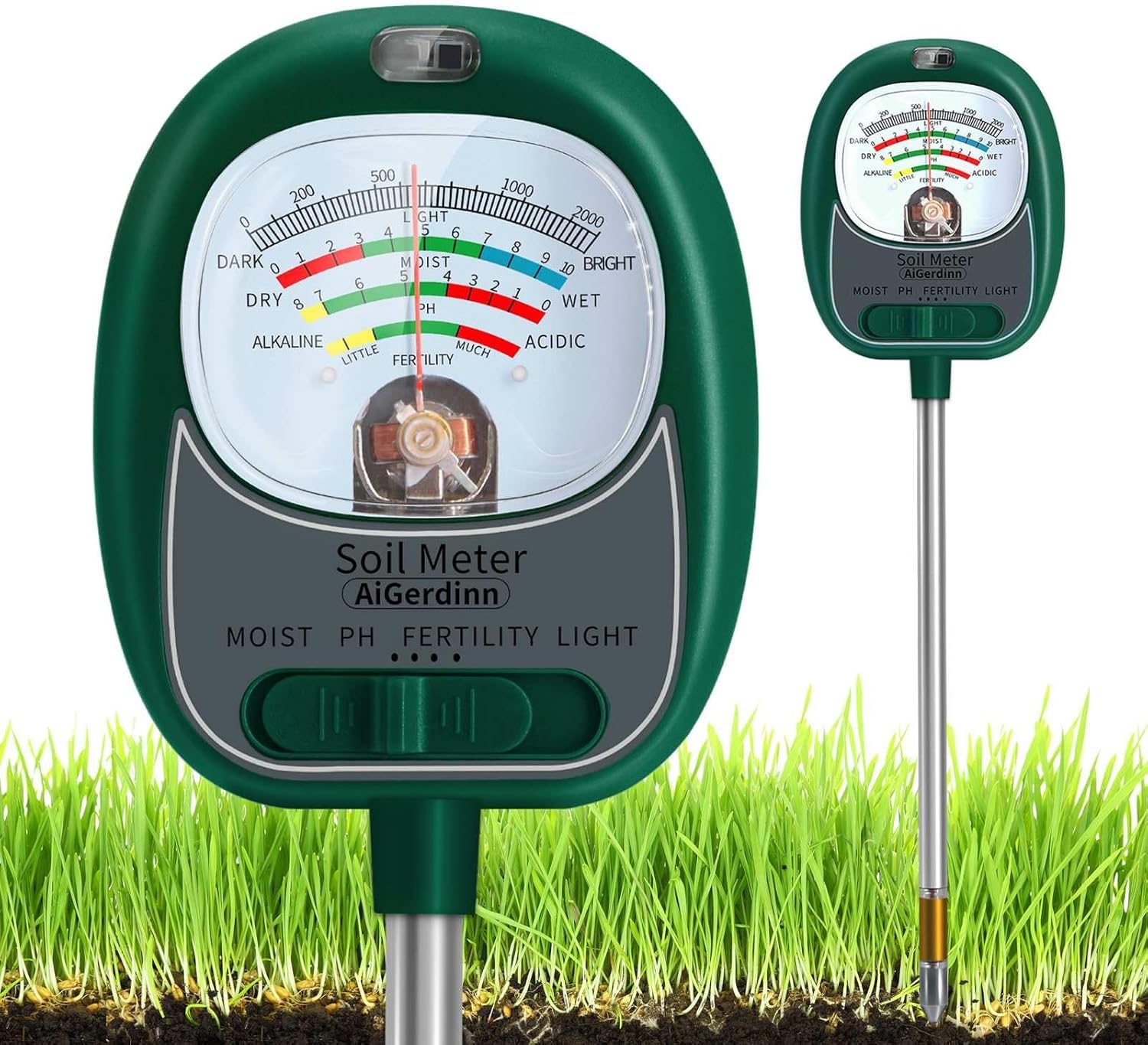
One oversized 1.95-inch dial that reads moisture, pH, fertility, and sunlight for soil nerds.
For the succulent keeper who wants the full picture of their soil, this 4-in-1 tester replaces several separate tools with a single oversized dial. The 1.95-inch dial is noticeably bigger than traditional soil hygrometers, making it comfortable for both young and older gardeners to read. You switch between modes with a single button to check soil moisture, soil pH, nutrients, and sunlight level — all without a battery.
The praise is consistently about functionality and ease of use, with owners noting it works well for both pots and gardens and that the large, clear dial is easy to read. It is particularly useful for plants sensitive to soil conditions, which describes most succulents. The single probe is upgraded to be durable and less harmful to roots, and it can detect complex mixed-soil conditions.
The honest limits come from the instructions: this is not for water, slurry soil, red clay soil, hard soil, or plant ash, and you should not test while watering. Moisture the soil before the test and make sure the probe and sensor do not touch the bottom of the pot for accurate readings. Owners find it a good-quality tool that helps keep plants healthy, with the multi-function bonus justifying the small step up in price.
The multi-tool appeal
- One battery-free device measures moisture, pH, fertility, and sunlight
- 1.95-inch oversized dial is genuinely easy to read
- Single probe is gentler on roots than multi-prong testers
The conditions it needs
- Refuses to work on very hard soil, slurry, or liquids
- Requires moistened soil before testing for best results
- Do not test right after watering
Best for: the soil-obsessed succulent grower who wants to dial in pH and fertility, not just moisture.
Not for: quick-hit watering checks — the multi-mode setup takes more steps than a simple analog probe.
7. Sustee Aquameter (Large Green Refillable – Bundle of 2)

A leave-in color-change stick that watches your soil so you do not have to.
This is a completely different approach: instead of probing and reading a dial, you leave the Sustee Aquameter in the soil and let it watch for you. The plant water indicator changes color depending on the soil — white means the plant needs watering, blue means it has been watered. It is a set of two refillable watering sticks at 10.04 inches long, intended for pot sizes of 6 to 12, and each stick lasts for approximately 6-9 months before the refillable core needs replacing.
What wins owners over is the hands-free convenience and the fact that it senses water at root level — no dirty fingers and no damaged roots from poking and prodding. It is maintenance-free with no battery required, and it was It was developed with Tokyo University of Agriculture.. Orchid customers note their plants staying much healthier with these, and some find the sticks last a little over a year in practice.
The honest caveat is that these take a while to respond — you water, wait a few moments, and if it is still white, water some more. The most common frustration is color reliability over time: some sticks worked great for the first day then faded and never changed color again. They are best used in soils that retain water rather than the fast-draining gritty mixes many succulents prefer, so check your soil type before committing.
The real trade-off: you trade instant dial readings for continuous, glance-and-know monitoring — brilliant for forgetful waterers, but the color-change mechanism is the part most likely to disappoint over months.
Reach for this if: you want a set-and-forget visual reminder that works in water-retentive soil.
Look elsewhere if: your succulents live in a fast-draining gritty mix or you prefer immediate numeric feedback.
8. IPPINKA Sustee Aquameter, Set of 4

Four Japanese-made color sticks to scatter across every plant in the house.
When you have more plants than patience, a set of four leave-in sensors means every container gets its own silent watchman. Each medium stick is 7.09 inches long and intended for pot sizes of 3.5, 4, 5, and 6 — right in the balance for typical succulent pots. The refillable cores last for approximately 6-9 months before you swap in replacements, and no batteries are needed at all.
Owners who have used both styles say these work much better than those meters with the needle, and they get praised for working across cactuses, tropical plants, and everything in between. The color indicator helps plants stay healthier by preventing both overwatering and underwatering, with some reporting it saved their potted plants. Parents even use the color change to teach kids when it is time to water.
The known quirks are real: the first use can take about two days to show the color change, which is easy to misread as a factory defect. Some sticks stay blue as if overwatered after a week, losing accuracy, and several owners note the value is just not there for the price. Made in Japan and developed with Tokyo University of Agriculture., the quality is genuine — but the color-change mechanism is a living component that can fade.
Why four beats one
- Four sticks cover a full windowsill of pots at once
- Color change is readable by kids and guests alike
- Refillable cores extend the life of each unit
The honest trade-offs
- First reading can take up to two days to appear
- Color accuracy can drift after the first week
- Premium price per stick for what is a simple mechanism
Best for: the plant-filled home where you want a visual, no-thinking check across many pots at once.
Think twice if: you need precise, immediate readings — these trade speed for convenience.
9. HSLGOVE 7-in-One Soil Test Kit
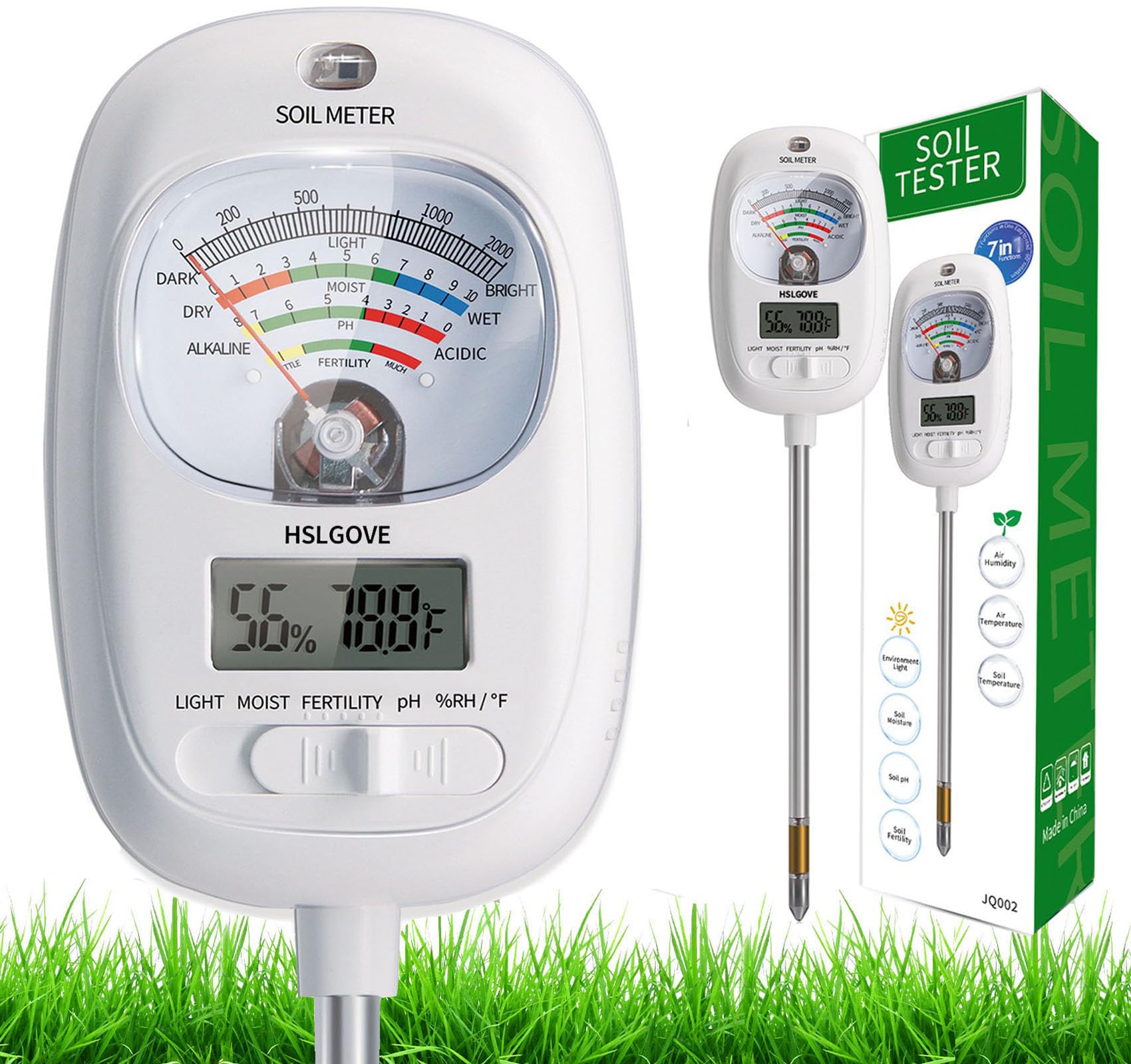
The 7-in-1 data nerd that shows moisture, pH, fertility, temperature, and humidity on dual screens.
If you want to stop guessing and start measuring everything, this kit combines a 1.6-inch chip board with a dual-screen design that displays soil moisture, pH, fertility, light, soil temperature, air temperature, and air humidity all in one unit. The dial handles the analog soil readings while the LCD screen shows digital soil and air temperature plus humidity. It is powered by 3 batteries, and you switch modes with a single button to read the LCD results in 3-5 minutes.
Owners — especially beginners — praise it for accurate readings with multiple measurements visible at once, and the clear LCD makes mode-switching easy. The effective probe is built from 3 kinds of quality metal for accuracy and durability, measuring about 6.8 inches, which suits medium to large potted plants. The single-probe design is less harmful to the root system and will not drag out much soil after testing.
The honest adjustment is the learning curve: you replace or install all 3 batteries each time, put the button to %RH/°F to turn on, and to LIGHT to turn off. It is not a water moisture meter, so never test liquids. For a dedicated succulent keeper who wants soil temperature and air humidity along with moisture, this is the most complete picture on this list — but it is also the most complex and the only one that needs batteries.
Who it is for: the data-driven grower raising seedlings or fussy succulents who wants soil temp and air humidity alongside moisture, and is happy to manage three batteries for the privilege.
Reach for this if: you want the full environmental picture — moisture, pH, fertility, temperature, and humidity in one gadget.
Look elsewhere if: you want grab-and-go simplicity — the battery management and mode switching add real friction to daily checks.
Understanding the Specs
Probe length and insertion depth
Probe length determines how deep you can read, which matters because moisture pools at the bottom of a pot where roots sit. Standard probes read shallow soil, while extended probes — like the XLUX at 5.5 inches (14 cm) longer than regular — reach the bottom of deep planters. Always insert the probe to the marked depth for a true reading, not a surface skim.
The 5-minute rule and probe care
Analog meters with metal tips corrode gradually if left buried in soil, which is why the instructions everywhere say do not leave the meter in the soil for more than 5 minutes. The routine is simple: insert, read the dial immediately, remove, and wipe the probe clean with a rag. Treat the probe gently — dropping it can break the internal connection permanently, and pushing into hard soil can bend it.
FAQ
How deep should I insert a moisture meter for succulents?
Can I leave a moisture meter in the soil permanently?
Why does my succulent meter always read dry?
What is the difference between a single-probe and double-probe moisture meter?
Can a moisture meter be used in water or liquid?
How long do leave-in moisture sensors like Sustee last?
What does the color blue and white mean on a Sustee Aquameter?
Is a battery-free moisture meter better than a digital one for succulents?
Why is my moisture meter giving different readings in different spots?
Final Thoughts: The Verdict
For the majority of shoppers, the moisture meter for succulents winner is the XLUX Orange 2 Pack because it delivers two battery-free meters with an easy three-zone dial at a price that makes daily checking painless. If you have deep pots and tall planters, grab the XLUX Long Probe for its 5.5-inch (14 cm) extended reach. And for the hands-off succulent keeper, the Sustee Aquameter turns watering into a glance at a color instead of a poke in the dirt.
How We Picked
We do not accept paid placement. Every pick is matched to a real buyer and a real use-case; we do not hands-on test units.
Sources & Methodology
Specifications: manufacturer listings and product documentation. Review insights: verified customer reviews, as of August 2026. Pricing: not shown on this page (it changes often); check the current price via the retailer link.
As an Amazon Associate, Lawn Gear Lab earns from qualifying purchases. This does not affect which products we feature.