
A microgreen tray that flexes when it’s full of damp soil is a recipe for disaster. A single buckle under weight can send a whole harvest crashing to the floor, ruining a week of careful germination. Beyond the immediate mess, a cheap, warped tray often lacks the rigidity needed to maintain consistent moisture levels across the growing medium, which directly impacts root development and the final yield of tender microgreens.
I’m Rikta — the co-founder and writer behind Lawn Gear Lab. I’ve spent hundreds of hours analyzing the mechanical specs of seed-starting hardware, cross-referencing the plastic gauge, ribbing patterns, and dimensional stability claims of dozens of growing flats against thousands of owner experiences and commercial grower forums.
After this deep dive, one thing is clear: not every flat is built for the consistent moisture and root space microgreens demand. This guide distills that research into the best microgreen trays on the market, helping you pick a flat that won’t crack, sag, or leak halfway through your cutting cycle.
How To Choose The Best Microgreen Trays
Selecting a tray for microgreens is a different calculation than picking one for general seedling starting. Microgreens grow in a dense mat, requiring a flat, consistent surface and the ability to hold a precise amount of water without pooling. You need a tray that acts as a reliable growing vessel, not just a drip catcher.
Wall Thickness and Ribbed Reinforcement
The two biggest failure points in standard flats are side-wall flex and bottom sag. On a microgreen shelf, a loaded tray of soil can weigh several pounds. A tray with thin walls (0.3mm to 0.5mm) will bow outward, while a flat bottom without ribs will bulge downward, creating uneven moisture pockets. Look for trays using thicker polypropylene (PP) or polystyrene (PS) — ideally 0.8mm to 1.8mm — with deep bottom channels. These ribs create a self-supporting structure that prevents the dreaded “belly” sag, ensuring your growing medium depth stays uniform across the entire flat.
Drainage vs. Solid Bottom
Microgreens thrive on a bottom-watering technique to prevent damping-off disease. A solid-bottom tray (no holes) allows you to pour water into the bottom and let capillary action wick it upward through the soil or mat, keeping the foliage dry. Drainage holes are better for growers who prefer a top-water-and-drain cycle, or who are repurposing these trays for sprouting where excess water must escape freely. For the dedicated microgreen grower, a solid-bottom 1020 tray is usually the gold standard, as it doubles as a perfect reservoir for the root mat.
True 1020 Sizing and Stackability
The industry standard is the “1020” tray, which measures roughly 10 inches by 20 inches on the bottom interior and about 21.5 inches by 11 inches at the top rim. This size fits under standard humidity domes and on dedicated wire rack shelving. Beware of trays labeled “1020” that are slightly smaller or larger, as they may not stack properly with plug inserts or domes from other brands. A tray that is stackable in storage is also a sign of precise manufacturing tolerance, as warped rims will cause a stack to wobble and potentially collapse in the greenhouse.
Quick Comparison
On smaller screens, swipe sideways to see the full table.
| Model | Category | Best For | Key Spec | Amazon |
|---|---|---|---|---|
| RooTrimmer 10 Pack | Premium | Heavy-Duty Bottom Watering | 1.8 mm reinforced wall | Amazon |
| Bootstrap Farmer 10 Pack | Commercial | Pro Grower, Long-Term Reuse | 1.8-2.0mm Polypropylene | Amazon |
| Hemlock Home Brewing 5 Pack | Mid-Range | Thick Flats, Smaller Kits | 1.2mm measured thickness | Amazon |
| Gardzen 10 Pack | Mid-Range | Large Volume, Value Pack | 21″ x 11″ x 2.4″ outer dims | Amazon |
| Living Whole Foods 10 Pack | Budget-Mid | Hydroponic Pads & Drain Trays | With Drain Holes | Amazon |
| YoleShy 10 Pack | Budget | Entry-Level Bottom Watering | 14.5″ x 9″ compact size | Amazon |
| EBaokuup 10 Pack | Budget | Soil-Free Sprouting Kits | 8.8″ x 5.7″ small trays | Amazon |
In‑Depth Reviews
1. RooTrimmer 10 Pack 1020 Trays (No Holes)

The RooTrimmer 1020 trays are built with a 1.8-millimeter wall thickness that immediately separates them from the flimsy supermarket flats. This extra PS material gives them a rigid feel even when loaded with saturated potting mix, resisting the side-wall bowing that causes microgreen mats to dry out unevenly. The bottom features deep concave-convex stripes that serve a dual purpose — they reinforce the floor against sagging and create micro-channels for even water distribution during bottom-watering cycles.
Users consistently report these trays surviving multiple seasons in a greenhouse environment, resisting the cracking that thin plastic develops after repeated UV exposure and temperature swings. The solid-bottom design makes them ideal for microgreen growers who want to maintain a consistent reservoir of water under their soil or coconut coir mat. At about 2.5 inches deep, they provide enough headroom for a solid root zone without wasting vertical space on a shelf rack.
One practical nuance to note is that older standard 1020 inserts may not fit perfectly inside these trays due to their slightly tighter interior dimensions. This is a minor compatibility issue for those using legacy plug inserts, but for pure microgreen production where you are growing directly in the flat, this is irrelevant. For the grower seeking a durable, leak-proof vessel that can handle daily watering without deforming, this pack is the most balanced option between cost and commercial-grade rigidity.
What works
- 1.8mm plastic resists flex even when fully saturated with soil.
- Deep bottom ribs prevent the floor from sagging under weight.
- Solid walls and bottom ensure zero leaks during bottom-watering.
What doesn’t
- Older standard 1020 inserts may not seat flush inside the tray.
- No drainage holes limits use to bottom-watering systems only.
2. Bootstrap Farmer Extra Strength 1020 Trays (with Holes)
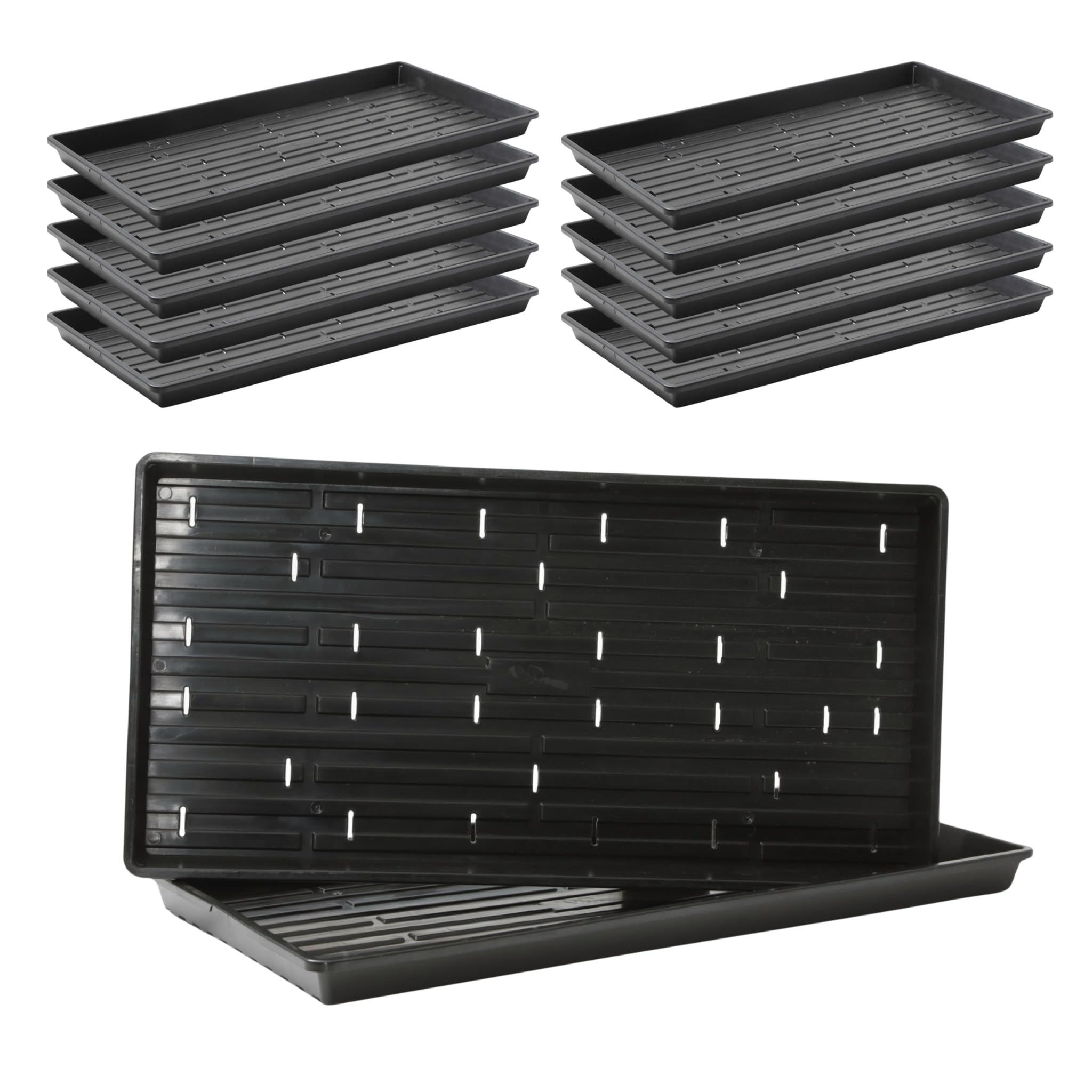
Bootstrap Farmer’s Extra Strength trays are engineered for commercial environments where a failure means losing hundreds of dollars in crop. They use a polypropylene blend measuring between 1.8 and 2.0 millimeters, which is the thickest wall in this lineup. This material choice is critical for microgreens because polypropylene has a higher impact resistance and flexibility than polystyrene, meaning these trays will snap back rather than crack if dropped or twisted while loaded.
The version with drainage holes is perfectly suited for growers who top-water their microgreens or who run a spray-and-drain cycle to keep humidity down. The holes are arranged in a cross-channel pattern that prevents standing water on the tray floor, reducing the risk of root rot. Even with the holes, the rigid side walls prevent flex, so you can move a fully saturated tray from shelf to shelf without fear of collapse.
Shipping can be a point of frustration. Multiple buyers have reported receiving trays with hairline cracks due to inadequate packaging from the retailer. The trays themselves are durable, but the packing process sometimes fails to protect them during transit. If you do receive a damaged tray, Bootstrap Farmer has a responsive replacement policy, but it is an extra step. For the serious microgreen hobbyist or small-scale commercial grower who plans to keep these trays for a decade, the initial investment pays for itself quickly compared to replacing cheap flats every season.
What works
- Thickest plastic in the review at 1.8-2.0mm; resists cracking and warping.
- Cross-channel drainage pattern prevents water pooling on the floor.
- Rigid walls allow confident transport of heavy, saturated trays.
What doesn’t
- Frequent shipping damage reports due to inadequate packaging.
- Premium price point that may be overkill for casual home growers.
3. Hemlock Home Brewing 1020 Seed Starting Trays (5 Pack)

Hemlock Home Brewing struck a smart balance with these trays. They are not as thick as the RooTrimmer or Bootstrap Farmer packs, but at a verified 1.2-millimeter thickness, they are significantly sturdier than standard Jiffy-brand or generic greenhouse flats that hover around 0.4 millimeters. The polypropylene construction gives them a slight flexibility that prevents snapping, yet they hold their shape well enough to carry a full tray of 50-cell inserts without buckling.
The green color is a deliberate bonus. As one long-time user pointed out, the vibrant pigment makes them easy to distinguish on a messy shelf, and the plastic does not become brittle with UV exposure as quickly as clear or black trays. The solid-bottom design is ideal for microgreens, allowing you to pour a steady reservoir of water into the bottom for wicking without worrying about holes leaking onto the shelf below.
These trays come in a five-pack, which is a smaller quantity than the ten-packs from competitors. This makes them a perfect entry point for the home grower who does not need a massive stack of trays all at once. The interior dimensions are true to the 1020 standard, so they accommodate standard humidity domes and plug inserts without issue. A few users noted that the price has increased over the past year, but the build quality justifies the mid-range cost for a durable, attractive flat that will last several seasons.
What works
- Measured 1.2mm thickness is a clear upgrade over standard 0.4mm flats.
- True 1020 dimensions fit all standard humidity domes and inserts.
- Green pigment improves visibility and resists UV degradation.
What doesn’t
- Five-pack offers lower volume than value-oriented ten-packs.
- Not as rigid as ultra-thick 1.8mm trays; some flex when fully packed.
4. Gardzen 10 Pack Seed Trays (No Drain Holes)

Gardzen takes a slightly different approach to the microgreen tray. These flats are made from polished polystyrene and measure a generous 21 inches by 11 inches at the top, with a 2.4-inch depth. The larger footprint gives you more growing area per tray than standard 1020 flats, which is useful if you are trying to maximize yield on a large shelf. The package also includes a dibber and a widger, small hand tools that are genuinely convenient for transplanting seedlings and loosening soil.
The solid-bottom design includes several raised channels that guide water across the tray floor during bottom-watering. This channel system prevents the soil mat from sitting in a stagnant puddle, while still allowing capillary action to pull moisture upward through the growing medium. The polystyrene material is rigid, but some users have reported cracking at the corners when the trays are stacked high or handled roughly. They hold up well under normal use, but they are not as impact-resistant as polypropylene alternatives.
These trays are a strong mid-range option for the grower who values scale and a complete starter package. The included tools save a trip to the garden store, and the 10-count pack provides plenty of capacity for a multi-shelf microgreen setup. Just be mindful of the corner stress points when stacking them; they benefit from a gentle hand during storage rotation.
What works
- Large 21″ x 11″ surface area provides more growing space than standard 1020 trays.
- Includes a dibber and widger, adding immediate value for beginners.
- Bottom channels improve water distribution during bottom-watering cycles.
What doesn’t
- Polystyrene corners can crack if trays are stacked or handled aggressively.
- Not as flexible as polypropylene; more prone to snapping under stress.
5. Living Whole Foods 10 Plant Growing Trays (With Drain Holes)

Living Whole Foods offers a ten-pack of flats that come pre-drilled with drainage holes, making them the ideal choice for growers who prefer a top-watering or spray-and-drain irrigation scheme. The holes allow excess water to escape freely, which is critical for preventing anaerobic conditions in microgreen mats if you accidentally over-water. The trays are sized to accommodate standard 20″ x 10″ hydroponic grow pads perfectly, so if you use coco coir or felt mats, these trays are essentially plug-and-play.
The plastic used here is slightly thicker than the cheapest generic trays found at big-box stores, but it is still prone to twisting when fully loaded with wet soil or heavy plug trays. Users have noted that you need to support the tray from the bottom with both hands when moving it to avoid flexing and cracking the side walls. Leaving them in direct sunlight for drying can also cause permanent warping, so indoor air-drying is recommended.
For their price point, these trays deliver excellent value if you are looking for a large quantity of functional, hole-punched flats. They are well-suited to a chicken fodder system or as replacement trays for standard hydroponic setups. Just do not expect the same structural rigidity as the thicker premium trays — these are lightweight tools designed for light-duty, consistent use.
What works
- Pre-drilled holes allow for top-watering and quick drainage.
- Designed to fit standard 20″ x 10″ hydroponic grow pads perfectly.
- Ten-pack delivers a high value for bulk system setups.
What doesn’t
- Walls can twist and flex when fully loaded; two-handed carry is necessary.
- Sun exposure and heat can permanently warp the tray shape.
6. YoleShy 10 Pack Seed Starter Tray (No Drain Holes)

YoleShy offers a compact tray that measures 14.5 inches by 9 inches, which is significantly smaller than a standard 1020 flat. This smaller footprint is a deliberate feature — it makes the trays more manageable on a windowsill or a narrow shelf, and they are easier to move around without needing two hands. The multi-color design adds a cheerful aesthetic, but the real story is in the reinforced perimeter. The tray edges have deeper ripples than typical compact flats, which adds some rigidity to the side walls.
The solid-bottom design works well for bottom-watering small batches of microgreens. While the plastic feels thicker than the absolute cheapest disposables, a few users have noticed slight flex in the bottom when the tray is heavily loaded with wet soil. The trays hold up well during a typical 7-to-10-day microgreen cycle, but they are not built to withstand the constant heavy lifting of a commercial rotation. They are best suited for the home grower who produces a few trays per week for personal consumption.
One common feedback point is the size: some buyers expected a larger tray. If you check the dimensions before purchasing, the compact nature becomes a strength rather than a disappointment. They stack neatly and take up minimal storage space between cycles. For the budget-conscious gardener who wants a reusable tray that does not take over the kitchen counter, this set offers a solid entry point.
What works
- Compact 14.5″ x 9″ size fits easily on shelves and windowsills.
- Reinforced perimeter ripples add side-wall rigidity.
- Solid bottom is perfect for simple bottom-watering routines.
What doesn’t
- Bottom can flex slightly when fully loaded with heavy soil.
- Smaller surface area yields fewer microgreens per tray.
7. EBaokuup 10 Pack Seed Sprouter Tray (With Drain Holes)

The EBaokuup trays are the smallest in this comparison, measuring only 8.8 inches by 5.7 inches. This micro-size is designed specifically for soil-free sprouting, using the included double-deck system where the inner tray with small holes sits inside a solid water-saving tray. The included planting paper provides a clean growing medium for beans, wheatgrass, and small microgreen varieties, allowing you to grow without any soil mess.
The double-deck design is clever for sprouting: you add water to the bottom tray, place the inner tray on top, and the small holes allow the roots to reach down into the reservoir while keeping the seeds elevated above standing water. This airflow below the seed mat significantly reduces mold issues, a common problem in microgreen germination. The trays are made from BPA-free PP plastic that is surprisingly sturdy for their size; one user reported they survived a fall that broke a tile floor.
These are not the trays to choose if you want to grow a full 1020 flat of sunflower or pea shoots on a large scale. They are specifically designed for variety and small-batch production. The included 40 sheets of planting paper add immediate value, making this a complete starter kit. For the urban grower who wants to keep 5-6 different varieties of microgreens or sprouts cycling on a kitchen counter, the EBaokuup set is a perfect, dedicated tool.
What works
- Double-deck design with drainage holes prevents root rot and mold in sprouts.
- Includes 40 sheets of planting paper for immediate, soil-free use.
- Compact footprint is ideal for kitchen counter variety growing.
What doesn’t
- Very small size limits yield; not a primary production tray for microgreens.
- May be too small for growers expecting a standard seed-starting flat.
Hardware & Specs Guide
Plastic Gauge (Thickness)
Measured in millimeters, the gauge of a microgreen tray directly correlates to its structural integrity. Standard cheap flats use 0.3mm to 0.5mm plastic that flexes and cracks easily. Semi-professional trays start around 0.8mm to 1.2mm, providing good rigidity for home use. Commercial-grade options like Bootstrap Farmer and RooTrimmer use 1.8mm to 2.0mm material that resists twisting when fully loaded. Always check user-review measurements, as advertised thickness can vary from actual production runs.
Ribbed Floor vs. Flat Bottom
A flat-bottom tray will bulge downward under the weight of saturated soil, creating an uneven growing surface and pooling water in the low spots. Ribbed or channeled bottoms — where the plastic is formed into a series of raised lines — act as structural beams that prevent sagging. For microgreens, these channels also serve a secondary purpose: they distribute water evenly during bottom-watering, ensuring the entire root mat gets consistent moisture without forming dry pockets on the edges.
FAQ
Should I buy microgreen trays with or without drainage holes?
What does “1020” mean in microgreen tray sizing?
Can I reuse microgreen trays after a harvest?
Final Thoughts: The Verdict
For most gardeners, the microgreen trays winner is the RooTrimmer 10 Pack because it delivers 1.8mm of dense wall rigidity and a ribbed bottom at a mid-range cost that beats flimsy flats without demanding a commercial budget. If you need a tray that can endure heavy commercial rotation and you prefer a drainage-ready design, grab the Bootstrap Farmer Extra Strength. And for the home grower who wants a five-pack of perfectly proportioned, UV-resistant trays, nothing beats the Hemlock Home Brewing 1020 Trays.