
Walking into a grocery store for fresh microgreens means paying premium prices for greens that often wilt within two days. A quality microgreen growing kit solves that by bringing the harvest directly to your kitchen counter, cutting the cost per serving to pennies while delivering produce that was alive minutes before you eat it. The challenge is picking the right system — tray-based, jar-based, or tiered — from a market flooded with options that vary wildly in drainage design, mesh tightness, and material safety.
I’m Rikta — the co-founder and writer behind Lawn Gear Lab. After analyzing hundreds of owner experiences and comparing tray dimensions, mesh gauges, and seed-starting success rates across the top contenders, I’ve sorted through the noise to find the setups that actually produce consistent, mold-free harvests.
Whether you are a first-time sprouter or an experienced grower looking for a reliable daily rotation, this guide breaks down the seven strongest performers to help you find the ideal microgreen growing kit for your space and skill level.
How To Choose The Best Microgreen Growing Kit
Not every kit that claims to grow microgreens actually handles the specific needs of small-seed germination. The difference between a lush 7-day harvest and a slimy, moldy failure often comes down to three core factors that separate well-engineered setups from decorative containers. Understanding these helps you match the system to the seeds you actually want to grow.
Mesh Density and Drainage Design
The single most common failure point in microgreen kits is seeds falling through drainage holes that are too large. Kits designed for bean sprouts often use 2–3 mm holes, which allow tiny broccoli, alfalfa, and amaranth seeds to pass straight into the water reservoir. Look for mesh or hole sizes at or below 1.2 mm if you plan to grow small-seed varieties. A well-designed tray also tilts or uses a raised inner tray to prevent seeds from sitting in stagnant water, which leads to rot within 48 hours.
Material Safety and Long-Term Durability
Because microgreens are consumed raw at the seedling stage, the kit’s material directly touches your food. Food-grade polypropylene (PP), borosilicate glass, and 304 stainless steel are the safest choices. Avoid unknown plastics that may leach at room temperature, especially since many microgreen setups sit in warm, humid conditions that accelerate chemical migration. For tray systems, BPA-free labeling is a minimum standard. For jar systems, check whether the mesh screen is rust-proof — standard stainless steel can corrode over repeated wet-dry cycles, while 316 grade stainless offers superior corrosion resistance.
System Type: Tray-Based Versus Jar-Based Versus Stackable
Tray-based kits with humidity domes are best for growing microgreens to the 1–3 inch harvest stage, where the plants develop true leaves and higher vitamin content. Jar-based sprouters with mesh lids are ideal for sprouting seeds like mung beans and alfalfa that are eaten at the tail-root stage (3–5 days). Stackable tier systems offer the best space efficiency for continuous production, allowing one level to germinate while another matures. The trade-off is cleaning difficulty — tiered mesh trays require scraping roots off screen surfaces, while jar systems are easier to rinse but yield only sprouts, not full microgreens with cotyledon leaves.
Quick Comparison
On smaller screens, swipe sideways to see the full table.
| Model | Category | Best For | Key Spec | Amazon |
|---|---|---|---|---|
| SOLIGT 2-Tier Stainless Steel | Stackable | Continuous high-yield production | 304 stainless steel, 2 mesh trays | Amazon |
| Back to the Roots 6-Grow | All-in-One | Zero-setup beginners, gift giving | Organic seeds included, 6 varieties | Amazon |
| True Leaf Market 12-Variety | Seed Sampler | Exploring diverse microgreen flavors | 12 x 1 oz seed packets, organic options | Amazon |
| LUVCOSY 5×5 Trays 6-Pack | Tray System | Growing true microgreens with leaves | 1.2 mm mesh holes, humidity dome | Amazon |
| ALCEDIA Sprouting Jar Kit | Jar Sprouter | Countertop aesthetics, small batches | Borosilicate glass, 316 stainless screen | Amazon |
| ZESTIGREENS Mason Jar Kit | Jar Sprouter | Dual-purpose sprouting + onion regrow | 2 x 32 oz jars, green onion regrower lid | Amazon |
| Elementi Mason Jar Kit | Jar Sprouter | Budget-friendly entry level sprouting | 2 wide-mouth jars, detachable mesh lid | Amazon |
In‑Depth Reviews
1. SOLIGT Stackable Stainless Steel Seed Sprouting Kit

The SOLIGT kit uses 304 stainless steel for every component — base tray, two mesh trays, and cover — eliminating the plastic degradation and staining issues common with polypropylene-based systems. Each 8-inch diameter tray features fine mesh designed to retain radish, alfalfa, and broccoli seeds without letting them slip through into the water layer. The stackable design allows two separate crops to germinate at staggered schedules within the same footprint, enabling continuous harvests without expanding counter space.
Owner reports consistently highlight the system’s ability to handle multiple seed types simultaneously without cross-contamination. The fine mesh also prevents seeds from lodging into holes and rotting, a problem that plagues wider-gauge trays. The stainless steel construction feels substantial enough for daily rinsing and resists the rust spots that sometimes appear on plated steel alternatives over extended wet-dry cycles.
The primary drawback is cleaning effort — removing spent root mats from the fine mesh screens requires careful scraping rather than a simple rinse. Some users also note that the cover doubles as a saucer but does not create a sealed humidity dome, which may slightly delay germination for seeds that prefer high-moisture environments during the first 48 hours. Overall, this is the strongest multi-harvest option for growers who prioritize durability and continuous production.
What works
- Full 304 stainless construction resists rust and food acid reactions
- Two-tier design allows staggered harvests in a single footprint
- Fine mesh retains even the smallest microgreen seeds effectively
What doesn’t
- Cleaning requires scraping root residue from mesh screens
- Cover lacks sealed humidity dome for high-moisture germination
- Single base tray limits water capacity for longer growing cycles
2. Back to the Roots DIY Microgreen Grow Kit

Back to the Roots packages six individual growing cycles into a single box, each containing a compostable bamboo tray, organic soil blend, and a seed packet from varieties that include broccoli, kale, purple kohlrabi, and red cabbage. The kit eliminates the need to source separate components — everything arrives ready for a 7-day grow cycle with nothing more than water and a windowsill. The seeds are USDA Certified Organic and Non-GMO Project Verified, removing concerns about pesticide residues on the tender seedlings.
Users report reliable germination across all six varieties, with the bamboo trays holding moisture evenly without developing the mold patches that sometimes appear in plastic systems when overwatered. The compact footprint fits on a typical kitchen windowsill, and the compostable tray can be planted directly into soil after harvest if you want to try growing the plants to full size. The included Green-Thumb Text Support line provides direct expert guidance for first-timers who encounter growth issues.
The trade-off is that the kit is consumable — once you finish the six trays and seed packets, you need to purchase refills or source your own components. The soil-based approach also creates more mess than hydroponic tray systems, and the bamboo trays lack drainage holes, requiring careful water management to avoid oversaturation. For absolute beginners wanting a foolproof introduction, this remains the lowest-risk entry point available.
What works
- USDA Organic seeds with verified Non-GMO certification
- Six individual grow cycles with compostable bamboo trays
- Text support line provides expert guidance for newcomers
What doesn’t
- Consumable design requires repurchasing after six cycles
- Soil-based growing creates more cleanup than hydroponic kits
- Bamboo trays lack drainage holes, increasing rot risk if overwatered
3. True Leaf Market 12 Variety Pack Microgreens Seeds Kit
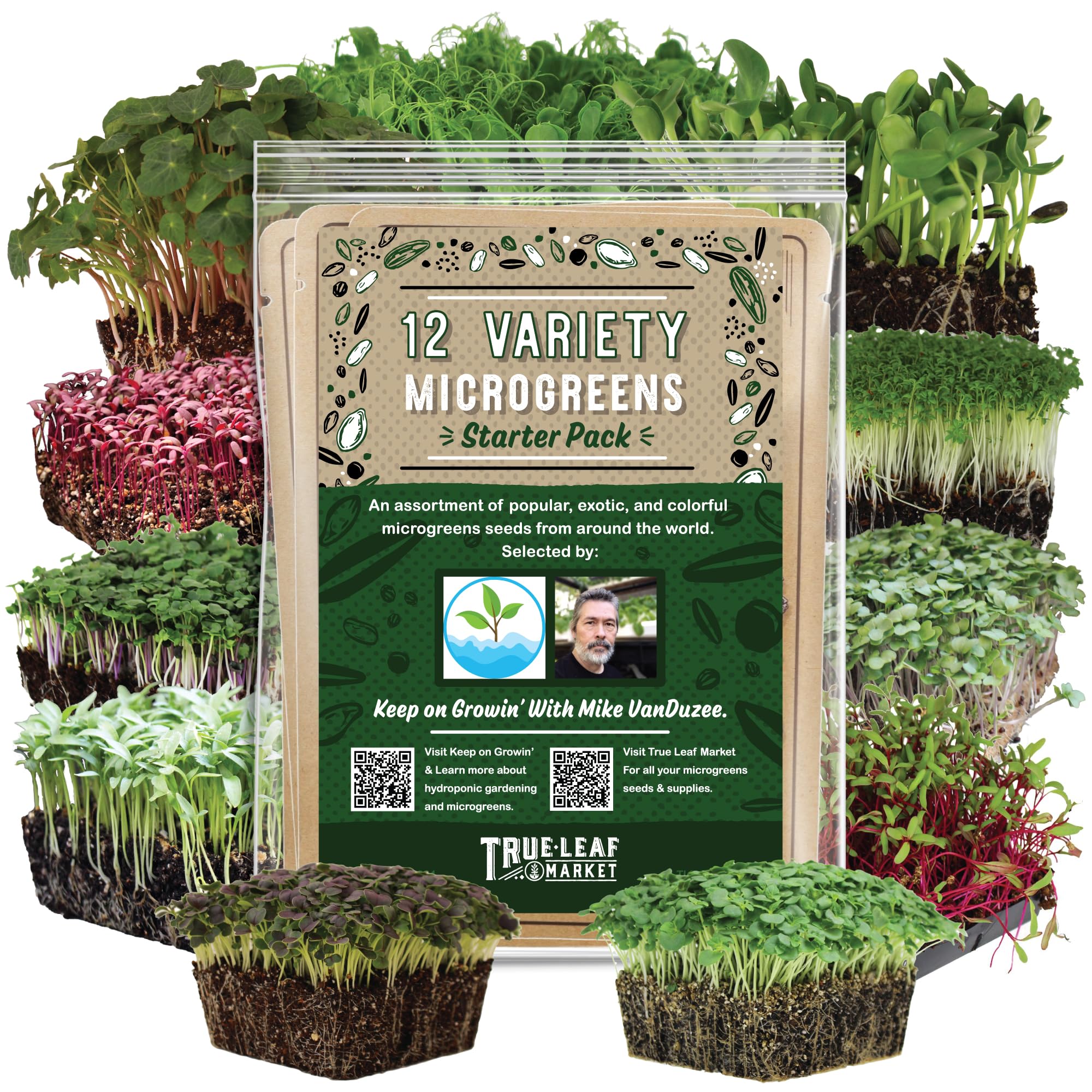
This seed sampler from Mountain Valley Seed Company (part of True Leaf Market) packs twelve 1-ounce packets covering a spectrum from easy staples like broccoli and purple radish to challenging specialty varieties such as Korean shiso, nasturtium, and orach. Curated by microgreen grower Mike VanDuzee, the selection intentionally mixes difficulty levels so beginners can start with forgiving varieties while experienced growers explore exotic flavors. The resealable foil bags preserve germination rates across multiple uses, and the organic options come from the Sustainable Seed Company line with OTCO certification.
Owner feedback emphasizes the generous seed quantity — 1 ounce per variety provides multiple grow cycles even for heavy-seeded types like sunflower and pea. The inclusion of true microgreen varieties like pak choi and beet (not just sprouting seeds) makes this kit compatible with soil or hydroponic tray systems where cotyledon-stage greens are harvested with scissors. The Asian seed selections from Kitazawa Seed Company add unique options that are difficult to find in typical grocery store sprouting mixes.
The kit does not include any growing trays, jars, or instructions specific to each seed type — you must already own a microgreen setup and know the different soak times and grow durations for each variety. Some users noted that radish seeds showed lower germination rates in their batches, though this is a rare complaint. As a seed-only kit, it serves experienced growers who want variety expansion rather than a complete starter package.
What works
- 12 unique varieties including rare Asian microgreen selections
- Generous 1-ounce packets provide multiple harvest cycles each
- Resealable foil packaging preserves long-term seed viability
What doesn’t
- No growing trays or instructions included in the kit
- Some varieties like radish may show inconsistent germination
- Mix of hydroponic and soil-friendly seeds requires separate systems
4. LUVCOSY Microgreen Growing Trays 6-Pack

LUVCOSY’s 6-pack of 5.9-inch square trays combines a bottom reservoir, inner mesh tray with 1.2 mm holes, and a clear humidity dome with adjustable vents — a complete three-component system optimized for growing microgreens to the leafy harvest stage rather than just tail-end sprouts. The 1.2 mm hole size is the critical spec here: it retains alfalfa, broccoli, and amaranth seeds while allowing water to drain freely, preventing the seed-slippage failures common in kits with wider perforations. The BPA-free polypropylene construction is dishwasher-safe for the base tray, though the dome should be hand-washed to preserve clarity.
Multiple owners report visible rooting within 24–48 hours and harvestable microgreens by day 6–8, with the adjustable vents providing control over humidity levels during the germination phase. The 5.9 x 5.9 inch footprint is compact enough for countertop rotation but large enough to produce enough microgreens for a family of four per cycle. The six-unit pack enables staggered planting schedules — start two trays every three days for continuous weekly harvests without interruption.
The polypropylene material, while food-grade and BPA-free, is less durable than glass or stainless steel alternatives and may show surface scratches from repeated cleaning over months of use. The included volume of 400 ml recommended water fill requires attention to avoid overfilling, and the domes are tall enough for most microgreens but will limit growth for varieties that reach beyond 4 inches before harvest. For growers who want a dedicated tray system with proven seed retention, this is the most reliable option at its tier.
What works
- 1.2 mm mesh holes retain even the smallest microgreen seeds
- Adjustable humidity dome vents improve germination success rates
- Six-tray pack enables continuous staggered harvest scheduling
What doesn’t
- Polypropylene trays may scratch over extended use
- Humidity domes are not dishwasher-safe despite base tray being safe
- Dome height limits very tall microgreen varieties
5. ALCEDIA Premium Sprouting Jar Kit
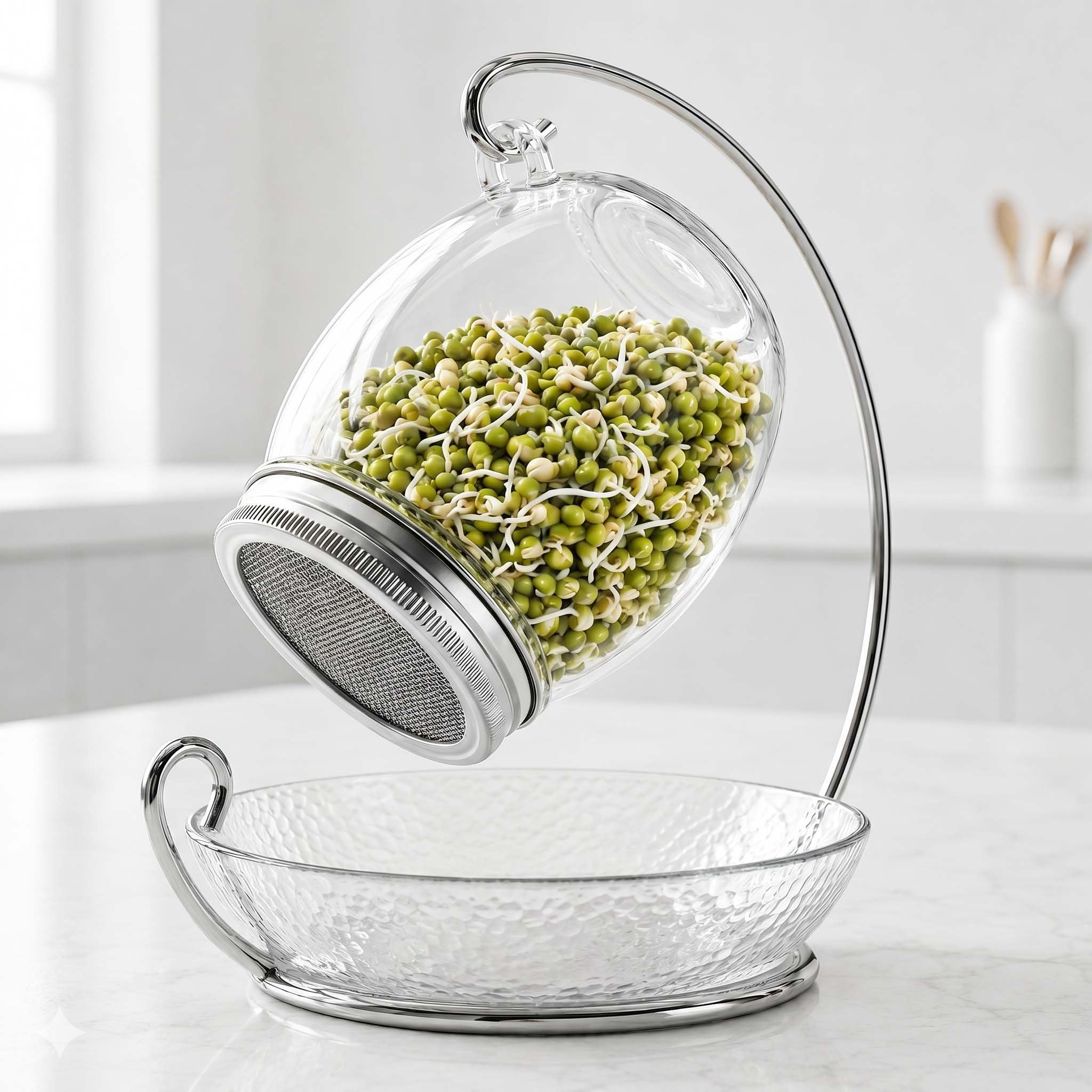
The ALCEDIA kit elevates the mason jar sprouter concept by using borosilicate glass — heat-resistant and stronger than standard soda-lime jars — paired with a 316-grade stainless steel mesh lid that resists corrosion far longer than common 304 screens. The 30-ounce (850 ml) capacity produces a meaningful sprout yield while maintaining a compact silhouette that fits on windowsills and countertops without dominating the space. The stand and drip tray assembly catches excess water neatly, preventing the countertop puddling that plagues jar-based systems when users invert them for drainage.
Owners consistently praise the jar’s gently curved shape, which prevents moisture pooling at corners and reduces the risk of mold developing in stagnant zones. The 316 stainless screen’s small mesh size retains even fine alfalfa seeds while allowing vigorous air exchange during the drainage phase. Sprout quality reports routinely describe crisp, fresh flavor that exceeds store-bought alternatives, with most varieties reaching harvest in 3–5 days depending on seed type and ambient temperature.
The jar is noticeably smaller than a standard 32-ounce wide-mouth mason jar, which means users accustomed to larger batch sizes may need to run multiple cycles for the same volume. The stand, while attractive, uses a hanging design that can feel slightly unstable on uneven surfaces. Overall, this is the strongest jar-based option for growers who want a countertop piece that doubles as kitchen decor without sacrificing food-grade material standards.
What works
- Borosilicate glass resists thermal shock from hot rinses
- 316 grade stainless mesh provides superior corrosion resistance
- Curved jar shape prevents moisture pooling and mold growth
What doesn’t
- 30-ounce capacity is smaller than typical 32-ounce mason jars
- Hanging stand design may feel unsteady on uneven counters
- Higher upfront cost than basic jar sprouting kits
6. ZESTIGREENS Premium Seed Sprouting Kit & Green Onion Regrower
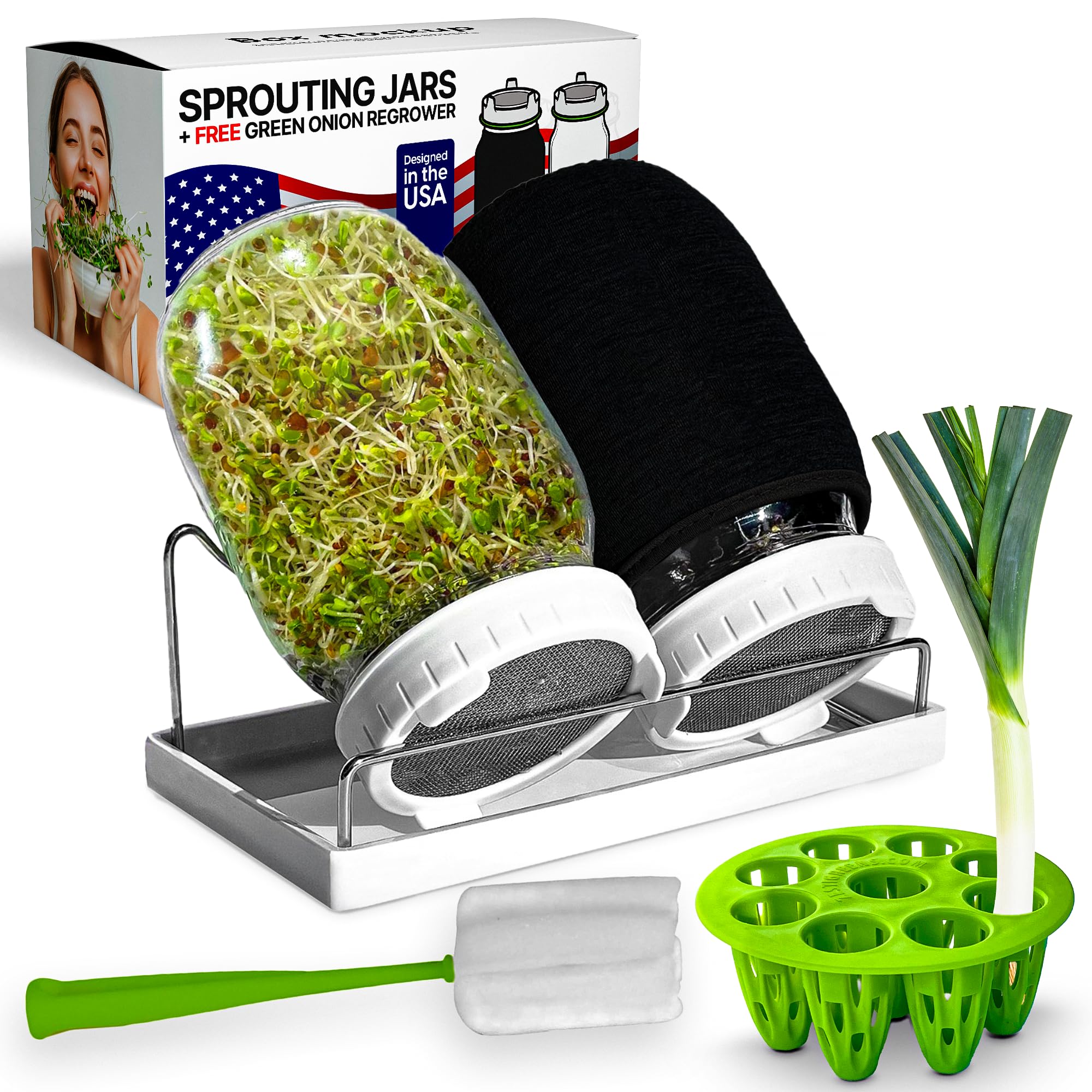
ZESTIGREENS expands the typical sprouting jar kit by bundling two 32-ounce wide-mouth glass jars with three distinct lid options: standard screen sprouting lids, a specialized green onion regrower lid, and a solid storage lid. The stainless steel stand with integrated drip tray holds both jars at an angled position that promotes complete drainage — a detail that matters because standing water in jar sprouters is the primary cause of failed crops. The included blackout sleeves allow light-sensitive seeds like alfalfa and radish to develop the pale, tender texture that growers prefer.
Users report that the green onion regrower lid works exactly as designed: placing cut onion bases into the lid’s slots and submerging the roots in water produces noticeable regrowth within 3–4 days, providing a continuous supply of fresh green onions from kitchen scraps. The dual-jar configuration enables simultaneous sprouting of two seed types — for example, broccoli in one jar and mung beans in the other — without cross-contamination. The mesh screens use a fine enough gauge to retain small seeds while allowing rapid water exchange during the rinse-and-drain cycle.
The blackout sleeves are fabric-based and require hand-washing to maintain their light-blocking properties, and some owners found them fiddly to secure around the jars compared to simply placing the jars in a dark cabinet. The stainless steel stand, while attractive, occupies more counter length than a single jar setup. For households that want both sprouting and regrowing functionality from one purchase, this kit delivers the best combination of features without requiring additional accessories.
What works
- Specialized green onion regrower lid extends kit functionality significantly
- Dual 32-ounce jars allow simultaneous multi-seed sprouting
- Angled stand and drip tray prevent water pooling in jars
What doesn’t
- Fabric blackout sleeves are fiddly to attach and require hand-washing
- Stand occupies more counter space than single jar options
- Green onion regrower lid works best with specific onion base sizes
7. Elementi Sprouting Jar Kit
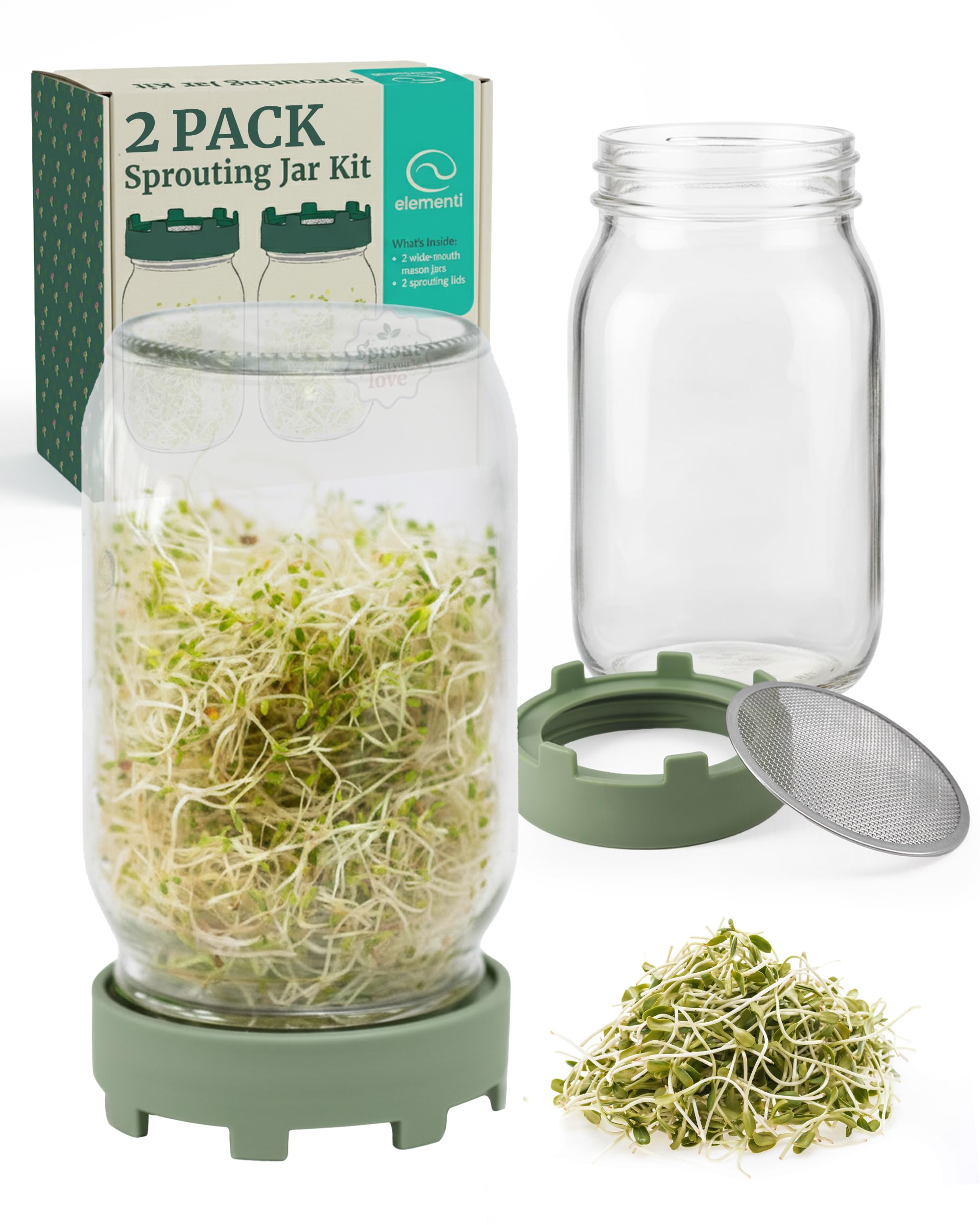
Elementi’s kit strips the sprouting jar concept down to essentials: two 1-quart wide-mouth mason jars, two stainless steel mesh screens, and two plastic sprouting lids. The mesh grain is fine enough to contain broccoli, alfalfa, and mung bean seeds while allowing efficient water drainage during the rinse cycles. The plastic lids screw onto standard wide-mouth jar threads securely, creating a leak-resistant seal during the invert-and-drain process that jar sprouters rely on for air circulation.
Owners report that the mesh screens are sturdy enough to withstand daily tapping against the sink edge — a technique used to dislodge seeds that sprout through the screen — without deforming or tearing. The detachable design allows the mesh to be removed from the plastic lid for thorough cleaning, addressing the mold-harboring crevices that plague fixed-screen lids. The sage green color adds a subtle aesthetic touch that distinguishes it from plain black or clear lids, and the jars are top-rack dishwasher safe as long as water temperature stays below 140°F to prevent thermal cracking.
Some users noted that the mesh screen fits slightly loosely within the plastic lid ring, allowing very small seeds to occasionally slip around the edges during drainage. Several owners resolved this by adding a standard wide-mouth jar silicone gasket, which the kit does not include. The plastic lids, while functional, lack the premium feel of all-metal alternatives and may degrade faster if exposed to frequent dishwasher cycles. For cost-conscious beginners who already own mason jars and want only the sprouting lids and screens, this is the most accessible entry point.
What works
- Detachable mesh screen design allows thorough cleaning access
- Stainless mesh withstands daily tapping for seed dislodgement
- Low entry cost for growers who already have mason jars
What doesn’t
- Mesh fits loosely in plastic lid, may require silicone gasket
- Plastic lids feel less durable than full-metal alternatives
- No stand, tray, or blackout sleeves included in the kit
Hardware & Specs Guide
Mesh Hole Diameter
The hole size in the inner tray or mesh screen is the single most decisive spec for microgreen success. Seeds like alfalfa (1–1.5 mm diameter), amaranth (0.8–1 mm), and broccoli (1.5–2 mm) require sub-2 mm perforations to stay in the growing chamber. The LUVCOSY tray’s 1.2 mm mesh is among the tightest in this category, while jar-based kits like ALCEDIA and SOLIGT use fine stainless weave screens that block even the smallest seeds while allowing vigorous airflow. Kits with holes larger than 2 mm are generally limited to sprouting mung beans and lentils, which are large enough not to fall through.
Material Grade and Food Contact Safety
Materials directly contact the edible seedling, making grade certification critical. Borosilicate glass (ALCEDIA) withstands thermal shock from hot water rinses better than soda-lime glass. Stainless steel grades matter: 304 (SOLIGT) offers good corrosion resistance for daily use, while 316 (ALCEDIA) adds molybdenum for superior durability in the constant wet-dry cycling of sprouting. Food-grade polypropylene (LUVCOSY) is BPA-free and dishwasher-safe but absorbs scratches over time that can harbor bacteria. The Back to the Roots kit uses unbleached bamboo fiber trays that are fully compostable but lack the reusability of hard materials.
FAQ
Can I grow microgreens without soil using these kits?
How often should I rinse seeds in a jar sprouter kit like the ZESTIGREENS or Elementi?
What causes microgreens to mold instead of germinate?
Are microgreen growing kits dishwasher safe?
Final Thoughts: The Verdict
For most gardeners, the microgreen growing kit winner is the SOLIGT Stackable Stainless Steel Kit because its 304 stainless construction and two-tier design deliver continuous harvests without plastic degradation concerns. If you want a no-mess, soil-free tray system that retains even the tiniest seeds, grab the LUVCOSY 6-Pack Tray Set. And for a beautifully built jar sprouter that doubles as kitchen decor, nothing beats the ALCEDIA Borosilicate Jar Kit.