
Specs are compiled from manufacturer listings and verified buyer reviews and can change over time — please confirm the key details on the product page before buying.
If your houseplants look stretched, pale, or just sad—especially during darker months—the issue is almost certainly not enough usable light. A true lights for growing plants setup delivers the specific wavelengths your greenery craves, from seed starting right through flowering, without turning your living room into a disco. The trick is matching the intensity, coverage, and spectrum to the plants you actually own, not the ones on the box.
I’m Rikta — the founder and writer behind Lawn Gear Lab. This guide is built by comparing the manufacturers’ published specifications and the patterns across verified customer reviews, so you get each pick’s real strengths and trade-offs instead of marketing spin.
Below you will find seven grow lights sorted by value and performance, covering everything from a simple clip-on for a single succulent to a 150-watt panel that fills a 3×3 foot tent. Whether you are starting seeds, overwintering herbs, or keeping a monstera lush, these lights for growing plants are the ones worth your attention.
Quick Picks
- VIPARSPECTRA XS1500 Pro — Top Performer
- Gerylove SP1000 — Best Overall
- SANSI Pot Clip 10W 2-Pack — Premium Clip-On
- SANSI Clip 20W (2 Head) — Best Value
- FECiDA Desk Grow Light 25W — Desk Starter
- Garpsen 5 Head Tripod Stand — Flexible Coverage
How To Choose The Best Lights For Growing Plants
Before you click buy, three things decide if a grow light will actually help your plants or just light up a corner. Ignore these and you risk weak growth or wasted electricity.
Light Intensity and Coverage (PPFD vs Wattage)
Wattage tells you how much power the light draws, but PPFD (photosynthetic photon flux density — the amount of usable light that reaches your plant’s leaves) is the real measure. A 20-watt light placed 6 inches above a succulent delivers plenty; a 150-watt panel covers a 3×3 foot veg area. Match the light’s coverage (stated in square feet) to your growing space: small pots need a clip-on or desk light, while shelves or tents need a full panel.
Full Spectrum vs Blurple
Full-spectrum lights (white LEDs emitting 380-800nm) look natural to your eyes and support every growth stage from seedling to flower. Blurple lights (red and blue only) are more efficient for flowering but make it hard to spot pests or mold. For most home growers, a full-spectrum white light is the better all-rounder because you can see your plants clearly and they get the wavelengths they need.
Timer and Dimmability
Plants need a consistent dark period to rest. A built-in auto timer (4/8/12 or 6/12/16 hour cycles) removes the risk of forgetting to turn the light on or off. Dimmability lets you reduce intensity for young seedlings or sensitive plants without raising the light higher, giving you finer control over growth without changing your setup.
Quick Comparison
On smaller screens, swipe sideways to see the full table.
| Model | Best For | Wattage (Actual) | Coverage (Veg) | Spectrum Type | Amazon |
|---|---|---|---|---|---|
| VIPARSPECTRA XS1500 Pro | Serious indoor tents | 150W | 3×3 ft | Full Spectrum (3000K, 5000K, 660nm, 730nm) | Amazon |
| Gerylove SP1000 | Veg/bloom in small tents | 120W | 3.5×3.5 ft | Full Spectrum (380-780nm, 660nm) | Amazon |
| TYAGMAM T8 4-Pack | Shelf & greenhouse rack lighting | 100W total (4x25W) | 2 ft per strip | Full Spectrum Sunlight | Amazon |
| SANSI Pot Clip 10W 2-Pack | Single potted plants | 10W per head | 6 inches per head | Full Spectrum | Amazon |
| SANSI Clip 20W (2 Head) | Shelves & desk setups | 20W (2x10W heads) | 2 small shelves | Full Spectrum (380-800nm) | Amazon |
| FECiDA Desk Light | Seed starting on a desk | 25W | 16-24 inch height | Full Spectrum (3000K, 5000K, 660nm, UV-IR) | Amazon |
| Garpsen 5 Head Tripod | Multi-plant living rooms | USB/AC (low voltage) | Adjustable arms | Full Spectrum (380-800nm, 660nm) | Amazon |
In‑Depth Reviews
1. VIPARSPECTRA XS1500 Pro

Optical lenses focus every photon where your plants need it most.
This is the serious grower’s pick: 150 watts of actual power, enough to cover a 3×3 foot veg area or a 2×2 foot flowering tent with intense, even light. VIPARSPECTRA uses optical lenses (small focusing lenses over each LED) to concentrate light with minimal loss, so the corners of your canopy get as much usable energy as the center — a common weak spot in cheaper panels. Buyers report their succulent collection loves this light, and one hot pepper grower achieved their first harvest after three years of failures by switching to this unit.
Unlike the Gerylove SP1000 which uses a fanless passive-cooled design, the XS1500 Pro stays cool thanks to a quality aluminum heatsink, and owners mention no noise or heat issues even after 12 hours at full power. The included dimming cable lets you dial it from 0-100%, and with the daisy-chain feature you can connect up to 20 units for a unified dimming setup in a larger grow room. The only trade-off: at 2.55 kg (about 5.6 pounds) it is noticeably heavier than a panel like the 3-pound TYAGMAM strips, but the included rope hangers make mounting straightforward.
If you are setting up a tent for vegetables, hot peppers, or flowering plants that demand high light levels (one verified reviewer measured a PPFD of 747 at 50% intensity), this panel delivers commercial-grade performance in a compact 14.2×11.4×3.1 inch frame.
Who it crushes it for: Anyone running a 2×2 or 3×3 grow tent who wants even canopy penetration, daisy-chain expandability, and proven results with demanding crops like tomatoes and peppers.
One honest limit: No physical on/off switch — the cheaper 100W model had one, and some reviewers miss it when using a timer.
Reach for it if: You need tent-grade intensity with uniform coverage and the option to scale to multiple lights.
Look elsewhere if: You only have a single desktop plant — a clip-on will do the job for much less.
2. Gerylove SP1000

A fanless 120W panel that quietly handles veg and bloom.
For indoor gardeners who want a single light that can take a plant from seedling to harvest, the SP1000 is a near-perfect match. With 120 watts of actual power and an efficiency of 2.7 μmol/J (a measure of how much usable light you get per watt), it covers 3.5×3.5 feet for vegetative growth and 3×3 feet for flowering. The full spectrum (380nm-780nm with added 660nm red) means you do not need a separate bloom lamp — just dim from 0-100% using the stepless dimmer to match growth stages. One reviewer has been running theirs for four years with heavy use, which says a lot about the build quality given that the plastic top covers dry-rotted from heat early on.
This light is fanless, using a thick aluminum heatsink for passive cooling, so it runs completely silent — a real advantage if your grow tent is in a bedroom or living space. The VIPARSPECTRA XS1500 Pro has higher peak power and optical lenses for more demanding crops, but the SP1000 is arguably a better value for the home grower who does not need the extra 30 watts. One buyer ran it at 100% on a pepper plant and saw wilting, then dialed back to 50% — fixed. That kind of dimming control is essential for young plants.
The package includes a thermometer/hygrometer and ratcheting hoists, so you are ready to hang it right away. Not bad for something that sits in the mid-range price tier.
Solid Reasons
- Quiet fanless operation keeps the tent silent
- Stepless dimming from 0-100% for every growth stage
- Includes thermometer/hygrometer and ratcheting hangers
Watch For
- Plastic top covers may dry-rot over years of heat
- At 100% it can stress young peppers — dial it down
Best for: Home growers with a 2×2 or 3×3 tent who want an all-in-one light that handles veg and bloom quietly.
skip it if: You need the absolute highest PAR for demanding flowering crops — the XS1500 Pro has more raw punch.
3. TYAGMAM T8 4-Pack (2ft Strips)

Strip lights that turn any shelf into a greenhouse row.
If you grow on multi-shelf racks — seedlings, herbs, succulents — these T8 strips are the most practical solution. Each of the four 2-foot strips draws 25 watts (100W total), and you can link up to 8 units in a series from a single outlet, which means one plug powers your entire rack. The shell is 100% aluminum with a polished finish that helps heat dissipation, so the LEDs stay cool enough for long service life. The listed dimensions are 23.6 x 5.5 x 3 inches per strip, and one reviewer measured theirs closer to 45 inches for a 2-pack — a minor discrepancy, but the coverage works perfectly on a standard 2-foot-wide shelf.
These lights produce a sunlight white color temperature that does not strain your eyes — a big plus over blurple lights that make everything look purple. The included clips and cable ties make installation a 5-minute job. Compared to the Garpsen 5-head tripod below, these strips give you more even, linear coverage across a shelf, but they lack a built-in timer, so you will need a smart plug for automation. Buyers confirm they work great for greenhouse racks and seed starting and should provide years of service.
With a maximum light output of 4000 lumens across the pack, these are bright enough to prevent leggy seedlings and keep ornamentals happy over winter.
Why it stands out: Linkable design with 100% aluminum housing, 4000 lumens total brightness, and easy mounting that turns a plain rack into a propagation station.
The catch: No built-in timer — you will need an external smart plug for automatic on/off cycles.
For shelf growers: This is the easiest way to light multiple tiers with one power cord and get uniform, eye-friendly light.
Not for tents: These are linear strips, not concentrated panels — they cannot match the intensity of the SP1000 in a tent.
4. SANSI Pot Clip 10W 2-Pack

A 10W clip with 169.7 μmol/s/m² PPFD.
This is a powerful compact clip-on light. SANSI uses their own ceramic technology to deliver 169.7 μmol/s/m² at a 6-inch distance. In plain terms, it means a single small light actually has enough punch to promote new leaf growth on a monstera in one month — exactly what one verified buyer experienced. The 360-degree gooseneck and sturdy clamp make it easy to position over a pot, and the ceramic base helps with efficient power conversion and heat management.
The built-in timer offers 4/8/12-hour cycles based on a 24-hour repeat pattern, so you set it once and it runs daily. Four dimming levels (25%, 50%, 75%, 100%) let you adjust intensity for different plants. One buyer praised the simple setup: no assembly needed, just clip and plug. The biggest limitation for taller plants is the gooseneck length — customers note it may be too short to reach the top of a tall pot unless you clip it above the plant. For single mid-sized plants or a cluster of small pots, this is a refined clip-on option.
SANSI backs this with a 2-year protection plan, while Garpsen lists 12-month support.
Why It Shines
- High PPFD (169.7 μmol/s/m²) for a compact light
- 4 dimming levels and 3 timer modes (4/8/12 hrs)
- 2-year warranty and ceramic construction for durability
Check First
- Gooseneck length limits placement for tall potted plants
- Each head covers a small area — best for 1-2 plants
Grab it for: A premium single-plant clip-on with real PPFD punch, a reliable timer, and a long warranty.
Skip if: You need to light a whole shelf or multi-plant setup — go for the 2-head SANSI or a strip.
5. SANSI Clip 20W (2 Head)

Two adjustable heads that replace a 300W bulb while drawing 20W.
This is the budget-friendly workhorse for people with a shelf or a couple of medium pots. The two 10W heads (total 20W) produce 2000 lumens, which replaces a 300-watt traditional bulb while saving you 90% on electricity according to SANSI. At just 1.76 pounds, the clip-on unit is portable enough to move between plants. Unlike the Pot Clip version above, this one uses standard E26 bulbs, and the clamps feel sturdy — one reviewer kept outdoor plants alive in a dark garage all winter with no issues.
The heads emit full spectrum light from 380nm to 800nm, mimicking natural sunlight. Reviewers point out plants like hoyas, monsteras, and desert roses thrive under it, and the timer with 4/8/12-hour settings automates the schedule. A useful detail: the timer resets if the power is unplugged, so you cannot rely on it through a power outage. Also, the bulbs get very hot — reviewers caution to keep foliage at least a few inches away to avoid leaf scorch, which is a real difference from the cool-running SANSI Pot Clip. On the plus side, SANSI offers a whole-life free replacement for the bulbs, so if one dies, you get a new one without buying a whole new light.
Compared to the Garpsen tripod below, this SANSI gives you more concentrated light intensity in a smaller footprint, but the tripod covers a wider area with five heads.
Why it works: 2000 lumens from only 20W, lifetime bulb replacement, and a straightforward timer that keeps your plants on a consistent cycle.
What to know: Bulbs run hot — keep leaves clear. The clip can swing if not tightened fully.
Reach for it if: You want a reliable, cheap-to-run 2-head clip light with lifetime bulb coverage and enough brightness for two small shelves.
Look elsewhere if: You need a cool-running light for tight spaces or have tall plants that cannot fit under the goosenecks.
6. FECiDA Desk Grow Light 25W
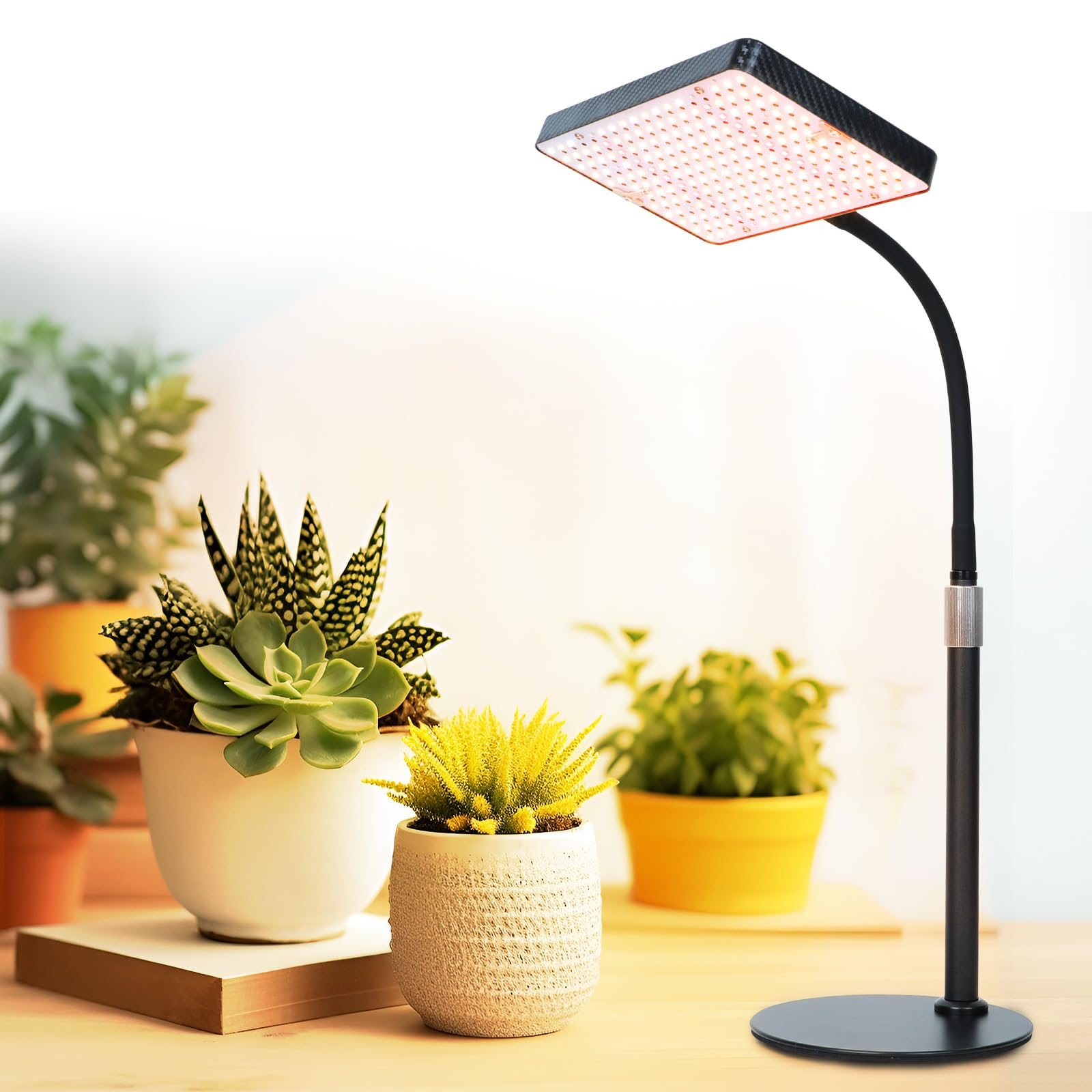
A desktop light with UV-IR for under that actually looks like natural sunlight.
Seed starting on a window sill or kitchen counter is exactly where this light earns its place. At 25 watts and 2000 lumens, it is equivalent to a 200-watt incandescent lamp but runs at a fraction of the power. The full spectrum includes 3000K, 5000K, 660nm red, plus UV and IR LEDs — the UV (395nm) helps plants stay healthy while the IR speeds flowering, according to FECiDA. Buyers confirm it is super bright and lights up an entire room, with one reviewer using 16 of them daisy-chained on a single smart outlet for an aroid collection.
Adjustable height from 16 to 24 inches on a stable aluminum base means you can raise it as seedlings grow. A simple physical on/off switch (fewer parts to break) is a practical touch that buyers appreciate for longevity. The daisy-chain function lets you connect up to 4 units from one outlet. One reviewer specifically mentioned that tomatoes need 14-16 hours of light daily, and this desk light is bright enough to meet that demand when placed 2-3 inches above the soil. It also won’t take up wall space since it sits on the desk — but that means you lose surface area underneath it.
FECiDA has been a grow light manufacturer for over 12 years and offers 12 months of warranty support. For seed starting and small desktop pots, this is a strong, simple choice.
Solid Points
- UV-IR included for healthier plants and faster bloom
- Daisy-chain up to 4 units from one outlet
- Stable aluminum base, adjustable 16-24 inch height
Watch For
- Uses desk space — no wall mount option
- Needs to be 2-3 inches above seedlings to prevent leggy growth
Best for: Seed starting and desktop aroid collections where you want UV-IR spectrum and daisy-chain expandability.
Skip if: You need to save desk space — this light sits on the surface, not wall-mounted.
7. Garpsen 5 Head Tripod Stand
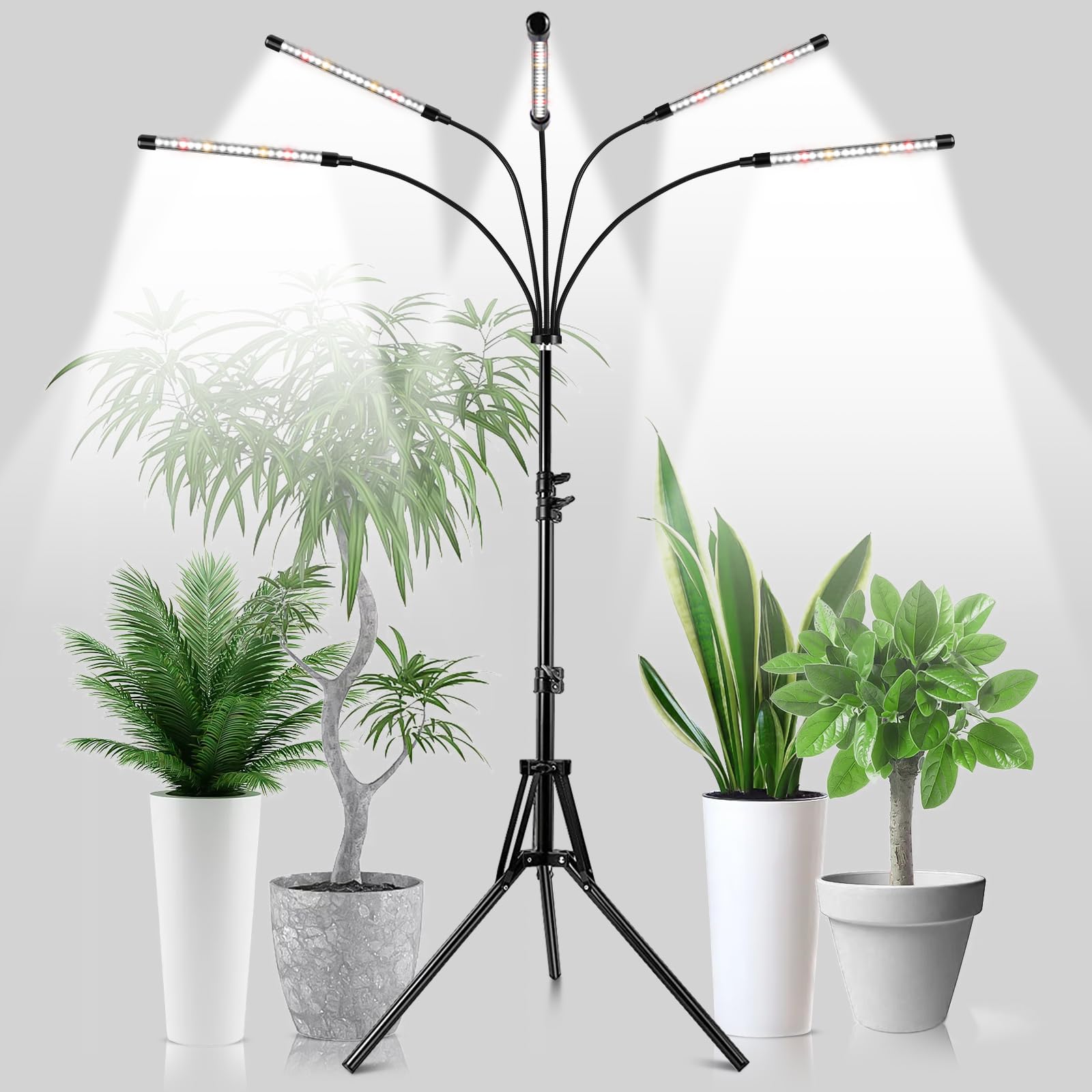
Five independent heads on a stand that grows with your plants from 15 to 63 inches.
If your indoor garden is a collection of pots scattered across a coffee table or shelf, this tripod stand gives you the most flexible positioning. Each of the 5 heads has a 360-degree stainless steel gooseneck, so you can point them in different directions to cover multiple plants at once. The adjustable stand ranges from 15 to 63 inches tall, which makes it useful for both low succulents and taller floor plants. It runs on either USB or AC power (adapter included), so you can carry it between rooms easily.
The timer offers 6, 12, and 16-hour cycles — the 16-hour option is longer than most lights offer and suits plants that need extended light, like seedlings and certain vegetables. A remote control is included, and you get 5 dimmable brightness levels plus 3 color modes. Reviewers report the timer works perfectly and the gooseneck arms hold their shape even on a 1.25-inch-thick shelf. One buyer has had theirs for years with no issues. Compared to the SANSI 20W 2-head clip, the Garpsen covers a wider area but each head is less intense — better for general maintenance than for high-light-demand crops.
The clip-free design means you need the tripod base or a flat surface to rest it. Power cords could be longer according to a couple of reviewers, but the flexibility of the arms makes up for it.
Why it fits: 5 adjustable heads, a 16-hour timer option, and a stand height range that works for small desktop plants up to floor-level pots.
The trade-off: Each head is lower intensity than a dedicated clip-on; better for general plant maintenance than high-light-demand flowers.
Reach for it if: You have multiple small-to-medium pots in one area and want to cover them all with a single, adjustable light source.
Look elsewhere if: You need concentrated high PPFD for a single plant — the SANSI Pot Clip delivers much more punch per head.
Understanding the Specs
PPFD — the real measure of usable light
PPFD (photosynthetic photon flux density) tells you how many photons of usable light hit each square meter of your plant’s leaves every second, measured in μmol/s/m². Wattage only tells you what the light draws from the wall; PPFD tells you how much of that energy actually reaches your plants. A light with 169.7 μmol/s/m² at 6 inches (like the SANSI Pot Clip) is strong enough to promote growth on a single plant, while a panel like the SP1000 covers a much larger area with lower peak PPFD per square inch. For seedlings, aim for 100-200 μmol/s/m²; for flowering plants, 400-700.
Full spectrum — why white light wins
Full spectrum lights emit wavelengths from roughly 380nm (violet) to 800nm (far-red), mimicking natural sunlight. This means one light works for every growth stage — no need to swap bulbs between seed starting and bloom. White light also makes it easy to spot pests, mold, or nutrient deficiencies, which is harder under blurple lights that tint everything pink or purple. Most modern full spectrum lights blend 3000K warm white, 5000K cool white, 660nm deep red, and sometimes UV or IR diodes for flowering boosts.
Dimmer — not just for brightness
A dimmable grow light lets you reduce intensity for young seedlings or sensitive plants without raising the light higher, which keeps your setup compact. Stepless dimming (0-100%) gives you the finest control. Lights with stepped dimming (25%, 50%, 75%, 100%) are simpler but still useful. Without a dimmer, you have to change the hanging height to adjust intensity, which is less precise.
Timer — low-maintenance consistency
An auto timer cycles the light on and off on a 24-hour schedule, typically offering 4/8/12 or 6/12/16 hour options. Consistent day length is critical — plants that get irregular light can stall or stretch. Timers that reset after a power outage are less reliable for bloom cycles, so look for models with memory or use a separate smart plug as backup.
FAQ
How close should I place a grow light to my plants?
Can I leave a grow light on 24 hours a day?
What is the difference between a grow light and a regular LED bulb?
How many grow lights do I need for a 2×2 foot tent?
Will a grow light raise my electricity bill noticeably?
What does full spectrum mean for a grow light?
Can I use a grow light for seed starting?
How long do LED grow lights last?
Do grow lights give off heat that can damage plants?
Can I connect multiple grow lights together?
Final Thoughts: The Verdict
For most people, the lights for growing plants winner is the Gerylove SP1000 because it delivers quiet, dimmable full-spectrum power at 120 watts that handles both veg and bloom in a 2×2 or 3×3 tent while staying affordable. If you want focused single-plant intensity with a convenient clip and a 2-year warranty, grab the SANSI Pot Clip 10W 2-Pack. And for seed starting on a desk or shelf where you need UV-IR spectrum and daisy-chain expandability, the FECiDA Desk Light is a strong pick.
How We Picked
We do not accept paid placement, and we did not hands-on test every unit. Instead, we match each pick to a real buyer and use-case by comparing the manufacturers’ published specifications against the patterns in verified customer reviews — so you get each pick’s real strengths and trade-offs instead of marketing copy.
Sources & Methodology
Specifications: manufacturer listings and product documentation. Review insights: verified customer reviews, as of July 2026. Pricing: not shown on this page (it changes often); check the current price via the retailer link.
As an Amazon Associate, Lawn Gear Lab earns from qualifying purchases. This does not affect which products we feature.