
Specs are compiled from manufacturer listings and verified buyer reviews and can change over time — please confirm the key details on the product page before buying.
You get your seed packets, your soil, and your trays all lined up, but within two weeks the seedlings are pale, stretching toward the window like they are begging for help. Your windowsill just does not deliver enough light, and without the right lamp, your starts will stay spindly and weak before they ever see a garden bed.
I’m Rikta — the founder and writer behind Lawn Gear Lab. This guide is built by comparing the manufacturers’ published specifications and the patterns across verified customer reviews, so you get each pick’s real strengths and trade-offs instead of marketing spin.
Whether you are starting tomatoes indoors under a desk lamp or setting up a shelf for peppers and herbs, finding the right light for seedlings means matching the intensity, spectrum, and adjustability that fragile young plants actually demand in those first few critical weeks.
Quick Picks
- VIPARSPECTRA XS1500 Pro LED Grow Light — Top Performer
- GLOWRIUM Grow Lights for Indoor Plants, Dual Heads — Best Overall
- FECiDA Desk Grow Lights for Indoor Plants — Bright Workhorse
- Aumtrly Grow Light, Full Spectrum Desktop 2-Pack — Sleek Duo
- Mefflypee Grow Lights for Indoor Plants, LED Tripod Stand — Tall & Flexible
- SDOVUERC Tri-Heads Grow Lights for Indoor Plants, 2-Pack — Budget Champion
How To Choose The Best Light for Seedlings
Seedlings have simple but strict needs: they demand a specific light spectrum that mimics the sun, a brightness level close enough to prevent them stretching (leggy growth), and a consistent daily duration. If you miss on any of these, the seedlings weaken before you ever harden them off. Here is what to look for.
Full Spectrum and Real Wattage
A full-spectrum light includes white diodes (usually 3000K and 5000K) plus specific red (660nm) and sometimes blue (460nm) or infrared wavelengths. This mix powers photosynthesis at every stage from germination to flowering. Do not trust “equivalent wattage” numbers — check the actual power draw in watts. A 25-watt true draw is far more telling than “200W equivalent” printed on the box.
Adjustability and Timer Memory
Seedlings need the light source placed just a few inches above the leaves (typically 2–6 inches) to stay compact. A light with a flexible gooseneck or adjustable stand lets you raise the lamp as they grow. A timer with a memory function is a huge convenience — it remembers your setting across power cycles so your seedlings get consistent 14–18 hour days even if you unplug the light.
Quick Comparison
On smaller screens, swipe sideways to see the full table.
| Model | Best For | Actual Power Draw | Height Range | Timer | Amazon |
|---|---|---|---|---|---|
| VIPARSPECTRA XS1500 Pro | Serious seed starting & grow tent | 150W | Hanging (rope hangers) | External timer required | Amazon |
| GLOWRIUM Dual Heads | Tall plants & smart care features | — | Up to 70.9 inches | 3/9/12/16H | Amazon |
| FECiDA Desk Grow Light | Bright desktop seedling starting | 25W | 16 to 24 inches | None (daisy chain) | Amazon |
| Aumtrly Desktop 2-Pack | Dual lights for multiple small pots | — | 7.8 to 26 inches | 6/12/16H | Amazon |
| Mefflypee Tripod Stand | Tall, flexible floor-standing setup | — | 26 to 58.66 inches | 3/9/12H | Amazon |
| SDOVUERC Tri-Heads 2-Pack | Budget clip-on for tight shelves | 15W | 360° gooseneck | 6/12/18H | Amazon |
In‑Depth Reviews
1. VIPARSPECTRA XS1500 Pro LED Grow Light

The serious seedling powerhouse that pulls real wattage for dense, bushy starts.
While most desktop lights run at 15 to 25 watts, the VIPARSPECTRA XS1500 Pro draws a genuine 150 watts — this is a different class of intensity entirely. That real power lets you cover a 2×2-foot flowering area or a 3×3-foot veg space, meaning you can fill a full shelf with seedling trays without supplementing with extra lamps. Buyers report excellent PAR levels (747 at 50% brightness and 13-inch distance), so seedlings get the light energy they need to stay compact and stocky rather than stretching.
The unit uses an optical-lens design (a special cover over the LEDs that focuses the beam) to spread the light evenly with minimal loss, and a dimmer lets you turn down the intensity if the light is too strong for young starts — one reviewer noted it can scorch seedlings if hung too close at full power. It weighs about 6 pounds and uses rope hangers, so it is best for a grow tent or a sturdy overhead shelf setup rather than a desk. Unlike the FECiDA desk light, this model does not include a built-in timer, but it works fine with an external outlet timer and can daisy-chain up to 20 units for unified dimming.
What pushes it ahead
- Genuine 150W draw versus 15–25W desk lights — 10x more power for serious growing.
- Optical-lens design delivers uniform light across the canopy.
- Dimmable intensity protects delicate seedlings from scorching.
Where it falls short
- No built-in timer — you need a separate smart plug or outlet timer.
- Heavy at about 6 lbs — not suitable for flimsy shelves or clip-on use.
Your best bet if: You are running a serious seed-starting station or a 2×2/3×3 grow tent and want one light that can take seedlings all the way to flower without upgrading.
The honest limit: No built-in timer means you need to buy a separate outlet timer for consistent daily light cycles.
2. GLOWRIUM Grow Lights for Indoor Plants, Dual Heads
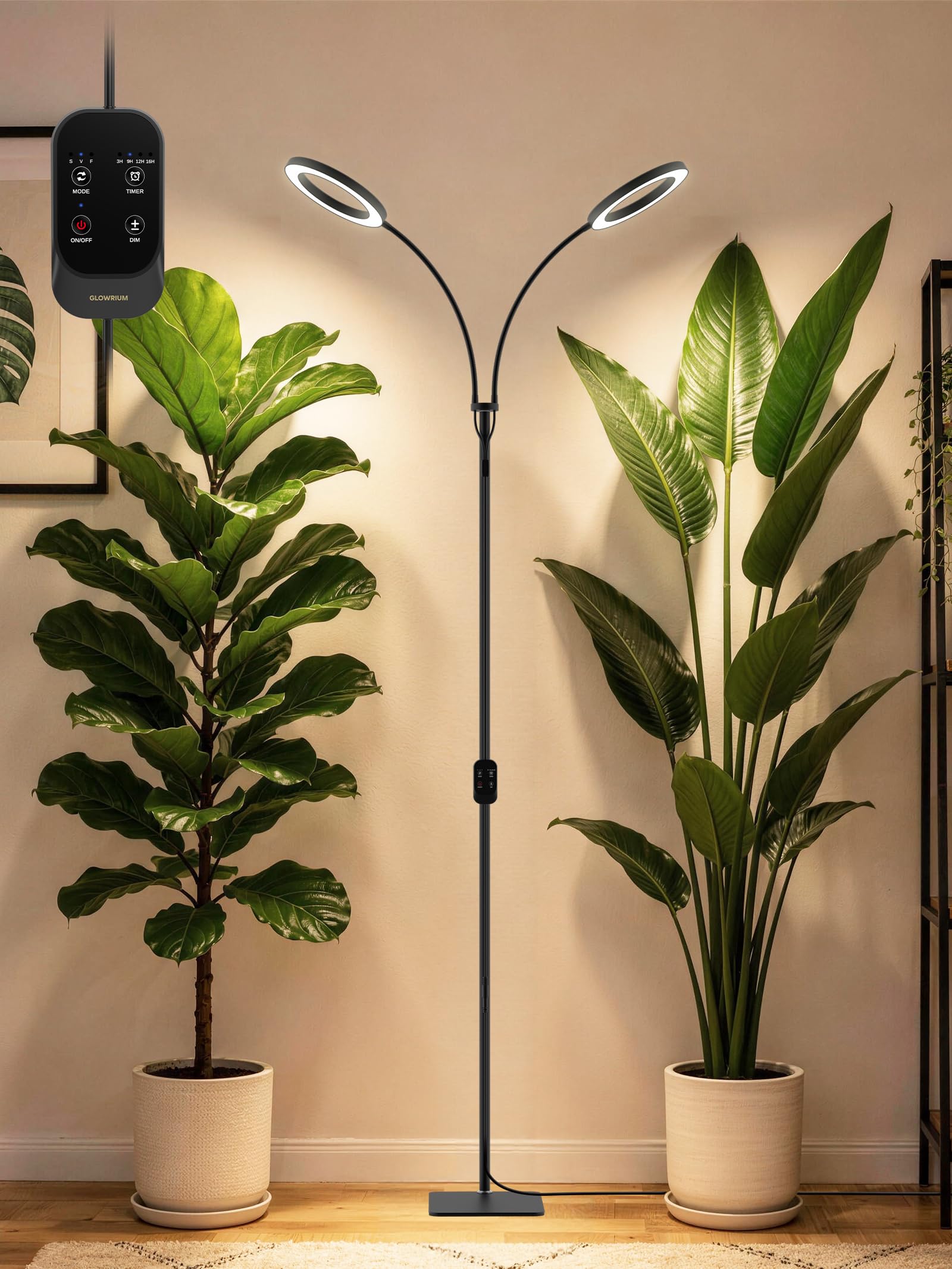
The tallest adjustable stand that pairs a smart growing assistant with full-spectrum intensity.
If you are growing seedlings on a tall plant stand or want a lamp that grows with your plants from starter to harvest, the GLOWRIUM Dual Heads reach up to 70.9 inches. That is more than 12 inches taller than the Mefflypee tripod and over 44 inches taller than the Aumtrly desktop light, giving you room to raise the lamp as your tomato or pepper plants get tall. The dual-head design with 360° flexible goosenecks lets you spread light wider or aim each head at a different tray.
The light includes a built-in timer with 3, 9, 12, and 16-hour settings plus a smart assistant feature that offers watering and fertilizer reminders, growth records, and light measurement — a real help if you are new to indoor seed starting. Reviewers report that African violets bloomed and cherry tomatoes produced fruit all winter under this lamp, and the stepless dimming lets you fine-tune the brightness from a soft glow up to a strong intensity. One owner noted the base needs a heavy plant on it for stability, so it is better suited to a floor next to a plant stand than a lightweight desk.
The standout strengths
- Extends up to 70.9 inches — fits tall plants and stand shelves.
- Smart assistant tracks light, watering, and growth history.
- 24V low-voltage system stays safe during long daily runs.
Things to weigh
- Base can be unstable — you may need to zip-tie it or add weight.
- Lamp heads can get hot after extended use, per buyer reports.
Reach for this if: You want a tall, full-featured lamp that remembers your schedule and helps you track plant care without a separate app.
Look elsewhere if: You work on a narrow desk — this is a floor lamp and takes up floor space, not a desktop unit.
3. FECiDA Desk Grow Lights for Indoor Plants
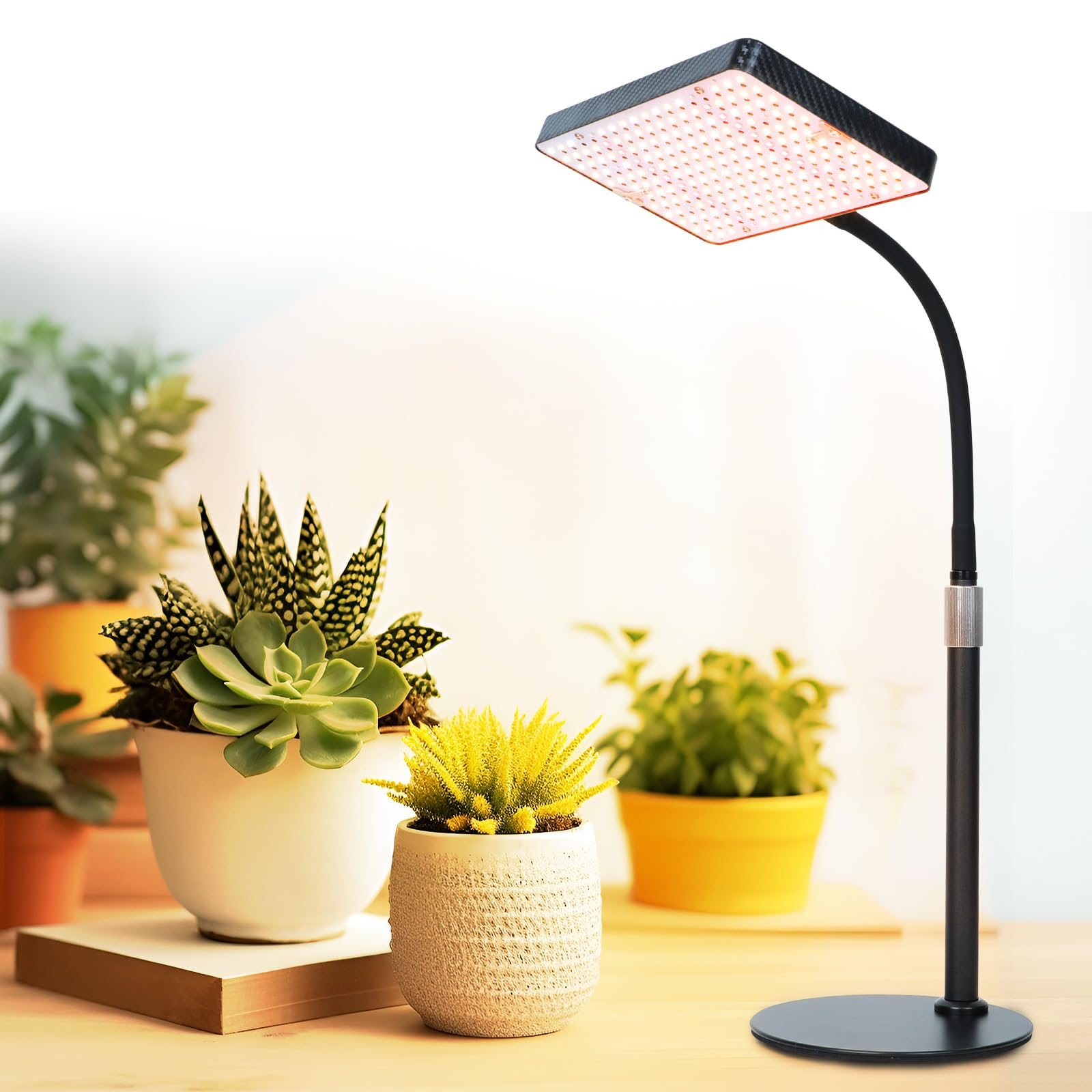
The desk lamp that floods your seedlings with 2000 lumens using just 25 watts.
For a desktop light that does not mess around with brightness, the FECiDA pushes 2000 lumens through 208 LEDs while drawing only 25 watts — that is 67% more power draw than the SDOVUERC tri-heads (15 watts), so you get noticeably stronger light for stockier seedling growth. The full spectrum includes 3000K, 5000K, 660nm red, UV, and IR diodes, which means the light looks fairly close to natural sunlight and covers the wavelengths seedlings need to avoid getting leggy. Owners mention that you should place it 2–3 inches above the seedlings and run it 14–16 hours daily for tomatoes, and they note it is effective but needs two units for four small planters.
A practical bonus is the daisy-chain outlet, which lets you link up to four lights from a single wall socket — so if you have a multi-shelf setup, you can plug one into the next without a power strip. The stand adjusts from 16 inches to 24 inches, and the base is stable enough to sit on a desk or tabletop. It lacks a built-in timer, but reviewers pair it with a smart plug to automate the daily cycle.
Why it earns its spot
- 2000 lumens at only 25W real draw — bright but cheap to run.
- Daisy-chain up to 4 lights from one outlet for multi-shelf setups.
- Includes UV and IR diodes for broader spectrum coverage.
Where it compromises
- No built-in timer — needs a smart plug for automatic daily cycles.
- Customers note you need 2 units to fully cover 4 small planters.
Grab this for: A desktop seed-starting station where you need serious brightness that can grow with your plants into the vegetative stage.
The one catch: It does not have an auto-timer, so you will need a separate smart plug to keep your seedling schedule consistent.
4. Aumtrly Grow Light, Full Spectrum Desktop 2-Pack
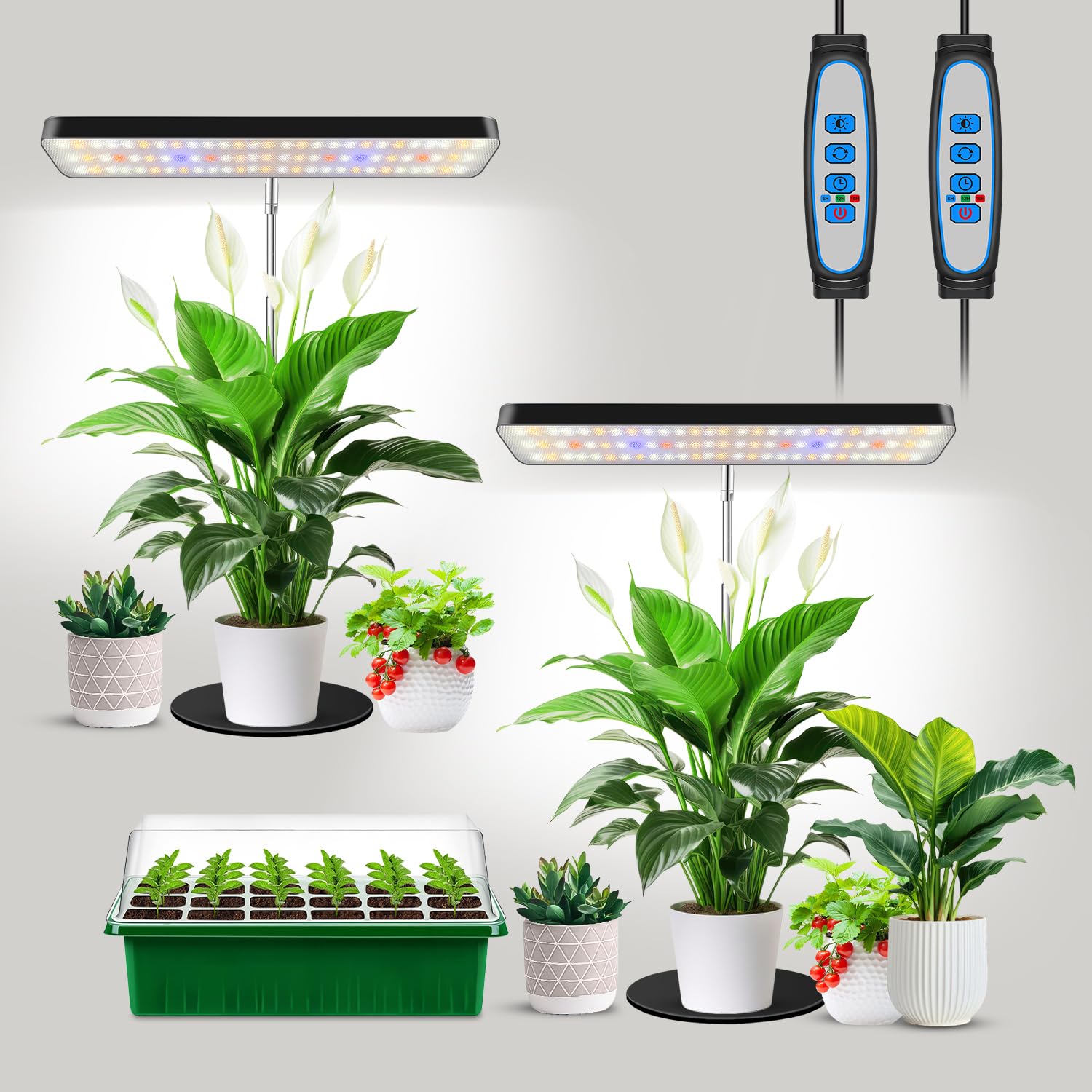
Two rectangular lights that give multiple seedling trays even coverage from a compact base.
Where most desktop lights use a round or single panel, the Aumtrly 2-pack gives you two rectangular heads that cast a wider, more even spread of light across a row of small pots — ideal if you are starting several seed varieties at once. The package includes two complete units (each with a metal base, adjustable stand, and adapter), so you can light two shelves or two ends of one table without daisy-chaining. The stand adjusts from 7.8 inches up to 26 inches, and the 5-inch metal base stays stable without hogging desk space.
The timer has 6, 12, and 16-hour options — the 16-hour setting is a standout since many seedlings need a long photoperiod, and buyers confirm the timer keeps accurate time even after power interruptions. The light modes include a full spectrum with red 660nm and blue 460nm plus warm 3200K and white 5000K, giving you the key wavelengths for early growth. One buyer mentioned “super high lux” at 3 inches, meaning the intensity is strong enough for compact seedling development.
What works well
- Comes as a two-pack — covers more shelf space from the start.
- 16-hour timer option suits long-day seedlings like tomatoes.
- Compact 5-inch base does not clutter your desk.
The trade-offs
- No daisy-chain port — each light needs its own outlet.
- Plastic housing feels less premium than aluminum-framed lamps.
Pick this pair if: You want to light multiple small trays on a desk or shelf and the 16-hour auto-timer saves you from remembering to turn them off.
skip it if: You prefer a single powerful panel that daisy-chains with other units — this model works independently per outlet.
5. Mefflypee Grow Lights for Indoor Plants, LED Tripod Stand
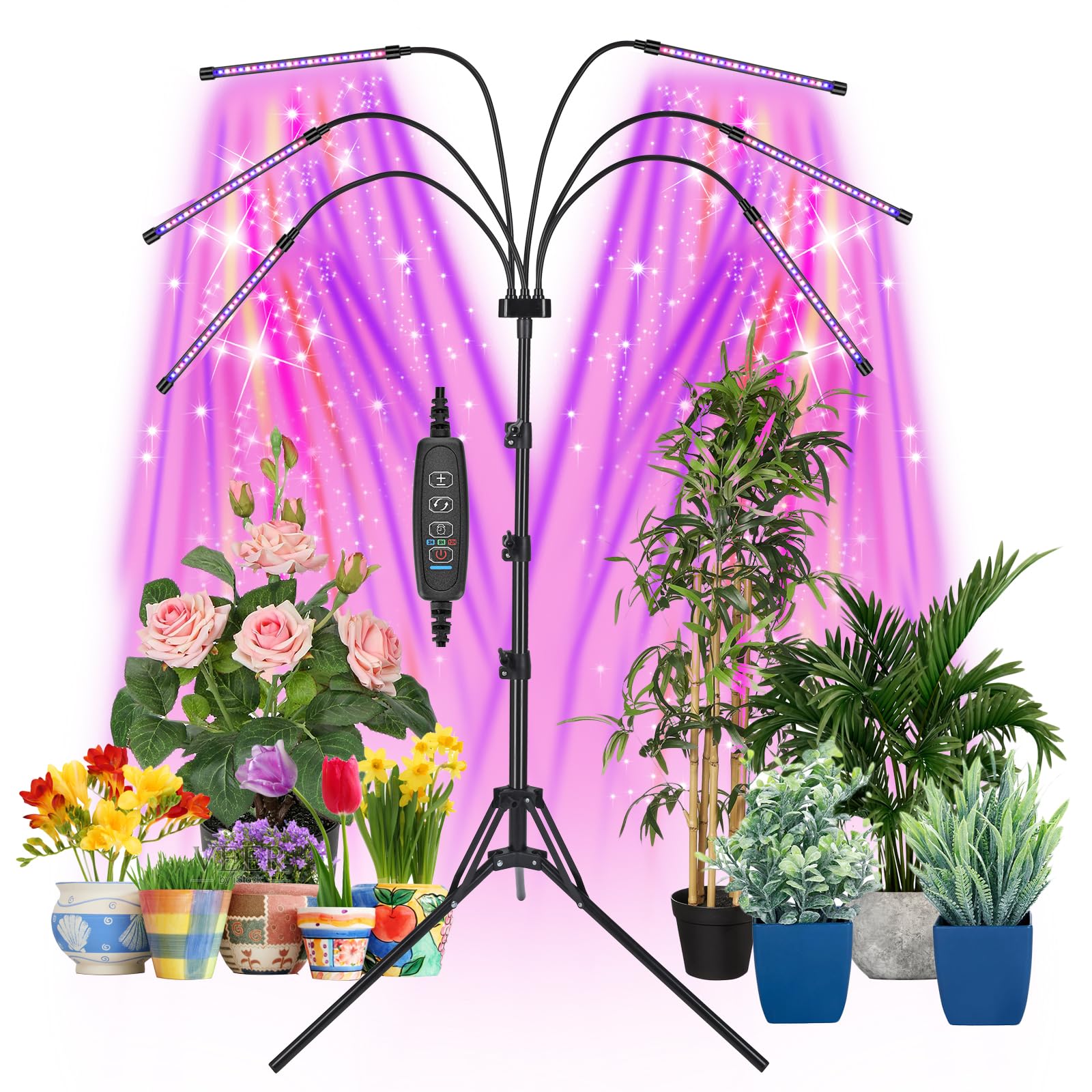
A floor-standing tripod that reaches nearly five feet tall for flexible, low-wattage lighting.
If your seedlings are on a low table or the floor and you need a lamp that stands independently, the Mefflypee tripod extends from 26 inches to 58.66 inches, and the six heads each swivel on a flexible gooseneck so you can direct light precisely where your trays sit. Unlike the FECiDA desktop unit that needs a table, this tripod sits on the floor and aims down at your plants, which is useful if you have a multi-tier plant stand or a corner growing station. The lamp runs on a DC 5V 3A adapter (very low voltage) and reviewers point out it works well for daily 8-hour use.
The light offers three spectral modes (red, blue, and yellow) plus a mix setting, and 10 brightness levels from 10% to 100%. It has a timer with 3, 9, and 12-hour settings. The catch is stability — multiple buyers mention the base slides or falls unless you position it just right, so it may need to lean against a wall or have a weight on the tripod legs. One owner reported it is “low wattage” and works better if you use two units rather than one.
What stands out
- Adjusts up to 58.66 inches — fits floor-level plant stands.
- Six flexible goosenecks cover a wide area.
- Very low power draw (DC 5V 3A) — cheap to run all day.
Drawbacks to consider
- Base is unstable — slides or tips easily without careful positioning.
- Low wattage means you may need two units for effective coverage.
Best for: A low-budget floor setup where you need flexible light direction and can position the tripod carefully against a wall.
Not ideal for: A wobbly shelf or a spot where kids or pets might bump the stand — the instability is a real frustration.
6. SDOVUERC Tri-Heads Grow Lights for Indoor Plants, 2-Pack

The clip-on two-pack that saved leggy seedlings on a tight shelf for under budget dollars.
When you need a cheap, no-fuss light that clips onto a shelf edge and covers a small tray of seedlings, the SDOVUERC tri-heads deliver for the lowest entry cost. Each unit pulls 15 watts, and the pack includes two complete lights, so you get a pair for the same price as one FECiDA desk lamp — but the 25-watt FECiDA is 67% more powerful per unit, so you trade raw intensity for quantity. Shoppers say this light “saved leggy seedlings,” and the foam-padded clip grips shelves without scratching surfaces.
The light offers a 6/12/18-hour timer with a memory function, so you set it once and it repeats daily — the 18-hour setting is longer than most competitors and suits plants that need extended light. You get 5 brightness levels and 3 spectrum modes (6000K cool white, 6000K + 660nm deep red, and full spectrum). The 360° gooseneck lets you aim each of the three heads independently. The main downside is the low wattage means the clip-on lights are best kept within a few inches of the seedlings — they do not penetrate deep canopies like the VIPARSPECTRA does.
The strong points
- Two lights per pack — covers two shelves or two different spots.
- 18-hour timer memory runs automatically every day.
- Secure foam-padded clip works on shelves, tables, and racks.
What to watch
- Only 15W per unit — you need to place them very close to seedlings.
- No mixer setting guidance — buyers wish the manual explained which mode to use for new vs. established plants.
Go for this if: You need a cheap, effective pair of clip-on lights for a small shelf or two starter trays and the long 18-hour timer is exactly what your seedlings need.
Pass if: You have a large grow tent or a tall plant stand — the low wattage and close-range clip design will not reach far enough.
Understanding the Specs
Actual Power Draw vs. Equivalent Wattage
Many grow lights advertise “200W equivalent” but that number is a comparison to an old incandescent bulb, not the real electricity it uses. The number that matters is the actual power draw in watts — a light that pulls 25W from the wall is 25W, period. A 150W light like the VIPARSPECTRA is in a different league from a 15W clip-on, so match the real wattage to the area you need to cover. Seedlings under a 15W light need it 2–4 inches above them; under 150W you can keep it 12–18 inches away.
Full Spectrum and Nanometer Wavelengths
A full-spectrum light includes red (660nm) and blue (460nm) wavelengths plus warm and cool white diodes. Red light drives flowering and stem growth; blue light controls leaf development and keeps seedlings compact. If a light only has red/blue diodes without white, the room looks purple and it is harder to spot pests or mold. Look for a mix that includes white 3000K–5000K plus 660nm red for the best seedling results.
FAQ
How close should a seedling light be to the plants?
Can I use a regular household LED bulb for seedlings?
How many hours a day should seedlings get light?
What is the difference between a grow light and a regular LED light?
Do I need a timer for my seedling light?
Will a 15-watt grow light work for starting seeds?
What does a blue light vs. red light do for seedlings?
Do I need UV or IR light for seedlings?
Can I daisy-chain multiple grow lights together?
Final Thoughts: The Verdict
For most people, the light for seedlings winner is the FECiDA Desk Grow Light because it delivers 2000 lumens with a true 25W draw and a full UV-IR spectrum on a stable desktop stand at a mid-range price. If you want the smartest setup with a built-in timer and a 70.9-inch reach, grab the GLOWRIUM Dual Heads. And for serious seed starting in a grow tent where the standout is raw intensity, the VIPARSPECTRA XS1500 Pro at 150W real draw is the top performer.
How We Picked
We do not accept paid placement, and we did not hands-on test every unit. Instead, we match each pick to a real buyer and use-case by comparing the manufacturers’ published specifications against the patterns in verified customer reviews — so you get each pick’s real strengths and trade-offs instead of marketing copy.
Sources & Methodology
Specifications: manufacturer listings and product documentation. Review insights: verified customer reviews, as of July 2026. Pricing: not shown on this page (it changes often); check the current price via the retailer link.
As an Amazon Associate, Lawn Gear Lab earns from qualifying purchases. This does not affect which products we feature.