
Specs are compiled from manufacturer listings and verified buyer reviews and can change over time — please confirm the key details on the product page before buying.
If your greenhouse plants are leggy, flowering late, or just not thriving, the right LED grow light can change everything — but picking the wrong one means wasted electricity and underwhelming yields. The three lights here cover the honest middle and premium ground, each suited for a different greenhouse size and budget tier.
I’m Rikta — the founder and writer behind Lawn Gear Lab. This guide is built by comparing the manufacturers’ published specifications and the patterns across verified customer reviews, so you get each pick’s real strengths and trade-offs instead of marketing spin.
Whether you are covering a single shelf or a whole commercial bench, this breakdown of the best led grow lights for greenhouse will help you match the right spectrum, wattage, and coverage to your actual growing space without guessing.
Quick Picks
- MARS HYDRO SP3000 — Best Overall
- FARMLITE 260W — Best Value
- VIPARSPECTRA XS1500 Pro — Compact Edge
How To Choose The Best LED Grow Lights For Greenhouse
Greenhouse lighting is different from a small indoor tent — you need wider coverage, better heat management in a humid space, and often the ability to dim or chain multiple units together. Focus on these three factors before you buy.
Coverage Area & Light Uniformity
A light that covers a 2×2 tent might leave dark corners in a greenhouse bench. Look for the manufacturer’s listed veg and flower coverage dimensions (e.g., “3×3 ft veg & 2×2 ft flower”). Bar-style lights like the MARS HYDRO SP3000 spread light more evenly across a rectangular space than a single square panel, which buyers consistently note leads to better edge-to-edge growth.
Spectrum & Dimmability
Full spectrum means the light includes both warm (3000K) and cool (5000K) white LEDs plus specific red (660nm) and sometimes infrared (730nm) wavelengths. This lets you run the same light from seedling through flower. A dimmer — either a manual knob or a 0-10V controller — is essential because seedlings need far less intensity than mature flowering plants, and scorching young leaves is a common mistake.
Daisy-Chain & Control Options
If you are covering more than a single shelf, you want lights that can be daisy-chained so one dimmer controls the whole row. Some premium models also offer a separate WiFi adapter for remote scheduling. For a greenhouse, IP65 waterproofing (splash resistance) is a plus — it protects the light beads from condensation and accidental spray.
Quick Comparison
| Model | Best For | Wattage | Light Output | Dimensions | Amazon |
|---|---|---|---|---|---|
| MARS HYDRO SP3000 | Even coverage & smart control | 300 Watts | 43836 Lumens | 42.8″ x 4″ x 4″ | Amazon |
| VIPARSPECTRA XS1500 Pro | Compact & budget-friendly | 150 Watts | — | 14.2″ x 11.4″ x 3.1″ | Amazon |
| FARMLITE 260W | Large area value | 260 Watts | 26000 Lumens | 23″ x 23″ x 2″ | Amazon |
In‑Depth Reviews
1. MARS HYDRO SP3000
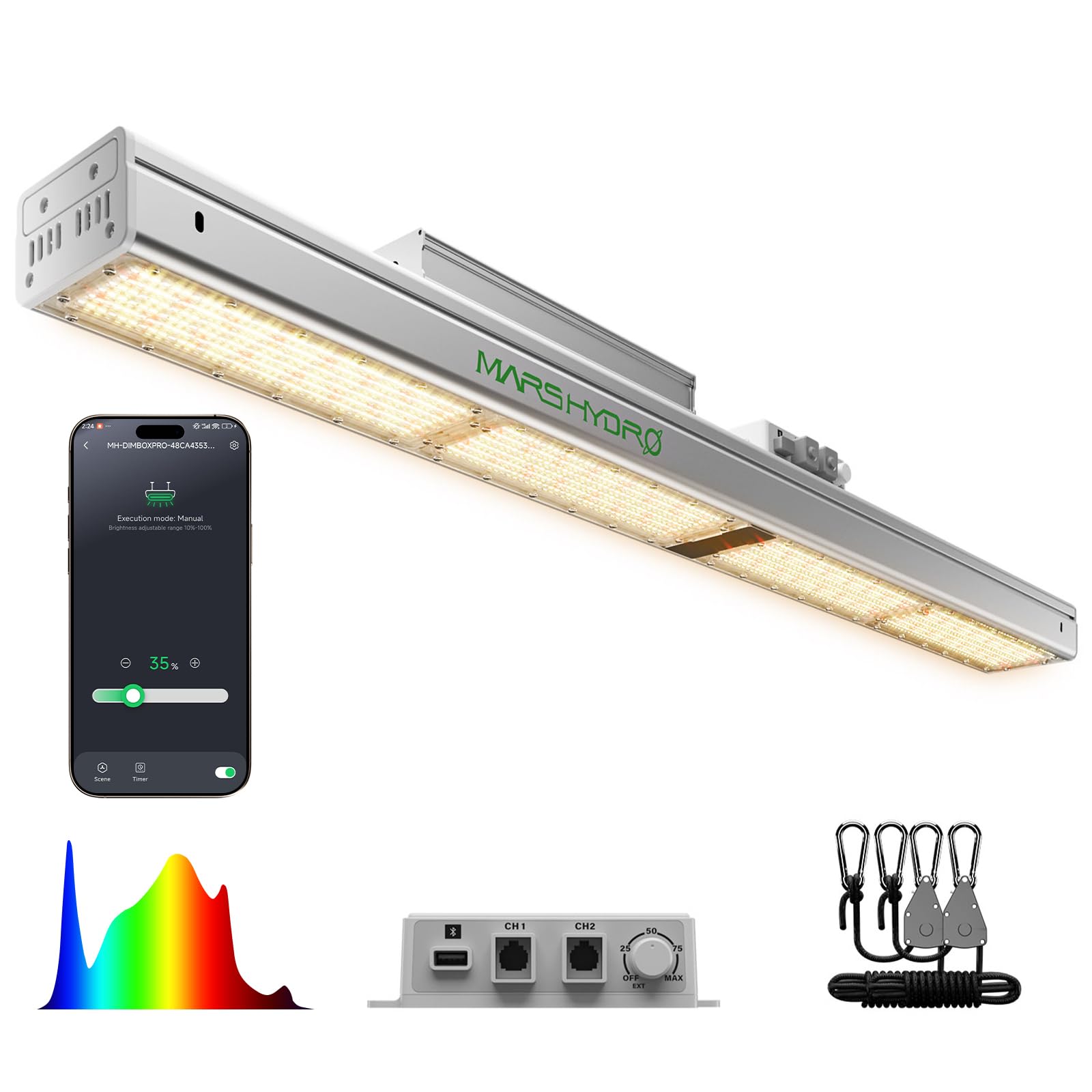
The bar-style light that growers buy two more of after the first one arrives.
This is the pick for greenhouse owners who value even, penetrating light across a wide rectangular footprint. The MARS HYDRO SP3000 pulls 300 Watts and delivers a PPF of 727.2 umol/S — numbers that translate to strong flower production in a 4×2 grow tent or a greenhouse bench of similar size. Buyers report the light pattern is “the most balanced I’ve found so far,” with one grower running three of them daisy-chained in a 5×5 space for uniform canopy coverage.
The big advantage here is the light bar shape: at 42.8 inches long but only 4 inches wide, this design spreads PAR across the full length of a bench without a hot spot in the middle. It beats the square-panel FARMLITE on coverage evenness for rectangular spaces. The 9.89-pound weight is manageable for hanging from greenhouse crossbars, and the aluminum heatsink keeps it running cool enough that you do not need extra ventilation. An optional WiFi adapter (sold separately) adds remote scheduling.
A minor real-world hassle: the oval hanging slots are narrow (about 3 cm across), which one owner noted makes it tricky to attach standard S-hooks compared to a clip-friendly frame. But that same owner also confirmed the 5-year warranty, and others praised MARS HYDRO’s responsive customer service when a driver failed after a year — they shipped a replacement within three days at no cost.
Balanced power pick: The light that fills a 4×2 area more evenly than any panel here, with a PPF of 727.2 umol/S to push dense flowers — backed by a 5-year warranty.
The only trade-off: No built-in dimmer knob or on/off switch on the unit itself; you need the daisy-chain controller or the optional WiFi adapter to adjust brightness.
Grab this for: A greenhouse bench or a 4×2 tent where even PAR distribution across the full length is your top priority — especially if you plan to run multiple lights side by side.
Look elsewhere if: You need a standalone light with a simple built-in dimmer and do not want to purchase an extra controller or adapter.
2. FARMLITE 260W

The big square panel that rivals premium brands.
If your greenhouse has a 4×4 area or you want to cover a wide bench on a budget, the FARMLITE 260W brings serious light output for the money. It delivers 26000 Lumens from 260 Watts and buyers call it a “great value 240W light for 2.5×5′ tent,” with one owner running it 18 hours a day for nearly a year without any issues. The square shape (23 by 23 inches) naturally fits a broader footprint than compact panels, and at 12 pounds it is the heaviest of the three here.
An honest trade-off: the IP65 waterproof rating is a real advantage in a humid greenhouse — the light beads are spray-glued to protect against condensation and accidental spray. However, some owners mention the daisy-chain function does not always sync as advertised, and the power cord is shorter than ideal if your outlet is far from the hanging point. One verified owner who has it running right next to a Gavita 1700E says the FARMLITE performs “just as good and doesn’t require an external controller.”
The included dimmer and the 0-10V control port give you flexibility to dial intensity down for seedlings and up for flower. It runs completely silent — no fan — which matters in a quiet greenhouse or home growing room.
Why growers choose it
- IP65 waterproofing handles greenhouse humidity without worry
- Runs silent with no fan, staying cool using lightweight aluminum bars
- Daisy-chain supports more than 100 lights for large-scale setups
Real-world catches
- Daisy-chain auto-sync can be inconsistent, per some buyer feedback
- Power cord feels short; a 220V cord option would be welcome
Choose this if: You need a big square panel for a 4×4 or wider space and want IP65 splash protection at a price point that leaves room for other gear.
skip it if: Your setup depends on flawless daisy-chain dimming across many units or you need a long power cable right from the start.
3. VIPARSPECTRA XS1500 Pro

The small panel that puts out a surprising punch for a single shelf.
For a compact greenhouse shelf or a small 2×2 flowering area, the VIPARSPECTRA XS1500 Pro is a tidy and effective choice. It draws only 150 Watts but customers note “excellent PAR levels (747 at 50% & 13″)” — that is strong light intensity relative to its size. The optical-lens design concentrates the beam with minimal loss, so the corners get consistent light rather than hot-center, cold-edge syndrome common in budget panels.
It is noticeably smaller than the others — the dimensions are 14.2 by 11.4 by 3.1 inches, at 14.2 inches versus 42.8 inches for the MARS HYDRO SP3000. This makes it ideal for narrow benches or seed-starting shelves where a long light bar is overkill. The included dimming cable and daisy-chain capability let you connect up to 20 units and control them from one dial, which means you can scale across a multi-shelf greenhouse rack without buying separate timers. The full spectrum includes warm 3000K, cool 5000K, red 660nm, and infrared 730nm LEDs, so it covers the full life cycle from seedling to flower.
One genuine annoyance reviewers point out: there is no physical on/off switch on the unit, so you will need an external timer to act as a switch. Also, at about 5.6 pounds (2.55 kilograms), one owner found it “heavy (~6 lbs)” for a compact panel, though the included ratchet straps make hanging straightforward.
What stands out
- Adjustable intensity dial with measured PAR of 747 at 50% and 13 inches
- Daisy-chain supports up to 20 lights for scalable greenhouse racks
- Includes 660nm red and 730nm IR LEDs for full-cycle spectrum
The small frustrations
- No on/off switch — you need an external timer to power it down
- Weighs roughly 5.6 lbs; heavier than its small footprint suggests
This fits: A compact greenhouse shelf, a 2×2 flowering tent, or a multi-shelf seedling rack where you want to daisy-chain up to 20 units with one dimmer.
Not if: You need to cover a 4×4 or larger area with a single fixture — its 150-watt draw and small footprint are better suited to smaller or multi-unit setups.
Understanding the Specs
PPF vs Wattage
Wattage (300W, 150W) tells you how much electricity the light draws, not how much usable light your plants get. PPF (Photosynthetic Photon Flux), measured in umol/S, tells you the actual light particles (photons) your plants can use for photosynthesis. The MARS HYDRO SP3000 publishes a PPF of 727.2 umol/S — that is the spec serious growers look at first, because it directly predicts yield potential. Without a PPF number, you are guessing.
Light Uniformity & Canopy Penetration
A light that is bright in the center but dim at the edges forces your plants to stretch unevenly. Bar-style lights (like the SP3000) spread the LEDs along a long rectangle, giving every inch of a 4×2 bench similar intensity. Square panels (like the FARMLITE) work better for square tents. Buyers consistently say PAR uniformity — not just peak brightness — decides whether every bud matures at the same time.
FAQ
What does PPF mean for a greenhouse grow light?
Can I daisy-chain different brands of grow lights together?
How close should I hang the light to my seedlings?
Do I need a special timer for these LED grow lights?
Is IP65 waterproofing necessary for greenhouse use?
Will a 150W light cover a 3×3 grow space?
How many hours a day should I run a full-spectrum LED in a greenhouse?
What is the difference between 3000K, 5000K, and 660nm red light?
Can I use these lights vertically in a greenhouse wall?
Final Thoughts: The Verdict
For most buyers, the led grow lights for greenhouse winner is the MARS HYDRO SP3000 because it delivers the most even PAR distribution across a rectangular bench, pulls 300 Watts with an efficient 2.8 μmol/J, and is backed by a 5-year warranty. If you are covering a large square area on a budget, grab the FARMLITE 260W for its IP65 splash protection and silent fanless design. And for a compact greenhouse shelf or seed-starting station, the VIPARSPECTRA XS1500 Pro packs a remarkable PAR punch at 150 Watts with daisy-chain flexibility.
How We Picked
We do not accept paid placement. Every pick is matched to a real buyer and a real use-case; we do not hands-on test units.
Sources & Methodology
Specifications: manufacturer listings and product documentation. Review insights: verified customer reviews, as of July 2026. Pricing: not shown on this page (it changes often); check the current price via the retailer link.
As an Amazon Associate, Lawn Gear Lab earns from qualifying purchases. This does not affect which products we feature.