
Specs are compiled from manufacturer listings and verified buyer reviews and can change over time — please confirm the key details on the product page before buying.
Picking the right LED grow lamp can feel like learning a second language — PAR, PPFD, spectrum charts, and wattage equivalents all blur together. But the real task is simpler: you want a light that makes your plants thrive without turning your electric bill into a second mortgage. Whether you are starting seedlings on a wire shelf or filling a 4×4 tent with flowering tomatoes, the lamp you choose determines everything from leaf shape to harvest weight.
I’m Rikta — the founder and writer behind Lawn Gear Lab. This guide is built by comparing the manufacturers’ published specifications and the patterns across verified customer reviews, so you get each pick’s real strengths and trade-offs instead of marketing spin.
After digging through the specs and thousands of owner experiences, This guide compares the noise to find the nine lamps that actually deliver on their promises — this is your shortcut to the best led grow lamp for your specific setup and budget.
Our Picks at a Glance

How To Choose The Best LED Grow Lamp
Every grow lamp looks promising on a product page. The key is knowing which specs actually predict plant performance vs. which ones are just marketing numbers. Here are the three factors that separate a solid lamp from a dud.
Real Power vs. “Equivalent” Wattage
Many budget lamps boast “2000W equivalent” when they pull only 100W from the wall. Ignore the hype number. What matters is the actual power draw — that is what drives light output and what you pay for on your bill. A honest 100W lamp can outperform a boastful “600W equivalent” unit if it uses efficient diodes and a good reflector.
Coverage Area and Canopy Penetration
A lamp’s coverage spec (like “3×3 ft veg”) tells you how far its usable light spreads at a given hanging height. For seedlings and leafy greens, you can push this area to its maximum. For dense, flowering plants that need light to reach deep into the canopy, you want tighter coverage — a lamp rated for 2×2 ft flower will give you thicker buds than one stretched over 3×3 ft.
Spectrum: Full Spectrum vs. Specialized
“Full spectrum” lamps attempt to cover the entire range of light plants use, from blue wavelengths for tight, leafy growth to red and infrared for flowering. This is a safe, versatile choice for most growers. Some cheaper lights lean heavily on red and blue LEDs, which can make your grow space look strange but still work fine for vegetative growth. If you grow a mix of plants or move from seed to flower, full spectrum is the path of least resistance.
Quick Comparison
| Model | Best For | Actual Wattage | Coverage (Veg) | Fixture Type | Amazon |
|---|---|---|---|---|---|
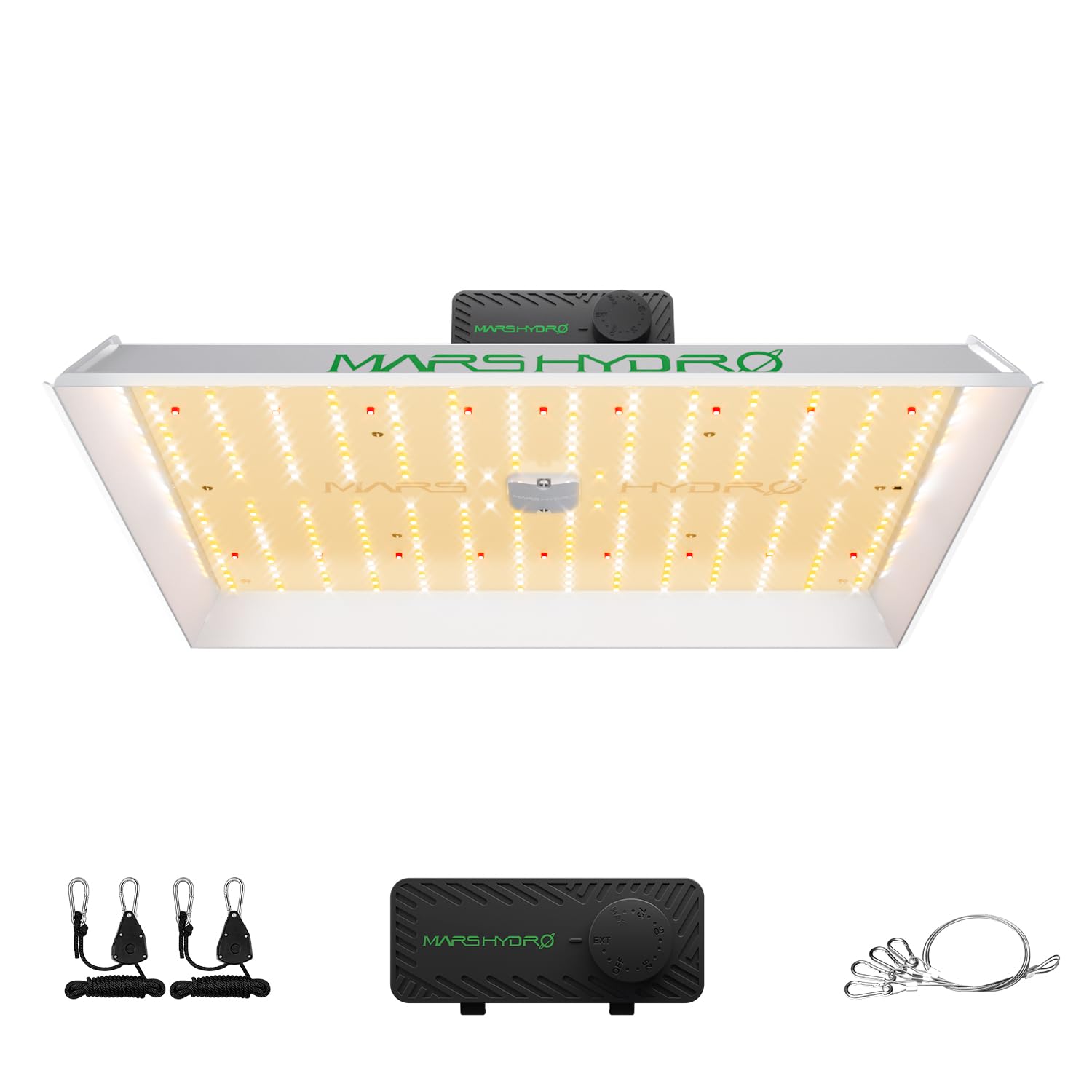
| MARS HYDRO TS1000★ Best Overall | All-around 2×2 tent grow | 150W | 2.5×2.5 ft | Quantum Board (Fanless) | Amazon |
| VIPARSPECTRA XS1500 ProTop Performer | High-PAR veg and flower | 150W | 3×3 ft | Quantum Board (Lens) | Amazon |
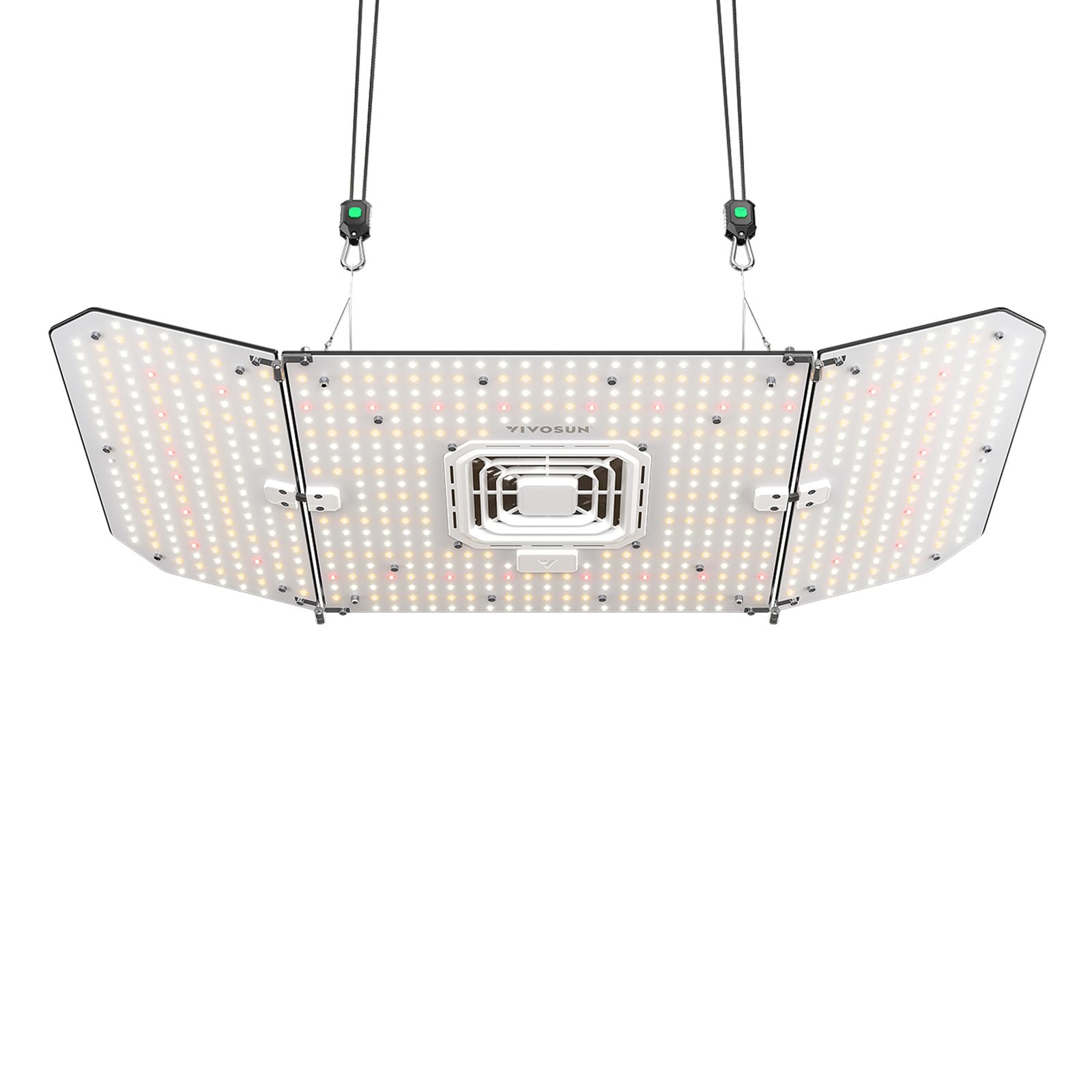
| VIVOSUN AeroLight AW200SESmart Pick | Integrated fan + smart control | 200W | 3×3 ft | Panel with Fan | Amazon |
| Barrina BU2000 | Large coverage with adjustable panels | 200W | 4×4 ft | Foldable Panel | Amazon |
| Spider Farmer SF600 | Seedling shelf or small veg tent | 72W | 2×4 ft | Linear Bar-style | Amazon |
| AGLEX K1000 | Budget daisy-chain setup | 100W | 2×3 ft | Quantum Board | Amazon |
| Gerylove SP1000 | Dim-master for small tents | 120W | 3.5×3.5 ft | Quantum Board | Amazon |
| TYAGMAM T8 Strips (4-Pack) | Greenhouse shelves and seedlings | 100W (total) | Varies | T8 Linear Strips | Amazon |
In‑Depth Reviews
1. MARS HYDRO TS1000
Our pick — over 4.5★ from 20,000+ verified ratings; the strongest balance of quality and price.
The crowd-pleaser that delivers dense fruit while staying affordable.
This is the lamp that keeps showing up in grow journals for a reason. The 150W TS1000 uses a patented highly-reflective hood with a 120° beam angle, which boosts light utilization by 25% compared to standard reflectors. That means more of the light your plants can actually use reaches the canopy instead of bouncing uselessly off the tent walls. The diode layout is arranged dense in the center and sparse toward the edges, creating an even spread across its 2.5×2.5 ft veg coverage. Buyers report an “immediate growth boost in tomato plant overnight,” and the fanless design keeps things silent — no hum, no whir, just light.
The build quality is the most-praised feature by a wide margin, with over a thousand owners calling it out. The 0-100% dimmer and daisy-chain capability (up to 50 lights via an RJ12 cable) make it scalable for larger setups. It draws only 150W but can replace a single-ended 250W HPS, so your electric bill stays low. The one trade-off you hear about is heat output — it runs warmer than some competing LEDs, and an occasional unit has reliability hiccups, but the overall satisfaction is high enough that it remains the top pick for almost any 2×2 or 3×3 tent grower.
What owners love
- Build quality is praised most — over a thousand owners call it solid and well-made
- Silent fanless operation means zero noise in your grow space
- Dimmable from 0-100% so you can dial in the perfect intensity for seedlings or flowering
The honest trade-off
- Runs warmer than some competitors; needs decent ventilation
- Some units have dimmer or longevity issues, though customer support is responsive
Reach for it if: you want a proven, silent workhorse that can take a 2×2 tent from seed to harvest with strong results.
Think twice if: you need a lamp that stays cool even in a poorly ventilated space — this one does produce noticeable warmth.
2. VIPARSPECTRA XS1500 Pro
Lens-focused light that punches above its size with even PAR distribution.
What sets this 150W lamp apart is its use of optical lenses over the LEDs. Instead of bare diodes spraying light in every direction, the lenses concentrate the beam with minimal loss, and the payoff is a uniform PPFD across the entire canopy — even at the corners. Owners mention PAR readings of 747 μmol/m²/s at 50% intensity from 13 inches away, which is impressive for a lamp this size. It covers a 3×3 ft veg area and a 2×2 ft flower area, making it a strong match for a single-plant or small-tent setup. The full spectrum includes white 3000K and 5000K, red 660nm, and IR 730nm, covering the full growth cycle without needing a separate veg and bloom lamp.
Build quality and PAR levels are the most-discussed positives, with many owners noting the solid aluminum heatsink keeps things cool even after long runs. It supports daisy-chaining up to 20 units, and the dimmer knob lets you adjust intensity from 0-100%. One minor annoyance: there is no physical off switch — you dial it to zero. At roughly 5.6 lbs, it is heavier than some similar-sized lamps, but the ratchet hangers handle the weight easily. A few owners note it adds about 10 degrees to tent temps, so good airflow is still necessary.
Standout strengths
- Optical lenses create remarkably even light distribution, eliminating hot spots
- High PAR output — owners measured 747 μmol/m²/s at 50% power
- Full spectrum means no swapping lamps between veg and flower
The catch
- No physical on/off switch; you must turn the dial to zero
- Runs slightly heavy at ~5.6 lbs and can raise tent temps by ~10°F
Best for: the grower who prioritizes even canopy coverage and high PAR levels in a 3×3 veg or 2×2 flower tent.
Not ideal if: you want a simple on/off switch — the dial-to-zero method bothers some owners.
3. VIVOSUN AeroLight AW200SE
A light that doubles as a fan, moving air where standard fans can’t reach.
The AeroLight’s defining trick is a centrally located circulation fan built right into the LED panel. This fan pushes air directly through the canopy — into the area that oscillating fans on the tent floor often miss. The result is better airflow, less stagnant humidity around leaves, and stronger stems. The 200W lamp itself uses a Sunlike full spectrum covering 380nm-780nm, including 660nm red and IR, so it is equally at home in veg and flower. It covers a 3×3 ft area and fits neatly in a 2×4 or 4×4 tent when paired with a second unit. Owners consistently call out the brightness and the built-in fan as the standout features.
One thing to know: to open up the smart control features (app-based scheduling, automation), you need to purchase the Vivosun GrowHub Controller separately. Without it, the lamp works as a standard plug-and-play unit with adjustable wings. The wings let you direct the light angle, and the industrial-grade fan with dual ball bearings runs quietly. A few owners noted missing screws for the H-brackets, and the separate controller requirement caught some off guard. But for those who want an all-in-one light-and-air solution, this is a clever space-saver.
What wins people over
- Integrated fan improves canopy airflow without taking up floor space
- Adjustable wings let you direct light coverage where it is needed most
- Full-spectrum Sunlike lighting supports every growth stage
Worth noting
- Smart app features require a separately purchased GrowHub controller
- A few owners reported missing hardware (screws for brackets)
Pick this if: you want a light that also improves air circulation in a 3×3 to 4×4 tent, reducing the need for extra fans.
skip it if: you do not want to buy a separate controller for smart features — it works fine without, but you lose automation.
4. Barrina BU2000

A foldable panel with wings that lets you shape light coverage for large tents.
The BU2000 packs 816 LEDs into a folding panel design, and the two sides can be angled independently — turning the fixture from a spotlight to a wide floodlight. When the panels are set at 60 degrees, the central area’s efficiency increases by more than 25%, giving dense canopies light from multiple angles. This is a 200W lamp with a PPFD up to 1600 in the center, and it covers a full 4×4 ft area, making it one of the largest-coverage lights on this list. The spectrum includes blue 5000K, warm white 3000K, red 660nm, and IR 730nm, which is particularly strong for flowering.
Brightness is the most-praised aspect by a wide margin — nearly a hundred owners single it out. Experienced growers (including one with 30 years of experience) note it outperforms 400W HPS and CMH bulbs in early fruiting stages. The lamp runs cool and silent, with no fan noise. The dimmer knob works smoothly, and multiple units can be linked for larger commercial setups. The main downside reported is reliability — a small number of owners say the unit stopped working after a short period, so while most are satisfied, the failure rate is higher than on the top picks.
What stands out
- Adjustable wing panels let you direct light for maximum canopy penetration
- 816 LEDs produce high PPFD (up to 1600 in the central area)
- Covers a 4×4 ft area — one of the biggest spreads here
The risk
- Reliability gets mixed reviews; a small number of units fail early
- Transformer gets hot during operation, though that is considered normal
Great for: growers with a 3×3 or 4×4 tent who want adjustable coverage and high light intensity for flowering.
Consider the risk: reliability is the most common negative mention — if failure would be a big setback, the MARS HYDRO or VIPARSPECTRA are safer bets.
5. Spider Farmer SF600

A low-wattage bar light that covers a 2×4 shelf without overheating seedlings.
The SF600 is a different shape than most lights here — a long, narrow bar measuring 39.3 inches. This makes it a natural fit for wire shelving units and 2×4 ft seedling tables. It draws only 72W but outputs 11,000 lumens, and its Sunlike full spectrum includes 660nm red and 730nm IR alongside warm and cool white channels. The efficiency is listed at 153 lumens per watt, which is respectable for this wattage class. Owners consistently praise its quality and functionality, and report that it works beautifully for micro dwarf tomatoes and seedlings on a 16-hour timer.
The brightness gets mixed feedback — some find it plenty bright for a shelf, while others wish it packed more punch for a 2×4 veg tent. It is not intended to replace a 200W panel for heavy flowering. But for seed starting, clones, and maintaining mother plants, it is quiet, cool-running, and easy to install with the included threaded hangers. The build quality is frequently noted as excellent, and the 5-year warranty is a confidence boost. One owner summed it up: “you can literally grow anything with these from feet away.”
Strengths
- Long, slim shape fits perfectly on 2×4 ft wire shelves and seedling tables
- Very low heat output — safe to place close to young plants
- 5-year warranty backs up the solid build quality
Limits
- 72W is not enough for dense flowering in a tent; best for veg and seedlings
- Brightness gets mixed reviews — some owners expected more punch
Best for: seed starting and vegetative growth on shelves or in a 2×4 veg tent where low heat is a priority.
Not for: heavy flowering — you will want a higher-wattage panel if dense buds are the goal.
6. AGLEX K1000

A 100W board with rock-solid build and a snap-dimmer that clicks through five power levels.
The K1000 is a straightforward quantum board that does not try to be fancy — and that is part of its appeal. It draws 100W from the wall and uses 264 SMD LEDs across a full spectrum that includes 3000K warm, 5000K white, 460nm blue, 660nm red, 730nm IR, and 405nm UV. The coverage is rated at 2×3 ft for veg and 2×2 ft for flower. The dimmer is a snap-style switch with distinct clicks (OFF, 25%, 50%, 75%, 100%, and Daisy-Chain), which many owners prefer to a smooth rotary knob because you feel the setting. The daisy-chain feature supports up to 100 lights on a single control line, making it a natural pick for commercial or multi-tent setups.
Build quality earns frequent praise — one owner described it as “rock solid” and joked it could be used as a weapon. It runs cool thanks to the fanless aluminum body, and the noise is zero. For seed starting, customers note excellent results with onions, tomatoes, and peppers on a 13-hour timer. The main caveat is that at this price range, some competitors deliver higher brightness per watt, and a few owners found it smaller than expected. But for a dimmable, daisy-chainable 100W board at a reasonable price, this is a very dependable option.
Why owners pick it
- Snap-style dimmer gives you clear, repeatable settings (OFF, 25%, 50%, 75%, 100%)
- Daisy-chain up to 100 lights for large-scale or multi-tent grows
- Build quality is repeatedly called rock solid and well-made
The trade-off
- Smaller physical size than some expect — verify your coverage needs
- Brightness is good but some comparably-priced competitors offer more punch
Choose this for: a reliable, dimmable 100W board that fits into a daisy-chain system and is built to last.
Pass if: you need maximum brightness per watt at this price point — other options edge ahead on raw output.
7. Gerylove SP1000

A dimmable 120W board that packs surprising intensity for its modest price tag.
The SP1000 runs at 120W with an output of 2.7 μmol/J and covers a 3.5×3.5 ft veg area and 3×3 ft for flower. That is a larger veg footprint than some 150W competitors, which makes it an efficient choice for spreading light over a wider area without cranking up wattage. The stepless dimmer lets you adjust brightness from 0-100% smoothly, and owners find this invaluable — one had to dial down to 50% after their tomato seedlings showed signs of light stress at full power. The lamp includes a thermometer/hygrometer and ratcheting hoists, adding value beyond the light itself.
What owners praise most is the value and performance for the price. The fixture runs cool and quiet, thanks to the fanless aluminum heatsink. A PNW gardener noted it replaced their fluorescent shop lights for seed starting and produced noticeably tighter, healthier growth. The main limitation is coverage for larger grows — it can handle 10 tomato and cannabis seedlings at max intensity, but needs more units for a full tent of flowering plants. At this price point, it is a strong entry-level or supplemental lamp.
Highlights
- Stepless dimmer from 0-100% gives you fine control over light intensity
- Includes a thermometer/hygrometer and ratcheting hoists in the box
- Runs cool and quiet with no fan noise
Limitation
- At full intensity, it can stress seedlings — requires careful dimming adjustment
- Coverage is good for veg but may need multiple units for a full flowering tent
Ideal for: budget-conscious growers who want a dimmable, cool-running lamp for a 3×3 ft veg space.
Not for: heavy flowering in a large tent without supplementing with additional units.
8. TYAGMAM T8 Strips (4-Pack)

Four 2-ft strips that daisy-chain together for easy shelf and greenhouse coverage.
If you are outfitting a greenhouse shelf, a seed-starting station, or a multi-tier wire rack, these T8 strips are the most practical solution. Each strip draws 25W for a total of 100W across the four-pack, and they output 4,000 lumens combined. They are full-spectrum lights designed to mimic sunlight, and the 100% aluminum housing with polycarbonate lens dissipates heat efficiently. Installation involves clips and cable ties — no tools needed — and you can link up to 8 strips in a single series. Owners who have been using them in a greenhouse for a full year report that seedlings thrive and the lights produce minimal heat.
The value proposition is strong: you get four lights for the price of a single panel, and they are easy to position exactly where you need them. The reflector design boosts light efficiency by 20%, and over 95% of the light energy can be absorbed by plants. A few owners note they are not powerful enough for dense flowering in a tall tent, but for their intended use — low-growing seedlings, clones, and leafy greens — they work flawlessly. The ability to chain them to a standard timer is a frequently mentioned bonus.
Pros
- Four strips in one pack offer flexible placement across shelves or benches
- Easy to install with clips and cable ties; daisy-chain up to 8 total
- Very low heat output makes them safe for close placement to young plants
Cons
- 100W total across four strips is not enough for dense flowering growth
- Designed for seedlings and low-light plants, not for tall canopy penetration
Perfect for: greenhouse shelving and multi-tier seed-starting stations where you need even, low-heat light across a wide area.
Not for: flowering tents or tall plants — these are strip lights for planar coverage.
Understanding the Specs
Actual Wattage vs. Equivalent Wattage
Many grow lights advertise “2000W equivalent” when they draw only 100W from the wall. Always check the actual wattage — that is the real power consumption, and it determines both your electricity cost and the light intensity your plants receive. A lamp’s true strength is measured in how many watts it actually uses, not how many watts it “matches” from an older technology like HPS.
PPFD and PAR
PAR (Photosynthetically Active Radiation) is the range of light wavelengths plants use for photosynthesis. PPFD (Photosynthetic Photon Flux Density) measures how many PAR photons hit a specific area every second, expressed in μmol/m²/s. A higher PPFD means more usable light reaches your plant canopy. For seedlings, 200-400 μmol/m²/s is plenty. For flowering, aim for 600-900 μmol/m²/s at the canopy.
Full Spectrum
A full-spectrum LED emits light across the entire range plants use, from blue (for compact vegetative growth) through red and infrared (for flowering and fruit set). White-light full spectrum looks natural to the eye and works for every stage of growth. Some specialized lights emphasize specific colors (deep red or blue) for targeted results, but full spectrum is the safest bet for a mixed garden.
Daisy Chain and Dimming
Daisy-chaining lets you connect multiple grow lights with a single cable and control them from one dimmer or timer. This is essential for larger tents or commercial racks. Dimming (stepless or stepped) lets you adjust light intensity without moving the lamp — seedlings need less light than flowering plants, and dimming saves electricity and reduces heat. A snap-style dimmer with distinct click-stops is easier to repeat than a smooth knob.
FAQ
How close should I hang my LED grow lamp to my plants?
Can I use an LED grow lamp for houseplants that never see natural light?
What is the difference between a grow lamp and a regular LED bulb?
How many grow lamps do I need for a 4×4 tent?
Do LED grow lamps produce enough heat to dry out my soil faster?
What does “actual power” mean on a grow light listing?
Can I daisy-chain different brands of grow lights together?
How long should I run my LED grow lamp each day?
Is a fanless LED grow lamp better than one with a fan?
Final Thoughts: The Verdict
For the majority of shoppers, the best led grow lamp winner is the MARS HYDRO TS1000 because it combines proven build quality, silent fanless operation, and enough 150W power to take a 2×2 tent from seed to harvest without stretching your budget. If you want the most even PAR distribution and don’t mind a slightly heavier fixture, grab the VIPARSPECTRA XS1500 Pro. And for a space-saving combo that moves air while delivering light, the VIVOSUN AeroLight AW200SE is the one to reach for.
How We Picked
We do not accept paid placement. Every pick is matched to a real buyer and a real use-case; we do not hands-on test units.
Sources & Methodology
Specifications: manufacturer listings and product documentation. Review insights: verified customer reviews, as of July 2026. Pricing: not shown on this page (it changes often); check the current price via the retailer link.
As an Amazon Associate, Lawn Gear Lab earns from qualifying purchases. This does not affect which products we feature.