
Specs are compiled from manufacturer listings and verified buyer reviews and can change over time — please confirm the key details on the product page before buying.
You want a thick, green lawn fast, and the phosphorus level in your first bag of fertilizer is one of the key things to check. Starter blends (fertilizers for new grass) work differently from the regular feed you spread on an established lawn — they use a higher middle number in the N-P-K ratio (the phosphorus, a nutrient that fuels root growth) to help new grass develop roots deep enough to handle foot traffic and heat. The wrong bag gives you weak roots, slow fill-in, and a yard that never knits together into a real lawn.
I’m Rikta — the founder and writer behind Lawn Gear Lab. This guide is built by comparing the manufacturers’ published specifications and the patterns across verified customer reviews, so you get each pick’s real strengths and trade-offs instead of marketing spin.
Whether you are seeding bare dirt, laying sod (pre-grown grass rolled out like carpet), or overseeding (sprinkling seed over thin patches), picking the right lawn starter fertilizer means matching the phosphorus level to your soil.
Quick Picks
- The Andersons Premium New Lawn Starter 20-27-5 Fertilizer (18 lb) — Best Overall
- Lawn Synergy Starter Fertilizer 15-20-10 (18 lbs) — Pro Grade
- Fertilome (10906) New Lawn Starter Fertilizer 9-13-7 (20 lbs.) — Top Value
- Jonathan Green (16007) Veri-Green Starter Fertilizer 12-18-8 (15 lbs) — Gentle & Effective
- Jonathan Green (11541) Green-Up Lawn Food for Seeding & Sodding 12-18-8 (15.2 lbs) — Fast Fill-In
How To Choose The Best Lawn Starter Fertilizer
A starter fertilizer is your new lawn’s first meal, so the nutrient balance you pick determines how quickly those seedlings establish roots that can reach water and anchor into the soil. The three numbers on the bag tell you everything — you just need to know which one to focus on.
Focus on the Phosphorus (the Middle Number)
Phosphorus is the nutrient that drives root formation and early plant development. In an established lawn you want higher nitrogen for leaf growth, but for seed or sod the priority flips. Look for a ratio where the second number (phosphorus) is roughly equal to or larger than the first (nitrogen) — for example 12-18-8 or 20-27-5. The higher the middle number relative to the rest, the more energy the grass puts into building a root system underground before it starts pushing up blades.
Nitrogen Timing: Quick vs. Sustained Feeding
Nitrogen comes in two forms. Quick-release nitrogen gives you fast green-up you can see within a week or two, while slow-release nitrogen feeds the lawn steadily over several weeks, reducing the risk of burning the tender new grass. Many premium starter blends combine both types, so you get that early visual result plus a longer feeding window without having to reapply. A single application feeding for up to 2 months, for instance, saves you a follow-up trip with the spreader.
Coverage and Bag Weight
The bag weight in pounds does not tell you how much area it covers — the nutrient density does. A 15-pound bag of a concentrated formula like 20-27-5 might cover 5,000 square feet, whereas a 20-pound bag of a milder 9-13-7 blend covers the same area because you need to apply more product per square foot to deliver enough phosphorus. Always check the “covers up to” number on the label rather than guessing by how heavy the bag feels.
Quick Comparison
| Model | Best For | N-P-K Ratio | Bag Weight | Coverage | Amazon |
|---|---|---|---|---|---|
| Lawn Synergy 15-20-10 | Professional-grade results at home | 15:20:10 | 18 lbs | Up to 4,500 sq.ft. | Amazon |
| The Andersons 20-27-5 | Fastest germination speed | 20:27:5 | 18 lbs | Up to 5,000 sq ft | Amazon |
| Jonathan Green 12-18-8 (16007) | Gentle on new seed with humates | 12:18:8 | 15 lbs | Up to 5,000 sq. ft. | Amazon |
| Fertilome 9-13-7 | Budget-friendly for large areas | 9:13:7 | 20 lbs | Up to 5,000 sq ft | Amazon |
| Jonathan Green 12-18-8 (11541) | Seeding and sodding with iron | 12:18:8 | 15.2 lbs | Up to 5,000 sq. ft. | Amazon |
In‑Depth Reviews
1. The Andersons Premium New Lawn Starter 20-27-5 Fertilizer (18 lb)
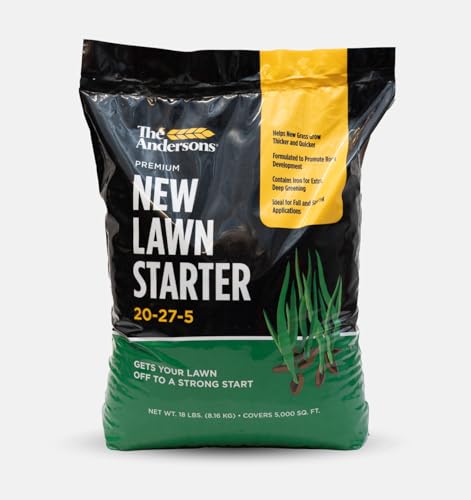
The phosphorus king that gets grass visible in just over a week
You want the fastest root development possible, and the Andersons starter delivers that with a 20-27-5 N-P-K (nitrogen-phosphorus-potassium) ratio — the highest phosphorus concentration on this list. Its phosphorus level is 27 in the N-P-K ratio versus 13 for the Fertilome 9:13:7 bag, supporting root establishment in a high-phosphorus starter formula. That matters when you are starting bare dirt or laying sod.
One reviewer noted they saw grass in just over a week after application, which matches the dual-nitrogen design — quick-release nitrogen gives you early visible green, while the slow-release portion keeps feeding new seedlings for up to 2 months without a second application. The 18-pound bag covers up to 5,000 square feet, and the included 1% iron (a mineral that deepens green color) gives the lawn a richer tone once blades emerge. It works on all turf types for both spring and fall application windows.
This bag is the fastest path to visible results on a new lawn, with a formula that handles the feeding schedule for you over several weeks. The trade-off is that this is the most expensive bag per square foot here — the concentrated 20-27-5 blend costs more per bag than the 9-13-7 Fertilome, even though the coverage area matches.
Instant root accelerator: The 20-27-5 ratio feeds aggressive root growth fast, supported by iron for color and a dual-release nitrogen schedule that eliminates the need for a follow-up application inside the first window.
Who it suits: Homeowners seeding or sodding a large bare area who want visible grass in around a week and prefer a single-and-done feeding schedule.
Consider the cost per bag: The phosphorus density commands a higher price than milder blends, so if your soil already tests high in phosphorus a lower ratio is more appropriate.
2. Lawn Synergy Starter Fertilizer 15-20-10 (18 lbs)
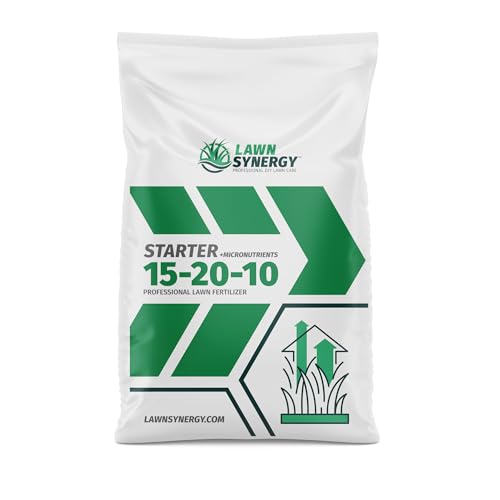
The pro-grade prill that feeds new grass without the burn risk
Lawn Synergy’s 15-20-10 N-P-K ratio puts it in the high-phosphorus starter category, but its standout feature is the XCU slow-release nitrogen (a polymer-coated nitrogen that meters out feed gradually). This protects tender new roots from the scorch that quick-release nitrogen can cause. The blend also includes ammonium sulfate and iron for early green color, and the manufacturer states there are less fillers in the bag — more nutrient per pound compared to budget blends.
One buyer mentioned the grass grew nice and dark green after using it, which reflects the iron working alongside the nitrogen. The bag covers up to 4,500 square feet, while several other bags on this list cover up to 5,000 square feet, and the 18-pound weight matches the Andersons bag. The “clean, easy-to-spread prill” (small, uniform granules) design means the flow through a broadcast or drop spreader is smooth, without clumping that causes striped skip lines.
This product is not sold in big box stores, so if you want the same blend landscape professionals use without going through a contractor supplier, this is your direct route. The trade-off: it covers 500 fewer square feet than the Andersons bag for a similar price, and the 15-20-10 ratio is less aggressive on phosphorus than the 20-27-5 leader.
Professional touch points
- XCU slow-release nitrogen protects new seedlings from fertilizer burn
- Clean, uniform prill flows evenly through all spreader types
- Includes iron and micronutrients for early green color
What to weigh
- Covers 4,500 sq ft — 500 sq ft less than most competitors at similar weight
- Premium pricing tier with a slightly lower phosphorus count than the top pick
Your move if: You are overseeding or starting a new lawn and want the extra safety margin of slow-release XCU nitrogen against accidental burn on tender seedlings.
Otherwise pick: If maximum phosphorus concentration is your only goal, the Andersons 20-27-5 bag has a wider coverage area and a higher middle number for the same weight.
3. Fertilome (10906) New Lawn Starter Fertilizer 9-13-7 (20 lbs.)
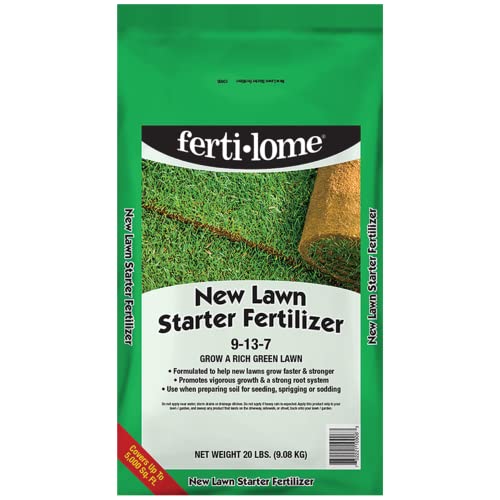
The workhorse 20-pounder that leans on bulk to cover ground
Fertilome uses a milder 9:13:7 N-P-K ratio, so you need to apply more product per square foot to deliver the same phosphorus dose as higher-concentration bags. The payoff is a 20-pound bag versus the 15.2-pound Jonathan Green bag, giving you more physical material for the same 5,000-square-foot coverage. Buyers report the balanced 9-13-7 NPK delivers strong root growth and a dark rich green that covers weak spots.
This is the most affordable option on this list, making it a smart pick if you are covering a large lawn area on a budget and are comfortable doing a second application after the first feeding window. One owner reported the granules are larger than some competing brands, providing a longer feeding duration with a lower burn risk compared to high-nitrogen quick-release formulas. The product works for seeding, overseeding, and sod, and the 9-13-7 ratio is a solid middle ground if your soil already has moderate phosphorus levels.
The catch: the phosphorus number is the lowest on this list, so if your soil is depleted or you are starting from bare dirt, you may need to apply again sooner than with the 20-27-5 or 15-20-10 blends. The bag also requires dry storage to keep the granules free-flowing, and multiple applications may be needed over a full growing season.
Budget-root builder: At 20 pounds with a balanced 9-13-7 profile, this is the most economical way to feed 5,000 square feet of new lawn without overloading nitrogen in the first pass.
Reach for this if: You are overseeding a large area or working on a tight budget and are willing to apply a second round to match the phosphorus impact of premium blends.
skip it if: You want a single-application solution with maximum phosphorus — the Andersons or Lawn Synergy bags deliver a stronger root punch in one go.
4. Jonathan Green (16007) Veri-Green Starter Fertilizer 12-18-8 (15 lbs)
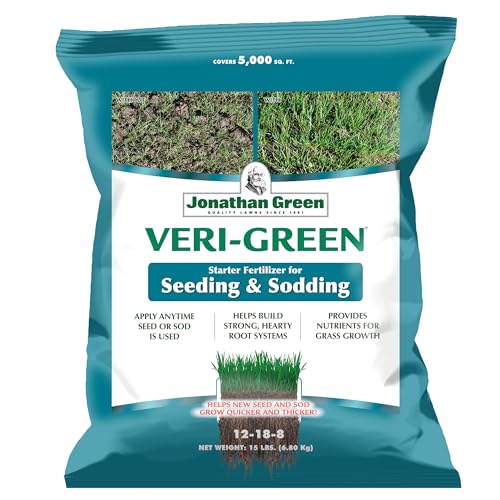
The humate-enhanced starter that won’t scorch even tender new sod
Jonathan Green’s Veri-Green formula uses a 12-18-8 analysis with a phosphorus-rich root builder, but its stand-out addition is humates (organic compounds that improve the soil’s ability to hold and exchange nutrients at the root zone). That means the fertilizer you put down stays available to the grass longer rather than washing through sandy soil or binding up in clay. The bag is labeled for seeding, overseeding, and sod, and one customer observed it was effective for grass seed growth with no burning or brown spots after 4 mows, noting they saved money compared to laying sod.
The 15-pound bag covers up to 5,000 square feet, and the feeding window lasts up to 2 months from a single application. The humate content is what really differentiates this from the Fertilome and the other Jonathan Green bag — instead of just delivering nutrients, it actively improves the soil chemistry so your seed or sod has a better growing environment beyond the feeding period. The 12-18-8 ratio is moderate, but the humates make the nitrogen and phosphorus more efficient.
The trade-off is bag weight and cost — at 15 pounds it is physically lighter than the Fertilome 20-pound bag, and the price per pound is higher. If your soil is already rich in organic matter, the humate benefit is less noticeable, and you may prefer a straight nutrient-dense blend instead.
Soil-enhancing advantage
- Humates improve nutrient uptake and availability at the root zone
- No burning or brown spots reported after 4 mows, even on new sod
- Up to 2 months of feeding from a single application
Consider before buying
- Higher price per pound compared to the Fertilome bulk bag
- Humate benefit is minimized in already-fertile soil
Best match for: Homeowners with sandy or clay-heavy soil who want the soil-conditioning benefit of humates alongside the high-phosphorus root kick for new seed or sod.
Not for you if: Your soil tests rich in organic matter — you would pay extra for a feature you do not need.
5. Jonathan Green (11541) Green-Up Lawn Food for Seeding & Sodding 12-18-8 (15.2 lbs)
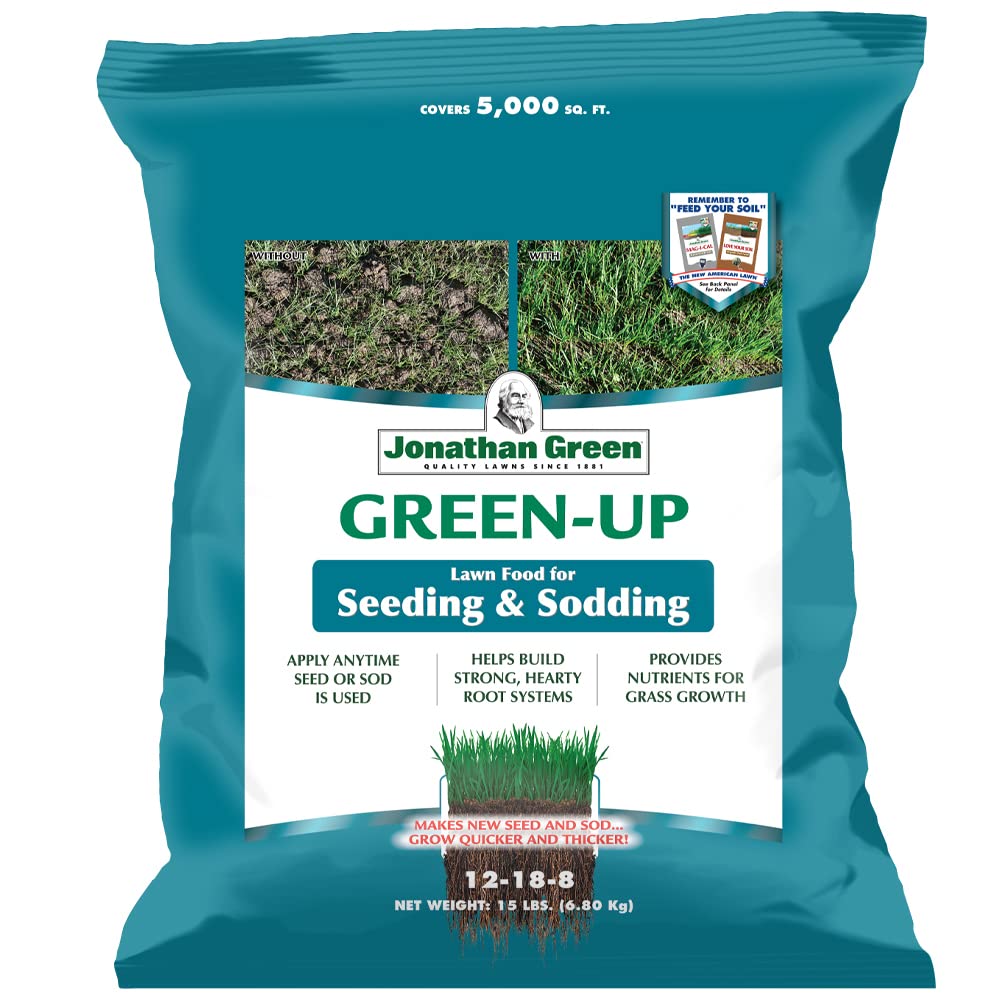
Iron-boosted feed that turned 90% of a shaded new lawn green in 4 weeks
This Green-Up formulation shares the same 12-18-8 N-P-K base as the Veri-Green product above, but swaps humates for added iron — a targeted approach if your main goal is deep green color rather than soil conditioning. One buyer in Minnesota with a full-shade lawn using Black Beauty Original seed reported 90% coverage of new lawn in 4 weeks, with grass visible in 1 week and mowable within 4, a timeline that matches the dual-release nitrogen design feeding for up to 2 months. The iron content gives the emerging blades a darker green tone, especially noticeable on cool-season grasses.
The bag is 15.2 pounds versus the Veri-Green’s 15 pounds, and covers the same 5,000 square feet. Like the other Jonathan Green starter, it contains a high-phosphorus formula for building roots in new seedlings, and it works under new sod as well as seeding. A reviewer who switched from a mainstream brand to this product along with Love Your Soil and Black Beauty Ultra blend noted that after 7 days they already had what they considered the best spring lawn in the area, outperforming a neighbor using the cheaper product applied the same day.
The limitation is that the 12-18-8 ratio is surpassed by the top-tier Andersons and Lawn Synergy in pure phosphorus concentration, so if you are working with heavily depleted soil, the Andersons will deliver a stronger initial root push. Additionally, one reviewer felt the product was expensive compared to iron supplements, suggesting that if you already have decent soil, you can add iron separately for less money.
Greening + rooting combo: The 12-18-8 ratio with included iron gives you both root development and visible blade color in a single bag, with verified fast fill-in even in shaded conditions.
Choose this if: You want the fastest visible green-up on new seed in shaded or partly shaded areas and are pairing it with a high-quality seed blend from the same brand.
Look elsewhere if: Your soil is already in decent shape and you just need pure phosphorus for root push — the Andersons 20-27-5 is a stronger root accelerator at a similar price tier.
Understanding the Specs
N-P-K Ratio and What It Means for New Grass
The three hyphenated numbers on a fertilizer bag stand for Nitrogen (first), Phosphorus (second), and Potassium (third). For a starter fertilizer, the second number (phosphorus) is the critical one — it fuels root formation and early seedling development. A ratio like 20-27-5 means 20% nitrogen for leaf growth, 27% phosphorus for root growth, and 5% potassium for overall plant health. The higher the middle number relative to the first, the more energy the grass puts into establishing a strong root system underground before it pushes up a dense canopy of blades.
Quick-Release vs. Slow-Release Nitrogen
Nitrogen can be formulated to release fast or slow. Quick-release nitrogen gives you a visible green-up within about a week but can burn tender new grass if applied too heavily. Slow-release nitrogen (often labeled as polymer-coated sulfur-coated or XCU) breaks down gradually over several weeks, providing a steady food supply and reducing the burn risk. The best starter blends combine both types so you get the early color signal that the fertilizer is working plus sustained feeding that lasts up to 2 months from a single application window.
FAQ
Can I use regular lawn fertilizer instead of a starter formula?
How long does it take to see results after applying starter fertilizer?
Should I apply starter fertilizer before or after seeding?
Can starter fertilizer burn new grass?
Is starter fertilizer safe for sod?
What is the difference between 12-18-8 and 20-27-5 starter fertilizers?
How often should I reapply starter fertilizer?
Can I use starter fertilizer on an established lawn?
Does starter fertilizer expire?
Which starter fertilizer is best for shaded lawns?
Final Thoughts: The Verdict
Across the board, the lawn starter fertilizer winner is the The Andersons Premium New Lawn Starter 20-27-5 because it delivers the highest phosphorus ratio on the list (20:27:5) for the fastest root development, paired with dual-release nitrogen that feeds for up to 2 months without a second application. If you want professional-grade slow-release XCU nitrogen that minimizes burn risk on tender seedlings, grab the Lawn Synergy 15-20-10. And for a budget-friendly approach on large areas where you are willing to apply a second round, the Fertilome 9-13-7 gives you the most physical product per bag at an entry-level price.
How We Picked
We do not accept paid placement. Every pick is matched to a real buyer and a real use-case; we do not hands-on test units.
Sources & Methodology
Specifications: manufacturer listings and product documentation. Review insights: verified customer reviews, as of July 2026. Pricing: not shown on this page (it changes often); check the current price via the retailer link.
As an Amazon Associate, Lawn Gear Lab earns from qualifying purchases. This does not affect which products we feature.